University of New Hampshire
University of New Hampshire Scholars' Repository
Geography Scholarship
Geography
9-3-2013
Spatially Explicit Data: Stewardship and Ethical
Challenges in Science
Joel N. Hartter
University of New Hampshire
, [email protected]
Sadie J. Ryan
State University of New York Syracuse
Catrina A. MacKenzie
McGill University
John N. Parker
Arizona State University
Carly A. Strasser
California Digital Library
Follow this and additional works at:
https://scholars.unh.edu/geog_facpub
Part of the
Geographic Information Sciences Commons
, and the
Scholarly Communication
Commons
This Article is brought to you for free and open access by the Geography at University of New Hampshire Scholars' Repository. It has been accepted for inclusion in Geography Scholarship by an authorized administrator of University of New Hampshire Scholars' Repository. For more information, please [email protected].
Recommended Citation
Perspective
Spatially Explicit Data: Stewardship and Ethical
Challenges in Science
Joel Hartter1* 2,3,4* 5 6 7
1Department of Geography, University of New Hampshire, Durham, New Hampshire, United States of America,2Department of Environmental and Forest Biology, SUNY College of Environmental Science and Forestry, Syracuse, New York, United States of America,3Center for Global Health and Translational Science, Department of Immunology and Microbiology, Upstate Medical University, Syracuse, New York, United States of America,4Faculty of Life Sciences, University of KwaZulu-Natal, Pietermaritzburg, South Africa,5Department of Geography, McGill University, Montreal, Quebec, Canada,6Barrett, the Honors College at Arizona State University, Arizona State University, Tempe, Arizona, United States of America,7California Digital Library, Oakland, California, United States of America
Introduction
Datasets and accompanying metadata are an important currency of scientific and intellectual advancement, deserving the same attention, planning, and scrutiny that research dollars receive. The move towards digital data is ubiquitous across disciplines [1–5]: earth scientists use satel-lite data to understand global patterns; ecologists use GPS tagging of mammals to understand migration paths; biomedical
researchers produce and consume record amounts of clinical and genetic informa-tion; and social scientists are inundated with social media data. These data must be synthesized and analyzed to conceptu-alize, comprehend, and solve real-world problems [6].
The digital nature of data means more data more quickly. This ‘‘data deluge’’ has been explored in academic literature [1,5,7,8] and major media including The Economist[9] andThe New York Times[10]. Among the most pressing problems asso-ciated with it is good data stewardship— the ability to effectively and efficiently record, curate, and facilitate access to large volumes of data. For in actuality, data are seldom shared, re-used, or preserved [11–13], resulting in inefficient use of research dollars, missed opportuni-ties to exploit prior investment, and overall loss for the scholarly community [14]. The development of good data stewardship techniques, software, and education lags behind the data deluge.
In February 2011, the US National Science Foundation (NSF) [15] prescribed that a two-page data management plan must accompany all research proposals. The National Science Board’s Data Poli-cies Task Force informs this requirement:
‘‘Progress in science and engineering has always been dependent on the collection of data through
observa-tion, experimentaobserva-tion, and more recently, computation. A core ex-pectation of the scientific process is the documentation and sharing of results along with the underlying data and methodology, thereby al-lowing others to verify data, repro-duce results, validate interpretations, and build upon previous work. (p.17)’’
To improve data stewardship for pub-licly funded projects, several US govern-mental funders (e.g., NSF, NOAA, USDA, EPA, DOD, NASA, NIH, CDC, DOE) require data management plans (DMPs) for all proposed research [16], and some journals request that supporting data be made available upon publication [17]. Data sharing policies are also in place for the Research Councils UK, a consortium of seven research councils (http://www. rcuk.ac.uk/research/Pages/DataPolicy. aspx), and the Digital Curation Centre (DCC) lists the specific DMP requirements by funder (http://www.dcc.ac.uk/ resources/data-management-plans/funders-requirements). Canada’s NSERC specifies data management requirements for grants through SSHRC and CRIC (http://www. nserc-crsng.gc.ca/Professors-Professeurs/ FinancialAdminGuide-GuideAdminFinancier/ Responsibilities-Responsabilites_eng.asp), as does the Australian National Data Service (ANDS) (http://www.ands.org.
The Perspective section provides experts with a forum to comment on topical or controversial issues of broad interest.
Citation:Hartter J, Ryan SJ, MacKenzie CA, Parker JN, Strasser CA (2013) Spatially Explicit Data: Stewardship and Ethical Challenges in Science. PLoS Biol 11(9): e1001634. doi:10.1371/journal.pbio.1001634
PublishedSeptember 3, 2013
Copyright: ß2013 Hartter et al. This is an open-access article distributed under the terms of the Creative Commons Attribution License, which permits unrestricted use, distribution, and reproduction in any medium, provided the original author and source are credited.
Funding:JH and SJR were supported by National Science Foundation (CNH-EX 1114977) and National Geographic Research and Exploration grants. The funders had no role in study design, data collection and analysis, decision to publish, or preparation of the manuscript.
Competing Interests:The authors have declared that no competing interests exist. * E-mail: [email protected] (JH); [email protected] (SJR)
Abstract: Scholarly communication is at an unprecedented turning point created in part by the increas-ing saliency of data stewardship and data sharing. Formal data management plans represent a new emphasis in research, enabling access to data at higher volumes and more quickly, and the potential for replication and augmentation of existing research. Data sharing has recently transformed the practice, scope, content, and applicability of research in several disciplines, in particular in relation to spatially specific data. This lends exciting potentiality, but the most effective ways in which to implement such changes, particularly for disciplines involving human subjects and other sensitive information, demand con-sideration. Data management plans, stewardship, and sharing, impart distinctive technical, sociological, and ethical challenges that remain to be adequately identified and remedied. Here, we consider these and propose potential solutions for their amelioration.
, Sadie J. Ryan. , Catrina A. MacKenzie , John N. Parker , Carly A. Strasser.
au/resource/data-management-planning. html). Institutions interested in protecting their investments increasingly look to libraries and information professionals to collaborate with scientists [18]; researchers, in turn, demand properly managed data from their colleagues [13].
Researchers are ethically obliged to be good data stewards to advance scientific knowledge, but those working with human subjects must also protect partic-ipant confidentiality [19]. Previously, meeting these ethical obligations fell to the individual researcher (or team) and was managed in an ad hoc manner. Human subjects research renders careful data stewardship more than a matter of scientific rigor—it requires ensuring con-fidentiality while providing sufficient information for validation, reproducibil-ity, reuse, and reporting. The need for rigor and data acquisition must be balanced against the ethical treatment of participants.
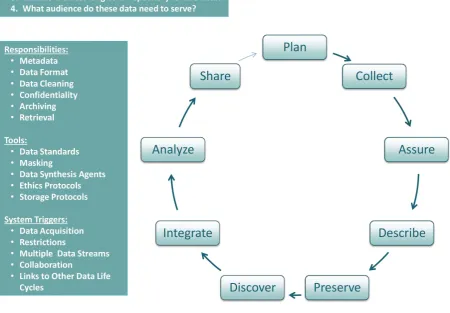
Data management plans require careful consideration of accessibility and data sharing; imparting challenges that have yet to be adequately identified and ad-dressed. Data sharing has transformed the practice, scope, content, and applicability of scientific research [20,21], and as calls for data stewardship increase, researchers need to consider how to most effectively comply. We examine these inherent tech-nical, socio-cultural, and ethical challenges and propose some means for solving them. Figure 1 summarizes the data life cycle in context of this discussion of stewardship and sharing.
Technical Challenges
The technical challenges of sharing scientific data abound, and are amplified in certain disciplines. For example envi-ronmental (including social) data are ‘‘messy’’ in ways that are not the case across much of the physical sciences [22,23]. Datasets are often small, hetero-geneous, collected via a wide array of methods, stored in a wide variety of formats, and analyzed using a plurality of methods and techniques. The variability of research approaches engaging human subjects (ranging from observations to attitudinal and network surveys to the social scientific methods of interviewing and ethnographic observations) and data types (ranging from numeric data points to photos, video, interview transcriptions, ethnographic field notes, audio recordings, and medical records) challenge the ability to store, retrieve, combine, use, and meaningfully re-analyze data [24,25].
Data sharing requires substantial time, energy, and technical capacity to organize, store, and preserve data and make them widely accessible [26], while potentially masking or securing sensitive or confiden-tial information. It requires designing and implementing rigorous metadata stan-dards, and the creation of flexible, intuitive databases [27]. Simultaneously, there aris-es the real danger of data misinterpreta-tion due to insufficient metadata standards [28,29]. Such technical challenges are heightened in remote locations or in situations wherein the necessary capital— i.e., technicians and data managers famil-iar with metadata language, programs, and standards—is unavailable, or where discrepancies are created by discipline-specific norms. Ironically, these are pre-cisely the locations and conditions in which much field research for conserva-tion biology or emerging infectious dis-ease, for example, takes place.
Socio-Cultural Challenges
Data sharing requires shifting from a research culture predicated on perpetual proprietary control over data to one that promotes scientific openness, and which values analysis and synthesis of secondary data [20,21,30–32]. In science it is com-mon to secret data and dole out findings selectively in accordance with strategic publication practices (e.g., [33,34]). Com-petition can create anxiety about being ‘‘scooped’’ by colleagues; data sharing raises the particularly vexing specter of being beaten to the punch with one’s own data [35,36]. Further, the benefits and dangers of data sharing are distributed unequally; e.g., scholars working in sensi-tive, high-profile, highly politicized sys-tems are at greater risk of being scooped. Unequal data sharing risks also emerge for scholars with limited funding, working far from the academic mainstream or at smaller institutions. Data sharing is more-over challenged by varying disciplinary practices and expectations, and by diverse organizational and institutional cultures. Interdisciplinary research data gatherers and those with whom data are shared can have divergent epistemological assump-tions, professional mandates, and reward systems [37–39], and legal and ethical standards for data sharing and protecting research subjects.
The study of ‘‘social-spatial linkage’’— the characteristics and behaviors of indi-viduals, households, or communities in geographical space—represents an impor-tant scientific advancement [40], but including human subjects also introduces the risk of confidentiality breach [41].
Global Positioning System (GPS) technol-ogy allows spatially explicit longitudinal studies [42], and increasing satellite and aerial imagery, coupled with GPS and radio-frequency identification tags, now provides voluminous information on the activities of people, animals, cars, etc. within dynamic landscapes. Geospatial technologies such as unmanned aerial vehicles, Google Earth, Google Maps, Wikimapia, and Open Street Maps offer unprecedented access to place-specific data and surveillance capabilities [43]. While these data are helpful for making maps, they can introduce complications. For example, conservation biology focuses on rare species, habitats, and resources, but identifying their locations with high-resolution geospatial data may render them vulnerable to abuse and extraction. Additionally, while social science data are integral to conservation [44,45], their inclusion adds related ethical challenges.
Traditionally, geographic information mainly existed as maps and atlases pro-duced by mapping authorities, agencies, and corporations, subsequently dispersed to users. Maps emphasized static attri-butes; now, input from users is being used for emergencies and everyday use [46]. Locational crowdsourcing or volunteered geographic information (VGI) is an excit-ing new area of data generation and geographic information delivery [47], wherein citizen volunteers contribute geo-graphic data and geo-tagged photos. An important advance in data collection and delivery [47–50], this is also one of the greatest ethical challenges because it can provide near real-time, dynamic snapshots of on-the-ground conditions [51,52]. Within the data deluge, geographic infor-mation is more readily accessible, created and distributed by a network of observers. Protocols and institutions are needed to ensure that the result is reliable, useful, and ethical [48–50,53].
Ethical Challenges
approval from Institutional Review Boards (IRBs) [55].
The primary benefit of capturing loca-tional human subjects data (e.g., socio-economic conditions and demographics) is to support longitudinal research, help avoid over-researched locales, and capture locational effects (e.g., elevated lead levels [56]). The ability to identify and locate these study ‘‘spaces’’ requires even stricter data control to protect confidential infor-mation. New methods aggregate social data at larger scales or mask data loca-tions, allowing data interpolation using less distinct spatial patterns. New spatially explicit IRB standards and virtual data management institutions are being piloted to improve privacy protection [57–60]. Researchers new to human subjects re-search may not be sensitive to the ethical restrictions of human data or know that
sharing spatially explicit data can breach confidentiality commitments. Additionally, research subjects may not want their responses to be traceable for fear of retribution, stigmatization, or prosecution. Maintaining confidentiality protects par-ticipants while promoting willingness to participate in future studies. Yet alteration of spatially specific data to protect confi-dentiality can undermine data quality and reliability. For instance, the United States Forest Service Forest Inventory and Anal-ysis National Program does not divulge the locations of the thousands of research plots throughout the US, hindering site-specific longitudinal studies. This suggests that better and more sensitive data ambigua-tion techniques are needed.
Some IRBs now require that spatially explicit social data be kept confidential or that anyone with data access be made
aware of their ethical obligations and added to ethics approval (e.g., [61]). For instance, an integrated study linking spa-tially explicit social data to other datasets required the originating IRB to approve all future uses of these social data, creating logistical challenges for data sharing and collaborative research. Beyond confidenti-ality, sharing social data requires that subsequent researchers understand how participant harm was managed by the original researcher. For instance, research into illegal activities oblige the researcher to protect subjects from retribution by aggregating data or masking locations [62]. Since datasets often contain general socio-economic data, other researchers unaware of the original use of these data could publish maps permitting identifica-tion of participants. There may also be risks created by publishing seemingly
Figure 1. The life cycle of data: the steps needed to responsibly collect, record, store, and steward data.We illustrate the steps needed to responsibly collect, record, store, and steward data, from collection, planning and design to sharing endpoints. The formative questions are a basic guide to researchers at the outset of a project, to shape the design of a robust dataset with an extended life. The responsibilities and tools are similarly guidance for consideration; the system triggers are a non-comprehensive list of when researchers might find themselves stepping into the cycle.
benign data—consider the implications of household tribal affiliation data when ethnic unrest erupts. Hopefully, socio-ecological data sharing will not face the extremes of protection required for spa-tially explicit medical data, but social researchers are still bound by the ethics of their discipline, and human subject data sharing requires developing methods to retain confidentiality and protect partici-pants from harm [63].
Conclusions and Recommendations
Strategies for meeting the aforemen-tioned challenges include: (1) establishing standards and norms of practice; (2) outlining governance structures to support human subjects-related data; and (3) enacting culture change towards better data stewardship.
Establishing standards and norms. Data sharing challenges are dominated by issues of variable methods, data, storage systems, and workflows. While unlikely that researchers will adhere to a limited set of research systems and methods, we should begin building on existing methods to facilitate synthesis. Tools such as social media, crowdsourcing, blogs, and wikis have enormous potential for fostering communication and collaboration around particular methods, analyses, or data types. Furthermore, durable and robust methods for synthesizing and sharing heterogeneous data have been pioneered at high-profile research centers (e.g., National Center for Ecological Analysis
and Synthesis and the National Center for Evolutionary Synthesis). Such skill sets, statistical techniques, software packages, and data curation protocols should be widely disseminated and training programs instantiated.
Outlining governance structures. Pro-tecting human subject confidentiality, ensuring safety, and preventing data misuse are increasingly complicated as data become more widely available. Data governance structures have not yet caught up to the pace of technology, thus many established laws (notably copyright) are inappropriate for digital datasets. IRB approval for human subjects research is similarly lagging. We must therefore define new rules and regulations tailored to digital data, with careful consideration for social-spatial data. Furthermore, researchers must be trained in data stewardship and responsible development of IRB protocols and data management plans.
Enacting culture change. We must move towards a norm of openness and sharing. Openly shared datasets require careful documentation with clearly outlined policies and procedures for appropriate use. Researchers must become much better data stewards, with an in-depth understanding of metadata, best practices for data organization, and plans for archiving and preserving data. Importantly, so must institutions; data stewardship takes time and resources, and researchers cannot simply be expected to be data stewards without sufficient resources and support. There
are many data standards (e.g., Darwin Core, The Conservation Measurement Partnership [64]) and tools (see e.g., dmptool.org; ecoinformatics.org; dataup. cdlib.org) available for facilitating good data stewardship. Emerging workflow systems (e.g., Kepler and Taverna) hold the promise of automated analytical workflows that can be shared, reused, and archived alongside datasets.
The technical, socio-cultural, and ethical challenges associated with data stewardship mentioned here are not the only ones. New mandates are created by funders as the culture of data steward-ship evolves, and new challenges will arise as data volume and precision increases. Coping with interdisciplinary differences will require cross-disciplinary graduate training (e.g., NSF IGERT programs) to lower cultural and episte-mic barriers between disciplines. Differ-ing organizational mandates and reward systems are more difficult to manage, but could be better accomplished by making researchers aware of these differences and working to find the ‘‘sweet spot’’ wherein collaborators’ organizational mandates, reward sys-tems and research interests converge [39]. The importance of sharing both data and findings to build new knowl-edge and advance science are para-mount. We therefore challenge research-ers, practitionresearch-ers, and policy-makers to devise the appropriate means, guide-lines, and tools to responsibly manage the rising tide of the data deluge.
References
1. Carlson S (2006) Lost in a sea of science data. The Chronicle of Higher Education 52: A35. 2. Borgman CL (2008) Data, disciplines, and
scholarly publishing. Learn Publ 21: 29–38. 3. Borgman CL (2009) The digital future is now: A
call to action for the humanities. Digit Hum 3. Available: http://www.digitalhumanities.org/ dhq/vol/3/4/000077/000077.html
4. Interagency Working Group on Digital Data (2009) Harnessing the power of digital data for science and society. Report to the Committee on Science of the National Science and Technology Council. January 2009. Available: http://www. nitrd.gov/about/harnessing_power_web.pdf 5. Faniel IM, Zimmerman A (2011) Beyond the data
deluge: a research agenda for large-scale data sharing and reuse. IJDC 6:58–69.
6. Liu J, Dietz T, Carpenter SR, Folke C, Alberti M, et al. (2007) Coupled human natural Systems. Ambio 36: 639–649.
7. Borgman CL, Wallis JC, Enydey N (2007) Little science confronts the data deluge: habitat ecology, embedded sensor networks, and digital libraries. In J Digit Libr 7: 17–30.
8. Bell G, Hey T, Szalay A (2009) Beyond the data deluge. Science 323: 1297–1298.
9. The Economist (2010 February 25) The data deluge: businesses, governments and society are only starting to tap its vast potential. http://www. economist.com/node/15579717. Accessed 12 August 2012.
10. Pollack A (2011 November 30) DNA Sequenc-ing caught in deluge of data. The New York Times. Available: http://www.nytimes.com/ 2011/12/01/business/dna-sequencing-caught-in-deluge-of-data.html Accessed 12 August 2012.
11. Nelson B (2009) Data sharing: empty archives. Nature 461: 160–163.
12. LeClere F (2010 August 3) Commentary: too many researchers are reluctant to share their data. The Chronicle of Higher Education. Available: http://chronicle.com/article/Too-Many-Researchers-Are/123749/. Accessed 15 July 2013.
13. Tenopir C, Allard S, Douglass K, Aydinoglu AU, Wu L, et al. (2011) Data sharing by scientists: practices and perceptions. PLoS One 6: e21101 doi:10.1371/journal.pone. 0021101
14. Nature Editorial (2009) Data’s shameful neglect. Nature 461: 145.
15. National Science Board (2011) Statement of principles. Committee on Strategy and Budget Task Force on Data Policies. NSF-11-20. Febru-ary 16, 2011. Available: http://www.nsf.gov/ nsb/committees/dp/principles.pdf
16. Dietrich D, Adamus T, Miner A, Steinhart G (2012) De-mystifying the data management requirements of research funders. Issues in Science and Technology Librarianship, Summer 2012. doi:10.5062/F44M92G2
17. Joint Data Archiving Policy (JDAP). Available: http://dryad.org/jdap. Accessed 11 October 2012
18. Peters C, Dryden AR (2011) Assessing the academic library’s role in campus-wide research data management: a first step at the University of Houston. Science & Technology Libraries 30: 387–403.
19. Hay I (1998) Making moral imaginations. Re-search ethics, pedagogy, and professional human geography.’’ Ethics, Place and Environment 1: 55–75.
20. Carpenter, SR, Armbrust EV, Arzberer PW, Chapin III FS, Elser JJ, et al. (2009) Accelerate synthesis in ecology and environmental sciences. BioScience 59: 699–701.
21. Hampton SE, Parker JN (2011) Collaboration and productivity in scientific synthesis. Bioscience 61: 900–910
22. National Research Council (1995) Finding the forest in the trees: the challenge of combining diverse environmental data. Committee for a Pilot Study on Database Interfaces. Washington (D.C.): The National Academies Press. 23. Bowker GC (2000) Biodiversity datadiversity. Soc
Stud Sci 30: 643–683.
production and policy. London: Ashgate. pp. 111–138.
25. Bowen GM, Roth W-M (2002) The ‘‘socializa-tion’’ and enculturation of ecologists in formal and informal settings. Electron J Sci Ed 6. 26. Zimmerman AS (2003) Data sharing and
second-ary use of scientific data: experiences of ecologists. [PhD dissertation]. Ann Arbor: The University of Michigan.
27. Zimmerman AS (2008) New knowledge from old data: the role of standards in the sharing and reuse of ecological data. Sci Technol Hum Val 33: 631–652.
28. Roth W, Bowen G (2001) Creative solutions and fibbing results: enculturation in field ecology. Soc Stud Sci 31: 533–556.
29. Hackett EJ, Parker JN, Conz D, Rhoten D, Parker A (2008) Ecology transformed: the Na-tional Center for Ecological Analysis and Synthe-sis and the changing patterns of ecological research. Olson GM, Zimmerman A, Bos N, editors. Scientific collaboration on the internet. Cambridge: Massachusetts Institute of Technolo-gy. pp. 277–296.
30. Hilgartner S, Brandt-Rauf SI (1994) Data access, ownership, and control: Toward empirical studies of access practices. Knowledge 15: 355–372 31. Benowitz S (2002) When scientists don’t share: is
secrecy a necessary evil? J Natl Cancer I 10: 712– 713.
32. Gøtzsche PC (2012) Strengthening and opening up health research by sharing our raw data. Circ Cardiovasc Qual Outcomes 5: 236–237. 33. Knorr-Cetina K (1999) Epistemic cultures: how
the sciences make knowledge. Cambridge: Har-vard University Press.
34. Hackett EJ (2005) Essential tensions: identity, control and risk in research. Soc Stud Sci 35: 787–826.
35. Watson JD (1968) The double helix: a personal account of the discovery of the structure of DNA. Norton: New York
36. Evans JA (2010) Industry collaboration, scientific sharing and the dissemination of knowledge. Soc Stud Sci 40: 757–791.
37. Bauer H (1990) Barriers against interdisciplinar-ity: implications for studies of science, technology and society. Sci Technol Hum Val 15: 105–119. 38. Lele S, Norgarrad RB (2005) Practising
interdis-ciplinarity. Bioscience 55: 967–975.
39. Parker JN (2010) Integrating the social into the ecological: organizational and research group challenges. Parker JN, Vermeulen N, Penders B, editors. Collaboration in the new life sciences: via
information and infrastructure to knowledge production and policy. Ashgate: London. pp. 85–110.
40. VanWey LK, Rindfuss RR, Gutmann MP, Entwisle B, Balk DL (2005) Confidentiality and spatially explicit data: Concerns and challenges. Proc Natl Acad Sci U S A 102: 15337–15342. 41. National Research Council (2007a) Putting
peo-ple on the map: protecting confidentiality with linked social-spatial data. Panel on Confidentiality Issues Arising from the Integration of Remotely Sensed and Self-Identifying Data. Gutmann MP, Stern PC, editors. Committee on the Human Dimensions of Global Change. Division of Behavioral and Social Sciences and Education. Washington (D.C.): The National Academies Press.
42. Montello DR, Sutton PC (2006) An introduction to scientific research methods in geography. Thousand Oaks (California): Sage.
43. Monmonier M (2002) Spying with maps: surveil-lance technologies and the future of privacy. Chicago: University Of Chicago Press. 44. Jacobson SK, Duff MD (1998) Training idiot
savants: the lack of human dimensions in conservation biology. Conserv Biol 12: 263–267. 45. Mascia MB, Brosius JP, Dobson TA, Forbes BC, Horowitz L, et al. (2003) Conservation and the social sciences. Conserv Biol 17: 649–650. 46. Goodchild MF, Glennon JA (2010)
Crowdsour-cing geographic information for disaster response: a research frontier. IJDE 3: 231–241. 47. ESRI (2011 March) Volunteered geographic
information plays critical role in crises. Arc-Wa tc h. Available: www.esri.com/news/ arcwatch/0311/power-of-vgi.html
48. Haklay M (2010). How good is volunteered geographical information? A comparative study of OpenStreetMap and Ordnance Survey data-sets. Environ Plann B 37: 682–703
49. Janelle DG, Goodchild MF (2011) Concepts, principles, tools, and challenges in spatially integrated social science. Nyerges TL, Couclelis H, McMaster R, editors. The SAGE handbook of GIS and society. Thousand Oaks (California): SAGE Publications Ltd. pp. 27–45.
50. Sui DZ (2011) Legal and ethical issues of using geospatial technologies in society. Nyerges TL, Couclelis H, McMaster R, editors. The SAGE handbook of GIS and society. Thousand Oaks (California): SAGE Publications Ltd. pp. 504– 528.
51. National Research Council (2007b) Successful response starts with a map: improving geospatial
support for disaster management. Washington (D.C.): National Academies Press.
52. Goodchild MF (2007) Citizens as sensors: the world of volunteered geography. GeoJournal 69: 211–221.
53. Goodchild MF (2010) Twenty years of progress: GIScience in 2010. Journal of Spatial Information Science 1: 3–20.
54. Office of the Secretary, US Department of Health & Human Services (1979) The Bel-mont report. Ethical principles and guidelines for the protection of human subjects of research. Washington (D.C.). Available: http://www.hhs.gov/ohrp/humansubjects/ guidance/belmont.html Accessed 18 October 2012.
55. De Vaus D (2002) Surveys in social research. 5th edition. St Leonards, NSW: Allen & Unwin. 56. Kellenberg J, DiPentima R (2005) Elevated blood
lead levels in refugee children - New Hampshire, 2003–2004. MMWR 54: 42–45.
57. Leitner M, Curtis A (2004) Cartographic guide-lines for geographically masking the locations of confidentail point data. Cartographic Perspec-tives: 8–25.
58. Armstrong MP, Ruggles AJ (2005) Geographic information technologies and and personal priva-cy. Cartographica 40: 63–73.
59. Curtis AJ, Mills JW, Leitner M (2006) Spatial confidentiality and GIS: re-engineering mortality locations from published maps about Hurricane Katrina. Int J Health Geogr 5: 44.
60. Boulos MNK, Cai Q, Padget JA, Rushton G (2006) Using software agents to preserve individ-ual health data confidentiality in micro-scale geographical analysis. J Biomed Inform 39: 160–170.
61. MacKenzie CA (2010) Ethics board clearance number 249–0308 amendment number 2. Mon-treal: McGill University.
62. MacKenzie CA, Chapman CA, Sengupta R 2012. Spatial patterns of illegal resource extrac-tion in Kibale Naextrac-tional Park, Uganda. Environ Conserv 39: 38–50.
63. Boulos MNK, Curtis AJ, Abdel Malik P (2009) Musings on privacy issues in health research involving disaggregate geographic data about individuals. Int J Health Geogr 8: 46. 64. Salafsky N, Salzer D, Stattersfield AJ,
Hilton-Tayler C, Neugarten R, et al. (2008) A standard lexicon for biodiversity conservation: unified classifications of threats and actions. Conserv Biol