EFFECTIVE MYANMAR KEY LAYOUT
DESIGN ANALYZING FOR ANDROID
SOFT KEYBOARD
NANDAR PWINT OO
Tutor
University of Computer Studies, Yangon [email protected]
NI LAR THEIN
Rector
University of Computer Studies, Yangon [email protected]
Abstract
In mobile phone soft keyboard layout, some Myanmar characters are behind the keyboard layout scene and it is needed to switch with some control key. For mobile phone text entry system, optimizing the fit between technology and the user is critical for realizing the potential benefits of assistive technology. It is a necessary task to try out the effective key layout design that can enhance the text entry speed. Moreover, there is also weak in analyzing of key layout design for Myanmar Language. The aim of this paper is to develop effective Myanmar soft keyboard layout on mobile touch phone to enhance text entry performance by analyzing the entire possible candidate layout according to their probability statistics. The text entry speeds of currently used Myanmar soft keyboards are also analyzed. The experiment shows that the proposed analytic soft keyboard improves typing performance than conventional soft keyboard on touch screen handheld devices.
Keywords: Soft keyboard, Touch screens, Usability, Human Computer Interaction (HCI).
1. Introduction
Start from the end of 2010, mobile phone market in Myanmar has changed dramatically to touch screen mobile phone. Mobile devices with touch screen capabilities often utilize an on-screen, virtual keyboard, or touch screen keyboard for text input [4]. It replaces the hardware keyboard through on screen character image map [2]. Thus, they can easily be adjusted for different languages and key layouts to achieve effective text entry speed. It is a challenging research area to arrange large number of keys into small handheld device interface for different languages. In personal computer, Myanmar text input is designed to mimic the de facto physical keyboard standard layout – Qwerty (type writer based keyboard). Qwerty keyboard performs poorly as a soft keyboard since common consecutive character pair appears on the opposite sides of a keyboard and some are behind the layout scene. When used with a single finger on mobile phone touch screen, back and forth lateral movement is more frequent.
2. Related Work
Since at least the 1980’s, researchers in HCI have realized the shortcoming of Qwerty as a soft keyboard layout and designed a variety of optimized soft keyboard layouts with increasingly more sophisticated and more rigorous optimization methods. Xiaojun Bi [14] shows the idea of quasi-Qwery soft keyboard by taking the user familiarity nature with Qwerty, a layout with quasi Qwerty optimization could significantly reduce novice users visual search time. Johan Himberg [1] also utilized two vector quantization algorithms to produce an adaptive keyboard with visual on-line feedback. For non Latin characters, Phavy Ouk [6] attemped to develop the non-Qwerty key layout arrangement and a word-based predictive text entry method for Khmer language by grouping consonants and vowels phonetically and orthographically. Jianwei Niu [4] tried to produce Chinese input method for touch screen mobile phones that leverages hieroglyphic properties of Chinese characters to enable faster and easier input of Chinese characters on mobile phones. For phonetic script language (also known as Complex Text Language) in south East Asia, Myanmar language has only a few research works in keyboard design. For Multi-tap phones, Ye Kyaw Thu [9] used the idea of key mapping based on Myanmar language characters writing positions for small computing devices such as mobile phones, PDAs and electronic dictionaries, etc. However, Myanmar soft keyboard on touch screen mobile phone has not yet been designed from technical point of view till now. In this paper, the proposed soft keyboard is tried to obviate the keyboard layout switching and to enhance input speed of Myanmar text on mobile phone touch screen.
3. Background
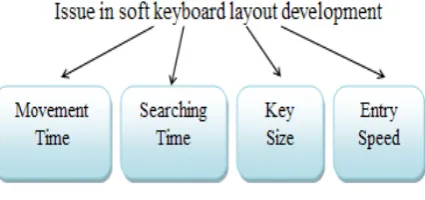
The organization of key layout in soft keyboard depends on various factors such as place of key, the time that the person need to find the key, distance between the current key and next prefer key (also known as movement time), size of the key and text entry speed in word per minute as shown in figure 1.
Fig. 1. Key Factors to Develop Soft Keyboard Layout
3.1. Text Entry Speed
The text entry speed is also known as Word Per Minutes (WPM) that can be calculated by taking the reciprocal of the mean Movement Time (MT^), multiplying by 60 seconds per minute and dividing by average number of character in a word as in equation 1.
Text Entry Speed = 1 MT^ ∗
60
n (1)
3.2. Mean Movement Time (MT^)
Mean movement time is calculated over all possible digraphs as depicted in equation 2. Where is bigram probability of selecting when is selected and it can be mathematically estimate by equation 3.
^ = ∗ + (2)
3.3.Movement Time (MT)
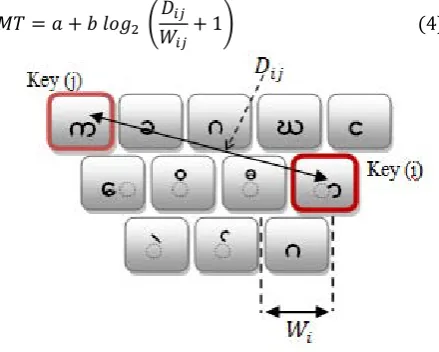
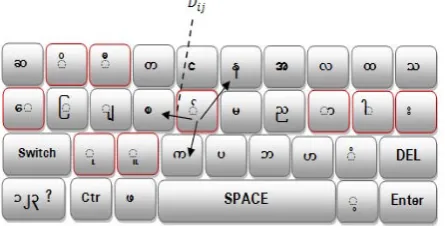
To calculate the movement time, Fitts's law is formulated mathematically according to equation 4. MT is the time to move from to another for a given distance and key size as depicted in figure 2. Where a and b are empirically determined coefficients.
= + + 1 (4)
Fig. 2. Key Size and Distance
3.4. Searching Time
For searching time calculation, Hick-Hyman law can calculate the average Reaction Time (RT) mathematically by assuming that the user choose candidate key among given n key according to equation 5. Where n is the number of keys in the keyboard, is constant and its value is determined empirically.
= ( + 1) (5)
4. Myanmar Soft Keyboard: Case Study
Myanmar script is a non-alphabetic script. Instead, like other Brahmi scripts, it is a syllabic script which composed of vowel or consonant and vowel signs. There are 34 consonant (က, ခ, ဂ, etc.), one virama or devowelizer sign (◌်), 11 dependent vowel signs (◌ာ, ◌ီ, ◌ိ, ေ◌, ◌ဲ, ◌ူ, etc.), 7 independent vowel (ဣ, ဤ, ဩ,
etc.), 4 medial signs (◌ျ, ြ◌, ◌ွ, ◌ှ), 2 diacritic signs (◌့, း), 10 digits (၀,၁,၂,၃, etc.), 4 various signs (၌, ၍, ၎, ၏) and 2 punctuation marks (။ , ၊) in basic Myanmar characters [7]. In Android platform’s Latin soft keyboard there are only 26 keys those are set as input characters to the device as shown in figure 3.
Fig. 3. Latin soft keyboard on Android touch phone
4.1. Current Myanmar Soft Keyboard on Touch Screen
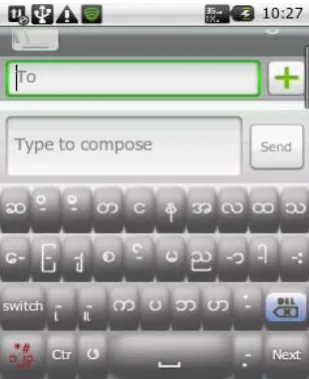
Fig. 4. Currently used Myanmar soft keyboard on Android (MyanDroid)
The key issue of currently used Myanmar soft keyboard is it’s excessive demand on control key to switch keyboard layout. After analyzing Myanmar sentences, some characters from layout 1 and layout 2 have to combine frequently especially in Finals cases such as က်, န်, မ်, ယ်, etc. Moreover, to be one syllable in Myanmar language, consonants are combined some keys in layout 2 that can load excessive layout switching time. For example, to input Myanmar short sentence “သူ ငယ်ချင်း ဘာေတွလုပ် ေန တာလဲ” [Hi friend, what are you doing?] , 15 switching time is needed to input 9 syllables.
သ+(switch)+◌ူ+(switch)+င+ယ+ခ+(switch)+◌ျ+(switch)+င+(switch)+◌်+း+(switch)+ဘ+(switch)+◌ာ+ေ◌+(switch )+တ+(switch)+◌ွ+(switch)+လ+(switch)+◌ု+ေ◌+(switch)+န+တ+(switch)+◌ာ+(switch)+လ+(switch)+◌ဲ
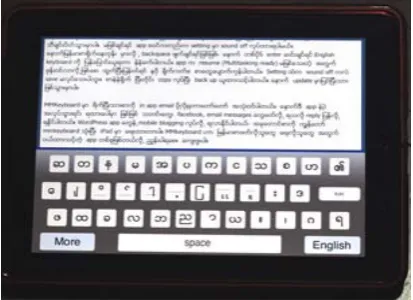
In addition, type writer based Myanmar keyboard layout is another attempt of soft keyboard on touch screen device as shown in Figure 5. Traditional type writer based Myanmar keyboard layout is officially used on personal computer and achieved desirable typing performance. To transplant type writer based keyboard layout to mobile phone, some characters are still left behind the layout and user can not be easy to input text with single finger or two thumbs on small handheld devices.
Fig. 5. Type Writer Based Myanmar Keyboard
4.2. Proposed Soft Keyboard Layout Implementation
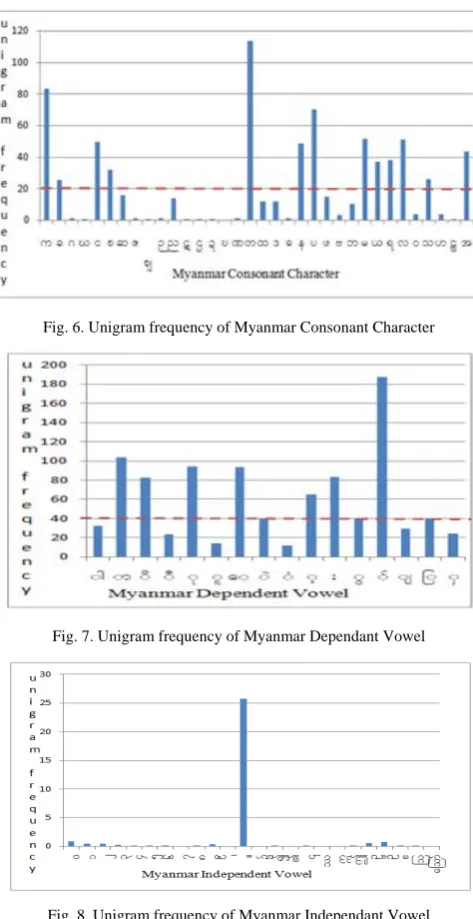
Fig. 6. Unigram frequency of Myanmar Consonant Character
Fig. 7. Unigram frequency of Myanmar Dependant Vowel
Fig. 8. Unigram frequency of Myanmar Independant Vowel
By taking the analytical Myanmar character unigram frequency and character combine usage pattern, the layout of soft keyboard is designed. The soft keyboard is designed to include three layouts. In the first layout, the most frequent used consonant characters (above the threshold dotted line as depict in figure 6 and 7) are interleaved with dependent vowel characters to reduce the hand movement time according to the text entry speed experimental results from algorithm 1. As shown in algorithm, n is the key number of key in soft keyboard as 29, a, b and b` used empirically coefficient as 0.5. Wij is assumed as the pixel length of soft keyboard on touch screen mobile phone. Dij is the length between keyi and keyj. For every random generated key layout, analyze text entry speed and print out to log file.
Algorithm-1: Text Entry Speed
{Assuming the inputs are n, Dij, Wij,Pij, a, b and b`}
begin
if(diagonal)
Dij:= √(len12+len22);
RT := b` * log2 (n+1);
repeat
generate_random_layout();
MTij=a+b*log2(Dij/Wij+1);
Calculate_MT^();
Analyze_Entry_Speed(); Print_to_File();
until(nn)
end
From the log file output, choose the best 10 layout and check with human user to reduce the learning curve of novice user. The system should also take into account the key searching habit of users. The users usually find the keys according to the direction of the key placement. For example, E_vowel (ေ◌) have to set in the left of the character. Whenever the users try to find E_vowel (ေ◌), they usually look it in the left of the layout and designed the soft keyboard layout is designed as shown in figure 9. Figure 10 shows the second layout, in that the rare used consonant and dependent vowel are set according to usage frequency and algorithm 1 analysis result. The third layout is for Myanmar digit characters and independent vowel as shown in figure 11.In addition, in Myanmar language, finals such as က်, င်, မ်, န်, etc. consonant characters such as က, င, မ, န,
etc. have to combine with devowelizer sign (◌်).As a result, the placement of devowelizer sing is important because of its frequent use with many consonant characters.
Fig. 9. The First Layout of the Proposed Soft Keyboard
Fig. 10. The Second Layout of the Proposed Soft Keyboard
Fig. 11. Myanmar Digit Character Layout of the Proposed Soft Keyboard
5. Experimental Result
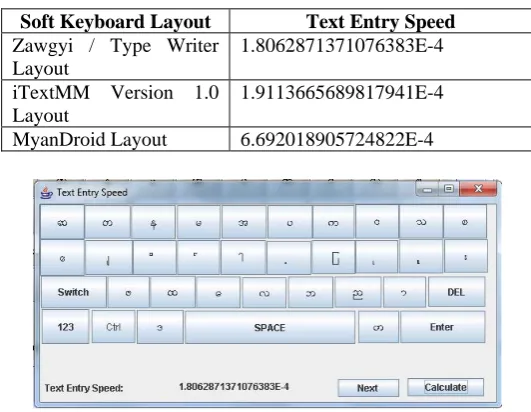
Table 1. The text entry speed comparison
Soft Keyboard Layout Text Entry Speed
Zawgyi / Type Writer Layout
1.8062871371076383E-4 iTextMM Version 1.0
Layout
1.9113665689817941E-4 MyanDroid Layout 6.692018905724822E-4
Fig. 12. Zawgyi Layout’s text entry speed
5.1. Statistical Study
By calculating the existing key layout deigns for Myanmar Language with algorithm 1, the best result in first screen key layout is Zawgyi Layout or Typewriter Layout. To figure out more efficient soft keyboard layout that is less than 1.8062871371076383E-4 text entry speed is the contribution of the paper. From the log result, chose the best 10 key layout and choose the best key layout with human user participation again. After analyzing the position of the key placement and text entry speed, all of the participants agreed to choose the proposed key layout is the most relevant.
Fig. 13. Text Entry Speed of First Screen Layout
5.2. User Study
For learning user searching behavior, the reality design of the proposed soft keyboard layout is developed on Android touch screen mobile phone (2.2 Froyo). To validate the analysis in practical way, the user evaluation for the proposed soft keyboard layout is performed. Before the actual testing, each candidate are given 15 minutes practice time to familiarize with the key arrangement. After the training time, let them to type randomly selected six Myanmar short sentences on both the 10 candidate soft keyboard layout and currently used Myanmar soft keyboard on Android. According to the experiment, the proposed soft keyboard layout can reduce key switching with less control to input Myanmar text on touch screen mobile devices.
Fig. 15. Text Entry Speed Comparison
Fig. 16. The Proposed Soft Keyboard Layout on Android
6. Conclusion
The proposed soft keyboard layout introduced a new Myanmar soft keyboard layout on Android touch screen mobile phone by leveraging the unigram frequency usage of Myanmar characters, text entry speed analysis statistics and the behavior of human user visual searching to help users input characters much faster and easier. Experimental result shows that the proposed soft keyboard outperforms the currently prevalent Myanmar input methods, and can lower the learning barrier for the novice users.
References
[1] Johan,H. , Jonna H., Jani M.,On-line Personalization of a Touch Screen Based Keybaord”, Proceedings of the 8th international conference on Intelligent user interfaces, New York, NY, USA, 2003
[2] Ko K.W., “Designing a Compliant Burmese Typewriter based Keyboard”, 2007.
[3] Kumar S. M., Somnath D.,Kumar S. P.,Debasis S., Parameters Effecting the Predictive Virtual Keyboard, Proceedings of the 2010 IEEE Student’s Technology Symposium, 3-4 April 2010, IIT Kharagpur.
0 10 20 30 40 50
[4] Niu J., Zhu L., Yan Q., Liu Y.,Wang K., Stroke++: A Hybrid Chinese Input Method for Touch Screen Mobile Phones, MobileHTC’10, September 7-10, 2010.
[5] Oo N.P. and Thein N.L., iTextMM: Intelligent Text Input System for Myanmar Language on Android Smart Phone, 3rd FTRA International Conference on Information Technology Convergence and Services of ITCS, Oct, 20-23, 2011.
[6] Phavy O.,Thu Y. K.,Mitsuji M.,Yoshiyori U., The Design of Khmer Word-based Predictive Non-QWERTY Soft Keyboard for Stylus-based Devices, IEEE Symposium on Visual Languages and Human-Centric Computing, 2008.
[7] Simpson R. and Horstmann K. H., An Adaptive Word Prediction Interface, AAAI Technical Report SS-00-01”, 2000.
[8] Soumalya G., Sayan S.,Manoj K. S., Debasis S., Effective Virtual Keyboard Design with Size and Space Adaptation, Proceedings of the 2010 IEEE Student’s Technology Symposium, 3-4 April 2010, IIT Kharagpur.
[9] Thu Y.K. and Prof. Yoshiyori U., Positional Mapping Myanmar Text Input Scheme for Mobile Devices, Mobile HCT'07 ACM 2007. [10] Thu Y.K. and Prof. Yoshiyori U, Positional Prediction: Consonant Cluster Prediction Text Entry Method for Burmese (Myanmar
Language), CHI 2008 Proceedings Student Research Competition.
[11] Thu Y.K. and Prof. Yoshiyori U, Positional Mapping Multi-tap for Myanmar Language, Human-Computer Interaction, PartII, HCII 2007, LNCS 4551, pp. 486
[12] Thu Y.K. and Prof. Yoshiyori U,Text Entry for Myanmar Language SMS: Proposal of 3 Possible Input Methods, Simulation and Analysis.
[13] Tim P., Kenghoa C. Itai A., Eric B. Tirthankar S. S., A Pratical Exmaniation of Multimodal Feedback and Guidance Signals for Mobile Touchscreen Keyboards” ,Proceedings of the 12th international conference on Human computer interaction with mobile devices and services, New York, NY, USA, 2010.