Optimization of the Wind Power generation
unit using Genetic Algorithm
Pankaj Jain1 P.B.Sharma2 V.K. Sethi1 Mukesh Pandey1
[email protected] [email protected] [email protected] [email protected]
1
Rajiv Gandhi Proudyogiki Vishwavidyalaya, (University of Technology of MP) Bhopal, India
2
Delhi Technological University, New Delhi, India
Abstract:
Wind is one of the cheapest and widely source of alternative energy. To convert it into electrical energy a wind turbine with generator is used but to properly convert this wind energy into electrical energy proper design of wind turbine is needed. In this paper we presents a genetic algorithm based optimization technique for the estimation of wind turbine parameters on the basis of requirements of electrical power, rotating speed, and chord area for the given range of wind velocity, blade radius, Tip speed ration (TSR), etc. the simulation results shows that the algorithm works well and can be used for wind turbine design. Furthermore we also analyzed the characteristics of the wind turbine with the specifications calculated by genetic algorithm.
Keywords: Genetic Algorithm, Wind Turbine, Wind Power Systems 1. Introduction
The wind energy uses is rapidly growing worldwide. This rapid growth of the wind energy industry has led to cost reduction challenges. There are various ways of reducing the cost of producing wind power: for example, the site selection, site layout design, predictive maintenance, and optimal control system design [1]. The wind farm layout design is an important component of ensuring the profitability of a wind farm project. An inadequate wind turbine design would lead to lower than expected wind power capture, increased maintenance costs, and so on. The reduction in cost with required performance could be achieved by optimal designing of turbine [2].
This paper presents the approach of optimal design by developing specific mathematical models to calculate the wake loss based on turbine locations. Solution of the constrained optimization problem is fully discussed with an evolutionary strategy algorithm, which can be easily extended by considering additional constraints.
2. Literature Review
The Claus Nybroe Windmission [4] provide a detail information for calculations of wind turbine & values of different parameters, they also discussed about blade chord profile selection some specific example calculations are also provided here. Asis Sarkar, Dhiren Kumar Behera [3] presented the power characters of turbine connected to generator through transmission. They also presented the effect of internal resistance of generator and load resistor. Andrew Kusiak, Zhe Song [2] presents a model for wind turbine placement based on the wind distribution. The model considers wake loss, which can be calculated based on wind turbine locations, and wind direction. They solved it as optimization problem, for ease of solving it; the constraints are transformed into a second objective function. Then a multi-objective evolutionary strategy algorithm is developed to solve the transformed bi-criteria optimization problem, which maximizes the expected energy output, as well as minimizes the constraint violations. The presented model is illustrated with examples as well as an industrial application. Juan Mendez and David Greiner [5] show a method to obtain optimal chord and twist distributions in wind turbine blades by using genetic algorithms. The distributions are computed to maximize the mean expected power depending on the Weibull wind distribution at a specific site. This approach avoids assumptions about optimal attack angle related to the ratio between the lift to drag coefficients. Andrew Kusiak, Haiyang Zheng [7] presented an evolutionary computation approach for optimization of power factor and power output of wind turbines. Their work shows that evolutionary strategy algorithm solves the data-derived optimization model and determines optimal control settings & simulation results demonstrate opportunities to improve the power factor and the power output by optimizing set points of blade pitch angle and generator torque. The concept and theory of the optimization algorithms is presented in [8] which is a useful reference for optimization problems and solution techniques.
3. Wind Turbine Blade Design Calculations
This section gives some mathematical details of governing equations and terms used in wind turbine blade calculations for more details about these equations please refer to [3] [4].
Tip Seep Ratio (TSR): = (tip speed of lade)/ (wind speed).
Generally, the slow running multi bladed wind turbine rotors operate with tip speed ratios like 1-4, while fast runners use 5-7 as tip speed ratios [3] [4].
The relations for power generated & rotating speed of turbine are given by
Where
= Rotor efficiency,
= Efficiency of driven machinery,
= Swept rotor area (m2), = Wind speed (m/s)
= Tip Speed Ratio
= Radius of rotor
Rotor efficiency can go as high as Cp = 0.48, but Cp = 0.4 is often used in this type of calculations [3][4]. Now if there is some mechanical coupling arrangement for power transmission then it should also be multiplied in the equation (1).
The width of the blade is which is also called the blade chord at point r (r < R) is given by
Where
= Radius at tip
= radius at point of computation
= number of blades
= Lift coefficient
4. Genetic Algorithm
A genetic algorithm (GA) is a search heuristic that mimics the process of natural evolution. This heuristic is routinely used to generate useful solutions to optimization and search problems. Genetic algorithms belong to the larger class of evolutionary algorithms (EA), which generate solutions to optimization problems using techniques inspired by natural evolution, such as inheritance, mutation, selection, and crossover.
In a genetic algorithm, a population of strings (called chromosomes or the genotype of the genome), which encode candidate solutions (called individuals, creatures, or phenotypes) to an optimization problem, evolves toward better solutions. Traditionally, solutions are represented in binary as strings of 0s and 1s, but other encodings are also possible. The evolution usually starts from a population of randomly generated individuals and happens in generations. In each generation, the fitness of every individual in the population is evaluated, multiple individuals are stochastically selected from the current population (based on their fitness), and modified (recombined and possibly randomly mutated) to form a new population. The new population is then used in the next iteration of the algorithm. Commonly, the algorithm terminates when either a maximum number of generations has been produced, or a satisfactory fitness level has been reached for the population. If the algorithm has terminated due to a maximum number of generations, a satisfactory solution may or may not have been reached.
Genetic algorithms find application in bioinformatics, phylogenetics, computational science, engineering, economics, chemistry, manufacturing, mathematics, physics and other fields. A typical genetic algorithm requires:
A genetic representation of the solution domain,
A standard representation of the solution is as an array of bits. Arrays of other types and structures can be used in essentially the same way. The main property that makes these genetic representations convenient is that their parts are easily aligned due to their fixed size, which facilitates simple crossover operations. Variable length representations may also be used, but crossover implementation is more complex in this case. Tree-like representations are explored in genetic programming and graph-form representations are explored in evolutionary programming.
The fitness function is defined over the genetic representation and measures the quality of the represented solution. The fitness function is always problem dependent. For instance, in the knapsack problem one wants to maximize the total value of objects that can be put in a knapsack of some fixed capacity. A representation of a solution might be an array of bits, where each bit represents a different object, and the value of the bit (0 or 1) represents whether or not the object is in the knapsack. Not every such representation is valid, as the size of objects may exceed the capacity of the knapsack. The fitness of the solution is the sum of values of all objects in the knapsack if the representation is valid or 0 otherwise. In some problems, it is hard or even impossible to define the fitness expression; in these cases, interactive genetic algorithms are used.
Once the genetic representation and the fitness function are defined, a GA proceeds to initialize a population of solutions (usually randomly) and then to improve it through repetitive application of the mutation, crossover, inversion and selection operators.
5. Proposed Algorithm
In the proposed algorithm firstly we formulates the problem as optimization problem in which a set of equations should be solved within required limit under some specific limits of system variables.
Translating it for our system we have to solved the equations
For the required values of Preq , RPMreq & BCAreq. and selecting the values of variables within given range.
Hence we created the objective function as
6. Simulation Results
The proposed method is simulated using Maltab & the simulation results for the different required values are shown in table below:
Genetic Parameters: Population Size = 16, Total Generations = 1000, Required Goal = 0.05. Required Values: Preq = 1000W, RPMreq = 200 & BCAreq = 0.5.
Achieved Goal = 0.048, Achieved P = 1005.09, Achieved RPM = 193.17, Achieved BCA = 0.495
Variable Max Min Optimum
Number of Blades 0 3 2
Rotor Efficiency 0.3 0.45 0.3895 M/C Efficiency 0.7 0.8 0.7133 Wind Speed 3.0 15.0 7.8699
TSR 3.0 12.0 5.0975
Radius of Rotor 0.5 5.0 1.9841 Lift Coefficient 0.3 0.85 0.5596
Figure 1: Wind Speed vs. Power Generation Characteristics
Figure 2: TSR vs. RPM Characteristics.
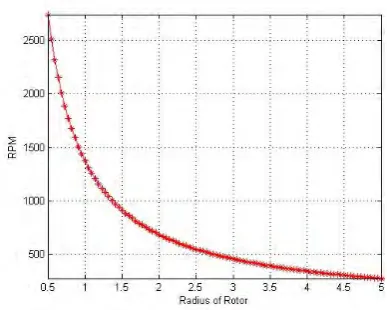
Figure 4: Radius of Rotor vs. RPM Characteristics
Required Values: Preq = 10000W, RPMreq = 450 & BCAreq = 0.5.
Achieved Goal = 0.046, Achieved P = 10028.2, Achieved RPM = 468.57, Achieved BCA = 0.498
Variable Max Min Optimum
Number of Blades 0 3 2
Rotor Efficiency 0.3 0.45 0.4167 M/C Efficiency 0.7 0.8 0.7462 Wind Speed 3.0 15.0 12.591
TSR 3.0 12.0 11.402
Radius of Rotor 0.5 5.0 2.9275 Lift Coefficient 0.3 0.85 0.5617
The Characteristics of the system designed with the optimum values shown in the table are plotted below
Figure 5: Wind Speed vs. Power Generation Characteristics.
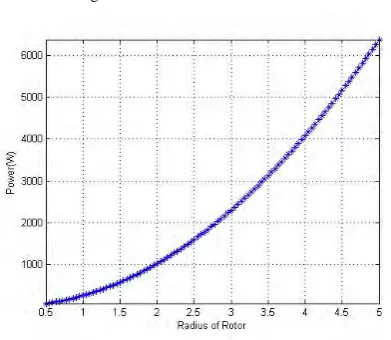
Figure 7: Radius of Rotor vs. Power Generation Characteristics.
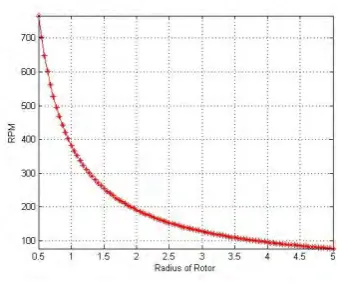
Figure 8: Radius of Rotor vs. RPM Characteristics.
7. Conclusion
It is well explained that optimize solution of wind turbine design problem can provide as the cost effective solution for wind energy to electric power production. The simulation results shows that the genetic optimization algorithm can be successfully used for the above problem also it also shows that the algorithm is capable to achieve the very different goals (as in the first scenario Preq = 1000W, RPMreq = 200 & in the second
scenario Preq = 10000W, RPMreq = 450) with the error of less than 5 percentage.
References
[1] Wiser R, Bolinger M. Annual report on U.S. wind power installation, cost, and performance trends: 2006.
[2] Andrew Kusiak & Zhe Song “Design of wind farm layout for maximum wind energy capture”, Renewable Energy 35 (2010) 685–694. [3] Asis Sarkar, Dhiren Kumar Behera “Wind Turbine Blade Efficiency and Power Calculation with Electrical Analogy”, International
Journal of Scientific and Research Publications, Volume 2, Issue 2, February 2012.
[4] Banzhaf, Wolfgang; Nordin, Peter; Keller, Robert; Francone, Frank (1998) Genetic Programming – An Introduction, Morgan Kaufmann, San Francisco, CA
[5] Juan Mendez and David Greiner “Wind blade chord and twist angle optimization by using genetic algorithms”.
[6] Fogel, David B (2006), Evolutionary Computation: Toward a New Philosophy of Machine Intelligence, IEEE Press, Piscataway, NJ. Third Edition
[7] Andrew Kusiak & Haiyang Zheng “Optimization of wind turbine energy and power factor with an evolutionary computation algorithm”, Energy 35 (2010) 1324–1332.
[8] Thomas Weise”Global Optimization Algorithms, Theory and Application”, http://www.it-weise.de/.
[9] Munir Ahmad Nayak and M. C. Deo “Wind Speed Prediction by Different Computing Techniques”, BALWOIS 2010 – Ohrid, Republic of Macedonia –25, 29 May 2010.
[10] Makarand A. Kulkarni, Sunil Patil, G. V. Rama and P. N. Sen “Wind speed prediction using statistical regression and neural network”, J. Earth Syst. Sci. 117, No. 4, August 2008, pp. 457–463.
[11] Gnana Sheela K. “Computing Models for Wind Speed Prediction in Renewable Energy Systems”, IJCA Special Issue on “Computational Science, New Dimensions & Perspectives NCCSE, 2011.
[12] http://en.wikipedia.org/wiki/Artificial_neural_network.
[13] Dr. Natacha Gueorguieva & Ohnmar Myint “Feed-Forward Neural Network with Backpropagation: Learning and Classification”, Department of Computer Science.