https://doi.org/10.5194/amt-12-5913-2019 © Author(s) 2019. This work is distributed under the Creative Commons Attribution 4.0 License.
Multiple-scattering correction factor of quartz filters and the effect
of filtering particles mixed in water: implications for analyses of
light absorption in snow samples
Jonas Svensson1,a, Johan Ström2, and Aki Virkkula1
1Atmospheric Composition Research, Finnish Meteorological Institute, Helsinki, Finland
2Department of Environmental Science and Analytical Chemistry, Stockholm University, Stockholm, Sweden anow at: Institute for Geosciences and Environmental Research, Université Grenoble Alpes, Grenoble, France Correspondence:Jonas Svensson ([email protected])
Received: 16 April 2019 – Discussion started: 29 May 2019
Revised: 13 September 2019 – Accepted: 7 October 2019 – Published: 11 November 2019
Abstract. The deposition of light-absorbing aerosol (LAA) onto snow initiates processes that lead to increased snowmelt. Measurements of LAA, such as black carbon (BC) and mineral dust, have been observed globally to darken snow. Several measurement techniques of LAA in snow col-lect the particulates on filters for analysis. Here we investi-gate micro-quartz filters’ optical response to BC experiments in which the particles are initially suspended in air or in a liquid. With particle soot absorption photometers (PSAPs) we observed a 20 % scattering enhancement for quartz filters compared to the standard PSAP Pallflex filters. The multiple-scattering correction factor (Cref) of the quartz filters for air-borne soot aerosol is estimated to be∼3.4. In the next stage correction factors were determined for BC particles mixed in water and also for BC particles both mixed in water and further treated in an ultrasonic bath. Comparison of BC col-lected from airborne particles with BC mixed in water filters indicated a higher mass absorption cross section by approxi-mately a factor of 2 for the liquid-based filters, which is prob-ably due to the BC particles penetrating deeper in the filter matrix. The ultrasonic bath increased absorption still further, roughly by a factor of 1.5, compared to only mixing in water. Application of the correction functions to earlier published field data from the Himalaya and Finnish Lapland yielded mass absorption coefficient (MAC) values of∼7–10 m2g−1 atλ=550 nm, which is in the range of the published MAC of airborne BC aerosol.
1 Introduction
Soot refers to carbonaceous particles formed during the incomplete combustion of hydrocarbon fuels and includes black carbon (BC) and organic carbon (OC) but can also include other elements, such as sulfates. As the most light-absorbing aerosol (LAA) by unit of mass, BC is highly effi-cient in absorbing solar radiation and is a vital component in Earth’s radiative balance (Bond et al., 2013). Once the par-ticles are scavenged from the atmosphere, possibly far from their emission source, BC can reach the snow surface and decrease the snow reflectivity (Warren and Wiscombe, 1980; Flanner et al., 2007). This will lead to accelerated and in-creased snowmelt, observed in different snow environments across the globe (see, e.g., recent review by Skiles et al., 2018). Perhaps the most notable is high-mountain Asia and its extensive cryosphere, where large emission sources of LAA in close proximity are affecting the region’s snow and ice (e.g., Xu et al., 2009; Gertler et al., 2016; Zhang et al., 2017).
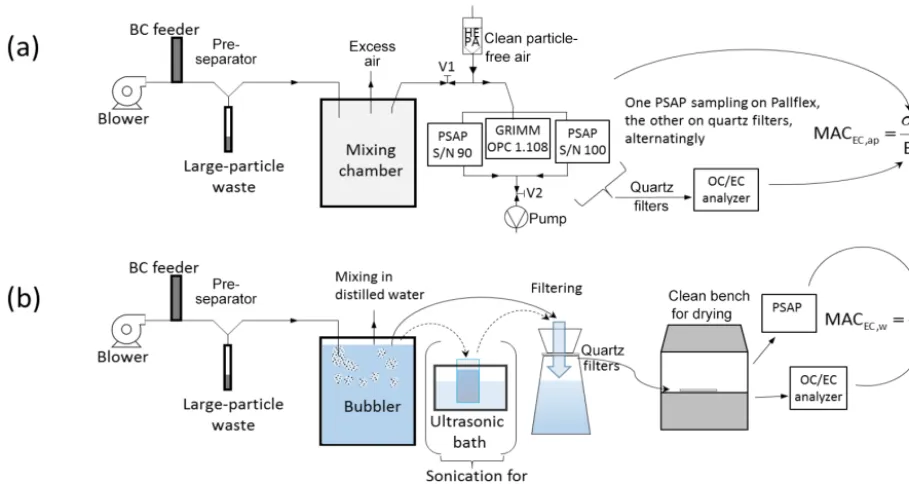
scat-Figure 1.Experimental setup for the airborne(a)and for the liquid(b)procedures.
tering of light that is enhanced in the filter substrate, and (3) the enhancement from the deposition of other light-scattering aerosol. One instrument used for light absorption measure-ments is the particle soot absorption photometer (PSAP), uti-lizing Pallflex filters. As an alternative to the optical filter analysis of eBC, another approach is to apply the thermal– optical method (TOM), providing organic carbon (OC) and elemental carbon (EC) mass of the aerosol on the filter. With this method, EC refers to the carbon content of carbonaceous matter (Petzold et al., 2013) and can be assumed to be the main light-absorbing element of BC. The technique involves a stepwise heating procedure, therefore creating a need to use micro-quartz-fiber filters. These filters have been used in nu-merous studies with filtering snow and ice samples and have been analyzed thereafter to determine the EC and OC con-tent of the samples (e.g., Hagler et al., 2007; Forsström et al., 2009; Meinander et al., 2013; Ruppel et al., 2014; Zhang et al., 2017). In Svensson et al. (2018), measurements with TOM were combined with an additional transmittance mea-surement to further investigate the relative contribution from BC and other LAA particles present in snow samples. The study involved laboratory tests as well as comparisons to am-bient snow samples taken from different environmental set-tings. One lesson from this study was that the optical prop-erties of absorbing particles on quartz filters must be better understood, in particular when using melted snow samples.
The overarching goal of this paper is to further investi-gate micro-quartz-fiber filters’ optical behavior when sam-pling BC particles in a liquid (to simulate snow samsam-pling). An advantage of using these filters is that the sample can
be analyzed readily using TOM to reach an EC concentra-tion on the filter (where MAC values are not needed). The aim is pursued through a series of laboratory studies. Our approach is to compare the use of quartz-fiber filter for air and liquid samples to the much better characterized Pallflex type filer used in commercial PSAPs. Hence, we do not in-tend to determine a universal MAC value but rather to un-derstand differences in the observations that might be due to the filter substrate or handling of the sample. We do not intend to answer all possible issues with filter sampling but will concentrate on the difference using the two filter types in air samples, the difference between air and liquid samples with respect to the quartz-fiber filter, and finally the potential effect from treating the liquid samples using ultrasound.
2 Materials, instruments, and data analyses 2.1 Soot aerosol production and sampling
2.1.1 Airborne sampling
Soot aerosol was sampled onto filters in an airborne phase and as a part of liquid solution. In the airborne aerosol tests, soot was blown into a cylindrical experimental chamber (0.8 m height×0.45 m diameter) through a stainless-steel tube (25 mm outer diameter) consisting of a y-shaped bend of 130◦, creating a size separation of the aerosol. Essentially a virtual impactor, this setup allowed the smaller-sized par-ticles to continue with the airflow into the chamber, while the larger (and heavier) particles were deposited into a waste pipe through inertial separation (see Sect. 2.2.3 for further description and results in Sect. 3.1.1). From the experimental chamber a sample inlet (copper, 6 mm outer diameter) simul-taneously fed two PSAPs and a portable aerosol spectrome-ter (Grimm 1.108). One of the PSAPs had quartz-fiber-filspectrome-ter punches mounted, while the other had standard PSAP filters installed. This setup was alternated among the PSAPs in be-tween the experimental runs during the experiment to have both PSAPs assessed with the different filters. In total, 22 dif-ferent experimental rounds were made with various amounts of aerosol deposited to the substrates.
2.1.2 Liquid sampling
In the liquid experiments, the same soot batch and procedure were used as above, but the outlet pipe was submerged into a 20 L container filled with deionized, purified Milli-Q (MQ) water. From this liquid solution, different small amounts (be-tween 10 and 100 mL) were extracted and mixed with ad-ditional MQ water to further dilute the sample (to a typical total volume of 400 mL). This was performed to get a range of filters with different EC concentrations and optical depths. The total number of liquid-generated filters was 35. Some se-lected liquid samples (n=10) were exposed to an ultrasonic bath (for at least 15 min) prior to filtration. All of the liquid solutions were filtered onto the same quartz filters used in the airborne test, applying the same filtering principles and anal-ysis procedures as used previously (Svensson et al., 2018). Punches from dried filters had their transmittance first mea-sured using a PSAP, followed by EC concentration measure-ments (TOM). This procedure was also applied to the quartz filters from the airborne experiment.
2.2 Instruments
2.2.1 Absorption measurements
Absorption was measured with two Radiance Research three-wavelength PSAPs (S/N 90 and S/N 100) atλ=467, 530, and 660 nm (Virkkula et al., 2005). One of them was loaded with a Pallflex E70-2075W filter that is generally used with the instrument, while the other was loaded with micro-quartz-fiber filters (Munktell, grade T293). The flows were calibrated with a Gilian Gilibrator bubble flow me-ter and set to 0.5 L min−1. Higher flow rates were not used
here, since the quartz filter tends to be more fragile and may not withstand higher flows. The sample spot diame-ters of the PSAPs were measured with an Eschenbach scale loupe with a 0.1 mm graduation 10 times each. The aver-age diameters (±standard deviation) were 5.04±0.10 and 5.05±0.10 mm, giving corresponding spot areas of 19.9±1.6 and 20.0±1.6 mm2. The aim was to use identical face ve-locities, i.e., average velocity of aerosol perpendicular to the filter (e.g., Müller et al., 2014) through both filter materials. The essentially identical spot areas also meant that we had tuned the flow rates identically. In addition, to study whether the PSAPs themselves affect the results, we used both filter materials alternatingly, as mentioned above, resulting in half of the 22 quartz filter samples being collected on the PSAP S/N 100 and the other half on the PSAP S/N 90. Another custom-built one-wavelength PSAP (λ=526 nm; Krecl et al., 2007) used in Svensson et al. (2018) was also utilized in for transmittance analysis of all the filters after their pro-duction in the airborne and liquid experiments.
2.2.2 EC measurements
Punches (typically with an area of 0.64 cm2) taken from the quartz filters were determined for their OC and EC content with a Sunset Laboratory OCEC analyzer (Birch and Cary, 1996), using the EUSAAR 2 protocol (Cavalli et al., 2010). The analysis procedure is based on stepwise increases in tem-perature in a helium atmosphere for the first stage, during which OC is detected with a flame ionization detector. The second phase of the analysis consists of introducing oxygen into the temperature increases and the detection of EC. Pyrol-ysis of OC during the first phase is monitored by a continuous laser transmittance measurement. Once the transmittance has reached the initial value for the filter in the second phase, a separation split point between OC and EC is established. 2.2.3 Size distribution measurements
Figure 2.Size-dependent aerosol properties relevant to the exper-iment.(a)Normalized average particle number size distribution of soot aerosol measurement in the mixing chamber with the Grimm 1.108 OPC. The continuous lines present the size distributions with the original diameters of the OPC, and the dashed lines show those assuming that the original diameters were underestimated by a fac-tor of 2.(b)Mass absorption and scattering coefficients, MAC and MSC, respectively, and single-scattering albedo ωo of single BC particles atλ=530 nm.
2.3 Data processing
Calculations are presented in a step-by-step procedure below. Loading corrections are routinely applied to filter-based mea-surements of light absorption by atmospheric aerosol, but, for measurements of absorption by melted and filtered snow samples, it is not applied. In the former, absorption is calcu-lated from the product of a loading correction and the rate of change of transmittance, whereas in the latter the absorp-tion is generally calculated simply from the transmittance of the filter only. We therefore show the equivalence of the two methods and that the loading corrections can and should also be applied to melted and filtered snow samples. First, we present a generally used equation for calculating absorp-tion by aerosol, explain how the multiple-scattering correc-tion factor Cref appears in the equations, and explain how we determined it for the quartz filters. The numerical values of two published loading corrections are given as clearly as possible to save the reader from looking for constants from the literature. Finally, we show the equivalence of calculat-ing the mass absorption coefficients from airborne aerosol and filtered snow samples.
A further note on data processing is important. The single-scattering albedo,ωo, i.e., the ratio of scattering and the ex-tinction coefficient, is a measure of the darkness of aerosol: for purely scattering aerosol,ωo=1. For freshly generated
pure BC, it has been measured to be∼0.2±0.1 (Bond et al., 2013). When pure BC particles get coated with some light-scattering material,ωoincreases so that far from the sources, it is typically larger than 0.9 (e.g., Delene and Ogren, 2002). However,ωovaries also with particle size even for pure BC in that it increases with increasing particle size, as can be seen in the simple Mie calculations in Fig. 2b. Both the coat-ing and particle size have consequences for the analysis of BC in snow by filter-based absorption measurements. The coating of BC particles typically consists of some water-soluble material such as sulfates, nitrates, and organics. The size of BC particles in snow has been shown to vary largely, from∼0.1 to>2 µm (e.g., Schwarz et al., 2013). On the other hand, the estimation of absorption from filter-based at-tenuation measurements is affected also by scattering aerosol and therefore by ωo (e.g., Arnott et al., 2005; Virkkula et al., 2005; Collaud Coen et al., 2010). Now, since we do not know theωo of the particles and will apply the algorithm presented by Virkkula (2010), we will repeat the calculations with four differentωo values. We use the size distribution measurements for estimating the size and the Mie modeling for estimating a realistic range ofωofor the calculations. 2.3.1 Calculation of absorption in aerosol
The PSAP was calibrated with the standard filter material Pallflex E70-2075W by Bond et al. (1999; here referred to as B1999) and Virkkula et al. (2005). Ogren (2010; here O2010) presented an adjustment to the Bond et al. (1999) calibration, while Virkkula (2010; here V2010) updated the Virkkula et al. (2005) calibration. In all of these the absorption coeffi-cient is calculated as
σap=f (Trt) A Q1tln
Tr t−1t Trt
−sσsp, (1)
wheref (Trt) is the loading correction function that depends
on the transmittance Trt =It/I0, in whichIt is the light
in-tensity transmitted through the filter at timet,I0the light in-tensity transmitted through a clean filter at timet=0,Athe spot area,Qthe flow rate, andsthe fraction of the scattering coefficientσspthat gets interpreted as absorption. This is usu-ally called the apparent absorption and should be subtracted from the uncorrected absorption or treated as presented by Müller et al. (2014). If apparent absorption can be consid-ered negligible, Eq. (1) becomes
σap=f (Trt) A Q1tln
Tr t−1t Trt
. (2)
In the present work, this approach was adapted for two rea-sons: (1)σspwas not measured during the calibration exper-iment, and (2) the aerosol used in the experiment was very dark (soot from oil-based burning); thus the apparent absorp-tion could be considered negligible.
correction function that equals 1 at Tr=1 and increases when the filter gets darker, i.e., when Tr<1:
σap= 1
Cref
g(Trt) A Q1tln
Tr t−1t Trt
. (3)
If there is only one time stept=1t, and if before sampling, Tr=1, then Trt−1t=Trt=0=1, and
σap= 1
Cref
g(Trt) A Vt ln 1 Trt = 1 Cref
g(Trt)σ0, (4)
whereVt is the air volume drawn through the filter from the
start of sampling at timet. The assumption of only one time step means that Eq. (4) presents the absorption coefficient from the start of sampling on the filter. According to the Bouguer–Lambert–Beer law, light intensity decreases expo-nentially as a function of the optical depthτ:
It=I0e−τ ⇔τ=lnI0
It
=lnTr1
t
. (5)
This is relevant especially in the present study, since the pur-pose is to improve estimation of absorption in filtered snow samples. In the analysis of a snow sample there is only one “time step”:I0is the intensity of light transmitted through a clean filter, andItis the intensity of light transmitted through
a filter through which the melted snow sample was filtered. Here the airborne data were also treated in a similar way: for each time step absorption was calculated from Eq. (4) from the start of sampling on the filter.
2.3.2 Calculation ofCrefof quartz filters
If we assume that the difference of the absorption coefficients of the PSAPs using the quartz and Pallflex filters,σap(Q)and
σap(P ), respectively, is due to the multiple-scattering correc-tion factors of the two materials only, we can calculate
Cref,Q= σap(Q)
σap(P )
Cref,P, (6)
whereCref,QandCref,Pare the multiple-scattering correction
factors of the quartz and Pallflex filters, respectively. How-ever, this is an approximation only, since the difference of
σap(Q)andσap(P )is also due to the different transmittances TrQand TrP of the two filter materials at each time step and
consequently different values of the loading correction. How-ever, below we will use Eq. (6) for the estimation ofCref,Q.
TheCref,P values for Pallflex E70-2075W filter were
cal-culated here from two published calibration experiments. The loading correction function of B1999 (with the O2010 adjustment) can be reformulated as
f (Tr)= 1
1.5557·Tr+1.0227. (7)
This can be further rewritten as
f (Tr)= 1 Cref
g(Tr)= 1 2.5784
1
0.6034·Tr+0.3966, (8) whereCref=2.5784. Similarly, the V2010 loading correc-tion can be rewritten as
f (Tr)=(k0+k1(h0+h1ω0)ln(Tr))
=k0
1+k1 k0
(h0+h1ω0)ln(Tr)
= 1
Cref
g(Tr)= 1 Cref
1+k1
k0
(h0+h1ω0)ln(Tr)
,
(9) whereh0,h1,k0, andk1are the constants presented in Table 1 in V2010 and the single-scattering albedoωo=σsp/(σsp+
σap). For the three wavelengths Eq. (10) becomes f467(Tr467)=
1
2.653(1−1.698(1.16−0.63·ω0)ln(Trb)), (10) f530(Tr530)=
1
2.793 1−1.788(1.17−0.71·ω0)ln(Trg)
, (11)
f660(Tr660)= 1
2.841(1−1.915(1.14−0.72·ω0)ln(Trr)) , (12) withCref,467=2.653,Cref,530=2.793, andCref,660=2.841. WhenCrefhas been determined, it is assumed thatg(Tr) is the same for both filter materials.
2.3.3 Calculation of mass absorption coefficient (MAC) IfmECis the mass of EC in the filter (corresponding to the spot area) through which the air volume ofVtflowed, the av-erage mass concentration of EC in aerosol in the air volume iscEC,aerosol=mEC/Vt. If σap is the absorption coefficient calculated from Eq. (4), the MAC can be calculated from MAC= σap
cEC,aerosol
= 1
Crefg(Trt)
A Vtτ mEC Vt = 1
Crefg(Trt)Aτ
mEC
= 1
Crefg(Trt)τ
mEC
A
=f (Trt)τ mEC/A
.
(13)
Table 1.Main information on aerosol samples taken during the experiment. Shown are sampling time, transmittances of Pallflex and quartz filters atλ=530 nm at the end of each sample (TR), attenuation coefficient, which is calculated without any loading corrections (σ0), ratio of optical depths of quartz and Pallflex filters (τ (Q)/τ (P )), and EC concentration in the quartz filter (EC). The 1 s data from samples denoted by∗were used for derivingCrefof quartz filters. Samples 1 and 2 were taken from the mixing chamber without any dilution.
Sample Sampling σ0(P ) σ0(Q)
number time (min) Tr(P) Tr(Q) Mm−1 Mm−1 τ (Q)/τ (P ) EC g m−2
1 0.55 0.314 0.279 84 245 92 840 1.102 0.172
2 0.43 0.493 0.458 65 284 72 082 1.104 0.113
3 1.82 0.544 0.487 13 405 15 842 1.182 0.094
4∗ 6.7 0.543 0.509 3646 4032 1.106 0.056
5∗ 11.8 0.746 0.702 993 1199 1.207 0.029
6 2.68 0.543 0.505 9103 10 184 1.119 0.062
7∗ 12.13 0.224 0.216 4932 5052 1.024 0.195
8 0.6 0.609 0.592 33 062 34 950 1.057 0.027
9 0.88 0.823 0.797 8821 10 275 1.165 0.014
10 0.67 0.913 0.902 5461 6188 1.133 0.016
11 1.38 0.931 0.923 2067 2317 1.121 0.027
12 0.32 0.915 0.904 11 221 12 749 1.136 0.012
13 0.57 0.927 0.913 5351 6425 1.201 0.009
14 0.65 0.814 0.781 12 664 15 211 1.201 0.011
15 2.93 0.704 0.664 4786 5584 1.167 0.032
16∗ 11.6 0.602 0.555 1750 2030 1.16 0.029
17 6.12 0.5 0.415 4533 5751 1.269 0.080
18∗ 11.92 0.401 0.354 3067 3486 1.136 0.113
19∗ 10.47 0.302 0.262 4576 5119 1.119 0.147
20∗ 6.97 0.402 0.367 5232 5755 1.1 0.113
21 3.6 0.6 0.558 5676 6482 1.142 0.055
22 2.1 0.849 0.833 3118 3480 1.116 0.017
3 Results and discussion
3.1 Airborne aerosol experiment
Through our 22 airborne aerosol samples, we aimed at get-ting a range of transmittances and EC concentrations in the filters for the regression analysis. The original goal was to control the final transmittances by the length of the sampling time; however, this was not always successful (as noted in Table 1). Without dilution the aerosol concentration in the mixing chamber was very high, with attenuation coefficients
σ0in the range of∼60 000 to∼90 000 Mm−1(see samples 1 and 2; Table 1). Therefore we added a dilution valve (V1) and a high-efficiency particulate air (HEPA) filter (Fig. 1) af-ter the first couple of experiment runs and had variations in the ratio of sample air to clean filtered air, which led to lower
σ0 in the range of ∼1000 to∼30 000 Mm−1. The system was not always stable, resulting in different measured con-centrations for similar sampling times.
3.1.1 Particle size distribution
The average size distribution measured with the Grimm 1.108 OPC shows that most particles larger than 1 µm (Fig. 2a) were efficiently removed from the air stream with the pre-separator (Fig. 1). This is uncertain, however, since the OPC was calibrated with white PSL spheres (as discussed in Sect. 2.2.3). Another important point is that the lower limit of the sizes the OPC measured was 300 nm and is proba-bly even higher due to the above-mentioned calibration error. The particle number size distribution, nevertheless, suggests that there were large numbers of BC particles smaller than can be detected by the OPC, since the particle number con-centration increases sharply with decreasing particle diame-ter (Fig. 2a).
Figure 3. Transmittance for quartz and Pallflex filters measured with PSAP Radiance Research and the Stockholm University custom-built PSAP.
multiplied by 2, respectively. These ωo values can be con-sidered to be upper estimates, considering that a large frac-tion of small particles were undetected. However, to take the
ωouncertainty into account, we calculated all V2010-related values by using fourωovalues: 0.3, 0.4, 0.5, and 0.6. 3.1.2 Comparison between custom built and
commercial PSAPs
The optical depths presented in Svensson et al. (2018) were measured with the custom-made PSAP of Stockholm Univer-sity atλ=526 nm, which is slightly different than the com-mercial Radiance Research PSAP (λ=530 nm). Therefore, before applying the corrections (determined in Sect. 3.1.3 below), we examined whether the transmittances measured with these two PSAPs agree. Transmittances of all Pallflex and quartz filters were measured with both instruments. The resulting scatter plot (Fig. 3) shows that the agreement is ex-cellent between the PSAPs; thus we concluded that the cor-rections established in this paper could be applied to the re-sults presented by Svensson et al. (2018).
3.1.3 Estimation of the multiple-scattering correction factorCreffor the quartz filter
Optical depths (τ) for both the Pallflex and quartz filters,
τ (P ) andτ (Q), respectively, were calculated from Eq. (5) at a 1 s time resolution. Theτ (Q)-to-τ (P )ratios – here theτ
ratio – had a wide range of values at 1 s time resolution, but most of them were>1:99.6 % ofτ (Q)/τ (P ) >1, and the average and median ratios were 1.21 and 1.16, respectively. To study how theτ ratio depends on filter loading, the data were classified into transmittance bins of a 0.025 width in the Tr(P) range of 0.3–1.0, and the averages and medians were calculated for each bin (shown in Fig. 4). The transmittance
dependence on theτ ratio of individual samples was often controversial: in some samples it decreased from the begin-ning, and in some samples, it increased. We do not have an explanation of this, although the high concentrations in the mixing chamber – see the attenuation coefficientsσ0in Ta-ble 1 – are probably largely the factor behind this observa-tion. However, for all data the average and medianτ ratio depended on the filter transmittance so that for a fresh clean filter at Tr>0.9, it was higher than for heavily loaded filters at Tr<0.4 (Fig. 4). In addition to the 1 s data, the τ ratio at the end of each sampling period is plotted as a function of transmittance of the Pallflex filter in Fig. 4. For the end values of all samples there was no clear Tr dependence. The most important conclusion in Fig. 4 is that theτ ratio of the two filter materials depends on the filter transmittance. On aver-age the ratio decreases with increasing loading even though the same amount of BC is collected on both filters. That sug-gests that the loading corrections to be applied depend on the filter material and that they do not differ just by a constant factor.
In sample runs 4, 5, 7, 16, 18, 19, and 20, the decrease in Tr was relatively slow, and we considered the bin averages and medians calculated from them to be the most suitable to be used for determiningCref. Sample 17 was also long, taking more than 6 min. Despite the similar settings used for filling the mixing chamber and the diluter, theτ ratio was completely different from the rest of the samples (Fig. 4). This outlier was therefore excluded from the analysis.
The two correction algorithms (B1999 and V2010) were next applied to both filter materials, andσap(Q)andσap(P ) (atλ=530 nm) were calculated from Eq. (4) by using the Tr bin averages and median ofσ0and then the ratio of these two,σap(Q)/σap(P ). When the constants within the correc-tion methods, including the Cref, were the same for both filter materials, the ratio is close to 1.2 (Fig. 5). As men-tioned previously, V2010 depends also on ωo, and due to the fact that we are unsure of the ωo of the aerosol, we present four lines (ωo=0.3, ωo=0.4,ωo=0.5, andωo= 0.6) in Fig. 4. The B1999 correction yields a slightly de-creasingσap(Q)/σap(P ), suggesting that only adjustingCref would not be enough. The V2010 correction does not yield a clear Tr dependence onσap(Q)/σap(P ), although it has high
σap(Q)/σap(P ) values in the Tr(P) range 0.6–0.85. They correspond to the local maxima of the average and medianτ
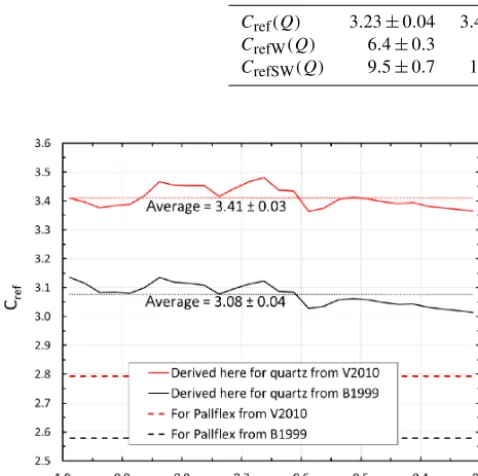
ratio shown in Fig. 4. Nevertheless, there are not enough data in this study to robustly test the correction algorithms. There-fore, all values are calculated with both of them. We next calculated the multiple-scattering correction factorCreffrom Eq. (7) by using the Tr(P) bin averages ofσap(Q)/σap(P ). The averages and standard deviations over the Tr(P,530) range of 1–0.3 and for averaging of all four single scatter-ing albedos,ωo=0.3,ωo=0.4,ωo=0.5, andωo=0.6, are presented in Table 2. It is worth noting that Cref≈3.4 at
Figure 4.Ratio of non-loading-corrected optical depths (τ=ln(1/Tr))of quartz and Pallflex filters,τ (Q)andτ (P ), respectively, atλ= 530 nm at 1 s time resolution. The numbers denote the value at the end of each sample. The red numbers are associated with the samples that were used for derivingCref(quartz) in Sect. 3.1.2
Figure 5. Average σap(quartz)/ σap(Pallflex) in 0.025 bins of transmittance of Pallflex filter at λ=530 nm. σap(quartz) and σap(Pallflex) were corrected either according to Bond et al. (1999) with the Ogren (2010) modification (O2010) or to Virkkula (2010; V2010) using four values for the single-scattering albedoωo.
uses quartz filters backed with supporting cellulose fibers. For instance, values around 3.5 were reported by Segura et al. (2014), Zanatta et al. (2016), and Backman et al. (2017).
3.2 Comparison ofτ vs. EC of soot mixed in water with airborne particles
respec-Table 2.Multiple-scattering correction factors of quartz filters.Cref(Q)is derived here for airborne BC particles from published Pallflex filter-loading corrections V2010 and O2010.CrefW(Q)is derived here for BC particles mixed in water and filtered through quartz filters. CrefSW(Q)is derived here for BC particles mixed in water and treated in an ultrasonic bath and filtered through quartz filters.
Derived from Derived from
V2010 O2010
467 nm 530 nm 660 nm Same for allλ
Cref(Q) 3.23±0.04 3.41±0.03 3.48±0.09 3.08±0.04 CrefW(Q) 6.4±0.3 6.7±0.3 6.9±0.4 5.9±0.2 CrefSW(Q) 9.5±0.7 10.0±0.8 10.2±0.8 9.1±0.6
Figure 6.The multiple-scattering correction factorCreffor quartz and Pallflex filters in 0.025 bins of transmittance of Pallflex filter atλ=530 nm. The straight lines forCrefof O2010 and V2010 are those shown in Eqs. (9) and (10).
tively, providing a ratio offw≈0.52±0.02, essentially iden-tical to that obtained from the V2010 correction.
The slope off τvs. EC of the 24 analyzed samples treated in the ultrasonic bath was even higher (Fig. 6a and b), re-flecting a probable greater penetration depth of the par-ticles. When f(Tr,Q,V2010) is calculated with ωo=0.4,
ωo=0.5, and ωo=0.6, the slopes of f τ vs. EC of the particles mixed in water with the ultrasonic treatment were 18.7±0.8, 17.8±0.8, and 16.9±0.7 m2g−1, respectively. The average plus or minus uncertainty of the ratios of the slopes of airborne and water-mixed particles with the ultra-sonic treatment is very stable, 0.34±0.02. If we consider this value to be a product of a factorfs, representing the ultra-sonic treatment and the factorfwpresented above, we obtain the valuefs≈0.67±0.04. Whenf(Tr,B1999) is used also for the water-mixed and ultrasonic-bath-treated particles, the slope of corrected optical depthf τ vs. EC concentration is 12.9±0.4 m2g−1, with the correspondingfs≈0.65±0.03. The factors are used for multiplying f (Tr, Q)= g(Tr)/Cref(Q), and so another way it can be interpreted is
that they affect the multiple-scattering correction
fsfwf (Tr)= 1 1
fs
1
fwCref
g(Tr).
In other words, CrefSW(Q)=Cref(Q)/(fwfs) and
CrefW(Q)=Cref(Q)/fw for BC particles mixed in wa-ter and filwa-tered through quartz filwa-ters with and without an ultrasonic bath, respectively. The values are presented in Table 2. The uncertainties ofCrefW(Q)andCrefSW(Q)were calculated with a standard error propagation formula by using the standard deviations of Crefs in Table 2 and the uncertainties offwandfspresented above.
To visualize the combined effects of the loading correc-tion funccorrec-tions and the two factorsfw andfs, they are plot-ted as a function ofτ in Fig. 8. The corresponding transmit-tances are shown in the secondaryxaxis. The range of opti-cal depths of EC in snow presented by Svensson et al. (2018) are also shown in the figure. It is obvious that the transmit-tances through those filters were much lower than Tr=0.3 used in the PSAP calibration in V2010 and even more low than the Tr=0.6 recommended in the World Meteorological Organization and Global Atmosphere Watch (WMO/GAW, 2011) standard operating procedures. However, since there is no published calibration for such low transmittances and high optical depths forτ, the approach of extrapolating is the best method. Figure 8 also shows how V2010 and B1999 cor-rections are close to each other at lowτ, but for dark filters at
τ≈2, there is a difference of a factor of∼2 between them. 3.3 Implications for field samples
Previously published laboratory and ambientτvs. EC regres-sions in Svensson et al. (2018) were updated with the correc-tions developed above. Svensson et al. (2018) presented lin-ear regressions of optical depthτvs. EC of the same chimney soot we used in the present study, NIST soot (NIST-2975), and field samples from the Himalaya (India), and Finnish La-pland.
Figure 7.Linear regressions of transmittance-corrected optical depthf τ (λ=530 nm) vs. EC of the BC particles blown into the mixing chamber (Air), blown into water (Liquid), and blown into water and treated in the ultrasonic bath (Liq_sonic). The optical depths were corrected with the(a)f(Tr,V2010,ωo=0.4) and(b)f(Tr,Q,O2010). The regressions were calculated by forcing offset to 0.
Figure 8.Loading correction functions derived from V2010 and O2010 for airborne BC particles collected on quartz filters (grey lines; f(Tr,Q,ωo)) and for BC particles mixed in water and filtered through similar quartz filters (blue lines;fwf(Tr,Q,ωo)). The green shading shows the range of optical depths andf(Tr) of the V2010 Pallflex filter calibration, and the yellow shading shows the range of optical depths of EC in snow presented by Svensson et al. (2018).
∼35 m2g−1to 11.9±0.9 and 9.6±0.6 m2g−1, respectively (Fig. 9a and b). In the scatter plot of the chimney soot, the two data points with the highest EC concentration of ∼0.04 g m−2are possible outliers. When they are discarded from the regression, the slope becomes 9.8±0.5 m2g−1, which is indicated by the red line in Fig. 9a. This is within the uncertainties and is essentially the same as for the NIST soot.
Figure 9.Reanalysis of linear regressions presented by Svensson et al. (2018).(a)chimney soot, with the red line showing the slope with the two points with the highest EC content excluded,(b)NIST soot,(c)field samples from the Indian Himalaya, and(d)field samples from Finnish Lapland. On thexaxis is the EC concentration (in g m−2), and on theyaxis are the non-corrected and corrected optical depth,τ andf τ, respectively.
water before the ultrasonic mixing. In the present work, in-stead, we blew the aerosol through a virtual impactor into the MQ water, took samples of this solution, and diluted the sam-ples before the mixing in the ultrasonic bath. The two major differences are the use of the size separation in the present work and the use of ethanol by Svensson et al. (2018), with the explanation being due to those.
For the re-evaluation of the field data presented by of Svensson et al. (2018) we multiplied the τ with
fwf(Tr,V2010,ωo=0.4, Q), since the field snow samples were melted and then filtered through the quartz filters. The slopes of the field samples from the Indian Himalaya and from Finnish Lapland decreased from 17.1±0.8 and 21.5±0.8 m2g−1to 7.5±0.4 and 9.8±0.5 m2g−1, respec-tively (Fig. 9c and d). All slopes above are in the range of the published MAC of BC. For instance, Quinn and Bates (2005) obtained MAC values ranging from 6 to 20 m2g−1; Bond and Bergstrom (2006) and Bond et al. (2013) reviewed several ar-ticles, and according to them the MAC of freshly generated BC is approximately 7.5±1.2 m2g−1atλ=550 nm.
4 Conclusions
Through the airborne laboratory experiments conducted in this study we determined that the multiple-scattering effect is enhanced by about 20 % with micro-quartz filters compared to Pallflex filters. In terms of the multiple-scattering correc-tion factor, Cref, of the quartz filters, we estimate it to be ∼3.4 for airborne sampled BC. It is worth noting that this is within the range ofCrefvalues published for the aethalome-ter, a very commonly used absorption photometer. The re-sults of the airborne experiments also have other implica-tions. Atmospheric aerosol is often collected on quartz filters and analyzed for EC concentration. The same filter samples can also be used for measuring light absorption to derive the MAC. The analysis showed that if this is done, the multiple-scattering correction and loading correction should be taken into account, just as they are in the data processing of online aerosol absorption photometers.
ef-fects are enhanced and thus account for the measured higher optical depth. In the airborne phase the depositional process is most probably different, with the particulates accumulat-ing in the surface layer of the filter.
When samples were mixed in an ultrasonic bath before fil-tering through quartz filters the attenuation was further en-hanced. The hypothesis for explaining the effect of the ultra-sonic bath is that it possibly breaks the chain-like structure of BC particles, resulting in smaller BC particles that are able to move to further depths in the filter matrix. This remains to be confirmed and can possibly be done with electron mi-croscopy. More research on the sampling of BC from melted snow and ice onto filter media is much needed.
All these effects mean that the absorption data obtained from melted snow samples have high uncertainties. How-ever, the application of the correction functions to earlier published field data from the Himalaya and Finnish Lapland yielded MAC values of∼7–10 m2g−1atλ=550 nm, which is in the range of the published MAC of airborne BC aerosol. This gives indirect support for the validity of the PSAP cal-ibration also for darker filters than those used as the limit in atmospheric measurements.
Data availability. All data in this paper are available upon request.
Author contributions. JS and AV jointly performed the experi-ments, the analysis, and writing of the paper. JS contributed to the analysis and the writing of the paper.
Competing interests. The authors declare that they have no conflict of interest.
Acknowledgements. Jonas Svensson is thankful for the aid from the Maj and Tor Nessling foundation; Johan Ström acknowledges sup-port by the Swedish Research Council (VR 2017-03758) “Black carbon particle size distributions from source to sink”.
Financial support. This research has been supported by the Academy of Finland consortium, “Novel Assessment of Black Car-bon in the Eurasian Arctic: From Historical Concentrations and Sources to Future Climate Impacts” (NABCEA project number 296302), and the Academy of Finland project, “Absorbing Aerosols and Fate of Indian Glaciers” (AAFIG; project number 268004).
Review statement. This paper was edited by Hartmut Herrmann and reviewed by two anonymous referees.
References
Arnott, W. P., Hamasha, K., Moosmüller, H., Sheridan, P. J., and Ogren, J. A.: Towards aerosol light-absorption measurements with a 7-wavelength aethalometer: Evaluation with a photoa-coustic instrument and 3-wavelength nephelometer, Aerosol Sci. Tech., 39, 17–29, 2005.
Backman, J., Schmeisser, L., Virkkula, A., Ogren, J. A., Asmi, E., Starkweather, S., Sharma, S., Eleftheriadis, K., Uttal, T., Jeffer-son, A., Bergin, M., Makshtas, A., Tunved, P., and Fiebig, M.: On Aethalometer measurement uncertainties and an instrument correction factor for the Arctic, Atmos. Meas. Tech., 10, 5039– 5062, https://https://doi.org/10.5194/amt-10-5039-2017, 2017. Barber, P. W. and Hill, S. C.: Light scattering by particles:
Compu-tational methods, World Scientific Publishing, Singapore, 1990. Birch, M. E. and Cary, R. A.: Elemental carbon-based
method for monitoring occupational exposures, to par-ticulate diesel exhaust, Aerosol Sci. Tech., 25, 221–241, https://doi.org/10.1080/02786829608965393, 1996.
Bond, T. C., Anderson, T. L., and Campbell, D.: Calibration and Intercomparison of Filter-Based Measurements of Visible Light Absorption by Aerosols, Aerosol Sci. Tech., 30, 582–600, https://doi.org/10.1080/027868299304435, 1999.
Bond, T. C. and Bergstrom, R. W.: Light absorption by carbona-ceous particles: An investigative review, Aerosol Sci. Tech., 40, 27–67, https://doi.org/10.1080/02786820500421521, 2006. Bond, T. C., Doherty, S. J., Fahey, D. W., et al.: Bounding
the role of black carbon in the climate system: A scien-tific assessment, J. Geophys. Res.-Atmos., 188, 5380–5552, https://doi.org/10.1002/jgrd.50171, 2013.
Cavalli, F., Viana, M., Yttri, K. E., Genberg, J., and Putaud, J.-P.: Toward a standardised thermal-optical protocol for measuring at-mospheric organic and elemental carbon: the EUSAAR protocol, Atmos. Meas. Tech., 3, 79–89, https://doi.org/10.5194/amt-3-79-2010, 2010.
Collaud Coen, M., Weingartner, E., Apituley, A., Ceburnis, D., Fierz-Schmidhauser, R., Flentje, H., Henzing, J. S., Jennings, S. G., Moerman, M., Petzold, A., Schmid, O., and Baltensperger, U.: Minimizing light absorption measurement artifacts of the Aethalometer: evaluation of five correction algorithms, Atmos. Meas. Tech., 3, 457–474, https://doi.org/10.5194/amt-3-457-2010, 2010.
Delene, D. J. and Ogren, J. A.: Variability of aerosol optical properties at four North American surface monitoring sites, J. Atmos. Sci. 59, 1135–1150, https://doi.org/10.1175/1520-0469(2002)059<1135:VOAOPA>2.0.CO;2, 2002.
Flanner, M. G., Zender, C. S., Randerson, J. T., and Rasch, P. J.: Present-day climate forcing and response from black carbon in snow, J. Geophys. Res.-Atmos., 112, D11202, https://doi.org/10.1029/2006JD008003, 2007.
Forsström, S., Ström, J., Pedersen, C. A., Isaksson, E., and Gerland, S.: Elemental carbon distribution in Sval-bard snow, J. Geophys. Res.-Atmos., 114, D19112, https://doi.org/10.1029/2008JD011480, 2009.
Gertler, C. G., Puppala, S. P., Panday, A., Stumm, D., and Shea, J.: Black carbon and the Himalayan cryosphere: a review, Atmos. Environ. 125, 404–417, https://doi.org/10.1016/j.atmosenv.2015.08.078, 2016.
Krecl, P., Ström, J., and Johansson, C.: Carbon content of atmo-spheric aerosols in a residential area during the wood com-bustion season in Sweden, Atmos. Environ., 41, 6974–6985, https://doi.org/10.1016/j.atmosenv.2007.06.025, 2007.
Meinander, O., Kazadzis, S., Arola, A., Riihelä, A., Räisänen, P., Kivi, R., Kontu, A., Kouznetsov, R., Sofiev, M., Svensson, J., Suokanerva, H., Aaltonen, V., Manninen, T., Roujean, J.-L., and Hautecoeur, O.: Spectral albedo of seasonal snow during inten-sive melt period at Sodankylä, beyond the Arctic Circle, At-mos. Chem. Phys., 13, 3793–3810, https://doi.org/10.5194/acp-13-3793-2013, 2013.
Müller, T., Virkkula, A., and Ogren, J. A.: Constrained two-stream algorithm for calculating aerosol light absorption coefficient from the Particle Soot Absorption Photometer, Atmos. Meas. Tech., 7, 4049–4070, https://doi.org/10.5194/amt-7-4049-2014, 2014.
Ogren, J. A.: Comment on calibration and intercompar-ison of filter-based measurements of visible light ab-sorption by aerosols, Aerosol Sci. Tech., 44, 589–591, https://doi.org/10.1080/02786826.2010.482111, 2010.
Peltoniemi, J. I., Gritsevich, M., Hakala, T., Dagsson-Waldhauserová, P., Arnalds, Ó., Anttila, K., Hannula, H.-R., Kivekäs, N., Lihavainen, H., Meinander, O., Svensson, J., Virkkula, A., and de Leeuw, G.: Soot on Snow experiment: bidirectional reflectance factor measurements of contaminated snow, The Cryosphere, 9, 2323–2337, https://doi.org/10.5194/tc-9-2323-2015, 2015.
Petzold, A., Ogren, J. A., Fiebig, M., Laj, P., Li, S.-M., Bal-tensperger, U., Holzer-Popp, T., Kinne, S., Pappalardo, G., Sug-imoto, N., Wehrli, C., Wiedensohler, A., and Zhang, X.-Y.: Rec-ommendations for reporting ”black carbon” measurements, At-mos. Chem. Phys., 13, 8365–8379, https://doi.org/10.5194/acp-13-8365-2013, 2013.
Quinn, P. K. and Bates, T. S.: Regional aerosol proper-ties: comparison of boundary layer measurements from ACE1, ACE2, Aerosols99, INDOEX, ACE Asia, TAR-FOX, and NEAQS, J. Geophys. Res., 110, D14202, https://doi.org/10.1029/2004JD004755, 2005.
Rosenberg, P. D., Dean, A. R., Williams, P. I., Dorsey, J. R., Minikin, A., Pickering, M. A., and Petzold, A.: Particle sizing calibration with refractive index correction for light scattering optical particle counters and impacts upon PCASP and CDP data collected during the Fennec campaign, Atmos. Meas. Tech., 5, 1147–1163, https://doi.org/10.5194/amt-5-1147-2012, 2012. Ruppel, M. M., Isaksson, E., Ström, J., Beaudon, E.,
Svens-son, J., Pedersen, C. A., and Korhola, A.: Increase in elemen-tal carbon values between 1970 and 2004 observed in a 300-year ice core from Holtedahlfonna (Svalbard), Atmos. Chem. Phys., 14, 11447–11460, https://doi.org/10.5194/acp-14-11447-2014, 2014.
Schwarz, J. P., Gao, R. S., Perring, A. E., Spackman, J. R., and Fahey, D. W.: Black carbon aerosol size in snow, Nat. Sci. Rep., 3, 1356, https://https://doi.org/10.1038/srep01356, 2013. Segura, S., Estellés, V., Titos, G., Lyamani, H., Utrillas, M. P.,
Zotter, P., Prévôt, A. S. H., Moˇcnik, G., Alados-Arboledas,
L., and Martínez-Lozano, J. A.: Determination and analy-sis of in situ spectral aerosol optical properties by a multi-instrumental approach, Atmos. Meas. Tech., 7, 2373–2387, https://doi.org/10.5194/amt-7-2373-2014, 2014.
Skiles, S. M., Flanner, M., Cook, J. M., Dumont, M., and Painter, T. H.: Radiative forcing by light-absorbing particles in snow, Nat. Clim. Change, 8, 964–971, https://doi.org/10.1038/s41558-018-0296-5, 2018.
Svensson, J., Virkkula, A., Meinander, O., Kivekäs, N., Hannula, H.-R., Järvinen, O., Peltoniemi, J. I., Gritsevich, M., Heikkilä, A., Kontu, A., Neitola, K., Brus, D., Dagsson-Waldhauserova, P., Anttila, K., Vehkamäki, M., Hienola, A., de Leeuw, G., and Lihavainen, H.: Soot-doped natural snow and its albedo – results from field experiments, Boreal Environ. Res., 21, 481–503, 2016. Svensson, J., Ström, J., Kivekäs, N., Dkhar, N. B., Tayal, S., Sharma, V. P., Jutila, A., Backman, J., Virkkula, A., Ruppel, M., Hyvärinen, A., Kontu, A., Hannula, H.-R., Leppäranta, M., Hooda, R. K., Korhola, A., Asmi, E., and Lihavainen, H.: Light-absorption of dust and elemental carbon in snow in the Indian Hi-malayas and the Finnish Arctic, Atmos. Meas. Tech., 11, 1403– 1416, https://doi.org/10.5194/amt-11-1403-2018, 2018. Virkkula, A.: Correction of the calibration of the 3-wavelength
Par-ticle Soot Absorption Photometer (3λPSAP), Aerosol Sci. Tech., 44, 706–712, https://doi.org/10.1080/02786826.2010.482110, 2010.
Virkkula, A., Ahlquist, N. C., Covert, D. S., Arnott, W. P., Sheri-dan, P. J., Quinn, P. K., and Coffman, D. J.: Modification, calibration and a field test of an instrument for measuring light absorption by particles, Aerosol Sci. Tech., 39, 68–83, https://doi.org/10.1080/027868290901963, 2005.
Warren, S. and Wiscombe, W.: A model for the spectral albedo of snow II. Snow containing atmospheric aerosols, J. Atmos. Sci., 37, 2734–2745, 1980.
WMO/GAW: WMO/GAW Standard Operating Procedures for In-situ Measurements of Aerosol Mass Concentration, Light Scat-tering and Light Absorption, GAW Report No. 200, World Me-teorological Organization, Geneva, Switzerland, 2011.
Xu, B., Cao, J., Hansen, J., Yao, T., Joswiak, D.R., Wang, N., Wu, G., Wang, M., Zhao, H., Yang, W., Liu, X., and He, J.: Black soot and the survival of Tibetan glaciers, P. Natl. Acad. Sci. USA, 106, 22114–22118, https://doi.org/10.1073/pnas.0910444106, 2009. Zanatta, M., Gysel, M., Bukowiecki, N., Müller, T., Weingartner, E.,
Areskoug, H., Fiebig, M., Yttri, K.E., Mihalopoulos, N., Kou-varakis, G., Beddows, D., Harrison, R.M., Cavalli, F., Putaud, J.P., Spindler, G., Wiedensohler, A., Alastuey, A., Pandolfi, M., Sellegri, K., Swietlicki, E., Jaffrezo, J.L., Baltensperger, U., and Laj, P.: A European aerosol phenomenology-5: clima-tology of black carbon optical properties at 9 regional back-ground sites across Europe. Atmos. Environ., 145, 346–364, https://doi.org/10.1016/j.atmosenv.2016.09.035, 2016.