University of Pennsylvania
ScholarlyCommons
Publicly Accessible Penn Dissertations
2017
Fully Distributed And Mixed Symmetric Diagonal
Dominant Solvers For Large Scale Optimization
Rasul Tutunov
University of Pennsylvania, [email protected]
Follow this and additional works at:
https://repository.upenn.edu/edissertations
Part of the
Computer Sciences Commons, and the
Engineering Commons
This paper is posted at ScholarlyCommons.https://repository.upenn.edu/edissertations/2617
Recommended Citation
Tutunov, Rasul, "Fully Distributed And Mixed Symmetric Diagonal Dominant Solvers For Large Scale Optimization" (2017).Publicly Accessible Penn Dissertations. 2617.
Fully Distributed And Mixed Symmetric Diagonal Dominant Solvers For
Large Scale Optimization
Abstract
Over the past twenty years, we have witnessed an unprecedented growth in data, inaugurating the
so-called "Big Data" Epoch. Throughout these years, the exponential growth in the power of computer
chips forecasted by Moore's Law has allowed us to increasingly handle such growing data
progression. However, due to the physical limitations on the size of transistors we have already
reached the computational limits of traditional microprocessors' architecture.Therefore, we either
need conceptually new computers or distributed models of computation to allow processors to solve
Big Data problems in a collaborative manner.
The purpose of this thesis is to show that decentralized optimization is capable of addressing our
growing computational demands by exploiting the power of coordinated data processing. In particular,
we propose an exact distributed Newton method for two important challenges in large-scale
optimization: Network Flow and Empirical Risk Minimization.
The key observation behind our method is related to the symmetric diagonal dominant structure
of the Hessian of dual functions correspondent to the aforementioned problems. Consequently, one
can calculate the Newton direction by solving symmetric diagonal dominant (SDD) systems in a
decentralized fashion.
We first propose a fully distributed SDD solver based on a recursive approximation of SDD matrix
inverses with a collection of specifically structured distributed matrices. To improve the precision of
the algorithm, we then apply Richardson Preconditioners arriving at an efficient algorithm capable
of approximating the solution of SDD system with any arbitrary precision.
vi
Our second fully distributed SDD solver significantly improves the computational performance of
the rst algorithm by utilizing Chebyshev polynomials for an approximation of the SDD matrix
inverse. The particular choice of Chebyshev polynomials is motivated by their extremal properties
and their recursive relation.
requirements. Roughly speaking, by allowing for one computer to aggregate some particular information
from all others, one can gain quite surprising computational benefits. The key idea is to
construct a spectral sparsifier of the underlying graph of computers by using local communication
between them.
Finally, we apply these solvers for calculating the Newton direction for the dual function of Network
Flow and Empirical Risk Minimization. On the theoretical side, we establish quadratic convergence
rate for our algorithms surpassing all existing techniques. On the empirical side, we verify our
superior performance in a set of extensive numerical simulations.
Degree Type
Dissertation
Degree Name
Doctor of Philosophy (PhD)
Graduate Group
Computer and Information Science
First Advisor
Ali Jadbabaie
Keywords
distributed algorithms, distributed optimization, empirical risk minimization, network flow problems, SDD
solvers, sparsifiers
Subject Categories
FULLY DISTRIBUTED AND MIXED SYMMETRIC DIAGONAL DOMINANT SOLVERS FOR
LARGE SCALE OPTIMIZATION
Rasul Tutunov
A DISSERTATION
in
Computer and Information Science
Presented to the Faculties of the University of Pennsylvania
in
Partial Fulfillment of the Requirements for the
Degree of Doctor of Philosophy
2017
Supervisor of Dissertation
Ali Jadbabaie, JR East Professor of Engineering, Institute for Data, Systems and Society, MIT
Graduate Group Chairperson
Lyle H. Ungar, Professor, Computer and Information Science
Dissertation Committee
George Pappas,
Joseph Moore Professor, Electrical and Systems Engineering, University of Pennsylvania
Michael Kearns,
Professor, Computer and Information Science, University of Pennsylvania
Daniel D. Lee,
Professor, Computer and Information Science, University of Pennsylvania
Suvrit Sra,
FULLY DISTRIBUTED AND MIXED SYMMETRIC DIAGONAL DOMINANT SOLVERS FOR
LARGE SCALE OPTIMIZATION
c
COPYRIGHT
2017
Rasul Tutunov
This work is licensed under the
Creative Commons Attribution
NonCommercial-ShareAlike 3.0
License
To view a copy of this license, visit
ACKNOWLEDGEMENTS
Even though only my name is presented on the cover of this thesis, many people have contributed
to its existence. I owe my gratitude to all of the people who have made this journey nothing short
of marvelous.
First of all, I would like to express my sincere gratitude to my thesis supervisor, Prof. Ali Jadbabaie.
Without his constant support and encouragement, this thesis would not have been written. I was
truly fortunate to be guided by a scientist who foster a rigorous mathematical culture and at the
same time provides very insightful ”big picture” explanations. It is usually said that theory is when
we know everything but nothing works and practice is when everything works but no one knows
why. Throughout these years, Ali showed amazing patience and persistence explaining to me the
importance of both of these aspects for - impactful research.
My first meeting with Ali happened in August 2011 in Philadelphia, where I came to pursue my
doctorate degree at University of Pennsylvania. When I entered his office the first things I saw were
hundreds of books and ”Guernica”, a reproduction of Picasso’s very famous painting. It took me
quite a while to realize that the office was a perfect reflection of Ali’s personality: the combination
of deep knowledge and the ability to look at problems abstractly by focusing on important features
and removing all nonessential details. The art to separate the wheat from the chaff is something
that Ali has tried to teach me all this way (I hope successfully).
I am deeply indebted to my main collaborator and colleague Dr. Haitham Bou Ammar with whom
I first met in 2014. Back then, I was a third-year PhD student with huge ambitions and zero
publications. Haitham showed me how pure theoretical constructions and results can be applied to
the very practical fields of machine learning and artificial intelligence. He constantly motivated and
encouraged me when our papers got rejected (which happened quite often, so all the bartenders in
University City became our good friends). But more than exceptional professional skills, I would
like to mention Haitham’s personal qualities. He always was ready to listen carefully and helped
with advice for any kind of problem or experience that my eager character encountered. Apart
from common scientific interests, we share the same values and views on many subjects including
traditions, music, and especially cuisine. He gave me an absolutely solid constructive proof that the
best cuisine in the world is Lebanese. I would like to express my sincere thanks to Haitham for these
friend but a brother.
I would like to thank my committee members for agreeing to assess my thesis and taking the time to
read it through: Prof. George Pappas, Prof. Michael Kearns, Prof. Daniel D. Lee and Prof. Suvrit
Sra. Your remarks and questions allowed me to look at completely different angles on this work and
eventually improved it significantly.
In addition to those mentioned above, I am very grateful to many friends who helped me with their
various forms of support during my graduate study. You are too many to be listed here, but you
ABSTRACT
FULLY DISTRIBUTED AND MIXED SYMMETRIC DIAGONAL DOMINANT SOLVERS FOR
LARGE SCALE OPTIMIZATION
Rasul Tutunov
Ali Jadbabaie
Over the past twenty years, we have witnessed an unprecedented growth in data, inaugurating the
so-called ”Big Data” Epoch. Throughout these years, the exponential growth in the power of
com-puter chips forecasted by Moore’s Law has allowed us to increasingly handle such growing data
progression. However, due to the physical limitations on the size of transistors we have already
reached the computational limits of traditional microprocessors’ architecture.Therefore, we either
need conceptually new computers or distributed models of computation to allow processors to solve
Big Data problems in a collaborative manner.
The purpose of this thesis is to show that decentralized optimization is capable of addressing our
growing computational demands by exploiting the power of coordinated data processing. In
partic-ular, we propose an exact distributed Newton method for two important challenges in large-scale
optimization: Network Flow and Empirical Risk Minimization.
The key observation behind our method is related to the symmetric diagonal dominant structure
of the Hessian of dual functions correspondent to the aforementioned problems. Consequently, one
can calculate the Newton direction by solving symmetric diagonal dominant (SDD) systems in a
decentralized fashion.
We first propose a fully distributed SDD solver based on a recursive approximation of SDD matrix
inverses with a collection of specifically structured distributed matrices. To improve the precision of
the algorithm, we then apply Richardson Preconditioners arriving at an efficient algorithm capable
Our second fully distributed SDD solver significantly improves the computational performance of
the first algorithm by utilizing Chebyshev polynomials for an approximation of the SDD matrix
inverse. The particular choice of Chebyshev polynomials is motivated by their extremal properties
and their recursive relation.
We then explore mixed strategies for solving SDD systems by slightly relaxing the decentralization
requirements. Roughly speaking, by allowing for one computer to aggregate some particular
infor-mation from all others, one can gain quite surprising computational benefits. The key idea is to
construct a spectral sparsifier of the underlying graph of computers by using local communication
between them.
Finally, we apply these solvers for calculating the Newton direction for the dual function of Network
Flow and Empirical Risk Minimization. On the theoretical side, we establish quadratic convergence
rate for our algorithms surpassing all existing techniques. On the empirical side, we verify our
TABLE OF CONTENTS
ACKNOWLEDGEMENT . . . iv
ABSTRACT . . . vi
LIST OF TABLES . . . xi
LIST OF ILLUSTRATIONS . . . xiii
CHAPTER 1 : INTRODUCTION . . . 1
CHAPTER 2 : SYMMETRIC DIAGONAL DOMINANT SOLVERS . . . 10
2.1 Preliminaries . . . 12
2.2 Fully Distributed Methods . . . 13
2.2.1 Algorithm I: Matrix Inverse Chain Approach . . . 13
2.2.2 Algorithm II: Chebyshev polynomials Approach . . . 20
2.2.3 Comparisons to Existing Literature . . . 27
2.3 Mixed Method . . . 29
2.3.1 Spanners and Sparsifiers . . . 31
2.3.2 Fast Mixed SDD Solver . . . 32
2.3.3 Theoretical Guarantees . . . 34
2.4 Special Cases . . . 36
CHAPTER 3 : APPLICATION OF SDD SOLVERS FOR LARGE SCALE OPTIMIZATION 43 3.1 Network Flow Optimization . . . 43
3.1.1 Problem Formulation . . . 44
3.1.2 Newton Method for Dual Descent . . . 45
3.1.3 Distributed Newton Method For Network Flow Problem . . . 46
3.1.4 Distributed Backtracking Line Search . . . 48
3.1.5 Accurate Distributed Newton Method . . . 49
3.1.6 Experiments . . . 51
3.2.1 Problem Formulation . . . 57
3.2.2 primal-dual Technique . . . 59
3.2.3 Distributed Computation of Newton Direction . . . 61
3.2.4 Distributed Newton Method For Empirical Risk Minimization . . . 62
3.2.5 Distributed Backtracking Line Search for Empirical Risk Minimization . . . . 63
3.2.6 Accurate Distributed Newton Method For Empirical Minimization Problem . 64 3.2.7 Do We Need Hessians? . . . 65
3.2.8 Too Many Training Points . . . 73
3.2.9 Experiments . . . 84
CHAPTER 4 : CONCLUSION . . . 95
4.1 Thesis Summary . . . 95
4.2 Future Work . . . 96
4.2.1 Non-Convex Case . . . 96
4.2.2 Experiments with SPARK . . . 97
APPENDIX . . . 98
A.1 Proof of Lemma 2.2.2 . . . 98
A.2 Proof of Lemma 2.2.3 . . . 100
A.3 Proof of Theorem 2.3.2 . . . 100
A.4 Proof of Lemma 3.1.2 . . . 100
A.5 Proof of Lemma 3.1.3 . . . 105
A.6 Proof of Lemma 3.1.4 . . . 105
A.7 Proof of Theorem 3.1.5 . . . 107
A.8 Proof of Lemma 3.2.2 . . . 109
A.9 Proof of Lemma 3.2.3 . . . 111
A.10 Proof of Lemma 3.2.4 . . . 114
A.11 Proof of Lemma 3.2.5 . . . 114
A.12 Proof of Lemma 3.2.6 . . . 115
A.13 Proof of Theorem 3.2.7 . . . 116
A.14 Proof of Lemma 3.2.9 . . . 118
A.16 Proof of Lemma 3.2.11 . . . 120
A.17 Proof of Theorem 3.2.12 . . . 121
A.18 Proof Of Lemma 3.2.14 . . . 123
A.19 Proof of Theorem 3.2.15 . . . 125
A.20 Experiments for Network Flow Problem . . . 127
A.21 Experiment for Empirical Risk Minimization Problem . . . 133
A.22 Computational Graph For Linear Regression . . . 139
A.23 Computational Graph For Logistic Regression . . . 141
LIST OF TABLES
TABLE 1 : Time Complexity For Different Graph Topologies . . . 42
TABLE 2 : Message Complexity For Different Graph Topologies . . . 42
TABLE 3 : Decomposition off(x1, x2) =ex1+x1x2−cos(x2) into elementary operations
and functions . . . 68
TABLE 4 : Computation of a directional derivative∇Tf
i(a)bforf(x1, x2) =ex1+x1x2−
cos(x2) witha= (1,1)T,b= (2,5)Tusing AD in forward mode. . . 70
TABLE 5 : Computation of gradient∇f(a) forf(x1, x2) =ex1+x1x2−cos(x2) at vector
LIST OF ILLUSTRATIONS
FIGURE 1 : Path graphP8 . . . 37
FIGURE 2 : Grid GraphGG4×8. . . 37
FIGURE 3 : Ring graphR8 . . . 38
FIGURE 4 : Star graphS9 . . . 38
FIGURE 5 : Erdos-Renyi graphERn,pwithp= 0.1 andp= 0.2 . . . 39
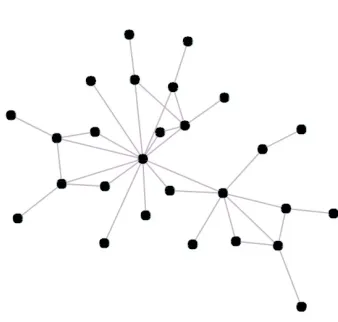
FIGURE 6 : Scale Free NetworkSFn . . . 40
FIGURE 7 : Bar Bell GraphBBG8 . . . 41
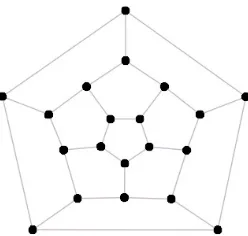
FIGURE 8 : Ramanujan Expander GraphREG3,20 . . . 42
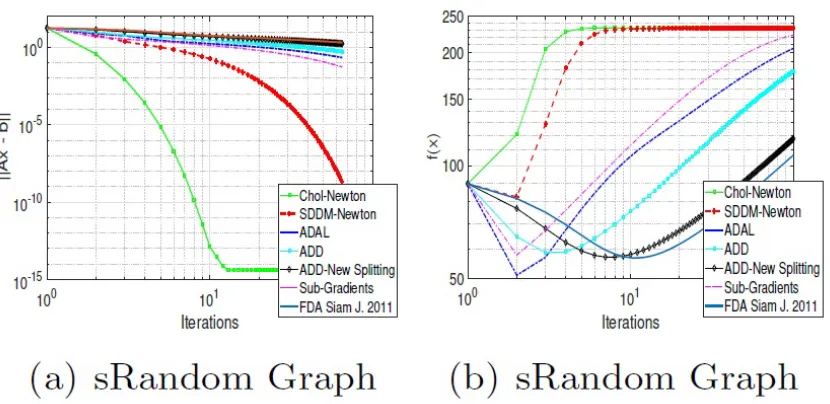
FIGURE 9 : Experimental Results for Small Random Graph . . . 53
FIGURE 10 : Experimental Results for Large Random Graph . . . 53
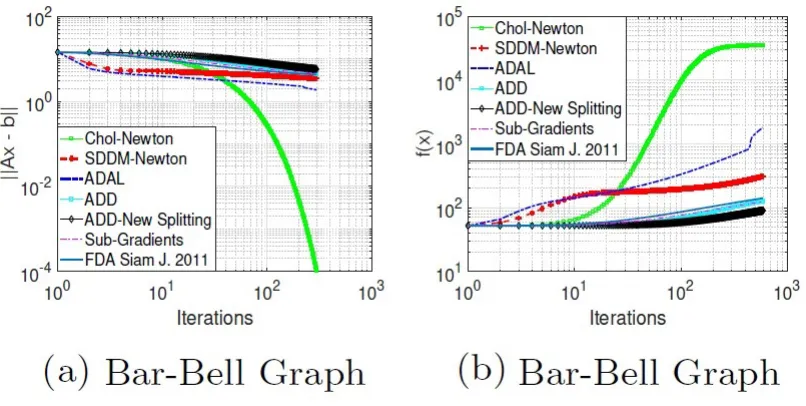
FIGURE 11 : Experimental Results for Bar-Bell Graph . . . 54
FIGURE 12 : Experimental Results for Bar-Star Graph . . . 54
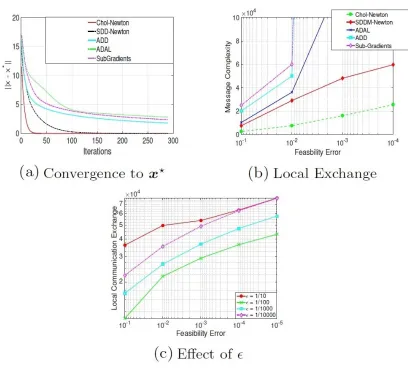
FIGURE 13 : Experimental results: convergence, communication overhead, accuracy effect 55 FIGURE 14 : Computational graph forf(x1, x2) =ex1+x1x2−cos(x2) . . . 69
FIGURE 15 : The effect of dimensionality using Automatic Differentiation . . . 72
FIGURE 16 : The effect of dimensionality. . . 85
FIGURE 17 : SPARK computational model. . . 86
FIGURE 18 : The effect of dimensionality for the SPARK model . . . 87
FIGURE 19 : Double Cart Pole System . . . 89
FIGURE 20 : Experimental Results on Linear Regression with a synthetic data set. . . . 90
FIGURE 21 : Experimental Results on Linear Regression with a real data set. . . 90
FIGURE 22 : Experimental Results on Logistic Regression with L2regularization. . . 91
FIGURE 23 : Experimental Results on Logistic Regression with L1regularization. . . 91
FIGURE 24 : Experimental Results on Reinforcement Learning. . . 92
FIGURE 25 : Experimental Results on fMRI images. . . 93
FIGURE 26 : Experimental results: communication overhead, CPU running times . . . . 94
FIGURE 28 : Experimental Results for Large Random Graph . . . 129
FIGURE 29 : Experimental Results for Bar-Bell Graph . . . 130
FIGURE 30 : Experimental Results for Bar-Star Graph . . . 131
FIGURE 31 : Experimental results: convergence, communication overhead, accuracy effect 132 FIGURE 32 : Experimental Results on Linear Regression with a synthetic data set. . . . 133
FIGURE 33 : Experimental Results on Linear Regression with a real data set. . . 134
FIGURE 34 : Experimental Results on Logistic Regression with L2regularization. . . 135
FIGURE 35 : Experimental Results on Logistic Regression with L1regularization. . . 136
FIGURE 36 : Experimental Results on Reinforcement Learning. . . 137
FIGURE 37 : Experimental Results on fMRI images. . . 138
FIGURE 38 : Experimental results: communication overhead, CPU running times . . . . 139
FIGURE 39 : Computational binary tree for ΦT(b)x . . . . 140
FIGURE 40 : Computational graphGgi forgi(x). Input nodes are marked by green. Last node is marked by red. . . 140
CHAPTER 1 : INTRODUCTION
Data analysis has become a major tool for acquiring predictive models with the goal of discovering
useful information, suggesting conclusions, and supporting decision-making in a variety of fields
including but not limited to heath-care (Zupan et al. (1997)), engineering (Spiliopoulou et al. (2014)),
marketing (Jeffery (2010)), et cetera. Before achieving a ”data product” raw information has to go
through several phases. After being acquired, data is first processed and cleaned to remove errors
and record duplication, as well as to recognize outliers that might have been incorrectly entered.
Once cleaned, it can be analyzed to arrive at mathematical models that can be used to derive
conclusions and make predictions in reality. The goal of such models is to identify relationships
among the variables, such as correlation or causation that reflect inherent properties in a particular
data set. Machine learning (ML) is a sub-field of computer science that is dedicated to deriving these
complex predictive models. In ML, computers act without being explicitly programmed. Contrary
to standard programming paradigms, in ML, a programmer designs a general architecture of a
computer code that can accept inputs and derive outputs. Rather than pre-setting all required
parameters to achieve the desired task, these are acquired with the aid of input data through a
process of self-tuning. Here the program automatically optimizes for free-parameters to minimize a
cost function that describes the task. To clarify, consider the example of classifying images of rhinos
versus elephants. A general computer program that can accept images, say in pixel format, and
output a class label, i.e., a discretized zero/one output, is first written. The program, however, is not
explicitly told how to output a class label to an input image. Rather a form of parameterized mapping
between images and class labels is assumed (e.g., logistic function, neural network, etc.). Having
acquired data, self-tuning commences to determine the ”best” parameters (i.e., those that optimize
a pre-specified cost/error on the training data) that correctly classifies rhinos from elephants.
Searching for the ”best” set of free-parameters ties machine learning to numerical optimization, which
delivers a rich literature of efficient and scalable algorithms for data analysis and machine learning.
Among these, maybe the most abundant are centralized first-order gradient techniques ( Boyd and
Vandenberghe (2004b), Ruder (2016), Andrychowicz et al. (2016a)). These algorithms come in
different flavors under different names, including gradient and steepest descent ( Andrychowicz et al.
following a scaled version of the gradient of the cost function. In the standard case, the gradient
is computed by running over all data points, while in the stochastic setting only one or a subset of
the data is considered, leading to a more appealing algorithm for large-scale applications. Though
abundant and cheap to compute, stochastic gradient-based methods are relatively slow exhibiting
sub-linear convergence of the formO√1
t
withtbeing the total number of iterations ( Blair (1985),
Agarwal et al. (2012)). This performance is caused by the diminishing step size essential for the
global convergence. Adaptive Gradient (AdaGrad) is an alternative approach that removes the
step size issue by dynamically incorporating knowledge of the geometry of the data observed in
earlier iterations to perform more informative gradient-based learning. In other words, this method
gives frequently occurring features low learning rates and infrequent features high learning rates. The
intuition behind of this behavior is that each time an infrequent feature is seen, the algorithm should
take notice. Thus, the adaptation facilitates finding and identifying very predictive but comparatively
rare features ( Duchi et al. (2010)). Although the convergence properties of AgaGrad are similar to
to those of its stochastic counterpart, numerous empirical studies show significant improvement for
the sparse data set scenarios.
Aiming at improving convergence speed limitations, the authors in Boyd et al. (2011) relied on
a primal-dual decomposition technique to propose the alternating direction method of multipliers
(ADMM) that achieves linear convergence of the formO 1
t
. Despite being successful at efficiently
reducing the error function value, it has been shown in later studies ( Nishihara et al. (2015),
Kadkhodaie et al. (2015)) that ADMM requires numerous iterations to achieve accurate solutions.
Another class of algorithms with superior performance to these detailed earlier is the class of
second-order (Newton) methods. Rather than solely relying on the gradient, Newton iterates consider the
curvature of the optimization objective by taking Hessian (the matrix of second-order gradients)
into account. Here, updates are done by descending in the Newton direction. Convergence results
in Boyd et al. (2011) have shown that following the Newton direction leads to improved algorithms
with two phases of convergence being strict and quadratic decrease. Despite the fast convergence
properties, the centralized application of Newton method is restricted by the necessity to compute
and invert the Hessian matrix. This situation becomes even worse for large-scale scenarios due to
excessive memory requirements.
Recently, researchers and developers have met new computational challenges caused by a remarkable
are growing much faster than processing speeds, making traditional centralized solutions (such as
various first order stochastic gradient descent (SGD) algorithms) inefficient. As an example let us
consider the current state of the art deep neural networks ( Szegedy et al. (2015), Krizhevsky et al.
(2012)) operating with millions of parameters and characterizing with a very slow training time
(may take several days). The typical strategy to accelerate the training procedure is adopting it to a
parallel framework by allocating resources over many machines. (Dean et al. (2012)). This approach
not only speeds up neural network training but also allows researchers to build more sophisticated
models where different machines compute different splits of the mini-batches. Even though SGD
exhibits nice scalability with respect to the complexity of a model and the size of datasets, it does
not adopt well into a parallel setting: larger mini-batches and more parallel computations exhibit
diminishing returns for SGD algorithms.
In the past decades, distributed programming frameworks such as Open Message Passing Interface
(MPI) have endorsed rich primitives to leverage flexibility in implementing algorithms across
dis-tributed computing resources, often delivering high-performance but coming with the cost of high
implementation complexity ( Quinn (2003)). Despite the high performance and significant practical
impact, the large-scale application of MPI methods is restricted by implementation complexities. In
order to handle correctly communication and synchronization between clusters, MPI methods require
a lot of programming effort as well as deep system-level understanding. The alternative models, such
as Hadoop and SPARK, have recently emerged and formulated well-defined distributed
program-ming paradigms leading to a powerful set of APIs specially built for distributed processing ( Chu
et al. (2007)). These abstractions make the implementation of distributed algorithms more easily
accessible to researchers, but seem to come with poorly understood overheads associated with
com-munication and data management, which make the tight control of computation vs comcom-munication
cost more difficult.
Apart from serving as a computational tool for very specialized scientific purposes and companies’
operational routines, distributed optimization is strongly involved in new emerging global
technolo-gies, such as Internet of Things (IoT) ( Vermesan and Friess, Mattern and Floerkemeier (2010)).
Simply put, IoT is the concept of connecting basically any device with an on and off switch to the
Internet (and/or to each other). Cell phones, headphones, lamps, refrigerators, coffee machines and
giant network of connected intelligent components interacting with each other. The analyst company
Gartner predicts that by 2020 the number of components in this network will be over 26 billion.
According to the recent EU Commission action plan recognized the Internet of Things as a general
evolution of the Internet from a network of interconnected computers to a network of interconnected
objects” ( IoT (2009)).
From a technical point of view, the IoT is not the result of a single novel technology; instead, several
complementary technical developments provide capabilities to build a bridge between the virtual
and physical world. These capabilities include but are not limited to:
• Communication and cooperation: Different components of the IoT network have the ability
to interact with each other, to make use of data and services and update their state. Wireless
technologies such as WPAN, GSM and UMTS, Wi-Fi, Bluetooth, ZigBee and various other
wireless networking standards are currently under development.
• Distributed information processing: Intelligent objects feature a processor, plus storage
capac-ity. These resources can be used, for example, to process and interpret sensor information, or
to collectively perform more sophisticated computations.
IoTs distributed and dynamic nature, resource constraints of sensors and embedded devices as
well as the amounts of generated data are challenging even for the most advanced data analysis
methods known today. In particular, the IoT requires a new generation of distributed analysis
methods. Many surveys ( Atzori et al. (2010), Gubbi et al. (2013) Partynski and Koo (2013),
Xu et al. (2014)) have strongly focused on the centralization of data in the cloud and big data
analysis (so-called Master/Slave model), which follows the paradigm of parallel high-performance
computing. However, bandwidth and energy can be too limited for the transmission of raw data,
or it is prohibited due to privacy constraints. Such communication-constrained scenarios require
decentralized analysis algorithms which at least partly work directly on the generating devices.
In the distributed setting, central problems are split across multiple processors each having access
to local objectives. To clarify, consider our running example of classifying images of rhinos versus
elephants. Rather than searching for a centralized solution, one can distribute the optimization
across multiple processors each having access to local costs defined over random subsets of the full
unified by incorporating consensus constraints. Recently, an increasing body of research has targeted
such a setting explicitly. For instance, Google’s federated learning aims at achieving collaborative
model learning across multiple mobile devices without the need for centralized training data in the
cloud. Here, a unified model is learned collaboratively based on only local data available on each
mobile device (Konecn´y et al. (2016b), Konecn´y et al. (2016a)). Another example of the growing
trend for distributed optimization is the recent work of McMahan et al. (2016). Here, the authors
consider highly-dimensional optimization problems with billions of parameters and solve them with
the help of tens of thousands of CPU cores. They show that this approach can lead to improved
convergence allowing for algorithms that can handle such Big Data problems.
Analogous to the centralized literature, distributed optimization has also provided a rich set of
al-gorithms for determining free parameters in a decentralized fashion by relying on communication
between the involved processors. Among many approaches (e.g., distributed averaging ( Olshevsky
(2014)), coordinate descent ( Richt´arik and Tak´ac (2013), Trofimov and Genkin (2015)) and
incre-mental methods ( Bertsekas (2015), Nedic et al. (2001)), two popular classes can be differentiated.
The first is sub-gradient based, while the second relies on a decomposition-coordination procedure.
Sub-gradient algorithms are similar to centralized first-order gradient methods, where they proceed
by taking a gradient-related step, followed by an averaging with the neighbors at each iteration.
The computation of each step is relatively cheap and can easily be implemented in a distributed
fashion ( Nedic and Ozdaglar (2009)). Though cheap to compute, the best known bound on the
rate of sub-gradients is sub-linear. As such, these algorithms share the problems of their
central-ized counterparts. The second class of algorithms solve constrained problems by relying on dual
methods. Their state-of-the-art technique is a distributed version of the centralized ADMM ( Wei
and Ozdaglar (2012), Chang et al. (2015)) that achieves a linear convergence rate with low message
complexity per iteration. Apart from only achieving linear convergence, distributed ADMM has also
been shown to suffer from accuracy issues as detailed in Kadkhodaie et al. (2015).
Many rate and accuracy improvements can be gained from adopting distributed second-order
(New-ton) methods. Though a variety of techniques have been proposed (Zargham et al. (2013) Mokhtari
et al. (2015), Gurbuzbalaban et al. (2015), Eisen et al. (2016)), less progress has been made at
leveraging ADMM’s accuracy and convergence rate issues.
by using the approach in Zargham et al. (2013) to approximate the Newton direction. As detailed
later, this method suffers from two problems. First, it fails to outperform ADMM and second, it
faces storage and computational deficiencies for large data sets, and thus ADMM retains
state-of-the-art status.
The alternative approach proposed by Eisen et al. (2016) calculates Newton direction by applying
a distributed version of the Sherman-Morrison formula ( Sherman and Morison (1949)). The
advan-tages of D-BFGS relative to approximate Newton methods are that they do not require computation
of Hessians, which can itself be expensive, and that they apply in any scenario in which gradients
are distributedly computable irrespective of the structure of the Hessian. In terms of convergence
properties, D-BFGS resembles the previously discussed Network Newton algorithm and empirically
surpassed by ADMM.
In scenarios where the number of local functions is large and not all of them simultaneously
avail-able, one is interested in optimization techniques that can iteratively update the estimate for an
optimal solution using partial information about component functions. The incremental Newton
method ( Gurbuzbalaban et al. (2015)) cycles deterministically through the component functionsfi
and uses the gradient offito determine the descent direction and the Hessian offito construct the
Hessian of the sum of component functions. Apart from requiring a global coordinator, this method
suffers from immense computational requirements caused by sequential inversion of local Hessians
in each iteration.
Contributions: In the previous paragraphs we discussed a general distributed optimization
frame-work and presented a brief overview of existing decentralized algorithms. In the next paragraphs,
we focus on both theoretical and practical contributions of this thesis.
Though appealing, computing the Newton direction in a distributed fashion is challenging due to
the need of inverting the Hessian matrix that requires global information. In our work, a novel
connection between the Hessian of a distributed optimization problem and Symmetric Diagonally
Dominant (SDD) matrices is derived. Recently, SDD matrices have captured strong attention due to
a series of breakthrough results (Koutis and Miller (2007), Kelner and Madry (2009), Kelner et al.
(2013), Cohen et al.) starting with work of Daniel Spielman and Shang-Hua Teng ( Spielman and
Teng (2006)) who suggested the first almost linear time algorithm for solving SDD linear systems.
domi-nance property gives us hope to calculate the Newton direction for a distributed problem without a
heavy computational burden by attempting fast distributed SDD solvers.
In Section 2.2 we suggested two fully distributed algorithms for solving symmetric diagonally
dom-inant systems. The first method utilizes the idea of Peng and Spielman (2013) by constructing
decentralized approximated inverse chain in a recursive fashion. This chain can be visualized as a
collection of matrices such that each cluster stores only the corresponding row of each of these
ma-trices. By traversing this chain first in forward and then in backward direction we arrive at a crude
solution of the SDD system that approximates an exact solution up to some constant accuracy. In
order to reach any given precision, we accompany the approximated inverse chain with an iterative
procedure called Richardson Preconditioners ( Axelsson (1994a)) gradually improving the accuracy.
To the moment of publishing, this method was the fastest fully distributed SDD solvers with time
complexity proportional to a condition number of an SDD matrix.
The linear dependence on a condition number is favorable for a wide range of cluster topologies
including expanders ( Hoory et al. (2006)), random graphs ( Hofstad (2008)), and grids ( Fadel et al.
(2015)). However, for configurations of clusters characterized by long diameters this behavior might
lead to a slow performance. As an example, let us consider BarBell topology for clusters ( Northup)
where two cliques of size dn
3e connected with a path graph on d
n
3e nodes. Due to this bottleneck
part, the corresponding condition number for SDD matrices can be cubic in a number of clusters.
To remedy this effect consider a polynomial approximation of SDD inverse with properly scaled
Chebyshev polynomials. The particular choice of these polynomials is motivated by their extremal
properties and the fast performance of the algorithm is guaranteed by the recursive relation between
them ( Chebyshev (1853)). Eventually, we arrive at a new SDD solver capable of computing an
approximate solution with any given precision in time proportional to the square root of a condition
number of an SDD matrix.
Having introduced fully decentralized techniques, we noticed that the total number of messages (in
literature often referred to as communication complexity) is increasing with ”spreadness” of the
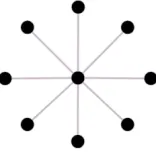
underlying network of clusters. To illustrate this phenomenon, let us consider Star Graph ( Shao
et al. (2000)) and previously discussed Barr-Bell models. In the former, all nodes are only
con-nected to a single master node responsible for all computational burden. As a result, the message
complexity in this case is only characterized by the number of clusters n. In the latter model, the
message complexity to be bounded byOn72
. Therefore, the question that follows naturally from
this observation is: can we eliminate this drastic effect of cluster configuration by ”slightly” relaxing
the decentralization requirements. Please notice, that by completely removing this requirement we
arrive at a highly impractical scenario, where all input data must be stored and processed in a single
cluster. In Section 2.3, using spectral sparsifiers, we propose a mixed strategy that allows for a fixed
node to aggregate some information from all others while preserving the slightly worse bound on
the size of local memory of this cluster compared to the fully decentralized case. Surprisingly, apart
from significantly improving the message complexity, we show that the time complexity of a new
mixed algorithm is even faster than in centralized and fully decentralized scenarios.
On the practical side, we contribute by applying the proposed SDD solvers for two problems that
have been in the focus of researchers for many years: Network Flow Problems and Empirical Risk
Minimization.
Network Flow Problems are considered one of the most fundamental problems in industrial
engen-dering and theoretical computer science ( Ahuja et al. (1993b), Ford and Fulkerson (2010), Dahan
and Amin (2016), Aly and Van Vyve (2015)). The ultimate goal here is to minimize the total cost
associated with all edges connecting clusters subject to flow conservation constraints. In Section 3.1
we show that significant progress can be attained by applying primal-dual techniques and
formu-lating an unconstrained dual problem. Careful analysis of the dual function shows that its Hessian
exhibits diagonal dominant property and, therefore, concedes utilization of SDD solvers for
calculat-ing the correspondent Newton direction. As a result, we develop the first exact distributed Newton
method for Network Flow problem demonstrating a quadratic convergence rate. We empirically
validate this result on a variety of numerical simulations with real data against several methods,
including the state-of-the-art ADAL algorithm (Chatzipanagiotis et al. (2015)).
Our second practical contribution is motivated by machine and statistical learning and has a wide
range of applications in data science ( Zhang (2010)), robotics ( Cetto et al. (2013)), image
pro-cessing ( He et al. (2015)), speech recognition ( Yu and Deng (2014)) et cetera. In Empirical Risk
Minimization problem a true risk defined by the unknown probability distribution over the training
func-tions computed at each data point for the chosen prediction model. In the distributed framework
the associated optimization problem is formulated as a finite sum minimization problem combined
with consensus constraints between the clusters. In Section 3.2.9, following primal-dual strategy
we constructed the corresponding dual function and recognize that its Hessian can be represented
as a product of SDD matrices. Based on this observation we calculate the Newton direction by
sequentially solving a collection of SDD systems. Our exact distributed Newton method for the
Empirical Risk Minimization problem is the first distributed algorithm achieving a quadratic
con-vergence rate. Finally, we suggest Hessian-free and stochastic variation of our algorithm by applying
automatic differentiation techniques and the Sherman-Morrison formula. In Section 3.2.9 we verify
our superior performance by conducting a series of numerical simulations:
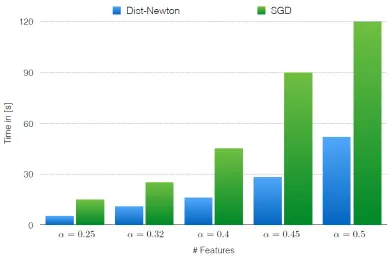
• against traditional decentralized stochastic gradient descent method using SPARK.
• against centralized stochastic gradient descent using streaming.
• against other distributed algorithms including state-of-the-art distributed ADMM (Wei and
Ozdaglar (2012))
CHAPTER 2 : SYMMETRIC DIAGONAL DOMINANT SOLVERS
The problem of solving a system of linear equations given by symmetric diagonally dominant
ma-trices (SDD) arises in a variety of real-world applications. For example, SDDs appear in multitude
of fields including but not limited to determining solutions of partial differential equations
LeV-eque (2007), semi-supervised learning Zhu et al. (2003), Zhou and Schlkopf (2004), computer vision
Casaca (2015), and computation of maximum flows in graphs Daitch and Spielman (2008), Madry
(2013).
Recently, much progress towards solving such problems has been made. Out of the different
tech-niques, the solution of Speilman and Teng Spielman and Teng (2006) stands out. Here, the authors
exploited three components for an efficient SDD solver. Namely, using the multi-level framework
suggested by Joshi (1996), low-stretch spanning tree preconditioners introduced by Boman et al.
(2008), and spectral graph sparsifiers Spielman and Teng (2008), they proposed a nearly linear-time
algorithm for solving SDD systems. These results were then improved by Koutis et al. Koutis et al.
(2010), Cohen et al. (2014), who developed an even faster algorithm for acquiring-close solutions to
SDD linear systems. Improvements have since been discovered by Kelner et al. Kelner and Madry
(2009), where their algorithm relied on only low stretch trees and eliminated the need for graph
sparsifiers and the multi-level framework.
Motivated by applications, much interest has been devoted to developing parallel versions of these
algorithms. Koutis and Miller Koutis and Miller (2007) proposed an algorithm requiring
nearly-linear work and m16 depth (m is the total number of nonzero entries of SDD matrix) for planar
graphs. This result was then extended to general graphs in Blelloch et al. (2011) leading to depth
close to m13. Since then, Peng and Spielman Peng and Spielman (2013) have proposed an efficient
parallel solver requiring nearly-linear work and poly-logarithmic depth without the need for
low-stretch spanning trees.
Less progress, on the other hand, has been made in the distributed version of these solvers. Contrary
to the parallel setting, memory is not shared and is rather distributed in the sense that each unit
Bertsekas and Tsitsiklis (1989) can be used for such distributed solutions but require substantial
complexity. In Mou et al. (2015), the authors propose a gossiping framework for acquiring a
solu-tion to SDD systems in a distributed fashion. Recent work Lee et al. (2014) considers a local and
asynchronous solution for solving systems of linear equations, where they acquire a bound on the
number of needed multiplication proportional to the degree and condition number of the graph for
one component of the solution vector.
In this chapter, we target both the theoretical investigation of distributed SDD solvers, as well
as their practical applications. The first part of the work provides basic definitions and properties
of SDD systems and then presents three fully distributed and one mixed algorithm for solving SDD
systems in a decentralized fashion. For all proposed methods we analyze the running time and
communication complexity in terms of the underlying graph topology. Finally, to provide better
intuition, we consider the following special cases for the processors’ graphs: path graph, grid graph,
ring graph, random graph, scale-free network, barbell graph, and Ramanujan expander.
The second part of the work includes interesting practical applications. In Section 3.1, we
con-sider network flow optimization - a fundamental problem with wide-ranging applicability including
but not limited to, DNA sequence alignment Ahuja et al. (1993a), scheduling on uniform parallel
machines Lawler et al. (1982), urban traffic flows Ahuja et al. (1993a), optimal energy allocation
Gurakan et al. (2015), etc. As networks grow larger, centralized approaches to network flow
op-timization underperform due to the increase in time and resource complexity needed. Distributed
methods for such network optimization problems present an alternative direction to cope with such
increased demand. Since existing distributed methods exhibit slow convergence rate (at most linear),
we propose a fully decentralized version of the Newton method using the developed SDD solvers
to arrive at quadratic convergence. On the empirical side, we demonstrate that our method
out-performs current algorithms for network flow in a broad set of experiments on a variety of network
topologies. We also show that this outperformance arrives at no increase in the local communication
2.1. Preliminaries
Throughout the remainder of this thesis we letG= (V,E,W) be a weighted connected undirected
graph with |V| = n nodes and E edges. We also assume that we > 0 for all e ∈ E. Each node
i∈Vrepresents an agent which is capable of storing information in local memory and can perform
computations. Moreover, the size of local memory for each node is bounded by O(n) making it
impossible to gather the full topology of networkGin one node. The distributed symmetric diagonal
dominant system associated withGis given as:
LGx=b (2.1)
whereLG∈Rn×n such that
LG(ij) = 0, ∀(i, j)6∈E
|LG(ii)| ≥ −
n X
j=1
|LG(ij)| ∀(i)∈V
Due to the sparsity pattern ofLG, Equation (2.1) can be represented in distributed fashion among
the nodes of G. Particularly, each node i ∈ G stores LG(ij) for j = 1, . . . , n, as well as the i
th
component, i.e.,b(i), of the demand vectorb. The goal is for each node to compute the corresponding
component of the solution vector by only allowing local message exchange between the nodes. As a
straightforward example of (2.1) is a Laplacian system, where
LG(ij) =
P
e∼iwe :i=j
−we : (ij)∈E
0 :otherwise
Following Koutis et al. (2010), we target an−close solution of the system in 2.1, which is defined
as:
Definition Letx∗ be the exact solution of system LGx=b. A vector ˜x is called approximate
solution, if
||x˜−x∗||LG≤||x
∗||
where||u||2 LG=u
TL Gu.
The important characteristic of system (2.1), which will be heavily used in our analysis is the
condition number, defined as:
Definition Let{µi}pi=1 be the collection of all non-zero eigenvalues of matrixLG, such that
µ1≤µ2≤. . .≤µp
The the ratioκ(LG) =µp
µ1 is called condition number of system (2.1).
In the case of graph Laplacians κ(LG) = µn
µ2 ≤
1 2
wmax
wminndmaxdiam(G), wherewmax, wmin are the
maximal and minimal edge weights inG,diam(G) its diameter, anddmaxis the maximal unweighted
degree.
Finally, we assume a synchronous model for distributed computation. Here, all message exchanges
between the nodes as well as local operations are directed by a global clock. The time complexity
is given in terms of the total number of time steps on the global clock needed to terminate an
algorithm. The message complexity (or communication complexity) is given in terms of the total
number of messages sent by nodes to terminate an algorithm.
2.2. Fully Distributed Methods
In this section, we describe two fully distributed algorithms for solving the system in (2.1). We
commence by describing the algorithms and then study their time and communication complexities.
2.2.1. Algorithm I: Matrix Inverse Chain Approach
The authors in Peng and Spielman (2013) developed a near-linear time solver capable of achieving
an−close approximation to the exact solution for any arbitrary >0. In this section, we propose
a distributed implementation of the aforementioned solver. Before presenting our solver, however,
Standard Splitting and Approximations
The story of computing an approximation to the exact solution of an SDD system of linear equations
starts from the standard splitting of symmetric matrices. Given a symmetric matrixLGthe standard
splitting is given by
LG=D0−A0 (2.3)
where D0 is a diagonal matrix that consists of the diagonal elements in LG while A0 is a matrix
collecting the negate of the off-diagonal components inLG. As the goal is to determine a solution
of the SDD system, we will be interested in inverses ofLG. Given the splitting in Equation 2.3, the
authors in Peng and Spielman (2013) prove that the inverse ofLG can be written as
(D0−A0)−1= 1 2
h
D−01+ I+D−01A0
D0−A0D−01A0−1
I+A0D−01i
(2.4)
SinceD0−A0D−01A0 is also SDD we can recurse the above for the length ofd=O(logn) to arrive
at the so-called inverse approximated chain,C={Dk,Ak}dk=1with
Dk=D0 and Ak=D0 D−01A0 2k
(2.5)
Hence, the inverse at thekthrecursion can be written as
(Dk−Ak)−1≈
1 2
h
D−k1+ I+D−k1Ak(Dk+1−Ak+1)−1 I+AkD−k1 i
Algorithm 1: ”Crude” SDD Solver
1: Input: Inverse approximated chainC, demand vector b. 2: Output: A ”crude” approximationx0 to the exact solutionx∗.
3: Initialize: b0=b.
4: fork= 1 tod=O(logn)do
5: bk= I+Ak−1D−k−11
bk−1.
6: end for
7: xd=D−d1bd.
8: fork=d−1 to 0do
9: xk= 12D−k1bk+ I+D−k1Akxk+1.
10: end for
Given the above, the approximate solution to the SDD system can be achieved using a two-step
Algorithm 1 describes a set of instructions used to acquire a crude approximation to the real solution
of the SDD system. The algorithm runs a forward and a backward loop with the number of steps
equal to the length of the inverse approximate chaind1. In the forward loop (lines 4-6) intermediate
vectors are constructed and used in the backward loop (lines 8-10) to determine a constant error (see
2.1) solution to the exact solution of the SDD system. Since the approximation incurs a constant
error to the real inverseL−1
G , the authors in Peng and Spielman (2013) then introduce the Richardson
preconditioning scheme detailed in Algorithm 2 to arrive at any arbitrary precision
Algorithm 2: ”Exact” SDD Solver
1: Input: Inverse approximated chainC, demand vector b, precision parameter.
2: Output: −close approximation ˜x, to the exact solutionx∗.
3: Initializey0=0.
4: Setχto be the crude solution returned by Algorithm 1.
5: fork= 1 tod=O log1
do
6: Setu(1)k =LGyk−1.
7: Setu(2)k by calling Algorithm 1 with b=u(1)k .
8: Updateyk=yk−1−u(2)k +chi
9: end for
10: Set ˜x=yq.
Algorithm 2 uses Algorithm 1 as a sub-routine to drive the ”crude”-solution to−close approximate
one for any >0 inO log1iterations.
The authors in Peng and Spielman (2013) show that the above iteration scheme can be parallelized
across multiple processors leading to an algorithm which can acquire -approximate solutions in
nearly linear time. As our goal is to determine the Newton direction of network flow problems in a
distributed fashion, i.e., using only local information exchange, we next present a distributed version
of Algorithms 1 and 2. Our strategy is similar to that in Peng and Spielman (2013) with crucial
differences related to the type and length of the inverse approximate chains as detailed below.
Distributed SDD Solvers: Methodology
A key ingredient enabling efficient solvers for SDD systems is the introduction of the inverse
approx-imate chain which rendered a parallelized implementation. Since our interest lies in a distributed
solution for determining the Newton direction, the first step needed for the development of our SDD
solver is an inverse chain which can be computed in a distributed fashion using only local
nication exchange among the nodes of G. As noted in Peng and Spielman (2013), a collection of
matricesC={D0,A0. . . ,Dd,Ad}is an inverse approximate chain toLGif there exist positive real
numbers0, . . . , d such that the following three conditions are satisfied:
1. Dk−Ak ≈k−1 Dk−1−Ak−1D −1
k−1Ak−1, for allk={1, . . . , d}.
2. Dk≈k−1 Dk−1 and
3. Dd≈dDd−Ad.
The ”≈” defines the notion of approximation for matrices previously introduced in Peng and
Spiel-man (2013) whereX≈Y is written to indicate
exp(−)XY exp()X
whereX Y reflects thatX−Y is positive semidefinite.
Starting from LG = D0−A0, and defining the inverse chain as in Equation 2.5, it is easy to
verify thatC is an inverse approximate chain toLG as it satisfies all three of the above conditions.
Hence, it can be used for computing a crude solution to an SDD system. To derive the distributed
algorithm, we further examine the update equations of Algorithm 1. Studying the forward loop, the
intermediate vectorsbk are constructed according to
bk= I+Ak−1D−k−11
bk−1=bk−1+A0D0−1A0D−01. . .A0D−01
| {z }
a product of 2kmatrices
bk−1
Examining each product of the 2k matrices, e.g., A0D−1
0 A0b0, we recognize that such a product
can be computed locally by each node. This is true as the first part of the product, i.e.,z=D−01b0
is a simple scaling, while the second, i.e.,A0zcan be performed completely in a distributed fashion
due to the sparsity pattern ofA0. Consequently, the overall product of the 2k terms can be also
distributed across the network provided the usage of a recursive update rule. Therefore, for a node
i, the first part (i.e., forward loop) of the distributed solver can be concisely summarized using the
set of instructions detailed in Algorithm 3.
Clearly, lines 6-8 are executing the distributed computation of the product of the 2kterms above,
while line 9 of the algorithm is computing theithcomponent ofb
de-scribed above. After running for a total ofditerations, Algorithm 3 returns theithcomponent of
in-termediate vectorsb1, . . . ,bd. Further, since the length of the chaind=dlog
2 ln 3 √
2
3 √
2−1
w
max
wminn 3e
withwmaxandwmindenoting the largest and smallest edge weights, each node needs to have memory
size ofO(max{d, dmax}) =O(n).
Algorithm 3: Forward Loop: Distributed ”Crude” Solver
1: Input: The ith row of matrices A0,D0, the ith component of vector b, the length d =
dlog2 ln 3 √
2
3 √
2−1
wmax
wminn
3eof approximated inverse chain.
2: Output: Theithcomponents of vectorsb1, . . . ,b d.
3: fork= 1 toddo
4: Setl= 2k−1.
5: Updatehu(1k−1)i
i
=
A0D−01bk−1i.
6: forj= 2 toldo
7: Updatehu(jk−1)i
i= h
A0D−01u(jk−−11)i
i.
8: end for
9: Set [bk]i= [bk−1]i− h
u(lk−1)i
i
.
10: end for
1
Analogous to Algorithm 1, the distributed solver commences by running a backward loop to compute
theithcomponent of the crude solution [x0]
i. Using a similar analysis to that of the forward rule, the
recursive update equations are represented in Algorithm 4. Algorithm 4 distributes the computations
of the products involved in determining theithcomponent of x0 using recursion. Furthermore, it
uses the same chain length as that in Algorithm 3.
Algorithm 4: Backward Loop: Distributed ”Crude” Solver
1: Input: The ith row of matrices A
0,D0, the ith component of vector b, the length d = dlog2 ln 3
√ 2
3 √
2−1
wmax
wminn
3eof approximated inverse chain, and [b
d]i as returned by Algorithm
3.
2: Output: Theithcomponents of ”crude” solution [x0]i.
3: Set [xd]i= [D[bd]i
0]ii
4: fork=d−1 to 1do
5: Setl= 2k. 6: Updatehη(1k+1)i
i
=
D−01A0xk+1
i.
7: forj= 2 toldo
8: Updatehη(jk+1)i
i
=hD−01A0η (k+1)
j−1 i
i
.
9: end for
10: Set [xk]i =12 h [b
k]i
[D0]ii + [xk+1]i+
h η(lk+1)i
i i
.
11: end for
12: Set [x0]i= 12 h [b]
i
[D0]ii+ [x1]i+
D−01A0x1 i
Having developed an algorithm which computes a crude approximation to an SDD system of linear
equations, we now provide an exact distributed solver which can drive x0 to an -close solution
for any arbitrary > 0. Similar to the previous analysis, each node i receives the ith row of
LG, the ith component of the right-hand side vector [b]
i, the length of the inverse chain d, and a
precision parameter as inputs. The algorithm then determines the ith component of the -close
approximation to the real solutionx∗as detailed in Algorithm 5. It should be noted that Algorithm
5 is a simple distributed implementation of the Exact SDD solver, where the products are computed
locally based on the sparsity pattern ofLG.
Algorithm 5: ”Exact” Distributed SDD Solver
1: Input: Theithrow of matricesA
0,D0, theithcomponent of vectorb, precision parameter.
2: Output: Theithcomponents of−approximate solution [˜x] i.
3: Initialize: [y0]i= 0 and [χ]i by running Algorithms 3 and 4 with [A0]i1, . . . ,[A0]in,[D0]ii,[b]i
anddas inputs.
4: fort= 1 toq=O 1
do
5: Sethu(1)t i
i
=
LGyt−1 i.
6: Set hu(2)t i
i
by running Algorithms 3 and 4 with [A0]i1, . . . ,[A0]in,[D0]ii,[u
(1)
t ]i and d as
inputs.
7: Update [yt]i= [yt−1]i− h
u(2)t i
i+ [χ]i.
8: end for
9: Set [˜x]i= [yq]i
Having developed the solvers, we next illustrate the most important theoretical results attained by
our distributed SDD solver and compare to current literature.
Theoretical Guarantees
In this section, we provide theoretical justification for the correctness of Algorithm 5. Namely, we
show that the distributed solver is capable of acquiring-close approximations to the exact solution
of the SDD system and provide its iteration count in terms of the network’s properties. These results
are summarized in the following theorem:
Theorem 2.2.1 The distributed SDD solver described in Algorithm 5 uses local communication
exchange to compute an-approximate solution of the SDD systemLGx=bin the following number
of rounds
O
κ(LG)wmax wmin
log
1
whereκ(LG)is condition number ofG, andwmax, wmin are maximal and minimum edge weights.
To arrive at such results, we require the analysis of both the crude and the exact distributed SDD
solvers. The remainder of this section is dedicated to the proof of the above theorem. It proceeds by
presenting two essential lemmas. The first shows that the distributed crude solver (i.e., Algorithms 3
and 4) returns a constant error approximation to the exact solution of the SDD system. The second
demonstrates that the exact solver in Algorithm 5 drives the crude solution to an-close one and
provides its iteration count.
To arrive at a crude approximation to the real solution of the SDD system, we need to show that
the procedure described in Algorithms 3 and 4 is capable of approximating the inverse of LG and
providing a good enough approximation to the exact solution. The accuracy of this approximation
and the needed iteration count has also to be quantified. We summarize these results for the case
of graph LaplacianLG in the following
Lemma 2.2.2 Let LG =D0−A0 be the standard splitting. Let the length of the inverse chain is
defined as d=dlog2 ln 3 √
2
3 √
2−1
wmax
wminn
3e. Further, let Z0 be the operator defined by the ”crude”
solver, such thatx0=Z0b. Then
1. d <13ln 2.
2. Z0≈dL −1
G , and
3. O 2d
rounds is required to arrive at the crude solutionx0.
The derived bounds depend on the length of the inverse approximate chain d. The choice of d has
to be made in such a way to guarantee that d ≤ 13ln 2. As mentioned in Lemma 2.2.2 a value
satisfying the above condition is given by
d=dlog 2 ln 3
√
2 3
√
2−1
!
wmax
wmin
n3
!
e, i.e.,D0≈dD0−D0 D −1 0 A0
2d
withd <
1 3ln 2
After attaining a crude solution to the SDD system, our strategy was the usage of the exact solver
in Algorithm 5 to drive it to an-approximate one for any >0. In what comes next, we show the
exact solver is capable of achieving such a solution.
requiresO log1 iterations to return the ith component of the−close solution to x∗ and requires
O 2dlog1
rounds.
Theorem 2.2.1 follows immediately from Lemmas 2.2.2 and 2.2.3. This result provides us with time
complexityOdmaxκ(LG)
wmax
wmin log 1
and message complexityOmκ(LG)wmax
wminlog 1
.
2.2.2. Algorithm II: Chebyshev polynomials Approach
Although Algorithm 5 is at lognfactor faster than other distributed solvers (see Section 2.2.3), it
suffers from linear dependency on condition numberκ(LG) for both time and message complexities.
Therefore, the practical application of such technique is restricted by graphs with small condition
numbers, such as expanders (Hoory et al. (2006)).
Next, we propose a novel distributed SDD solver that acquires an -close solution in time and
message complexities sub-linearly dependent on the condition number of the processing graph. We
achieve such a reduction by exploiting well-known polynomial representation of the inverse of the
graph Laplacian. Our method aims at constructing a set of Chebyshev polynomials that reduce the
differential to the optimal solution as quickly as possible.
Polynomial Representation.
Similar to the previous approach, we consider the same story of computing an approximation to the
exact solution of an SDD system of linear equations that starts from standard splittings of symmetric
matrices. Given a symmetric matrix, sayLG, the standard splitting is given byLG=D0−A0. The
authors in Peng and Spielman (2013) exploited the fact that the inverse ofLG can be written as:
(D0−A0)−1=D −1
2
0 h
I−D−12
0 A0D −1
2
0 i−1
D−12
0 =
D−12
0 Y
k≥0
I+hD−12
0 A0D −1
2
0 i2k
D−12
0 ≈D −1
2
0
O(logT) Y
k=0
I+hD−12
0 A0D −1
2
0 i2k
D−12
0 =
ˆ pT(LG).
where ˆpT(LG) is a polynomial of degree T = 2
d ∼ κ(L
G) where κ(LG) is the condition number,
chosen to guarantee accuracy properties of the approximate solution, ˜x= ˆpT(LG)b, toxwith respect
and message dependencies on the condition number of the processing graph relies on determining a
”better” polynomial expansion2for (D
0−A0)−1than ˆpT(LG)b. Formally, our goal is to determine
a solution vector in the following form:
xk =pk(LG)b (2.6)
where pk(LG) is a polynomial of degreek. Consequently, the differential between xk−x∗ can be
written as:
xk−x∗=pk(LG)b−x ∗=p
k(LG)LGx
∗−x∗= (p
k(LG)LG−I)x ∗=
(LGpk(LG)−I)x ∗=−q
k(LG)x ∗
whereqk(LG) =−LGpk(LG) +I. Notice, that between polynomialsqk(LG) andpk(LG) there is one
to one correspondence. Givenpk(LG) we can easily constructqk(LG). On the other hand, for any
degreek,qk(LG) polynomial, we can recoverpk(LG) using
3
pk(LG) =L −1
G (I−qk(LG))
Plugging the above result back in Equation 2.6, we arrive at the following representation for the
solutionxk:
xk =L−G1(I−qk(LG))b (2.7)
Hence, we recognize that instead of seekingpk(LG), one can think of trying to construct polynomials
qk(LG) that reduce the termxk−x∗as fast as possible. This intuition can be formalized in terms of
the properties ofqk(LG) by requiring the polynomial to have a minimal degree, as well as to satisfy
the following two conditions for a given precision parameter
qk(0) = 1 (2.8)
|qk(µi)| ≤ for all i= 1, . . . , p
2As shall be seen later, better here means a polynomial with a lower degree. 3Please note that for the case of singularL
G, we can safely replaceL
−1
G by the pseudo-inverseL
†
G. This is true
since in such a scenariob∈(ker(LG))⊥andL†
GL
r
Gb=L
r−1
with µi being the ith nonzero eigenvalue of LG. The first condition is a result of observing that
qk(z) =−zpk(z) + 1 (analogous toqk(LG) =−LGpk(LG) +Iis unity when evaluated atz= 0. The
second, on the other hand, guarantees an-approximate solution tox∗:
||xk−x∗||2LG=||qk(LG)x
∗||2
LG ≤ ||qk(LG)||
2 2||x∗||
2
LG= maxi |qk(µi)|
2||x∗||2 LG ≤
2||x∗||2 LG
In other words, findingqk(z) that has minimal degree and that satisfies the conditions in Equation
2.8 guarantees an efficient and an-approximate solution to x∗.
Candidate Solutions & Chebyshev Polynomials.
Among other potential solutions, Chebyshev polynomials of the first kind resemble a good candidate
for determiningqk(z). These forms are defined as
Tk(z) =
cos (karccos(z)), ifz∈[−1,1]
1 2 (z+
√
z2−1)k+ (z−√z2−1)k
, otherwise
(2.9)
Interestingly,Tk(z)≤1 on [−1,1] and among all polynomials of degreek with a leading coefficient
1, the polynomial Tk(z) acquires its sharpest increase outside the range [−1,1]. At this stage, we
are ready to consider qk(z) in terms of Tk(s). We posit that a good candidate is q∗k(z), which we
define as
q∗k(z) = Tk
µ
p+µ1−2z
µp−µ1
Tk
µ
p+µ1
µp−µ1
(2.10)
Next, we will demonstrate that q∗k(z) is indeed a good candidate since it meets the requirements
in Equation 2.8 and allows for an efficient distributed SDD solver. First, it is easy to see that the
polynomial defined in Equation 2.10 attains a unity value when evaluated atz= 0 (i.e. q∗
k(0) = 1).
![Table 5: Computation of gradient ∇f(a) for f(x1, x2) = ex1 + x1x2 − cos(x2) at vector a = [1, 1]Tusing AD in backward mode.](https://thumb-us.123doks.com/thumbv2/123dok_us/9305776.1465426/87.612.108.545.71.346/table-computation-gradient-cos-vector-tusing-backward-mode.webp)