Salem et al.Algorithms for Molecular Biology 2010, 5:12 http://www.almob.org/content/5/1/12
Open Access
R E S E A R C H
© 2010 Salem et al; licensee BioMed Central Ltd. This is an Open Access article distributed under the terms of the Creative Commons Attribution License (http://creativecommons.org/licenses/by/2.0), which permits unrestricted use, distribution, and reproduction in any medium, provided the original work is properly cited.
Research
FlexSnap: Flexible Non-sequential Protein
Structure Alignment
Saeed Salem*
1, Mohammed J Zaki
2and Chris Bystroff
3Abstract
Background: Proteins have evolved subject to energetic selection pressure for stability and flexibility. Structural similarity between proteins that have gone through conformational changes can be captured effectively if flexibility is considered. Topologically unrelated proteins that preserve secondary structure packing interactions can be detected if both flexibility and Sequential permutations are considered. We propose the FlexSnap algorithm for flexible non-topological protein structural alignment.
Results: The effectiveness of FlexSnap is demonstrated by measuring the agreement of its alignments with manually curated non-sequential structural alignments. FlexSnap showed competitive results against state-of-the-art
algorithms, like DALI, SARF2, MultiProt, FlexProt, and FATCAT. Moreover on the DynDom dataset, FlexSnap reported longer alignments with smaller rmsd.
Conclusions: We have introduced FlexSnap, a greedy chaining algorithm that reports both sequential and non-sequential alignments and allows twists (hinges). We assessed the quality of the FlexSnap alignments by measuring its agreements with manually curated non-sequential alignments. On the FlexProt dataset, FlexSnap was competitive to state-of-the-art flexible alignment methods. Moreover, we demonstrated the benefits of introducing hinges by showing significant improvements in the alignments reported by FlexSnap for the structure pairs for which rigid alignment methods reported alignments with either low coverage or large rmsd.
Availability: An implementation of the FlexSnap algorithm will be made available online at http://www.cs.rpi.edu/ ~zaki/software/flexsnap.
Background
The wide spectrum of functions performed by proteins are enabled by their intrinsic flexibility [1]. It is known that proteins go through conformational changes to perform their functions. Homologous proteins have evolved to adopt conformational changes in their structure. Therefore, simi-larity between two proteins which have similar structures with one of them having undergone a conformational change will not be captured unless flexibility is considered. The problem of flexible protein structural alignment has not received much attention. Even though there are a pleth-ora of methods for protein structure comparison [2-8], the majority of the existing methods report only sequential alignments and thus cannot capture non-sequential align-ments. Non-sequential similarity can occur naturally due to
circular permutations [9] or convergent evolution [10]. The case is even harder for flexible alignment since only two methods, FlexProt [11], and FATCAT [12] report flexible alignments. Nevertheless, both methods are inherently lim-ited to sequential flexible structural alignment because both methods employ sequential chaining techniques. The com-plexity of protein structural alignment depends on how the similarity is assessed. Kolodny and Linial [13] showed that the problem is NP-hard if the similarity score is distance matrix based. Therefore, over the years, a number of heuris-tic approaches have been proposed, which can mainly be classified into two main categories: dynamic programming and clustering.
Dynamic Programming (DP) is a general paradigm to solve problems that exhibit the optimal substructure prop-erty [14]. DP-based methods, Structal [15] and SSAP [16], construct a scoring matrix S, where each entry, Sij, corre-sponds to the score of matching the i-th residue in protein A * Correspondence: [email protected]
1 Department of Computer Science, North Dakota State University, Fargo, ND
and the j-th residue in protein B. Given a scoring scheme between residues in the two proteins, dynamic program-ming finds the global alignment that maximizes the score. DP-based methods suffer from two main limitations: first, the alignment is sequential and thus non-topological simi-larity cannot be detected, and second, it is difficult to design a scoring function that is globally optimal [13]. In fact, structure alignment does not have the optimal substructure property, therefore DP-based methods can find only a sub-optimal solution [17]. The other category of alignment methods, the Clustering-based methods, DALI [2], SARF2 [4], CE [5], SCALI [7], and FATCAT [12], seek to assemble the alignment out of smaller compatible (similar) element pairs such that the score of the alignment is as high as possi-ble [18]. Two compatipossi-ble element pairs are consistent (can be assembled together) if the substructures obtained by ele-ments of the pairs are similar. The clustering problem is NP-hard [19], thus several heuristics have been proposed. The approaches differ in how the set of compatible element pairs is constructed and how the consistency is measured. Both SARF2 and SCALI produce non-sequential align-ments.
The two main flexible alignment methods, FlexProt [11] and FATCAT [12], work by clustering (chaining) aligned fragment pairs (AFPs) and allowing flexibility while chain-ing, by introducing hinges (twists). FlexProt searches for the longest set of AFPs that allow different number of hinges. It then reports different alignments with different number of hinges. The FATCAT method works by chaining AFPs using dynamic programming. The score of an align-ment ending with a given AFP is computed as the maxi-mum score of connecting the AFP with any of alignments that end before the AFP. A penalty is applied to the score to compensate for gaps, root mean squared deviation (rmsd), and hinges. A third method, which can handle flexible alignments, is the HingeProt [20] method. HingeProt first partitions one of the two proteins into rigid parts using a Gaussian-Network-Model-based (GNM) approach and then aligns each rigid region with the other protein using the MultiProt [6] method. HingeProt uses the MultiProt algo-rithm in the sequential mode and thus does not report flexi-ble non-sequential alignments. Therefore, the accuracy of the HingeProt approach depends on the accuracy of identi-fying the rigid domains which is a hard problem as the best known method, HingeMaster [21], has a sensitivity of only 50%.
To address the limitations of exisiting algorithms we pro-pose FlexSnap, a greedy algorithm for flexible sequential and non-sequential protein structural alignment (the name of the algorithm is a non-sequential permutation of the bold letters in Flexible non-Sequential protein alignment). The algorithm assembles the alignment from the set of AFPs and allows non-sequential alignments and hinges. We dem-onstrate the effectiveness of FlexSnap by evaluating its
alignments' agreement with manually curated non-sequen-tial alignments. Moreover, FlexSnap shows competitive results on the FlexProt dataset when compared to the main flexible alignment methods, FlexProt and FATCAT.
Methods
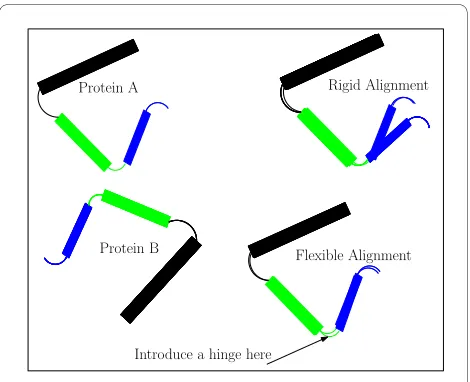
The main idea of the FlexSnap approach is to assemble the alignment from short well-aligned fragment pairs, which are called AFPs. As we assemble the alignment by adding AFPs, introducing hinges when necessary. Figure 1 shows how the alignment is constructed from smaller aligned frag-ment pairs. When chaining a fragfrag-ment pair to the align-ment, we choose the fragment that has the highest score when joined with the last rigid region in the alignment. The score rewards longer alignments with small rmsd and penalizes large rmsd, gaps, and the introduction of hinges. In the next subsections, we provide a detailed discussion of the FlexSnap algorithm.
AFPs Extraction
Let A = {A1, A2,..., An} and B = {B1, B2,..., Bn} be two pro-teins with n and m residues respectively, where Ai 8 ᑬ3 × 1 (similarly Bi) represents the 3D coordinates of the Cαatom
of the i-th residue in protein A. The first step in FlexSnap is to generate a list of aligned fragment pairs (AFPs):
Each AFP, (i, j, l), is a fragment that starts at the i-th resi-due in A and j-th residue in B and it has a length of l
resi-AFPs={( , , ) |i j l rmsd i j l( , , )≤ε}
Figure 1 Flexible Structural Alignment. The Figure shows proteins A and B which have 3 similar structure fragments. A rigid alignment (top right) is not able to align the blue fragment, but a flexible align-ment (bottom right) can do this easily by introducing a hinge between the rigid block (the black and green fragments) and the blue fragment. As we assemble the alignment from well-aligned pairs, we introduce hinges to get a longer alignment and smaller rmsd.
Introduce a hinge here Protein A
Protein B
Rigid Alignment
Salem et al.Algorithms for Molecular Biology 2010, 5:12 http://www.almob.org/content/5/1/12
Page 3 of 13
dues. An AFP is formally represented as a set of l
equivalenced pairs between the two proteins, and given as:
where (Ai, Bj) indicates that the ith residue of protein A is paired with the jth residue of protein B, and l is AFP's length. Each AFP must satisfy a user-defined similarity constraint. In FlexSnap, we employ the root mean square deviation as the similarity measure, i.e., rmsd(i, j, l) ≤ ε. Moreover, we require that the length of the AFP be at least
L, i.e., 3 ≤L ≤l. Furthermore, we define and to be the beginning and end of the AFPk along the backbone of protein B. For example, for a triplet AFPk = (i, j, l) and pro-tein A, = i and = i + l - 1.
The number of possible AFPs can be as large as O(n3).
The set of all AFPs can be obtained by iterating over all the triplets (i, j, l),
and for each triplet checking if the rmsd(i, j, l) ≤ε. The
rmsd of a fragment of length l can be obtained in O(l) [22].
A naive implementation that iterates over all the triplets (i, j, l) to obtain the set of all the AFPs would have an O(n4)
time complexity. However, by observing that the rmsd of the AFP (i, j, l + 1) can be computed incrementally from the
rmsd of AFP (i, j, l) in constant time, the set of aligned
frag-ment pairs (AFPs) can be obtained in O(n3) time
complex-ity [11].
The main idea to incrementally compute the rmsd is to simplify the rmsd formula. Given two sets, A and B, of N
points each, the root mean square deviation (rmsd) is calcu-lated as [23]:
where A' and B' denote the points after recentering, i.e.,
, and the di's are the singular values of C
= A'B'T, which is a 3 × 3 covariance matrix given as:
In rare cases when the determinant of C is negative, then
d3 = -1 * d3. Equation (1) can be simplified as:
It is clear that all the terms used in equation (3) can be updated in constant time, and thus computing the rmsd for
N + 1 points requires constant time if we have all the terms evaluated for the first N points. Therefore computing the
rmsd for AFP(i, j, l) for all values of l's (for a given i and j ) requires only O(n) time. Thus, the total time complexity for the seeds extraction step is O(n3) ...
Flexible Chaining
The second step in FlexSnap is to construct the alignment by selecting a subset of the AFPs. Given a set of AFPs, P, obtained in the AFPs extraction step, we are interested in finding a subset of AFPs, R : P, such that all the AFPs in R
are mutually non-overlapping and the score of the selected AFPs in R is as large as possible. At one hand, we want to get as large an alignment as possible, while on the other hand, we want to minimize the number of hinges and gaps. Therefore, our goal is to optimize a score that rewards long alignments with small rmsd, and penalizes the introduction of hinges and gaps.
The set of AFPs can be thought of as runs in an n × m
matrix S, where n and m are the sizes of proteins A and B, ( , , )i j l ={(A Bi, j),(Ai+1,Bj+1),",(Ai l+ −1,Bj l+ −1)}
bkP ekP
bkA ekA
where
i n L
j m L
L l min n i m j
= − = − ≤ ≤ − + − + ⎡ ⎣ ⎢ ⎢ ⎢ ⎤ ⎦ ⎥ ⎥ ⎥ 1 1 1 1 " " ( , ) rmsd
N Ai B d
i N i i i i N 2 2 1 2 1 3 1 1 2 = ×⎛ ′ + ′ − ⎝ ⎜ ⎜ ⎞ ⎠ ⎟ ⎟ = = =
∑
∑
∑
′ = −∑=Ai Ai
Ai iN
N 1
C A B i Ai
N BiT i n N i i T i n = −∑ = ∑ = =
∑
1 1 1rmsd
N Ai N A B N B
i N i i N i i i N 2 2 1 1 2 2 1
1 1 1
= × − ⎛ ⎝ ⎜ ⎜ ⎞ ⎠ ⎟ ⎟ + − ⎛ ⎝ ⎜ ⎜ ⎞ ⎠ ⎟ ⎟ = = =
∑
∑
1∑
22−2 31⎛ ⎝ ⎜ ⎜⎜ ⎞ ⎠ ⎟ ⎟⎟ = =
∑
∑
dii i
N
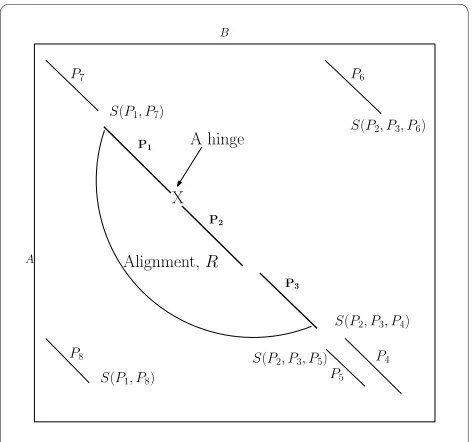
Figure 2 Flexible Structural Alignment by AFPs chaining. When extending the alignment R = {P1, P2, P3}, the score of extending R with each AFP is computed and we extend the alignment with the AFP that gives the best score. The score S(P4, P2, P3)) indicates the score of
add-ing P4 to the region composed of P2 and P3.
X P4 P5 A hinge A B P6 P7 P8
S(P2, P3, P6)
S(P2, P3, P5)
S(P1, P8)
S(P1, P7)
Alignment,R P1
P2
P3
respectively (see Figure 2). We define a precedence rela-tion, Ɱ, between two AFPs such that Pi Ɱ Pj if Pi appears either in the upper or lower left quadrant of Pj, i.e.
and , or and (recall that and
denote the beginning and end, respectively, of AFP Pi in protein A). Generally speaking, we say that two AFPs, Pi and Pj, can be chained if they do not overlap, i.e., Pi ⱮPj or
Pj ⱮPi As depicted in Figure 2, P7 and P8 can be chained to
P1.
For sequential chaining, we define a sequential prece-dence relation, Ɱs, such that Pi precedes Pj (written as Pi Ɱs Pj) if Pi appears strictly in the upper left quadrant with respect to Pj, i.e. and . Two AFPs Pi and
Pj can be sequentially chained together if Pi Ɱs Pj or Pj Ɱs
Pi. In Figure 2, P7 and P2 can be sequentially chained to P1. An AFP, Pi, can be chained to an alignment R, denoted as (R TPi), if it does not overlap with any AFP in R. In Figure 2, P7, P4, and P5 can be sequentially chained to R which
consists of AFPs {P1, P2, P3}; and both P6 and P8 can be non-sequentially chained to R. Next, we shall introduce our solution for the general flexible chaining problem.
The FlexSnap Approach
The goal of chaining is to find the highest scoring subset of AFPs, i.e., R : P, such that all the AFPs in R are mutually consistent and non-overlapping. The problem of finding the highest scoring subset of AFPs is essentially the same as finding the maximum weighted clique in a graph G = (V, E, w) where the set of vertices V represent the set of AFPs, each vertex vi has a weight equal to the score of the AFP,
w(vi) = S(Pi), where the score of an AFP Pi, S(Pi), could be its length or some other combination of length and rmsd. There is an edge (vi, vj) 8 E if the AFPs Pi and Pj do not overlap and are consistent (can be joined with small rmsd or have similar rotation matrices).
The problem of finding the maximum weighted clique in a graph is computationally expensive; it is NP-hard [19]. Thus, we propose a greedy algorithm to find an approxi-mate solution for the chaining problem. The main idea is to start building the alignment from an initial AFP and to add AFPs to the alignment. We start the alignment by selecting the longest AFP, then we iteratively add new AFPs to the alignment as long as the newly added AFP improves the score of the alignment. Given an alignment, R, we add to it the AFP that contributes most. We keep growing the align-ment until no more AFPs can be added. The contribution of an AFP to the alignment is scored by how consistent the
AFP is with the alignment and how good the AFP is. When adding an AFP to an alignment, we reward longer AFPs with smaller rmsd, and we penalize for gaps, inconsistency, and hinges. The penalty takes into consideration: 1) the number of gaps introduced; 2) the increase in rmsd when combining two or more AFPs; 3) the introduction of new hinges.
As depicted in Figure 2, the scores of extending the align-ment, R, with P4, P5, P6, P7, or P8 are computed and the AFP with the best score is added to the alignment. When measuring the score of adding an AFP to the alignment, we actually measure the score of adding the AFP to the last rigid region, and not just to the last fragment, in the align-ment. In Figure 2, the score of adding P4 to R is the score of adding P4 to the region composed of P2 and P3. Since P2 and P3 together form a rigid sub-alignment (as we can see there
is no hinge between them). When adding P7 to R, the score of adding P7 to the region composed only of P1 is com-puted.
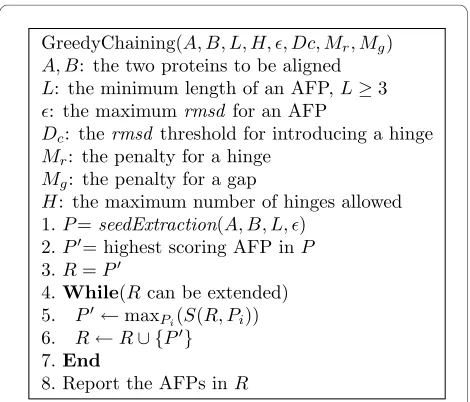
Figure 3 shows the pseudo-code for the greedy chaining algorithm used in FlexSnap. Since the chaining is a greedy algorithm, we run the algorithm K times starting from the K
highest scoring non-overlapping AFPs and we report the alignment with the best score.
Alignment Extension Score
Next, we will discuss how we extend a partial alignment with the next best AFP. More specifically, given an align-ment R, the next AFP to chain to the alignment is the one that maximizes the following scoring function:
bjA>eiA
bjB>eiB ejA<biA bBj >eiB biA
eiA
bjA>eiA bjB >eiB
Figure 3 A greedy AFP chaining algorithm. A greedy algorithm for AFP chaining. The algorithm iteratively chooses an AFP to add to R (lines 4-7) until no more AFPs can be added, or the best score of adding an AFP to R is negative.
GreedyChaining(A, B, L, H, , Dc, Mr, Mg) A, B: the two proteins to be aligned L: the minimum length of an AFP,L≥3 : the maximumrmsd for an AFP
Dc: thermsdthreshold for introducing a hinge Mr: the penalty for a hinge
Mg: the penalty for a gap
H: the maximum number of hinges allowed 1.P=seedExtraction(A, B, L, )
2.P= highest scoring AFP inP 3.R=P
4.While(Rcan be extended) 5. P←maxPi(S(R, Pi)) 6. R←R∪ {P} 7.End
Salem et al.Algorithms for Molecular Biology 2010, 5:12 http://www.almob.org/content/5/1/12
Page 5 of 13
where R TPi indicates that Pi does not overlap with R, and S(R, Pi) is the score of chaining Pi to R. The score, S(R,
Pi), is a combination of the weight of the AFP, W(Pi), and the penalty of extending R with Pi, C(R T Pi). The score is defined as follows:
where C(R TPi) is the penalty incurred when connecting
Pi to R, and W(Pi) is the score of the AFP itself. The scoring function rewards longer AFPs with small rmsd and penalize gaps and hinges. If the addition of an AFP Pi to the align-ment results in a large rmsd, then we introduce a hinge only if W(Pi) is large enough to compensate for the penalty incurred. A similar approach for penalizing gaps and hinges was used in the FATCAT method [12]. Though their score and cost functions are different, and they do not consider rigid regions as we do in FlexSnap when connecting an AFP to the alignment. The score of connecting Pi to R is defined as follows:
where Mg is the penalty for a gap, Mr is the maximum penalty for a hinge, and is the rmsd of connecting Pi
to the last rigid region in R. If increases above a
user-defined threshold, Dc, we introduce a hinge and the penalty is maximum; if not, the penalty is proportional to how far
the rmsd value is from ε (maximum rmsd for an AFP).
Moreover, we allow only a maximum number of H hinges. The score for an AFP is a function of its length and rmsd. The score is the length of the AFP, L(Pi), plus a contribution of the rmsd of the AFP, rmsd(Pi), to the score, and is given as:
The complexity of the chaining algorithm depends on the number of AFPs, M, that the two structures have. In the worst case, M could be close to n3, but in practice it is much
less, i.e., M ≤ n2. The complexity of the algorithm is Mlog(M) + k * M * n, where k is the number of AFPs in the final solution and n is the size of the larger protein.
Sequential Flexible Chaining
The above general chaining algorithm reports both sequen-tial and non-sequensequen-tial alignments. In the results section, we demonstrate that the quality of its non-sequential align-ments is competitive to state-of-the-art non-sequential alignment methods. However, for sequential flexible align-ment, there are more efficient chaining algorithms, namely the approach proposed by the FATCAT algorithm. The FATCAT algorithm follows a dynamic programming approach for chaining the AFPs. In FATCAT, the score of an alignment ending with an AFP, Pi, is defined in terms of the score of Pj's and the connection cost of Pi with these Pj's such that Pj precedes Pi (Pj Ɱs Pi). More specifically, FAT-CAT defines the score of the alignment that ends with Pi as follows:
where C(Pj T Pi) is the penalty incurred when connecting
Pi to the alignment that ends with Pj and it is similar to the penalty function used in the general chaining and W(Pi) is the score of the AFP itself. We propose an approach that is
′ =
∀ →
P S R P
P s t Ri Pi i max { ( , )} , . .
S R P( , )i =W P( )i +C R( →Pi)
C R P M Z D M gap
Z D
if D D
DRPi Dc
i r RP g
RP RP c i i i ( ) * ( ) * ( ) → = + = > − where 1 ε −− ⎛ ⎝⎜ ⎞
⎠⎟ < <
⎧ ⎨ ⎪ ⎪⎪ ⎩ ⎪ ⎪ ⎪ ⎫ ⎬ ⎪ ⎪⎪ ⎭ ⎪ ⎪ ⎪ ε ε 2 0
if D D
otherwise
RPi c
DRPi DRP
i
W P( )i =L P( )i + * ( ) *L Pi ⎛ −rmsd Pi( )
⎝⎜ ⎞⎠⎟
α ε
ε
2
S Pi W Pi max S P C P P
P s t Pj j s iP j j i
( ) ( ) max { ( ( ) ( ), )}
, . .
= + + →
∀ < 0
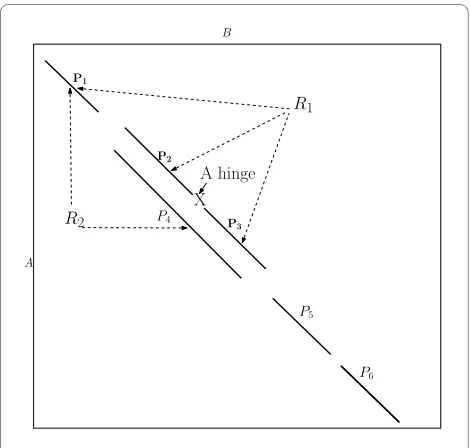
Figure 4 A greedy sequential AFP chaining algorithm. A greedy sequential algorithm for AFP chaining. When encountering the begin-ning of an AFP, the algorithm computes the scores of adding the AFP to the alignments in the upper left corner and the AFP is chained to the alignment with which it gives the highest score.
similar in spirit to FACTCAT, however, it is different in two important aspects. The first aspect is the optimality of the alignment reported by FATCAT. The main issue here is that the scoring function has an rmsd term since W(Pi) is a func-tion of the length of Pi and its rmsd. Therefore, S(Pi) cannot be optimal because we do not know of a scoring function that involves the rmsd value that is additive and optimal
(rmsd score is not a metric since it does not satisfy the
trian-gular inequality property). Therefore, the optimality of FATCAT alignments is not guaranteed since the sub-opti-mality property of the dynamic programming does not hold if the score incorporates an rmsd term. In Figure 4, let the optimal alignment be {P1, P4, P5, P6}, the sub-optimality
property requires that {P1, P4, P5} is also optimal, and it is
the best alignment that ends with P5. This is not necessarily true in structural alignment, because it could happen that the alignment {P1, P2, P3, P5} is better {P1, P4, P5}. In gen-eral, the flexible structural alignment does not exhibit the optimal substructure that would justify the use of dynamic programming.
In FlexSnap, we follow a similar approach as the approach presented in [24] for chaining substrings. In the original algorithm, once we reach the end of a substring (segment), Pi, we delete all the solutions that end with Pj's whose ends are lower and to the left of the endpoint of Pi and S(Pj) <S(Pi). For the segments shown in Figure 4, let
S(P3) >S(P4), once we encounter the end of P3, we should delete the solution that ends with P4. When we encounter
P5, we know that the best solution it can be chained to ends with P3. This approach works fine for regular chaining
problems (like strings). However for the structural align-ment problem, this approach does not yield the optimal alignment since the problem does not exhibit the optimal substructure property. Therefore, in FlexSnap, once we reach the end of an AFP, Pi, we do not delete all solutions that end with Pj's which are to the left and below Pi; instead we only delete the ones that have very low scores as com-pared to S(Pi). Though not optimal, this approach gave bet-ter results for sequential chaining than the pure greedy approach presented in the previous section.
The second aspect where FlexSnap is different from FAT-CAT is that in FATFAT-CAT C(Pj TPi) is the connection cost of
Pi and Pj while in FlexSnap it is the connection cost of Pi to the rigid region that contains Pj. In FATCAT, if Pj belongs to a rigid region and the connection cost of Pi with Pj is small,
Pi will be added to the same rigid region as Pj even though
Pi might not be consistent with other AFPs in the same region. In Figure 4, if we were connecting P5 to R2 that ends
with P4, FATCAT would compute the connection cost C(P5, P4) but FlexSnap would compute C((P1, P4) T P5) since P4
belongs to the rigid region that contains P1. In FATCAT,
when connecting P5 to R2, we might get the conclusion that there is no need to introduce a hinge and thus P5 belongs to the same rigid region as P1 and P4. This may lead to a large
rmsd when we report the alignment since we did not check
if P5 is consistent with P1. However, when FlexSnap adds P5 to the same rigid region as P4 and P1, it will not harm the final rmsd when we report the alignment as FlexSnap ensures that all the segments in the same rigid region are consistent. In the results section, we investigate how com-puting the connection cost with the whole rigid region as opposed to the last segment in the rigid region affects the quality of the alignment. For some structure pairs, consider-ing the whole rigid region in computconsider-ing the connection cost resulted in significant improvements.
Results and Discussion
To assess the quality of FlexSnap alignment compared to other structural alignment methods, we evaluated the agree-ment of the methods' alignagree-ments with reference manually-curated alignments. We compared FlexSnap against sequential methods (DALI [2] and CE [5]), non-sequential methods (SARF2 [4], MultiProt [6], and SCALI [7]), and flexible sequential alignment methods (FlexProt [11] and FATCAT [12]). Finally, we analyzed the flexibility on the DynDom dataset [25], which is a comprehensive and non-redundant dataset of protein domain movements.
All the experiments were run on a 1.66 GHz Intel Core Duo machine with 1 GB of main memory running Ubuntu Linux. The chaining algorithm is efficient and its running time varies from 1 second to a minute depending on the size of the proteins. We used the corresponding web server for most of the other alignment methods. The optimal values for the different parameters were found empirically such that they give the best agreement with manually curated alignments; we used L = 8, ε= 2 Å, Dc = 3 Å, α= 0.5, Mr = -10, Mg = -1, and H = 3 (see Figure 3).
Non-Sequential Alignments
Salem
et a
l.
Al
gor
ithm
s fo
r Mol
ecu
la
r
Bi
ol
o
g
y
20
10
,
5
:1
2
http
://
w
w
w
.a
lmob.or
g
/c
onte
nt/5/1/
1
2
Pa
g
e
7 o
f 13
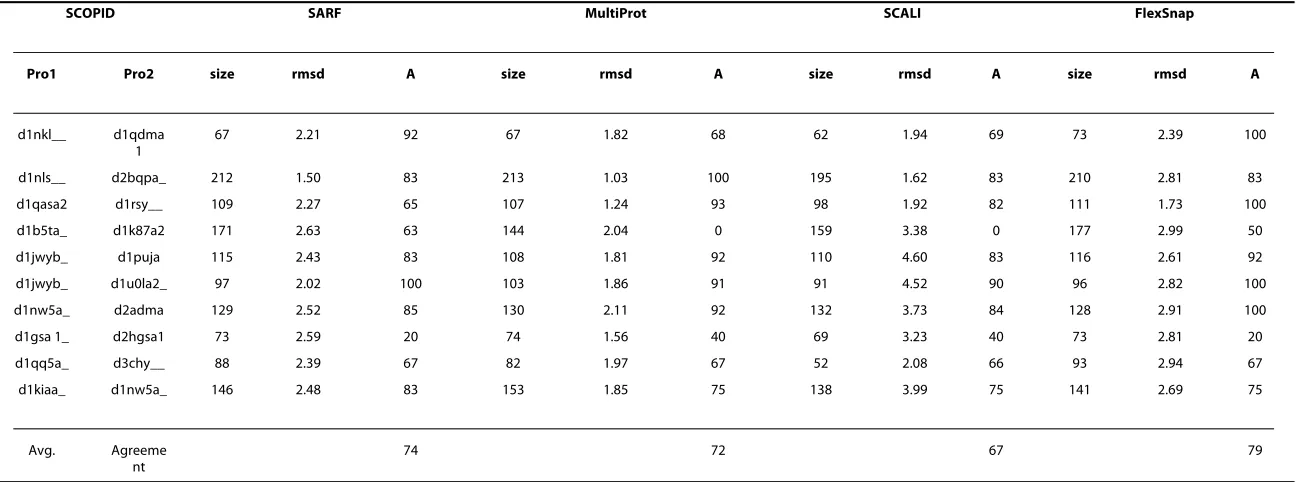
Table 1: Comparison of SARF, MultiProt, SCALI, and FlexSnap on the RIPC dataset.
SCOPID SARF MultiProt SCALI FlexSnap
Pro1 Pro2 size rmsd A size rmsd A size rmsd A size rmsd A
d1nkl__ d1qdma
1
67 2.21 92 67 1.82 68 62 1.94 69 73 2.39 100
d1nls__ d2bqpa_ 212 1.50 83 213 1.03 100 195 1.62 83 210 2.81 83
d1qasa2 d1rsy__ 109 2.27 65 107 1.24 93 98 1.92 82 111 1.73 100
d1b5ta_ d1k87a2 171 2.63 63 144 2.04 0 159 3.38 0 177 2.99 50
d1jwyb_ d1puja 115 2.43 83 108 1.81 92 110 4.60 83 116 2.61 92
d1jwyb_ d1u0la2_ 97 2.02 100 103 1.86 91 91 4.52 90 96 2.82 100
d1nw5a_ d2adma 129 2.52 85 130 2.11 92 132 3.73 84 128 2.91 100
d1gsa 1_ d2hgsa1 73 2.59 20 74 1.56 40 69 3.23 40 73 2.81 20
d1qq5a_ d3chy__ 88 2.39 67 82 1.97 67 52 2.08 66 93 2.94 67
d1kiaa_ d1nw5a_ 146 2.48 83 153 1.85 75 138 3.99 75 141 2.69 75
Avg. Agreeme
nt
74 72 67 79
shows the agreements of four different methods with the reference alignments in the RIPC dataset. The results show that FlexSnap is competitive to state-of-the-art methods for non-sequential alignment. In fact, it has the highest average agreement (79%) among the methods shown. The average agreement of most of the sequential alignment methods we compared with were drastically lower: DALI [2] (40%), CE [4](36%), FATCAT [12](28%), and LGA [27](38%).
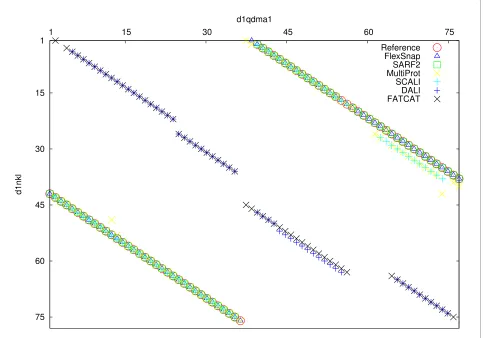
FlexSnap alignments have 100 percent agreement on four structure pairs. One such pair is the alignment of NK-lysin (1nkl, 78 residues) with prophytepsin (1qdm, chain A, 77 residues). On this pair, all the sequential alignment methods (CE, DALI, FATCAT, and LGA) returned zero agreements. For the non-sequential ones: SARF returned 92%, Multi-Prot got 68%, and SCALI returned 69%. The reference alignment had 72 aligned pairs. As shown in Figure 5, the sequential alignment methods (only DALI and FATCAT shown) have their alignment paths along the diagonal and
do not agree with the reference alignment (shown as cir-cles).
Sequential Flexible Alignments
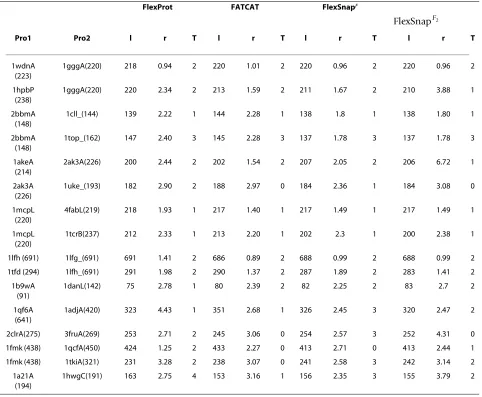
Table 2 shows the alignments of different methods on the FlexProt dataset [11] which is obtained from the database of macromolecular motions[28]. We have implemented two versions of FlexSnap namely FlexSnapF, and ; In FlexSnapF, C(P
j T Pi) is the cost of connecting Pi with the rigid region to which Pj belongs. In the second version, , C(Pj T Pi) is the connection cost of Pi with only Pj. It is observed that when considering the entire rigid region, as in FlexSnapF, we get much better alignments, i.e., they have lower rmsd and fewer hinges. Moreover, FlexSnapF gives comparable results to the FATCAT method. In few cases, it got slightly shorter alignments with FlexSnapF2
FlexSnapF2
Figure 5 Comparison of the agreements of the alignments with one structure pair from the RIPC dataset. Comparison of the agreement be-tween the reference alignment and 6 other alignment methods on the structure pair of prophytepsin(d1qdma1) and nk-lysin(d1nkl__). Residue po-sitions of d1qdma1 and d1nkl__ are plotted on the x-axis and y-axis, respectively. Note: the reference alignment pairs are shown in circles. The SARF, MultiProt, SCALI, and FlexSnap plots overlap with the reference alignment. FlexSnap has 100 percent coverage of the reference alignment; there is a triangle in every circle.
1
15
30
45
60
75
1 15 30 45 60 75
d1nkl
d1qdma1
Salem et al.Algorithms for Molecular Biology 2010, 5:12 http://www.almob.org/content/5/1/12
Page 9 of 13
much better rmsd as in the case of the third and fourth alignment pairs.
Flexibility in the DynDom Dataset
The DynDom dataset [25] is a comprehensive and non-redundant dataset of protein domain movements; it has been compiled by an exhaustive analysis of protein domain movements on all available protein structures using the DynDom program [29]. The protein conformations are first grouped into families based on sequence similarity, result-ing in 1825 families with an average of 11.5 family mem-bers. Then a clustering procedure is applied to members of
the same family to remove dynamic redundancy (same motion) and finally running the DynDom program to ana-lyze domain movements in each family. There are currently 2035 representative pairs belonging to 1578 families in the DynDom dataset. Since these representative pairs involve domain movements, rigid alignment methods would not be able to align these pairs effectively, while flexible align-ment methods will be able to introduce hinges and align the pairs more effectively. We define the coverage of the align-ment as the percentage of the number of residues in the alignment to the length of the smaller protein. More
for-Table 2: Comparison of FlexProt, FATCAT, FlexSnapF, and .
FlexProt FATCAT FlexSnapF
Pro1 Pro2 l r T l r T l r T l r T
1wdnA (223)
1gggA(220) 218 0.94 2 220 1.01 2 220 0.96 2 220 0.96 2
1hpbP (238)
1gggA(220) 220 2.34 2 213 1.59 2 211 1.67 2 210 3.88 1
2bbmA (148)
1cll_(144) 139 2.22 1 144 2.28 1 138 1.8 1 138 1.80 1
2bbmA (148)
1top_(162) 147 2.40 3 145 2.28 3 137 1.78 3 137 1.78 3
1akeA (214)
2ak3A(226) 200 2.44 2 202 1.54 2 207 2.05 2 206 6.72 1
2ak3A (226)
1uke_(193) 182 2.90 2 188 2.97 0 184 2.36 1 184 3.08 0
1mcpL (220)
4fabL(219) 218 1.93 1 217 1.40 1 217 1.49 1 217 1.49 1
1mcpL (220)
1tcrB(237) 212 2.33 1 213 2.20 1 202 2.3 1 200 2.38 1
1lfh (691) 1lfg_(691) 691 1.41 2 686 0.89 2 688 0.99 2 688 0.99 2
1tfd (294) 1lfh_(691) 291 1.98 2 290 1.37 2 287 1.89 2 283 1.41 2
1b9wA (91)
1danL(142) 75 2.78 1 80 2.39 2 82 2.25 2 83 2.7 2
1qf6A (641)
1adjA(420) 323 4.43 1 351 2.68 1 326 2.45 3 320 2.47 2
2clrA(275) 3fruA(269) 253 2.71 2 245 3.06 0 254 2.57 3 252 4.31 0
1fmk (438) 1qcfA(450) 424 1.25 2 433 2.27 0 413 2.71 0 413 2.44 1
1fmk (438) 1tkiA(321) 231 3.28 2 238 3.07 0 241 2.58 3 242 3.14 2
1a21A (194)
1hwgC(191) 163 2.75 4 153 3.16 1 156 2.35 3 155 3.79 2
Comparison of FlexProt, FATCAT, FlexSnapF, and . Each alignment is reported in the following format: its length, l, its rmsd, r,
and the number of hinges introduced, T.
FlexSnapF2
FlexSnapF2
Table 3: Comparison of several alignment methods on the DynDom dataset
DALI Structal MultiProt FlexSnapR FlexSnap FlexProt
aC/aR aC/aR aC/aR aC/aR aC/aR/aH aC/aR/aH
97/2.31 87/1.27 87/1.15 85/1.60 96/1.46/0.45 88/2.14/0.45
Two values are reported for the alignments of each method: average coverage for the method (aC in %), and average rmsd (aR in Å). For FlexSnap and FlexProt, we also report the average number of hinges introduced (aH). FlexSnapR is FlexSnap in rigid mode with the number
of maximum allowed hinges set to zero.
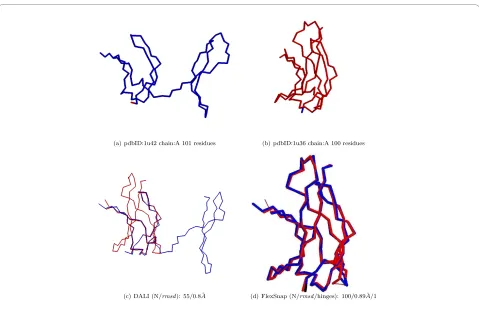
Figure 6 An example of a rigid alignment with low coverage. A DynDom pair with low alignment coverage: Rigid vs. Flexible alignment.
(a) pdbID:1u42 chain:A 101 residues (b) pdbID:1u36 chain:A 100 residues
(c) DALI (N/rmsd): 55/0.8˚A (d) FlexSnap (N/rmsd/hinges): 100/0.89˚A/1
mally, the coverage of an alignment of length Nmat is
defined as , where |A| is the
length of protein A, similarly for |B|.
Table 3 shows the average coverage, rmsd, and hinges reported by different methods on the DynDom dataset. For the same structure pair, FlexProt reports different solutions with different number of hinges ranging from 0 to 5 hinges. For the sake of fair comparison, we choose the FlexProt alignment with the same number of hinges as the solution reported by FlexSnap. Moreover, we also run FlexSnap in
rigid mode (FlexSnapR) with the number of allowed hinges set to 0 to investigate how it compares to rigid alignment methods. DALI has the highest coverage followed by Flex-Snap. However, the average rmsd of FlexSnap alignments is much smaller than the average rmsd for DALI align-ments. On average, FlexSnap introduced 0.59 hinges in the alignments. By introducing flexibility in the alignments, FlexSnap reported alignments with significantly smaller
rmsd while maintaining high alignment coverage. Also
Salem et al.Algorithms for Molecular Biology 2010, 5:12 http://www.almob.org/content/5/1/12
Page 11 of 13
Table 4: Comparison of FlexSnap and FlexProt on the DynDom pairs for which rigid alignment methods returned coverage ≤ 60%
Rigid Alignment FlexSnap FlexProt
Method #Pairs aC(%)/aR(Å) aC(%)/aR(Å)/aH aC(%)/aR(Å)/aH
DALI 30 31/2.3 89/1.75/1.37 79/2.36/1.37
Structal 282 52/0.77 94/1.72/1.34 93/2.08/1.34
MultiProt 164 53/1.12 92/1.59/1.56 93/2.0/1.56
Two values are reported for the alignments of each method: average coverage for the method (aC in %), and average rmsd (aR in Å). For FlexSnap and FlexProt, we also report the average number of hinges introduced (aH).
Table 5: Comparison of FlexSnap and FlexProt on the DynDom pairs for which rigid alignment methods returned alignments with rmsd ≥ 4.0 Å
Rigid Alignment FlexSnap FlexProt
Method #Pairs aC(%)/aR(Å) aC(%)/aR(Å)/aH aC(%)/aR(Å)/aH
DALI 295 94/5.89 94/1.61/1.54 93/2.02/1.54
Structal 16 88/5.03 82/1.97/2.19 78/2.75/2.19
Two values are reported for the alignments of each method: average coverage (aC in %), and average rmsd (aR in Å). For FlexSnap and FlexProt, we also report the average number of hinges introduced (aH).
DynDom Pairs with Low Coverage
Rigid alignment methods try to optimize a score that is usu-ally dependent on the length and rmsd of the alignment. Therefore, they might prefer shorter alignment with small
rmsd over a longer alignment with significantly larger
rmsd. In some cases, like when there is a movement in one of the proteins, they have no choice but to report a shorter alignment with an acceptable rmsd value. We analyze the alignments of structure pairs for which rigid alignment methods returned short alignments as compared to the length of the smaller protein. We run three different rigid alignment methods, DALI, Structal, and MultiProt, and get the pairs for which any of the methods returned a coverage less than or equal to 60%. The list has 30 pairs for DALI, 282 for Structal, and 164 for MultiProt. An example of a rigid alignment with low coverage is shown in Figure 6. For this DynDom pair, Structal reported an alignment of 52
res-idues with rmsd 0.40 Å; MultiProt's alignment was 54 with
rmsd 0.52 Å.
Table 4 shows the average coverage, rmsd, and hinges reported by FlexSnap on these structure pairs. For fair com-parison, we choose the FlexProt alignment with the same number of hinges as the FlexSnap solution. FlexSnap sig-nificantly improves the coverage of the alignments of these hard pairs. Moreover, it does so while maintaining good
rmsd values and introducing on average about 1.5 hinges.
more structure pairs when compared to DALI. The reason behind that is the fact that the Structal method depends on the initial alignments for its initial transformations and it might miss the true alignment if the initial alignments are not good starting points.
DynDom Pairs with Large rmsd
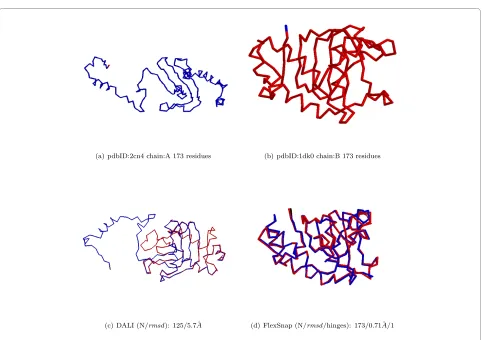
In some cases rigid alignment methods would seek to opti-mize the score that favors longer alignments with accept-able rmsd values, and thus they may have good coverage on some pairs, but the rmsd values may be too large. Flexible alignments can be employed for these cases to get similar alignments but with much better rmsd values. For each of our test methods, namely DALI, Structal, and MultiProt, we compiled a list of the structure pairs for which the method reported an alignment with rmsd ≥ 4.0 Å, and we ran FlexS-nap on these pairs. An example of a rigid alignment with large rmsd is shown in Figure 7. FlexSnap reported an alignment with 100% coverage with an rmsd of 0.71 Å by introducing only one hinge in the alignment. Table 5 shows the average coverage, and rmsd as reported by the native rigid method and by FlexSnap. Under this criterion, DALI reported alignments with rmsd ≥ 4.0 Å on 295 pairs, much more than what the other methods reported. MultiProt
didn't report any alignment with large rmsd. In fact, all of the MultiProt alignments had rmsd ≤ 2.3 Å; this can be explained by noting that MultiProt includes in the align-ment only residue pairs which are closely aligned and thus the overall rmsd will not be large.
FlexSnap significantly improved the average rmsd of the alignments of these pairs. For the 295 pairs for which DALI reported an average rmsd of 5.89 Å, FlexSnap reported an average rmsd of 1.61 Å. For the 16 pairs reported by Struc-tal, FlexSnap average rmsd is 1.97 Å as opposed to 5.03 Å reported by Structal.
Conclusions
We have introduced FlexSnap, a greedy chaining algorithm that reports both sequential and non-sequential alignments and allows twists (hinges). We assessed the quality of the FlexSnap alignments by measuring its agreements with manually curated non-sequential alignments (on the RIPC dataset). On the FlexProt dataset, FlexSnap was competi-tive to state-of-the-art flexbile alignment methods. More-over, we demonstrated the benefits of introducing hinges by showing the significant improvement in the alignments reported by FlexSnap for the structure pairs for which rigid
Figure 7 An example of a rigid alignment with large rmsd. A DynDom pair with large alignment rmsd: Rigid vs. Flexible alignment.
(a) pdbID:2cn4 chain:A 173 residues (b) pdbID:1dk0 chain:B 173 residues
Salem et al.Algorithms for Molecular Biology 2010, 5:12 http://www.almob.org/content/5/1/12
Page 13 of 13
alignment methods reported alignments with either low coverage or large rmsd (on the DynDom dataset).
Competing interests
The authors declare that they have no competing interests.
Authors' contributions
SS and MJZ designed the FlexSnap algorithm with the proposed scoring scheme. SS coded the algorithm in C++ and wrote the paper. CB proposed the experiments and helped analyze the alignments. All authors read and approved the final manuscript.
Acknowledgements
We would like to thank the anonymous reviewers for their comments and sug-gestions. Also, we thank the authors of the different alignment algorithms for making their programs available. This work was supported in part by NSF Grants EMT-0829835 and EIA-0103708, NIH Grant 1R01EB0080161-01A1, and NIH grant number P20 RR016741 from the INBRE program of the National Cen-ter for Research Resources.
Author Details
1Department of Computer Science, North Dakota State University, Fargo, ND
58108, USA, 2Department of Computer Science, Rensselaer Polytechnic
Institute, 110 8th St, Troy, NY 12180, USA and 3Department of Biology,
Rensselaer Polytechnic Institute, 110 8th St, Troy, NY 12180, USA
References
1. Wriggers W, Schulten K: Protein domain movements: detection of rigid domains and visualization of hinges in comparisons of atomic coordinates. Proteins: Structure, Function, and Genetics 1997, 29:1-14. 2. Holm L, Sander C: Protein structure comparison by alignment of
distance matrices. J Mol Biol 1993, 233:123-138.
3. Subbiah S, Laurents D, Levitt M: Structural similarity of DNA-binding domains of bacteriophage repressors and the globin core. curr biol 1993, 3:141-148.
4. Alexandrov N: SARFing the PDB. Protein Engineering 1996, 50(9):727-732. 5. Shindyalov I, Bourn P: Protein structure alignment by incremental
combinatorial extension (CE) of the optimal path. Protein Eng 1998,
11:739-747.
6. Shatsky M, Nussinov R, Wolfson H: A method for simultaneous alignment of multiple protein structures. Proteins: Structure, Function, and Bioinformatics 2004, 56:143-156.
7. Yuan X, Bystroff C: Non-sequential Structure-based Alignments Reveal Topology-independent Core Packing Arrangements in Proteins. Bioinformatics 2003, 21(7):1010-1019.
8. Zhu J, Weng Z: FAST: A Novel Protein Structure Alignment Algorithm. Proteins: Structure, Function and Bioinformatics 2005, 14:417-423. 9. Lindqvist Y, Schneider G: Circular permutations of natural protein
sequences: structural evidence. Curr Opin Struct Biol 1997, 7(3):422-427. 10. Milik M, Szalma S, Olszewski K: Common Structural Cliques: a tool for
protein structure and function analysis. Protein Engineering 2003,
16(8):543-552.
11. Shatsky M, Nussinov R, Wolfson H: Flexible protein alignment and hinge detection. Proteins: Structure, Function, and Bioinformatics 2002,
48:242-256.
12. Ye Y, Godzik A: Flexible structure alignment by chaining aligned fragment pairs allowing twists. Bioinformatics 2003, 19:II246-II255. 13. Kolodny R, Linial N: Approximate protein structural alignment in
polynomial time. PNAS 2004, 101:12201-12206.
14. Needleman S, Wunsch C: A general method applicable to the search for similarities in the amino acid sequence of two proteins. J Mol Biol 1970,
48:443-453.
15. Gerstein M, Levitt M: Using Iterative Dynamic Programming to Obtain Accurate Pairwise and Multiple Alignments of Protein Structures. Proc Int Conf Intell Syst Mol Biol 1996, 4:59-67.
16. Orengo C, Taylor W: SSAP: sequential structure alignment program for protein structure comparison. Methods Enzymol 1996, 266:617-35.
17. Eidhammer I, Jonassen I, Taylor WR: Protein Bioinformatics: An algorithmic Approach to Sequence and Structure Analysis UK: John Wiley & Sons Ltd; 2004.
18. Eidhammer I, Jonassen I, Taylor W: Structure comparison and structure patterns. J Comput Biol 2000, 7(5):685-716.
19. Garey M, Johnson D: Computers and Intractability: A Guide to the Theory of NP-Completeness San Francisco, CA: W.H. Freeman; 1979.
20. Emekli U, Schneidman-Duhovny D, Wolfson H, Nussinov R, Haliloglu T:
HingeProt: Automated Prediction of Hinges in Protein Structures. Proteins 2008, 70(4):1219-1227.
21. Flores S, Keating K, Painter J, Morcos F, Nguyen K, Merritt E, Kuhn L, Gerstein M: HingeMaster: normal mode hinge prediction approach and integration of complementary predictors. Proteins 2008, 73:299-319. 22. Kabsch W: A solution for the best rotation to relate two sets of vectors.
Acta Crystallogr 1976, A32:922-923.
23. Chwartz J, Sharir M: Identification of partially obscured objects in two dimensions by matching of noisy characteristic curves. Int J Robotics Res 1987, 6:29-44.
24. Gusfield D: Algorithms on strings, trees, and sequences: Computer science and computational biology New York: Cambridge University Press; 1999. 25. Qi G, Lee R, Hayward S: A comprehensive and non-redundant database
of protein domain movements. Bioinformatics 2005, 21(12):2832-2838. 26. Mayr G, Dominques F, Lackner P: Comparative Analysis of Protein
Structure Alignments. BMC Structural Biol 2007, 7(50):564-77. 27. Zemla A: LGA - a Method for Finding 3D Similarities in Protein
Structures. Nucleic Acids Research 2003, 31(13):3370-3374.
28. Gerstein M, Krebs W: A database of macromolecular motions. Nucleic Acids Res 1998, 26(18):4280-4290.
29. Hayward S, Berendsen H: Systematic Analysis of Domain Motions in Proteins from Conformational Change; New Results on Citrate Synthase and T4 Lysozyme. Proteins, Structure, Function and Genetics 1998, 30:144-154.
doi: 10.1186/1748-7188-5-12
Cite this article as: Salem et al., FlexSnap: Flexible Non-sequential Protein Structure Alignment Algorithms for Molecular Biology 2010, 5:12 Received: 19 August 2009 Accepted: 4 January 2010
Published: 4 January 2010 This article is available from: http://www.almob.org/content/5/1/12 © 2010 Salem et al; licensee BioMed Central Ltd.
This is an Open Access article distributed under the terms of the Creative Commons Attribution License (http://creativecommons.org/licenses/by/2.0), which permits unrestricted use, distribution, and reproduction in any medium, provided the original work is properly cited.