R E S E A R C H A R T I C L E
Open Access
Turkish medical educators
’
TPACK
components and characters: an analysis
within the framework of simulation-based
medical education
Engin Karadag
Abstract
Background:Nowadays, a comprehensive approach is needed to describe the current status of the technology integration process and the identification of the factors that affect it, because the description and frame of the existing situation will be the starting point in the organization of the roadmap to the realization of an effective integration process. The purpose of this study is to identify the differences in technology integration of the medical educators working in Turkey and analyze these according to various variables on the basis of technological
pedagogical content knowledge.
Method:Data used in the study were collected from 301 medical educators using theTPACK-Practical Scaleand Attitude towards Technology Scale. The data were analyzed using Ward’s minimum variance hierarchical clustering analysis, discriminant function analysis and multinomial logistic regression analysis.
Results:According to the results of the study, medical educators’technology integration was grouped in the following clusters, according to their TPACK: (i)activity-based,(ii)student- basedand (iii)topic-based. It was found that the developed model explains 79%of the variance of technology integration. The implementation of simulation-based medical education in medical school and the department where they work affect the clusters to which the medical educators were assigned, whereas the gender variable didn’t have an effect. The findings showed that attitudes towards technology, simulation education and working in the field of basic medical sciences increased medical educators’activity-based presence.
Conclusions:The review of the clusters and their characteristics showed that there are similarities between the items used in the designing stage of the education programs and the relationships of these items among them. Learner centered approaches are based on the assumption that students are located at the center of the program. In these designs, teaching mostly focuses on the learner, rather than program, learning or administrative body. Individuals and their identities are crucial.
Keywords:Medical education, Simulation-based medical education, TPACK, Educational technology, Teaching/ learning strategies
© The Author(s). 2019Open AccessThis article is distributed under the terms of the Creative Commons Attribution 4.0 International License (http://creativecommons.org/licenses/by/4.0/), which permits unrestricted use, distribution, and reproduction in any medium, provided you give appropriate credit to the original author(s) and the source, provide a link to the Creative Commons license, and indicate if changes were made. The Creative Commons Public Domain Dedication waiver (http://creativecommons.org/publicdomain/zero/1.0/) applies to the data made available in this article, unless otherwise stated.
Correspondence:[email protected];[email protected]
Background
The acceptance and implementation of a new technol-ogy is very similar to the process of accepting an innovation. According to Rogers [1], based on the studies conducted on individuals and communities, the investigation of the adaptation to an innovation and the process of acceptation for different persons are of great importance. Today, where the pace of technologic devel-opments is increasing, many researchers, featuring the technology adaptation of the educators and effective usage of the technological devices are conducted [2–4].
Simulation is a method in which the students gain artificial and virtual experience in an activity which re-flects real life circumstances without taking the risk of real life situations [5,6]. The use of simulation in medi-cine dates back to the 1950’s. Early medicine simulators were manikins which were named‘phantom’in the 16th and 17th centuries. These practices stand out as nonsys-tematic practices in teaching and examining obstetric skills with the aim of decreasing maternal-infant mortal-ity. The first critical rise in medical simulation came out with Ressusi-Anne which was a result of collaborative work of anesthetists and the industry in twentieth cen-tury. This manikin became an example for other models and designs in terms of resuscitation and basic skills education [7, 8]. Current practices of simulation use in medicine include role-playing with simulators (with real or simulated patients), computer-based simulation, simulation software, videos, DVDs or creating virtual reality, computer controlled simulators and interactive patient simulators [5]. Simulation based education is a context which is egalitarian, gives every student an op-portunity to learn, uses adult education principles effect-ively and appeals to different learning styles. In these contexts, interests and needs are defined by the learner and educator, learner experiences are prioritized, learners are given chance to learn by doing and sup-ported with feedbacks. Although it seems to appeal to kinesthetic learners, simulation based medicine educa-tion, supported by different theories (behaviorist, cogni-tivist, constructivist and humanistic), gives chance to individuals to learn in their own style by employing mul-tiple education methods and using various education materials together [6,9,10]. Today, thanks to the oppor-tunities provided by technology, different perspectives have emerged about the development of learning environments and technology integration in education. Regarding this rapid change cycle and development of technology, the position of the educators in the process and their activity levels are seen as important issues by the researchers [11].
Nowadays, concrete applications are needed for de-scribing the current status of the technology integration process and the identification of the factors that affect it,
because the description and frame of the existing situ-ation will be the starting point in the organizsitu-ation of the roadmap related to its realization. Therefore, the aim of this research is to make a contribution to the description of the current situation of ICT integration in the learning-teaching process from a medical educator di-mension and to examine it in terms of the variables that may affect the integration process.
Within the study, the following hypotheses were tested:
H1 Medical educators’ technology integration is clus-tered according to the TPACK-Practical model.
H2The clusters formed according to TPACK-Practical skills of the medical educators and the distribution of the medical educators who were working in the schools where simulation-based medical education was imple-mented are independent.
H3The clusters formed according to TPACK-Practical skills of the medical educators and the department where they were working are independent.
H4The clusters formed according to TPACK-Practical skills of the medical educators and their gender distribu-tion are independent.
H5Medical educators’seniority, attitude towards tech-nology, the status of simulation-based medical education implementation in their school, the department where they were working and gender variables affect their pres-ence in the clusters formed according to TPACK-Practical skills.
Related literature
Technological pedagogical content knowledge (TPACK)
and content and refers to the use of technology that is more appropriate for representing the subject and con-tent of a particular discipline. Technological Pedagogical Knowledge [TPK] is the combination of technology and pedagogy and considers the effects of technology usage on learning in the teaching process [4,13–15].
TPACK-practical model
According to Van Driel Verloop and De Vos [16], educa-tors’ practical knowledge and PCK play an important role in the regulation of the teaching process and in the fulfillment of learning objectives via appropriate teaching strategies. In this context, practical knowledge (teaching experience) with the combined use of content and pedagogy skills is involved in the process as much as PCK. The TPACK model has evolved from different per-spectives in the literature and tackle knowledge and skill dimensions independent of teaching experience and per-formance. From this perspective, the TPACK-Practical model is a model that considers the teaching process as the basis upon which practical knowledge (teaching ex-perience) and TPACK skills work together. The consid-eration of TPACK and the teaching process together is important in terms of the skills used through the process and the consideration of the interaction between these two processes in addition to providing immediate feed-back. Specifically, it should not be ignored that the
processes requiring different technologies, such as the recognition of students, planning, design, and evaluation, require different TPACK skills. According to Yeh, Hsu, Wu and Chien [17], in-service educators’TPACK can be very different from that which pre-service educators develop, because teaching experiences and beliefs can personally vary and intuitively interact. Thus, teaching processes and outcomes are affected by the interaction of possessed knowledge and skills with teaching experi-ence. Jang and Chen [18] stated that the lack of experi-ence and naivety of educators may act as the limiting factor in the use of TPACK skills. Thus, variables, such as the experience and performance of the educator, must be involved in the process. The implementations of TPACK skills in different disciplines are also different. Educators are the key element to introduce ICT into educational practice [19].
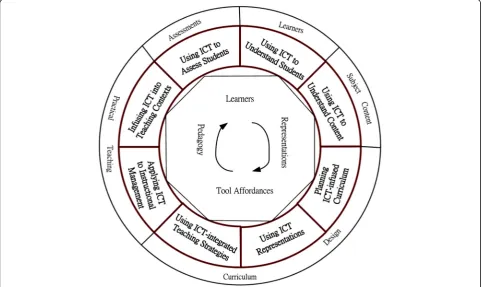
The TPACK-Practical model (see Fig. 1) consists of eight knowledge dimensions from five pedagogical areas. These pedagogical areas include the following: (i) learners, (ii) subject content, (iii) curriculum design, (iv) practical teaching, and (v) assessment. The knowledge dimensions belonging to these areas are the following: (i) using ICT to understand students, (ii) using ICT to understand subject content, (iii) planning ICT-infused curricula, (iv) using ICT representations, (v) using ICT-integrated teaching strategies, (vi) applying ICT to
instructional management, (vii) infusing ICT into teach-ing contexts, and (viii) using ICT to assess students [18].
Methods
Research design
The research was designed using the correlational method, which is one of the non-experimental quantita-tive research approaches. The correlational model is the design where the researcher seeks for a relationship between two or more variables that interact with each other. The aim of the study is to reach a decision or a model by analyzing the relationship between variables. Thus, this research is based on the Explanatory Correl-ational Design[20].
Participants
This study was conducted with 339 medical educators from 14 medical schools that were identified by means of deliberate sampling. The data obtained from 38 med-ical educators were likely to adversely affect the reliabil-ity of the study and were removed before beginning the analysis (these medical educators gave the same scores to all of the items). Therefore, the data obtained from 301 participants were used in the study.
Data collection tools TPACK-practical scale
The TPACK-Practical Scale items were obtained from the Delphi study conducted by Yeh, Hsu, Wu, Hwang and Lin [19], which was performed in two stages with the participation of 6 researchers and 54 specialists. Regarding the Turkish version of the scale, as a result of item-total (r= .44–.65, p < .01) and item-rest (r= .41–.63, p < .01) correlation analysis, it was found that there is a significant relationship for each item in the scale, and the differentiating power was found to be 27% and the relationship between lower and upper groups’averages was found to be significant for all tested items at p < .05 level. According to the confirmatory factor analysis conducted, the original structure of the scale was confirmed and, as in the original form, eight knowledge dimensions from five pedagogic domains were revealed. In addition, for internal consistency, Cronbach’s Alpha reliability coefficient of the scale was found to be 0.89.
The content of the scale factors can be described as follows:
(i.) Learners:High scores for this factor indicate that the medical educator has gained skills such as recognizing the students using ICT, identifying and resolving the students’difficulties in the learning process (e.g., misconceptions), identifying the
students’learning styles and following up on their improvement levels.
The following are sample items related to this factor:
(1) I know how to use ICT to identify students’ learning difficulties.
(2) I am able to use different technology-infused instruction to assist the students with different learning characteristics.
(ii.)Subject Content:High scores for this factor indicate that the medical educator has gained skills such as using ICT to learn the content. The following are sample items related to this factor:
(1) I am able to use ICT to better understand the subject content.
(2) I am able to identify the subject topics that can be better presented with ICT.
(iii.)Curriculum Design:High scores for this factor indicate that the medical educator has gained skills such as planning a curriculum integrated with ICT, using ICT designs and teaching strategies integrated with ICT. The following are sample items related to this factor:
(1) I am able to evaluate the factors that influence the planning of an ICT-infused curriculum.
(2) I use appropriate ICT representations to present instructional content.
(iv.)Practical Teaching:High scores for this factor indicate that the medical educator has skills such as using ICT in instructional management and facilitating the achievement of the students. The following are sample items related to this factor:
(1) I am able to indicate the advantages and
disadvantages of ICT for instructional management. (2) I am able to use ICT to facilitate the achievement
of teaching objectives.
(v.)Assessment:High scores for this factor indicate that the medical educator has gained skills such as using ICT technologies to assess student learning. The following are sample items related to this factor:
(1) I know the types of technology-infused assessment approaches.
Attitude towards technology scale
Attitude towards Technology Scale (ATT), which was developed by Yavuz [21] to determine educators and educator candidates’ attitudes towards technology, con-sists of 5 factors and 19 items expressed a five-point Likert scale, as ‘definitely agree’ (5),‘agree’ (4),‘ indiffer-ent’ (3),‘disagree’ (2) and ‘definitely disagree’ (1). The factors that form the scale are as follows: (i) not using technological tools in the education area, (ii) using technological tools in education area, (iii) the effects of technology on education, (iv) knowing how to use technological tools and (v) the evaluation of techno-logical tools. The scale consists of 13 positive and 6 negative items. The reliability coefficient of the measure-ment tool was calculated using the Cronbach Alpha method and the reliability coefficient was found to be 0.87. The correlations of 19 items were calculated to re-veal item discrimination and item difficulty were found to vary between .24–.68 [20]. Accordingly, the obtained data were coded by assigning a value from 5 to 1 to positive items, and a value from 1 to 5 to negative items. The content of the scale factors can be described as follows:
(i.) Not Using Technological Tools in Education(5 items): Educators who get high scores from this factor possess negative attitudes towards
technology, such as the use of technological tools in education is unnecessary, they are not economical in terms of time and they don’t have any impact on the motivation of the students. A sample of the items belonging to this factor are as follows:
(1) Using the Internet in the learning process is a waste of time.
(2) Using technological tools does not affect students’ motivation.
(ii.)Using Technological Tools in Education(4 items): Educators who achieved high scores from this factor believe that the use of technological tools in education is important and necessary and it will contribute to the gains of education. A sample of the items belonging to this factor are as follows:
(1) Students should receive basic education on computer literacy.
(2) Technological tools could be used for practice or revision.
(iii.)The Effects of Technology on Education Life(4 items): Educators who get high scores from this factor believe that technology is important and indispensable in education; its necessity is not
limited to the classroom, it goes outside the school as well. A sample of the items belonging to this factor are as follows:
(1) One does not have to use technological facilities in order to be successful in life.
(2) Technological facilities have a positive effect on productive studying and learning.
(iv.)Teaching How to Use Technological Tools(4 items): Educators who achieved high scores from this factor believe that training featuring the use of technology should be provided within the educator training system and students should be informed about their capabilities. A sample of the items belonging to this factor are as follows:
(1) Students should get advanced information on the usage of new technologies.
(2) The use of new technologies in educator’s education should be increased.
(v.)Evaluating technological tools(2 items): Educators who get high scores from this factor have positive attitudes toward the effectiveness of technological tools. A sample of the items belonging to this factor are as follows:
(1) Technological tools can only succeed when they address all the senses.
(2) In order to be able to graduate from the university, the ability to“use the technological materials of the field”should be rated.
Procedure
In the study, data were obtained by applying the scales to the participants. Participants answered demographic questions first, than they marked their level of agree-ment to the items on the scale. Filling the scale was optional and permission was granted from the school administrators and medical educators prior to the appli-cation of the scale. In order to determine the differenti-ation of the medical educators’ technology integration according to technological pedagogical content know-ledge, theWard’s minimum variance hierarchical cluster analysis was performed; discriminant function analysis
was conducted to ensure the validity of the clusters;one sample t-test was conducted for the comparisons of the clusters to identify their characteristics and name them;
Levene test and ANOVA was applied for the compari-sons between clusters; and post-hoc analysis was conducted using theScheffe testto identify the source of significant differences in the main affect. In addition,
relationships between medical educators’ technology in-tegration and their attitudes towards technology. The
chi-square independence test was used to test the hy-pothesis about the clusters based on medical educators’ TPACK-Practical skills and the distribution of the med-ical educators according to implementation status of simulation-based medical education, department, and gender variables. In addition, the prediction power of the variables, such as gender, medical educators’ senior-ity, their attitudes towards technology, implementation of simulation-based medical education’s in their school and the department where they were working, and the assignment of the medical educators to one of the clusters formed by the clustering analysis was analyzed using the Multinomial Logistic Regression. The forward stepwise method was used in Multinomial Logistic Regression. Since both main and common affects were included in the hypothesis, very big parameter predic-tions and standard errors were obtained, and therefore it was decided that there existed multicollinearity among variables. In order to analyze multicollinearity, Pearson correlation coefficients of the continuous variables were calculated. The correlation between age and seniority was very high, thus the age variable was excluded from the model to ensure that the Multinomial Logistic Re-gression analysis explained abnormal behaviors (r= .89,
p < .01). In order to check if there were other variables to be excluded, likelihood ratio statisticswas performed. To determine the size of the dependent variable’s vari-ance, Cox and Snell R2 and Nagelkerke R2 values were checked.
Results
In the study, TPACK-Practical skills were taken as the clustering variable while determining the differ-entiation of medical educators’ technology integra-tion. In the conducted Ward’s minimum variance hierarchical cluster analysis, the graphical illustration of the data was examined as a dendrogram in order to determine the appropriate number of clusters and the examination of the dendrogram revealed several solutions consisting of three, four five clusters. Each clustering solution was evaluated and clusters belong-ing to these potential solutions were formed separ-ately in order to find the most meaningful clustering solution. Accordingly, the solution with three clusters was chosen and the distribution of the clusters is presented in Table 1.
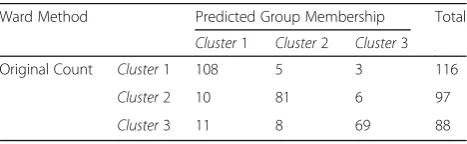
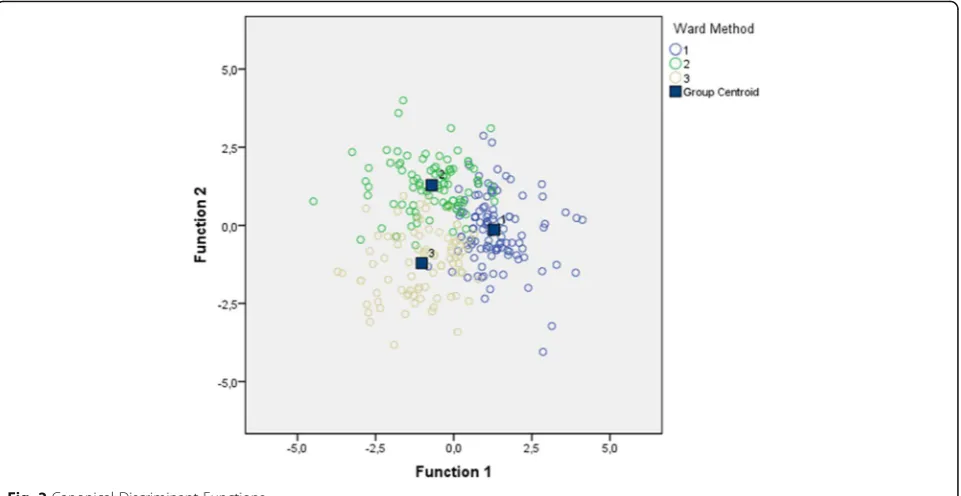
The review of Table1shows that the number of med-ical educators in the clusters is 116, 97 and 88, respect-ively. To ensure the validity of the clusters obtained via clustering analysis, discriminant function analysis was conducted to the whole sample [22]. The results of this analysis are presented in Table 3. It can been seen that
the three-cluster solution predicted 83%of cluster mem-bership (See Table2and Fig.2), whereas the four-cluster solution predicted 72%and the five-cluster solution pre-dicted 65% of it. Consequently, the three-cluster solu-tion was found to be the best solusolu-tion for identifying similarities within medical educators’groups and differ-entiations among groups.
Comparison of the clusters and determination of cluster characteristics
After the identification of the clusters, their characteris-tics were revealed and they were named accordingly. In addition, comparisons within and between clusters were reported.
Comparisons between clusters
In order to determine the characteristics of the clusters and to name them, the assumption of homogeneity of variance was checked (Levene test, p= .09; p= .24;
p= .21;p= .69 and p= .62). Accordingly, it was decided that it was appropriate to perform an ANOVA test on the data (p > .05). As a result of ANOVA, it was found that there were significant differences between the mean scores achieved by the clusters in the following areas of TPACK-Practical scale: learners [F(2, 298)= 19.41; p < .01], subject content [F(2, 298)= 20.07; p < .01], prac-tical teaching [F(2, 298)= 59.42; p < .01] and assessment
[F(2, 298)= 5.98;p <.01]. There were no significant
differ-ences between the three clusters in terms ofcurriculum design[F(2, 298)= 0.99;p >.05].
Regarding the direction of the differences between clus-ters, the difference was in favor of the second cluster (stu-dent-based) in the learner’s area. In the subject content
area, the means of the first (activity-based) and third (topic-based) clusters were found to be higher than
Table 1Distribution of the Cluster Analysis Results about TPACK-Practical skills
Clusters n %
Cluster1 116 38.5
Cluster2 97 32.2
Cluster3 88 29.2
Total 301 100
Table 2Cluster Membership Predicted by the Classification Matrix
Ward Method Predicted Group Membership Total
Cluster1 Cluster2 Cluster3 Original Count Cluster1 108 5 3 116
Cluster2 10 81 6 97
Cluster3 11 8 69 88
second cluster (student-based). In the practical teaching
area, it was found that the mean of the first cluster (activ-ity-based) was higher than the other two clusters. In the
assessmentsarea the difference was not based on one clus-ter; it was in favor of the second (student-based) and third (topic-based) clusters. As can be seen, the clusters, which possess advantages in some areas, were named after the names that form the conceptual basis of this area. The characteristics of these clusters and the graphic showing their mean scores in each area are displayed in Fig.3.
The review of Fig. 3 shows that the highest mean of the activity-based cluster is on the practical teaching
area (M= 4.11), whereas the lowest mean is on the
learnersarea (M= 3.51). On the other hand, the highest mean of student-based cluster is on the learners area (M= 4.16), whereas the lowest mean is on the subject content area (M= 3.48). Regarding topic-based cluster, the highest mean is observed on the assessment area (M= 4.20), whereas the lowest mean is on the practical teachingarea (M= 3.09). As can be seen from Fig.3, the characteristics of the clusters are in line with their names.
Comparisons within clusters
After the identification of the TPACK-Practical Scale clus-ters’characteristics and calculating the mean score in each area, comparisons were done within each cluster. In the study, the shape of TPACK-Practical skills among medical educators and the attitudes of the clusters, which consist of medical educators having similar skills, towards technology were especially considered. According to the
hypothesis that Practical skills of the medical educators would vary according to their attitudes towards the source of TPACK-Practical skills, an individual-centered ap-proach was adopted. In this context, the null hypothesis was tested.
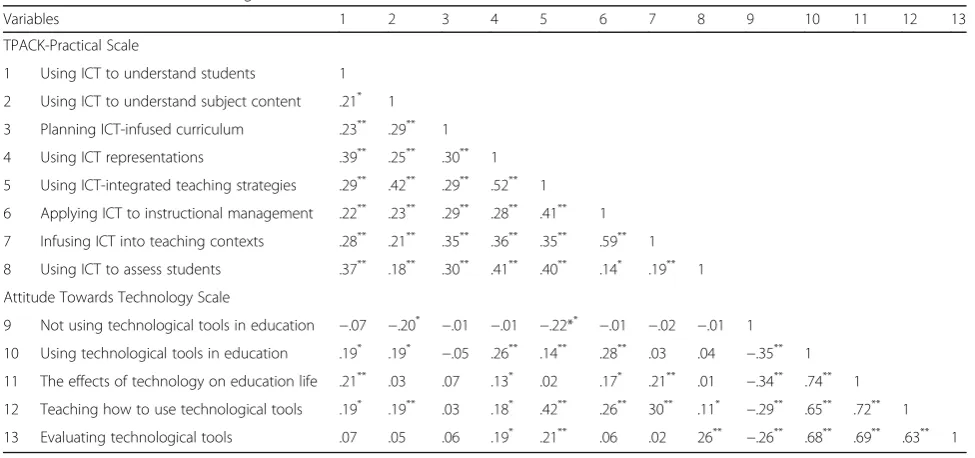
The review of Table3revealed that there are positively correlated, negatively correlated and non-correlated fac-tors among TPACK-Practical and ATT scales facfac-tors. The significant relationship between TPACK-Practical and ATT scales factors supports the hypothesis that Practical skills of the medical educators vary according to their attitudes towards the source of TPACK-Practical skills. Accordingly, it can be concluded that medical educators’ attitudes towards technology affect their TPACK-Practical skills.
H2 hypothesis -“The clusters formed according to
TPACK-Practical skills of the medical educators and the distribution of the medical educators who were working in the schools where simulation-based medical educa-tion was implemented are independent”- which was formed to reveal the factors effecting medical educators’ technology integration process, was tested using the data obtained from the TPACK-Practical scale and demo-graphic information.
The data about the clusters and medical educators who were working in the schools where simulation-based medical education was implemented and not implemented and the results of the chi-square independ-ence test are presented in Table4. According to Table4, 82 medical educators (70.7%) from the activity-based
based clusters and 37 medical educators (42.0%) from the topic-based clusters were working in the schools where simulation-based medical education was imple-mented. According to these results, the hypothesis -“The clusters formed according to TPACK-Practical skills of the medical educators and the distribution of the med-ical educators working in the schools where simulation-based medical education was implemented are inde-pendent”- was rejected (X2(2)= 36.41; p< .01).
Conse-quently, it can be expressed that the implementation of simulation-based medical education affects the medical educators’cluster.
H3 hypothesis -“The clusters formed according to
TPACK-Practical skills of the medical educators and the department where they were working are independent” -was tested using the data obtained from the
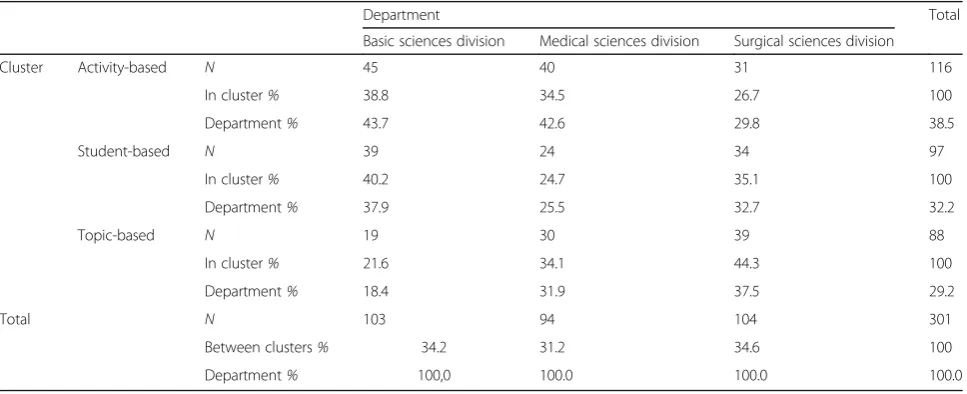
TPACK-Practical scale and demographic information. The results are displayed in Table5.
According to Tables 5, 45 of 116 medical educators (38.8%) from theactivity-basedcluster were working in the basic sciences division, 40 medical educators (34.5%) in the medical sciences division and 31 medical educa-tors (26.7%) in the surgical sciences division. Besides, 39 medical educators (40.2%) from student-based cluster were working in the basic sciences division, 34 medical educators (35.1%) in the surgical sciences division and 24 medical educators (24.7%) in the medical sciences division. Regarding the topic-based cluster, 39 medical educators (44.3%) were working in the surgical sciences division, 30 medical educators (34.1%) in the medical sciences division and 19 medical educators (21.6%) in the basic sciences division.
Fig. 3Mean Scores of the Clusters in Various Areas of the TPACK-Practical Scale
Table 3Correlation Matrix among the Factors of TPACK-Practical and ATT Scales’Factors
Variables 1 2 3 4 5 6 7 8 9 10 11 12 13
TPACK-Practical Scale
1 Using ICT to understand students 1
2 Using ICT to understand subject content .21* 1
3 Planning ICT-infused curriculum .23** .29** 1
4 Using ICT representations .39** .25** .30** 1
5 Using ICT-integrated teaching strategies .29** .42** .29** .52** 1
6 Applying ICT to instructional management .22** .23** .29** .28** .41** 1
7 Infusing ICT into teaching contexts .28** .21** .35** .36** .35** .59** 1
8 Using ICT to assess students .37** .18** .30** .41** .40** .14* .19** 1
Attitude Towards Technology Scale
9 Not using technological tools in education −.07 −.20* −.01 −.01 −.22** −.01 −.02 −.01 1
10 Using technological tools in education .19* .19* −.05 .26** .14** .28** .03 .04 −.35** 1
11 The effects of technology on education life .21** .03 .07 .13* .02 .17* .21** .01 −.34** .74** 1
12 Teaching how to use technological tools .19* .19** .03 .18* .42** .26** 30** .11* −.29** .65** .72** 1
13 Evaluating technological tools .07 .05 .06 .19* .21** .06 .02 26** −.26** .68** .69** .63** 1
According to these results, the hypothesis -“The clus-ters formed according to TPACK-Practical skills of the medical educators and the department where they were working are independent”- was rejected (X2(4)= 81.41; p< .01). Consequently, it can be expressed that the department affect the medical educators’cluster.
H4 hypothesis -“The clusters formed according to
TPACK-Practical skills of the medical educators and their gender distribution are independent”- was tested using the data obtained from the TPACK-Practical scale and demographic information. The results are displayed in Table6.
According to the results, 65 medical educators (56.0%) from the activity-based clusters, 62 medical educators
(63.9%) from thestudent-based clusters and 59 medical educators (67.0%) from the topic-based clusters were female. According to these results, the hypothesis -“The clusters formed according to TPACK-Practical skills of the medical educators and their gender distribution are independent”- was accepted (X2(2)= 1.99; p> .05). As a
result, it can be said that the gender of the medical educators’doesn’t affect their cluster.
Cluster definitions
The three clusters formed via the cluster analysis were compared within themselves and with other clusters in terms of both TPACK-Practical and ATT factors. The outcomes are discussed below.
Table 4The Results of Chi-square Independence Test for the Implementation Status of Simulation-Based Medical Education (SBME) and Medical Educators’Clusters
SBME Total
Not in use In use
Cluster Activity-based N 34 82 116
In cluster% 29.3 70.7 100
SBME% 23.0 53.6 38.5
Student-based N 63 34 97
In cluster% 64.9 35.1 100
SBME% 42.6 22.2 32.2
Topic-based N 51 37 88
In cluster% 58.0 42.0 100
SBME% 34.5 24.2 29.2
Total N 148 153 301
In cluster% 49.2 50.8 100
SBME% 100 100 100
p< .01,X2
= 36.41,DF= 2
Table 5The Results of Chi-square Independence Test for the Department and Medical Educators’Clusters
Department Total
Basic sciences division Medical sciences division Surgical sciences division
Cluster Activity-based N 45 40 31 116
In cluster% 38.8 34.5 26.7 100
Department% 43.7 42.6 29.8 38.5
Student-based N 39 24 34 97
In cluster% 40.2 24.7 35.1 100
Department% 37.9 25.5 32.7 32.2
Topic-based N 19 30 39 88
In cluster% 21.6 34.1 44.3 100
Department% 18.4 31.9 37.5 29.2
Total N 103 94 104 301
Between clusters% 34.2 31.2 34.6 100
Department% 100,0 100.0 100.0 100.0
p< .01;X2= 81.41;DF= 4
Table 6The Results of Chi-square Independence Test for Gender and Medical Educators Clusters
Gender Total
Male Female
Cluster Activity-based N 51 65 116
In cluster% 44.0 56.0 100
Gender% 44.3 34.9 38.5
Student-based N 35 62 97
In cluster% 36.1 63.9 100
Gender% 30.4 33.3 32.2
Topic- based N 29 59 88
In cluster% 33.0 67.0 100
Gender% 25.2 31.7 29.2
Total N 115 186 301
Between clusters% 38.2 61.8 100
Gender% 100 100 100
Activity-based cluster
The activity-based cluster is a big cluster consisting of 116 (38%) medical educators. They got higher scores from practical teaching, especially from skills such as
“Using ICT-integrated teaching strategies” and “Using ICT on education management”. The main characteris-tic, which differentiated this cluster from the others, is the even distribution of the mean scores from the five areas, compared to the other clusters.
Medical educators of the activity-based cluster have higher scores from the following factors compared to the other clusters:“Use of Technological Tools in Educa-tion”, “Impact of Technology on Education”, “Knowing How to Use Technological Tools” and “Evaluation of Technological Tools”. The majority of these medical edu-cators (%70.7) work at schools where simulation-based medical education was implemented. 58%of the medical educators working in the school where the project was implemented fell in to this cluster. Medical educators mostly work at the basic sciences division (34%), and they form 47% of the medical educators working at the basic sciences division. The cluster has a balanced distri-bution in terms of gender.
Student-based cluster
Medical educators falling to in this cluster form approxi-mately 32% of the participants (97 medical educators). They got higher scores from the factor“Using ICT in un-derstanding the learners”. They have lower scores for
“Using ICT to understand subject content” compared to the other clusters. However, these medical educators have high mean scores on the skills about running the technology in the assessment process. Their skill for using the technology in the teaching process is lower than the activity-based cluster. Their attitude towards technology is high. Compared to the topic-based cluster, they are aware of the impact of technology on education and they know well how to use technological tools. 35%
of the medical educators working in the schools where simulation-based medical education was implemented fell in to this cluster. In other words, 64%of these med-ical educators work in schools where simulation-based medical education has not been implemented. In addition, medical educators of these clusters form half of the medical educators working at the basic sciences div-ision. Regarding gender, approximately 59%are female.
Topic-based cluster
The topic-based cluster is the smallest cluster, consisting of 88 medical educators (29%). Medical educators of this cluster give importance to technology usage in the topic area. In terms of teaching the content, they are better than the activity-based and student-based groups. They have the “Ability to use ICTs to better understand the
subject matter content”and the“Ability to identify topic’s themes that could be presented in a better way with ICT”. They know well the appropriate technology to be used for the topics. The attitude towards technology of these medical educators who select the technology ac-cording to topic is lower than in the other clusters. Even though a small proportion of these medical educators work in the schools where simulation-based medical education was implemented, the majority of basic and medical sciences divisions, simulation-based medical education has not been implemented. These divisions are comprised mostly of women (64.7%).
The research addressed the question -“What are the factors affecting the assignment of the medical educators to the clusters that were formed according to TPACK-Practical skills?”- The proposed model tested the H5
hy-pothesis;−“Medical educators’seniority, attitude towards technology, simulation-based medical education’s imple-mentation status in their school, department and gender variables affect their presence in the clusters formed according to TPACK-Practical skills”-. The predictor variables of the model generated in the study were seni-ority, ATTS scores, implementation status of simulation-based medical education, department and gender. The outcome variable of the analysis is being assigned to a cluster. The prediction powers of seniority, attitude to-wards technology, implementation status of simulation-based medical education at their school, department where they work and gender variables were analyzed via
Multinomial Logistic Regression. In order to ensure that
Multinomial Logistic Regressionanalysis explains abnor-mal behaviors, the age variable was not used in the analysis as a predictor variable (See Methodology).
In Table 7, the -2log likelihood fit index shows the fit of the estimated model. This value was found to be 599.1 at the beginning and 458.2 at the end. According to Hair, Balack, Babin, Anderson, and Tatham [23], the difference between the initial and final values of likeli-hood should be evaluated for the interpretation of -2log likelihood difference. According to Table 7, this differ-ence is significant (X2(20)= 140.9;p< .01). Accordingly, it
was concluded that the predictor variables make a sig-nificant contribution to improve the fit of the estimated model.
Table8presents the results of goodness of fit test. Ac-cording to Garson [24], the goodness of fit test evaluates the fit of logistic regression model as a whole. The significance of this test results (p > .05) shows that the
Table 7Model Likelihood Values
−2 Log Likelihood Chi-Square DF p
Intercept only 599.1 140.9 20 .00
model-data fit is at an appropriate level. According to Table 8, the model-data fit of the model is sufficient (X2(573)= 539.5;p> 05).
Corrected R2 values are shown in Table 9. Higher values mean better fit [25]. As can be seen from Table9, this value is .79, which means that the model developed using dependent variables explains the independent vari-able with 79%variance estimation.
The results of the Multinomial Logistic Regression are presented in Table 10. The reference cluster of the
Multinomial Logistic Regression analysis is the activity-basedcluster. According to the results of the Wald test presented in Table 10, it was found that “Teaching how to use technological tools”, which is the fourth factor of the ATT scale, decreases the likelihood of being in the
student-based cluster compared to being in activity-based cluster, which is the reference cluster. One unit increase in the“Teaching how to use technological tools”
factor, causes a 71% decrease [(0.29–1)× 100] on the odds of being in the student-based cluster. In other words, it means that the “Teaching how to use techno-logical tools” factor increases the likelihood of being in
activity-based cluster 3.44 times (OR = 1/0.29 = 3.44), compared to being in thestudent-basedcluster.
According to the Wald test, the lack of implementa-tion of simulaimplementa-tion-based medical educaimplementa-tion in medical educators’ schools increases the likelihood of being in the student-based cluster 4.3 times (OR = 4.38). This finding can be expressed as follows: the implementation of simulation-based medical education increases the likelihood of being in the activity-based cluster 4.38 times. In addition, working in primary schools in-creases the likelihood of being in the student-based
cluster (compared to activity-based cluster) 17.01 times (OR = 17.01).
According to the Wald test, “Using technological tools in education” and “Teaching how to use technological tools”, which are the second and fourth factors of the ATT scale, have an increasing effect of being in the
topic-based cluster compared to the reference cluster by approximately 1.91 (OR = 1.91) and 2.38 (OR = 2.38)
times, whereas “Evaluating technological tools”, which is the fifth factor, leads to a 61.1%decrease [(0.39–1)× 100] on the odds of being in thetopic-basedcluster.
Regarding the variable featuring the workplace of the medical educators, working in the basic sciences division increases the likelihood of being in thetopic-based clus-ter by 4.87 times (OR = 4.87) compared to being in the
activity-basedcluster.
Discussion
Clusters formed based on the TPACK-practical skills of the medical educators and their characteristics and discussion
It was found that, in terms of technology integration medical educators were grouped under 3 clusters and the developed model predicted 83%of the cluster mem-bership. In addition it was found that these clusters were not correlated with gender, but significant relationships were identified between the cluster of the medical educators and their school type and the implementation status of simulation-based medical education in their school.
The review of the clusters and their characteristics showed that there are similarities between the items that are used in the design stage of the education programs and the relationships of these items among them. Learner centered approaches are based on the assump-tion that students are located at the center of the pro-gram. In these designs, teaching focuses mostly on the learner, rather than the program, learning or administra-tive body. Individuals and their identities are crucial [26]. According to Ornstein and Hunkings [27], in this design students need the methods and materials used in different subject areas while solving the problems that they encounter. The review of the student-based cluster’s characteristics obtained from the research shows that medical educators achieved high scores on the “Using ICT to understand students” factor. Accordingly, it can be said that medical educators who belong to the cluster that places students at the center of teaching (such as learning disability, individual differences, understanding the students), learner centered program design, imple-mentation process and assessment.
Considering the characteristics of the students-based cluster, they are mainly composed of medical educators working in basic sciences divisions. In addition, this cluster was dominated by female medical educators. Regarding topic-centered approaches, schools following this design have a strong academic rationalism. The effectiveness of the textbooks and medical educator training are important. In the design of the subject area, which is one of the topic-centered designs, the underlining idea is that topics are held the best in the textbooks. In topic design the content is empha-sized, and students’ interests, needs and lives are put
Table 8Results of Goodness of Fit Test
Goodness of Fit
Chi-Square DF p
Pearson 539.5 573 .18
Deviance 417.3 573 .91
Table 9Corrected R2Values
CorrectedR2
Cox and Snell .79
on the back burner [27]. According to the results of the study, the topic-based cluster achieved a higher mean on the use of technology for the subject area, compared to other clusters. Regarding the characteris-tics of the activity-based cluster, it can be seen that these medical educators understood the importance of technological tools and equipment on the technology integration process and they possess adequate mater-ial about how to run technology in education.
The characteristics of the clusters discussed above within the context of TPACK-Practical, can be explained according to the approach suggested by Mandinach and Cline [28], which was proposed within the context of ICT usage stages in the process of technological integra-tion and which considered individual differences on the dissemination of the innovations in schools. This approach argues that individual characteristics are im-portant in the dissemination of educational technology
in schools and the individual may be at one of four different stages. These stages are expressed as survival, mastery, impact and innovation. At the survival stage, medical educators attempt to use technology by trial and error, while maintaining their positions in the class-rooms. At the mastery stage, their technical abilities increase, new forms of interaction appear, new learning strategies and different curriculum models are devel-oped, and consequently they become less dependent on field specialists. At the impact stage, classrooms become more student centered, and thus the variety of techno-logical learning activities and the use system applications increase. And finally when the innovation stage is reached, medical educators restructure the curriculum and learning activities, and carry the operations and the content to a more advanced level [28]. This approach, which can explain topic-based and student-based clusters, is not very descriptive for activity-based medical
Table 10Results of the Multinomial Logistic Regression
Ward Method B Std. Error Wald DF p Exp(β)
Student-based Intercept −3.11 1.11 7.98 1 .00
Seniority .03 .03 1.78 1 .21 .92
ATT1 −.23 .19 1.09 1 .33 .81
ATT2 .39 .31 2.35 1 .15 1.45
ATT3 .58 .41 2.89 1 .09 1.93
ATT4 −1.12 .38 8.78 1 .00 .29
TTF5 .39 .27 1.86 1 .22 1.42
[SBME = not in use] 1.49 .59 5.79 1 .00 4.38
[SBME = in use] 0b – – 0 – –
[Basic sciences division] 2.70 .69 13.96 1 .00 17.01
[Medical sciences division] −.61 .64 .77 1 .41 .49
[Surgical sciences division] 0b
– – 0 – –
[Female] .25 .35 .51 1 .53 1.31
[Male] 0b – – 0 – –
Topic-based Intercept −3.29 1.21 8.29 1 .00
Seniority .04 .04 .87 1 .41 .91
ATT1 −.37 .25 3.36 1 .09 .71
ATT2 .58 .31 4.38 1 .01 1.91
ATT3 .38 .35 .77 1 .41 1.53
ATT4 −1.28 .37 12.12 1 .00 .39
ATT5 .71 .34 5.32 1 .00 2.38
[SBME = not in use] .65 .61 1.17 1 .32 2.01
[SBME = in use] 0b – – 0 – –
[Basic sciences division] 3.88 .75 28.86 1 .00 4.87
[Medical sciences division] .79 .65 1.64 1 .26 2.17
[Surgical sciences division] 0b – – 0 – –
[Female] .48 .39 1.74 1 .21 1.43
educators who were mostly working at the schools where simulation-based medical education was imple-mented. The reason for this may be the external direct support (in-service training, software, technical informa-tion, educational design, etc.) provided at survival and mastery stages and the influence of the factors outside of school. According to Jen, Yeh, Hsu, Wu and Chen [29], TPACK-Practical is developed based on experiences of teaching with technology and instructional reflection, and neither academic nor application TPACK-Practical can effectively be enhanced when technology are not implemented or experimented within classrooms.
Results about the factors affecting the assignment of the medical educators to the clusters formed according to TPACK-practical skills and discussion
In the study, the factors, which affect the assignment of the medical educators to the clusters formed according to TPACK-Practical skill, were examined, and it was found that“Teaching how to use technological tools”and the implementation of simulation-based medical educa-tion increases the likelihood of being in the activity-based cluster, compared to being in the student-activity-based cluster. This fact can be explained as the positive affect of the technological infrastructure and the trainings pro-vided after the implementation of simulation-based medical education. Having the ability of using techno-logical tools enables medical educators to make import-ant progress in fulfilling their shortcomings of technological knowledge. Researches shows that medical educators who acquired hi-level technology usage skills are more willing to use technology in their classrooms [30, 31]. Yavuz-Konokman, Yanpar-Yelken and Sancar-Tokmak [32] stated that TPACK perceptions of the medical educators differ according to the level of tech-nology usage. Chai et al. [33] suggested that individuals who follow the development speed of ICT can integrate these technologies with pedagogical values more easily for teaching purposes. According to there was no rela-tionship between how medical educators were thinking about technology integration and their self-assessment of technology integration competence. Accordingly, it can be said that simulation-based medical education and the training received in the way of gaining TPACK skills made an important contribution to the medical educa-tors of the activity-based cluster in reaching the point of technology integration that they have arrived. Regarding the results of the research, it was found that working in primary schools increases the likelihood of being in student-based and topic-based clusters compared to be-ing in the activity-based one. This fact is an indication that the technology integration process follows a differ-ent path in these schools, compared to activity-based cluster’s medical educators. It may be because the
implementation of simulation-based medical educations varies according to department and it is different in the clusters as well. The evaluation of technological tools, which affect being in the topic-based cluster, shows that these medical educators put place an emphasis on the topic in of technology integration and they evaluate the tools in terms of the value of the gains for these topics.
Conclusion
theory. Medical educators’ attitude towards technology and the effects of this attitude on the sub-factors can be explained by the internalization principle, whereas the technological equipment that medical educators get with the implementation of simulation-based medical educa-tion, which affected their TPACK-Practical performance, can be explained by the externalization principle. The usage of ICT as a tool for realizing educational goals of the learning-teaching process is supported by the principle of mediation, whereas the acceptance of inte-gration as a process, not as an event, and the require-ment of long terms examinations is in line with the principle of development. According to Demiraslan and Koçak-Usluel [36], ICT integration and the TPACK process form a dynamic system. Therefore, it is import-ant to reveal future trends via the examination of the past and present status of the process and make com-ments about the process by monitoring the changes.
Directions for future research and limitations
The suggestions developed for TPACK research, medical educator training process technology integration and affective teaching, and future studies are as follows:
Further studies featuring the factors that may affect TPACK factors, other than gender, department, seniority and attitude towards technology, can be conducted to fulfill the gap in the literature. Designing qualitative studies aiming to determine
technology integration of the medical educators in terms of TPACK skills may reveal the role of the variables affecting integration processes.
The provision of technological infrastructure and software required for the improvement of assessment skills, accompanied with an adequate training about the application.
The position and importance of the technology should be explained to the medical educators and they should be convinced that the technology integration process is not limited to school life. Prior to in-service training, medical educators can
be classified according to TPACK components; in-service training can be tailored according to the contribution of these components to TPACK.
It should be noted that the collection of the data by self-reporting might have caused subjectivity and distor-tion of the reladistor-tionships between variables. The most im-portant limitation of this study is the common method bias. The main reason of this limitation is the collection of the data from a single source (medical educators). This might have caused an artificial increase of the observed correlations. Although the aforementioned limitation cannot be fully eliminated from the study, the
errors can be reduced to the minimum level. Therefore, the necessary precautions were taken during the data collection phase via the applications suggested at the beginning of the paper. First of all, the validity and reli-ability of the scales used in data collection stage were checked. Second, the participants were clearly informed that the responses would be kept confidential and they would not be revealed in any way. In addition the ques-tionnaire is designed in a way that the scale items related to independent variables are listed before the ones related to dependent variables.
Abbreviations
ATTS:Attitude towards Technology Scale; ICT: Information and Communication Technology; PCK: Pedagogical Content Knowledge; TCK: Technological Content Knowledge; TPACK: Technological Pedagogical Content Knowledge; TPK: Technological Pedagogical Knowledge
Acknowledgements
The author wants to thank participants for their invaluable contributions.
Authors’contributions
The author read and approved the final manuscript.
Funding
No funding to disclose.
Availability of data and materials
All data generated or analyzed during this study are included in this manuscript. The raw or analyzed data of the current study are available on reasonable request.
Ethics approval and consent to participate
The study was approved by the Research Committee of Health Sciences (2018/3). All students were informed that participation was voluntary and that they could withdraw from the study. They gave informed verbal consent to participate in the study.
Consent for publication
The voluntary participation and verbal consent of the participant students reveal their consent for publication.
Competing interests
The authors declare that they have no competing interests.
Received: 6 December 2018 Accepted: 11 June 2019
References
1. Rogers E. Diffusion of innovations. New York: Free Press; 2003. 2. Abbitt J. Measuring technological pedagogical content knowledge in
preservice teacher education: a review of current methods and instruments. J Res Technol Educ. 2011;43(4):281–300.
3. Doering A, Scharber C, Miller C, Veletsianos G. GeoThentic: Designing and assessing with technological pedagogical content knowledge. Contemp Issues Technol Teach Educ. 2009;9(3):316–36.
4. Graham C, Burgoyne N, Cantrell P, Smith L, Clair L, Harris R. TPACK development in science teaching: measuring the TPACK confidence of inservice science teachers. TechTrends. 2009;53(5):70–9.
5. Alinier G. A typology of educationally focused medical simulation tools. Medical Teacher. 2007;29:243–50.
6. Patrik J. Simulation. In: Training: research and practice. London: Academic Press; 2002. p. 487–508.
7. Bradley P. The history of simulation in medical education and possible future directions. Med Educ. 2006;40:254–62.
9. Kneebone R. Simulation in surgical training: educational issues and practical implications. Med Educ. 2003;37:267–77.
10. Weller J. Simulation in undergradute medical education: bridging the gap between theory and practice. Med Educ. 2004;38:22–38.
11. Yeh Y, Lin T, Hsu Y, Wu H, Hwang F. Science teachers’proficiency levels and patterns of TPACK in a practical context. J Sci Educ Technol. 2015;24(1):78–90.
12. Koehler M, Mishra P. What happens when teachers design educational technology? The development of technological pedagogical content knowledge. J Educ Comput Res. 2005;32(2):131–52.
13. Angeli C, Valanides N. Epistemological and methodological issues for the conceptualization, development, and assessment of ICT–TPCK: advances in technological pedagogical content knowledge (TPCK). Comput Educ. 2009; 21(4):154–68.
14. Koehler M, Mishra P. What is technological pedagogical content knowledge. Contemp Issues Tech Teach Educ. 2009;9(1):60–70.
15. Koh J, Chai C, Tsai C. Examining practicing teachers’perceptions of technological pedagogical content knowledge (TPACK) pathways: a structural equation modeling approach. Instr Sci. 2013;41:793–809. 16. Van-Driel J, Verloop N, De-Vos W. Developing science teachers’pedagogical
content knowledge. J Res Sci Teach. 1998;35(6):673–95.
17. Yeh Y, HsU Y, Wu H, Chien S. Exploring the structure of TPACK with video-embedded and discipline-focused assessments. Comput Educ. 2017;104:49–64.
18. Jang S, Chen K. From PCK to TPACK: developing a transformative model for pre- service science teachers. J Sci Educ Technol. 2010;19(6):553–64. 19. Yeh Y, Hsu Y, Wu H, Hwang F, Lin T. Developing and validating
technological pedagogical content knowledge-practical (TPACK-practical) through the Delphi survey technique. Br J Educ Technol. 2013;44(6):1–16.
20. Creswell J. Educational research: planning, conducting, and evaluating quantitaive and qualitative research NY: Pearson; 2005.
21. Yavuz S. Developing a technology attitude scale for pre-service chemistry teachers. Turk Online J Educ Technol. 2005;4(1):17–25.
22. Romensburg H. Cluster analysis for researchers. Belmont: Lifetime Learning Publications; 1984.
23. Hair J, Black W, Babin B, Anderson R, Tatham R. Multivariate data analysis upper. Saddle River: Pearson Prentice Hall; 2006.
24. Garson G. Discriminant function analysis; 2008.
25. Field A. Discovering statistics using SPSS for Windows. London: Sage Publication; 2005.
26. Dolance M. The learner-centered curriculum model. A structured framework for technology planning. Center Appl Res. 2003;23(3):321–35.
27. Ornstein A, Hunkins F. Curriculum: foundations, principles, and issues. Boston: Allyn and Bacon; 1998.
28. Mandinach E, Cline H. Classroom dynamics: implementing a technology-based learning environment. Hillsdale: Lawrence Erlbaum Associates; 1994.
29. Jen T, Yeh Y, Hsu Y, Wu H, Chen K. Science teachers’TPACK- practical: standard-setting using an evidence-based approach. Comput Educ. 2016;95:45–62.
30. Hammond M, Fragkouli E, Suandi I, Crosson S, Ingram J, Johnston-Wilder P, et al. What happens as student teachers who made very good use of ICT during pre-service training enter their first year of teaching. Teach Dev. 2009;13(2):93–106.
31. Paraskeva F, Bouta H, Papagianna A. Individual characteristics and computer self-efficacy in secondary education teachers to integrate technology in educational practice. Comput Educ. 2008;50(3):1084–91.
32. Yavuz-Konokman G, Yanpar-Yelken T, Sancar-Tokmak H. Sınıf öğretmeni adaylarının TPAB’lerine ilişkin algılarının çeşitli değişkenlere göre incelenmesi: Mersin üniversitesi örneği. Kastamonu Eğitim Fakültesi Dergisi. 2012;21(2):665–84.
33. Chai C, Koh J, Tsai C, Tan L. Modeling primary school pre-service teachers’ technological pedagogical content knowledge (TPACK) for meaningful learning with information and communication technology (ICT). Comput Educ. 2011;57(1):1184–93.
34. Nardi B. Context and consciousness: activity theory and human computer
ınteraction. Cambridge: The MIT Press; 1996.
35. Minnis M, Steiner V. Are we ready for a single,ıntegrated theory?. Essay Review of Perspectives on Activity Theory; 2000.
36. Demiraslan Y, Koçak-Usluel Y. Bilgi ve iletişim teknolojilerinin öğ renme-öğretme sürecine entegrasyonunda öğretmenlerin durumu. Turkish Online J Educ Technol. 2005;4(3):119–23.
Publisher’s Note