Graph-based Patterns for
Local Coherence Modeling
vorgelegt von
Mohsen Mesgar
Coherence is an essential property of well-written texts. It distinguishes a multi-sentence text from a sequence of randomly strung sentences. The task of local coherence modeling is about the way that sentences in a text link up one another. Solving this task is beneficial for assessing the quality of texts. Moreover, a coherence model can be integrated into text generation systems such as text summarizers to produce coherent texts.
In this dissertation, we present a graph-based approach to local coherence modeling that accounts for the connectivity structure among sentences in a text. Graphs give our model the capability to take into account relations between non-adjacent sentences as well as those between adjacent sentences. Besides, the connectivity style among nodes in graphs reflects the relationships among sentences in a text.
We first employ the entity graph approach, proposed by Guinaudeau and Strube (2013), to represent a text via a graph. In the entity graph representation of a text, nodes encode sentences and edges depict the existence of a pair of coreferent mentions in sentences. We then devise graph-based features to capture the connectivity structure of nodes in a graph, and accordingly the connectivity structure of sentences in the corresponding text. We extract all subgraphs of entity graphs as features which encode the connectivity structure of graphs. Frequencies of subgraphs correlate with the perceived coherence of their corresponding texts. Therefore, we refer to these subgraphs as coherence patterns.
In order to complete our approach to coherence modeling, we propose a new graph represen-tation of texts, rather than the entity graph. Our approach employs lexico-semantic relations among words in sentences, instead of only entity coreference relations, to model relationships between sentences via a graph. This new lexical graph representation of texts plus our method for mining coherence patterns make our coherence model.
We evaluate our approach on the readability assessment task because a primary factor of readability is coherence. Coherent texts are easy to read and consequently demand less ef-fort from their readers. Our extensive experiments on two separate readability assessment datasets show that frequencies of coherence patterns in texts correlate with the readability rat-ings assigned by human judges. By training a machine learning method on our coherence
systems, we show how our coherence patterns can be integrated into a graph-based text sum-marizer to produce informative and coherent summaries. Our coherence patterns improve the performance of the summarization system based on both standard summarization metrics and human evaluations. An implementation of the approaches discussed in this dissertation is publicly available1.
Kohärenz ist eine wesentliche Eigenschaft von gut geschriebenen Texten. Sie unterscheidet einen Text mit mehreren Sätzen von einer Folge von zufällig aufgereihten Sätzen. Bei der Auf-gabe der lokalen Kohärenzmodellierung geht es darum, wie Sätze in einem Text miteinander verbunden sind. Die Lösung dieser Aufgabe ist nützlich für die Bewertung von Textqualität. Außerdem kann ein Kohärenzmodell in Textgenerierungssystemen wie z.B. Textzusammen-fassungssystemen integriert werden, um zusammenhängende Texte zu erzeugen.
In dieser Doktorarbeit präsentieren wir einen graphbasierten Ansatz zur lokalen Kohärenz-modellierung, welcher die Verbindungsstruktur unter den Sätzen in einem Text darstellt. Die Graphen geben unserem Modell die Fähigkeit, sowohl die Verbindungen zwischen benachbar-ten als auch zwischen nicht benachbarbenachbar-ten Sätzen zu berücksichtigen. Darüber hinaus spiegelt der Verbindungsstil unter Knoten in Graphen die Beziehungen zwischen den Sätzen in einem Text wider.
Zuerst verwenden wir den von Guinaudeau und Strube (2013) entwickelten Entity-Graph-Ansatz, um einen Text durch einen Graphen darzustellen. In diesem Ansatz werden Sätze durch Knoten repräsentiert, und Kanten zwischen Knoten repräsentieren koreferente Aus-drücke in zwei Sätzen. Danach entwickeln wir graph-basierte Eigenschaften zum Erfassen der Verbindungsstruktur von Knoten in einem Graphen, und von den Sätzen im dazugehörigen Text. Wir extrahieren alle Untergraphen der Entity-Graphen als Merkmale, die die Verbin-dungsstruktur der Graphen repräsentieren. Die Häufigkeit der Untergraphen korrelieren mit der wahrgenommenen Kohärenz ihrer entsprechenden Texte. Deshalb beziehen wir uns auf diese Untergraphen als Kohärenzmuster.
Um unseren Ansatz zur Kohärenzmodellierung zu vervollständigen, schlagen wir als Alter-native zum Entity-Graphen eine neue Graphrepräsentation von Texten vor. Unser Ansatz nutzt lexiko-semantische Beziehungen zwischen Wörtern, und nicht nur Koreferenzbeziehungen, um semantische Beziehungen zwischen Sätzen als Graph zu Modellieren. Diese neue lexika-lische Graphrepräsentation von Texten plus unsere Methode für die Kohärenzmusterextraktion bildet unser Kohärenzmodell.
Durch umfangreiche Versuche auf zwei verschiedenen Datensätzen zur Lesbarkeitsbewertung untersuchen wir die Korrelation zwischen den Häufigkeiten der Kohärenzmuster in Texten und von menschlichen Subjekten vorgenommenen Lesbarkeitsbewertungen.
Durch das Trainieren eines maschinellen Lernverfahrens auf unseren Kohärenzmustern über-trifft unser Modell seine Gegenstücke im Bewerten von Texten hinsichtlich ihrer Lesbarkeit. Da eines der eigentlichen Ziele der Kohärenzmodellierung der Einsatz in Texterzeugungssys-temen ist, zeigen wir, wie unsere Kohärenzmuster in ein graphbasiertes Textzusammenfas-sungssystem zum Erzeugen von informativen und kohärenten Zusammenfassungen integriert werden kann. Unsere Kohärenzmuster verbessern die Leistung des Zusammenfassungssys-tems basierendn auf sowohl Standardzusammenfassungsmetriken als auch auf menschliche Bewertungen. Eine Implementierung der in dieser Doktorarbeit diskutierten Ansätze ist öf-fentlich verfügbar2.
First and foremost, I would like to thank my supervisor, Michael Strube. It has been an honor for me to be a Ph.D. student of Michael. He is a true mentor, who has guided me in how to perform and present fascinating research. I appreciate all of his contributions of time, ideas and motivations to make my Ph.D. experience productive and stimulating. Moreover, his patient and careful editing of my research papers have considerably improved my skills in scientific writing and presentation.
I give my gratitude to Anette Frank, Katja Markert, and their team members for their useful comments and questions about my research during my presentations in the Ph.D. colloquium series at Heidelberg University. I am eternally grateful to Katja Markert for agreeing to be the second reviewer of this dissertation.
Many thanks to the Klaus Tschira Foundation for financially supporting me by a Ph.D. scholarship during the time that I was conducting my research at the Heidelberg Institute for Theoretical Studies (HITS). I appreciate the German Research Foundation as part of the research training group “Adaptive Preparation of Information from Heterogeneous Sources” (AIPHES) for supporting me, as one of its associate researchers, to travel to a conference in the U.S. for presenting one of my papers, which is used in the research of this dissertation.
I want to express my heartfelt gratefulness to all HITS members for providing a friendly and inspiring environment. In particular, I thank my colleagues in the natural language processing (NLP) group at HITS: Alex Judea, Angela Fahrni, Benjamin Heinzerling, Daraksha Parveen, Nafise Moosavi, Mark-Christoph Müller, and Sebastian Martschat. People who were the first that listened to my research ideas and the last that read my papers before submissions.
My sincere thanks also go to Holger Gebert, one of the leaders of the NLP projects at SAP SE in Germany, and Ashish Gard, the manager of the Siri team at Apple Inc. in the U.S., for providing me an opportunity to join their teams as an intern. They gave me access to the laboratory and research facilities to deepen my knowledge of NLP and machine learning.
Last but not least, I want to thank my family and friends, who have always been supportive. Individually, my heartfelt thanks are for my spouse Shaghayegh Tavafi for all of her lovely supports in all easy and challenging moments of our residency in Germany.
1 Introduction 1
1.1 Motivation and Research Questions . . . 2
1.2 Contributions . . . 3
1.3 Outline . . . 4
1.4 Published Work . . . 5
2 Coherence Modeling 7 2.1 Problem Definition . . . 7
2.2 The Linguistics of Coherence . . . 9
2.3 Evaluation . . . 18
3 Related Work 21 3.1 Entity-based Approaches to Local Coherence . . . 21
3.2 Lexical Approaches to Local Coherence . . . 35
3.3 Applications and Evaluations of Coherence Models . . . 41
4 Graph-based Coherence Patterns 47 4.1 Why Graph-based Patterns? . . . 47
4.2 Coherence Pattern Extraction . . . 49
4.3 Coherence Modeling . . . 55
4.4 Experiments . . . 56
4.5 Summary . . . 86
5 Lexical Cohesion Graph 89 5.1 Lexical Cohesion . . . 89
5.2 LexGraph . . . 91
5.3 Coherence Pattern Mining . . . 94
5.4 Smoothing . . . 95
5.6 Summary . . . 109 6 Conclusions 113 6.1 Contributions . . . 113 6.2 Future Work . . . 114 List of Figures 117 List of Tables 119 List of Algorithms 121 Bibliography 123
Research in natural language processing intends to provide models for understanding and generating texts. One crucial aspect in the processing of multi-sentence texts iscoherence: How sentences in such a text are related to one another to make the text a whole. As an example, consider the following text snippet1:
(1) A total of 248 people, including a dozen Americans, were killed in the terror-ist bombing of the U.S. Embassy in Nairobi on August 7, 1998. A twin attack on the U.S. Embassy in Tanzania killed 11 people, all Africans. Osama bin Laden is the suspected mastermind of the bombings. Through the Saudis, the United States asked the Taliban, the Islamic movement that controls most of Afghanistan, to deport bin Laden, but they refused. Evidence suggests that the terror suspects accused in the bombings, regardless of their nationality or place of residence, are associates of bin Laden or associated with terrorist groups under his control.
The above text is a summary which is provided by a human from several documents. All sentences are attached together in a way that the whole text conveys a meaning. The first sen-tence gives some information about a “bombing”. The second sensen-tence takes this information and expands it to another instance. The third sentence uses the given information (“bombing”) from its preceding sentences to introduce “Osama bin Laden” as new information. The rest of the sentences follow a similar structure of relationships. The text below2is a summary which
is generated automatically from the same cluster of documents. It is less coherent than the text in Example (1), as its sentences are weakly related to each other.
(2) Solemn-faced Kenyans, whose relatives were killed in the terrorist bombing of a U.S. Embassy, collected benefits on Friday. They said failed to compen-sate for their losses. Nearly two months after the bombings of the American 1Article D31038.M.100.T.B Taken from http://homepages.inf.ed.ac.uk/mlap/coherence/
accessed 28 May 2018.
2Article D31038.M.100.T.16 taken from http://homepages.inf.ed.ac.uk/mlap/coherence/
Embassies in Kenya and Tanzania, a picture of those charged in the case is slowly emerging. Nine months before the attack on the American Embassy here, U.S. intelligence officials received a detailed warning that Islamic rad-icals were plotting to blow up the building, according to Kenyan and Ameri-can officials.
A coherence model should first represent how sentences in a text are related to each other. It then uses the structure of relations to ideally rank and distinguish texts with respect to their perceived coherence. For example, consider the text snippets in Example (1) and Example (2), a coherence model should ideally rank the former text higher, in terms of coherence, than the latter one.
As it has been shown in the above examples, applications of a coherence model are in downstream tasks in natural language processing. One example is in readability assessment, in which coherence is employed as an essential factor in measuring the quality of texts. Co-herent texts avoid confusion, so they are easy to read and follow. Another example is in text summarization, which can employ a coherence model in two ways: First, a coherence model can be used for evaluating the quality of outputs of automatic summarizers. In this case, the usage of coherence models for the summarization task is similar to their usage in general text quality assessment. Second, a coherence model can as one component be integrated into summarization systems to generate coherent summaries directly.
In the research presented in this dissertation, we aim to develop a computational model for text coherence. We also intend to evaluate our coherence model in extrinsic applications. In the remainder of this chapter, we take a further look into the motivation of the research con-ducted in this thesis and formulate main research questions (Section 1.1), briefly explain our contributions (Section 1.2), present the outline of this dissertation (Section 1.3), and describe which parts of this dissertation were published (Section 1.4).
1.1 Motivation and Research Questions
As we have described above, the goal of computational coherence models is to compare texts with respect to their coherence. It suggests that there should be certain features which are characteristic of coherent texts while these features are absent in incoherent texts. In the lit-erature, we encounter different sets of features relying on relations which are extracted from a text. One type of relations prominently employed by coherence models is coreference. In such coherence models, relations among sentences represent the existence of noun phrases
that refer to the same entity in sentences. The underlying premise of these models is that co-herent texts reveal specific patterns in their relations. However, these models predefine and limit patterns to linear relations over adjacent sentences. This observation leads us to the first research question investigated in this dissertation:Do there exist nonlinear connectivity pat-terns in coherent texts that take long-distance relations into account? If we can answer this question by discovering frequent patterns, which involve long-distance relations, in coher-ent texts, a follow-up question arises, which is how the frequencies of these patterns correlate with the quality of texts. Another question is whether these features improve the performance of downstream natural language processing systems. The answers to these questions help to learn how coherence patterns proposed in the research in this dissertation compete with their peers, where they are evaluated in coherence related downstream tasks.
In order to develop a robust computational coherence model, we not only need an approach to extract coherence patterns, which represent connectivity structures of sentences, but we also require a computational method to encode semantic relations between sentences. Sen-tence relations are not limited to coreference between referring expressions in senSen-tences; other semantic relations such as synonymy and antonymy among words in sentences can connect sentences as well. This fact motivates our second research question:How can we model sen-tence relations in a text beyond coreference relations over entities by means of semantic relations among words of sentences?In order to answer this question, we first need to define appropriate word representations. Word representations should give the model the capability to quantify lexico-semantic relations between words. The model is then required to encode connections between sentences based on the words that are semantically related. Finally, given such representations of relations among sentences in a text, we can use our approach to coher-ence pattern extraction for modeling the connectivity structure of sentcoher-ences in texts. By such patterns, we then rank texts concerning their coherence.
1.2 Contributions
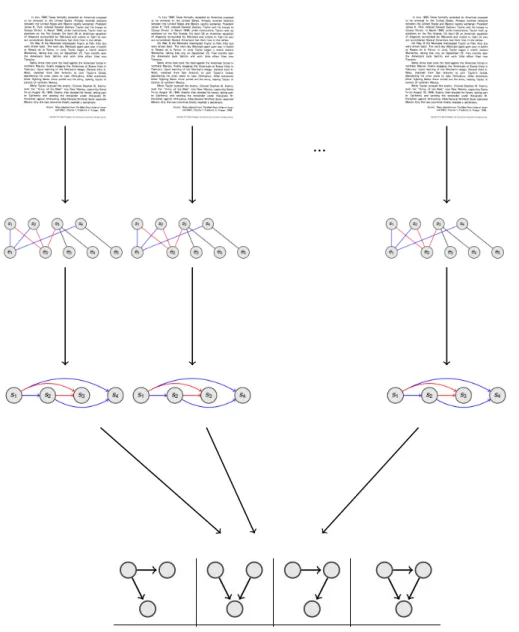
We answer the first question by introducing a graph-based representation of coherence pat-terns. The graph representation empowers our coherence model to take long-distance relations as well as relations among adjacent sentences into account. It further captures the connectiv-ity style of relations among sentences. In such graphs, nodes encode sentences, and edges capture relationships between sentences. Then, we formulate the task of extracting coherence patterns from a set of texts as a subgraph mining problem from a set of graphs. We show how frequencies of subgraphs in a graph capture the connectivity style of nodes in the graph
and consequently the coherence of the corresponding text. We illustrate how frequencies of patterns in texts correlate with the quality ratings that are assigned to those texts by human judges.
We answer the second question by motivating and developing an approach to coherence modeling based on lexical relations. This approach represents relations among sentences via a graph. Nodes in such graphs represent sentences, and edges represent the existence of lexico-semantic relations among words in sentences. We explain how word embeddings are em-ployed to quantify the strength of semantic relations between words in sentences. We show that applying subgraph mining methods on such graph representations of texts leads to pre-dictive coherence patterns. We further investigate the impact of the size of subgraphs on the performance of patterns. We discuss that the frequencies of large subgraphs highly correlate with the quality of texts as they are more informative about connectivity structures of graphs in comparison to small subgraphs. However, most of the large subgraphs only occur in a few graph representations of texts resulting in a sparsity problem. We show how smoothing meth-ods, which are applied in statistical language models, can be adapted to solve this sparsity problem in the frequency of coherence patterns.
The implementation of graph representations, subgraph mining approaches, and the smooth-ing method discussed in this thesis are publicly available3.
1.3 Outline
The remainder of this thesis is organized into five chapters.
In Chapter 2, we discuss the task of coherence modeling in detail. We give a formal defi-nition of coherence modeling. Furthermore, we address linguistic properties, primary issues, and evaluation approaches.
In Chapter 3, we review the related work on which we mainly built our coherence model. We survey different tasks that have been employed to evaluate the coherence models presented in the research in this dissertation.
In Chapter 4, we present our approach to coherence pattern mining. We recast the problem of coherence pattern mining as extracting frequent subgraphs in graph representations of texts. We assess the usefulness of coherence patterns on the readability assessment task. We show how coherence patterns extracted from a set of news articles correlate with their readability ratings assigned by human judges. We observe that the frequencies of patterns as features,
which encode coherence, are more predictive than other examined features for ranking texts concerning their coherence. A fundamental analysis of the size of extracted subgraphs leads us to the observation that by increasing the number of nodes in subgraphs the predictive power of coherence patterns for ranking texts improves. We furthermore evaluate our approach to coherence pattern mining in the summarization task. We show how subgraphs extracted from coherent summaries can improve the performance of an automatic summarization system to produce more coherent summaries.
In Chapter 5, we propose a graph-based representation method for modeling coherence based on lexico-semantic relations between words in sentences. We show that coherence patterns extracted from such graphs are more beneficial for the readability assessment task in comparison to the patterns extracted from the entity graph representations of texts. We investigate broader about the quality of coherence patterns extracted from such lexical graph representations of texts and the influence of their size on the overall performance of the model. We explain the sparsity problem in the frequencies of subgraphs and its impacts on the perfor-mance of our coherence model. Following smoothing methods utilized in statistical language models, we introduce an approach to solve the sparsity problem in graphs.
In Chapter 6, we summarize the answers that the research presented in this dissertation gives to the research questions formed in Section 1.1. Furthermore, we discuss possible research avenues for future work.
1.4 Published Work
Most research presented in this thesis is an extension of published research first-authored by the author of this thesis. Some parts of the presented research originated from the published research to which the author of this dissertation contributed.
The idea of using subgraphs as coherence patterns, presented in Chapter 4, was published in Mesgar and Strube (2015). A preliminary investigation of graph-based coherence mod-eling was presented in Mesgar and Strube (2014). The application of coherence patterns in summarization, also presented in Chapter 4, is published in Parveen et al. (2016). Our lexical approach to local coherence modeling, and the smoothing method, which both are described in Chapter 5, are proposed in Mesgar and Strube (2016). A follow-up paper to the research presented in this dissertation is published in Mesgar and Strube (2018).
Local coherence modeling with varying specifications over the years is a crucial task for nat-ural language processing. This chapter provides definitions related to this task as it is tackled in the research presented in this dissertation. We formally define the problem of coherence modeling (Section 2.1) and then explain the linguistics of coherence (Section 2.2). Finally, we discuss our evaluation approach for assessing the coherence models (Section 2.3) presented in this dissertation.
2.1 Problem Definition
In this research, we tackle the problem of local coherence modeling. The simplified definition of this task is to model how text units (or segments) in a text are related to one another. This task has been the focus of the majority work in text processing (see Chapter 3). Variations of this task consider different types of relations, such as rhetorical (Hovy and McCoy, 1989) or lexical (Morris and Hirst, 1991), between different spans of texts, such as clauses (Strube, 1998) or sentences (Halliday and Hasan, 1976), in various text types, such as dialogue (Wang et al., 2013) or monologue (Barzilay and Lapata, 2008). Here we formally define this task as it is investigated in this research with the goal to use this definition for establishing the next chapters of this dissertation.
2.1.1 Formal Modeling
In order to provide a formal definition of the task, i.e. local coherence modeling in texts, we first need to define what we refer to as a text. In this research, we assume that a text consists of two sentences or more.
Definition 1. TextT is a sequence of a finite number of sentences[s0, s1, s2, ..., sn], where the
number of sentences is greater than 1.
Definition 2. Sentence si is a sequence of words [w0, w1, w2, ..., wn] that forms a sentence
structure in a text.
An underlying assumption in research on text processing is that a text is more than the sum of its sentences (Webber et al., 2012). It is not sufficient to collect an arbitrary sequence of sentences in order to obtain a text. Sentences in a text are supposed to be related to one another to make a whole. Therefore, a relationship function is required to check if two sentences are related.
Definition 3. Relationship functionR(si, sj)indicates whether two sentences si and sj in a
text are related. The domain of this function is a pair of sentences, and its range is a number.
The output of the relationship function indicates the strength of the relation between the input sentences. The output of this function can, however, be limited to a binary value{0,1}. In this case, the value indicates if there is a relationship between sentences or not.
Given the above definition of the relationship function, relationships across all sentences in a text can be represented by a setP, which contains all relationships between any pair of sentences in the text.
Definition 4. Letrij =R(si, sj)indicate the relationship between a sentence pair (si, sj)in
a textT; the setP ={rij|(si, sj)∈T2, i6=j}contains allrij for any pair of sentences inT.
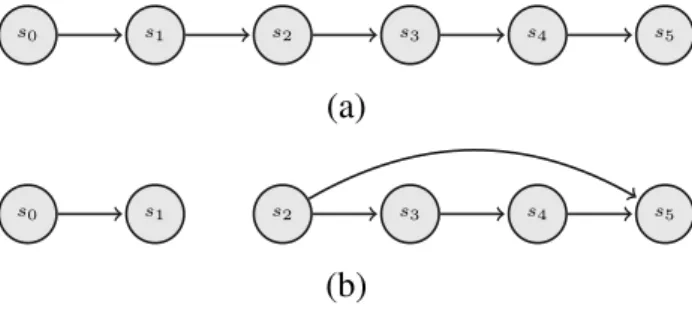
Although we defineP as a set, it can be partially structured, e.g., where sentencesi has to
precede sentencesj in a text. However, we do not make any assumption in this regard in our
formulation to give coherence models the freedom to make it concrete.
While some texts can easily be recognized as coherent or incoherent, often local coherence is a matter of degree (Halliday and Hasan, 1976). A text can be less coherent when compared to one text, but more coherent when compared to another. As such, since the notion of coher-ence is relative, cohercoher-ence assessment is better to be performed as a ranking problem. Given a pair of texts, a coherence model ideally ranks the texts with respect to their coherence. In order to rank texts concerning their coherence, we should capture patterns that frequently occur in more coherent texts and rarely in less coherent ones. Coherence patterns are templates of re-lationships among sentences in texts where their frequencies assist in distinguishing coherent texts from incoherent ones.
Definition 5. A coherence pattern is a subset of relationsp⊆ P occurring among sentences in a text.
Definition 6. Given a corpusC, a pattern mining methodM extracts all subsets of relations that occur in any text inCas a set of coherence patterns.
The output of the pattern mining process from a corpus of texts is a set of coherence patterns. Frequencies of these patterns in a text encode the coherence of the text.
Definition 7. LetP ={p0, p1, p2, ..., pm}be a set of patterns extracted from a corpus of texts
C; the perceived coherence of textT is represented by vectorφ =< f0, f1, f2, ..., fm >, where
fkis the frequency of patternpk in textT.
A vector representation of coherence allows us to employ machine learning models to rank texts with respect to their coherence. In Chapter 3, we describe several approaches to modeling relationships between a pair of sentences, i.e.R(si, sj). We then explain how these approaches
represent the set of all relationships in a text, i.e., P. We additionally review how different computational models derive method M in our formulation. We employ a plausible repre-sentation for texts, i.e. the entity graph reprerepre-sentation (Guinaudeau and Strube, 2013), from the literature and develop our approach to extracting coherence patterns in Chapter 4. We further improve the predictive power of coherence patterns by a new approach to representing relationships among sentences, i.e.P, in Chapter 5.
2.2 The Linguistics of Coherence
The aforementioned formal definitions are sufficient for the research presented in this disser-tation to develop a represendisser-tation of cohesive relations, extract coherence patterns, and model coherence computationally. However, since coherence is a semantic property of text, its def-inition requires to be related to the text linguistic properties. Therefore, in this section, we explain the linguistics of coherence.
We start with the linguistic properties of what we refer to as a text in this research. As we aim to represent cohesive relations among sentences, we explain what aspects of sentences serve to relate them in a text. We finally discuss how coherence patterns are approached in the linguistics of coherence, since they are the core of our coherence model.
2.2.1 Text
The first definition in our formal model of coherence is about text. In linguistics, the word “text” is used to refer to any passage, spoken or written, of whatever length that forms a unified whole. In this dissertation, we follow other coherence models (Barzilay and Lapata,
2008; Guinaudeau and Strube, 2013) and use the word “text” to denote a monologue written passage, which includes more than one sentence.
One-sentence texts, of course, do exist, such as public notices, proverbs, and advertising slogans. For instance, a sample text with only one sentence is shown in Example (3)1:
(3) A journey of a thousand miles begins with a single step.
However, in the research presented in this thesis2, we assume that texts contain at least two
sentences. We also assume that texts are written in formal register, in contrast to informal register like language used in tweets3.
2.2.2 Coherence
Coherence is a vital factor for distinguishing a well-written text from a sequence of unrelated sentences. A coherent text discusses a sequence of topics in a structured way by which a reader can recognize the relationships among topics, and collectively render the text as a unified whole (Stede, 2012). Lautamatti (1978) defines the term “topic”, generally, as what text units are mainly about. Each topic tends to occupy a (topical) segment in a text. Coherence is the result of the relations and the structures of topical segments in a text (Hearst, 1997). This structure is sometimes referred to as global coherence since it is coarse-grained and may span the entire text (Elsner et al., 2007). In general, however, it is not straightforward, first, to define the notion of topics and, second, to recognize topics and their boundaries across text segments (Stede, 2012).
2.2.3 Local Coherence
From a linguistic viewpoint, a (coherent) text employs linguistic devices, which are readily identifiable linguistic signals, to relate sentences4of a text to each other. These devices signal readers to interpret each sentence while considering its relationships with other linked sen-tences (Dijk, 1977). Therefore, understanding a text implies uncovering such relationships among its sentences. Local coherence is about the way that linguistic devices are utilized to relate sentences in a text (Stede, 2012). Halliday and Hasan (1976) refer to this phenomenon 1Taken from
https://www.engvid.com/english-resource/50-common-proverbs-sayings/, accessed 1 June 2018.
2Texts that consist of one sentence do not exist in the datasets employed for experiments of the research
pre-sented in this thesis.
3A post made on the social media application Twitter. 4We limit the text units in linguistics to sentences.
as “cohesion”. Stoddard (1991) argues that local coherence and cohesion are not distinguish-able and can be used interchangeably. With reference to Stoddard (1991), we use the term “local coherence”.
Stede (2012) states that signals of local coherence serve as indicators of topicsl structure in a text. Exisiting of these signals is a sign of topic continuity, and the absence of a surface relation is a sign of a topic shift. Barzilay and Lapata (2008) note that the local coherence of a text implies its global coherence. Since the research presented in this dissertation is about “local coherence modeling”, henceforth we refer to it shortly as “coherence modeling”. We explicitly distinguish these terms where they are not distinguishable from the context.
Cohesive devices, which are used to connect sentences, can be grouped into grammatical and lexical relations between elements of sentences (Halliday and Hasan, 1976). Grammatical relations are reference, substitution, ellipsis and conjunctions. Lexical relations include any lexico-semantic relation such as repetition, synonym, antonym, and the like between words of sentences. Among the grammatical relations, reference devices, which are also known as entity relations, have widely been studied. The intuition behind the leveraging of entity relations for coherence modeling is that related sentences in a text contain text pieces that are used to refer to the same entities. Since the core of these models is the entity, we follow Barzilay and Lapata (2005) and Elsner and Charniak (2010), and define an entity as follows: Definition 8. An entity is perceived as a person, a physical object, a concept, or an abstraction that exists (or may exist) in the world external to a text.
An entity can be referred to in different ways by various expressions, or mentions. Definition 9. The pieces of a text that are used to refer to an entity are called mentions.
Given these definitions, one way of representing an entity is to group all mentions that refer to that entity. Each cluster of mentions represents an entity. The task of identifying mentions that refer to the same entity is known as coreference resolution.
Definition 10. The task of detecting all mentions in a text and clustering all mentions that refer to the same entities is called coreference resolution.
The text in Example (4)5 shows how coreference relations among mentions of an entity
relate its sentences.
5Taken from https://web.stanford.edu/class/archive/cs/cs224n/cs224n.1162/ handouts/cs224n-lecture11-coreference-6up.pdf, accessed 2 June 2018.
(4) Mr. Obamavisited the city.
The presidenttalked about Milwaukee’s economy. Hementioned new jobs.
In the text shown in Example (4), “Mr. Obama”, “The president” and “He” are three men-tions that refer to the 44th president of the United States. The three sentences of this text are connected because they contain mentions that refer to the same entity.
One of the popular entity-based frameworks for local coherence modeling is centering the-ory (Grosz et al., 1995). The heart of this thethe-ory is the concept of the “text center”. The text center at any given point in a text is the most “salient” entity at that point. For instance, at the end of the last sentence in the text that is shown in Example (4), the text center is on the entity “Barack Obama”. Centering theory (for English texts) takes the grammatical roles of mentions of entities in sentences as the most significant linguistic signs for the saliency of en-tities. Precisely, the grammatical subject is preferred as the default position for the text center. So the text center can be various entities at different points in a text.
Centering theory accounts for the process of the center flow in a text as the text center captures the focus of attention in the reader’s mind through the text (Grosz et al., 1995). De-pending on the configuration of the grammatical roles of mentions of an entity in adjacent sen-tences, Brennan et al. (1987) define four different types of transitions for the text center across sentences. These transitions capture the smoothness of the center move from one sentence to another. Therefore they encode the local coherence of a text. Where a sentence focuses on the topic, i.e. the text center, that is discussed in sentences preceding that sentence, the transition is Retain or Continue. Other transitions involve a topic shift: Smooth Shift, or Rough Shift. The center transitions presented in centering theory have directly motivated several coherence models, e.g., the model proposed by Karamanis et al. (2004). However, since centering the-ory requires human annotations for center transitions across sentences, some computational models preferred to employ principles of centering theory as soft constraints or features in a probabilistic framework. An example of such models is the entity grid model (Barzilay and Lapata, 2005, 2008), which is discussed in more detail in Chapter 3.
Further linguistic research shows that grammatical role information is far less predictive for tracking the text center in other languages such as German, which is a free word order language (Strube and Hahn, 1996). Instead of that, Strube and Hahn (1996) consider the “functional information structure” (Daneš, 1974). The idea behind this structure is to capture the flow of information within a text. Some information in a sentence is known (or old) for
readers because sentences preceding that sentence discuss it, and some information is new. The way that the information status changes within a text reveals how smoothly topics flow across sentences, or how coherent the text is (Daneš, 1974).
The other perspective of local coherence is lexical cohesion. It is the cohesive effect based on lexico-semantic relations between words in a text (Halliday and Hasan, 1976). An advan-tage of lexical cohesion models, in contrast to entity-based models, is that they require no semantic annotation. The insight of local coherence resulting from lexical relations is that content words in a text do not occur independently of one another, but rather bear semantic relatedness. So in a coherent text, content words of sentences are expected to be semantically related. A form of lexical cohesion is reiteration, which involves different types of lexical relations such as repeating a word, using a synonym of a word, and employing a superordinate word. Example (5) is taken from Halliday and Hasan (1976) to illustrate these relations:
(5) (a) Repetition:
There was a large mushroom growing near her, about the same height as herself; and when she had looked under it, it occurred to her that she might as well look and see what was on the top of it.
She stretched herself up on tiptoe and peeped over the edge of the mush-room, [...]
(b) Synonymy:
Accordingly [...] I took leave, turned to theascentof the peak. Theclimbis perfectly easy.
(c) Superordinate:
Henry’s bought himself a newJaguar. He practically lives in thecar.
In Example (5)(a), the word “mushroom” is exactly repeated in the sentences. In (b) the two words “ascent” and “climb” carry the same meaning. In (c), the word “car” is a superordinate, any word whose meaning includes that of the earlier one, of “Jaguar” since a vehicle is a superordinate of a car. The relationship between “spoon” and “teaspoon” is another example of the superordinate relation. The boundary between the reiteration type in lexical cohesion and reference type in entity relations is by no means clearcut (Halliday and Hasan, 1976). It clarifies why local coherence and cohesion are, for purposes of the research presented in this dissertation, largely synonymous.
In summary, there is a local coherence relation between any pair of lexical items that stand to each other in some lexico-semantic relations, even including relations between word pairs shown in Example (6) (Halliday and Hasan, 1976).
(6) rail ... road car ... brake try ... succeed walk ... drive Tuesday ... Thursday like ... hate red ... green
For local coherence modeling, it is (almost) sufficient to know that a pair of words is in a relationship, apart from the type of the relation (Halliday and Hasan, 1976). Hoey (1991) also examined how lexical elements make a text organized and contribute to local coherence. He showed that relationships between semantically related words in a text follow similar patterns in texts. In Chapter 3, we survey some related computational models of lexical cohesion in texts.
2.2.4 Coherence Patterns
Numerous researchers and practitioners in natural language processing deal with whole texts rather than individual sentences. While it is evident that text must have a coherent structure, its characteristics are less explicit, making it more difficult to exploit in applications (Webber et al., 2012). A text commonly comprises a sequence of sentences. Text structures are the patterns that one observes in connections among multi-sentence texts (Webber et al., 2012). Recognizing these patterns, which are referred to as coherence patterns, in terms of the ele-ments that construct them is essential to derive and interpret information in a text correctly. Coherence patterns can also be characteristics of particular types of texts and therefore be of value in assessing the quality of texts generated automatically.
The concept of coherence patterns is linguistically derived from the “texture” of texts (Hall-iday and Hasan, 1976). The texture of text is the semantics perceived because of the combina-tion of the different text units. Stoddard (1991) defines a text as “a phenomenon of seemingly infinite complexity due to its synergistic nature”, where units of a text are supposed to coop-erate for an enhanced effect. It is synergism that makes texts more than consecutive words and sentences. The dynamics of synergism, which is because of its multi-dimensionality, is
beyond the linear and sequential structure of texts. One cause of the multi-dimensionality of synergism is a global component which is referred to as texture.
From Stoddard (1991)’s perspective, the texture of text is interpretable by means of elements that occur in texts and distinguish them. She refers to these elements as “coherence patterns”. So, texture manifests itself in coherence patterns that occur in similar texts. We have discussed that texture is one cause of the multi-dimensionality of synergism in texts; therefore, texture involves the quality of depth, which may range from minimal (approximating “flatness”) to maximal or at any level in between. In other words, coherence patterns can be as basic as the linear relations among consecutive text units, or be more complicated and non-linear by incorporating long-distance relations between non-adjacent units.
The texture, which is a composite of patterns, is like the “fingerprint” of a text (Stoddard, 1991), which can be used to distinguish texts. In this sense, the texture of text is mostly re-lated to “style”, which is undoubtedly associated with the local coherence of text (Barzilay and Lapata, 2008). This explains why such patterns are referred to as coherence patterns. Fur-thermore, this linguistically supports our first research question that concerns the non-linearity of patterns in distinguishing coherent texts from incoherent ones.
Coherence patterns occurring in a text should be recognizable by readers of the text to assist them to understand the text easily. The unity of text is the result of the interactiveness of text units. Such interactiveness seems to have a degree of consistency across texts (Stoddard, 1991), so they should be identifiable as patterns. Moreover, it would be easier for readers to smoothly process texts in which patterns of interactions of text units are not only clearly recognizable, but also familiar to readers.
Stoddard (1991) graphically illustrates6 the way that text units interact in a few texts. The
results of her text analysis show that local coherence manifests itself in the connectivity struc-ture of text units in the examined graphical illustrations of texts. The key results of her study can be summarized as follows: First, the unity of a text is better to be modeled by means of patterns that span through adjacent and non-adjacent text units, and second, both typologies (i.e. graphical structure) and counting should be involved to gain a better understanding of the local coherence of text. So, one factor that must be considered in describing coherence pat-terns as the input to texture is the likelihood of patpat-terns occurring over the broad stretch of a text. The facts that cohesive patterns occur in texts and cohesiveness is relative in texts provide useful validation of the intuition used in the research presented in this thesis: Coherent texts reveal some regularities in their structure that can be encoded with the frequency of coherence 6The term of “networks of cohesion” proposed by Halliday and Hasan (1976) can be interpreted (almost)
patterns.
Daneš (1974) had spoken about the concepts of text structure and coherence patterns more generally and earlier than Stoddard (1991). Daneš (1974) describes the structure of texts by the concept of “thematization”, which has also been noticed by Halliday and Hasan (1976) as “given-new information structure”. At each point of a text, “given information” is what has been talked about earlier than that point in the text and “new information” is been mentioned now. A theme, from Daneš (1974)’s perspective, is a point of departure where a text flows from a topic towards a rheme or another topic. In simple words, theme can be realized as given information, and rheme is new information. The contextual determination of givenness is far from being a simple phenomenon. Daneš (1974) explains that given information can be realized either directly with an identically worded expression or indirectly with a synonymous one. The indirect mentioning is based on semantic inference. For instance, the expression “illness” occurring in a sentence might convey a piece of given information if in one of its preceding sentences “disease” has been somehow mentioned. In opposite, the new information may neither be mentioned in its proceeding context nor be related to any given information.
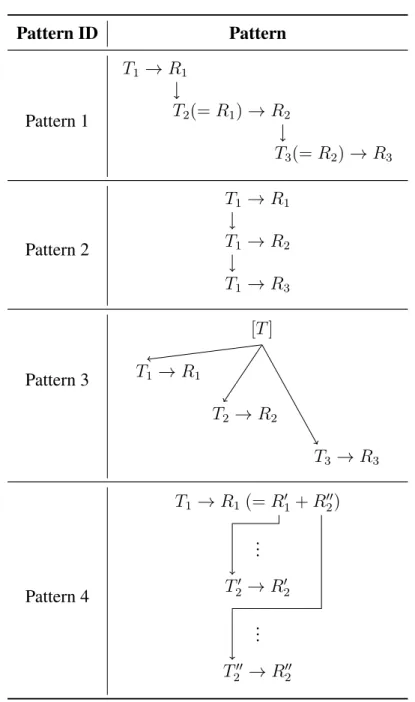
Thematization is about the structure of transitions between themes and rhemes in a text. Daneš (1974) illustrates the relation between a theme and a rheme in a text unit byT → R. This notation encodes that the flow of information in a text unit is from given information (or theme, T) to new information (or rheme, R). Daneš (1974) states that the inquiry into the thematic organization of the text is highly connected with the investigation of the so-called “text coherence” or “text connectivity”. He analyzes Czech scientific and other professional texts, as well as some other materials in the German and English languages. He ascertains sev-eral essential types of organizational patterns in the examined texts, represented in Table 2.1. Daneš (1974) interprets these patterns as follows:
• Pattern 1: This patterns illustrates a linear transition between themes and rhemes. In this pattern, each text unit takes the rheme presented in the preceding context of the unit as given information and transfers it to new information or a new rheme. In other words, each R (i.e. new information) in a text unit becomes T (i.e. given information) in its next unit.
• Pattern 2: This pattern depicts a constant theme continuation across text units. One theme appears in a series of text units, each of which, however, presents new information about the presented theme.
Pattern ID Pattern Pattern 1 T1 →R1 T2(=R1)→R2 T3(=R2)→R3 Pattern 2 T1 →R1 T1 →R2 T1 →R3 Pattern 3 [T] T1 →R1 T2 →R2 T3 →R3 Pattern 4 T1 →R1 (=R01+R 00 2) .. . T20 →R20 .. . T200→R002
Table 2.1: Coherence patterns that are defined by Daneš (1974). A horizontal arrow indicates a transition in an utterance, while a vertical one indicates a contextual connection within utterances.
unit. This pattern shows that different units can be connected because their themes, or their given information, are semantically related to a hypertheme.
• Pattern 4: Different combinations of patterns can emerge in different texts. Some of these combinations are such frequent that they can be taken as particular types of theme-rheme transitions of a higher order. This pattern is one of the high-order pat-terns, where a text unit presents two (which can potentially be several) rhemes,R0 and
R00, in connection with a given theme. First, R0 is expanded, and when its progres-sion completes,R00becomes the theme for another transition. In-between transitions for extending each rheme may follow their own patterns.
Daneš (1974) notes that one of the crucial properties of these patterns is their missing link. For example, in Pattern 1 there is no link between the earliest and latest text units. Those are connected because of the middle unit that makes transitions between themes and rhemes smoother. In contrast, all text units in Pattern 3 are linked to each other because they all have
T1as shared given information.
2.3 Evaluation
The goal of the research presented in this dissertation is to provide an approach to coherence modeling and compare it with other models. In order to accomplish this, it is essential to have a method to evaluate the performance of coherence models. In this section, we complete our definition by describing the evaluation methods we employ for assessing coherence models that are examined in our experiments.
2.3.1 Intrinsic vs. Extrinsic
Intrinsic and extrinsic are two types of evaluation methodologies for computational methods. In an intrinsic evaluation, system outputs are directly evaluated in terms of a set of norms or predefined criteria about the desired functionality of the system itself. In an extrinsic evalua-tion, system outputs are assessed on their impacts on a task external to the system itself.
Some research papers on local coherence modeling use intrinsic evaluation approaches such as sentence ordering (Lapata, 2003; Mihalcea and Tarau, 2004; Karamanis et al., 2004; Barzi-lay and Lee, 2004; BarziBarzi-lay and Lapata, 2008). Such an evaluation method is primarily de-signed to model violations of restrictions in centering theory (Karamanis et al., 2004). The goal of the sentence ordering task is to check if a coherence model can recognize the original
order of sentences in a text as the best order of its sentences. The main underlying assumption for this task is that perturbing the order of sentences in a text disturbs its coherence. However, datasets used for this task are artificially created (Lai and Tetreault, 2018), which eases the task for coherence models.
Some other approaches take the coherence of a text as a factor of the text quality and ex-trinsically evaluate the coherence model in downstream tasks (Miltsakaki and Kukich, 2004; Yannakoudakis and Briscoe, 2012). In this dissertation, we follow extrinsic evaluation meth-ods, and evaluate our coherence model based on its performance for the readability assessment task and the automatic single document summarization task.
In the readability assessment task (Miltsakaki and Kukich, 2000; Pitler and Nenkova, 2008; Petersen and Ostendorf, 2009; Flor et al., 2013), a coherence model is used to assess the readability of texts. The insight of this task is that coherent texts contain less complexity than other ones; therefore, they are easy to read and understand (Pitler and Nenkova, 2008). We use readability assessment as an extrinsic evaluation task for coherence models.
Automatic text summarization has received a lot of attention by researchers in natural lan-guage processing because of its potential for various information access applications. For instance, it is useful for tools that aid users to navigate and digest web content (e.g. news, social media, and product reviews), question answering, and personalized recommendation engines. Single document summarization is the task of producing a shorter version of a text while preserving its information content (Nenkova and McKeown, 2011). A basic approach to single document summarization is extractive, in which a summary is produced by identify-ing and concatenatidentify-ing the most important sentences in a text. Ideally, information in selected sentences for a summary should be the most important information in the input text. This information, however, should have satisfactory variance (or minimum redundancy), and be presented coherently in the summary to be readable. Developing an extractive summarizer that jointly optimizes these three crucial factors – importance, diversity, and coherence – is a challenging task because the inclusion of relevant sentences relies not only on properties of the sentences themselves, but also the properties of every other sentence in a summary. More-over, since the length of a summary is limited7, making a balance between these three factors
is difficult. For example, a summarizer may select a sentence which contains less important information in comparison to other sentences just to make other selected sentences coherent.
7Forcing summaries to obey a length constraint is a typical setup in summarization as it allows for a fair
empirical comparison between different possible outputs. Furthermore, it represents a real world scenario where summaries are supposed to be shown on small screens.
2.3.2 Ranking as Classification
Coherence is not a binary property of a text that either exists or not. It is a comparative attribute of texts: Is a text more coherent than other one? Even for humans, it might be ambiguous to decide if a text is coherent or not; however, they can rank texts with respect to their coherence (Halliday and Hasan, 1976). This fits to the task of text ranking with respect to readability, where a coherence model is evaluated by comparing its rankings with rankings provided by human judges for readability.
From a computational point of view, the core of the evaluation method in this dissertation is a pairwise ranking task: Given a pair of texts, which one is more coherent? For being conve-nient for machine learning models, the pairwise ranking task is recast as a classification task, where each text pair is associated with a label. The value of the label represents which text in a pair should be ranked higher; we use label+1where the first text in a pair is ranked higher, and
−1otherwise. This binary classification task can be solved by a machine learning approach, such as Support Vector Machines (SVMs) (Bishop, 2006). The details of experimental setups for machine learning models are explained in Chapter 4 and Chapter 5.
2.3.3 Evaluation Metrics
In order to perform a quantitative analysis of labels predicted by a coherence model for text pairs, we employ different metrics.
For the readability assessment task we use accuracy and F1-measure. Accuracy quantifies how often a coherence model makes a correct decision on text pairs in test data. A decision is correct if the label predicted by a model for a text pair is identical with the label that is assigned by human judges.
F1-measure is the harmonic mean between precision and recall. Precision is the ratio of the number of correct predictions over the number of all predicted labels. If a model predicts a label for each text pair in test data, then precision and accuracy are identical. However, it is also likely that a model does not rank a pair of texts and sees the texts equally coherent. In such cases, precision and accuracy are not identical. Recall is the number of correct predictions among the number of pairs with the desired label in test data.
For the summarization task, we use ROUGE metrics to evaluate the performance of the examined summarizers. ROUGE is a standard metric for text summarization. It compares a summary generated by a summarizer with a gold summary, which usually is generated by a human, based on word overlaps between summaries. We explain these metrics in more detail in related chapters of this thesis.
The task of coherence modeling has received much attention due to its significant impact on other natural language processing tasks. In this dissertation, we propose a novel approach to local coherence modeling based on a graph representation of texts. We apply our approach to two types of graphs. The first type captures coreference relations among entity mentions in a text. The second one captures lexical relations among words in a text. We evaluate our coherence model by examining its impact on readability assessment and text summarization.
Accordingly, we first review entity-based approaches to local coherence (Section 3.1). We then survey lexical approaches (Section 3.2). Finally, we review approaches that use a local coherence model for the readability assessment and summarization tasks (Section 3.3).
3.1 Entity-based Approaches to Local Coherence
The preliminary steps of the research presented in this dissertation are inspired by entity-based coherence models. In this section, we explain the details of two popular entity-based models: the entity grid model and the entity graph model. We also discuss their extensions.
Historical review. Entity-based approaches to local coherence modeling have a long history within the linguistics literature (Kuno, 1972; Halliday and Hasan, 1976; Prince, 1981; Joshi and Weinstein, 1998). Most approaches share a common primary assumption: Coherence is perceived based on how entities are introduced and discussed within a text (Barzilay and Lap-ata, 2008). Texts that keep referring to similar entities are supposed to be more coherent than those with random and unexpected switches from one entity to another. Different linguistic theories support this premise. One of them is centering theory (Grosz et al., 1995; Joshi and Weinstein, 1998), which is discussed in Chapter 2.
A great deal of research has been devoted to implementing centering theory directly (Milt-sakaki and Kukich, 2000; Karamanis et al., 2004). However, it is a challenging task because computational models need to determine how to instantiate the parameters of the theory as they are often underspecified. Interestingly, Poesio et al. (2004) noticed that even for basic
parameters of centering theory such as “utterance”, “realization”, and “ranking”, multiple in-terpretations have been developed, as centring theory does not formulate its parameters explic-itly. For example, in some studies entities are ranked with respect to the grammatical roles of their mentions (Brennan et al., 1987; Grosz et al., 1995) whereas in some other studies entities are ranked with respect to the position of their mentions (Prince, 1981). In some other studies they are ranked concerning their familiarity status (the thematic role) (Strube and Hahn, 1999; Moens, 2008). Therefore, two instantiations of the same theory make different predictions for the same input.
Another vein of research tries to avoid this by finding an instantiation of parameters so that the parameters are the most consistent with observable data (Strube and Hahn, 1999; Karama-nis et al., 2004; Poesio et al., 2004). Some others adopt a specific instantiation in a way that the performance of the coherence model improves for a specific task. For example, Miltsakaki and Kukich (2000) annotate a corpus of student essays with entity transition information and then show that the distribution of transitions correlates with human grades. Analogously, Hasler et al. (2003) investigate whether centering theory can be used in evaluating the read-ability of summaries, which were produced by humans or machines, by annotating them with the entity transition information. Poesio et al. (2004) demonstrate that the predictive power of the models that directly implement centering theory is highly sensitive to their parameter instantiations, no matter for which task such instantiations are specified.
Barzilay and Lapata (2005, 2008) propose a general framework for coherence modeling. The primary goal of this framework is to eliminate the need for human annotations for pa-rameters in centering theory, regardless of what the evaluation task is. Inspired by that theory, this model hypothesizes that the distribution of entities within coherent texts reveals certain regularities that make these texts distinguishable from incoherent ones. Machine learning ap-proaches can learn these regularities. Since the entity grid model has been the core of many research papers in the area of coherence modeling (including the research presented in this dissertation), we explain details of this model.
3.1.1 The Entity Grid Model
Barzilay and Lapata (2005, 2008) are the first researchers who proposed a general compu-tational approach to local coherence modeling based on the entity relations across adjacent sentences. Supported by some linguistic work such as centering theory (Grosz et al., 1995) and other entity-based theories of text (Prince, 1981), they assume that the distribution of entities within coherent texts exhibits certain regularities that can be reflected in a grid
topol-ogy, which is named “entity grid”. In this dissertation, we refer to this model as the entity grid model because its main idea is to represent the distribution of entities (see Chapter 2 for the definition of entity) across sentences in a text via a grid. In practice, mentions of an en-tity are linked in order to show that they are referring to the same enen-tity. Connections between mentions not only show that they are used to refer to the same entity, but also indicate that sen-tences that contain those mentions are (almost) about the same topic or information (Barzilay and Lapata, 2008). So entity coreference relations can be seen as signals for local coherence. 3.1.1.1 Text Representation: Entity Grids
In the entity grid model, each text is represented by a grid, which is a two-dimensional array, whose rows correspond to entities and whose columns correspond to sentences. An entryri;j
in a grid describes the grammatical role of entityiin sentencej if the entity is mentioned in the sentence. The grammatical roles are categorized as subject (S), object (O), or all other grammatical roles (X). Besides, if an entity is not mentioned in a sentence, a special marker (-) fills the corresponding entryri;jin the grid. Finally, if a sentence contains several mentions
of one entity, the corresponding entry describes the most important grammatical role of the mentions in the sentence: subject if possible, then object, or finally other.
The discussion of entity grids develops around two essential questions: Which textual units should be considered mentions of an entity? How should different mentions be linked to rep-resent an entity? A perfect solution in this regard would use a coreference resolution system to recognize mentions, to link arbitrary mentions to the same entities, and to discard noun phrases which do not correspond to an entity. Since coreference resolution systems are far from perfect, and tend to work even more poorly on incoherent texts, this approach is not generally the one utilized. Moreover, a non-perfect coreference resolution system introduces more noisy connections to a coherence model than what it fixes (Barzilay and Lapata, 2008). As an alternative, implementations of the entity grid model tend to employ all noun phrases as mentions and apply a heuristic coreference resolution to them. This coreference model con-nects all mentions that have an identical head noun as one entity. However, such a coreference resolution system is quite strict and straightforward. Detailed discussions of this heuristic are given in Poesio and Kabadjov (2004) and Elsner and Charniak (2010).
Example (7) shows a sample text1. In this example, noun phrases are marked with brackets
as an indication of mentions. Mentions in a sentence are associated with their grammatical 1The text with ID D31010, taken from the Document Understanding Conference (DUC 2002) dataset, which
we use in one of our summarization experiments. Numbers are not marked because they are filtered out in preprocessing.
roles in the sentence, annotated with a letter (S: subject, O: object, and X: others) next to the brackets.
(7)
s0: [An arctic cold wave]S, [the worst]X in [10 years]X, hit [parts]O of [Eu-rope]X, bringing [sub-zero temperatures]O and killing [scores]O of [peo-ple]X.
s1: Hardest hit were [Poland]S, [Bulgaria]S, and [Romania]Sas well as [parts]S of [central]Xand [eastern France]X.
s2: In [Poland]X, [three weeks]Xof [sub-zero temperatures]Xkilled [at least 85 people]Oin [November]X, 29 more than in [all]Xof [the previous winter]S.
s3: [Most]Sof [the victims]X were homeless [whose deaths]X by [exposure]X were alcohol related.
s4: [Blizzards]X and [cold temperatures]S also hit [Bulgaria]X and [Roma-nia]O, stranding [hundreds]Oin [their cars]X.
s5: Elsewhere, [snow]Sblanketed [the Italian island]Oof [Capri]Xfor [the first time]Xin [10 years]X.
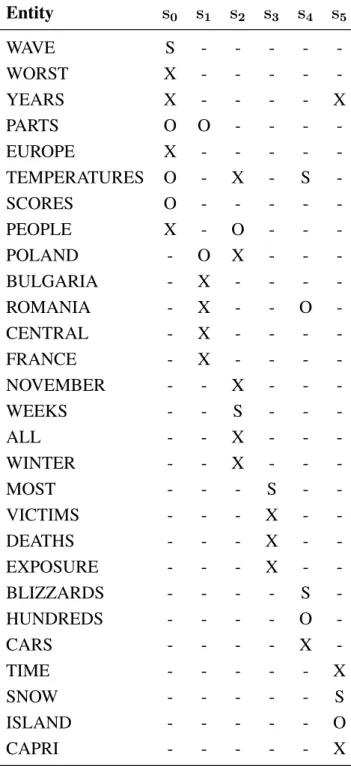
The corresponding entity grid for the text that is shown in Example (7) is presented in Table 3.1. For constructing this grid, we follow Barzilay and Lapata (2005, 2008) and consider head nouns of noun phrases to represent the entities. The coreferent mentions are detected by string matching over head nouns.
It is worth noting that although an entity in the original version of the entity grid is indi-cated by the head of a noun phrase, Elsner and Charniak (2011a) show that adding non-head nouns of a noun phrase to a grid improves the representation power of the entity grid. This enables the model to involve both head nouns and pre-modifiers in noun phrases to link sen-tences. Therefore, Elsner and Charniak (2011a) consider all nouns as entities in the entity grid representation. The non-head mentions are given the role X.
3.1.2 Pattern Definition: Grammatical Transitions
The key hypothesis in the entity grid model is that the way that entities are distributed as well as the way that the grammatical roles of entity mentions change through a text reveal similar patterns in coherent texts. Barzilay and Lapata (2005, 2008) define all possible transitions that may occur for an entity in a text as patterns.
More concretely, they define a transition pattern as a sequence of symbols, which are em-ployed to demonstrate grammatical roles of mentions, with sizen, i.e.,{S, O, X,–}n.
Entity s0 s1 s2 s3 s4 s5 WAVE S - - - - -WORST X - - - - -YEARS X - - - - X PARTS O O - - - -EUROPE X - - - - -TEMPERATURES O - X - S -SCORES O - - - - -PEOPLE X - O - - -POLAND - O X - - -BULGARIA - X - - - -ROMANIA - X - - O -CENTRAL - X - - - -FRANCE - X - - - -NOVEMBER - - X - - -WEEKS - - S - - -ALL - - X - - -WINTER - - X - - -MOST - - - S - -VICTIMS - - - X - -DEATHS - - - X - -EXPOSURE - - - X - -BLIZZARDS - - - - S -HUNDREDS - - - - O -CARS - - - - X -TIME - - - X SNOW - - - S ISLAND - - - O CAPRI - - - X
Table 3.1: The entity grid representation of the text presented in Example (7). The rows rep-resent entities, and the columns encode sentences. If an entity is mentioned in a sentence, the corresponding entry in the grid indicates the grammatical role of the mention in the sentence (S: subject, O: object, X: others, and “–”: none).
Each pattern represents entity occurrences between sentences and the way that their gram-matical roles innadjacent sentences change. For instance, for two adjacent sentences (n = 2) there are16possible patterns. These patterns are shown in Table 3.2.
S S S O S X S – O S O O O X O – X S X O X X X – – S – O – X – –
Table 3.2: Transition patterns that are defined in the entity grid model. These patterns repre-sent all possible entity occurrences in two adjacent repre-sentences. Symbols S (subject), O (object), and X (others) show the grammatical role of an entity in a sentence. Symbol “–” encodes that an entity is not mentioned in a sentence.
Each pattern that is shown in Table 3.2 represents one possible way in which an entity may occur in two adjacent sentences. For example, pattern “S O” encodes that an entity appears in two adjacent sentences, and its grammatical role is changing from subject to object across sentences. As another example, consider pattern “S –”. It indicates that an entity is referred to by a mention in the subject position of a sentence, and that the entity has no mention in the immediately following sentence.
3.1.2.1 Coherence Representation: Probabilities of Transitions
The entity grid model revolves around the assumption that coherent texts reveal certain regu-larities over the frequency of transitions or patterns (Barzilay and Lapata, 2005, 2008). The frequency of patterns can be used as an indicator of the preference of coherent texts in using or avoiding certain transitions. However, in order to prevent the model to be biased towards the text length, the probability of each pattern, rather than its raw frequency, is computed. More formally, given the entity grid representation of a text, the probability of a transition pattern occurring in the grid is computed as follows:
p(t) = n(t)
n(t∗), (3.1)
wheretis a transition,n(t)indicates the number of times that transitiontoccurs in the entity grid, and denominatorn(t∗)depicts the number of occurrences of all patterns whose length is as same as the length of t in the grid. For instance, consider the grid in Table 3.1; the probability of pattern “O O” is .01, which is computed as a ratio of its frequency, i.e. 1, divided by the total number of patterns of length two, i.e.,140. Therefore, the coherence of a text can be represented by the distribution of patterns in the text. The entity grid model captures frequencies of entity transitions in the entity grid representation of a text with a
S S S O S X S – O S O O O X O – X S X O X X X – – S – O – X – –
.00 .00 .00 .04 .00 .01 .01 .04 .00 .00 .00 .12 .04 .04 .11 .60
Table 3.3: Probabilities of the entity transition patterns, which are introduced in Table 3.2, in the entity grid shown in Table 3.1.
vector, which represents the coherence of the text. This vector can be interpreted as a feature vector for the coherence of the text, where each feature is the probability of a pattern in the grid representation of the text. Table 3.3 shows the feature vector representation of the grid presented in Table 3.1 using all transitions of length two.
Centering theory and its extensions define and rank transistions for center shifts through a text. The key advantage of the entity grid model is that it does not define any preference over transitions. It just computes probabilities of patterns in entity grids and defines them as features. The ranking or any other interplay among these features are learned by a machine learning model such as support vector machines.
In summary, given a dataset consisting of texts with different degrees of coherence, the en-tity grid model captures the coherence of each text in the dataset with a vector of transition probabilities. These vectors are supplied to machine learning models to distinguish texts con-cerning their coherence. Machine learning models automatically learn how coherence patterns should interact with each other to accomplish the final evaluation task.
3.1.2.2 Extensions of the Entity Grid Model
There are several extensions to the entity grid model in the literature. They mostly extend the entity grid model in two ways. Some employ different approaches for entity identification, and some others use various linguistic information about entities to fill entries of grids.
Filippova and Strube (2007) extend the entity grid approach by grouping all entities that are semantically related. They demonstrate that by grouping related entities, the performance of the entity grid model improves, especially when syntactic information is not involved. They use WikiRelate (Strube and Ponzetto, 2006) to compute relatedness between entities,
SemRel(ei, ej) > t, where t is a threshold. Different values of t result in different grid
densities. For small values, a grid is dense since many entities are grouped into one.
Elsner and Charniak (2008) employ the information status, i.e. new or the first mention vs. given or subsequent mentions, of entities, rather than grammatical roles. They run a maximum-entropy classifier to assign each noun phrase (i.e. mention) a labelLnp ∈ {new, old}.