D - U P P S A T S
The influence of internal and
external factors on entry modes
Anna Puljeva
Peter Widén
Luleå tekniska universitet D-uppsats
Marknadsföring
“To say that a company cannot afford to plan an entry strategy is to say that it cannot afford to think systematically about its future in world markets.”
ACKNOWLEDGEMENTS
We are pleased to finally have finished our Master’s thesis. Researching this area has given us a great amount of new and interesting knowledge about internal and external factors influencing the entry mode. We hope that this new knowledge can be of use in our future carriers as well as for fellow researchers in the future. During this time period there has been a lot of hard work as well as moments of laughter. There have been a lot of people involved and without their encouragement this thesis would not have been possible to complete. Our greatest appreciation goes to our supervisor Mr. Håkan Perzon at Luleå University of Technology, as well as our family and friends.
Luleå University of Technology, June 4, 2007
ABSTRACT
As internationalization and globalization increases in today’s business society, it becomes ever more important for individual business to keep up with the development. The way a company ventures from their domestic market to new geographical markets is of great importance for how well the company succeeds with their overall business mission. Selecting the right entry mode is an important decision that demands a lot of resources and thorough planning. When selecting entry mode a wide range of internal and external factors must be taken into consideration before making the final decision. This thesis purpose is to provide a better understanding of the impact of internal and external factors on Swedish SMEs’ choice of international market entry strategies. In order to reach the purpose we constructed two research questions regarding how the internal and external factors influence firm’s choice of international market entry mode. Based on the research questions, a literature review was conducted, which resulted in a conceptual framework that presented what would guide the data collection. In order to collect data, a qualitative, case study methodology was used, using a multiple case study through interviews as our main data collection tool. The main conclusions regarding the internal factors revealed in this thesis are that company size/resources limit the companies’ possibilities to choose market entry modes which demands great financial resources, it also affects the management risk attitude toward being more risk averse. Further the findings suggest that even though the companies in the study do not exclude any single market entry mode, they prefer the use of entry modes from which they have previous experience. The findings also suggest that the motive for engaging in internationalization is that the domestic market is insufficient due to the size and maturity. The main conclusions regarding the external factors revealed in this thesis are that industry feasibility/viability of MEM influences the choice of market entry mode when there is an interest of a market as the company will alter their market entry mode in order to avoid legal difficulties when trying to reach the market. This is further enhanced by the factor of market barriers as they might force the company to choose a specific market entry mode in order to avoid legal difficulties when entering a new international market. Target country production factors can be overcome through effective implementation of well thought strategic plans, without affecting the companies’ choice of market entry mode. Finally our findings suggest that the geographical distance influence on the choice of market entry mode decreases when the company’s resources and knowledge increase.
SAMMANFATTNING
Allt eftersom internationalisering och globalisering ökar i dagens affärsvärld blir det viktigare och viktigare för enskilda företag att vara delaktiga i utvecklingen. Hur ett företag går till väga när de söker sig utanför sitt hemlands gränser för att hitta nya geografiska marknader är enormt viktigt för hur de kommer att lyckas med hela deras affärsverksamhet. Att välja rätt marknadsinträdessätt är ett viktigt beslut som kräver stora resurser och noggrann planering. När företaget skall välja inträdessätt finns det stora mängder interna och externa faktorer som bör beaktas innan det slutgiltiga beslutet skall tas. Syftet med den här uppsatsen är att skapa en större förståelse för hur inverkan av interna och externa faktorer påverkar svenska små och medelstora företag i deras val av marknadsinträdessättstrategier. För att nå det syftet konstruerades två forskningsfrågor gällande hur de interna och externa faktorerna påverkar svenska små och mellanstora företags val av marknadsinträdessätt. Utifrån forskningsfrågorna genomfördes en litteraturstudie, vilket resulterade i upprättandet av en teoretisk referensram, som fungerade som guide för vad för data som skulle samlas in. För datainsamlingen användes en kvalitativ fallstudiemetodologi, en flerfallsstudie med intervjuer som huvudsaklig datainsamlingskälla. De huvudsakliga slutsatserna gällande de interna faktorerna i denna uppsats är att, företags storlek/resurser begränsar möjligheterna att välja marknadsinträdessätt som kräver stora resurser, det påverkar också ledningens attityd gällande risktagande åt att bli mindre benägna att ta risker. Vidare antyder resultaten att även om företagen i uppsatsen inte exkluderar något inträdessätt, föredrar de inträdessätt som de har tidigare erfarenhet av. Resultaten visar också att motiven för att inleda företagets internationalisering är att den inhemska marknaden inte är tillräckligt stor, eller är mättad. Vi har också hittat belägg för att valet av inträdessätt beror på företags kort- och långsiktiga mål. De huvudsakliga slutsatserna gällande de externa faktorerna i den här uppsatsen är att branschens genomförbarhet/godtagbarhet av ett visst inträdessätt påverkar valet av marknadsinträdessätt, eftersom företaget i fråga kommer att förändra vilket sätt de träder in på en specifik marknad för att undvika komplikationer på grund av lagar och förordningar. Detta är ytterligare förstärkt av faktorn handelshinder eftersom företaget kan tvingas att välja ett specifikt marknadsinträdessätt för att undvika straffskatter och dylika hinder för fri handel. Målmarknadens produktionsfaktorer kan överbryggas av genomförandet av väl genomtänkta strategier, utan att påverka företagets val av internationella marknadsinträdessätt. Slutligen visar våra data på att det geografiska avståndets inflytande på inträdessättet minskar i samband med att företagets resurser och kunskaper ökar.
TABLE OF CONTENTS
1. INTRODUCTION...1
1.1 BACKGROUND ...1
1.2 PROBLEM DISCUSSION...5
1.3 PURPOSE AND RESEARCH QUESTIONS ...6
1.4 DEMARCATIONS...6
1.5 THESIS OUTLINE...7
2. LITERATURE REVIEW ...8
2.1 INTERNAL FACTORS ...8
2.1.1 Theory by Koch (2001)... 8
2.1.2 Theory by Brassington and Pettitt (2000) ... 11
2.1.3 Theory by Hollensen (2001)... 11
2.1.4 Theory by Root (1994)... 11
2.1.5 Theory by Bruhno and Schilt (2001) ... 13
2.1.6 Additional theory by Root (1994)... 15
2.2 EXTERNAL FACTORS ...15
2.2.1 Theory by Koch (2001)... 15
2.2.2 Theory by Root (1994)... 17
2.2.3 Theory by Bell (1995)... 18
2.2.4 Theory by Bruhno and Schilt (2001) ... 18
2.2.5 Additional theory by Root (1994)... 19
2.3 CONCEPTUAL FRAMEWORK ...20
2.3.1 Research question 1 - How do internal factors influence firm’s choice of international market entry mode?... 20
2.3.2 Research question 2 - How do external factors influence firm’s choice of international market entry mode?... 21
3. METHODOLOGY ...23 3.1 RESEARCH PURPOSE...23 3.2 RESEARCH APPROACH...24 3.3 RESEARCH STRATEGY ...24 3.4 DATA COLLECTION ...25 3.5 SAMPLE SELECTION...26 3.6 DATA ANALYSIS...26 3.7 QUALITY STANDARDS ...27 3.7.1 Validity... 27 3.7.2 Reliability ... 27 4. EMPIRICAL DATA...29 4.1 CASE 1 – MEVA...29
4.1.1 Case 1 – Data regarding RQ1: How do internal factors influence firm’s choice of international market entry mode?... 29
4.1.2 Case 1 – Data regarding RQ2: How do external factors influence firm’s choice of international market entry mode?... 31
4.2 CASE 2 – PURAC ...32
4.2.1 Case 2 – Data regarding RQ1: How do internal factors influence firm’s choice of international market entry mode?... 32
4.2.2 Case 2 – Data regarding RQ2: How do external factors influence firm’s choice of international market entry mode?... 34
5. DATA ANALYSIS ...35
5.1 CASE ANALYSIS RESEARCH QUESTION 1...35
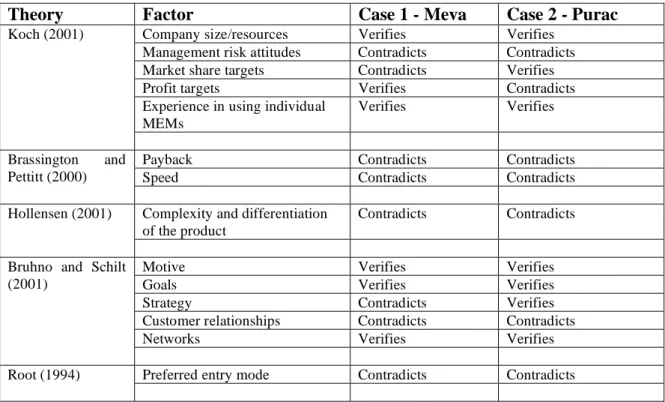
5.1.1 Theory by Koch (2001)... 35
5.1.2 Theory by Brassington and Pettitt (2000) ... 37
5.1.3 Theory by Hollensen (2001)... 37
5.1.4 Theory by Bruhno and Schilt (2001) ... 38
5.1.5 Theory by Root (1994)... 39
5.2 SUMMARIZATION OF FINDINGS IN RESEARCH QUESTION 1 ...40
5.3 CASE ANALYSIS RESEARCH QUESTION 2...41
5.3.1 Theory by Koch (2001)... 41
5.3.2 Theory by Root (1994)... 42
5.3.3 Theory by Bruhno and Schilt (2001) ... 43
5.3.4 Additional theory by Root (1994)... 44
5.4 SUMMARIZATION OF FINDINGS IN RESEARCH QUESTION 2 ...45
6. CONCLUSIONS AND IMPLICATIONS...46
6.1 RESEARCH QUESTION 1 – HOW DO INTERNAL FACTORS INFLUENCE FIRM’S CHOICE OF INTERNATIONAL MARKET ENTRY MODE?...46
6.2 RESEARCHQUESTION 2 – HOW DO EXTERNAL FACTORS INFLUENCE FIRM’S CHOICE OF INTERNATIONAL MARKET ENTRY MODE?...47
6.3 IMPLICATIONS FOR THEORY ...48
6.4 IMPLICATIONS FOR PRACTITIONERS/MANAGERS ...49
6.5 IMPLICATIONS FOR FUTURE RESARCH...49
REFERENCES ...50
1. INTRODUCTION
This first chapter is intended to give an introduction through a background to the research area. The background will be followed by the problem discussion, which will lead to the purpose and research questions of this thesis. Finally demarcations will be presented, followed by a layout for the rest of the thesis.
1.1 BACKGROUND
Internationalization/Globalization
According to Bender and Fish (2000) the world is in an era of globalization, and companies are continuously affected by the competition around the world. Internationalization is necessary because, from a national view, economic isolation has become impossible. Failure to participate in the global marketplace assures declining economic capability of a nation (Czinkota and Ronkainen, 2004). As businesses are no longer limited by national boundaries and therefore organizations are performing activities outside their home countries. Barkema, Shenkar, Vermeulen and Bell (1997) argues that through accumulate experience in foreign markets, firms gain local market knowledge and develop routines and process for dealing with the foreign context.
The concept of globalization and internationalization is referred to as the trend toward greater interdependence among national institutions and economies. It is a trend that is characterized by “denationalization” in which national boundaries are becoming less relevant. It also refers to the cooperation between national actors (Wild, Wild and Han, 2003). In addition, Friedman (1999) states that globalization is not a phenomenon or just some passing trend, indeed it is an overarching international system, shaping the domestic politics and foreign relations of virtually every country.
According to Root (1994) the new global economy has created business environments that require firms to look past the traditional thinking of the domestic market, and to start looking at business from an international global perspective instead. Friedman (1999) also brings out the tremendous opportunities and benefits that come with globalization. Furthermore the increasing globalization according to Bender and Fish (2000) leads to an increase in international joint ventures, companies establishing subsidiaries and sales offices abroad. If companies want to become successful, they must manage their knowledge within the organization, especially across national borders.
Internationalization process
Kotler and Armstrong (2001) explain the process of a company’s internationalization in five stages. These stages are (1) deciding whether to go international or not, (2) deciding which markets to enter, (3) deciding how to enter the market, (4) deciding on global marketing programs, and (5) deciding on global marketing organizations.
According to Kotler and Armstrong (2001) first the company has to decide whether to go international or not. The company has to compare and evaluate the opportunities and risks of going abroad, and whether or not they have the ability to survive on the global market. Second, the company has to try to define their international marketing objectives and policies, and decide upon which market to enter. Then the company must choose how many countries to enter. In the initial stage of their internalization many companies choose to enter either one or a few countries in order to create a deep relationship. After selecting markets, the company has to decide how to enter that/those markets. There are several market entry modes a company can chose from, for example export, strategic
alliances and foreign direct investment (FDI). Each entry mode contains commitments and risks as well as control and potential profits. The next stage is to decide on a global marketing program and adjust their national marketing program to international standards. This is a question of using either a standardized marketing mix or an adapted marketing mix, adjusted for each new market. The final stage of the internalization process is to decide upon a global marketing organization, most companies have at least three different ways of managing their international activities. Generally, companies start with organizing an export department, then an international division is created and finally they become a global organization (Kotler and Armstrong, 2001).
Eriksson, Johanson, Majkgård and Sharma (1997) emphasize the difficulties with the process of internationalization. They also consider international entry as an incremental process that begins relatively late in a firm’s life cycle which might warn of potentially negative consequences of early internationalization on firm survival, this is further supported in findings made by Johanson and Vahlne (1977, 1990).
Entry strategies
According to Osland, Taylor and Zou (2001) globalization of business has grown rapidly in recent decades, which has in turn forced companies to develop strategies for entering and expand their businesses into new markets. One of the most crucial strategic decisions an international company has to make is selecting a mode for entering a new foreign market. Entry strategies for international markets are according to Hollensen (1998) a key strategic issue for companies in today’s rapidly growing and internationalizing market. Root (1994) states that entry strategies help to set the objectives, goals, resources and policies in order to guide the company’s international business activities to reach sustainable growth on the international market. He further emphasizes that it is important to realize that a company’s entry strategy is not a single market plan, but a combination of several market plans.
When companies consider entering new foreign markets they have to have a specific set of strategic alternatives that varies by different target markets, and the different entry mode alternatives. Managers need to consider how their company best can enter a specific market and take into consideration the risk and environmental factors that are associated with the different entry strategies (Deresky, 2000). The foreign market entry selection is highly significant for the company’s future performance and survival on the international market (Ekeledo and Sivakumar, 2004). According to Bradley (2002) the concept of market entry refers to the difficulty or ease a company face when entering international markets. “Entry is one of the supreme tests of competitive ability. No longer is the company providing itself on familiar ground, instead it has to expose its competences in a new area” (Bradley, 2002, p.244). Furthermore, Terpstra and Sarathy (2000) state that one of the most critical decisions in the internationalization process is the choice of method of entry into foreign markets. This, because the entry mode decision is a macro decision, companies do not only choose a level of involvement in the foreign market, they also make choices about their marketing program.
Entry modes
An international market entry mode is an arrangement that creates the possibility for a company’s products, technology, human skills, management, or other resources to enter into a foreign country (Root, 1994).
Bradley (2002) states that all aspects of marketing have to be of superior performance in order for a company to have a successful market entry. When selecting the appropriate mode of entry, companies have to answer two questions: first, what level of resource commitment are they willing to make? And second, what level of control over the operation do they desire? The factor influencing these two questions is the perceived risk of entering a new country and a new market, thus it has to be taken into consideration and the alternatives have to be well evaluated because this will eventually lead to the entry mode choice (ibid).
Bradley (2002) further states that once a strategy is selected companies have to select the right type of market entry mode. The foreign market entry modes can be divided into three groups:
1. Export entry modes 2. Contractual entry modes 3. Investment entry modes
Export entry modes include direct and indirect exporting i.e. selling to foreign visitors on the domestic market or to foreign agents, distributors or a subsidiary. The difference between export entry modes and the other entry modes, contractual and investment entry modes, is that within export entry modes the final product is produced outside the target market. Contractual entry modes include licensing, franchising, contract manufacturing etc. The third group, investment entry modes, includes joint ventures, foreign direct investment (FDI), and acquisitions etcetera (Bradley, 2002).
Furthermore Root (1994) argues that from an economist’s perspective, a company can arrange entry into a foreign country in only two ways. First, it can export its products to the target country from a production base outside that country. Second, it can transfer its resources in technology, capital, human skills and enterprise to the foreign country, where they may be sold directly to users or combined with local resources (especially labor) to manufacture products for sale in local markets. From a management/operations perspective, these two forms of entry break down into several distinctive entry modes, which offer different benefits and costs to the company. These are:
Export Entry Modes • Indirect
• Direct Agent/Distributors • Direct Branch/ Subsidiary Contractual Entry Modes • Licensing
• Franchising
• Technical agreements • Service contract • Management contracts
• Construction/ turnkey contracts • Contract manufacture
Investment Entry Modes
• Solo venture: new establishment • Solo venture: acquisition
• Joint venture: new establishment/ acquisition
Root (1994) argues that export entry modes differ from the other two primary entry modes (contractual and investment) in that a company’s final or intermediate product is manufactured outside the target country and subsequently transferred to it. Thus exporting is confined to physical products. Further Root (1994) states that contractual entry modes are long-term non equity associations between an international company and an entity in a foreign target country that involve the transfer of technology or human skills from the former to the latter. The third kind of entry mode is stated by Root (1994) to be the investment entry mode, which involves ownership by an international company of manufacturing plants or other production units in the target country. In terms of ownership and management control (which is the distinctive feature of this entry mode), foreign production affiliates may be classified as solo ventures with full ownership and control by the parent company or as joint ventures with ownership and control shared between the parent company and one or more local partners. A company may start a solo venture from scratch (new establishment) or by acquiring a local company (acquisition) (Root, 1994).
There is evidence that many firms develop their export business gradually (Albaum, Strandskov, Duerr and Dowd, 1994). Several authors (Hollensen, 1998; Albaum, Strandskov and Duerr, 1998) argues that the most common mode for entering international markets is export. Hollensen (1998) emphasizes that this can be done direct or indirect and Albaum et. al. (1998) states that it is often the first step of a firm’s internationalization. Many companies appear to grow into international activities through a series of phased developments. They gradually change strategy and tactics as they become more involved. Others enter international markets after much research, with long-range plans fully developed (Cateora, 1996). According to De Burca, Brown and Fletcher (2004), there are various approaches when selecting entry modes for foreign markets and these have different implications for small and medium-sized as oppose to large sized firms. Most small and medium-sized enterprises that enter foreign markets do it in a country-by-country basis. In this way the small actors can expand to new markets in a suitable pace with good control over the development (ibid).
1.2 PROBLEM DISCUSSION
Hollenstein (2005) explains that the internationalization process for small and medium sized enterprises (SMEs) involves limitations of resources in form of finance, information and management capacity to a much higher extent that for multinational cooperation’s (MNC’s). According to the recommendation of the European Union (http://europa.eu/scadplus/leg/en/lvb/n26026.htm) the definition of SMEs is based on the number of employees and their turnover or annual balance sheet. If there are less than 50 employees and the turnover/ balance sheet does not exceed 10 million the company is regarded as a small enterprise. The definition of a medium sized enterprise on the other hand is up to 250 employees with an annual turnover not exceeding 50 million or a balance sheet not exceeding 43 million annually. SME’s also face external barriers such as laws and regulations and imperfections to a higher extent than MNC’s (Hollenstein, 2005).
Bradley, Meyer and Gao (2006) argue that many SMEs are forced to internationalize, particularly high technology firms, due to a focus on niche markets, shorter product life cycles and, frequently, the small size of their domestic markets relative to the potential that exists abroad. The authors however state that these firms’ face a serious dilemma, should they attempt to internationalize unaided or do they try a form of partnership with stronger firms in their business system that can help them. The authors argue that the primary foreign market entry mode used by small business is exporting, additionally it is argued that this is an effect of exporting offering an effective means of internationalization without over- extending the capabilities or resources of the firm. The authors also stress that small firms often skip some- and/or all of the “internationalization stages” as many firms must be international from the outset.
Hollensen (1998) states that if a company in the initial stage of its internalization makes a poor selection of entry modes, it can become a threat for its future market entries and expansions. However, there is no entry mode that can be seen as the best choice. The selection of entry mode is different from one company to another and is influenced by a number of factors, both internal and external to the company (ibid). How a company deals with the external factors depends on the internal factors that a company is facing when choosing an entry mode (Root, 1994). It is of great importance for SME’s to find out what factors that was central in the modal choices of other companies. This is in order to improve the SMEs’ strategies and entry mode selection and not make the same mistakes as others have done (Osland, Taylor and Zou, 2001). Deresky (2000) points out that SME’s often use export as an initial entry mode since it is a low-risk alternative, and in addition it does not demand large capital resources or investments and withdrawal is relatively easy.
Obadia and Vida (2006) bring up that companies more often choose to open foreign subsidiaries to expand internationally. Additionally the authors state that the size of the company is of great importance for the internationalization to be successful, as the SME’s tend to be less prepared than larger firms to deal with issues such as geographic, cultural, and institutional distance between the home country and the country in which the investment was made. The authors pinpoint the lack of research made on the specific reasons why SME’s performance when internationalizing and specifically regarding issues that SME’s face with their foreign subsidiaries.
Selecting the right entry mode is an important decision, which demands a lot of resources and thorough planning. When selecting entry mode a wide range of factors must be taken into consideration before making the final decision (Young, Hamill, Wheeler and Davies, 1989). Furthermore Koch (2001) states that all factors proposed to influence the market/ market entry mode selection process fall into three broad categories: external, internal, and the mixed, internal/external category.
In addition to this Root (1994) states there is difference in the internal and external factors when companies choose a market entry mode. The difference is that the company management rarely can influence the external factors. In the final decision of market entry mode, there is supposed to be a balance between different factors that are in conflict with each other, and in the end a balance between risk and control must be established. These external factors can seldom be affected by managers’ decisions and are external to the company and may be regarded as parameters of the entry mode decision. Because no single external factor is likely to have a decisive influence on the entry mode for companies in general, these factors only encourage or discourage a particular entry mode. The author also puts forward that a company’s choice of its entry mode for a given product/ target country is a net result of several, often conflicting forces.
The factors influencing company’s choice of entry mode are according to Johansson and Vahlne (1977) divided into two main groups, external factors and internal factors. The external consists of determinants regarding the company’s environment while the internal are determined by company specific factors.
1.3 PURPOSE AND RESEARCH QUESTIONS
Based on the problem discussion the research purpose of this thesis is to provide a better
understanding of the impact of internal and external factors on SMEs’ choice of international market entry strategies.
In order to reach the purpose of this thesis the following research questions were developed.
RQ 1: How do internal factors influence firm’s choice of international market entry mode?
RQ 2: How do external factors influence firm’s choice of international market entry mode?
1.4 DEMARCATIONS
There is vast research made in the area of companies choosing entry mode in a foreign market. The majority of the research has been focused on the internationalization process of firms. Our research will, in accordance with our frame of reference, focus on the factors influencing the company’s choice of entry mode in new markets. The theories on the subject bring forward three different types of factors, internal, external and the mixed category. We will only focus on the internal and the external factors, since the mixed category factors can be included in one or the other of the internal and external factors.
1.5 THESIS OUTLINE
This report will be divided in six chapters as shown in figure 1.1: Introduction, Literature review, Methodology, Data Presentation, Data Analysis and Conclusions and Implications. The Introduction presents the research area through a background and problem discussion. It also contains the overall purpose, which leads to the specific research questions. Finally it clarifies the demarcations and the outline of the thesis. The second chapter, Literature review, will present the theories connected to the research area and will lead to the conceptual framework used in this report. The third chapter, Methodology, will present and motivate the choices we have made regarding research method. Chapter four, Data Presentation, presents the empirical data collected. In the fifth chapter, Data Analysis, we will compare the empirical data to the conceptual framework in form of a case-analysis. Finally in chapter six, Conclusions and Implications, we will present the findings to the stated research questions and provide recommendations for future research.
CHAPTER 1 Introduction
CHAPTER 6 Conclusions & Implications
CHAPTER 4 Data Presentation CHAPTER 2 Literature Review CHAPTER 3 Methodology CHAPTER 5 Data Analysis
2. LITERATURE REVIEW
In the previous chapter we outlined a research area that led to an overall purpose, landing in two research questions. In this chapter an overview of previous studies related to the research area is presented. This chapter will review literature studies related to our first research question regarding the internal factors influence on firm’s choice of international market entry mode and to our second research question regarding the external factors influence on firm’s choice of international market entry mode. Finally, a conceptual framework, based on theory is displayed.
2.1 INTERNAL FACTORS
2.1.1 Theory by Koch (2001)
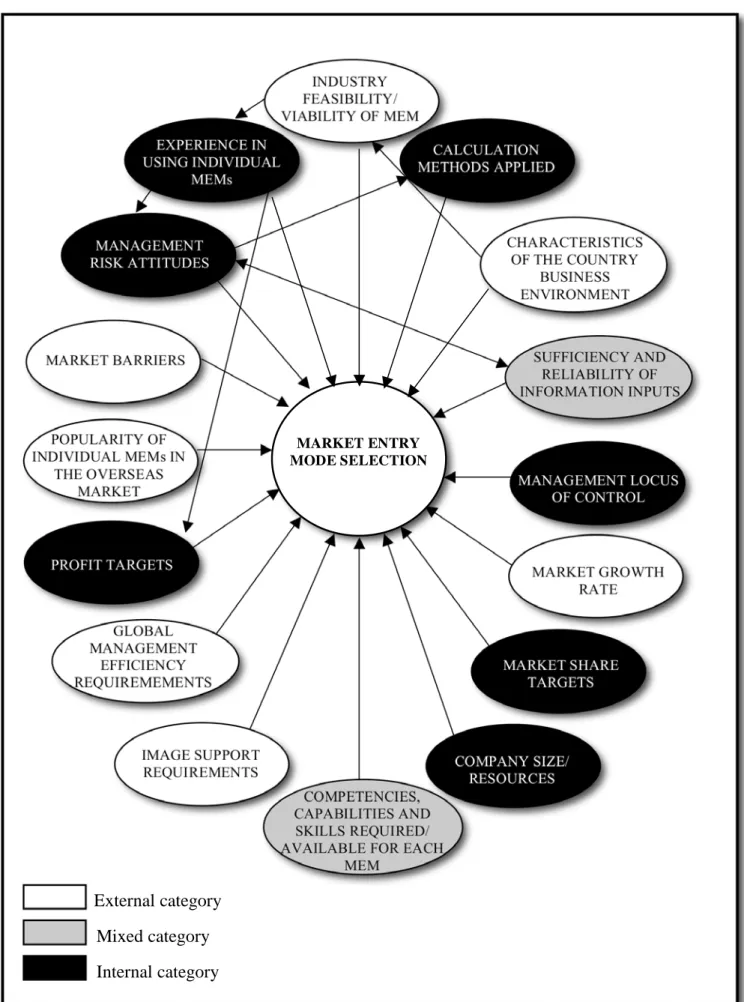
Koch (2001) introduced a holistic model of the market and Market Entry Mode Selection process (MEMS). All factors proposed to influence the market/ market entry mode selection process fall into three broad categories: external, internal, and the mixed, internal/external category. Some of the proposed categories of factors may influence some others, adding to the complexity of the decision process. These factors are shown in figure 2.1 on page 10.
Company size/ resources
According to Koch (2001) smaller companies usually have fewer market servicing options, as their very limited own resources may simply not allow, or discourage from, some market entry modes. For example, establishing a fully owned subsidiary often involves very substantial investment and correspondingly high risk levels. Similarly, small companies may not have sufficient management potential and special skills to enter foreign market through establishing fully owned foreign-based subsidiaries or international joint ventures. The influence of company size on its freedom of choice in selecting market entry mode and their relevant preferences depends on industry-specific resource demands for individual market entry modes.
Management locus of control
Koch (2001) also states that the significance of management locus of control for the degree of company international business involvement and the market entry mode preference is often underestimated, if not overlooked altogether. Yet strong internal, or external, loci of control are likely to considerably affect manager perceptions; the way their institution works and their market entry mode decisions may thus, particularly in less experienced companies, determine the outcome of this decision process. If the decision is significantly influenced by a number of managers, we have a potentiality of locus of control discord; depending on its management style, the company will either disregard loci of control, which do not agree with the decision maker or undertake actions aimed at achieving perceptual consensus with regard to the situation at hand. Finally, one has to acknowledge that individual loci of control may change, as a result of some critical events or, more gradually, as the relevant experience grows. Management risk attitudes
The level to which the company will accept various international business risks depends on the context according to Koch (2001): the company’s financial situation, its strategic options, the competitiveness of its competitive environment, its relevant experience etc. Risks may be estimated by using appropriate formulae. One should, however, bear in mind that the perception of risks associated with individual market entry modes or countries may influence companies’ decisions considerably, as well. The less risk-averse the management, the more
likely it is for the company to select countries that show greater long-term prospects and promise to enhance the firm’s capabilities.
Market share targets
When criterion used in market entry mode selection is sales or market share maximization, market entry modes, which are believed to be most likely to deliver the desirable results within established planning periods, will be preferred (Koch, 2001).
Calculation methods applied
The broad alternatives of risk or benefit based calculation method and cost or control based calculation method are available also with regard to the market entry selection (Koch, 2001). Profit targets
According to Koch (2001) various market entry modes are likely to produce different levels of profit; equally importantly, the dynamics of profit generation of various modes will be very dissimilar. The former will show some profits almost immediately and then may soon level off, the latter may mean no profits for three or four years (construction cycle, time needed to establish all necessary market contacts, acquire/ build all necessary assets, train the sales force as required, develop customer base, etc.). A long decision horizon may prefer the latter; a short one will prefer the former.
Experience in using individual MEMs
The market entry mode decision is affected by how many times, how recently and in what circumstances the company or its competitors have used any particular entry mode. The decision is depending on the success rate and degree of the MEM when used in earlier market entries. The experience of a particular entry mode influences the decision through the perceived use of a particular mode of entry. Due to the manager’s choice of entry mode is likely to be subject of scrutiny, the choice is likely to be made to favor a MEM which the manager have experienced success in an earlier market entry.
Figure 2.1: Factors influencing market entry mode selection Source: Adapted from Koch (2001), p.353
CHARACTERISTICS OF THE COUNTRY BUSINESS ENVIRONMENT SUFFICIENCY AND RELIABILITY OF INFORMATION INPUTS COMPANY SIZE/ RESOURCES INDUSTRY FEASIBILITY/ VIABILITY OF MEM EXPERIENCE IN USING INDIVIDUAL MEMs CALCULATION METHODS APPLIED MANAGEMENT RISK ATTITUDES POPULARITY OF INDIVIDUAL MEMs IN THE OVERSEAS MARKET MARKET BARRIERS MARKET GROWTH RATE GLOBAL MANAGEMENT EFFICIENCY REQUIREMEMENTS MARKET SHARE TARGETS IMAGE SUPPORT REQUIREMENTS MANAGEMENT LOCUS OF CONTROL COMPETENCIES, CAPABILITIES AND SKILLS REQUIRED/ AVAILABLE FOR EACH
MEM PROFIT TARGETS MARKET ENTRY MODE SELECTION External category Mixed category Internal category
2.1.2 Theory by Brassington and Pettitt (2000)
Brassington and Pettitt (2000) discuss two other internal factors. These are Payback and Speed. With payback the authors’ mean the time it takes for the company to create revenue from an investment in a new market that influences the company’s choice of foreign market entry mode. The authors also state that speed, with which the author means the time it takes to reach the target market, also greatly influences the choice of entry mode.
2.1.3 Theory by Hollensen (2001)
Hollensen (2001) brings up three more factors of internal nature that might influence the choice of market entry mode. These are:
Complexity and differentiation of the product
The product complexity and differentiation of the product that the company is about to market to a new international market may very well influence the choice of entry mode according to Hollensen (2001), as it influences the cost of shipping, economies of scale, technology transfer, and already existing know-how, as an example the author brings up the risk of licensee abuse of technical know-how and that it might render unbearable costs to ship heavy or large goods due to the high shipping costs.
Risk
The amount of risk the company is willing to take when entering a new market is according to Hollensen (2001) influencing the choice of foreign market entry mode, the scale of risk connected to entry mode ranges from exporting, which is the least risky; to wholly owned subsidiaries or production facilities which, involves the most risk due to the heavy resource committed to such entry.
Flexibility
Somewhat connected to risk, mentioned above, is the flexibility of the chosen entry mode as it according to Hollensen (2001) influencing the choice of entry mode, as it is crucial to a company to be able to swiftly respond to changing market conditions or even withdraw entirely from a market. This is, as the risk factor ranging from export being the most flexible due to the low cost involved, to wholly owned subsidiaries due to the high cost of withdrawing from such a high involvement entry.
2.1.4 Theory by Root (1994)
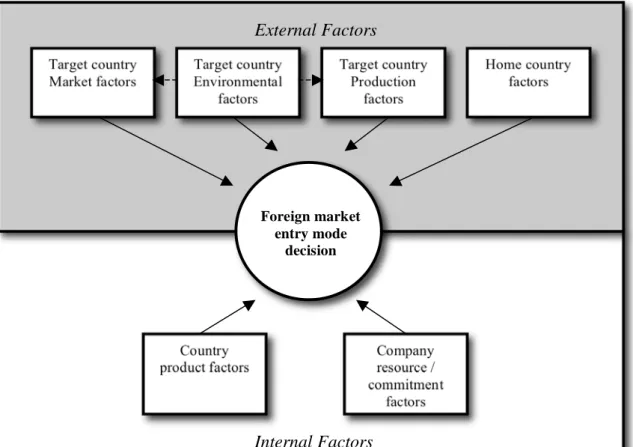
Root (1994) argues that how a company responds to external factors in choosing an entry mode depends on the internal factors. As seen in Figure 2.2 (page 12), he also puts forward two internal factors, and these are:
Product Factors
Root (1994) states that highly differentiated products with distinct advantages over competitive products give sellers a significant degree of pricing discretion. These products can absorb high unit transportation costs and high import duties and still remain competitive in a foreign target country. In contrast weakly differentiated products must compete on a price basis in a target market, which may be possible only through some form of local production. Hence high product differentiation favors export entry, while low differentiation pushes a company toward local production and choosing an entry mode such as contract manufacture or equity investment. Furthermore, if a company’s product is a service, such as engineering, advertising, computer services, tourism, management consulting, banking or retailing then the company must find a way to perform the service in the foreign target country, because
services cannot be produced in one country for export to another. Local service production can be arranged by training local companies to provide the service (as in franchising), by setting up branches and subsidiaries (as an advertising agency or branch bank) or by directly selling the service under contract with the foreign customer (as in technical agreements and construction contracts). Technologically intensive products give companies an option to license technology in the foreign target county rather than use alternative entry modes. Products that require considerable adaptation to be marketed abroad favor entry modes that bring a company into close proximity with the foreign market (branch/ subsidiary exporting) or into local production (Root, 1994).
Resource/ Commitment Factors
Root (1994) also states that the more abundant a company’s resources in management, capital, technology, production skills and marketing skills, the more numerous are their entry mode options. Conversely, a company with limited resources is constrained to use entry modes that call for only a small resource commitment. Hence company size is frequently a critical factor in the choice of an entry mode. Resources must be joined with a willingness to commit to foreign market development. A high degree of commitment means that managers will select the entry mode for a target country from a wider range of alternative modes than managers with low commitment. Therefore, a high-commitment company, regardless of its size, is more likely to choose equity entry modes.
Target country Market factors Home country factors Target country Production factors Target country Environmental factors Country product factors Company resource / commitment factors Foreign market entry mode decision External Factors Internal Factors
Figure 2.2: Factors in the entry mode decision Source: Adapted from Root (1994), p.9
2.1.5 Theory by Bruhno and Schilt (2001)
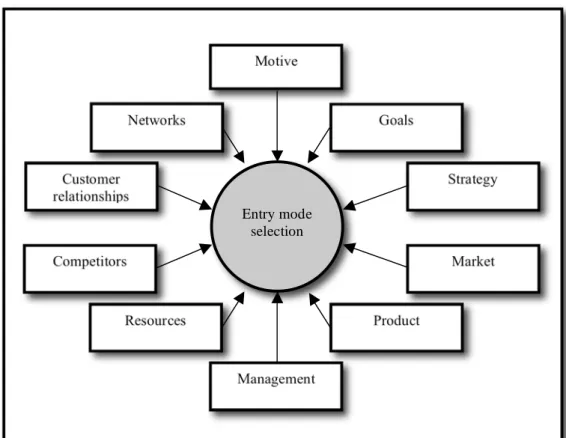
Bruhno and Schilt (2001) have developed a model in which the authors present internal and external factors that influence a company’s choice of marketing channel. The authors also state that these factors should not be studied isolated but instead viewed as related to each other. See figure 2.3 on page 14. These are the internal factors:
Motive
The first factor; the motive, is meant to answer questions such as: What motives were there in the company for internationalization? A small home market and a strong competitive product are examples of answers to that question. What motives influenced the company’s choice of entry mode? There are also examples of indirect motives that may influence the choice of entry mode, such as a temporary contact with a company outside of the home country (Bruhno and Schilt, 2001).
Goals
What goals did the company have with their internationalization? Have the goals changed since the start with the international business? Are there any long-term and/or short-term goals for the company? What specific goals exists regarding market shares and sales volume? Does the company have any ambition to gain a great part of a market in a specific country (Bruhno and Schilt, 2001)?
Strategy
Does the company have special strategies for the abroad activity? Are there any specific strategies for each market? Does the company work with development of these strategies (Bruhno and Schilt, 2001)?
Product
What qualities does the product have that will be exported? Are these products standardized or adaptable? How many products does the company have? These questions affect the company’s way of conducting the internationalization (Bruhno and Schilt, 2001).
Management
How extensive is the international experience in the company? Is there any specific experience of any marketing channel in the company? Are there any general ideas on how the managers should pursuit their international strategy? How great is the management’s engagement? What competencies are demanded in the international activity? Does the management develop these competencies? What language skills are there amongst the management? How great is the knowledge of different marketing channels and their pros and cons (Bruhno and Schilt, 2001)?
Resources
How does the financial, human and technological resources influence the company’s choice of marketing channel? Limited resources can limit the company’s freedom of choice when choosing a marketing channel (Bruhno and Schilt, 2001).
Customer relationships
How many customer relationships does the company have? Are the company’s customer relationships homogenous or heterogeneous? Does the company put any effort on developing their customer relationships (Bruhno and Schilt, 2001)?
Resources Motive Networks Customer relationships Competitors Goals Strategy Market Product Management Entry mode selection
Figure 2.3: Influencing factors in entry mode selection Source: Adapted from Bruhno & Marco Schilt (2001), p.44
Networks
Does the company have any existing contacts and relationships in the different markets? Does the company have the opportunity to get any help from other Swedish firms on the different markets? Does the company have any external part involved in their international act? Does the company actively work with development of participation in different networks? Does the participation in the different networks affect the choice of market (Bruhno and Schilt, 2001)?
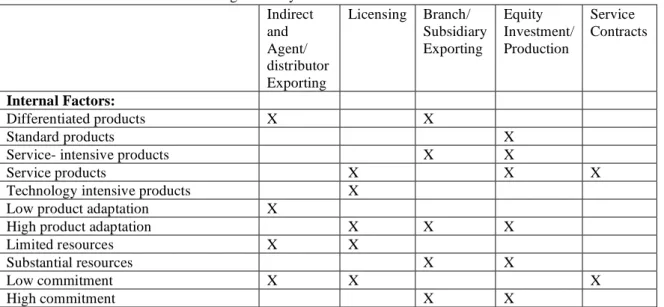
TABLE 2.1 Internal factors influencing the Entry Mode Decision
2.1.6 Additional theory by Root (1994)
Root (1994) has also summarized the influence of internal factors on the choice of entry mode as shown in Table 2.1.
2.2 EXTERNAL FACTORS
2.2.1 Theory by Koch (2001)
Koch (2001) states that the following factors are the external, as also seen in Figure 2.1 (page 10).
Industry feasibility/ viability of MEM
Some entry modes, like fully owned foreign subsidiary and international joint ventures, may be excluded by law in some countries; some of these exclusions may relate to selected industries considered to be of strategic significance for the state. Other entry modes like licensing may involve excessive know-how dissemination risk, particularly if the foreign country is not a signatory to the appropriate international conventions. Other hindrances (e.g. restrictive labor regulation and practices, cost of labor, insufficient level of skill) may discourage from establishing a subsidiary, or a joint venture operation in a foreign market. Investing in a foreign subsidiary may secure a favorable taxation treatment (for instance, tax holidays) and save the company a lot of money on avoiding paying custom duties (Koch, 2001).
Characteristics of the overseas country business environment
While the general characteristics of overseas country business environments are usually very easy to obtain these days, industry and company-specific information is usually more difficult to acquire. Whilst the former category of information is not always free from bias, complete and up-to-date, the latter is considered quite sensitive and usually not provided for free of charge, a concern for small beginners, in particular. Similarity and volatility of general business regulation/practices, business infrastructure and supporting industries levels of development, forms, scope and intensity of competition, customer sophistication and
Indirect and Agent/ distributor Exporting Licensing Branch/ Subsidiary Exporting Equity Investment/ Production Service Contracts Internal Factors: Differentiated products X X Standard products X
Service- intensive products X X
Service products X X X
Technology intensive products X Low product adaptation X
High product adaptation X X X Limited resources X X
Substantial resources X X
Low commitment X X X
High commitment X X
customer protection legislation are amongst those characteristics which would normally attract the attention of potential entrants into a foreign market (Koch, 2001). In addition Hollensen (2001) adds to this that a highly competitive business environment may lead to the company entering through less resource intense entry modes in order to avoid unnecessary risk.
Market growth rate
As a market entry selection criterion, market growth rate can be expected to be of considerable significance. If a market is growing at a fast rate, and this rate of growth does not seem sustainable over several years, the company will be advised to tap into this opportunity without any delay and use indirect or direct exporting. If demand in a foreign market is anticipated to be very large, but only in several years, establishing own manufacturing/ marketing subsidiaries may be the best answer (Koch, 2001).
Image support requirements
In some industries, companies want to build and sustain the image of a leading global supplier have to be present in leading markets. Some companies may license their inventions to increase their role as global providers of newest technology, and influence the relevant industry standards (Koch, 2001).
Global management efficiency requirements
Koch (2001) argues that the increasing involvement in international business raises the awareness of the limitations of the company’s resources and, sooner or later, results in a re-definition of the company’s global strategy. For some companies choosing a diversified, multinational mode of operation is the answer, for others – the standardized, global approach may turn out to be more appropriate from the strategic efficiency point of view. Critical success factors and companies’ core capabilities must be examined to find the optimal organizational structure and strategy to follow.
Popularity of individual MEMs in the overseas market
According to Koch (2001) some country markets may show a high popularity level for some modes of market entry with the industry in question. Selection of entry mode by new potential entrants will be influenced by the experience, degree of success of the former entrants and the anticipated product market situation. On the other hand, companies that had positive experience in different entry modes in other markets before may sometimes be tempted to try an alternative to the mode of entry prevalent in the new market, if that could improve strategy match.
Market barriers
Koch (2001) states that amongst barriers that can make access to foreign markets more difficult, the following categories are considered of major importance:
• Tariff barriers
• Governmental regulations • Distribution access
• Natural barriers (market success and customer allegiances) • Advanced versus developing countries
2.2.2 Theory by Root (1994)
As mentioned earlier, Root (1994) argue that a company’s choice of entry mode for a given product/ target country is a net result of several, often conflicting forces. The author has developed a model that is divided in external and internal factors where external factors are market, production, and environmental in both the target and home countries. The external factors that Root (1994) puts forward are described below. See Figure 2.2 for the model (page 12).
Target Country Market Factors
The present and projected size of the target country market is an important influence on the entry mode. Small markets favor entry modes that have low breakeven sales volumes (indirect and agent/ distributor exporting, licensing and some contractual arrangements). Markets with high sales potentials can justify entry modes with high breakeven sales volumes (branch/ subsidiary exporting and equity investment in local production). Further Root (1994) argues that another dimension of the target market is its competitive structure. Markets can range from atomistic (many nondominant competitors) to oligopolistic (a few dominant competitors) to monopolistic (a single firm). An atomistic market is usually more favorable to export entry than an oligopolistic or monopolistic market, which often requires entry via equity investment in production to enable the company to compete against the power of dominant firms. In target countries where competition is judged too strong for both export and equity modes, a company may turn to licensing or other contractual modes (Root, 1994). Target Country Production Factors
Root (1994) also states that the quality, quantity, and cost of raw materials, labor, energy and other productive agents in the target country, as well as the quality and cost of economic infrastructure (transportation, communications and port facilities) have an evident bearing on entry mode decisions. Low production costs in the target country encourage some for of local production as against exporting and finally, high costs would militate against local manufacturing.
Target Country Environmental Factors
Root (1994) argues that the political, economic and sociocultural character of the target country can have a decisive influence on the choice of entry mode and the most noteworthy may be government policies and regulations regarding to international business. Restrictive import policies (high tariffs, tight quotas and other barriers) discourage an export entry mode in favor for other modes. Another environmental factor is the geographical distance. When the distance is great, transportation costs can make it impossible for some export goods to compete against local goods in the target country. Thus high transportation costs discourage export entry in favor of other modes that do not incur such costs. The target country’s economy can also influence the choice of entry mode. Equity entry modes are usually not possible in centrally planned socialist economies, so companies wanting to do business in with socialist countries must rely on nonequity exporting, licensing or other contractual modes. Furthermore, the size of the economy (as measured by gross national product), its absolute level of performance (gross national product per capita), and the relative importance of its economic sectors (as a percentage of gross national product) are of importance. Generally these features relate closely to the market size for a company’s product in the target country. The cultural distance also influences the choice of target countries, because companies tend to first enter those foreign countries that are culturally close to the home country (Root, 1994).
Home Country Factors
Market, production, and environmental factors in the home country also influence a company’s choice of entry mode to penetrate a target country. A big domestic market allows a company to grow to a large size before it turns to foreign markets. The competitive structure of the home market also affects the entry mode. Firms in oligopolistic industries tend to imitate the actions of rival domestic firms that threaten to upset competitive equilibrium. Finally, there are two other home country factors that deserve to be mentioned. High production costs in the home country relative to the foreign target country encourage entry modes involving local production, such as licensing, contract manufacture and investment. The second factor is the policy of the home government toward exporting and foreign investment by domestic firms (Root, 1994).
In addition Root (1994) also bring forward the geographic distance as an influencing factor due to the fact of high transportation cost when the distance is great and to such markets establishing local presence might be more suitable for the company.
2.2.3 Theory by Bell (1995)
Bell (1995) contributes to the previous theory by stating that firms initially target neighboring countries and subsequently enters foreign markets with successively greater “psychic distance” in terms of cultural, economic and political differences and also in relation to their geographical proximity.
Bell (1995) found that “psychic distance” is a key factor in the selection of export markets. The research showed that there is an overall pattern that indicates that 50 – 70 per cent of firms entered “close” markets in the initial stages of export development. Thus, for example, Finnish firms’ targeted Sweden, Norway and the former USSR – countries that are geographically and culturally proximate with Finland, especially, in the case of the latter, has very strong historic ties. Similarly Norwegian firms selected Sweden, the UK, or Finland. The author also found that some 30 – 50 per cent of firms had initiated exports with sales to countries that could be considered as either psychologically or geographically proximate. The in-depth interviews that Bell conducted revealed several important factors that strongly influenced firms’ initial and subsequent market selection decisions, namely: client follower ship and sector targeting (Bell, 1995).
2.2.4 Theory by Bruhno and Schilt (2001)
Bruhno and Schilt (2001) have developed a model where they present internal and external factors that influence a company’s choice of marketing channel. The authors also state that these factors should not be studied isolated but instead viewed as related to each other. See figure 2.3 on page 14. These are the external factors:
Market
Are there any trade barriers or laws and regulations that limit the company’s choices with internationalization? How does this affect the choice of entry mode (Bruhno and Schilt, 2001)?
Competitors
How many competitors does the company compete with in the respective market? How large market share does the company have? How does the competition influence the company’s choice of marketing channel on the respective market (Bruhno and Schilt, 2001)?
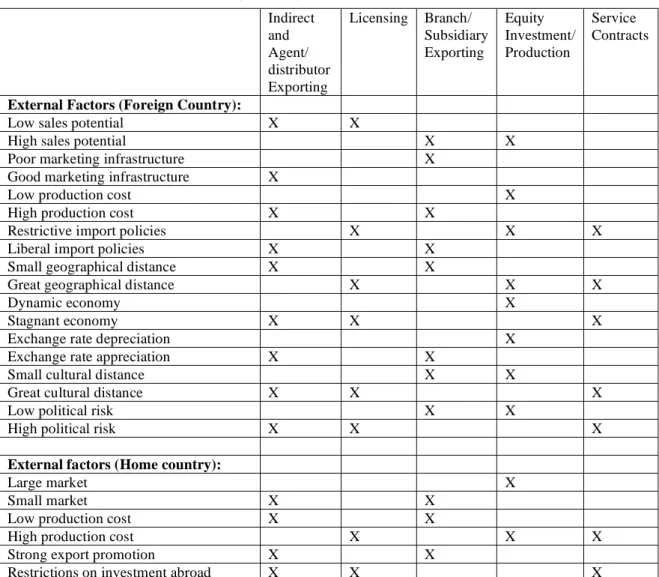
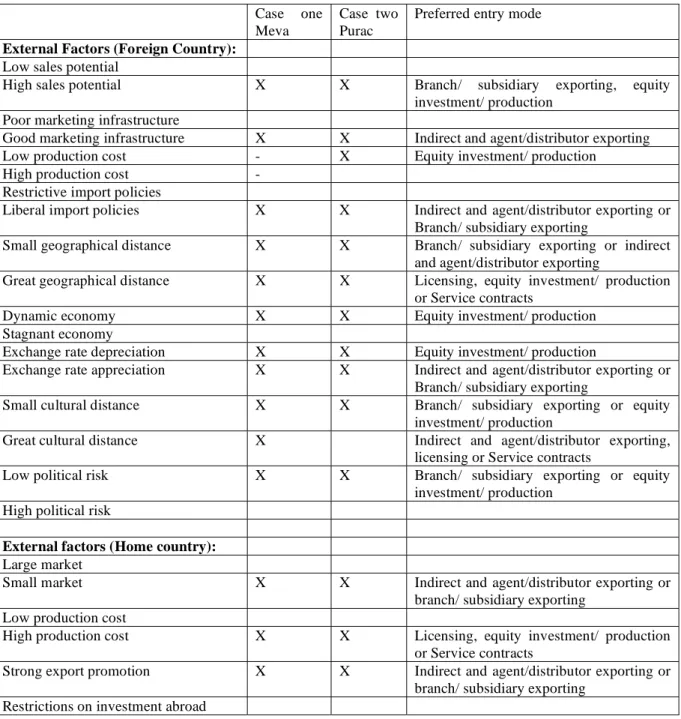
TABLE 2.1 External factors Influencing the Entry Mode Decision
2.2.5 Additional theory by Root (1994)
Root (1994) has summarized the influence of external factors on the choice of entry mode as shown in Table 2.1. Indirect and Agent/ distributor Exporting Licensing Branch/ Subsidiary Exporting Equity Investment/ Production Service Contracts
External Factors (Foreign Country):
Low sales potential X X
High sales potential X X Poor marketing infrastructure X
Good marketing infrastructure X
Low production cost X
High production cost X X
Restrictive import policies X X X Liberal import policies X X
Small geographical distance X X
Great geographical distance X X X
Dynamic economy X
Stagnant economy X X X
Exchange rate depreciation X Exchange rate appreciation X X
Small cultural distance X X
Great cultural distance X X X Low political risk X X
High political risk X X X
External factors (Home country):
Large market X
Small market X X
Low production cost X X
High production cost X X X Strong export promotion X X
Restrictions on investment abroad X X X Source: Adapted from Root, (1994), p.16
2.3 CONCEPTUAL FRAMEWORK
Miles and Huberman (1994) explain conceptual framework as the explanation of the most important elements to be studied in a thesis, the authors also add that this can be performed and shown in a graphical or a narrative form. The conceptual framework, which emerges from the studied literature in this thesis, is created to help us collect the data needed to answer the research questions. In order to do so, the literature perceived as most relevant to the research area will be selected and presented in the order of the previously stated research questions, furthermore each presented theory is also connected to each specific research question.
2.3.1 Research question 1 - How do internal factors influence firm’s choice of international market entry mode?
In order to answer the first research question we will among others rely on Koch’s (2001) holistic model of the market entry mode selection process. Koch mentions seven internal factors that influences the choice of entry mode from which we will focus on:
• Company size/ resources • Management risk attitudes • Market share targets
• Profit targets
• Experience in using individual MEMs
We will not look into Management locus of control and Calculation methods applied, since these two factors are highly individually varying and difficult to label.
Brassington and Pettitt (2000) also brings forward two internal factors that add an additional dimension to the subject, which we will investigate, and these are:
• Speed • Payback
Furthermore Hollensen (2001) states three internal factors of which we will use only Complexity and Differentiation of the product factor, as it is highly relevant to the chosen industry of this thesis. We have chosen not to focus on the Risk and Flexibility factors, as they are included in earlier mentioned theories.
Root’s (1994) theory regarding Product factors and Resource/ Commitment factors will not be used since there are more recent theories published regarding these factors and will be covered with previously mentioned theories. We will however use the theories brought forward by Bruhno and Schilt (2001), who mentions eight internal factors, of which we will consider five, leaving out the product, management and resources factors, since they are already included in earlier mentioned theory. These factors are:
• Motive • Goals • Strategy
• Customer relationships • Networks
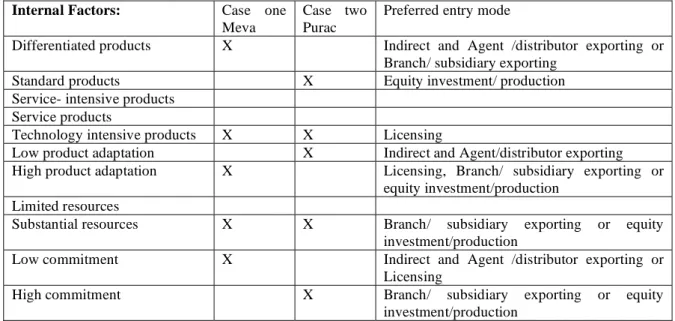
Bell (1995) brings forward the predomination for exporting as an internal factor, which will not be used, since the chosen firms already have established export channels in their businesses. Finally, Root’s (1994) summarization of internal factors in table 2.1 on page 15 will be used as a complement to the above mentioned theories since it has a clear connection between the internal factor and the actual choice of market entry mode and these are:
• Differentiated products • Standard products
• Service-intensive products • Service products
• Technology-intensive products • Low products adaptation
• High products adaptation • Limited resources
• Substantial resources • Low commitment • High commitment
The above mentioned internal factors will be used as base for developing the interview guide which will be used to answer our research questions and thereby fulfilling the purpose of this thesis.
2.3.2 Research question 2 - How do external factors influence firm’s choice of international market entry mode?
Koch (2001) has developed a holistic model of the market entry mode selection process. Koch mentions seven external factors that influences the choice of entry mode from which we will focus on:
• Industry feasibility/ viability of MEM • Characteristics of the overseas country
business environment
• Market growth rate • Market barriers
We will on the other hand not use Image support requirements, Global management efficiency requirements and Popularity of individual MEMs in the overseas market in this current study, as these are not relevant to the research area.
Hollsensen (2001) brings forward two other external factors, which are Highly competitive business environment and Forced choice of entry mode. We will not take these under consideration when conducting our thesis, since both these factors are integrated in Koch’s (2001) theory of market entry mode selection. Furthermore Root (1994) adds another theory where he discusses four external factors to consider when choosing market entry mode selection. Of these four we will focus on:
• Target country market factors • Target country production factors
• Home country factors
The choice to leave out the fourth factor of Target country environmental factors was made because environmental factors are as earlier mentioned brought up in previous theory. As a complement to Root’s (1994) model of external factors influencing the entry mode decision Root (1994) highlights the Geographic distance as an additional important external factor, which we will investigate together with the contribution made by Bell (1995) that firms initially target neighboring countries and subsequently enters foreign markets with greater “physic distance”.
Regarding Hollensen’s (2001) statement of the importance in Available number of export intermediaries will be disregarded, as it is not relevant to the thesis purpose. From Bruhno and Shilt’s (2001) theory we have chosen to focus on the external factor of Competitors, as the market factor is already more extensively covered in previously mentioned theory. Finally Root’s (1994) summarization of the external factors shown in table 2.1 will be used as a complement to the external factors previously mentioned since it has a clear connection between the external factors and the actual choice of market entry mode and these are:
External Factors (Foreign Country): • Low sales potential
• High sales potential
• Poor marketing infrastructure • Good marketing infrastructure • Low production cost
• High production cost • Restrictive import policies • Liberal import policies • Small geographical distance
• Great geographical distance • Dynamic economy
• Stagnant economy
• Exchange rate depreciation • Exchange rate appreciation • Small cultural distance • Great cultural distance • Low political risk • High political risk External factors (Home country):
• Large market • Small market
• Low production cost
• High production cost • Strong export promotion
• Restrictions on investment abroad The above mentioned external factors will be used as base for developing the interview guide which will be used to answer our research questions and thereby fulfilling the purpose of this thesis.
3. METHODOLOGY
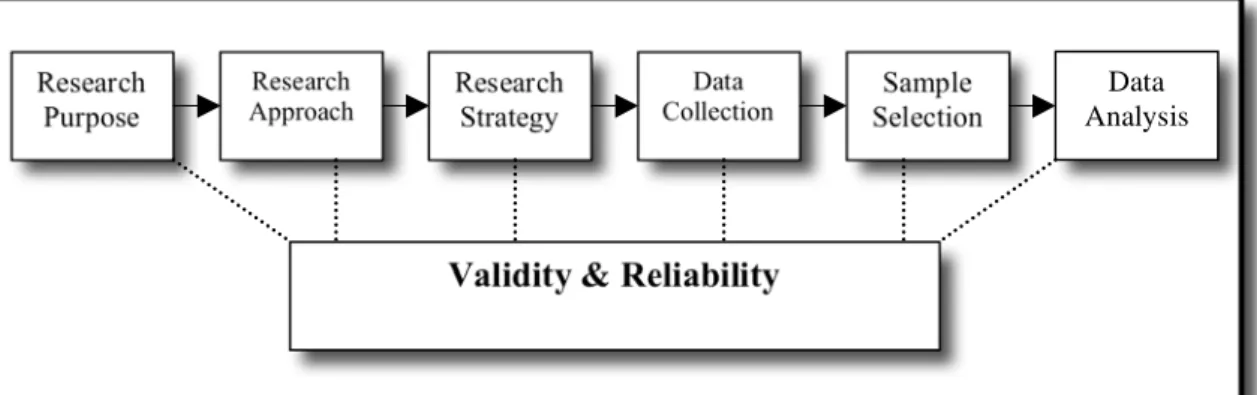
In this chapter the methodology used in this thesis will be presented. This chapter presents and motivates how, the data will be collected in order to find answers to our research questions, and by that fulfilling the purpose of the thesis. It starts with presenting the purpose of the research, followed by the research approach. Then the research strategy will be examined, moving on to the data collection, the sample selection and data analysis. Finally, the means of how to increase validity and reliability are discussed. The presentation of the methodology is presented below in figure 3.1.
3.1 RESEARCH PURPOSE
According to Yin (1994), there are three different categories of research; exploratory, explanatory and descriptive. These three classifications can be founded on how much knowledge the researcher has about the problem before starting the investigation, and further, the type of information that is needed in order to deal with the purpose of the thesis.
Exploratory research is performed when a problem is difficult to limit and when there is little or restricted research on the topic. According to Denscombe (2000) the purpose of exploratory research is to gather as much information as possible through the use of different sources, in addition Yin (1994) states that an exploratory study should state a purpose and the criteria to judge the exploration successful. According to Foster (1998) descriptive research is performed when studying a problem area with already existing theories or information. The goal with this type of research is to develop careful descriptions of different patterns that were suspected in the exploratory research. Finally, according to Yin (1994), explanatory research explains the causal relationships between cause and effect. Moreover, Denscombe (2000) argues that the aim of explanatory research is to develop a theory in order to explain the empirical generalization developed in the descriptive stage.
Bearing these criteria in mind, we can define our study as being mainly descriptive, however it will also be exploratory and to some extent explanatory. This is based on the purpose of this thesis being to provide a better understanding of the of impact internal and external factors on Swedish SME’s choice international market entry strategies. In order to find answers to our research questions we will have to explore the thesis topic and in the end of this thesis we will also begin to explain the research area.
Validity & Reliability
Research Approach Research Strategy Research Purpose Sample Selection Data Collection Data Analysis
Figure 3.1: Schematic Presentation of Chapter 3