
Department of Computer Science Series of Publications A
Report A-2018-5
Solving Optimization Problems via
Maximum Satisfiability: Encodings and
Re-Encodings
Jeremias Berg
To be presented with the permission of the Faculty of Science of the University of Helsinki, for public criticism in Auditorium CK112, Exactum, Gustaf H¨allstr¨omin katu 2b, on May 25th, 2018, at 12 o’clock noon.
University of Helsinki Finland
Associate Professor Matti J¨arvisalo, University of Helsinki, Finland Professor Petri Myllym¨aki, University of Helsinki, Finland
Pre-examiners
Professor Lakhdar Sais, Universit´e d’Artois, France
Professor Peter Stuckey, University of Melbourne, Australia Opponent
Associate Professor Inˆes Lynce, Universidade de Lisboa, Portugal Custos
Associate Professor Matti J¨arvisalo, University of Helsinki, Finland
Contact information
Department of Computer Science
P.O. Box 68 (Gustaf H¨allstr¨omin katu 2b) FI-00014 University of Helsinki
Finland
Email address: [email protected]
URL: https://www.helsinki.fi/en/computer-science Telephone: +358 2941 911
Copyright c 2018 Jeremias Berg ISSN 1238-8645
ISBN 978-951-51-4241-2 (paperback) ISBN 978-951-51-4242-9 (PDF) Helsinki 2018
Solving Optimization Problems via Maximum Satisfiability: Encodings and Re-Encodings
Jeremias Berg
Department of Computer Science
P.O. Box 68, FI-00014 University of Helsinki, Finland [email protected]
http://www.jeremiasberg.com
PhD Thesis, Series of Publications A, Report A-2018-5 Helsinki, April 2018, 86 + 102 pages
ISSN 1238-8645
ISBN 978-951-51-4241-2 (paperback) ISBN 978-951-51-4242-9 (PDF) Abstract
NP-hard combinatorial optimization problems are commonly encountered in numerous different domains. As such efficient methods for solving in-stances of such problems can save time, money, and other resources in several different applications. This thesis investigates exact declarative ap-proaches to combinatorial optimization within the maximum satisfiability (MaxSAT) paradigm, using propositional logic as the constraint language of choice. Specifically we contribute to both MaxSAT solving and encoding techniques.
In the first part of the thesis we contribute to MaxSAT solving technology by developing solver independent MaxSAT preprocessing techniques that re-encode MaxSAT instances into other instances. In order for preprocess-ing to be effective, the total time spent re-encodpreprocess-ing the original instance and solving the new instance should be lower than the time required to directly solve the original instance. We show how the recently proposed label-based framework for MaxSAT preprocessing can be efficiently inte-grated with state-of-art MaxSAT solvers in a way that improves the empir-ical performance of those solvers. We also investigate the theoretempir-ical effect that label-based preprocessing has on the number of iterations needed by MaxSAT solvers in order to solve instances. We show that preprocessing does not improve best-case performance (in the number of iterations) of MaxSAT solvers, but can improve the worst-case performance. Going
yond previously proposed preprocessing rules we also propose and evaluate a MaxSAT-specific preprocessing technique called subsumed label elimina-tion (SLE). We show that SLE is theoretically different from previously proposed MaxSAT preprocessing rules and that using SLE in conjunction with other preprocessing rules improves empirical performance of several MaxSAT solvers.
In the second part of the thesis we propose and evaluate new MaxSAT encodings to two important data analysis tasks: correlation clustering and bounded treewidth Bayesian network learning. For both problems we em-pirically evaluate the resulting MaxSAT-based solution approach with other exact algorithms for the problems. We show that, on many benchmarks, the MaxSAT-based approach is faster and more memory efficient than other exact approaches. For correlation clustering, we also show that the qual-ity of solutions obtained using MaxSAT is often significantly higher than the quality of solutions obtained by approximative (inexact) algorithms. We end the thesis with a discussion highlighting possible further research directions.
Computing Reviews (2012) Categories and Subject Descriptors:
Mathematics of computing→Combinatorial optimization Theory of computation→Constraint and logic programming Theory of computation→Problems, reductions and completeness General Terms:
Algorithms, Satisfiability, Combinatorial Optimization Additional Key Words and Phrases:
Acknowledgements
This work was done as part of the Constraint Reasoning and Optimization (CoReO) group of the Department of Computer Science at the Univer-sity of Helsinki. First and foremost I would like to express my sincerest gratitude to my advisor, Associate Professor Matti J¨arvisalo for all of the guidance and advice I have received during my PhD studies. I especially want to thank you for believing in me enough to let me pursue my own research interests. I am also very grateful to Professor Petri Myllym¨aki for the numerous roles he has played in making this work possible. Many thanks go to all of my other co-authors as well: Paul Saikko, Brandon Mal-one, Tuukka Korhonen, Antti Hyttinen, Emilia Oikarinen, Kai Puolam¨aki, Kerstin Bunte and Samuel Kaski. Working with all of you has been most pleasant and educational.
The quality of this manuscript has been significantly improved by the valuable feedback I have received from various people. I would especially like to thank my pre-examiners Professor Lakhdar Sais and Professor Peter Stuckey for their valuable input as well as Associate Professor Inˆes Lynce for taking the time to come to Helsinki to be my opponent. I extend my gratitude to everyone else who has given me feedback and suggestions, Matti, Antti, Jonas and Brandon as well as all anonymous reviewers of each publication.
I am immensely grateful for the support I have received from the Doc-toral School of Computer Science (DoCS). I thank the board and steering committee for giving me the financial stability needed complete my PhD. I especially want acknowledge Dr Pirjo Moen for helping me with most non-research related issues during my time as a PhD student. I also want to thank the Emil Aaltonen Foundation and the Nokia Foundation for fi-nancially supporting my PhD research.
I consider myself very lucky to have been a member of the CoReO research group. I’d like to thank past and present members of CoReO for the very inspiring research environment you have provided and the many interesting discussions we have had over the years. In addition to
my colleagues I would also like to thank my friends and other colleagues, both in and outside of Kumpula campus, for the welcome and necessary distractions from research. A special thanks goes to everyone that played cards with me in the coffee room or belayed me on the climbing wall. I am also immensely grateful for the opportunities given to me by my family and relatives. Without your support I would not be who I am today and probably would not have pursued a PhD in the first place. Finally I would like to thank Christina for being there for me through the ups and downs of day to day life.
Helsinki, April 2018 Jeremias Berg
Contents
1 Introduction 1
1.1 Maximum Satisfiability . . . 3
1.2 Contributions of the Thesis . . . 4
1.2.1 Original Publications . . . 5
1.2.2 Research Questions . . . 5
1.2.3 Specific Contributions by the Present Author . . . . 10
1.3 Organization of the Thesis . . . 11
2 Preliminaries 13 2.1 Propositional Satisfiability . . . 13
2.2 Maximum Satisfiability . . . 15
2.3 Cardinality Constraints . . . 17
2.4 SAT-based MaxSAT Solvers . . . 18
3 Preprocessing for Maximum Satisfiability Solving 23 3.1 Label-based MaxSAT Preprocessing . . . 24
3.2 Integrating Label-based Preprocessing into SAT-based Solving 27 3.3 Effect of Preprocessing on SAT-based Solving . . . 32
3.4 Subsumed Label Elimination . . . 35
4 Maximum Satisfiability for Data Analysis 41 4.1 Correlation Clustering . . . 41
4.1.1 Problem Setting . . . 42
4.1.2 MaxSAT Encodings of Correlation Clustering . . . . 43
4.1.3 Experimental Evaluation . . . 47
4.2 Bounded Treewidth Bayesian Network Structure Learning . 50 4.2.1 Problem Setting . . . 50
4.2.2 MaxSAT Encoding of BTBNSL . . . 51
4.2.3 Experimental Evaluation . . . 53
5 Conclusion 55
References 59 Reprints of the original publications 87
Chapter 1
Introduction
Mathematical optimization is a rich field of study with numerous applica-tions. Whenever we are given a problem and tasked with finding a solution that is “best”, we are faced with an optimization problem. If the space of possible (feasible) solutions is discrete, we talk about a combinatorial optimization problem [1]. The exact definition of a solution being best (op-timal) depends on the specific problem at hand. Commonly used quality measures include the length or cost of a solution. In this thesis, we focus on computationally challenging combinatorial optimization problems and, in particular, on developing maximum satisfiability [2] as a tool for solving them.
Computationally challenging optimization problems are common. Sev-eral of the well-known complete decision problems correspond to NP-hard optimization problems. Consider, for example, the traveling salesper-son problem (TSP) [3, 4]. An instance of TSP consists of a set of locations and the pairwise distances between them. A (feasible) solution to the in-stance is a route which visits all of the locations. The problem of deciding the existence of a route that has length at most some given bound is NP-complete. The corresponding NP-hard combinatorial optimization problem asks to find the shortest possible route.
NP-hard optimization problems are encountered in various settings, in-cluding, but not restricted to: telecommunications and network design [5], computational biology [6, 7], clustering [8–10], structure learning of prob-abilistic graphical models [11–13], argumentation [14], itemset mining [15– 18], data visualization [19–21], planning [22–24], scheduling [25–30], rout-ing [31], timetablrout-ing [32–36], hardware and software verification [37–39], covering [40], air traffic management [41, 42] and cancer therapy design [43]. The abundance and diversity of optimization problems suggests that efficient algorithms for can save time (e.g,. scheduling), money (e.g.,
work design) or other resources in various applications. For example, an effective solution method to TSP could significantly decrease the delivery times and fuel costs of a delivery company.
The research field of combinatorial optimization is well-established and studied [1]. The solution approaches to combinatorial optimization prob-lems can roughly be divided into four categories: approximation algo-rithms [44–48], local search algoalgo-rithms [49–52], problem-specific exact al-gorithms [3, 53–56] and exact declarative methods [2, 57–62]. This thesis focuses on exact declarative methods for solving NP-hard combinatorial optimization problems.
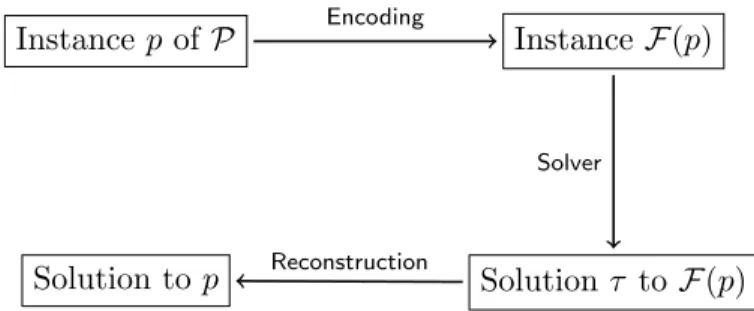
Figure 1.1 overviews the declarative approach to solving an instance p
of an NP-hard optimization problem P. The first step of the declarative approach is theencoding of pinto some mathematical constraint language
L. In other words, the declarative approach assumes the existence of a function (an encoding)P → Lthat maps each instancepofP to an instance
F(p) ofL, i.e., a set of constraints inL. The instanceF(p) describespin the sense that optimal solutions toF(p) correspond to optimal solutions to p. We assume that the constraint instance F(p) can be formed in polynomial time with respect to the size ofp. This assumption is typical when working with declarative methods, although there has been some research into larger encodings, often for solving even more complex problems [63–65].
After encoding p into F(p), the next step in the declarative approach is solving F(p), i.e., computing an optimal assignment to the variables in
F(p). We call such an assignment anoptimal solution toF(p). Finally, the optimal solution to F(p) is used to reconstruct an optimal solution to p. Analogously to the encoding step, we assume that the reconstruction step is computable in polynomial time. SinceP is NP-hard, these assumptions imply that L should be NP-hard as well. More specifically, we focus in this thesis on optimization problems and constraint languages with NP-complete decision counterparts. In the rest of the text, we use the term NP-hard in an informal manner to refer to specifically to such problems.
A notable characteristic of the pipeline in Figure 1.1 is that the (only) two computationally challenging steps are defining an encoding P → L
and solving the constraint instanceF(p). Assuming P6= NP, no complete solver for an NP-hard constraint language will run in polynomial time on every instance [66]. The efficiency of the declarative approach relies instead on designing solvers and encodings which ensure that the “interesting” in-stances ofP are encoded into constraint instancesF(p) on which the solver is able to avoid its worst case running time. By interesting instances we mean instances that are encountered in actual applications of the
prob-1.1 Maximum Satisfiability 3 Instancep ofP InstanceF(p) Solution τ toF(p) Solution to p Encoding Solver Reconstruction
Figure 1.1: A declarative approach to solving an optimization problemP.
lem. Consider for example a delivery company applying a solution method to TSP. A significant fraction of the theoretically possible instances (sets of locations) of TSP are never going to be encountered by the company in practice. Instead, an encoding and a solver which together are able to solve the instances corresponding to actually possible locations are enough to obtain a solution approach to TSP which is sufficient for the company’s needs.
A significant benefit of the declarative approach to solving optimization problems is its generality. The computationally challenging step of solving
F(p) is independent of the particular optimization problemP being solved. This means that improvements in solver technology of the chosen constraint language translate directly into more efficient algorithms to several different optimization problems, given the existence of well-performing encodings. Over the last decades, a number of different NP-hard constraint languages with varying features have been proposed and developed. A well known example is integer programming [57, 67, 68]. Others include constraint programming [59, 69], answer set programming [60, 61], maximum satisfi-ability [2] and its extensions to satisfisatisfi-ability modulo theories [70–72]. This thesis focuses on propositional logic as the underlying constraint language and maximum satisfiability as the corresponding constraint optimization problem.
1.1
Maximum Satisfiability
Maximum satisfiability (MaxSAT) is the optimization counterpart of the archetypical NP-complete propositional satisfiability (SAT) problem [66]. The expressive semantics of propositional logic, the constraint language underlying MaxSAT, allow encoding many NP-hard optimization problems as MaxSAT instances. At the same time, the relatively simple syntax also
allows the development of efficient solvers. The potential of propositional logic as the constraint language has been witnessed by the exceptional suc-cess of SAT solvers over the last decade [73, 74]. Recent improvements in MaxSAT solving technology and encodings have led to MaxSAT being applied in many different problem domains, including clustering [75], prob-abilistic modeling [76–79], data visualization [20], haplotype inference [80– 82], game theory [83] treewidth computation [84], reasoning over biological networks [85, 86], electronic markets [87], routing [31], software verifica-tion and code debugging [37, 88–92], planning [24, 93, 94], cancer ther-apy design [43], computing covering arrays [95] scheduling [36], probabilis-tic reasoning [78], upgradeability [96], design debugging [97], analysis of other constraint satisfaction problems [98] and computer memory recon-struction [99].
The state of the art in MaxSAT solving techniques is evaluated annually in the MaxSAT Evaluations [100–102]. The evaluations have shown that the effectiveness of MaxSAT solvers for solving other optimization problems builds heavily on the effectiveness of SAT solvers. More specifically, many of the solvers that are most effective on MaxSAT instances that correspond to other optimization problems make extensive use of satisfiability solvers as subroutines. In the rest of the thesis such solvers are collectively called SAT-based MaxSAT solvers. SAT-SAT-based MaxSAT solvers can further be divided into roughly three subcategories: the model-guided [103–108], the core-guided [106, 109–120] and the implicit hitting set based [121–123] solvers. Most of the contributions of this thesis are developed in the context of core-guided and implicit hitting set based solvers, although many of the ideas are simple to extend to model-guided solvers as well.
It should be noted that in addition to SAT-based MaxSAT solvers, an-other commonly used approach to MaxSAT solving is branch and bound (B&B) [124–134]. B&B solvers tend to be most effective on random MaxSAT instances as well as challenging instances of smaller size. Such instances are encountered for example in combinatorics [100–102].
1.2
Contributions of the Thesis
This thesis is based on six peer-reviewed publications. The contributions of this thesis are divided into two interrelated research questions. In this section we first overview the publications and then discuss the research questions. We also briefly overview the specific contributions of the present author to each individual publication. The remaining chapters of the thesis will then discuss the contributions of each publication in more detail.
1.2 Contributions of the Thesis 5
1.2.1 Original Publications
The following six peer-reviewed publications form the basis of this thesis. The papers are referred to as Papers I-VI in the rest of the text.
I Jeremias Berg, Paul Saikko, and Matti J¨arvisalo. Improving the Effectiveness of SAT-Based Preprocessing for MaxSAT. In
Proceedings of the 24th International Joint Conference on Artificial Intelligence (IJCAI), pages 239-245. AAAI Press, 2015.
II Jeremias Berg, Paul Saikko, and Matti J¨arvisalo. Re-using Auxil-iary Variables for MaxSAT Preprocessing. InProceedings of the IEEE 27th International Conference on Tools with Artificial Intelli-gence (ICTAI), pages 813-820. IEEE Computer Society, 2015.
III Jeremias Berg and Matti J¨arvisalo. Impact of SAT-Based Pre-processing on Core-Guided MaxSAT Solving. InProceedings of the 22nd International Conference on Principles and Practice of Con-straint Programming (CP), volume 9892 of Lecture Notes in Computer Science, pages 66-85. Springer International Publishing, 2016.
IV Jeremias Berg, Paul Saikko, and Matti J¨arvisalo. Subsumed Label Elimination for Maximum Satisfiability. In Proceedings of the 22nd European Conference on Artificial Intelligence (ECAI), volume 285 of Frontiers in Artificial Intelligence and Applications, pages 630-638. IOS Press, 2016.
V Jeremias Berg and Matti J¨arvisalo. Cost-Optimal Constrained Correlation Clustering via Weighted Partial Maximum Sat-isfiability. Artificial Intelligence. 244:110-142, 2017.
VI Jeremias Berg, Matti J¨arvisalo, and Brandon Malone. Learning Op-timal Bounded Treewidth Bayesian Networks via Maximum Satisfiability. InProceedings of the 17th International Conference on Artificial Intelligence and Statistics (AISTATS), volume 33 of JMLR Workshop and Conference Proceedings, pages 86-95. JMLR, 2014. Reprints of the publications are included at the end of the thesis.
1.2.2 Research Questions
This thesis contributes to improving the effectiveness of using MaxSAT for solving combinatorial optimization problems by studying two distinct but connected research questions. The first question concerns the development
of MaxSAT solving methods, specifically in the form of solver-independent MaxSAT preprocessing [135]. The second question concerns the develop-ment of new MaxSAT encodings for two data analysis problems, correlation clustering [136] and bounded treewidth Bayesian network structure learn-ing [137, 138].
Research Question 1: Preprocessing in MaxSAT solving
The first part of the thesis focuses on improving SAT-based MaxSAT solv-ing. More specifically, Papers I-IV develop preprocessing techniques for MaxSAT. Preprocessing [139–141] extends the declarative pipeline (Fig-ure 1.1) by adding a preprocessing step directly after the encoding step. During preprocessing, the constraint instance F(p) is re-encoded into an-other constraint instancepre(F(p)) using polynomial-time computable in-ference rules. In this context, the inin-ference rules are called preprocessing rules and the process of re-encoding F(p) is called preprocessing F(p). Analogously to the encoding, the preprocessing rules used should preserve optimal solutions. Informally, we say that preprocessing issound if any op-timal solution topre(F) can be used to reconstruct an optimal solution to
F in polynomial time. The goal of (sound) preprocessing is to increase the applicability of MaxSAT for solving optimization problems by decreasing the overall time spent solving instances. In other words, effective prepro-cessing makes the total time spent preproprepro-cessing F(p) together with the time spent solvingpre(F(p)) lower than the time required to directly solve
F(p). In this thesis, we focus on problem-independent preprocessing, i.e., preprocessing that does not depend on the particular optimization problem
P being solved. In other words, we focus on preprocessing techniques that can be applied on any MaxSAT instance F, regardless of the particular domain from which F was obtained.
In SAT solving, the importance of preprocessing is well-understood [140]. Many modern SAT solvers apply preprocessing before starting search [141– 150]. The effectiveness of preprocessing in SAT solving suggests that simi-lar effective preprocessing rules could be developed for MaxSAT solving as well. This possibility is especially interesting in the context of SAT-based MaxSAT solvers, since their effectiveness relies heavily on SAT solvers. Generalizing preprocessing rules proposed for SAT solving to MaxSAT is not straightforward. Direct application of many such rules to MaxSAT in-stances is not sound [135]. Informally, the reason is that, in order to be sound for SAT-solving, a preprocessing rule should preserve satisfiability, not the number of falsified clauses, and thus not optimal MaxSAT solutions either [151].
1.2 Contributions of the Thesis 7 One approach to sound MaxSAT preprocessing is the so-called MaxSAT resolution rule [151]. Preprocessing rules based on MaxSAT resolution are indeed used by some B&B solvers [131, 152, 153]. However, such rules are difficult to use efficiently when solving MaxSAT instances that cor-respond to industrial applications. The reason is that each application of MaxSAT resolution adds several new clauses to the instance. Hence, MaxSAT resolution based preprocessing rules often increase the size of the already large industrial instances beyond what MaxSAT solvers can handle. In this thesis we focus on an alternative approach to MaxSAT preprocessing known as label-based preprocessing [135, 154]. Label-based preprocessing of MaxSAT instances allows generalizing several of the existing and well-established preprocessing rules proposed for SAT solving to MaxSAT by adding a single new variable (a label) to each soft clause of the instance before preprocessing.
In Papers I and II we develop label-based preprocessing further. In Paper I we show how label-based preprocessing can efficiently be incor-porated with SAT-based MaxSAT solvers. The central insight of Paper I is that most SAT-based MaxSAT solvers add extra variables to the soft clauses of MaxSAT instances regardless of the use of preprocessing. In Pa-per I we show that the labels added during preprocessing can be reused in the solver, thus avoiding the need for the solver to add any new variables. We also show that reusing variables improves the empirical performance of LMHS, an at the time state-of-the-art SAT-based MaxSAT solver [123]. In Paper II we take the idea further and show that some variables in the input MaxSAT instance itself can be reused in the preprocessing and solv-ing phases. This further reduces the number of new variables that need to be added when preprocessing and solving MaxSAT instances. We also show that identifying reusable variables from MaxSAT instances improves empirical performance of LMHS.
In Paper III we present a theoretical analysis on the effect of prepro-cessing on the number of SAT solver calls that SAT-based MaxSAT solvers require in order to terminate. An underlying motivation for the analysis is that SAT solver calls are the most computationally expensive step of such solvers. Thus insights into which factors influence the number of necessary calls can potentially significantly improve them. In Paper III we show that label-based generalizations of preprocessing rules for SAT solving can not reduce the minimum number of necessary SAT solver calls. We also show that preprocessing can ensure that the solver avoids worst-case executions, i.e., that preprocessing can decrease the maximum number of iterations required by SAT-based MaxSAT solvers.
Finally, in Paper IV we propose and analyze a new label-based MaxSAT preprocessing rule called subsumed label elimination (SLE). We analyze the theoretical differences between SLE and the generalizations of prepro-cessing rules for SAT solving. In particular, we show that including SLE amongst the preprocessing rules used during label-based preprocessing can result in more clauses and variables removed from the instance. We also report on an empirical evaluation on the effect of using SLE during label-based preprocessing. Our results show that SLE can improve the empirical performance of some state-of-the-art SAT-based MaxSAT solvers.
Research Question 2: Applications of MaxSAT in Data Analysis The second part of this thesis focuses on developing MaxSAT encodings of other NP-hard combinatorial optimization problems. More specifically, Pa-pers V and VI develop new MaxSAT encodings for two data analysis tasks: correlation clustering [136] (Paper V) and bounded treewidth Bayesian net-work structure learning [137, 155] (Paper VI).
Clustering is one of the central problems of unsupervised machine learn-ing [156–159]. Given a set of data points, the goal of clusterlearn-ing is to par-tition the set in some meaningful way. The parpar-titioning is typically called a clustering of the data and each set of a clustering is a cluster. This definition of clustering is very general, a number of different clustering problems and algorithms have been proposed over the years [160–164], in-cluding some constraint-based approaches [8–10, 165–167]. In Paper V, we focus on the correlation clustering problem [168–174]. Correlation cluster-ing is a recently proposed clustercluster-ing paradigm geared towards classifycluster-ing data based on qualitative similarity information—as opposed to quantita-tive information—of pairs of data points. An instance of the correlation clustering problem consists of a set of data points and pairwise similarity information over them. The similarity information expresses preferences on whether or not the pair of points should be assigned to the same cluster. Informally, pairs of points that are similar should be assigned to the same cluster. At the same time, pairs of points that are dissimilar should be assigned to different clusters. An optimal solution to the instance balances these two conflicting objectives as well as possible. In contrast to other typi-cal clustering paradigms, correlation clustering does not require the number of clusters as input. Instead, the optimal number should be learned during search. This makes correlation clustering especially well-suited for settings in which the true number of clusters is unknown. Consider for example the problem of clustering documents by topic without any prior knowledge on what those topics might be or how many of them there are [136, 175].
1.2 Contributions of the Thesis 9 In Paper V we propose and prove the correctness of three MaxSAT encodings of correlation clustering. We also empirically compare the re-sulting MaxSAT-based solution approach with previously proposed exact and approximation (inexact) algorithms. Our results indicate that, within the scalability of exact approaches, the MaxSAT-based approach is often both faster and more memory-efficient than other exact approaches. We also show that the clusterings obtained using MaxSAT are of significantly better quality than the ones obtained by inexact algorithms, especially on sparse instances with missing similarity information.
Bayesian networks are an important class of probabilistic graphical models widely-used for representing joint probability distributions of sets of random variables [137, 176]. A Bayesian network structure is a directed acyclic graph (DAG) in which each node corresponds to a random variable. The graph represents the conditional dependencies between the variables. Often, a Bayesian network structure that represents given data well is not known a priori, and needs to be learned from observations (data) instead. Learning the optimal structure is a well-known optimization problem called the Bayesian network structure learning problem (BNSL) [177–180]. There are two main frameworks for BNSL: the score-based framework, and the independence test-based framework. In the score-based framework, each possible DAG structure is assigned a score that measures how well the structure explains the observations. The goal of BNSL is to compute a best-scoring network. For several commonly used scoring functions, the BNSL problem is NP-hard [181]. As is typical for challenging optimiza-tion problems, early soluoptimiza-tion methods to the problem tended to focus on polynomial-time inexact algorithms [182–187] while interest in exact algo-rithms for BNSL has increased within the last decade [54, 180, 188–191].
After having learnt a Bayesian network structure, the network is typ-ically used for probabilistic inference tasks, such as inferring the prob-ability distribution of some variables, possibly given the values of oth-ers. For general Bayesian network structures, this inference task is NP-hard [192]. However, it is becomes tractable whenever the underlying net-work structure has bounded (fixed) treewidth [193, 194]. Treewidth is a well-known graph-theoretic measure [195]. Informally, treewidth measures how “close” a given graph is to being a tree. All trees have treewidth 1 and all complete graphs withnnodes have treewidthn−1. Treewidth has important connections to (in)tractability. Many NP-hard problems become tractable when restricted to instances that can be modeled using graphs with bounded treewidth [196, 197]. The fact that inference is tractable in Bayesian networks with low treewidth motivates the development of
algorithms that learn optimal Bayesian network structures with bounded treewidth, a problem known as bounded treewidth Bayesian network struc-ture learning (BTBNSL). Compared to the recent progress in practical al-gorithms for optimally solving BNSL, fewer alal-gorithms have been proposed for BTBNSL [138, 198–201]. In Paper VI we study BTBNSL in the score-based framework. It should be noted that the extra constraint bounding the treewidth of the solution network structure is a non-trivial addition to BNSL. BTBNSL is also an NP-hard optimization problem [199]. In fact, computing the treewidth of any graph is NP-hard [202].
In Paper VI we propose a MaxSAT encoding of BTBNSL. We com-pare the resulting MaxSAT-based solution approach to a previously pro-posed dynamic programming algorithm as the only other practical exact solution algorithm to BTBNSL available at the time of the publication of Paper VI [198]. We show that the MaxSAT-based method is more memory-efficient and scales noticeably better than the dynamic programming algo-rithm.
1.2.3 Specific Contributions by the Present Author
All publications were jointly co-written by all of their authors. Other con-tributions by the present author are as follows.
Paper I: The idea of reusing labels in a SAT-based MaxSAT solver was first proposed by the present author. The modifications required for label reusing in LMHS were done by the second author of the paper as the author of the LMHS solver. The present author modified a SAT preprocessor to be usable as a MaxSAT preprocessor and ran all of the experiments. Paper II: The idea of identifying literals from the input formula that can be used as labels in preprocessing and assumptions in MaxSAT solving was a natural extension of Paper I. The present author implemented the modifications to the external preprocessor used in the publication and ran all of the experiments.
Paper III: The theoretical analysis was conducted by the present author under the guidance of the second author.
Paper IV: The idea of subsumed label elimination was developed by the present author with assistance from the other authors. The present author implemented the technique into the preprocessor and ran all of the experiments.
1.3 Organization of the Thesis 11 Paper V: The MaxSAT encoding of correlation clustering was jointly developed by the authors of the publication. The present author ran all of the experiments.
Paper VI: The MaxSAT encoding of bounded treewidth Bayesian net-work learning was co-developed by the authors of the publication. The present author ran all experiments presented in the paper.
1.3
Organization of the Thesis
The rest of the thesis is organized as follows. In Chapter 2 we give the background information relevant to this thesis. The contributions to the first and second research question are then overviewed in more detail in Chapters 3 and 4, respectively. We conclude the thesis with a summarizing discussion in Chapter 5.
Chapter 2
Preliminaries
In this chapter we give the relevant definitions and background informa-tion for understanding the main results of this thesis. First we give precise definitions of the satisfiability and maximum satisfiability problems in Sec-tions 2.1 and 2.2, respectively. We then proceed by overviewingcardinality constraints in Section 2.3 as an important class of higher level constraints commonly used in both SAT-based MaxSAT solving and MaxSAT encod-ings of other optimization problems. We end the chapter by overviewing SAT-based MaxSAT solvers in Section 2.4. In our discussion we assume familiarity with propositional logic.
2.1
Propositional Satisfiability
We identify the truth value true with 1 and false with 0. A Boolean variable
x has the domain{0,1}. A literall is a Boolean variable xor its negation
¬x. For a literall, it holds that¬¬l=l. A clauseC is a disjunction (∨) of literals and a formula in conjunctive normal form (CNF) is a conjunction (∧) of clauses. We will mostly treat clauses as sets of literals and CNF for-mulas as sets of clauses. We will also simplify set notation when modifying formulas. Specifically, given a clause C and a CNF formula F, F \C is identified withF\ {C}andF∪C withF∪ {C}. We denote the set of vari-ables and literals of a clauseC by Var(C) andLit(C), respectively. The set of variables Var(F) and literals Lit(F) of a formula F are defined by
Var(F) = SC∈F Var(C) and Lit(F) = SC∈F Lit(C), respectively. For a set L of literals, we use ¬L to denote the set of negations of the literals in L, i.e., ¬L = {¬l | l ∈ L}. L is a set of assumptions if either x /∈ L
or ¬x /∈ L for each variable x ∈ Var(F). Given a literal l, we denote by ClF(l) the set of clauses of F which contain l, dropping the subscript
whenever clear from context. The clauses Cl(L) containing literals from the set L⊆Lit(F) are defined byCl(L) =∪l∈LCl(l).
Given a set V of Boolean variables, a truth assignment τ over V is a functionτ:V → {0,1}. A truth assignment is extended to literals, clauses and CNF formulas in the standard way: ¬x is true (τ(¬x) = 1) if x is false (τ(x) = 0), a clauseC is true (τ(C) = 1) if τ(l) = 1 for at least one literal l∈ C, and a CNF formula F is true (τ(F) = 1) if τ(C) = 1 for all clausesC ∈F. A truth assignmentτ satisfies a clauseC ifτ(C) = 1 and a formula ifτ(F) = 1, else it falsifies them. A CNF formulaF is satisfiable if there exists a truth assignment τ which satisfies it, elseF is unsatisfiable. Two formulas F1 and F2 are equivalent if τ(F1) = τ(F2) for any truth
assignmentτ overVar(F1)∪Var(F2). The formulas areequisatisfiableifF1
is satisfiable if and only ifF2is. The well-known propositional satisfiability
(SAT) problem asks if a given CNF formulaF is satisfiable. As is common in most practical applications, we treat the SAT problem as the problem of computing a satisfying assignment toF or proving that one does not exist. Essentially all modern SAT solvers can provide a satisfying assignment whenever invoked on a satisfiable formula F.
A truth assignment τ:S → {0,1} over a proper subset S ⊂ Var(F) is a partial assignment of the formula F. The simplification of F under a partial truth assignmentτ is another formula Fτ obtained by removing all clauses satisfied by τ from the formula and all literals falsified by τ from the remaining clauses. When convenient, we will treat a (partial) truth assignment τ as a set of literals by l∈τ if and only ifτ(l) = 1. Similarly, each set L ⊆ Lit(F) of assumptions can be treated as a (partial) truth assignment. In this thesis we use partial truth assignments in the context of satisfiability checking under assumptions [203]. Given a formula F and a set of assumptions L ⊆ Lit(F), we say that F is satisfiable under L if
FL is satisfiable. For an alternative view, F is satisfiable underL if there exists a satisfying assignmentτ toF that setsτ(l) = 1 for alll∈L.
Given a CNF formula F, a SAT solver is an algorithm that computes a satisfying assignment to F or proves that one does not exist. The de-velopment of SAT solvers is an active area of research [73, 74, 204–210]. Besides pure satisfiability checking, SAT solvers are commonly used as sub-routines in more complex algorithms, for example in SAT-based MaxSAT solvers [116, 203]. Most modern SAT solvers that are used in SAT-based MaxSAT solving implement the conflict-driven clause learning (CDCL) al-gorithm [204, 211, 212]. CDCL solvers have in turn evolved from the older Davis-Putnam-Logemann-Long search procedure [213]. In this thesis we only use CDCL SAT solvers as black boxes in SAT-based MaxSAT solvers
2.2 Maximum Satisfiability 15 and as such will not discuss the details of how they operate here. The only requirement we make of a SAT solver is that it supports satisfiability querying under assumptions, and that it is able to compute subsets of the assumptions which explain unsatisfiability. More precisely, given a formula
F and a set of assumptions L⊆Lit(F) for which FL is unsatisfiable, we
assume that the SAT solver can extract a subset L0 ⊆ L such that FL0
is unsatisfiable as well. Most modern CDCL SAT solvers support these features through the so-calledassumption interface.
2.2
Maximum Satisfiability
An instanceF of weighted partial maximum satisfiability (or MaxSAT for short) is a triplet F = (Fh, Fs, w) consisting of two CNF formulas, the
hard clauses Fh and thesoft clauses Fs, and a weight functionw:Fs→N.
The literals Lit(F) and variables Var(F) of MaxSAT instances are the literals and variables of Fh∧Fs, respectively. Given a MaxSAT instance
F = (Fh, Fs, w), any truth assignment τ which satisfiesFh is a solution to
F. The cost COST(F, τ) of a solution τ toF is the sum of the weights of soft clauses it falsifies, i.e.,
COST(F, τ) = X
C∈Fs
w(C)·(1−τ(C)).
A solution τo to F is optimal if COST(F, τo) ≤ COST(F, τ) for all so-lutions τ to F. The (optimal) cost of the instance F is the cost of the optimal solutions to F. We denote the optimal cost of an instance F by
COST(F). In the rest of the thesis, we assume that all MaxSAT instances have solutions, or equivalently, thatFh is satisfiable.
The MaxSAT solvers we work with in this thesis make extensive use
unsatisfiable cores. Given a MaxSAT instance F = (Fh, Fs, w), a subset
κ⊆Fsis an unsatisfiable core if the formulaFh∧κis unsatisfiable. A core
κ is a minimal if Fh∧κs is satisfiable for all κs ⊂ κ. Minimal cores are
abbreviated by MUS (minimal unsatisfiable subformula). A set M ⊆ Fs
is a correction set (of F) if the formula Fh ∧(Fs\M) is satisfiable. The
correction setM is minimal (an MCS) if Fh∧(Fs\Ms) is unsatisfiable for
all Ms ⊂M. We denote the set of MUSes and MCSes of F by MUS(F)
and MCS(F), respectively.
The MCSes and MUSes of MaxSAT instances are related to each other viahitting sets. Given a collection of setsK, a setH is a hitting set overK ifH∩K 6=∅ for allK ∈ K. A hitting set H is irreducible if no Hs ⊂H is
a hitting set overK. For a MaxSAT instance F, the well known hitting set duality theorem establishes a connection between MUS(F) and MCS(F).
Theorem 1 (Hitting Set Duality [214]). A set κ is an MUS of a MaxSAT instance F if and only if it is an irreducible hitting set over MCS(F). Similarly, a setM is an MCS of F if and only if it is an irreducible hitting set over MUS(F).
Minimal correction sets provide an alternative definition of the MaxSAT problem. For a solution τ to a MaxSAT instance F = (Fh, Fs, w), let
U(τ) ⊆ Fs be the set of soft clauses falsified by τ. We say that τ is a
minimal solution toF ifU(τ) is set-minimal, i.e., if there does not exist a solutionτ2 toF for whichU(τ2)⊂U(τ). Notice that all optimal solutions
toF are minimal but the converse does not hold. It is simple to show that there exists a many-to-one correspondence between minimal solutions and the MCSes ofF. More specifically, a solution τ ofF is minimal if and only if U(τ) ∈ MCS(F). We say that a minimal solution τ to F corresponds to an MCSMτ of F ifMτ =U(τ). The correspondence is not one-to-one, instead eachM ∈MCS(F) corresponds to a set of minimal solutions ofF. However, if two minimal solutionsτ1 and τ2 toF correspond to the same
M ∈ MCS(F), then τ1 and τ2 satisfy (and hence also falsify) the exact same clauses ofF. This implies that
Cost(F, τ1) = X C∈Fs τ1(C)=0 w(C) = X C∈M w(C) = X C∈Fs τ2(C)=0 w(C) =Cost(F, τ2).
In this thesis we will treat minimal solutions that correspond to the same MCSes as equivalent. We say that an M ∈ MCS(F) corresponds to a solutionτM ifτM is a minimal solution ofF that corresponds toM. A set
M ∈MCS(F) is optimal if it corresponds to an optimal solution ofF. The relationship between MCSes and minimal solutions of MaxSAT instances suggests an alternative definition of the MaxSAT problem. Let
F = (Fh, Fs, w) be a MaxSAT instance with the weight functionwextended
to sets S ⊆ Fs of soft clauses by w(S) = PC∈Sw(C). Denote the set of
solutions and minimal solutions toF bysol(F) andmsol(F), respectively. The optimal costCOST(F) of F can be expressed in terms of the MCSes of F by
COST(F) = min
τ∈sol(F)COST(F, τ) =τ∈msolmin(F)COST(F, τ)
= min
τ∈msol(F)w(M
τ) = min
M∈MCS(F)w(M).
In other words, an M ∈ MCS(F) is optimal if w(M) ≤ w(M0) for all
2.3 Cardinality Constraints 17 problem of computing an Mo ∈arg min
M∈MCS(F){w(M)}. By hitting set
duality, such Mo is also a minimum-cost hitting set over MUS(F), i.e., a hitting set over MUS(F) which minimizes w(Mo) over all hitting sets of MUS(F). Notice that a minimum-cost hitting set is guaranteed to be irreducible. The following theorem shows that a satisfiability query can be used in order to verify that a hitting set over any collection of cores of F
is an optimal MCS without computing the entireMUS(F).
Theorem 2 (Adapted from [122]). Let F = (Fh, Fs, w) be a MaxSAT
instance andC a collection of cores ofF. LetM be a minimum cost hitting set over C and assume that Fh ∧(Fs \M) is satisfiable. Then M is an
optimal MCS ofF.
The implicit hitting set solvers we work with in this thesis are based on Theorem 2.
2.3
Cardinality Constraints
Despite the simple syntax, several types of complex constraints can be mod-eled with CNF formulas. One such class of constraints commonly used in both SAT-based MaxSAT solving and MaxSAT encodings of other problems are cardinality constraints, an important special case of the more general class ofpseudo-boolean constraints. Given a setL={l1, . . . , ln}ofnliterals,
a setW ={w1, . . . , wn} of weights, a constantkand ◦ ∈ {≤,≤,≥≥,=}, a
pseudo-boolean constraint is a linear constraint overLof formPni=1wili◦k.
A truth assignment τ satisfies the constraint whenever Pni=1wiτ(li)◦k is
true. We denote the set of clauses resulting from encoding a pseudo-boolean constraintPni=1wili◦kto CNF byCNF(Pni=1wili◦k). A pseudo-boolean
constraint is a cardinality constraint ifwi = 1 for all 1≤i≤n. The
numer-ous applications of cardinality constraints have motivated the development several different CNF encodings of them [215–220].
Example 1. Let L = {l1, . . . , lN} be a set of literals and consider the
at-most-onecardinality constraint
N
X
i=1
li≤1
enforcing that at most one of the literals in L must be set to true. The at-most-one constraint is commonly used in SAT-based MaxSAT solving [111, 115, 116, 120] as well as MaxSAT encodings of other problems, including correlation clustering and bounded treewidth Bayesian network structure
learning. A simple way of encoding this constraint in CNF is with O(n2) clauses of form(¬li∨¬lj)for every distinctliandlj inL. As an example of
a more compact encoding, the ladder encoding usesn−1auxiliary variables
y1, . . . , yn−1 and clauses corresponding toli ↔(¬yi∧yi+1) as well as yi→
yi+1. All in all the ladder encoding uses O(n) auxiliary variables and O(n) clauses.
2.4
SAT-based MaxSAT Solvers
In this section we overview and discuss the two types of MaxSAT solvers on which the rest of the thesis focuses on. The contributions of this thesis to MaxSAT preprocessing are not specific to a single MaxSAT solver, but instead two classes of MaxSAT solvers that we call core-guided solvers [111, 115–117, 119, 120] and implicit hitting set based solvers [121–123]. We discuss these solvers in terms of two abstract MaxSAT solving algorithms:
CG, representing core-guided solvers andIHS, representing implicit hitting set based solvers. In the rest of the thesis, we use the term MaxSAT algorithm to refer to abstractions and MaxSAT solver to refer to concrete implementations of MaxSAT algorithms.
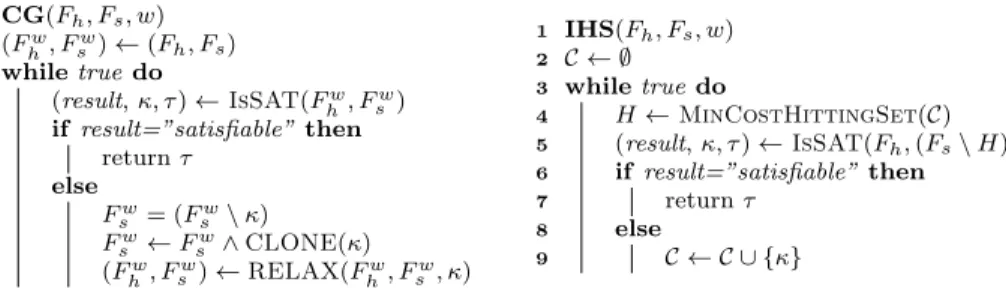
The CG and IHS algorithms are presented in pseudocode in Figure 2.1 on the left and right side, respectively. These abstractions cover several modern MaxSAT solvers, including Fu-Malik (WPM1, WMSU1) [116, 221, 222], PMRES [115], OLL [111, 223] and ONE (K) [119] (the CG algorithm), as well as MaxHS [121, 122] and LMHS [123] (the IHS algorithm). It should be noted that solvers implementing CG or IHS often also make use of several different additional heuristics and search strategies [224–227] that are not included in the pseudocodes of Figure 2.1.
Both CG and IHS rely extensively on the ability to extract unsatisfiable cores from MaxSAT instances. Let (Fh, Fs) be two sets of clauses such that
Fh∧Fs is unsatisfiable. In both CG and IHS, a core κ ⊆Fs is extracted
using the assumption interface of the underlying SAT solver. Let FsA =
{C∨aC |C∈Fs}be the set of all clauses inFs, each extended with a unique
assumption variableaC. Let alsoA(Fs) =Var(FsA)\Var(Fs) be the set of
all assumption variables and consider a subsetAs⊆ A(Fs). Core extraction
using assumptions is based on the fact that the simplification of Fh ∧FsA
under¬Asis the formulaFh∧ {C|C∨aC ∈Cl(As)}. In order to see this,
consider a clause C∨aC ∈ FsA. If aC ∈ As, the partial assignment ¬As
reducesC∨aC toC. IfaC ∈ A/ s, the clauseC∨aC can be trivially satisfied
by setting aC to true. Hence we can check the satisfiability of Fh ∧Fs
2.4 SAT-based MaxSAT Solvers 19 1 CG(Fh, Fs, w) 2 (Fw h, Fsw)←(Fh, Fs) 3 whiletrue do 4 (result,κ, τ)←IsSAT(Fw h, Fsw) 5 if result=”satisfiable”then 6 returnτ 7 else 8 Fw s = (Fsw\κ) 9 Fw s ←Fsw∧CLONE(κ) 10 (Fw h, Fsw)←RELAX(Fhw, Fsw, κ) 1 IHS(Fh, Fs, w) 2 C ← ∅ 3 whiletruedo 4 H←MinCostHittingSet(C) 5 (result,κ, τ)←IsSAT(Fh,(Fs\H)) 6 ifresult=”satisfiable” then 7 returnτ 8 else 9 C ← C ∪ {κ}
Figure 2.1: Abstractions of the two types of MaxSAT algorithms we work with in this thesis.
If the formula is satisfiable, the returned truth assignment (restricted to
Var(Fh∧Fs)) is also a satisfying assignment of Fh ∧Fs. Otherwise, the
subset ¬Aκ ⊆ ¬A(Fs) of the assumptions returned by the solver can be
mapped to an unsatisfiable core κ = {C |C∨aC ∈ Cl(Aκ)} of (Fh, Fs).
In Figure 2.1 we abstract this functionality into the function IsSAT. The result of a query IsSAT(Fh, Fs) is a triplet (result, κ, τ), where result is
true if and only if Fh ∧Fs is satisfiable. If Fh ∧Fs is satisfiable, then
τ is a satisfying assignment to it. Otherwise κ is an unsatisfiable core of Fh ∧Fs. In the IHS algorithm the assumption interface is also used
for removing clauses from the SAT-solver queries. More specifically, for a subset H ⊆ Fs, the satisfiability of Fh ∧(Fs\H) is equivalent to the
satisfiability of Fh ∧FsA under ¬RH = ¬(A(Fs)\ A(H)). This enables
clause removal from the formula without the need to reset the internal state of the SAT solver. Notice that ifFh∧FsAis unsatisfiable under¬RH,
the core returned by the SAT solver is guaranteed to be a subset ofFs\H.
Given an input MaxSAT instance F = (Fh, Fs, w), the CG algorithm
maintains a working formula (Fhw, Fsw), initialized to (Fh, Fs) on Line 2.
The algorithm iteratively queries the internal SAT solver using the function
IsSAT(Fhw, Fsw) (Line 4), obtaining a triplet (result, κ, τ). Whenever the SAT solver returns “satisfiable”, CG terminates and returns the assignment
τ, guaranteed to be an optimal solution toF (Line 6). Otherwise, a coreκ
of (Fhw, Fsw) is obtained. The algorithm proceeds byrelaxing the working instance andcompiling information about the core into it (Line 10). Most of the implementations of RELAX that we are aware of assume that all of the soft clauses in the core have equal weight. To handle cores κ with varying clause weights, the solvers use a standard technique known as clause cloning [109, 221] (Line 9). First the smallest weight among all clauses in
κ is computed, wminκ = min{w(C) | C ∈ κ}. Then each clause C ∈ κ
to Fw
s , the weight of the original clause is set to wminκ , and the duplicate
Clone(C) is given the residual weight w(Clone(C)) =w(C)−wminκ . All duplicates are left in the working instance as soft clauses and the function
RELAX(Fw
h, Fsw, κ) is invoked using the original clauses ofκwhich now all
have equal weight. The exact manner in which the formula is modified, i.e., the implementation of RELAX, depends on the concrete MaxSAT solver. A classical example is the Fu-Malik solver [116] in which each clauseC ∈κ
is extended with a fresh relaxation variablerC to form the extended clause
C∨rC. The extended clauses are left in the formula as soft and a cardinality
constraint CNF(Pr = 1) is added as hard clauses. Several of the early core-guided solvers relax the soft clauses in the core and add cardinality constraints as hard clauses. In contrast, more recently proposed core-guided solvers harden the soft clauses in the core and add cardinality constraints as soft clauses [111, 115, 119, 120].
In contrast to the CG algorithm, the IHS algorithm does not add or remove any clauses at all during execution and instead only works on the input hard and soft clauses. Given an input MaxSAT instance
F = (Fh, Fs, w), the IHS algorithm maintains a set Cof cores of F,
initial-ized to∅on Line 2. At each iteration, a minimum-cost hitting set overC is computed (Line 4). Then a SAT solver is invoked on all of the clauses in the working formula, except for the ones inH (Line 5). If the formula is satisfi-able,His an optimal MCS ofF(Theorem 2) and IHS terminates, returning the optimal solution satisfying Fh ∧(Fs\H) (Line 7). Otherwise, a new
core is obtained and added to the setC(Line 9), after which the algorithm reiterates. In two solvers implementing the IHS algorithm, MaxHS [122] and LMHS [123], a minimum-cost hitting set is obtained by solving the current hitting set problem using an integer programming solver.
Beyond the scope of this thesis, a third class of SAT-based MaxSAT solvers are the so-called model-guided solvers [103–108, 110]. When in-voked on a MaxSAT instance F = (Fh, Fs, w), a model-guided solver
initializes an upper and lower bound UB and LB of the optimal cost of
Cost(F). The exact manner in which the bounds are initialized depends on the solver, a simple example sets LB = 0 and UB = PC∈Fsw(C). During search, the solver queries a SAT solver for the satisfiability of
Fh∧FsA∧CNF(
P
C∈Fs(w(C)·aC) ≤ k) where k is some constant
sat-isfying LB ≤ k ≤ U B. If the formula is satisfiable, then Cost(F) ≤ k
and the value of the upper bound is lowered. Similarly, if the formula is unsatisfiable, then Cost(F) > k and the value of the lower bound is in-creased. The solver iterates until an optimal solution is found. Different model-guided solvers make use of several different search strategies and
2.4 SAT-based MaxSAT Solvers 21 encodings of cardinality constraints. Some also use unsatisfiable cores for more precise control on which soft clauses are relaxed and how much the bounds are updated [106, 107].
Finally we mention that in addition to SAT-based MaxSAT solvers a central approach to exact MaxSAT solving is branch and bound (B&B) [124– 133]. Given an input MaxSAT instanceF, B&B solvers search for an opti-mal solution toF by branching on the two possible values of each variable in the formula. In order to avoid exhaustive search over all possible assign-ments of the variables, B&B solvers make use of several different bound computation and other inference rules [131, 134, 152, 228, 229] designed to allow effective pruning of the search tree. Some B&B solvers also make use of restricted forms of unsatisfiable cores in their bound computations [125].
Chapter 3
Preprocessing for Maximum
Satisfiability Solving
In this chapter we discuss the contributions of this thesis to MaxSAT pre-processing techniques, overviewing Papers I-IV. While the importance of preprocessing in SAT solving is well-established [140–144, 146–150], the role of preprocessing in MaxSAT solving is not as developed [135, 151]. Here we focus on the label-based approach to MaxSAT preprocessing [135] and the CG and IHS MaxSAT algorithms presented in Figure 2.1 of Section 2.4. The empirical results presented in this chapter focus on the LMHS MaxSAT solver [123], a from-scratch instantiation of the IHS algorithm by the sec-ond author of Papers I, II and IV. All experiments were performed on a cluster of 2.53-GHz Intel Xeon quad core machines with 32 GB memory and Ubuntu Linux, using a per-instance memory limit of 30 GB. Since the time limit used in the experiments varied between papers, we will specify them in the relevant sections. For the formal proofs and complete empirical results, we direct the reader to the reprints of the papers at the end of the thesis.
This chapter is organized as follows. In Section 3.1 we give prelimi-naries on label-based preprocessing of MaxSAT instances. In Section 3.2 we discuss how label-based preprocessing can be integrated into SAT-based MaxSAT solving in a manner that significantly decreases the number extra variables and clauses that are added (Papers I and II). We demonstrate that tighter integration between the preprocessing and solving steps results in improved empirical performance of LMHS. In Section 3.3 we overview a theoretical analysis of the effect of preprocessing on the number of it-erations required by CG and IHS (Paper III). Finally, in Section 3.4 we present a MaxSAT-specific preprocessing technique that we call subsumed label elimination (SLE) (Paper IV). We give theoretical results on the
ences between SLE and the MaxSAT generalizations of preprocessing rules for SAT solving. We also show that using SLE in conjunction with previ-ously proposed preprocessing rules leads to further simplifications during preprocessing as well as improved empirical performance of LMHS.
3.1
Label-based MaxSAT Preprocessing
Most of the contributions of this thesis to MaxSAT preprocessing build on previous work [135] on lifting four central preprocessing rules proposed for SAT to MaxSAT using the so called labeled CNF (LCNF) framework [154, 230]. More specifically, the rules lifted are bounded variable elimination, subsumption and self-subsuming resolution [141], as well as blocked clause elimination [231]. In this chapter we focus on the same four rules and call them SAT-based preprocessing rules. It should, however, be noted that, in addition to these four, several other preprocessing rules have been proposed for SAT solving [140, 142, 143, 145–150].
For some intuition on why SAT-based preprocessing rules can not di-rectly be applied on MaxSAT instances, consider the subsumption elimi-nation (SE) rule. Let F be a SAT formula andC, D two clauses ofF. We say that C subsumes D ifC ⊆D. A clause D is subsumed if some other clause subsumes it. The SE rule allows removing subsumed clauses from
F. Let pre(F) be the formula resulting after an application of SE on F. ThenF and pre(F) are equisatisfiable since any assignmentτ that satisfies the former will satisfy the latter and vice versa. More generally, we say that a preprocessing rule is sound for SAT-solving if (i) applying the rule to a formulaF gives an equisatisfiable formulapre(F) and (ii) a satisfying assignment to F can be reconstructed from any satisfying assignment to
pre(F) in polynomial time. Even if SE is sound for SAT solving, the next example demonstrates that directly removing subsumed clauses from the hard and soft clauses of MaxSAT instances can alter the costs of solutions and thus also the optimal solutions.
Example 2. Let F = (Fh, Fs, w) be a MaxSAT instance with
Fh ={(¬x1),(¬x2),(¬x3∨ ¬x4)},
Fs ={(x1∨x3),(x2∨x3),(x3),(x4)}
and w(C) = 1 for each C ∈Fs. An optimal solution τ to F sets τ(x1) =
τ(x2) = τ(x4) = 0 and τ(x3) = 1, falsifying one soft clause. Direct appli-cation of SE on Fh∧Fs removes two soft clauses. The resulting instance
3.1 Label-based MaxSAT Preprocessing 25
F2 = (F2
h, Fs2, w2) has
Fh2 ={(¬x1),(¬x2),(¬x3∨ ¬x4)} andFs2 ={(x3),(x4)}. One optimal solution τ2 to F2 sets τ2(x
1) = τ2(x2) = τ2(x3) = 0 and
τ2(x4) = 1. This solution falsifies one soft clause in F2 but three in F.
Example 2 illustrates the fact that instead of only preserving satisfying assignments, MaxSAT preprocessing should preserve the optimal solutions
of instances.
Definition 1. Let F be a MaxSAT instance, R a preprocessing rule, and
pre(F) the instance obtained by preprocessing F with R. Assumeτp is an
optimal solution topre(F). The preprocessing ruleRis sound for MaxSAT if an optimal solution τ to F can be reconstructed from τp in polynomial time.
Procedure 3.1 describes label-based preprocessing of a MaxSAT instance
F = (Fh, Fs, w) using SAT-based preprocessing rules. First, each soft
clause C ∈ Fs is extended with a unique new label (Boolean variable)
lC to form the labeled clause C ∨lC and the set of labeled soft clauses
FL
s ={C∨lC |C ∈Fs}. Notice the similarity between labels and
assump-tion variables used in SAT-based MaxSAT solving (recall Secassump-tion 2.4). Let
L(F) =Var(FsL)\Var(Fs) be the set of all added labels. The next step of
label-based preprocessing is preprocessing the formula Fh∧FsL with
SAT-based preprocessing rules, thereby obtaining the formulapre(Fh∧FsL). In
order to guarantee soundness for MaxSAT, bounded variable elimination and self-subsuming resolution are restricted from removing any variables inL(F) during preprocessing [135]. Finally, the preprocessed MaxSAT in-stancepre(F) = (Fhp, Fsp, wp) has Fhp =pre(Fh∧FsL) as hard clauses. The
soft clauses Fsp contain unit clauses with negations of labels that appear
among the hard clauses: Fsp ={(¬lC)|lC ∈Lit(Fhp)∩ L(F)}. The weight
of each soft clausewL((¬lC)) is equal to the weightw(C) of the soft clause
to whichlC was added in the first step. We emphasize that soft clauses are
only added for labels lC ∈ Lit(Fhp). Even if bounded variable elimination
or self subsuming resolution can not remove any labels, a label can still be removed from the instance during preprocessing. For example, if a soft clause is subsumed by a hard clause, SE can remove the labeled soft clause during preprocessing together with the corresponding label.
The basis for the soundness of label-based preprocessing with SAT-based preprocessing rules is the following theorem.
Preprocess F = (Fh, Fs, w)
1. Let FsL = {C ∨lC | C ∈ Fs, lC new} and L(F) = Var(FsL)\
Var(Fs).
2. Preprocess the CNF formula Fh∧FsL using SAT-based
prepro-cessing rules.
• Do not remove any l ∈ L(F) with bounded variable elimi-nation nor self-subsuming resolution.
3. Return
pre(F) = (Fhp, Fsp, wp)
with Fhp = pre(Fh∧FsL), Fsp = {(¬lC) |lC ∈ Lit(Fhp)∩ L(F)}
and wp((¬lC)) =w(C).
Procedure 3.1: Label-based preprocessing of a MaxSAT instanceF. Theorem 3. (Adapted from [135]) Assume that an instanceF= (Fh, Fs, w)
is preprocessed using label-based preprocessing with SAT-based preprocess-ing rules to obtainpre(F) = (Fhp, Fsp, wp). For each soft clause C∈Fs, let
lC be the label added to C during preprocessing. Then the following hold.
(i) The optimal costs of F and pre(F) are equal.
(ii) M ∈MUS(F) if and only if {(¬lC)|C ∈M} ∈MUS(pre(F)).
We show that label-based preprocessing with SAT-based preprocess-ing rules is sound for MaxSAT uspreprocess-ing Theorem 3 and hittpreprocess-ing set duality (Theorem 1).
Theorem 4. Label-based preprocessing with SAT-based preprocessing rules is sound for MaxSAT.
Proof. (Sketch) Let F = (Fh, Fs, w) be a MaxSAT instance andpre(F) =
(Fhp, Fsp, wp) an instance obtained by label-based preprocessing of F using
SAT-based preprocessing rules. Consider an optimal solutionτp topre(F) and let Mτp be the MCS corresponding to τp. By Theorem 3 and hitting set duality, the set M = {C | (¬lC) ∈ Mτ
p
} is an MCS of F. Since
wp((¬lC)) =w(C) for all (¬lC)∈ Mτ
p
, it follows thatwp(Mτp) =w(M). Since Mτp is optimal for pre(F) and COST(pre(F)) = COST(F), the
3.2 Integrating Label-based Preprocessing into SAT-based Solving 27 MCS M is optimal for F. Hence the solution τM corresponding to M is
an optimal solution to F. The fact that τM can be reconstructed from
τp in polynomial time follows from the fact that SAT-based preprocessing rules allow reconstruction of satisfying assignments to CNF formulas [135, 140].
3.2
Integrating Label-based Preprocessing into
SAT-based Solving
As the first contribution to MaxSAT preprocessing of this thesis we inves-tigate label-based preprocessing in conjunction with SAT-based MaxSAT solving. In Paper I we show how to improve the empirical performance of LMHS [123], a MaxSAT solver implementing the IHS algorithm, by reusing labels as assumptions.
More generally, we show that if a preprocessed MaxSAT instancepre(F) is solved with a SAT-based MaxSAT solver, the labels introduced during preprocessing can be reused as the assumption variables used for core ex-traction within the internal SAT solver. Since a similar number of as-sumption variables would otherwise be introduced by the solver, reusing labels as assumptions removes the need to add extra variables when using label-based preprocessing with SAT-based MaxSAT solving. In more detail, assume that the IHS algorithm instructed to reuse labels as assumptions is invoked on a preprocessed MaxSAT instancepre(F) = (Fhp, Fsp, wp). Then
the internal SAT solver of IHS is first initialized with the clauses inFhp (and specifically notFsp). During search, the cores in C are maintained in terms
of label variables. Each computed hitting setH is the set of label variables that should not be assumed to be false in the next SAT solver call. Each unsatisfiable SAT solver call obtains a new subset of the label variables and the augmented IHS algorithm terminates as soon as a SAT solver call returns “satisfiable”. While Paper I focuses on the IHS algorithm, a similar idea is applicable to the CG algorithm as well. Notice that labels lcan be treated as soft clauses by introducing a unit clause (¬l) on demand.
Informally, the correctness of reusing labels as assumptions follows by considering an execution of IHS not reusing labels as assumptions invoked on a preprocessed MaxSAT instance pre(F) = (Fh, Fs, w). Initially each
soft clause (¬lC)∈ Fs is extended with an assumption variable ato form
the clause (¬lC∨a). Notice that this clause is equivalent to the implication
¬a→ ¬lC. Let A(pre(F)) be the set of all assumption variables. During
an iteration of the while-loop (Lines 3-9), IHS will first compute H as a minimum-cost hitting set over the set of cores C identified so far. In
practice,H is a subset ofA(pre(F)) containing the assumption variablesa
of all clauses ¬lC ∨a which will be removed from the instance in the next
SAT solver call. Afterwards a SAT solver is invoked on Fh ∧FsA under
¬(A(pre(F))\H). In this call, each soft clause (¬lC∨a) for which a /∈H
is reduced to (¬lC) due to assuming a to be false. Thus the value oflC is
propagated to false as well. Similarly, ifa∈H, the value ofais not assumed to be anything at all. However, asaonly appears in a single clause, the SAT solver can assign it to true in order to satisfy the clause (¬lC∨a). As¬lC
does not appear in any other clause, the SAT solver can also assign lC to
true, satisfying all clauses in ClFh(lC). Thus the assumptions only affect
the values of the corresponding label variables through the implications
¬a → ¬lC. An alternative description of reusing labels as assumptions
is hence to not introduce the implications ¬a → ¬lC at all, but instead
directly assume the values of the lC variables. In Paper I we give a more
direct proof of soundness using the formal LCNF framework [135].
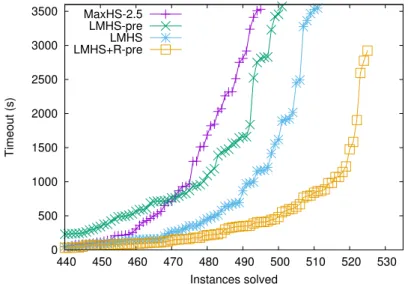
In addition to the theoretical analysis, Paper I also reports on an ex-perimental evaluation of the effect that reusing labels as assumptions has on LMHS. The evaluation was performed using the weighted partial indus-trial and crafted benchmarks of the 2014 MaxSAT evaluation [101] using a per-instance time limit of 1 h. Figure 3.2 shows a summary of the results. The line MaxHS-2.5 corresponds to the newest version of the MaxHS solver at the time [121, 122]. MaxHS is included to give a baseline comparison to LMHS.
The line LMHS+pre of Figure 3.2 of shows the performance of LMHS using preprocessing without reusing labels as assumptions. We note that preprocessing without reusing labels actually degrades overall performance of the solver. The best overall performance is achieved by LMHS+R-pre, corresponding to LMHS using preprocessing and reusing labels as assump-tions. In the rest of this chapter, we will refer to LMHS+R-pre simply as LMHS, explicitly mentioning whenever it is used without reusing labels as assumptions.
Reusing Literals from MaxSAT Instances
In Paper II we show how the number of variables that need to be in-troduced to a MaxSAT instance F during preprocessing and SAT-based solving can be decreased further. We prove that literals l ∈ Lit(F) that satisfy three easily identifiable criteria can be reused as labels in prepro-cessing and assumptions in SAT-based MaxSAT solving. We also propose
group detection as a simple pattern-matching procedure to identify such literals. We experimentally demonstrate that reusable literals can be
iden-3.2 Integrating Label-based Preprocessing into SAT-based Solving 29 0 500 1000 1500 2000 2500 3000 3500 440 450 460 470 480 490 500 510 520 530 Timeout (s) Instances solved MaxHS-2.5 LMHS-pre LMHS LMHS+R-pre
Figure 3.2: The effect of reusing labels as assumptions on LMHS (from Paper I).
tified in a significant fraction of the MaxSAT evaluation benchmarks and that using group detection leads to modest improvements in the empirical performance of LMHS.
In more detail, we introduce the concept of a group-detectable literal. Definition 2. Let F = (Fh, Fs, w) be a MaxSAT instance andl∈Lit(F).
The literal l is group-detectable if it satisfies the following three criteria. 1. (¬l)∈Fs.
2. ¬l /∈Lit(Fh∧(Fs\(¬l))).
3. l /∈Lit(Fs).
In words, a literallis group-detectable in an instanceF = (Fh, Fs, w) if lis
not a member of any soft clauses ofF and its negation¬ldoes not appear in any clause inFh∧Fs except for one unit soft clause. We say that a soft
clause (¬l) is group-detectable if the literall is.
In Paper II we show that givenany MaxSAT instanceF (preprocessed or not), all group-detectable literals l ∈ Lit(F) can be reused as labels for preprocessing and assumptions for core extraction. For some intuition on the connection between Paper I and II, notice that if an instance F




![Table 4.1: Running times in seconds of our MaxSAT-based approach (MS) and the dynamic programming (DP) approach [198] for different UCI datasets and treewidth bounds k = 2, 3, 4](https://thumb-us.123doks.com/thumbv2/123dok_us/1996428.2796512/62.748.107.636.511.696/running-seconds-approach-programming-approach-different-datasets-treewidth.webp)