ORIGINAL ARTICLE
Efficient mining fuzzy association rules from
ubiquitous data streams
Amal Moustafa
*, Badr Abuelnasr, Mohamed Said Abougabal
Computer and Systems Engineering Department, Faculty of Engineering, Alexandria University, Egypt Received 22 January 2015; revised 9 March 2015; accepted 15 March 2015
Available online 11 April 2015
KEYWORDS Data mining;
Fuzzy association rules; Fuzzy sets;
Data streams;
Ubiquitous data streams
Abstract Due to the development in technology, a number of applications such as smart mobile phone, sensor networks and GPS devices produce huge amount of ubiquitous data in the form of streams. Different from data in traditional static databases, ubiquitous data streams typically arrive continuously in high speed with huge amount, and changing data distribution. Dealing with and extracting useful information from that data is a real challenge. This raises new issues, that need to be considered when developing association rule mining techniques for these data. It should be noted, that data, in the real world, are not represented in binary and numeric forms only, but it may be represented in quantitative values. Thus, using fuzzy sets will be very suitable to handle these values.
In this paper the problem of mining fuzzy association rules from ubiquitous data streams is stud-ied, and a novel technique FFP_USTREAM (Fuzzy Frequent Pattern Ubiquitous Streams) is developed. This technique integrates fuzzy concepts with ubiquitous data streams, employing slid-ing window approach, to mine fuzzy association rules. In addition, the complexity and the efficiency of this technique are discussed. Examples of real data sets are usedto testthe proposed technique. Further research issues are also suggested.
ª2015 Faculty of Engineering, Alexandria University. Production and hosting by Elsevier B.V. This is an open access article under the CC BY-NC-ND license (http://creativecommons.org/licenses/by-nc-nd/4.0/).
1. Introduction
Recent emerging applications, such as network traffic monitor-ing, sensor network data analysis, web click stream minmonitor-ing, power consumption measurement, and dynamic tracing of stock market fluctuations, call for studying a new kind of data. This is called stream data, which can be continuous, poten-tially infinite flow of information, as opposed to finite, stati-cally stored data sets. Stream Data Mining is the process of
extracting knowledge structures from continuous, and rapid data records.
The dissemination of data streams systems, wireless net-works and mobile/handheld devices motivates the need for an efficient data analysis tool capable of gaining insights about these continuous data streams [1]. Ubiquitous data streams mining (UDM) is the process of pattern discovery on mobile, embedded and ubiquitous devices. It represents the next generation of data mining systems, that will support the intel-ligent and time-critical information needs of mobile users, and will facilitate ‘‘anytime, anywhere’’ data mining.
Fuzzy logic is a type of logic used in artificial intelligence. It is referred to as a multi-valued logic.Instead of having two * Corresponding author.
Peer review under responsibility of Faculty of Engineering, Alexandria University.
H O S T E D BY
Alexandria University
Alexandria Engineering Journal
www.elsevier.com/locate/aej www.sciencedirect.com
http://dx.doi.org/10.1016/j.aej.2015.03.015
1110-0168ª2015 Faculty of Engineering, Alexandria University. Production and hosting by Elsevier B.V. This is an open access article under the CC BY-NC-ND license (http://creativecommons.org/licenses/by-nc-nd/4.0/).
values (true and false), there are a continuum of possible truth values[2]. In fuzzy logic, every proposition is a statement that is assigned a number between 0 (false) and 1 (true), such a statement is called a fuzzy proposition. Fuzzy logic provides a powerful tool to categorize a concept in an abstract way by introducing vagueness.
Many data streams applications exist, that require associa-tion rule mining, such as network traffic monitoring and web click streams analysis. These applications’ goal is to discover important associations among items as the presence of some items will imply the presence of others.
Fuzzy association rule approach could combine data min-ing results with human expertise and background knowledge, in the form of rules, to attain labeled classes for classification of data streams. Another advantage of the fuzzy logic approach is that it gives classification results, which include a degree of probability.
This paper demonstrates the effectiveness of Fuzzy Association Rules Mining from Ubiquitous Data Streams. This will be revealed in the coming sections. For this purpose, the remaining part of the paper is organized as follows: the work related to Fuzzy Association rules mining and ubiquitous data streams mining are reviewed and summarized in Section2. An efficient fuzzy association rules mining technique from ubiquitous data streams is proposed in Section3, and its complexity is analyzed in Section 4. Moreover,experimental results are discussed in Section 5. The paper is concluded and future research issues are presented, in Section6.
2. Related work
This paper belongs to different inter-related research fields. The two main related topics of this work are presented: Ubiquitous Data Streams Mining Techniques that can effec-tively analyze continuously streaming data and Fuzzy associa-tion rules mining algorithms. These two fields will be surveyed. 2.1. Ubiquitous data streams mining
The approach, based on finite statically stored data sets, is not satisfactory in several applications. These include wireless net-work analysis, intrusion detection, stock market analysis, sen-sor network data analysis, and, in general, any setting in which every information available should be used to make an immediate decision. Such situations demand new algorithms, that are able to cope with evolutions of data as shown in Table 1 [3].
Ubiquitous Data Mining (UDM) is the time-critical process of pattern discovery in data streams in a wireless environment [4]. The widespread use of mobile devices, with increasing com-putational capacity, is leading to the emergence of the ubiqui-tous computing paradigm. This paradigm facilitates continuous access to data and information by mobile users with handheld devices [5]. UDM is the process of analyzing data from distributed and heterogeneous sources with mobile devices or within sensor networks, where the data is continu-ously streamed to the device, and where there are temporal constraints, that necessitate analysis ‘‘anytime, anywhere’’[6]. In the following subsections preprocessing required for data streams is presented.
2.1.1. Data streams techniques
Research problems and challenges that appeared in mining data streams have their solutions using well established sta-tistical and computational approaches. These solutions could be categorized to data-based and task-based ones. This classi-fication is depicted inFig. 1 [7]. In data-based solutions, the idea is to examine only a subset of the whole dataset or to transform the data vertically or horizontally to an approxi-mate smaller size data representation. On the other hand, in task-based solutions, techniques from computational theory have been adopted to achieve time and space efficient solutions.
2.1.1.1. Data-based techniques.Data-based techniques refer to summarizing the whole dataset or choosing a subset of the
Table 1 Taxonomy of data mining environment.
Data localization
Centralized A single entity can access every data Distributed Each node can access just a part of the data Homogeneous . . .data related to the same entity (e.g. people) are
owned by just one node
Heterogeneous . . .data related to the same entity (e.g. people ) may be spread among several nodes
Data evolution
Statical Data are definitively stored and invariable (e.g. related to some past and concluded event) Incremental New data are inserted and access to past data is
possible (e.g. related to an ongoing event) Evolving The dataset is modified with either updates,
insertions or deletions, and access to past data is possible
Streaming Data arrives continuously and for an indefinite time. Access to past data is restricted to a limited part of them or summaries
Figure 1 Classification of data streams preprocessing methods
incoming stream to be analyzed. Sampling, load shedding and sketching techniques are most commonly used[7].
2.1.1.2. Task-based techniques. Task-based techniques are those methods that modify existing techniques,or invent new ones in order to address the computational challenges of data streams processing. Approximation algorithms, window mod-els (landmark window model, damped window model, or slid-ing window model), and algorithm output granularity represent this category[7].
2.1.2. Data streams association rules
A number of algorithms have been proposed for extracting knowledge from streaming information. These include cluster-ing, classification, frequency counting and time series analysis techniques. As the number of applications on mining data streams grows rapidly, there is an increasing need to perform association rule mining on stream data. An example applica-tion of data streams associaapplica-tion rule mining is to estimate missing data in sensor networks[8]. Another example is to pre-dict frequency estimation of Internet packet streams[9].
In the MAIDS project[10], this technique is used to find alarming incidents from data streams. Association rule mining can also be applied to monitor manufacturing flow to predict failure, or generate reports based on web log streams[11].
Several frequent pattern algorithms[12–18]were suggested in the literature. Most of these approaches either produce approximate results, discover special subsets (closed, maximal, and constraint-based) or provide exact results. These are com-pared inTable 2 [19].
2.2. Fuzzy association rules mining
Most studies have shown how binary valued transaction data may be handled. However, transaction data in real-world applications, usually consist of fuzzy and quantitative values. Thus, designing sophisticated data-mining algorithms, able
to deal with various types of data presents a challenge to work-ers in this research field. Three Fuzzy Association rules algo-rithms[20–22]were recently proposed in the literature. These are compared inTable 3.
2.3. Need to extend existing work
Close study ofTables 2 and 3reveals the need to develop a novel technique for mining fuzzy association rules from ubi-quitous data streams.This technique should enjoy the follow-ing features:
– the ability of handling the continuous flow of data streams, – the ability of handling data concept drift over time, – the ability of handling memory bounded size, suitable for
ubiquitous applications,
– facilitates data analysis and quick decision support for users, by scanning the flow of data streams only once, – could determine fuzzy sets & membership functions, – could determine user-defined min support, and – gives accurate results.
In the following sections, an efficient Fuzzy Frequent Pattern Ubiquitous Streams technique (FFP_USTREAM), that satisfies the above features is proposed.
3. Proposed technique: FFP- USTREAM
The proposed technique consists of four steps, as indicated in AlgorithmA.1. These are detailed below.
3.1. Step 1: Specifying sliding window
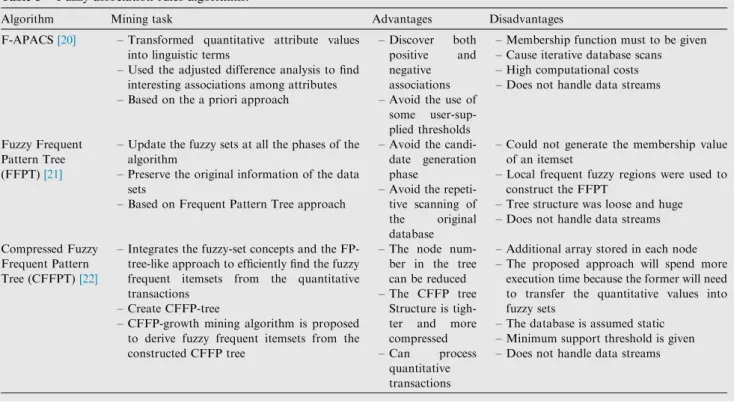
To handle continuously generated ubiquitous data streams, a sliding window model is used as shown inAlgorithm A.2, to find exact recent fuzzy frequent patterns. The first step is to determine a sliding window size. Old transactions are expired, Table 2 Comparative analysis of frequent pattern algorithms[19].
Algorithm name Window model Algorithm type Updation rate Merits Limitations Lossy counting [12]
Landmark Approximate Batch wise No false negatives in results Setting up of relaxed minimum support threshold leads to dilemma
Data Stream Mining Frequent Itemsets (DSM-FI)[13]
Landmark Approximate Batch wise Compact tree structure has been designed to store the frequent patterns
It needs more tree traversals for the frequency count Compact Prefix tree Structure (CPS)[14] Sliding window
Exact Batch wise It maintains the frequency count lists at the last node, which can reduce the size of the prefix tree
Additional computational cost needed for restructing the tree after every pane insertion. Frequent Pattern (FP-Stream)[15] Tilted time window
Approximate Batch wise It extracts complete set of frequent patterns using time sensitive data streams
FP-Stream tree becomes very large with time Weighted sliding Window (WSW) [16] Sliding window
Exact Batch wise A single pass algorithm was developed to discover the frequent itemsets
Weights of each window affected the mining results. So, user should specify the reasonable weight for each window Weighted Support Frequent Pattern (WSFP)[17] Sliding window Exact Transaction wise
It collects the important recent frequent patterns with limited memory space
Initial setting of normalized minimum and maximum weight is given as random
Variable Sliding Window VSW[18]
Sliding window
Exact Batch wise Obselete transactions are deleted with respect to calculated formula
The prefix tree becomes very large where there is no changes occurred in the frequent patterns in processing
once the new transactions arrive into the current window. The size of the window depends on the application and the system resources[19]. In this work, the size of window is considered constant.Variable window size is left for future work.
An example of sliding window in fuzzy data streams is depicted inFig. 2. In this example, the window size (number of panes) and pane size (number of transactions) are set to 2. The notation (A:5) indicates the number of purchased units of item A.
3.2. Step 2: Fuzzification
Fuzzification of quantative values of data streams attributes involves two processes. Firstly, derive the fuzzy sets for vari-ables and represent them with linguistic terms[23]. Secondly, estimate the membership functions[24]. In practice, member-ship functions can have multiple different types, such as triangular waveform,trapezoidal waveform, Gaussian wave-form, bell-shaped wavewave-form, sigmoidal wavewave-form, and S-curve waveform. In this work triangular and trapezoidal waveforms are used.
3.3. Step3: Tree structure construction
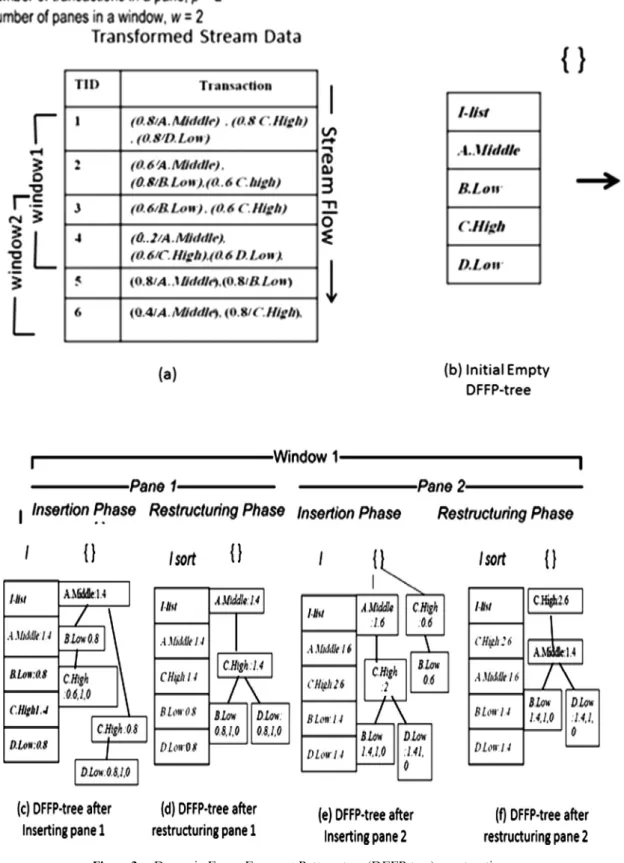
In order to infer Fuzzy Association Rules from ubiquitous data streams, Dynamic Fuzzy Frequent Pattern tree (DFFP-tree) is constructed. The basic structure of DFFP-tree is similar to Frequent Pattern tree (FP-tree)[25]. However, a member-ship value is added to each node as shown inAlgorithm A.3. In order to render this technique suitable for limited resources ubiquitous devices, anAlgorithm A.4 is added to delete old panes, and insert new panes (i.e. restructuring trees), as windows are changed.
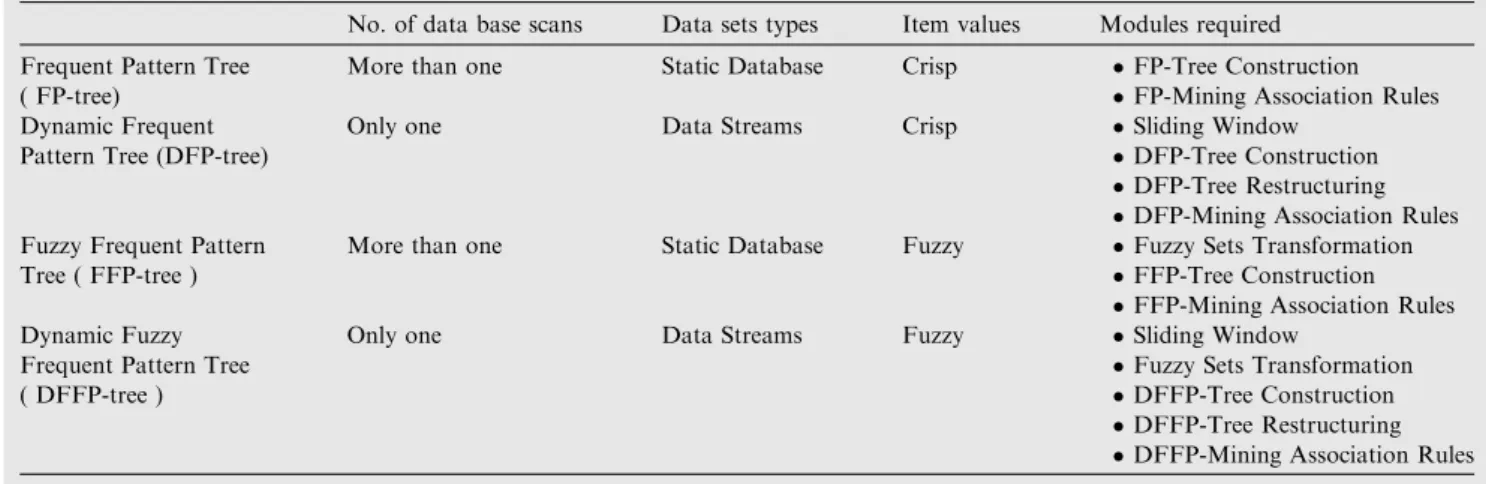
Step by step construction procedure is shown inFig. 3. In addition a comparative analysis between DFFP-tree and pre-vious tree structures is illustrated inTable 4.
3.4. Step 4: Extracting fuzzy association rules
Once the DFFP-tree is constructed,Algorithm A.5is used to generate the complete set of exact (not approximate) fuzzy fre-quent patterns from the current window. Hence, fuzzy Table 3 Fuzzy association rules algorithms.
Algorithm Mining task Advantages Disadvantages
F-APACS[20] – Transformed quantitative attribute values into linguistic terms
– Used the adjusted difference analysis to find interesting associations among attributes – Based on the a priori approach
– Discover both positive and negative associations – Avoid the use of
some user-sup-plied thresholds
– Membership function must to be given – Cause iterative database scans – High computational costs – Does not handle data streams
Fuzzy Frequent Pattern Tree (FFPT)[21]
– Update the fuzzy sets at all the phases of the algorithm
– Preserve the original information of the data sets
– Based on Frequent Pattern Tree approach
– Avoid the candi-date generation phase
– Avoid the repeti-tive scanning of the original database
– Could not generate the membership value of an itemset
– Local frequent fuzzy regions were used to construct the FFPT
– Tree structure was loose and huge – Does not handle data streams Compressed Fuzzy
Frequent Pattern Tree (CFFPT)[22]
– Integrates the fuzzy-set concepts and the FP-tree-like approach to efficiently find the fuzzy frequent itemsets from the quantitative transactions
– Create CFFP-tree
– CFFP-growth mining algorithm is proposed to derive fuzzy frequent itemsets from the constructed CFFP tree
– The node num-ber in the tree can be reduced – The CFFP tree
Structure is tigh-ter and more compressed – Can process
quantitative transactions
– Additional array stored in each node – The proposed approach will spend more
execution time because the former will need to transfer the quantitative values into fuzzy sets
– The database is assumed static – Minimum support threshold is given – Does not handle data streams
association rules are deduced according to a certain confidence usingAlgorithm A.6.
4. Discussion of the complexity of the Algorithms
In this section, the complexity of FFP-USTREAM is analyzed. The following notations are defined for this discussion.
P, is the number of transactions in each window. S, is the number of fuzzy sets.
I, is the number of distinct attributes relative to the study.
The discussion is separated into two parts: runtime com-plexity, and memory complexity.
4.1. Runtime complexity
It may be shown that the run time complexity is divided into three major steps.
– Fuzzification process, which is the mapping of attributes quantitative values to fuzzy sets. The number of mapping will be of orderO(ŒSŒ*ŒPŒ*ŒIŒ) maps.
– DFFP-tree construction, it is the core of the proposed tech-nique. The complexity will be of order O(ŒPŒ*ŒIŒ), representing updating node value, or creating new node. – Extracting the fuzzy association rules, its complexity will be
of orderO(ŒPŒ*ŒIŒ), representing number of comparison.
4.2. Memory complexity
The memory complexity varies with the window size and the order of items in data streams transactions. Assuming worst-case scenario, number of nodes in DFFP-tree may be derived to be of orderO(ŒPŒ*ŒIŒ).
Table 4 Comparative analysis between DFFP-tree and previous tree structures.
No. of data base scans Data sets types Item values Modules required Frequent Pattern Tree
( FP-tree)
More than one Static Database Crisp FP-Tree Construction FP-Mining Association Rules Dynamic Frequent
Pattern Tree (DFP-tree)
Only one Data Streams Crisp Sliding Window
DFP-Tree Construction DFP-Tree Restructuring DFP-Mining Association Rules Fuzzy Frequent Pattern
Tree ( FFP-tree )
More than one Static Database Fuzzy Fuzzy Sets Transformation FFP-Tree Construction FFP-Mining Association Rules Dynamic Fuzzy
Frequent Pattern Tree ( DFFP-tree )
Only one Data Streams Fuzzy Sliding Window
Fuzzy Sets Transformation DFFP-Tree Construction DFFP-Tree Restructuring DFFP-Mining Association Rules
Table 5 Dataset characteristics. Data set name No. of trans. No. of items Total length Average length % Accidents [26] 30571 342 3164207 30.2% Retail[27] 29387 13737 1362940 0.34%
Figure 4 Membership functions with three Regions Fuzzy Sets.
5. Experimental results
To assess the validity of the proposed technique, experiments are conducted using real data sets, in Microsoft Visual
Studio 2010 C#. Two different data sets were chosen, ‘‘Accidents’’ and ‘‘Retail’’ data sets. These were downloaded fromfimi.cs.helsinki.fi/data/and summarized inTable 5. 5.1. Required parameters
Two main parameters have great effect on the experimental results performance, the selection of window size & pane size, and the selection of an appropriate membership function with fuzzy sets regions.
5.1.1. Window & pane size
DFFP-tree dynamically restructures itself after each window slide. The runtime and memory complexity vary depending on the window parametersw(window size) andp(pane size), as mentioned in Section4above and illustrated in Section5.2. 5.1.2. Membership functions & fuzzy sets
An important step in FFP_USTREAM, was the selection of the membership functions and the number of fuzzy sets. Thus, an appropriate membership function must be selected carefully depending on the nature of the data sets and the user application.In this work, Fuzzy Logic Tool Box in Matlab 7 was used.
Table 6 Runtime distribution with variation of fuzzy regions. Data sets Window
size
Pane size
20 50 100
Runtime in sec. Runtime in sec. Runtime in sec.
Three fuzzy regions Five fuzzy regions Three fuzzy regions Five fuzzy regions Three fuzzy regions Five fuzzy regions Accidents (Dense) 2 3.4788 5.1387 8.3928 10.23 16.4872 19.152 4 6.552 10.24 16.38 20.34 32.532 35.858 8 13.1678 15.542 32.5574 35.94 65.0862 71.988 Retail (Sparse) 2 0.421 1.1644 1.53252 2.3394 4.09 5.14 4 1.404 2.3213 2.5741 4.8373 8.2 9.677 8 3.0199 3.276 8.2294 8.651 15.852 16.618
Figure 6a ‘‘Accidents’’ runtime distribution on variation of fuzzy regions.
Figure 6b ‘‘Retail’’ runtime distribution on variation of fuzzy regions.
InFig. 4, the membership function with three fuzzy regions (‘LOW’, ‘MIDDLE’, ‘HIGH’) is presented. The membership function with five fuzzy regions (‘VERYLOW’, ‘LOW’, ‘MIDDLE’, ‘HIGH’, ‘VERY HIGH’) is also presented in Fig. 5.
5.2. Analysis of results
In the following sections, the results of DFFP-tree construc-tion are presented. Extensive experimental analyses show that DFFP-tree is highly efficient in terms of memory storage when finding exact fuzzy frequent patterns from a high-speed ubiqui-tous data streams.
5.2.1. Runtime trend
For each data sets, the overall runtime,of DFFP-tree, based on changes in the fuzzy set regions was evaluated. The results are depicted inTable 6andFig. 6. In the graphs,y-axes represent the total time including DFFP-tree construction time and tree
restructuring time. Thex-axes show the variation of the pro-duct of number of window size and pane size.
A close study ofFig. 6reveals the following trends. – Larger pane and window sizes imply longer total tree
con-struction & restructuring times for the two types of data sets (Dense & Sparse).
– The number of fuzzy sets regions affects the tree construc-tion runtime. A long runtime will be required with large fuzzy sets regions.
– Higher runtime will be required for dense data sets as com-pared to sparse data sets.
5.2.2. Memory efficiency
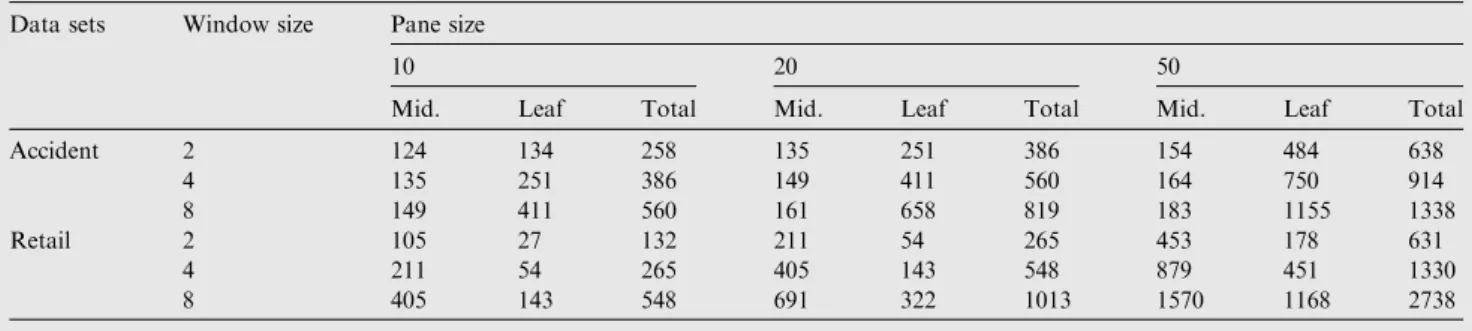
Experiments have been conducted to verify the memory requirements for DFFP-tree construction on different data sets by varying the window size. FFP_USTREAM always captures the window contents in full (i.e., not depending on support Table 7 Node distribution.
Data sets Window size Pane size
10 20 50
Mid. Leaf Total Mid. Leaf Total Mid. Leaf Total
Accident 2 124 134 258 135 251 386 154 484 638 4 135 251 386 149 411 560 164 750 914 8 149 411 560 161 658 819 183 1155 1338 Retail 2 105 27 132 211 54 265 453 178 631 4 211 54 265 405 143 548 879 451 1330 8 405 143 548 691 322 1013 1570 1168 2738
Figure 7a ‘‘Accidents’’ node distribution.
threshold) in order to minimize the database scan to only once. Thus, the support threshold values do not influence the required memory in this approach. The number of nodes in DFFP-tree with the window size and pane size variations, is depicted inTable 7.Table 7is represented byFig. 7.
It should be notated that the number of nodes is constant, with the variation of window size for different data sets. 5.2.3. Fuzzy frequent patterns list
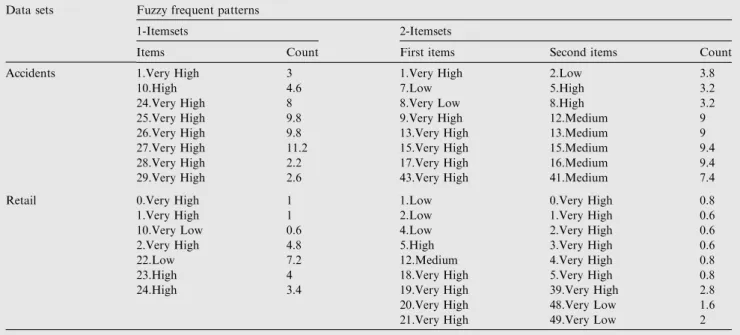
After the construction of DFFP-tree, fuzzy association rules algorithm has been applied to extract exact fuzzy frequent pat-terns. Data sets mentioned inTable 5and membership func-tions with five regions fuzzy sets (‘‘Very Low’’, ‘‘Low’’, ‘‘Medium’’, ‘‘High’’, ‘‘Very High’’ ) mentioned in Fig. 5 are used.Table 8represents a sample of the final fuzzy frequent
1-itemsets and 2-itemsets with their total scale cardinality in all transactions calculated as ‘‘count’’ value for pane size = 20. The complete sets are not presented for lack of space. Predefined minimum support for ‘‘Accidents’’ data sets is selected = 5% where it is = 2.5% for ‘‘Retail’’ data sets. Hence, fuzzy association rules could be deduced as shown in Table 9.
Note that the numbers written before Linguistic terms represent weather conditions (sunny, cloudy, etc.) for ‘‘Accidents’’ data sets, where,they represent purchased items (milk, bread, eggs,. . .) for ‘‘Retail’’ data sets.
6. Conclusion & future work
To the authors’ knowledge,there are no existing techniques in the literature, that mine fuzzy association rules from a high-speed ubiquitous data streams. In this paper, an efficient tech-nique suitable for ubiquitous applications, and satisfying the features mentioned in Section2.3, was proposed. Also, a novel tree structure Dynamic Fuzzy Frequent Pattern tree (DFFP-tree) that combines fuzzy frequent pattern tree with the con-cept of dynamic tree restructuring (i.e. deleting old panes, and inserting new ones) at runtime was introduced. The pro-posed FFP_USTREAM technique could be very helpful in many practical situations for managers to make more signifi-cant and flexible decisions such as.
– Determining stock required in retail applications.
– Determining methods of treatment in medical applications. – Determining methods of precaution in road safety
applications.
The following are some suggestions for possible future work. – The current FFP_USTREAM is based on the assumption that fuzzy sets and membership function are generated in triangular and trapezoidal waveforms only. Other Table 8 Fuzzy frequent patterns.
Data sets Fuzzy frequent patterns
1-Itemsets 2-Itemsets
Items Count First items Second items Count
Accidents 1.Very High 3 1.Very High 2.Low 3.8
10.High 4.6 7.Low 5.High 3.2
24.Very High 8 8.Very Low 8.High 3.2
25.Very High 9.8 9.Very High 12.Medium 9
26.Very High 9.8 13.Very High 13.Medium 9
27.Very High 11.2 15.Very High 15.Medium 9.4
28.Very High 2.2 17.Very High 16.Medium 9.4
29.Very High 2.6 43.Very High 41.Medium 7.4
Retail 0.Very High 1 1.Low 0.Very High 0.8
1.Very High 1 2.Low 1.Very High 0.6
10.Very Low 0.6 4.Low 2.Very High 0.6
2.Very High 4.8 5.High 3.Very High 0.6
22.Low 7.2 12.Medium 4.Very High 0.8
23.High 4 18.Very High 5.Very High 0.8
24.High 3.4 19.Very High 39.Very High 2.8
20.Very High 48.Very Low 1.6
21.Very High 49.Very Low 2
Table 9 Fuzzy association rules. Data sets Fuzzy association rules
Accidents – The Very High value of item: 17)Medium value of item: 16
– The Very High value of item: 9)Medium value of item: 12
– The Very High value of item: 43)Medium value of item: 41
– The Very Low value of item: 1)Low value of item: 2
Retail – The Very High value of item: 19)Very High value of item: 39
– The Very High value of item: 21)Very Low value of item: 49
– The Very High value of item: 20)Very Low value of item: 48
– The Low value of item: 1)Very High value of item: 0
– The High value of item: 5)Very High value of item: 3
waveforms such as Gaussian, bell-shaped, sigmoidal, and S-curve should also be considered depending on the applications.
– In this paper, window size & pane size were assumed con-stant. It is worthwhile to consider variable window and pane size.
– The proposed FFP_USTREAM handles distributed homogenous data streams. Thus, there is a need to investi-gate the cases where the distributed flow of data streams are heterogeneous, and the data sets are incompatible. – The problem of mining fuzzy association rule from
ubiqui-tous data streams can be introduced using other window techniques like tilted-window or land mark window.
Appendix A. Algorithms used in the proposed technique
Algorithm A.1. FFP_USTREAM.
Input:Data Streams (DS), window sizeðxÞ, pane size (p), minimum support (s), confidence (c), fuzzy set region (R) and membership function (f).
Output:A set of fuzzy frequent patterns (FFP). A set of fuzzy association rules (FAR).
Method:FFP_USTREAM Algorithm is implemented as follows.
Begin
(1) Create Sliding Window ( ). (2) Fuzzy Set Transformation ( ). (3) Dynamic Fuzzy Tree construction ( ). (4) Find Fuzzy Association Rules ( ).
END
Algorithm A.2. Create sliding window module.
Create_Window(T,Sizew,Sizep)
Input: Data StreamsDS, window sizeSizew, pane sizeSizep; Output:Data Streams Window Transaction T.
Method: Create Sliding Window Algorithm is implemented as follows.
Begin
1- w = ø, p = ø;
2- If T = ø Then // First Window
3- Call Insert Pane ( ); 4- Else
5- Call Delete Pane ( );// Next Window
6- Call Insert Pane ( ); 7- End If
End
Inset Pane(T;Sizew;Sizep)
Begin
1- x= ø, p = ø; 2- Whilex–Sizew, do 3- Whilep–Sizep, do
4- insert a transaction ofDSintoTaccording to its incoming
order; 5- p pþ1; 6- End while 7- p= ø; 8- x xþ1; 9- End While End
Delete Pane(T;Sizew;Sizep)
Begin
1- x= ø, p = ø; 2- Whilex–Sizew, do 3- Whilep–Sizep, do 4- Delete transactions fromT;
5- p pþ1; 6- End while 7- p= ø; 8- x xþ1; 9- End While End.
Algorithm A.3. Construction of a dynamic fuzzy frequent pat-tern tree DFFP-tree.
Create DFFPtreeðUDS;Sizew;SizepÞ
Input:The updated data streams (After applying fuzzy set transformation), Window_size w, pane size p.
Output:T: a Dynamic fuzzy frequent pattern tree (DFFP-tree). Method:The Dynamic Fuzzy Frequent Pattern tree construction algorithm is implemented as follows.
Begin
1- w Ø;
2- T a prefix tree with null initialization; 3- Current_sort_order Initial_Sort_order;
4- While (w – window_size) do// For the first Window
5- Call Insert_Pane(T);// Insertion Phase
6- Current_Sort_Order Frequency_descending sort order;
7- Call Restructure ( T,I_list);// Restructuring Phase
8- w = w + 1;
9- End While
10- Repeat//At each slide of window.
11- Delete the oldest pane information from T;//Delete old pane.
12- Call Insert_Pane(T);// Insertion Phase
13- Current_Sort_Order Frequency_descending sort order;
14- Call Restructure (T,I_list);// Restructuring Phase End
Insert_Pane (T)
Begin
1- p ø;
2- While (p–pane_size) do
3- Insert transaction into T according to Current_Sort_Order;
5- End While
End
Algorithm A.4. Restructure DFFP-tree.
Restruct_DFFP-tree(T,I) Input:Prefix tree T, I list. Output:Restructure tree Tsort, Isort.
Method:The Dynamic Fuzzy Frequent Pattern tree restructure algorithm is implemented as follows.
Begin
1- For each branchBiinT 2- For each unprocessed pathPi 3- IfPiis sorted then 4- S_Branch ( ); 5- Else 6- Sort_Path (); 7- End if 8- End For 9- End For End Process_Branch (T) Begin
1- For each path,piinT, do 2- Ifpiis not sorted, do
3- extract and sortpidepending onOrder;
4- reinsertpiintoTand setpi’s tail node information again; 5- End If
6- End For
End
Sort pathðT;IsortÞ
Begin
1. For each path,piin the old pane, do 2. find a tail node,tiforpi;
3. For each node,nkinpi, do//Bottom up manner 4. nk.val= nk.val ti.val.first;
5. Ifnk.val = 0, do 6. deletenk;
7. Else
shift pane counters of all remaining tail nodes inT
to left by one;
8. End If
9. End For
10. For each transaction,triof the new pane in DS;do=16i6Sizep
11. inserttriinto according toOrder; 12. set tail node information fortri;
13. End For
14. End For
End.
Algorithm A.5. Extract exact fuzzy frequent patterns.
Extract_FFP(T)
Input:The constructed DFFP tree, Header_Table, and the predefined minimum support thresholds.
Output:The Fuzzy Frequent Patterns list Ifp.
Method:The algorithm is implemented as follows.
Begin
3. For each fuzzy region in Header_table 4. Process the fuzzy regionsRj;
5. Find all the nodes withRjin the DFFP tree through the links;
6. For each nodeKextracted in DFFP
7. Extract the fuzzy itemsets and their membership values stored inK;
8. Sum the membership values; 9. Sum_val = Sum_val + member_val; 10. End For
11. If Sum_val >= minimum_support (sÞthen 12. AddRjin Ifplist;
13. End If 14. Output Ifpas fuzzy frequent pattern; 15. End For
End
Algorithm A.6. Deduce fuzzy association rules.
Extract_FAR(Ifp,conf) Input:Ifplist.
Output:The Fuzzy Association rules list Iar. Method:The algorithm is implemented as follows.
Begin
10- For each ItemIiinIfp.
11- For each ItemIjinIfp.
12- Rule_val=[(IiSum_val, IjSum_val)
13- IfRule_val>= Confidence (c) then
14- AddIi,IjandRule_valin Iarlist;
15- End If
16- Output Iaras fuzzy association rules;
17- End For
End
References
[1] M.M. Gaber, S. Krishnaswamy, A. Zaslavsky, ‘‘Ubiquitous Data Stream Mining,’’ Current Research and Future Directions Workshop Proceedings held in conjunction with PAKDD, Sydney, Australia, May 26, 2004.
[2] M. Hellmann, Fuzzy logic introduction, Universite´ de Rennes 1, 2001.
[3]M. May, B. Berendt, A. Cornuejols, J. Gama, F. Giannotti, A. Hotho, D. Malerba, E. Menesalvas, K. Morik, R. Persen, et al, Research challenges in ubiquitous knowledge discovery, Next Generation Data Min. (2008) 131–150.
[4]Z. urRehman, M. Shahbaz, M. Shaheen, S. Mehmood, S.A. Masood, Anomalous pattern detection using context aware ubiquitous data mining, Life Sci. J. 9 (3) (2012) 6–12.
[5]J. Gama, Data Stream Mining: The Bounded Rationality, Informatica, Slovenia 37 (1) (2013) 21–25.
[6] H.Kargupta, B.Park, S.Pittie, L.Liu, D.Kushraj, and K.Sarkar, MobiMine: Monitoring the Stock Market from a PDA,. ACM SIGKDD 2002.
[7]O.Z. Maimon, L. Rokach (Eds.), Data Mining and Knowledge Discovery Handbook, vol. 1, Springer, New York, 2005. [8] M. Halatchev, Le Gruenwald, Estimating missing values in
related sensor data streams, in: Int’l Conf. on Management Data, Jan. 2005.
[9] E.D. Demaine, A. Lpez-Ortiz, J. Ian Munro, Frequency estimation of internet packet streams with limited space, in: European Symposium on Algorithms, Sept. 2002.
[10] Y. Dora Cai, G. Pape, J. Han, M. Welge, L. Auvil, MAIDS: mining alarming incidents from data streams, in: Int’l Conf. on Management Data, June 2004.
[11] H. Kargupta, R. Bhargava, K. Liu, M. Powers, P. Blair, S. Bushra, J. Dull, K. Sarkar, M. Klein, M. Vasa, D. Handy, VEDAS: a mobile and distributed data stream mining system for real-time vehicle monitoring, in: SIAM Int’l Conf. on Data Mining, 2004.
[12] G.S. Manku, R. Motwani, Approximate frequency counts over data streams, in: Proceedings of the 28th International Conference on Very Large Databases, Hong Kong, August 2002, pp. 346–357.
[13] Hua-Fu Li, Suh-Yin Lee, Man-Kwan Shan, An efficient algorithm for mining frequent itemsets over the entire history of data streams, in: Proceedings of the First International Workshop on Knowledge Discovery in Data Streams, in Conjunction with the 15th European Conference on Machine Learning ECML and the 8th European Conference on the Principals and Practice of Knowledge Discovery in Databases PKDD, Pisa, Italy, 2004.
[14]S.K. Tanbeer, C.F. Ahmed, B.S. Jeong, Y-K. Lee, Sliding window-based frequent pattern mining over data streams, Inform. Sci. 179 (2009) 3843–3865.
[15] C. Gianella, J. Han, J. Pei, X. Yan, P.S. Yu, Mining frequent patterns in data streams at multiple time granularities, in: H. Kargupta, A. Joshi, D. Sivakumar, Y. Yesha (Eds.), Data Mining: Next Generation Challenges and Future Directions, MIT/AAAI Press, pp. 191–212.
[16]P.M. Tsai, Mining frequent itemsets in data streams using the weighted sliding window model, Expert Syst. Appl. 36 (2009) 11617–11625.
[17]Y. Kim, W. Kim, U. Kim, Mining frequent itemsets with normalized weight in continuous data streams, J. Inform. Process. Syst. 6 (1) (2010) 79–89.
[18]M. Deypir, M.H. Sadreddini, S. Hashemi, Towards a variable size sliding window model for frequent itemset mining over data streams, Comput. Ind. Eng. 63 (2012) 161–172.
[19]P.G. Student, I. Madurai, Survey on frequent pattern mining over data streams, Int. J. Eng. 2 (12) (2013).
[20] Chan, C.C. Keith, A.U. Wai-Ho, Mining fuzzy association rules, in: Proceedings of the Sixth International Conference on Information and Knowledge Management, ACM, 1997. [21] S. Papadimitriou, S. Mavroudi, The fuzzy frequent pattern tree,
in: The WSEAS International Conference on Computers, July 2005, pp. 1–7.
[22]C.W. Lin, T.P. Hong, W.H. Lu, An efficient tree-based fuzzy data mining approach, Int. J. Fuzzy Syst. 12 (2) (2010) 150–157.
[23]C.W. Lin, T.P. Hong, W.H. Lu, Linguistic data mining with fuzzy FP-trees, Expert Syst. Appl. 37 (6) (2010) 4560–4567. [24]S. Medasani, J. Kim, R. Krishnapuram, An overview of
membership function generation techniques for pattern recognition, Int. J. Approximate Reasoning 19 (1998) 391–417.
[25] R. Agrawal, R. Srikant, Fast algorithms for mining association rules in large databases, in: Proceedings of the 20th International Conference on Very Large Data Bases, September 1994, pp. 487–499.
[26] K. Geurts, Traffic accidents data set [online], 2003. <http://fimi. cs.helsinki.fi/data/accidents.pdf>.
[27] T. Brijs, Retail market basket data set, Workshop on Frequent Itemset Mining Implementations (FIMI’03), 2003.
![Figure 1 Classification of data streams preprocessing methods [7].](https://thumb-us.123doks.com/thumbv2/123dok_us/9446384.2818938/2.892.481.810.702.1041/figure-classification-data-streams-preprocessing-methods.webp)