Title Why do some students learn better than others in digital gamebased learning? The role of hope and social support
Author(s) Law, WWT; Du, H; King, RB; Chu, SKW
Citation
The 2014 Research Symposium of the Center for Information Technology in Education (CITERS 2014), The University of Hong Kong, Hong Kong, 13-14 June 2014.
Issued Date 2014
URL http://hdl.handle.net/10722/204512
I:\Sam-publications\published materials\conference papers\Law 2014 Why do some students learn better than others in digital Cited As: Law, W.W.T., Du, H., King, R.B., & Chu, S.K.W (2014). Why do some students learn better than others in digital game based learning? The role of hope and social support. Paper presented at the CITE Research Symposium 2014, The University of Hong Kong, Hong Kong.
Why Do Some Students Learn Better Than Others in Digital Game
Based Learning? The Role of Hope and Social Support
Wilson W.T. Law
Faculty of Business and Economics The University of Hong Kong Hong Kong
Hongfei Du
Pediatric Prevention Research Center
Carmen and Ann Adams Department of Pediatrics School of Medicine,
Wayne State University USA
Ronnel B. King
Learning Sciences Laboratory National Institute of Education Nanyang Technological University Singapore
Samuel K.W. Chu Faculty of Education
The University of Hong Kong Hong Kong
ABSTRACT
Growing evidence suggests the technically-enriched educational games can enhance students’ learning motivation and interest. However, a paper that successfully explains the variation in students’ performance in similar setting is still very rare. This study aims to fill in the gap by proposing the question “why do some students learn better than others in the digital game based learning?”. Hong Kong secondary school students (N = 384) participated in the study and answered questionnaires about their psychological factors as well as their overall reflections after playing the digital sexuality education game. Preliminary results suggested that the role of hope and social support predicted the students’ learning outcomes in the game; while taking the mediation role of games usability into account, it partially mediated the relationship between the psychological factors and learning objectives. Implications and directions for future research are discussed.
I:\Sam-publications\published materials\conference papers\Law 2014 Why do some students learn better than others in digital
1.
INTRODUCTION
A well-designed game is interactive, goal-oriented, and most importantly is fun to play (Prensky, 2001). Putting digital game into educational settings has been a growing trend in the past decade (Hwang & Wu, 2012). Plenty of empirical evidence has shown that it served as an effective tool for enhancing students’ learning and motivation (e.g.(Cordova & Lepper, 1996; Ebner & Holzinger, 2007; Tüzün, Yılmaz-Soylu, Karakuş, İnal, & Kızılkaya, 2009). However, most of the studies only focused on the average but overlooked the variation – most of the digital game based learning model did improve the average learning performance in a targeted population; but what made some students learnt better than others? And why some of them showed little or no interest in it even though we did believe the game was so interesting and attractive? In other words, we should not only focus on the technological development, but also to the educational prerequisites for utilizing the potential of the digital game based learning model. It is also worth to integrate the educational theory into the digital game based learning especially when the related model is very rare or absent (Kiili, 2005).
Instead of focusing on what does not work (i.e. why do some students have no interest in it), we focus on what works by proposing a question “why do some students learn better than others in the digital game based learning?”. In this paper, we would like to provide a possible answer to it from an educational psychology perspective. By examining the role of “Hope” and “Social Support” (See Section 1.1 & 1.2) in the digital game based settings, we can possibly gain more understanding on:
How the role of hope and social support predicts the learning performance. How to further improve the learning effectiveness of students especially for
those who are not motivated nor engaged in the digital game based learning. How to utilize the potential of digital game based learning in educational
setting.
1.1 Hope
“Hope” has been defined as “a cognitive set that is composed of a reciprocally derived sense of successful (a) goal-directed determination and (b) planning of ways to meet goals” (Snyder et al., 1991). Lack of either one does not result in high level of hope. To illustrate the concept of “hope”, we modified the example given by Curry et al. and shown as follows (Curry, Snyder, Cook, Ruby, & Rehm, 1997):
Student A can think of many differing ways to learn sex education (e.g. visit a reliable site, attend the related talks organized by authoritative institution) but she is not motivated to use these ways.
Student B is highly motivated but she cannot think of any ways to learn sex education effectively (e.g. she may just randomly browse the internet)
(a) Goal-directed determination
(b) Planning of ways
to meet goals Level of Hope
Student A No Yes Low
Student B Yes No Low
Student C Yes Yes High
One can say the person has high level of hope only if she has a sense of successful goal-direct determination and planning of ways to meet goals (i.e. Student C). This example also clearly illustrates the importance of hope in students’ effective learning.
1.2 Social Support
The perceived support from important people such as parents and peers has been regarded as an important factor in student’s motivation (Wentzel, 1998). Broadly speaking, social support can be viewed as the “social relationships that provide (or can potentially provide) material and interpersonal resources that are of value to the recipient, such as counseling, access to information and services, sharing of tasks and responsibilities, and skill acquisition” (Thompson, 1995). The types of supports can be from emotional perspective (e.g. empathy and caring), informational perspective (e.g. giving advice) and other different possible perspectives (Gottlieb & Bergen, 2010). This definition provides a brief understanding of what social support is about and why it matters.
1.3. Integrating “Hope” and “Social Support” into digital game based learning The main purpose of this study is to provide a preliminary understanding on why some students learn better than others in a digital game based learning. We will investigate the effect of “Hope” and “Social Support” on the learning objectives, at the same time taking the mediation role of games usability into account. Games usability can be regarded as the clearness of the instruction and the ease of use. We argue that for those students who have a high level of hope and social support, they may have better understanding on the instruction and find the game easier to use; if they have a clear understanding on the game and can use it well, they can possibly learn more effectively, and vice versa. To examine all these, we develop the following hypotheses:
H1: The relationship between the psychological factors (X) and learning objectives (Y) will be positively related (See solid line in fig. 1)
I:\Sam-publications\published materials\conference papers\Law 2014 Why do some students learn better than others in digital
H2: Games Usability (M) will mediate the relationship between the psychological factors (X) and learning objectives (Y) (See dotted lines in fig. 1)
Fig.1 Hypothesized mediation model (Note: X: independent variables; Y: Learning Objectives; M: Mediator) Solid line denotes the effect of the psychological factors on learning objectives when the games usability is not included as a mediator.
2.
METHODOLODY
2.1 Participants and Research Settings
Participants in the study comprised 384 secondary 1 to 3 students (between ages 12-16) in three co-education schools in Hong Kong. The ratio of male students to female students was around one-to-one.
The sexuality education game app called “Making Smart Choices” (MSC)1 was used in this study. It is a pioneer Chinese language interactive game app which was co-developed by the Faculty of Education of the University of Hong Kong (HKU), the Family Planning Association of Hong Kong (FPAHK) and FifthWisdom Technology Limited. The app consists of 5 mini-games offering five scenarios where participants have to choose a virtual character and practice their problem-solving and decision-making skills to make ‘smart choices’. By dealing with different situations in relation
1 The Facebook version is available at https://apps.facebook.com/fpasmartchoices.
(X) The psychological Factors (1) Hope (2) Social Support (M) Games Usability (Y) Learning Objectives (1) Sexual Knowledge Learning (2) Value and Skill
to love and relationship, the participants are expected to acquire positive sex messages in a fun and interactive manner.
Students were given free choice to play and were allowed to play as many times as they liked in the game sessions. They were invited to respond to a questionnaire after playing the game. The next section presents the five main measures used in the study.
2.2 Measures 2.2.1 Hope
Perceived hope state was …
Participants were asked to select the number ranging from 1 (never) to 6 (always) that best described the corresponding questions.
2.2.2 Social Support
Perceived social support was measured with an adapted version of the social support scale (Zimet, Dahlem, Zimet, & Farley, 1988). The scale includes two dimensions with 8 items in total: perceived support from family (e.g. my family really tried to help me; I get the emotional help and support I need from family) and friends (e.g. I can talk about my problems with my friend; I can count on my friends when things go wrong). Participants were asked to select the number ranging from 1 (strongly disagree) to 5 (strongly agree) that best described the corresponding questions.
2.2.3 Games Usability
The games usability was measured by 6 items (e.g. the game instruction of different stages is clear and easy to understand; I understand the purpose of the first stage of the game). A 6-point Likert-type scale ranging from 1 (strongly disagree) to 6 (strongly agree) was used.
2.2.4 Sexual Knowledge Learning
This 12-item measure of sexual knowledge learning comprises the question such as “I have learned how to reduce the risk of getting sexual transmitted diseases” and “I have learned how to practice safe sex”. A 6-point Likert-type scale ranging from 1 (strongly disagree) to 6 (strongly agree) was used.
I:\Sam-publications\published materials\conference papers\Law 2014 Why do some students learn better than others in digital 2.2.5. Value and Skill Learning
There are 5 items which set to measure the value and skill learning. Examples of questions are “Enhanced my value and belief” and “Enhanced my decision making skills”. A 6-point Likert-type scale ranging from 1 (strongly disagree) to 6 (strongly agree) was used.
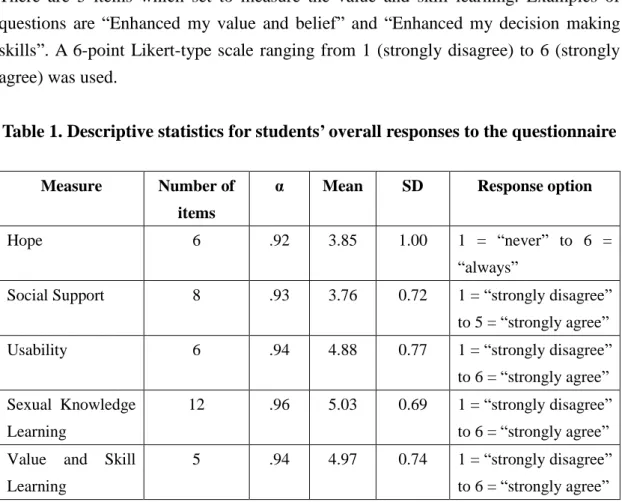
Table 1. Descriptive statistics for students’ overall responses to the questionnaire
Measure Number of
items
α Mean SD Response option
Hope 6 .92 3.85 1.00 1 = “never” to 6 =
“always”
Social Support 8 .93 3.76 0.72 1 = “strongly disagree” to 5 = “strongly agree”
Usability 6 .94 4.88 0.77 1 = “strongly disagree”
to 6 = “strongly agree” Sexual Knowledge
Learning
12 .96 5.03 0.69 1 = “strongly disagree” to 6 = “strongly agree” Value and Skill
Learning
5 .94 4.97 0.74 1 = “strongly disagree” to 6 = “strongly agree”
3.
RESULTS
3.1Preliminary Analysis
Table 1 shows the descriptive statistics as well as the internal consistency reliabilities of the various measures that were used. Results showed that all measures had a high internal reliability (Note: α > 0.9 in all measures)
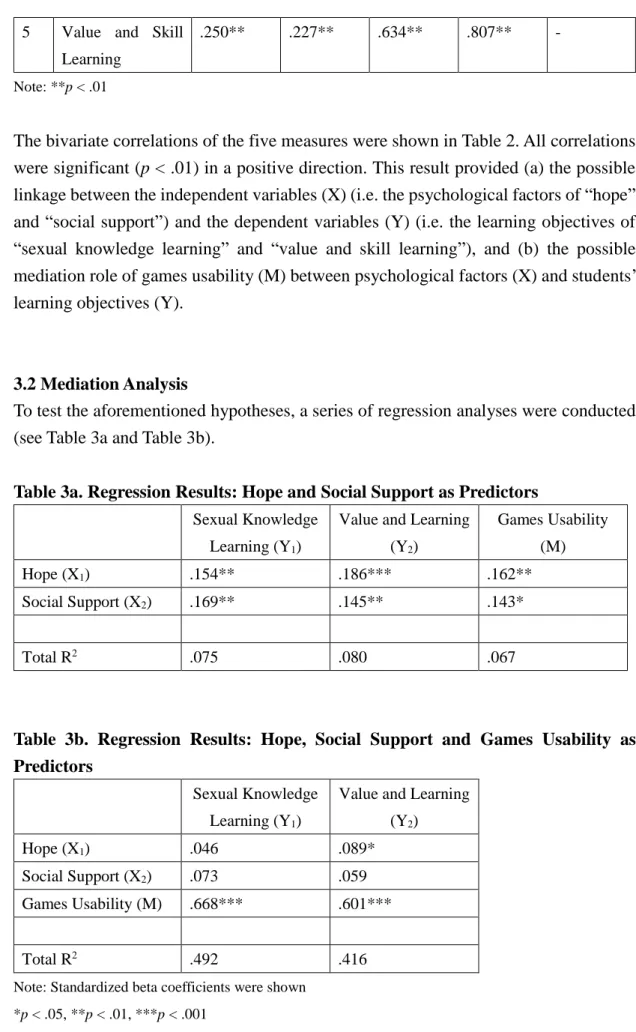
Table 2. Correlations among measures
1 2 3 4 5 1 Hope - 2 Social Support .443** - 3 Usability .226** .215** - 4 Sexual Knowledge Learning .229** .237** .694** -
5 Value and Skill Learning
.250** .227** .634** .807** -
Note: **p < .01
The bivariate correlations of the five measures were shown in Table 2. All correlations were significant (p < .01) in a positive direction. This result provided (a) the possible linkage between the independent variables (X) (i.e. the psychological factors of “hope” and “social support”) and the dependent variables (Y) (i.e. the learning objectives of “sexual knowledge learning” and “value and skill learning”), and (b) the possible mediation role of games usability (M) between psychological factors (X) and students’ learning objectives (Y).
3.2 Mediation Analysis
To test the aforementioned hypotheses, a series of regression analyses were conducted (see Table 3a and Table 3b).
Table 3a. Regression Results: Hope and Social Support as Predictors
Sexual Knowledge Learning (Y1)
Value and Learning (Y2) Games Usability (M) Hope (X1) .154** .186*** .162** Social Support (X2) .169** .145** .143* Total R2 .075 .080 .067
Table 3b. Regression Results: Hope, Social Support and Games Usability as Predictors
Sexual Knowledge Learning (Y1)
Value and Learning (Y2)
Hope (X1) .046 .089*
Social Support (X2) .073 .059 Games Usability (M) .668*** .601***
Total R2 .492 .416
Note: Standardized beta coefficients were shown *p < .05, **p < .01, ***p < .001
I:\Sam-publications\published materials\conference papers\Law 2014 Why do some students learn better than others in digital Fig.2a Path standardized coefficients for simple mediation model analysis. Solid line denotes the effect of the psychological factors on sexual knowledge learning (Y1) when the games usability is not included
as a mediator. *p < .05, **p < .01, ***p < .001
Fig.2b Path standardized coefficients for simple mediation model analysis. Solid line denotes the effect of the psychological factors on value and skill learning (Y2) when the games usability is not included as
a mediator. *p < .05, **p < .01, ***p < .001
3.2.1 Result on H1: The relationship between the psychological factors (X) and learning objectives (Y) will be positively related
(X1) Hope (X2) Social Support (M) Games Usability (Y1) Sexual Knowledge Learning β = .073 β = .046 β = .154** β = .169** β = .162** β = .143* β = .668*** (X1) Hope (X2) Social Support (M) Games Usability (Y2)
Value and Skill Learning β = .059 β = .089* β = .186*** β = .145** β = .162** β = .143* β = .601***
When the games usability is not included as a mediator, the coefficients between psychological factors (X) and learning objectives (Y) were all positively associated (i.e. Hope → Sexual Knowledge Learning, β = .154, p < .01; Social Support → Sexual Knowledge Learning, β = .169, p < .01; Hope → Sexual Knowledge Learning, β = .186,
p < .001; Social Support → Value and Skill Learning, β = .145, p < .01), supporting H1 (see the solid lines in fig. 2a and fig. 2b).
3.2.2 Result on H2: Games Usability (M) will mediate the relationship between the psychological factors (X) and learning objectives (Y)
Taken the mediation role of games usability into account, the psychological factors (X) exerted an indirect effect on learning objectives (Y) through games usability (M): Hope → Games Usability (β = .162, p < .01), Social Support → Games Usability (β = .143,
p < .05), Games Usability → Sexual Knowledge Learning (β = .668, p < .001), Games Usability → Value and Skill Learning (β = .601, p < .001). This result clearly supported H2 (see the dotted lines in fig. 2a and fig. 2b).
3.2.3 Other results
Under the mediation effect of games usability (M), the coefficients between psychological factors (X) and learning objectives (Y) were no longer significant except one path:. Hope → Value and Skill Learning (β = .089, p < .05). The non-significant paths are listed as follows: Hope → Sexual Knowledge Learning, Social Support → Sexual Knowledge Learning, Social Support → Value and Skill Learning (see the dotted lines in fig. 2a and fig. 2b).
4.
DISCUSSION
The role of hope and social support directly predicted the learning objectives in a digital game based learning (see section 3.2.1). While taking the mediation role of games usability into account, it was also shown to be significant (see section 3.2.2). It mediated the relationship between psychological factors and students’ learning outcomes. This result had two implications: 1) the level of hope and social support of students predicted the level of usability. In other words, a student with higher hope and receive a strong support from family and peers would generally have a clear and better understanding on the instruction and the purpose of the game; 2) A student who finds the game easy to use as well as understands the purpose of the game would in general learn more effectively.
I:\Sam-publications\published materials\conference papers\Law 2014 Why do some students learn better than others in digital
Even taken the mediation into consideration, the path “Hope → Value and Skill Learning” remained a significant effect. Regardless of the usability of the game, a student who has a goal-direct determination and planning to achieve the goal would have a better learning throughout the game. This indicated the role of usability had a partial but not complete mediation effect.
5.
LIMITATIONS AND DIRECTIONS FOR FUTURE RESEARCH
This study has certain limitations. First, we used a cross-sectional design in the whole analysis. With regard to the mediation mechanisms, a prospective longitudinal design would be needed to make stronger claims. Second, the sample data was collected from three secondary schools in Hong Kong. Future studies could also explore the similar construct among other cultural group. Moreover, in terms of academic performance, these schools are relatively doing well among all schools in Hong Kong. Future research could consider recruiting students from some lower performing schools.
This study relied on the quantitative data in the whole analysis. To gain a better understanding on how the found results can be directly attributed to digital game based learning, the additional qualitative data will be aimed in next step.
To gain in-depth understanding of the variations in terms of students’ learning performance, this study may provide directions for further investigation in other possible psychological factors that may account for it. The effect of gender and grade difference would also be advisable for future studies to take into account.
6.
CONCLUSION
In conclusion, this study provides a possible answer to explain why some students learn better than others in digital game based setting. It also contributes the evidence for the importance of the role of hope and social support in it. Our study enriches previous research by integrating the educational psychology ideas into digital game based learning. Through the mediation analysis, this study sheds light on the possible psychological mechanism through which hope and social support impact the learning outcomes.
Several practical implications can be drawn from this study. These findings suggest that hope may serve as a target for educational interventions. While advocating digital game based learning in today’s classroom, educators may at the same time consider implementing some programs that can help students increase their level of hope;
Comparing to the personality structure of hope, the perceived social support from parents and peers would be rather stable and harder to intervene. Instead of individual use of the game, forming students in groups may provide a supporting environment which helps them in understanding the instructions and the purpose of the game, and ultimately would learn more effectively (i.e. Social Support → Usability → Sexual Knowledge and Value and Learning).
7.
REFERENCE
Cordova, D. I., & Lepper, M. R. (1996). Intrinsic motivation and the process of learning: Beneficial effects of contextualization, personalization, and choice.
Journal of Educational Psychology, 88(4), 715-730. doi: http://dx.doi.org/10.1037/0022-0663.88.4.715
Curry, L. A., Snyder, C., Cook, D. L., Ruby, B. C., & Rehm, M. (1997). Role of hope in academic and sport achievement. Journal of Personality and Social
Psychology, 73(6), 1257.
Ebner, M., & Holzinger, A. (2007). Successful implementation of user-centered game based learning in higher education: An example from civil engineering.
Computers & Education, 49(3), 873-890.
Gottlieb, B. H., & Bergen, A. E. (2010). Social support concepts and measures.
Journal of Psychosomatic Research, 69(5), 511-520. doi: http://dx.doi.org/10.1016/j.jpsychores.2009.10.001
Hwang, G. J., & Wu, P. H. (2012). Advancements and trends in digital game‐based learning research: a review of publications in selected journals from 2001 to 2010. British Journal of Educational Technology, 43(1), E6-E10.
Kiili, K. (2005). Digital game-based learning: Towards an experiential gaming model.
The Internet and Higher Education, 8(1), 13-24.
Prensky, M. (2001). Fun, play and games: What makes games engaging. Digital game-based learning, 1-31.
Snyder, C. R., Harris, C., Anderson, J. R., Holleran, S. A., Irving, L. M., Sigmon, S. T., . . . Harney, P. (1991). The will and the ways: Development and validation of an individual-differences measure of hope. Journal of Personality and Social Psychology, 60(4), 570-585. doi: http://dx.doi.org/10.1037/0022-3514.60.4.570
Tüzün, H., Yılmaz-Soylu, M., Karakuş, T., İnal, Y., & Kızılkaya, G. (2009). The effects of computer games on primary school students’ achievement and motivation in geography learning. Computers & Education, 52(1), 68-77. Thompson, R. A. (1995). Preventing child maltreatment through social support: A
I:\Sam-publications\published materials\conference papers\Law 2014 Why do some students learn better than others in digital critical analysis: Sage Publications, Inc.
Wentzel, K. R. (1998). Social relationships and motivation in middle school: The role of parents, teachers, and peers. Journal of Educational Psychology, 90(2), 202-209. doi: http://dx.doi.org/10.1037/0022-0663.90.2.202
Zimet, G. D., Dahlem, N. W., Zimet, S. G., & Farley, G. K. (1988). The
Multidimensional Scale of Perceived Social Support. Journal of Personality Assessment, 52(1), 30.