A Framework for the Adoption of
Enterprise Resource Planning (ERP)
Systems in Higher Education
Brenda Scholtz
Department of Computing Sciences
A Framework for the Adoption of Enterprise Resource
Planning (ERP) Systems in Higher Education
By
Brenda Scholtz
Submitted in fulfilment of the requirements for the degree of Philosophiae Doctor in Computer Science and Information Systems at the Nelson Mandela Metropolitan University
December 2011
Promoter: Prof A.P. Calitz Co-Promoter: Prof C.B. Cilliers
i
Summary
Information Communication Technology (ICT) practitioners and Enterprise Resource Planning (ERP) specialists are highly sought after globally and in South Africa. In order to address this need for ERP specialists, several studies propose that ERP systems should be adopted in the Information Systems (IS) curricula in higher education institutions (HEIs) for instructional purposes. Whilst many HEIs in the United States, Australia and Europe have successfully adopted ERP systems into their curricula, less than 30% of South African HEIs have followed this trend. The adoption of ERP systems is a challenging process as such systems are resource-intensive, costly, complex, and have a steep learning curve. Educators are faced with resource problems and a dearth of options relating to the adoption process. In addition it is critical that the skills and knowledge competencies attained in these courses are industry-relevant.
Several education frameworks have been recommended to assist educators with the process of adopting an ERP system in the curriculum, but these frameworks are not comprehensive since they do not consider all the factors relating to the adoption of an ERP system. In addition existing frameworks are not based on industry-relevant competencies but rather on educational objectives. This has resulted in a difference between the competencies required by organisations and those produced by higher education. Whilst there are several research studies on ERP education, empirical studies on frameworks supporting the adoption of ERP systems in HEIs for instructional purposes are limited, particularly on the impact of these frameworks on educational outcomes. The impact of the usability of the ERP system on educational outcomes has also not been fully explored.
A survey of ERP consulting organisations in South Africa confirmed that these organisations struggle to obtain ERP specialists with the appropriate competencies. The survey results also contributed to a standardised, comprehensive, set of industry-relevant ERP competencies. The competency set forms part of a comprehensive Competency Framework for ERP System Adoption in IS Higher Education (ERPEd), which can assist educators with the decisions relating to the adoption of an ERP system into the IS curriculum. It includes all the categories of competencies relevant to industry and maps these onto a recommended ERP system adoption approach, an ERP learning tool, as well as the appropriate level of adoption.
ii
The application of the ERPEd framework to a case study, the Management Information Systems (MIS) course at the Nelson Mandela Metropolitan University (NMMU), resulted in the adoption of the SYSPRO medium-sized ERP system into the MIS course with the on approach. The empirical results of the evaluation of the case study revealed that the hands-on use of a medium-sized ERP system, SYSPRO, can successfully chands-ontribute to the attainment of educational outcomes. These outcomes were mapped to the three core competencies addressed by the MIS course, which were ERP Theory and Concepts, ERP Transactions and Business Process Management (BPM).
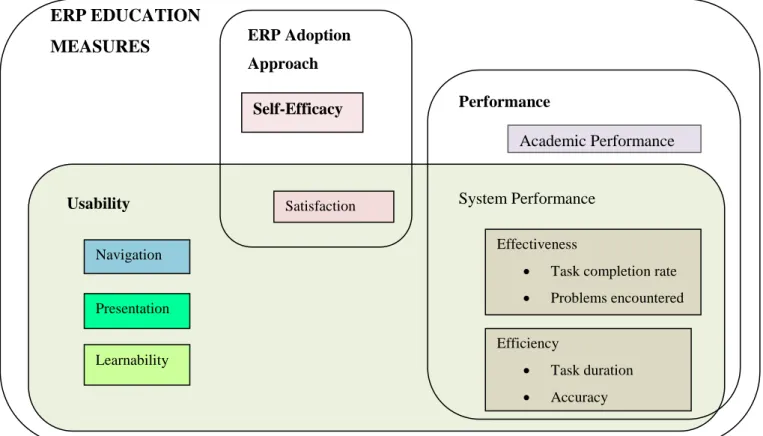
The educational outcomes evaluated were the measures of performance, self-efficacy and usability. Self-efficacy included satisfaction with the adoption approach. The results were positive in terms of all the metrics of performance, and all three competency categories had positive post-intervention self-efficacy ratings. In terms of growth in self-efficacy from pre-intervention to post-pre-intervention, BPM was the only competency category that did not show a significant growth, however the satisfaction data indicated that students found that the use of SYSPRO improved their competencies in business process understanding. Usability was evaluated in terms of navigation, presentation and learnability. Learnability was the only usability measure in the neutral range, with the other measures falling in the positive range. This confirms related studies reporting that ERP systems are not designed for learning. Overall the students enjoyed the practical application of the theory by using SYSPRO. Several positive and negative features of the user interface were provided which can be used in the design of improved ERP systems for instructional purposes.
The results of this investigation can assist in narrowing the gap between industry requirements and IS education programmes. The ERP competency set provides a standardised list of skills and knowledge which is the starting point for any skills improvement program. The ERPEd framework can improve the quality of ERP courses and the competencies of IS graduates. This in turn, can benefit the business community since it will improve the chances of ERP project success. This research is a major contribution to both government and academic initiatives in South Africa to address both the ICT skills problem as well as the need for ERP specialists.
iii
Acknowledgements
This thesis would not have been completed without the support, assistance, encouragement and guidance of a number of people over the last few years. Professors André Calitz and Charmain Cilliers, my promoters in the Department of Computing Sciences at the Nelson Mandela Metropolitan University (NMMU), whose wisdom, enthusiasm and encouragement are greatly appreciated. Their input has been essential to the completion of this thesis.
I would also like to thank my other colleagues in the Department of Computing Sciences at the NMMU for their support, knowledge and help in conducting this study. In particular I would like to thank Prof Jean Greyling for allowing me to pursue this research in the Department of Computing Sciences and for his support, guidance and assistance to complete this research.
Thanks must also go to Mr Danie Venter, statistical consultant in the Department of Mathematical Statistics at the NMMU, who provided expert advice and confirmation of the appropriateness of the quantitative statistical analysis techniques applied.
The 2010 Management Information Systems (MIS) students, for being such willing and co-operative participants in the current study.
Thanks must also go to my husband, Blayne, for his unwavering love, support and encouragement even in the most stressful times of completing this thesis. I would also like to thank my two beautiful daughters, Caylee and Courtney, for their support and for sacrificing several opportunities of fun because mom had to work on her thesis.
iv
Table of Contents
Page
Summary ... i
Acknowledgements ... iii
Table of Contents (Appendices) ... ix
List of Figures ... x
List of Tables ... xi
CHAPTER 1: RESEARCH CONTEXT ... 1
1.1 Background ... 1
1.1.1 Growth and Benefits of ERP Systems ... 2
1.1.2 Demand for ERP Competencies ... 3
1.1.3 ERP Education in Higher Education Institutions (HEIs) ... 5
1.2 Research Rationale ... 7
1.3 Research Problem ... 9
1.4 Thesis Statement ... 10
1.5 Research Purpose and Objectives ... 10
1.6 Envisaged Contribution ... 11
1.7 Research questions ... 12
1.8 Scope and Constraints ... 13
1.9 Research Philosophy and Approach ... 13
1.9.1 Research Philosophy ... 14
1.9.2 Research Approach ... 15
v
1.10 Conclusions and Proposed Thesis Structure ... 17
CHAPTER 2: COMPETENCIES FOR ERP SPECIALISTS ... 20
2.1 Introduction ... 20
2.2 The ERP Systems Market ... 21
2.3 Competencies Required for ERP Specialists ... 23
2.3.1 Supporting Competencies ... 24
2.3.2 Technical ERP Competencies ... 27
2.3.2.1 Core Technical Competencies ... 27
2.3.2.2 Supplementary Technical Competencies ... 28
2.4 Survey of ERP Specialist Employer Organisations ... 29
2.4.1 Data Collection ... 29
2.4.2 Results ... 30
2.5 Survey of ERP Specialists ... 32
2.5.1 Data Collection ... 33
2.5.2 Quantitative Results ... 34
2.5.3 Qualitative Results ... 40
2.6 Conclusion ... 41
CHAPTER 3: ERP SYSTEMS IN HIGHER EDUCATION ... 45
3.1 Introduction ... 45
3.2 Educational Context ... 47
3.3 Selecting ERP Learning Tools for HEIs ... 51
3.4 ERP Education Frameworks ... 53
3.4.1 Breadth and Depth of Adoption ... 54
3.4.2. Peslak’s Multiple-Course Approach ... 59
3.4.3 ERP Technical Knowledge Framework... 61
vi
3.4.5 A Comparison of ERP Education Frameworks ... 64
3.5 Evaluation of ERP Adoption in HEIs ... 65
3.6 ERP Adoption in South African HEIs ... 70
3.7 Conclusion ... 72
CHAPTER 4: A COMPETENCY-BASED ERP EDUCATION FRAMEWORK ... 74
4.1 Introduction ... 74
4.2 ERP Education Framework ... 75
4.3 ERP Education Measures... 78
4.4 ERP System Usability Measures... 80
4.4.1 Usability Problems ... 80
4.4.2 Usability Measures... 82
4.4.3 Measuring Usability of ERP Systems ... 85
4.5 Conclusion ... 90
CHAPTER 5: APPLICATION OF THE COMPETENCY-BASED ERP EDUCATION FRAMEWORK ... 94
5.1 Introduction ... 94
5.2 Case Study Purpose ... 95
5.3 Case Study Selection ... 98
5.3.1 Motivation of Case Study and Survey Strategy ... 98
5.3.2 Selection of a Single Case Study ... 101
5.4 Case Study Protocol ... 104
5.4.1 Case Study Questions ... 104
5.4.2 Case Study Research Materials and Measuring Instruments ... 104
5.4.2.1 Demographic Materials ... 105
vii
5.4.2.3 Assessment Instruments ... 108
5.4.2.4 Evaluation Instruments ... 109
5.4.3 Data Collection Procedure and Quality ... 111
5.4.4 Data Preparation and Analysis ... 114
5.4.4.1 Quantitative Techniques ... 114
5.4.4.2 Qualitative Techniques ... 116
5.4.5 Risks and Constraints ... 117
5.5 Conclusions ... 118
CHAPTER 6: CASE STUDY RESULTS ... 121
6.1 Introduction ... 121
6.2 Selection of Participants ... 122
6.3 Performance Results ... 124
6.3.1 Task Completion Rate and Problems Encountered ... 124
6.3.2 Task Duration... 130
6.3.3 Accuracy ... 131
6.3.3.1 Accuracy in Informal Assessment ... 131
6.3.3.2 Accuracy in Formal Assessment ... 133
6.4 Self-Efficacy Results ... 134
6.4.1 Self-Efficacy Ratings ... 134
6.4.2 Satisfaction of Competency Improvement... 137
6.5 Usability ... 141
6.5.1 Quantitative Usability Ratings ... 141
6.5.2 Qualitative Usability Ratings ... 147
6.6 Discussion and Analysis of Results ... 154
6.6.1 Performance Results ... 154
6.6.2 Self-Efficacy Results ... 156
6.6.3 Usability Results ... 157
viii
6.6.5 Research Quality Ensured ... 160
6.7 Conclusions ... 161
CHAPTER 7: RECOMMENDATIONS AND CONCLUSIONS ... 164
7.1 Introduction ... 164
7.2 Achievement of Research Objectives ... 165
7.2.1 Competency Set for ERP Specialists in South Africa (RO1 and RO2) ... 166
7.2.2 Compare Frameworks and Approaches for ERP System Adoption (RO3) ... 167
7.2.3 Framework for ERP System Adoption in IS Curricula in South Africa (RO4)... 167
7.2.4 Set of Educational Measures for ERP System Adoption in IS curricula (RO5) ... 167
7.2.5 Apply the ERP Education Framework at NMMU (RO6) ... 168
7.2.6 Evaluate the Application of the ERP Education Framework at NMMU (RO7) ... 168
7.3 Research Contributions ... 170
7.3.1 Theoretical Contributions ... 170
7.3.1.1 Set of Competencies for ERP specialists ... 170
7.3.1.2 The ERP Adoption Levels Matrix for Higher Education ... 172
7.3.1.3 The ERPEd Framework ... 172
7.3.1.4 A Set of Measures for ERP Education ... 173
7.3.1.5 Data Triangulation Process ... 174
7.3.2 Practical Contributions... 175
7.4 Problems Encountered and Limitations Identified ... 176
7.5 Recommendations ... 177
7.5.1 Recommendations for Theory ... 177
7.5.2 Recommendations for Practice ... 181
7.6 Recommendations for Future Research ... 182
7.7 Summary ... 183
ix
Table of Contents (Appendices)
Page
Appendix A: ERP Specialist Employer Questionnaire ……….……… 204
Appendix B: ERP Specialist Competency Questionnaire ……….……… 205
Appendix C: Correlation of ERP Specialist Competency Questionnaire ……… 210
Appendix D: Results of t tests for Differences Between Competency Categories….. 211
Appendix E: ERP Specialist Competency Item Ratings ……….………. 212
Appendix F: IBC Paper ……… 215
Appendix G: HEI Questionnaire……….. 240
Appendix H: ERP Student Background Questionnaire …..………. 242
Appendix I: Prior Knowledge Profiling Test ……….. ……… 244 Appendix J: ERP Formal Assessment ………. 247
Appendix K: ERP Student Self-Efficacy Questionnaire ………. 254
Appendix L: ERP Usability Questionnaire ……….. 256
Appendix M1: Practical Tasks (Prac 1) ……….……….. 258
Appendix M2: Practical Tasks (Prac 2) ……….……….. 267
Appendix M3: Practical Tasks (Prac 3) ……….………….. 276
Appendix M4: Practical Tasks (Prac 4) ……….….. 285
Appendix N: Task Duration ……… 295
Appendix O: Accuracy for Tasks ……….. 297
Appendix P: Formal Assessment Scores……… 299
Appendix Q: Results of t tests for Self-Efficacy ……….. 301
Appendix R: Results of Usability ……….. 303
Appendix S: SYSPRO Positive Features………...……… 304
Appendix T: SYSPRO Negative Features ………. 306
x
List of Figures
Page
Figure 1-1 ERP Application Revenue Estimates (AMR Research 2007)……… 2
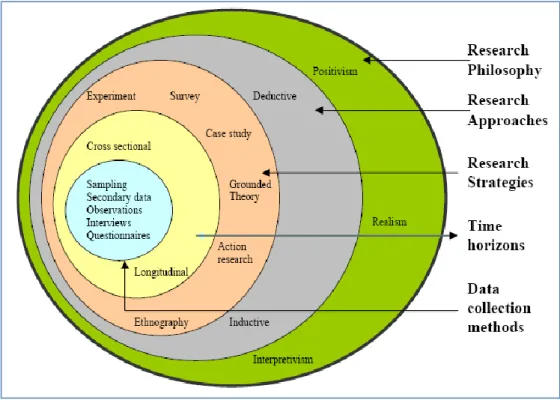
Figure 1-2 The Research Onion Process (Saunders et al. 2009) ……….… 14
Figure 1-3 Structure of Thesis ……….… 18
Figure 2-1 ERP systems by Tier (SYSPRO 2010) ………...… 22
Figure 2-2 Organisation Size (n = 20)……….. 31
Figure 2-3 ERP System supported by Organisation……….. 31
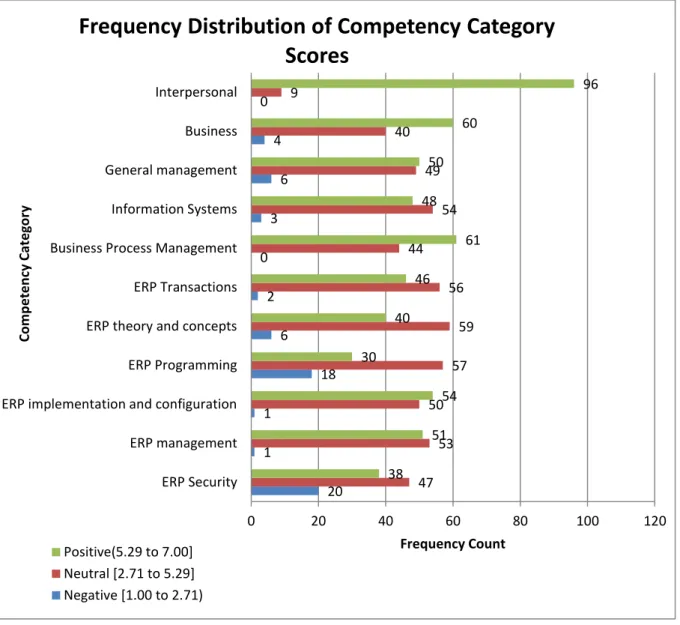
Figure 2-4 Frequency Distribution of Competency Categories……… 39
Figure 3-1 ERP Technical Knowledge Framework (Boyle, 2007) ……….. 61
Figure 4-1 A Competency Framework for ERP System Adoption (ERPEd: Version 1). 76 Figure 4-2 ERP Usability Criteria and Heuristics (Singh and Wesson 2009) …………. 87
Figure 4-3 Usability Measures for ERP Systems Used for Instructional Purposes…..… 90
Figure 4-4 A Competency Framework for ERP System Adoption (ERPEd: Version 2) 91 Figure 4-5 ERP Education Measures……….. 92
Figure 5-1 Case Study Purpose …………...……….…. 96
Figure 5-2a Competency Framework for ERP System Adoption (ERPEd) ……… ………….… 103 Figure 5-2b ERPEd Applied at NMMU ……….. 103
Figure 5-3 Sequence of Administration of Research Materials and Instruments…..….. 110
Figure 5-4 Data Triangulation and Map to Materials ……….……. 113
Figure 6-1 Task Duration for Prac 1 to Prac 4 ……...……….. 132
Figure 6-2 Box Plot of Accuracy for Prac 1 to Prac 4……….. 132
Figure 6-3 Box Plot of Accuracy per Competency Category (Formal Assessment)…… 134
Figure 6-4 Mean Plot of Usability Ratings for SYSPRO ………..……….. ……… 144 Figure 6-5 Mean Plot of Overall Usability for all Practical Sessions……….. 145
Figure 6-6 SYSPRO Main Menu Screenshot ………... 149
Figure 6-7 Data Display of Positive Perceptions of SYSPRO’s Menu Navigation …… 150
Figure 6-8 SYSPRO Purchase Order Entry Screenshot ………... 152
Figure 6-9 Data display of Negative Perceptions with SYSPRO Presentation of the UI. 154 Figure 7-1 A Competency Framework for ERP System Adoption (ERPEd: Version 2) 173 Figure 7-2 ERP Education Measures ………... 174
xi
List of Tables
Page
Table 1-1 Research Questions and Chapters Addressing the Questions…..……….. 12
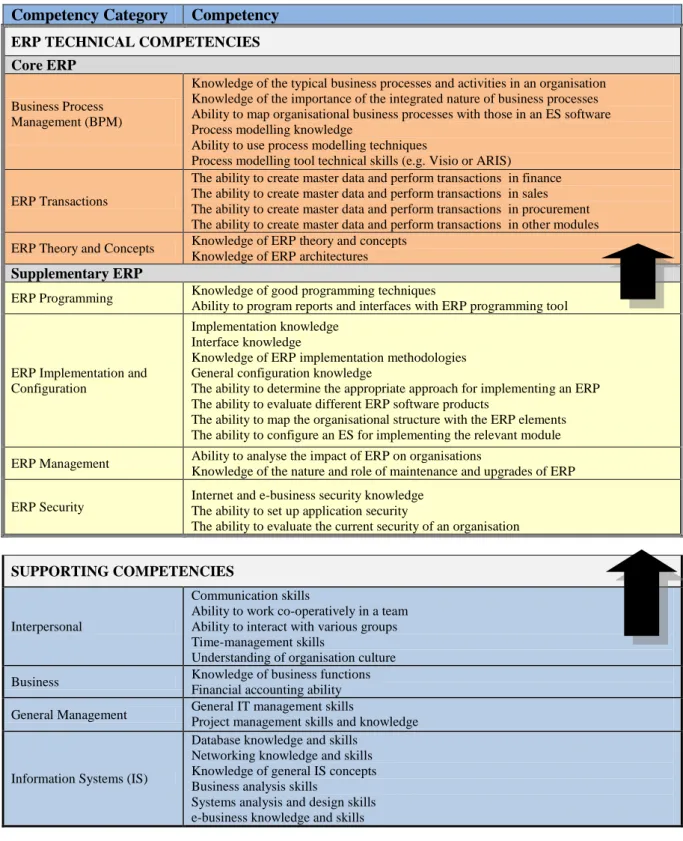
Table 2-1 ERP Specialist Competencies………. 25
Table 2-2 Reasons for ERP Skills Problem……….… 32
Table 2-3 Cronbach’s Alpha for ERP Competency Categories……….. 35
Table 2-4 Demographic Profile for ERP specialists………. 36
Table 2-5 Practical Significance Interpretation Intervals (Gravetter and Walnau 2009)…. 37 Table 2-6 ERP Competency Categories (In order of importance) …….……….………… 38
Table 2-7 Significantly Highest Rated Groups for ERP Technical Competencies …..….. 40
Table 2-8 Additional Key Competencies for ERP Specialists.………..….. 41
Table 2-9 Final Set of Competencies for ERP Specialists………..…….… 43
Table 3-1 IS2010 Competency Metric for Undergraduate Programmes……….… 50
Table 3-2 Summary of Depth of Adoption of ERP Systems (Guthrie and Guthrie 2000). 55 Table 3-3 Summary of Breadth of Adoption of ERP Systems ……….. 56
Table 3-4 Properties of Courses in Each Tier (Springer et al. 2007) ………... 57
Table 3-5 ERP Adoption Levels Matrix for IS Higher Education ……….…. 58
Table 3-6 Multiple-Course Approach to ERP Education ……… 59
Table 3-7 ERP Specialist Roles and Competencies ……….….... 62
Table 3-8 A Framework to teaching ERP/SAP Implementation ………. 63
Table 3-9 A Comparison of ERP Education Frameworks ……….……….. 64
Table 3-10 Comparison of Competencies Addressed by ERP Frameworks ………... 65
Table 3-11 Summary of Hands-on ERP Adoption ………..……… 68
Table 3-12 Universities in South Africa that have ERP Outcomes in their curriculum...… 71
Table 4-1 Usability Criteria for ERP Systems Used for Instructional Purposes ……….… 93
Table 5-1 Case Study Measuring Materials and Instruments ……….. 105
Table 5-2 ERP Lectures and Practical Sessions in the MIS Course………. 107
Table 5-3 ERP Practical Sessions and Tasks ………... 108
Table 5-4 Practical Significance Interpretation Intervals (Gravetter and Walnau 2009)…. 116 Table 5-5 Evaluation Instruments and Data Analysis Techniques………...……… 120
Table 6-1 Demographic Profile of Actual Participants ……….……….. 123
xii
Table 6-3 Task Completion Rate ……….……… 125
Table 6-4 Reasons for Non-completion Related to Usability………... 126
Table 6-5 Extreme Cases in Practical Sessions (n = 10) ….……….……….…….. 127
Table 6-6 Problems in Practical Sessions ……… 128
Table 6-7 Problems Encountered During Practical Sessions………... 129
Table 6-8 Cronbach’s Alpha for Self-Efficacy Questionnaires ………..……… 135
Table 6-9 Descriptive Statistics for Self-efficacy ……….…….. 136
Table 6-10 Growth in Self-Efficacy from Pre-intervention to Post-intervention ………... 137
Table 6-11 Improvement in Competencies for Prac 1 to Prac 4 ….……..……….. 138
Table 6-12 Reasons for not Improving Competencies in Prac 1 to Prac 4 ……… 139
Table 6-13 Reasons for Improving Competencies in Prac 1 to Prac 4 ….…………..…... 141
Table 6-14 Cronbach’s Alpha for the Usability Questionnaires………... 142
Table 6-15 Descriptive Statistics for the Usability Criteria for all Practical Sessions …... 142
Table 6-16 Positive Usability Criteria for SYSPRO ………... 143
Table 6-17 Differences between Usability from Pre-intervention to Post-Intervention …. 146 Table 6-18 Pearson Product-Moment Correlation Results for Accuracy and Usability….. 147
Table 6-19 Top Positive Perceptions of SYSPRO………... 148
Table 6-20 Top Negative Perceptions of SYSPRO……….……. 151
Table 7-1 Research Questions and Chapters Addressing the Questions ……… 166
Table 7-2 Competency Set for ERP Specialists ……….. 171
1
Chapter 1: Research Context
1.1 Background
Businesses have become increasingly reliant on Information Systems (IS) to support their operations and it has become impossible to manage business processes effectively without the use of modern IS (Magal and Word 2012). Investments in Information Communication Technology (ICT), and in particular enterprise systems, have significantly increased the profitability and competitiveness of organisations (McAdam and Galloway 2005; Ketikidis et al. 2008; Magal and Word 2012). During the 1960s and 1970s, simple inventory-tracking systems were developed and these then evolved into more sophisticated manufacturing systems such as Materials Requirements Planning (MRP) systems (Monk and Wagner 2009). The functionality provided by MRP systems continued to expand and MRPII (Manufacturing Resource Planning) systems were developed, which provide methods to plan all resources for a manufacturer (Olson 2004). MRPII was then further extended into integrated Enterprise Resource Planning (ERP) systems. Whereas the focus of MRP and MRPII is on the manufacturing process, ERP systems look at a much broader integration of the planning, management and use of all the resources and data in the entire organisation (Al-Mashari et al. 2003).
ERP systems are dominant in the business community and the application of an ERP system can provide many benefits to organisations, but also introduces many challenges (Section 1.1.1). These challenges include problems relating to a global demand for ICT and ERP competencies (Section 1.1.2). Several studies show that there is a misalignment between the ERP competencies required by business and those provided by education. This situation has led to pressure on higher education to address this need for quality ERP education (Section 1.1.3).
2
1.1.1 Growth and Benefits of ERP Systems
ERP systems are defined as “a highly unified, consolidated and reliable network of business systems, built on a single integrated platform” (Vaman 2007), and are the biggest and most complex of enterprise systems (Magal and Word 2012). Enterprise systems is a term used to describe systems that involve the entire enterprise or at least two departments from it (Turban et al. 2010). Many organisations that had not previously adopted ERP systems became motivated to do so in the late 1990s because of the Year 2000, or Y2k problem (Robey et al. 2000; Vaman 2007). An additional impetus for adopting ERP systems occurred in 2002 with the introduction of the Surbanes-Oxley Act, a federal law passed in response to the accounting fraud discovered at Enron and WorldCom (Monk and Wagner 2009).
Despite the current economic and business climate, there is still a positive forecast for the ERP market (AMR 2007; IDC 2008; Gartner 2010). According to the Enterprise Applications Software Forecast report by Gartner, the Europe, Middle East and Africa (EMEA) region market for ERP systems will reach $24.7bn by 2014 (Figure 1-1), which represents a compound annual growth of 4.2% (Eid et al. 2010). Another report from Forrester forecasts that the global ERP market will reach $45.5bn in 2011, and increase to $50.3bn by 2015 (Forrester 2011).
3
Several reports have cited the growing dominance of ERP systems in the business community (Wailgum 2003; Mohamed and McLaren 2009; ACM 2010; Winkelmann and Leyh 2010; Panorama 2011), and even in small to medium-sized organisations (Loh and Koh 2004; Pang 2008; Koh et al. 2009). Practically all types of organisations, including non-manufacturing organisations like universities and hospitals (Olson 2004; McGauhey and Gunasekaran 2007), as well as organisations in developing countries, have ERP systems (Sheu et al. 2004; Kanthawongs 2010a; 2011). There are numerous ERP vendors in the market with the company, Systems Applications and Products in Data Processing (SAP), being the leading vendor (Monk and Wagner 2009) with more than one hundred thousand customers in over one hundred and twenty companies worldwide in 2010 (SAP 2010).
Numerous potential benefits of implementing ERP in industry have been reported (Shang et al. 2000; O'Grady 2002; McAfee and Brynjolfsson 2008; Esteves 2009; Schubert and Williams 2010). One of the main benefits of an ERP system is its ability to provide all of the enterprise’s needs by means of its integration of all department and function information across a company into a single system (Wailgum 2003; Vaman 2007; Turban et al. 2010).
1.1.2 Demand for ERP Competencies
The potential benefits of ERP systems have led to a global demand for ERP systems in organisations (Muscatello and Chen 2008; Koh et al. 2009; Mohamed and McLaren 2009). However, ERP implementations are faced with many challenges which include problems with obtaining resources and a demand for quality ERP specialists worldwide (Wang and Chen 2006; Muscatello and Chen 2008; Beer 2010; Law et al. 2010). Gartner (2010) has reported that ERP and SAP specialists are some of the most difficult to recruit and hire for positions in Information Technology (IT) today. The high costs of consultants are considerably higher for ERP projects than for other system implementation projects (Robey et al. 2000; Sahadi 2007). In South Africa there is also a need for ERP specialists with appropriate competencies (Seymour et al. 2006; Scholtz 2011).
ICT has been identified as a catalyst for growth in the current economic crisis by the World Economic Forum – The Global Information Technology Report 2008-2009. In the United States (U.S.), congress passed an ICT skills shortage national priority plan to try to address the ICT skills shortage problems (WEForum 2009).
4
The European e-skills Forum report has defined ICT practitioner skills as “the capabilities required for researching, developing and designing, managing, the producing, consulting, marketing and selling, the integrating, installing and administrating, the maintaining, supporting and service of ICT systems” (European e-skills Forum 2004). In South Africa, there is a similar ICT skills shortage to that of the rest of the world and this has been acknowledged by the local government (Pandor 2006; e-skills 2008). The South African Minister of Science and Technology, Mrs Naledi Pandor MP, stated at the South-Africa-Ireland education conference in Dublin that “We are short of men and women with IT skills. All recent
studies and 3 surveys confirm what we already know about scarce skills – management, engineering, and IT are key areas of shortage‟ (Pandor 2006). This was confirmed again by the minister when she signed the Birchwood Declaration in 2008 in Johannesburg, stating that government intervention was required in the ICT skills shortage.
The South African Medium Term Strategic Framework (MTSF) has documented the contribution that competencies make to society and to the development of the national economy and has set objectives, amongst others, to improve South Africa’s competency base and produce quality outcomes in the field of Science and Technology (DOC 2009). According to the e-Skills council, “South Africa’s Information Communication Technology (ICT) needs have
to be addressed in order to further development and service delivery” (e-skills 2008). The e-Skills Institute of the Department of Communications (DOC) indicates that several reports in South Africa in the period since 2000 consistently report an ICT skills shortage. This ICT skills shortage was the focus of the e-skills summit in Cape Town in 2010 (e-skills 2010).
The ICT skill shortage problem impacts the availability of ERP specialists since the competencies required to install, develop, integrate, support and maintain ERP systems required by an ERP specialist fall into the category of ICT practitioner skills. The scope of responsibility of the ERP specialist discussed in this study is that of those not employed in-house by the organisation and referred to as ERP consultants (Boyle and Strong 2006).
In order to address the need for ERP specialists in particular, the South African Qualifications Authority (SAQA) has defined several qualifications for ERP specialists (SAQA 2010). In addition, the higher education community in South Africa established an Enterprise Architecture Research Forum (EARF) at a workshop held in June 2010.
5
The primary objective of the EARF workshop was to address the need for ERP specialists and for enterprise systems education in South Africa (EARF 2010). The international education community has also taken cognisance of the importance of ERP systems and a need for the required ERP competencies, and has identified a career track for the ERP specialist in the IS2010 curricula (ACM 2010).
Research conducted in South Africa on ICT graduate skills indicates that a misalignment exists between ICT skills required by business and the ICT skills provided by higher education and training institutions in South Africa (Kim et al. 2006; Lee and Fang 2008; Calitz 2010; Merkofer and Murphy 2010). A similar problem exists with ERP education programmes which are not adequately addressing the needs of industry (Hawking and McCarthy 2000; Joseph and George 2002; Boyle 2007). According to Cameron (2008), students are not adequately prepared to work as IS practitioners in the enterprise systems environment. IT departments in higher education institutions (HEIs) need to change their focus and go beyond the traditional programming approach to accommodate the employment requirements for enterprise systems competencies generated by a global economy (Mahoney 2005; Strong et al. 2006; Dawson 2008; Tuson 2008). The provision of quality education in HEIs can bridge the gap between the competencies attained by graduates of ERP programmes and those required by industry (Barnes and Ferguson 2008).
1.1.3 ERP Education in Higher Education Institutions (HEIs)
Related studies (Hawking and McCarthy 2000; Jensen et al. 2005; Seethamraju 2007; Mohamed and McLaren 2009; Lindoo and Wilson 2010; Winkelmann and Leyh 2010) have shown that a lack of ERP competencies, together with an increased demand for ERP specialists, has also led to students and future employers placing pressure on HEIs to provide ERP courses in the IS curriculum. IS graduates who are employed as ERP specialists are primarily involved in the implementation and support of ERP systems, therefore the competencies attained by these graduates must be relevant to the industries in which they will be employed (Antonucci et al. 2004; Boyle and Strong 2006; Wang and Chen 2006; Winkelmann and Leyh 2010).
6
In an effort to address the need for ERP education, several HEIs have entered into Academic Alliance agreements with ERP software vendors (Springer et al. 2007; Desai and Pitre 2009; Kreie et al. 2010). These alliances provide educators with software and data resources for ERP courses, and in some cases with training material.
In response to the need for ERP education, several HEIs have adopted ERP systems into their curriculum (Hawking et al. 2004; Surendran et al. 2006; Hustad and Olsen 2011). Several education frameworks for adopting ERP systems into IS and business curricula in HEIs have been proposed (Shtub 2001; Joseph and George 2002; Peslak 2005; Boyle 2007; Pellerin and Hadaya 2008; Wang et al. 2009). A framework is defined as “a set of beliefs, ideas or rules that is used as the basis for making judgements or decisions”, or “the structure of a particular system” (Oxford 2009). ERP education frameworks can be categorised on the
types of decisions for which they provide support to educators (Chapter 3). These decisions relate to the level of ERP adoption required, the type of ERP system to adopt and the adoption approach to use.
There are several levels of ERP system adoption available to educators depending on the competencies required and the resources available (Section 3.4). The level of adoption can vary from a lectures-only approach, to a tutorial approach and finally to the most resource-intensive level of the hands-on approach. The tutorial approach uses simulators and tutorials to teach ERP systems, whilst the hands-on approach involves students actually using an industry ERP system, for example SAP ERP, to process transactions.
Studies have shown that the adoption of an ERP system such as SAP R/3 for instructional purposes in IS and in business curricula has many benefits for students and can improve the quality of learning (Becerra-Fernandez et al. 2000; Hawking and McCarthy 2000; Nelson 2002; Bradford et al. 2003; Kirkham and Seymour 2005; Seymour et al. 2006; Seethamraju 2007). An improvement in the quality of learning can be measured by the students’ achievement of the required levels of academic performance and by a significant, perceived improvement in several ERP competencies (Davis and Comeau 2004; Jensen et al. 2005).
7
Students enjoy the hands-on use of ERP systems and appreciate the importance of having exposure to ERP systems used in industry (Bradford et al. 2003; Wang et al. 2009). The adoption of ERP into the curricula can improve the students’ understanding of ERP systems and business processes (Davis and Comeau 2004; Draijer and Schenk 2004; Peslak 2005; Jensen et al. 2005). In addition, studies (Fedorowitz et al. 2004; Sager et al. 2006) have shown that students who graduate with ERP skills have greater earning potential than those students who do not graduate with ERP skills.
In spite of the potential benefits of the adoption of an ERP system in the IS curricula, the process is challenging for ERP educators and requires detailed planning (Fedorowitz et al. 2004; Léger 2006; Strong et al. 2006). ERP systems are resource-intensive, costly, complex and have a steep learning curve (Eicker et al. 2007; Wang et al. 2009). Continual evaluation of the effectiveness of ERP courses is critical (Seethamraju 2007; Winkelmann and Leyh 2010) and these courses should be kept in line with changing business needs and technologies as well as with the changing demographics of students (Seethamraju 2007).
The hands-on use of ERP systems by students can result in user frustration due to the poorly designed user interface (UI) of the ERP system (Shtub 2001; Surendran et al. 2006). Several usability problems with ERP systems used for instructional purposes have been reported (Nelson 2002; Surendran et al. 2006; Scholtz 2010). The amount of time required to learn the details of all screens and functions of an ERP system is excessive as these systems are not specifically designed to support teaching (Shtub 2001). The usability problems associated with ERP systems results in additional challenges for educators who adopt an ERP system into the IS curricula.
1.2 Research Rationale
A need for the adoption of ERP systems in the IS curriculum exists in order to keep abreast of the ERP competency requirements of industry (Section 1.1). Existing ERP education research is limited to discussions on various frameworks for adopting ERP systems in the curriculum, with the majority of these studies having been administered in the U.S., Europe and Australia (Chapter 3). The impact of ERP educational offerings on students has not been examined to a great extent (Kanthawongs 2010a).
8
Existing frameworks are not comprehensive as they do not take into account all the industry-relevant competencies required for ERP specialists (Chapter 2). They also do not consider the impact of the usability of an ERP system on the attainment of these competencies and thus on educational outcomes in ERP courses (Chapter 4). More systematic investigation into the role of consultants in ERP consultation and implementation is required (Wang and Chen 2006). Studies relating to the correlation of ERP competencies covered in subjects and those required by industry are limited (Hawking and McCarthy 2000; Boyle and Strong 2006). In South Africa, only one such study was identified, but this study did not consider the effect of the usability of the ERP system on the attainment of educational outcomes (Seymour et al. 2006). In addition several educational outcomes for ERP were not addressed by this study (Chapter 3).
Research that evaluates the effectiveness of an ERP system adoption is continually required in an attempt to keep IS educational outcomes in line with changing business needs (Bendoly 2005; Peslak 2005; Sager et al. 2006; Seethamraju 2007). The gap between the ERP skills required by industry and the content of IS programmes has increased (Wang and Chen 2006; Boyle 2007). ERP systems have been used for educational purposes and several successes of ERP adoption have been reported. However, little objective, empirical evidence supporting the success of ERP education has been presented (Grandzvol 2004; Sager et al. 2006). In comparison with the number of articles on ERP implementation in industry, the number of articles on ERP adoption for instructional use in education are relatively few (Moon 2007; Hustad and Olsen 2011).
The educational benefits of instructional uses of ERP systems have, thus far, been established on the basis of anecdotal statements from faculty and students rather than on empirical and objectively measured data, secured by educational research (Noguera and Watson 2004). Sager et al. (2006) believe that gathering empirical data on the value of ERP systems in education from both the student and company points of view can be extremely useful to both HEIs and organisations. An ERP education framework is required which can assist ERP educators with the decision-making process when adopting an ERP system in the curriculum. Empirical data is required on the impact of the application of ERP education frameworks which support this ERP system adoption on educational outcomes.
9
Research on industry-relevant, competency based ERP education frameworks can assist educators with addressing the requirements of industry. The relevance of this research is thus to complement existing research with empirical data and to evaluate the application of the proposed framework by measuring ERP usability and its relationship with educational outcomes.
1.3 Research Problem
The practical problem researched in this study is based on the realisation that there is shortage of quality ERP specialists globally and specifically in South Africa (Seymour et al. 2006; Gartner 2010). A gap exists between the skills required by organisations and the content of IS programmes both internationally (Boyle 2007) and in South Africa (Griesel and Parker 2009). Whilst several HEIs have adopted ERP in their curricula, it is not certain that they are providing students with industry-relevant competencies (Desai and Von der Embse 2001; Boyle and Strong 2006; Cameron 2008). Existing ERP education frameworks are not comprehensive and do not necessarily take into account the usability challenges of the adopted ERP system. ERP systems are not designed to specifically support teaching and this can negatively affect the learning process, especially for students who are novice users (Shtub 2001; Surendran et al. 2006). As a result, users tend to focus on the completion of tasks and not on the underlying concepts (Davis and Comeau 2004; Winkelmann and Leyh 2010). The core problem of this study is that existing ERP education frameworks are not comprehensive and are not competency-based. They are not comprehensive since they do not address all the decisions relating to the adoption of an ERP system in the curriculum. Existing ERP education frameworks are also not based on industry-relevant competencies. This study will propose a comprehensive ERP education framework for South African HEIs, which is based on industry-relevant competencies and also takes into account the usability of the adopted ERP system on these competencies and on educational outcomes. An improvement in these competencies and in educational outcomes can thus improve the quality of ERP education (Davis and Comeau 2004), which in turn can increase the employability of graduates and better satisfy the needs of employers in terms of acquiring their required ERP capability (Calisir and Calisir 2004; Seymour et al. 2006; Strong et al. 2006; Hawking et al. 2009).
10
1.4 Thesis Statement
A comprehensive framework for the adoption of ERP systems into the IS and business curricula in HEI undergraduate degree programmes will be investigated. This framework will provide guidance to educators for planning the adoption of an ERP system in the IS curriculum. The framework should therefore be comprehensive and include all decisions relating to the adoption of an ERP system in the curriculum, as well as all the ERP knowledge and skill competencies that are relevant to industry. In this way the framework can increase the ERP competency levels of ERP graduates.
The following thesis statement of this student is based on the core problem statement:
A comprehensive, competency-based ERP education framework which supports the attainment of educational outcomes and industry-relevant competencies can be implemented in the IS curriculum at a South African Higher Education Institution (HEI).
The success of an ERP programme in the IS curriculum can be measured by the educational outcomes of performance, self-efficacy and the usability of the ERP system. The usability of the ERP system adopted in the curriculum can impact on the academic performance of students. The success of the adoption of the ERP system can also be measured in terms of self-efficacy and student satisfaction.
1.5 Research Purpose and Objectives
The purpose of this research is to propose, apply and evaluate a comprehensive, ERP education framework that assists educators with decisions regarding the adoption of an ERP system into the IS curriculum. Factors that affect the successful adoption of an ERP system into the curriculum will also be examined. In particular, the factor that will be examined is usability of the ERP system tool used. In order to achieve the research purpose, the following research objectives have to be realised:
Primary Research Objective
o To propose and apply a comprehensive, competency-based education framework for the support of the adoption of an ERP system at an HEI in South Africa.
11
Secondary Research Objectives
RO1. To identify and compile a set of competencies for ERP specialists;
RO2. To validate the ERP competency set according to the requirements of South African ERP consulting organisations;
RO3. To compare frameworks and approaches which can be used to adopt ERP systems into the IS curricula;
RO4. To propose an education framework which can be used for the adoption of ERP systems in an IS curriculum in HEIs in South Africa;
RO5. To propose a set of educational measures for ERP system adoption in an IS curriculum;
RO6. To apply the ERP education framework at the Nelson Mandela Metropolitan University (NMMU) to support the adoption of an ERP system in the IS curriculum;
RO7. To evaluate the application of the proposed ERP education framework at NMMU.
1.6 Envisaged Contribution
The main difference between this study and other similar studies is that it proposes and validates a comprehensive framework for ERP education. The framework will provide the following:
A standardised set of competencies for ERP specialists that are relevant to employers of IS graduates in South Africa (Chapter 2); and
A classification of the possible levels of ERP system adoption for education in IS curricula that is appropriate for the industry-relevant competencies (Chapter 3).
The proposed framework is different from existing frameworks in that it is comprehensive since it assists with all the decisions relating to the adoption of an ERP system into the IS curriculum. These decisions are related to which industry-relevant competencies to address, which ERP system adoption approach to use, which ERP learning tool to adopt and which level of adoption to implement in the curriculum. Evaluation measures for ERP education and the usability of ERP systems are also proposed.
12
This study can provide benefits to the business management, education and Human Computer Interaction (HCI) communities. The competency set can assist ERP employer organisations with the recruitment and selection of ERP graduates, whilst the results of the usability evaluation can be used to assist HCI designers with the process of designing more usable ERP learning tools. Measures and metrics for evaluating ERP education (Chapter 4) provided by this study can contribute to education research in South Africa.
1.7 Research questions
Based on the purpose of the research and the research objectives (Section 1.5), the main research question can be phrased as:
“What is the impact of the application of an ERP education framework at NMMU?”
Several subsidiary research questions arise from the main research question. These questions are listed in Table 1-1 together with the research methods used to answer each question. The chapter in which each research question is addressed is also included in the table.
Table 1-1 Research Questions and Chapters Addressing the Questions
Research Question Chapter Research
Objective RQ1 What competencies (skills and knowledge) are required for an ERP
specialist by ERP consulting companies in South Africa? 2 RO1 & RO2
RQ2 What frameworks and approaches can be used to adopt ERP systems
into the IS curricula? 3 RO3
RQ3 What comprehensive education framework can be used in an ERP
course in higher education institutions in South Africa? 4 RO4
RQ4 How can the impact of ERP system adoption in a curriculum be
measured? 4 & 5 RO5
RQ5 What is the impact of the adoption of an ERP system in the IS
curriculum at NMMU on ERP educational outcomes? 6 & 7 RO6 & RO7
The research process entails three distinct but related investigations:
1. Establish what the stakeholders actually require for ERP specialists;
i. Establish what the ERP consulting companies in South Africa require for ERP specialists (RQ1):
ii. Investigate what the educational context of ERP systems is internationally and in South Africa (RQ2);
13
iii. Establish what international curricula and research communities require for ERP education (RQ2);
iv. Establish what education frameworks have been proposed by other HEIs to produce ERP specialists (RQ2);
2. Establish the measures and metrics used by HEIs for ERP educational quality (RQ4); 3. Design, implement and evaluate an ERP education framework (RQ3, RQ4, RQ5).
These investigations are required in order to answer the main research question and the five subsidiary research questions. The results of the three investigations will contribute to the artefacts of this study.
1.8 Scope and Constraints
This study will focus on the competencies required by outsourced ERP specialists and not on those employed in an in-house IT department. The scope will be limited to the investigation of undergraduate curricula in universities, and excludes curricula of technikons (now universities of technology) and colleges. It will also examine curricula for one discipline only, namely the IS discipline and will therefore not consider approaches for multidisciplinary education.
The evaluation of the proposed framework will be limited to the practical use of an ERP system in an undergraduate course which teaches core technical ERP concepts (Section 2.3.2.1) at a HEI in South Africa, namely NMMU. Supplementary ERP competencies such as configuration, implementation and programming (Section 2.3.2.2) will not be included in the scope of the evaluation. E-learning applications for ERP systems will also fall outside the scope of this study.
1.9 Research Philosophy and Approach
The research process is used to define the research strategy of this study in detail. Figure 1-2 to follow illustrates a generic research process “onion” showing the relationship between the various aspects of the research process.
14
Figure 1-2 The Research Onion Process (Saunders et al. 2009)
Saunders et al. (2009) states that a research philosophy relates to the development of knowledge and the nature of the knowledge (Section 1.9.1) whereas a research approach indicates whether the use of theory is explicit within the research design (Section 1.9.2). Following consideration of the research philosophical stance, research approach and the logic of reasoning to be applied in the research, the next aspect to address is what strategy to employ in the research process (Section 1.10.3).
1.9.1 Research Philosophy
Research studies can be undertaken using one of three primary research philosophies, namely: positivism, realism and interpretivism (Saunders et al. 2009). Positivism is based on the belief that the social world can be studied in the same manner as the natural world. Positivists believe that one reality exists and it is the researcher’s task to discover that reality. Realism is another philosophical position which relates to scientific enquiry. The essence of realism is that what the senses show us as reality is the truth: that objects have an existence independent of the human mind. Realism is similar to positivism in that it assumes a scientific approach to the development of knowledge.
15
Interpretivism advocates that it is necessary for the researcher to understand differences between humans in our role as social actors, and it emphasises that there is a difference between conducting research among people rather than objects, like cars. The underlying assumption of interpretivism is that the whole needs to be examined in order to understand a phenomenon. The focus of this study is on ERP system adoption in education, which is impacted by the social world of the people who are stakeholders in ERP education therefore a combination of interpretivism and positivism will be used.
1.9.2 Research Approach
Researchers can derive meaning from a phenomenon under study by applying any of the following types of logical thinking: Deductive or inductive approaches (Mouton 2001). Induction is building theory, whereas deduction is the process of testing theory (Saunders et al. 2009). An inductive approach emphasises gaining an understanding of the meanings humans attach to events and a close understanding of the research context. It is a more flexible structure to allow changes of research emphasis as the research progresses, and has less concern with the need to generalise.
When researching a topic that is new and on which there is little existing literature, it is more appropriate to work inductively by generating data and analysing and reflecting on what theoretical categories the data suggests. Inductive approaches include generalisation and retroductive reasoning (Mouton 2001). Inductive generalisation involves applying inferences from specific observations (such as a sample of cases) to a theoretical population. Any form of statistical inference in which generalisation is made from a sample to the target population is a form of inductive generalisation. Retroductive reasoning is another form of inductive inference and involves using inference from observations of data in order to construct or “infer” an explanation from such observations. On the basis of observations that have been made and perceived patterns and trends in the observations, explanations that would explain the observed events are derived.
16
Deduction involves the development of a theory that is subjected to a rigorous test, and is the dominant research approach in the natural sciences where laws present the basis of explanation, allow the anticipation of phenomena, predict their occurrence and therefore permit them to be controlled (Collis and Hussey 2003). Deduction emphasises moving from theory to data and is most suitable where there is a wealth of literature from which a theoretical framework and a hypothesis can be defined. It is often advantageous to combine both the deductive and inductive approaches (Saunders et al. 2009) and therefore, although this study will be mostly deductive there will be some aspects that are inductive, particularly when the design of the framework is introduced. The inductive approach will be used to build new theories that have not emerged previously and to derive the proposed theoretical ERP education framework. A deductive approach will be used to address the initial research questions and test certain aspects of the theoretical framework.
1.9.3 Research Strategies and Ethical Considerations
Saunders et al. (2009) define a research strategy as “a general plan of how you go about answering the research questions you have set”. The choice of a good strategy will be driven by set objectives answering the research questions. In the strategy, possible data collection sources and research constraints are explored. This study will use several research strategies, including surveys and a case study. Surveys will be used to determine the requirements of ERP consulting organisations for ERP specialists. This process is described in more detail in Chapter 2. The case study approach is used to test the theoretical framework. A case study is a strategy for doing research which involves an empirical investigation of a particular contemporary phenomenon, within its real life context, using multiple sources of evidence (Saunders et al. 2009). A single case study is used for the application and evaluation of the framework. The motivation for using case studies will be presented in more detail in Chapter 5 when the research design is discussed.
The research, for all purposes, abided by and followed on the proposals from the Research Ethics Committee (Human) of the Nelson Mandela Metropolitan University (NMMU) and ethical approval for this study was awarded by the NMMU Ethics Committee (Ethics Clearance Reference Number is H10-Sci-CSS-002). In line with this, the researcher made explicit to the selected organisations and student participants that their interests would be safeguarded and would remain anonymous.
17
1.10 Conclusions and Proposed Thesis Structure
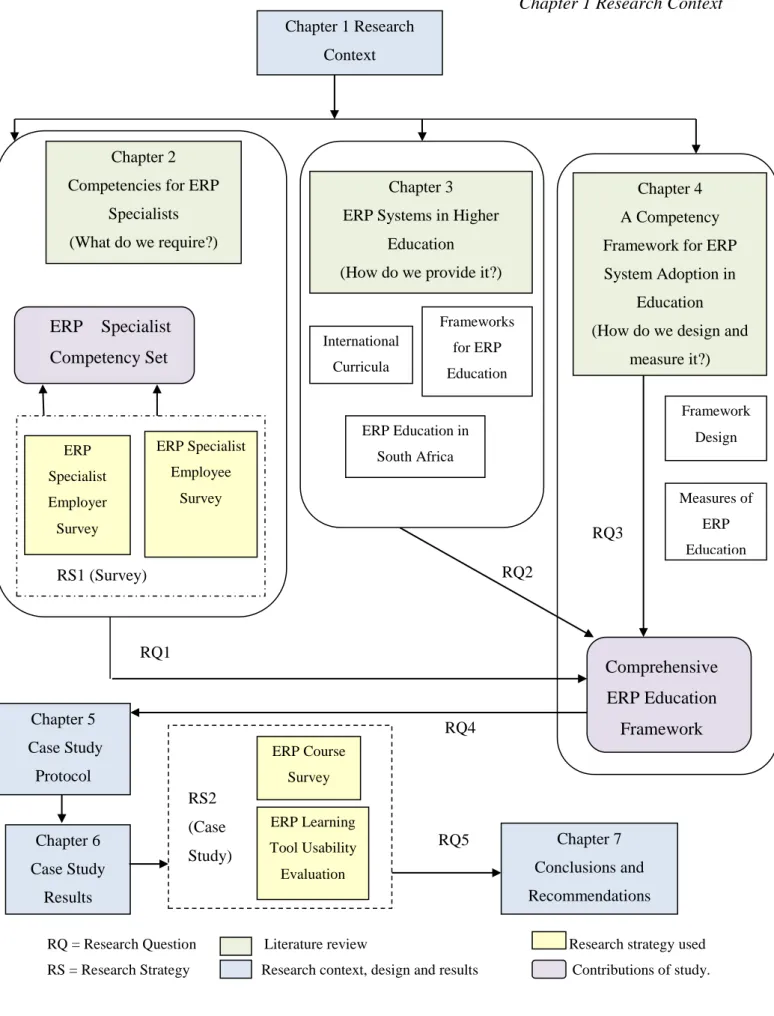
A need for research into ERP education in South Africa exists in order to meet the demand for ERP specialists (Section 1.2). The demand is for ERP specialists with industry-relevant competencies but existing frameworks for ERP education are not comprehensive and do not take into account the requirements of consulting organisations in South Africa. In addition, empirical evidence of the success of the adoption of an ERP system in South Africa is limited. No comprehensive ERP education framework for the IS curriculum in South Africa exists. Similar studies in other countries have not addressed the impact of the usability of ERP systems on the attainment of educational outcomes. Five subsidiary research questions are identified for this study (Table 1-1) in order to answer the primary research question. In order to address the research questions of this study, this dissertation is structured accordingly and this structure is illustrated in Figure 1-3 together with the research questions asked and the related strategies used to answer these questions. The question of what is required for ERP specialists is addressed in Chapter 2 and several key competencies for ERP specialists are identified by means of a literature review. To confirm the competencies identified in the theoretical framework, a survey strategy is used and a survey of South African ERP specialist employers is undertaken using structured interviews and questionnaires.
Once the requirements for the competencies of ERP specialists are established it is necessary to determine how these competencies can be attained by means of education programmes in HEIs. Chapter 3 therefore investigates several approaches and frameworks used to adopt ERP systems in education. When it is determined how to provide an ERP education that supports the attainment of industry-relevant competencies, it is important to address how ERP educational outcomes and the success of the adoption of an ERP system into the curriculum can be measured. Chapter 4 discusses the criteria, measures and metrics for evaluating ERP education. This chapter will also discuss the design of the proposed comprehensive ERP education framework and the importance of usability in evaluating ERP education quality.
18
RQ = Research Question Literature review Research strategy used RS = Research Strategy Research context, design and results Contributions of study. Figure 1-3 Structure of Thesis
Chapter 3 ERP Systems in Higher
Education (How do we provide it?)
Chapter 4 A Competency Framework for ERP System Adoption in
Education (How do we design and
measure it?) Chapter 5 Case Study Protocol Chapter 6 Case Study Results Chapter 7 Conclusions and Recommendations Chapter 1 Research Context Chapter 2 Competencies for ERP
Specialists (What do we require?) ERP Specialist Competency Set ERP Specialist Employer Survey ERP Specialist Employee Survey International Curricula Frameworks for ERP Education ERP Education in South Africa ERP Course Survey ERP Learning Tool Usability Evaluation RQ1 RQ2 RQ3 RQ4 RQ5 Comprehensive ERP Education Framework RS1 (Survey) RS2 (Case Study) Framework Design Measures of ERP Education
19
Chapter 5 discusses the research design and methodology of the case study at NMMU used to evaluate the impact on educational outcomes of adopting ERP systems. This chapter discusses the case study protocol, the data that was collected, and the reasons and methods for collecting this data. In Chapter 6 the results of the data collected from a single case study of students registered for an ERP course are discussed. The analysis and interpretation of the results relating to the educational outcomes of the ERP course are provided in Chapter 6 as well as the results from the usability evaluation of the ERP system. Chapter 7 summarises the results of the research to show whether or not, based on the results, the framework is useful and usable. Shortcomings of the research and future work will also be identified and discussed.
20
Chapter 2: Competencies for ERP Specialists
2.1 Introduction
In South Africa finding ICT employees with the right competencies has become a major issue for employers (Alexander et al. 2009; Calitz 2010; ITWeb 2010; Pieterse 2010). Companies in South Africa have indicated that the shortage of ICT skills in South Africa could affect their survival (Textio 2010). ICT practitioners include ERP specialists for which the supply and demand are out of sync (Sahadi 2007). A CNN Money report listed ERP and SAP consultants as one of the top 6 jobs identified in terms of earnings (Sahadi 2007). This demand for ERP competencies challenges academia to produce ERP graduates that have industry-relevant competencies. Competency can be defined as the necessary skill or knowledge required to perform a task successfully (Pinto 2010).
The wide range of ERP systems available on the market will influence the key competencies that organisations expect from graduates of ERP tertiary programmes. Consequently the focus of this chapter is on the identification of competencies (in terms of knowledge and skills) that are required for an ERP specialist by ERP consulting companies in South Africa. This chapter will therefore answer the first research question, “What competencies (skills and knowledge) are required for an ERP specialist by ERP consulting companies in South Africa?”.1
1 The results reported on in this chapter were published as a full paper in a double-blind peer reviewed conference at the International Business Conference (IBC) in September 2010. Scholtz, B., Calitz, A., Cilliers, C. Critical Competencies for South African ERP Consultants. IBC Conference. Mauritius (Appendix F).
21
A number of ERP systems are currently used in the marketplace (Section 2.2). ERP graduates will work on at least one of these ERP systems and will require industry-relevant competencies related to these systems. The set of technical and supporting competencies required for ERP specialists (Section 2.3) is confirmed and augmented by a survey of 22 ERP specialist employer organisations (Section 2.4) and 105 South African employers of ERP specialists (Section 2.5) to produce a comprehensive set of the key competencies required for ERP specialists (Section 2.6). The ERP competency set can be used as a checklist for ERP consulting organisations when recruiting consultants and for job assessments.
2.2 The ERP Systems Market
The implementation of ERP systems brings many benefits as a result of the integration of business processes and related information (Section 1.1). This integration is made possible by a common database which is responsible for storing all of the data from business processes that are essential for business operations and decision-making (Turban et al. 2010). The removal of barriers to sharing information between functional divisions and the holistic management of processes have enabled ERP systems to increase significantly the profitability and productivity of organisations (McGauhey and Gunasekaran 2007; McAfee and Brynjolfsson 2008).
The demand for ERP systems has led to a demand for ERP specialists (Section 1.1.2). Recent studies (Boyle 2007; Winkelmann and Leyh 2010) have reported that IS graduates who are recruited as ERP specialists will work with one or more ERP systems. One study (Winkelmann and Matzner 2009) argues that the ERP specialist may also have an influence on the investment decisions concerning the adoption, upgrade, or alteration of ERP systems. Organisations that recruit ERP specialists, therefore, require graduates that have product-based ERP competencies related to the ERP systems which the specialists will support. ERP systems include, amongst others, those developed and marketed by the top vendors in the marketplace, such as SAP, Baan and Oracle (Seethamraju 2007). Several vendors have produced ERP systems aimed at the small to medium sized organisation (Boyle 2007), because the ERP systems aimed at very large organisations are often too sophisticated and complex for smaller organisations (Computer Weekly 2010; Winkelmann and Leyh 2010).
22
An ERP system can thus be classified according to the size of the organisation that it is designed to support (Shaul 2005). Figure 2-1 illustrates the four tiers of ERP systems. Tier 1 ERP systems address the needs of very large organisations and include SAP, Oracle, Microsoft and SageERP (SYSPRO 2010). SAP is the leading ERP vendor and was formed in 1972 by five former IBM systems analysts (Monk and Wagner 2009; Magal and Word 2012). In 2008, SAP’s market share in the ERP category was equivalent to the market share of the next four largest ERP vendors combined (Pang 2008).
Figure 2-1 ERP Systems by Tier (SYSPRO 2010)
Vendors have introduced less complex ERP systems such as SYSPRO, Softline Accpac and others, which are specifically designed for organisations in Tier 2 (upper mid-market) and Tier 3 (lower mid-market). Tier 2 is the mid-sized tier and organisations in this tier are usually in the $20 million to $200 million dollars income bracket. ERP systems in Tier 2 include those in Tier 1 as well as SYSPRO, Softline ACCPAC and SAP Business All-In-One. Tier 3 software is designed for single site organisations of under $40 million dollars income and with 5 to 30 users. ERP systems for small to medium organisations are classified as Tier 4 software which comprises basic accounting systems and includes products such as Pastel, Accpac and Quickbooks (Shaul 2005).
23
2.3 Competencies Required for ERP Specialists
There is a shortage of ERP competencies globally and various strategies can be employed to improve these competencies (Willcocks and Sykes 2000). The use of external consultants from the ERP vendor, or from ERP resellers, that can complement or replace in-house skills has become desirable practice (Willcocks and Sykes 2000; Muscatello and Chen 2008; Law et al. 2010). The availability of skilled project members, including external consultants, and how to manage them, is essential for ERP success (Somers and Nelson 2004; Ngai et al. 2008). The high turnover rate of ERP skills and the difficulties with finding suitable ERP specialists have jeopardised many ERP projects (Tsai et al. 2005; Xue et al. 2005; Law et al. 2010). ERP project success is dependent upon an organisation having the appropriate specialised competencies in the project team (Duplaga and Astani 2003; Amoako-Gyampah 2004; Peslak 2005; Gartner 2006; Aloini et al. 2007; Ifinedo and Nahar 2009; Rothenberger et al. 2010). The demand for external consultants can limit ERP implementations (Wu and Wang 2007).
A demand for ERP specialists exists (Section 1.1.2). However, unlike general computer skills, ERP specialist competencies are not widely diffused in the working population (Davis and Comeau 2004). The skill sets of ICT practitioners, required by employers, are changing and employers are seeking an ever-increasing number and variety of skill sets from employees (Gallivan et al. 2004). ERP implementation requires a critical mass of knowledge to enable people to solve problems (Umble et al. 2003).
The wide range of ERP systems in the marketplace requires certain competencies of ERP specialists. Several studies have identified competencies that an ERP specialist should have (Shields 2001; Peslak 2005; Jensen et al. 2005; Seymour et al. 2006; Boyle 2007; Seethamraju 2007; Cronan et al. 2008; Pellerin and Hadaya 2008). ERP consultants must have a diverse set of knowledge and skills, which include system knowledge as well as business and industry-specific knowledge which makes it different from those in traditional IS contexts (Wang and Chen 2006). Only a few studies (Seymour et al. 2006; Mohamed and McLaren 2009; Boyle and Peslak 2010) have investigated ERP specialist competencies from the perspective of what provides value to industry, rather than from an academic viewpoint and only one of these (Boyle and Peslak 2010) included a survey of industry requirements.