Multiqubit and multilevel quantum
reinforcement learning with quantum
technologies
F. A. Ca´rdenas-Lo´ pez1,2*, L. Lamata3, J. C. Retamal1,2, E. Solano3,4,5
1 Departamento de Fı´sica, Universidad de Santiago de Chile (USACH), Santiago, Chile, 2 Center for the Development of Nanoscience and Nanotechnology, Estacio´n Central, Santiago, Chile, 3 Department of Physical Chemistry, University of the Basque Country UPV/EHU, Bilbao, Spain, 4 IKERBASQUE, Basque Foundation for Science, Bilbao, Spain, 5 Department of Physics, Shanghai University, Shanghai, China
Abstract
We propose a protocol to perform quantum reinforcement learning with quantum technolo-gies. At variance with recent results on quantum reinforcement learning with superconduct-ing circuits, in our current protocol coherent feedback dursuperconduct-ing the learnsuperconduct-ing process is not required, enabling its implementation in a wide variety of quantum systems. We consider diverse possible scenarios for an agent, an environment, and a register that connects them, involving multiqubit and multilevel systems, as well as open-system dynamics. We finally propose possible implementations of this protocol in trapped ions and superconducting cir-cuits. The field of quantum reinforcement learning with quantum technologies will enable enhanced quantum control, as well as more efficient machine learning calculations.
Introduction
Machine Learning (ML) is a subfield of Artificial Intelligence (AI) that has attracted increasing attention in the last years. ML usually refers to a computer program which can learn from experience E with respect to some class of task T and performance measure P, if its perfor-mance at tasks in T, as measured by P, improves with experience E [1]. In other words, Machine Learning addresses the problem of how a computer algorithm can be constructed to automatically improve with experience. Several applications in this field have been imple-mented such as handwriting pattern recognition [2], speech recognition [3] and the develop-ment of a computer able to beat an expert Go player [4], just to name a few.
The learning process in ML can be divided in three types: supervised learning, unsupervised learning and reinforcement learning [5]. In supervised machine learning, an initial data set has the function of training the system for later prediction making or to classify data. Usually, supervised learning problems are categorized into regression (continuous output) or classifica-tion (discrete output). Unsupervised learning allows one to address problems where the train-ing data is not necessary and only correlations between subsets in the data (clustertrain-ing) are considered and analyzed. Finally, reinforcement learning [6] differs from supervised and a1111111111 a1111111111 a1111111111 a1111111111 a1111111111 OPEN ACCESS
Citation: Ca´rdenas-Lo´pez FA, Lamata L, Retamal
JC, Solano E (2018) Multiqubit and multilevel quantum reinforcement learning with quantum technologies. PLoS ONE 13(7): e0200455.https:// doi.org/10.1371/journal.pone.0200455
Editor: Zoltan Zimboras, Wigner Research Centre,
HUNGARY
Received: April 12, 2018 Accepted: June 25, 2018 Published: July 19, 2018
Copyright:©2018 Ca´rdenas-Lo´pez et al. This is an open access article distributed under the terms of theCreative Commons Attribution License, which permits unrestricted use, distribution, and reproduction in any medium, provided the original author and source are credited.
Data Availability Statement: All relevant data are
within the paper and its Supporting Information files.
Funding: We acknowledge support from CEDENNA
basal grant No. FB0807 and Direccio´n de Postgrado USACH (FAC-L), FONDECYT under grant No. 1140194 (JCR), Spanish MINECO/FEDER FIS2015-69983-P and Basque Government IT986-16 (LL and ES), and Ramo´n y Cajal Grant RYC-2012-11391 (LL).
Competing interests: L. L. declares his affiliation
unsupervised learning in that it takes into account a scalar parameter (reward) to evaluate the input-output relation in a trial and error way. In this case, the system (so-called “agent”) obtains information from its outer world (“environment”) to decide which is the better way to optimize itself, for adapting to the environment.
Quantum information processing (QIP) could contribute positively in the future in the development of the machine learning field, with several quantum algorithms for machine learning with significant possible gains with respect to their classical counterparts [7–11]. More specifically, quantum algorithms have been developed and in some cases implemented for supervised and unsupervised learning problems [12–18]. However, quantum reinforce-ment learning has not been widely explored and just a few results have been obtained up to now [19–26]. Related topics in biomimetic quantum technologies are quantum memristors [27–30], as well as quantum Helmholtz and Boltzmann machines [31–33]. These, together with quantum reinforcement learning, may set the stage for the future development of semi-autonomous quantum devices.
The field of quantum technologies has grown extensively in the past decade. In particular, two architectures which are very promising for the implementation of a quantum computer, in terms of numbers of qubits and gate fidelities, are trapped ions [34,35] and superconduct-ing circuits [36–38]. Current technological progress in trapped ions has allowed us to imple-ment quantum protocols with several ions involving high-fidelity single and two-qubit gates as well as high-fidelity readout [39,40]. Superconducting circuits have also proven to be an excel-lent platform to perform quantum information processing protocols because of their individ-ual addressing and scalability. Two-qubit quantum gates have achieved fidelities larger than 99% [41,42] in this platform. Furthermore, technological progress in this architecture has made possible to build artificial atoms with high coherence time in coplanar [43] and 3D architecture [44], allowing for the development of feedback control with superconducting cir-cuits [45,46]. This feedback mechanism has inspired protocols for quantum reinforcement learning with superconducting circuits [23] where the feedback loop control allows one to reward and restart the system to obtain maximal learning fidelity.
Here, we propose a general protocol to perform quantum reinforcement learning with quantum technologies. We understand general in the sense that it goes beyond the context of qubits for embedding information in agent or environment. In this sense, and at variance with a previous result [23], we extend the realm of the quantum reinforcement learning protocol to multi-qubit, multi-level, and open quantum systems, therefore permitting a wider set of sce-narios. Our protocol considers a quantum system (the agent), which interacts with an external quantum system (its environment) via an auxiliary quantum system (a register). The aim of our quantum reinforcement learning protocol is for the agent to acquire information from its environment and adapt to it, via a rewarding mechanism. In this fully quantum scenario the meaning of the learning process is the establishment of quantum correlations among the par-ties [21]. In our specific case, the quantum agent aims at attaining maximum quantum state overlap with the environment state, in the sense that local measurements on agent and envi-ronment will produce the same outcomes or, equivalently, that the agent and envienvi-ronment entangled final state is invariant under the exchange of these two subsystems. An interpreta-tion of this outcome is that the agent can learn about the informainterpreta-tion embedded in the envi-ronment state, which has been consequently modified from a separable to an entangled state with the agent and registers. After this process we are in position of evaluating any figure of merit with the outcome measurements. Optimizing this figure of merit should be associated to a particular learning process probably requiring particular actions to be applied on the agent. Another possible result is obtained by considering projective measurements in the register sys-tems. Only after these projective measurements agent and environment will be decoupled
alter our adherence to PLOS ONE policies on sharing data and materials.
from them and the protocol assures that the former are in a pure correlated state, without needing to know any information about their initial states. We analyze the case where the reg-ister subspace is larger than agent and environment subspaces. The inclusion of more elements in the register subspace allows for delaying the application of the rewarding criterion to the end of the quantum protocol. This fact will enable its implementation in a wider variety of quantum platforms, besides superconducting circuits with coherent feedback. We also study quantum reinforcement learning in the case where agent, environment and register are com-posed of qudits. In this case, we obtain that the maximal learning fidelity is achieved in a fixed number of steps in the qudit dimension, and this number scales polynomially with the number of subsystems in the environment subspace. In addition, we analyse quantum reinforcement learning in the situation where the environment is larger than the agent. We highlight two results: the first of them is obtained when considering that the register has the same elements than the environment. In this case, two rewarding criteria are needed to obtain maximal learn-ing fidelity and the entanglement between the agent and a specific part of the environment is a key resource. The other case is the situation where the register has more elements than the environment. In this case, only one measurement is needed to obtain maximal learning fidelity and the environment-agent entanglement is not a key resource. Based on this fact, the reward-ing criterion is applied at the end of the protocol. Finally, we describe how our quantum learn-ing protocols can be implemented in quantum platforms as trapped ions and superconductlearn-ing circuits.
Quantum reinforcement learning protocol with final measurement
Here, we introduce a protocol to perform quantum reinforcement learning, which introduces significant novelties with respect to the existing literature. Unlike a previous quantum rein-forcement learning result [23], the protocol described here needs one measurement at the end of the procedure and no feedback, allowing for its implementation in a variety of quantum platforms including ions and photons. The improvement relies on adding more registers than before [23] and making them interact conditionally with each other. The inclusion of ancillary systems has proven to be useful in several implementations of quantum information, because measurements on the ancillary system allow one in principle to obtain information about the main system without destroying it. Moreover, the measurement associated with the rewarding criterion is performed at the end of the protocol. This opens the possibility to implement quan-tum reinforcement learning protocols in architectures for which implementing coherent feed-back may be a challenging problem.
The quantum reinforcement learning protocol described here works in the following way. We firstly consider an agent and environment, composed of one qubit each, and two register qubits, seeFig 1. The first step is to encode the environment information in the register states (usually this kind of operation in the context of classical reinforcement learning is called the action). Subsequently, the internal states of the registers interact conditionally with the agent (usually this kind of operation in classical reinforcement learning is called the percept). Finally, an agent-register interaction changes the agent state (partial rewarding mechanism). At this stage the rewarding criterion is satisfied, in the form of a correlated agent-environment state, in the sense that local measurements on agent and environment will produce the same out-comes. On the other hand, the agent-environment system is also entangled with the two regis-ters, and in order to attain a correlated pure state of agent and environment, a single, final measurement may be performed on the two register states. This will produce an agent-envi-ronment state maximizing the learning fidelity defined asFAE¼ jhcAjEij, where |ψAiis the agent state and |fEiis the environment state, both after the protocol.
To perform our quantum reinforcement learning protocol we consider that initially agent and environment are in arbitrary single-qubit pure states, whereas the register states are in their ground state, namely
fjAi ¼a0 Aj0iAþa 1 Aj1iA;jEi ¼a 0 Ej0iEþa 1 Ej1iE;jRi ¼ j0i1j0i2g ð1Þ jCi0 ¼ jAijEijRi: ð2Þ
The first step in the protocol is to extract information from the environment, updating the information in the registers conditionally to the environment state. This process is done by applying a pair of CNOT gates in the environment-register subspace. Here, the first system is the control and the second the target,
jCi1 ¼ UCNOT ðE;R2ÞU CNOT ðE;R1ÞjCi0; ð3Þ jCi1 ¼ ða 0 Aj0iAþa 1 Aj1iAÞða 0 Ej0iEj0i1j0i2þa 1 Ej1iEj1i1j1i2Þ: ð4Þ
Then, the information encoded on the registers is updated conditional on the agent state. As the register subspace is larger than the agent subspace, we will choose which part of the register subspace will the agent update. Without loss of generality, let us assume that the registerR1
Fig 1. Proposed protocol to perform quantum reinforcement learning with final measurement. We consider a set composed of four qubits, corresponding to agent
A, environment E, and registersR1andR2. The considered interactions agent-register, register-register and environment-register consist of CNOT gates. The measurement in the register subspace is denoted by the rightmost box.
will be updated. The upgrade of agent subspace is performed by a CNOT gate acting in theA−
R1subspace, where the agent state is the control and the register is the target,
jCi2 ¼ UCNOT ðA;R1ÞjCi1; jCi2 ¼ ða 0 Aa 0 Ej0iAj0iEj0i1j0i2þa 0 Aa 1 Ej0iAj1iEj1i1j1i2þa 1 Aa 0 Ej1iAj0iEj1i1j0i2 þa1 Aa 1 Ej1iAj1iEj0i1j1i2Þ: ð5Þ
Subsequently, the registerR2is also updated with respect to theR1state. This is accomplished
by applying a CNOT gate in the register subspace, whereR1acts as control andR2as target, jCi3 ¼ UðCNOTR1;R2ÞjCi2; jCi3 ¼ ða0 Aa 0 Ej0iAj0iEj0i1j0i2þa 0 Aa 1 Ej0iAj1iEj1i1j0i2þa 1 Aa 0 Ej1iAj0iEj1i1j1i2 þa1 Aa 1 Ej1iAj1iEj0i1j1i2Þ: ð6Þ
Followingly, we update the agent state according to the information encoded in the registerR1.
This is done by applying a CNOT gate in theR1−Asubspace, whereR1is the control andAis
the target, jCi4 ¼ UðCNOTR1;AÞjCi3; jCi4 ¼ ða0 Aa 0 Ej0iAj0iEj0i1j0i2þa 0 Aa 1 Ej1iAj1iEj1i1j0i2þa 1 Aa 0 Ej0iAj0iEj1i1j1i2 þa1 Aa 1 Ej1iAj1iEj0i1j1i2Þ: ð7Þ
We point out that, in the previous state, agent and environment are already maximally corre-lated, in the sense of having the same outcomes with respect to local measurements performed on either of them, or, equivalently, the state is invariant under particle exchange with respect to the agent-environment subsystem. We also remark that this state is general, valid for any initial agent and environment states. The fact that agent and environment get entangled with the two registers allows one to distinguish between identical agent-environment components that originate from different initial states, namely, to distinguish between states arising from
a0 Aa 0 Eora 1 Aa 0 E, as well as froma 0 Aa 1 Eora 1 Aa 1 E.
Finally, by performing a projective measurement on the register subspace, the rewarding criteron is satisfied. It is easy to show that, independently of the measurement outcome, the learning fidelityFAE¼ jhcAjEijis maximal, given that agent and environment states end up being in the same state, either |0ior |1i. In this case only one iteration of the protocol is suffi-cient in order that the agent adapts to the environment. Moreover, throughout the protocol, measurements on agent and/or environment are not required, which may allow its implemen-tation in a variety of quantum platforms as trapped ions, superconducting circuits, and quan-tum photonics.
In our protocol, we do not need coherent feedback given that the registers entangle with agent and environment and as a result produce the desired agent-environment state that is invariant under permutation. It is true that the entanglement with the registers produces a mixed state in case the register states are discarded, but this is not a drawback in our protocol. Indeed, what our protocol does is, for arbitrary initial agent and environment states, which need not be known, to give a constructive way to produce a final agent-environment state per-fectly correlated, in the sense of invariant under permutations in agent-environment subspace. This state is in general entangled, namely, quantum, and we do not need to perform any mea-surement on agent and environment during the protocol, namely, it can equally well work with photons, ions, and superconducting circuits, among others. After the production of the agent-environment-register entangled state, the registers are entangled with agent and
environment, but this does not prevent us from measuring the registers at a certain desired time, and decoupling agent and environment from them. This way, we will not have measured agent and environment at any time of the protocol, and we can assure that they are perfectly correlated irrespective of their initial states, and without having any prior information about them. This may be useful, e.g., for distributing private keys in quantum cryptography for arbi-trary, unknown, initial states, without the need to initialize agent and register in reference states.
Quantum reinforcement learning for multiqubit systems with final
measurement
In the previous section, we have showed that by considering more than just one register the rewarding criterion in the quantum reinforcement learning algorithm can be done at the end of our protocol. The same results can be obtained when we consider more complex configura-tions. Indeed, by assuming that agent and register are composed of two qubits each, and four qubits act as registers, we show that the rewarding criterion can also be applied at the end of the quantum protocol. Let us illustrate this fact with an analysis for multiqubit agent, environ-ment, and register states,
jAi ¼a00 Aj00iAþa 01 Aj01iAþa 10 Aj10iAþa 11 Aj11iA; ð8Þ jEi ¼a00 Ej00iEþa 01 Ej01iEþa 10 Ej10iEþa 11 Ej11iE; ð9Þ jRi ¼ j0i1j0i2j0i3j0i4; ð10Þ jCi0¼ jAijEijRi: ð11Þ
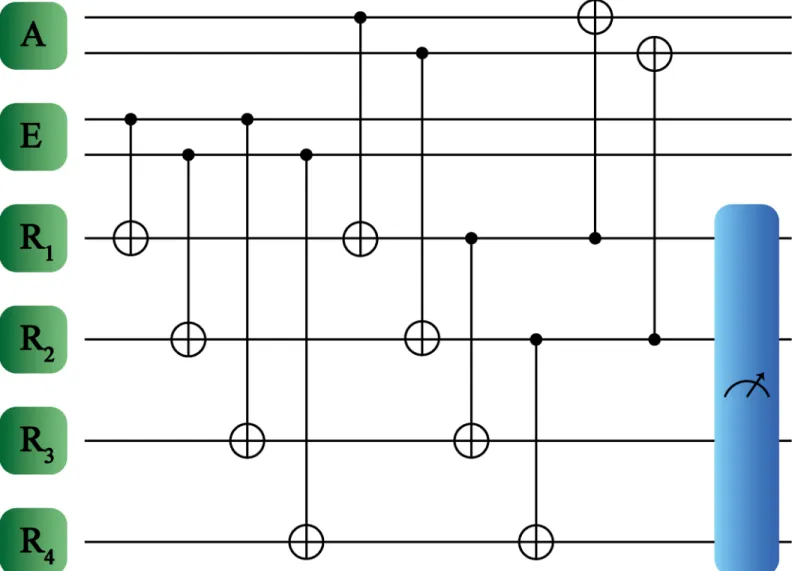
Following the same procedure described previously, the protocol consists mainly in three types of interaction, as shown inFig 2. Firstly, we update the registers conditionally to the envi-ronment states. More specifically, we consider an interaction between the envienvi-ronment qubits
E1andE2with the registersR1andR2, respectively. In this description, the environment acts as
control and the registers act as targets in the CNOT gates,
jCi1 ¼ U CNOT ðE1;R1ÞU CNOT ðE2;R2Þ;jCi0; jCi1 ¼ jAiða 00 Ej00iEj0i1j0i2j0i3j0i4þa 01 Ej01iEj0i1j1i2j0i3j0i4 þa10 Ej10iEj1i1j0i2j0i3j0i4þa 11 Ej11iEj1i1j1i2j0i3j0i4Þ: ð12Þ
Thereafter, we update similarly the remaining registers, that is, we apply a CNOT gate between the environment qubitsE1andE2and the register qubitsR3andR4, respectively, obtaining
jCi2 ¼ UCNOT ðE1;R3ÞU CNOT ðE2;R4ÞjCi1; jCi2 ¼ jAiða00 Ej00iEj0i1j0i2j0i3j0i4þa 01 Ej01iEj0i1j1i2j0i3j1i4 þa10 Ej10iEj1i1j0i2j1i3j0i4þa 11 Ej11iEj1i1j1i2j1i3j1i4Þ: ð13Þ
Thus, the registersR1andR2will be updated viaA1andA2, respectively, jCi3 ¼ UðCNOTA1;R1ÞU CNOT ðA2;R2ÞjCi2; jCi3 ¼ a00 Aa 00 Ej00iAj00iEj0i1j0i2j0i3j0i4þa 00 Aa 01 Ej00iAj01iEj0i1j1i2j0i3j1i4 þa00 Aa 10 Ej00iAj10iEj1i1j0i2j1i3j0i4þa 00 Aa 11 Ej00iAj11iEj1i1j1i2j1i3j1i4 þa01 Aa 00 Ej01iAj00iEj0i1j1i2j0i3j0i4þa 01 Aa 01 Ej01iAj01iEj0i1j0i2j0i3j1i4 þa01 Aa 10 Ej01iAj10iEj1i1j1i2j1i3j0i4þa 01 Aa 11 Ej01iAj11iEj1i1j0i2j1i3j1i4 þa10 Aa 00 Ej10iAj00iEj1i1j0i2j0i3j0i4þa 10 Aa 01 Ej10iAj01iEj1i1j1i2j0i3j1i4 þa10 Aa 10 Ej10iAj10iEj0i1j0i2j1i3j0i4þa 10 Aa 11 Ej10iAj11iEj0i1j1i2j1i3j1i4 þa11 Aa 00 Ej11iAj00iEj1i1j1i2j0i3j0i4þa 11 Aa 01 Ej11iAj01iEj1i1j0i2j0i3j1i4 þa11 Aa 10 Ej11iAj10iEj0i1j1i2j1i3j0i4þa 11 Aa 11 Ej11iAj11iEj0i1j0i2j1i3j1i4: ð14Þ
Fig 2. Schematic representation of quantum reinforcement learning protocol for multiqubit systems. Agent, environment and registers are denoted asA, E and R1, R2,R3andR4, respectively. The measurement in the register subspace is denoted by the rightmost box.
Afterwards, to obtain orthogonal outcomes in the register subspace we perform a pair of CNOT gates in this subspace. The interaction will be between the registers that interact with a common environment, namely, registerR1interacts withR3because both have interacted with
E1. Similarly forR2andR4, which have interacted withE2. In this case,R1(R2) is the control
andR3(R4) is the target. jCi4 ¼ UðCNOTR1;R3ÞU CNOT ðR2;R4ÞjCi3; jCi4 ¼ a 00 Aa 00 Ej00iAj00iEj0i1j0i2j0i3j0i4þa 00 Aa 01 Ej00iAj01iEj0i1j1i2j0i3j0i4 þa00 Aa 10 Ej00iAj10iEj1i1j0i2j0i3j0i4þa 00 Aa 11 Ej00iAj11iEj1i1j1i2j0i3j0i4 þa01 Aa 00 Ej01iAj00iEj0i1j1i2j0i3j1i4þa 01 Aa 01 Ej01iAj01iEj0i1j0i2j0i3j1i4 þa01 Aa 10 Ej01iAj10iEj1i1j1i2j0i3j1i4þa 01 Aa 11 Ej01iAj11iEj1i1j0i2j0i3j1i4 þa10 Aa 00 Ej10iAj00iEj1i1j0i2j1i3j0i4þa 10 Aa 01 Ej10iAj01iEj1i1j1i2j1i3j0i4 þa10 Aa 10 Ej10iAj10iEj0i1j0i2j1i3j0i4þa 10 Aa 11 Ej10iAj11iEj0i1j1i2j1i3j0i4 þa11 Aa 00 Ej11iAj00iEj1i1j1i2j1i3j1i4þa 11 Aa 01 Ej11iAj01iEj1i1j0i2j1i3j1i4 þa11 Aa 10 Ej11iAj10iEj0i1j1i2j1i3j1i4þa 11 Aa 11 Ej11iAj11iEj0i1j0i2j1i3j1i4: ð15Þ
Finally, we update the agent considering the states of the register in order that the rewarding criterion is satisfied. This is done by applying two CNOT gates in the agent-register subspace, whereA1is controlled byR1andA2is controlled byR2,
jCi5 ¼ UðCNOTR1;A1ÞU CNOT ðR2;A2ÞjCi4; jCi5 ¼ a00 Aa 00 Ej00iAj00iEj0i1j0i2j0i3j0i4þa 00 Aa 01 Ej01iAj01iEj0i1j1i2j0i3j0i4 þa00 Aa 10 Ej10iAj10iEj1i1j0i2j0i3j0i4þa 00 Aa 11 Ej11iAj11iEj1i1j1i2j0i3j0i4 þa01 Aa 00 Ej00iAj00iEj0i1j1i2j0i3j1i4þa 01 Aa 01 Ej01iAj01iEj0i1j0i2j0i3j1i4 þa01 Aa 10 Ej10iAj10iEj1i1j1i2j0i3j1i4þa 01 Aa 11 Ej11iAj11iEj1i1j0i2j0i3j1i4 þa10 Aa 00 Ej00iAj00iEj1i1j0i2j1i3j0i4þa 10 Aa 01 Ej01iAj01iEj1i1j1i2j1i3j0i4 þa10 Aa 10 Ej10iAj10iEj0i1j0i2j1i3j0i4þa 10 Aa 11 Ej11iAj11iEj0i1j1i2j1i3j0i4 þa11 Aa 00 Ej00iAj00iEj1i1j1i2j1i3j1i4þa 11 Aa 01 Ej01iAj01iEj1i1j0i2j1i3j1i4 þa11 Aa 10 Ej10iAj10iEj0i1j1i2j1i3j1i4þa 11 Aa 11 Ej11iAj11iEj0i1j0i2j1i3j1i4: ð16Þ
From the latterEq (16), it is straightforward to see that independently of the measurement out-comes the learning fidelity is maximal. Moreover, as in the previous case, one iteration of the quantum reinforcement protocol is needed to obtain maximal learning fidelity,
FAE¼ jhcAjEij.
Quantum reinforcement learning for qudit systems
So far, we have studied quantum reinforcement learning processes only for two-level systems or in pairs of them. However, there are several quantum systems which cannot be described in terms of a two-level system. For instance, quantum harmonic oscillators, electronic energy lev-els in an ion, and superconducting artificial atoms such as transmons [47], where for some regimes of Josephson energy they must be considered as a three-level system. In this context, it is interesting to extend the quantum reinforcement learning protocol developed here for cases where multilevel systems compound the agent, environment, and register.
To perform the previous task, we first need to define a set of logic operations that we will perform on our system. In the qubit case, the main logical operation applied is the CNOT gate,
which considers a conditional interaction between two qubits, where one acts as a control while the other acts as a target. The control qubit remains unchanged whereas the target qubit output is modified by the addition modulo 2. Then, it is wise to assume that the set of logic operations between multilevel systems could be defined in terms of an addition moduloD, whereDstands for the dimension of one subsystem (agent, environment or register sub-spaces), according to
Ujii1jji2¼ jii1jiji2: ð17Þ
Here,ijstands for the addition moduloD. This gate is usually known asXORgate [48]. For two-dimensional systems, this gate corresponds to the CNOT gate. Nevertheless, for higher dimensional systems this definition presents several disadvantages. For instance, theXORgate defined as inEq (17)is unitary but not Hermitian forD>2. Moreover, this logical operation is no longer its own inverse. To avoid these problems, in the literature [48] the generalized XOR gate (GXOR) has been defined as
GXOR1;2jii1jji2 ¼ jii1ji ji2; ð18Þ
where the operation denotes the differencei−j moduloD. The GXOR gate ofEq (18)does not present the disadvantages pointed out in the definition ofEq (17). That is, the GXOR gate is Hermitian, unitary andi j= 0 only wheni=j.
Considering our proposed protocol for single-qubit cases, we show that when we take into account multilevel systems, the number of interactions to obtain maximal learning fidelity is fixed and depends only on the number of agent subsystems in the protocol. Let us illustrate this with an example of multilevel agent-environment-register state,
jC0i ¼ XN 1 n¼0 XN 1 m¼0 an Aa m EjniAjmiEj0i1j0i2: ð19Þ
The first step in our protocol is identical to the equivalent one in the single-qubit case. We update the register conditionally on the environment state, that is, we transfer information of the environment and encode it in the register system. This is done by applying a pair of GXOR gates acting in the environment-register subsystem. In this case, the environment interacts with both registersR1andR2. The environment acts as control and both registers are targets,
jC1i ¼ UðGXORE;R1ÞjC0i; jC1i ¼ XN 1 n¼0 XN 1 m¼0 an Aa m EjniAjmiEjmi1j0i2: ð20Þ jC2i ¼ UðGXORE;R2ÞjC1i; jC2i ¼ XN 1 n¼0 XN 1 m¼0 an Aa m EjniAjmiEjmi1jmi2: ð21Þ
Once the information has been transferred to the register, we update the registerR1based
on the agent state. That is, we perform a GXOR gate in the subspace composed of agent and register. Here, the agent act as a control and the registerR1is the target,
jC3i ¼ UðGXORA;R1ÞjC2i; jC3i ¼ XN 1 n¼0 XN 1 m¼0 an Aa m EjniAjmiEjn mi1jmi2: ð22Þ
Orthogonal outcome measurements in the register subspace are provided by interactions between the registers in this subspace. Thus, we apply a GXOR gate in the register subspace, whereR1is the control andR2is the target,
jC4i ¼ UðGXORR1;R2ÞjC3i; jC4i ¼ XN 1 n¼0 XN 1 m¼0 an Aa m EjniAjmiEjn mi1jðn mÞ mi2: ð23Þ
Subsequently, the agent state is updated conditionally to the information encoded in the state of the registerR1. The GXOR gate is applied in the register-agent subspace. In this case,R1is
the control and the agent is the target,
jC5i ¼ UðGXORR1;AÞjC4i; jC5i ¼ XN 1 n¼0 XN 1 m¼0 an Aa m Ej0 miAjmiEjn mi1jn 2mi2: ð24Þ
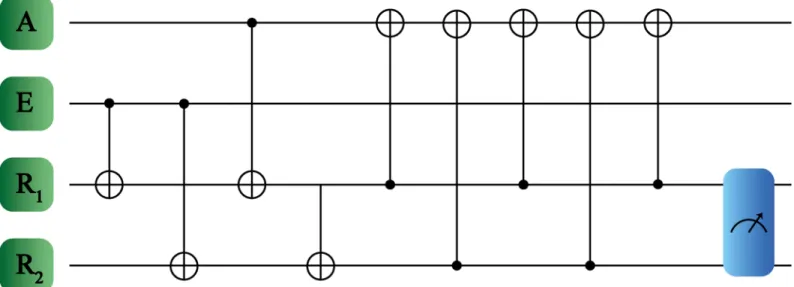
For the case where the multi-level system containsD¼2, we recover the result discussed pre-viously because of 0 m=mfor that dimension. On the other hand, we are interested in sys-tems with more energy levels, such that we need to adapt the protocol to obtain maximal learning fidelity for a fixed number of steps. In this case, we will update the agent subsystem by an iterative interaction with registersR1andR2as shown inFig 3. Here, the agent always acts
as target, while the registers are the controls. Therefore, we apply a GXOR gate between the registerR2and the agent,
jC6i ¼ U GXOR ðR2;AÞjC5i; jC6i ¼ XN 1 n¼0 XN 1 m¼0 an Aa m Ejn miAjmiEjn mi1jn 2mi2: ð25Þ
Now, by applying a GXOR gate between the registerR1and the agent we obtain,
jC7i ¼ UGXOR ðR1;AÞjC6i; jC7i ¼ XN 1 n¼0 XN 1 m¼0 an Aa m Ej0iAjmiEjn mi1jn 2mi2: ð26Þ
We perform subsequently a GXOR gate in the subspace composed ofR2and agentA, jC8i ¼ UðGXORR2;AÞjC7i; jC8i ¼ X N 1 n¼0 XN 1 m¼0 an Aa m Ejn 2miAjmiEjn mi1jn 2mi2: ð27Þ
Finally, applying a GXOR gate on the register-agent subspace we obtain the desired result. By considering a fixed number of interactions between the set of agent, environment and register, the learning fidelity becomes maximal independently of the outcome measurement on the reg-ister subspace, which can again be carried out at the end of the protocol,
jC9i ¼ UðGXORR1;AÞjC8i; jC9i ¼ XN 1 n¼0 XN 1 m¼0 an Aa m EjmiAjmiEjn mi1jn 2mi2: ð28Þ
systems (seeFig 3), the number of logical operations required to obtain maximal learning fidelity does not depend on the system dimension.
Example
Here, we exemplify how our reinforcement learning protocol works in qudit systems. We con-sider, without loss of generality, the case for dimensionD¼4. In this case, the agent-environ-ment-register state has the following form,
jAi ¼a0 Aj0iAþa 1 Aj1iAþa 2 Aj2iAþa 3 Aj3iA; ð29Þ jEi ¼a0 Ej0iEþa 1 Ej1iEþa 2 Ej2iEþa 3 Ej3iE ð30Þ jRi ¼ j0i1j0i2 ð31Þ jCi0¼ jAijEijRi: ð32Þ
As mentioned previously, the considered quantum gate is a GXOR gate with subtraction mod-ulo 4. The first step is to update the register according to the environment information,
jCi1 ¼ U GXOR ðE;R1ÞjCi0; jCi1 ¼ ða 0 Aj0iAþa 1 Aj1iAþa 2 Aj2iAþa 3 Aj3iAÞ ða0 Ej0iEj0i1j0i2þa 1 Ej1iEj1i1j0i2þa 2 Ej2iEj2i1j0i2þa 3 Ej3iEj3i1j0i2Þ; ð33Þ jCi2 ¼ U GXOR ðE;R2ÞjCi1; jCi2 ¼ ða 0 Aj0iAþa 1 Aj1iAþa 2 Aj2iAþa 3 Aj3iAÞ ða0 Ej0iEj0i1j0i2þa 1 Ej1iEj1i1j1i2þa 2 Ej2iEj2i1j2i2þa 3 Ej3iEj3i1j3i2Þ: ð34Þ
Fig 3. Quantum reinforcement learning protocol for qudits. The systems involved are denoted as agent A, environment E and registersR1,R2. In this case, the logical
quantum gates which are applied in the learning protocol correspond to GXOR gates. The measurement process in the register subspace is denoted with the rightmost box.
Subsequently, the register is updated conditional to the agent state, jCi3 ¼ U GXOR ðA;R1ÞjCi2; jCi3 ¼ a 0 Aa 0 Ej0iAj0iEj0i1j0i2þa 0 Aa 1 Ej0iAj1iEj3i1j1i2þa 0 Aa 2 Ej0iAj2iEj2i1j2i2 þa0 Aa 3 Ej0iAj3iEj1i1j3i2þa 1 Aa 0 Ej1iAj0iEj1i1j0i2þa 1 Aa 1 Ej1iAj1iEj0i1j1i2 þa1 Aa 2 Ej1iAj2iEj3i1j2i2þa 1 Aa 3 Ej1iAj3iEj2i1j3i2þa 2 Aa 0 Ej2iAj0iEj2i1j0i2 þa2 Aa 1 Ej2iAj1iEj1i1j1i2þa 2 Aa 2 Ej2iAj2iEj0i1j2i2þa 2 Aa 3 Ej2iAj3iEj3i1j3i2 þa3 Aa 0 Ej3iAj0iEj3i1j0i2þa 3 Aa 1 Ej3iAj1iEj2i1j1i2þa 3 Aa 2 Ej3iAj2iEj1i1j2i2 þa3 Aa 3 Ej3iAj3iEj0i1j3i2: ð35Þ
Then, to obtain orthogonal outcome measurements in the register basis, we perform an inter-action in the register subspace,
jCi4 ¼ U GXOR ðR1;R2ÞjCi3; jCi4 ¼ a 0 Aa 0 Ej0iAj0iEj0i1j0i2þa 0 Aa 1 Ej0iAj1iEj3i1j2i2þa 0 Aa 2 Ej0iAj2iEj2i1j0i2 þa0 Aa 3 Ej0iAj3iEj1i1j2i2þa 1 Aa 0 Ej1iAj0iEj1i1j1i2þa 1 Aa 1 Ej1iAj1iEj0i1j3i2 þa1 Aa 2 Ej1iAj2iEj3i1j1i2þa 1 Aa 3 Ej1iAj3iEj2i1j3i2þa 2 Aa 0 Ej2iAj0iEj2i1j2i2 þa2 Aa 1 Ej2iAj1iEj1i1j0i2þa 2 Aa 2 Ej2iAj2iEj0i1j2i2þa 2 Aa 3 Ej2iAj3iEj3i1j0i2 þa3 Aa 0 Ej3iAj0iEj3i1j3i2þa 3 Aa 1 Ej3iAj1iEj2i1j1i2þa 3 Aa 2 Ej3iAj2iEj1i1j3i2 þa3 Aa 3 Ej3iAj3iEj0i1j1i2: ð36Þ
Now, we need to apply iterative interactions in the register-agent subspace to update the agent in each step until we get maximal learning fidelity with respect to the environment. We start by performing a GXOR gate between the registerR1and the agent,
jCi5 ¼ UGXOR ðR1;AÞjCi4; jCi5 ¼ a 0 Aa 0 Ej0iAj0iEj0i1j0i2þa 0 Aa 1 Ej3iAj1iEj3i1j2i2þa 0 Aa 2 Ej2iAj2iEj2i1j0i2 þa0 Aa 3 Ej1iAj3iEj1i1j2i2þa 1 Aa 0 Ej0iAj0iEj1i1j1i2þa 1 Aa 1 Ej3iAj1iEj0i1j3i2 þa1 Aa 2 Ej2iAj2iEj3i1j1i2þa 1 Aa 3 Ej1iAj3iEj2i1j3i2þa 2 Aa 0 Ej0iAj0iEj2i1j2i2 þa2 Aa 1 Ej3iAj1iEj1i1j0i2þa 2 Aa 2 Ej2iAj2iEj0i1j2i2þa 2 Aa 3 Ej1iAj3iEj3i1j0i2 þa3 Aa 0 Ej0iAj0iEj3i1j3i2þa 3 Aa 1 Ej3iAj1iEj2i1j1i2þa 3 Aa 2 Ej2iAj2iEj1i1j3i2 þa3 Aa 3 Ej1iAj3iEj0i1j1i2: ð37Þ
Hereafter, we apply the GXOR gate in theR2-agent subspace, jCi6 ¼ UðGXORR2;AÞjCi5; jCi6 ¼ a0 Aa 0 Ej0iAj0iEj0i1j0i2þa 0 Aa 1 Ej3iAj1iEj3i1j2i2þa 0 Aa 2 Ej2iAj2iEj2i1j0i2 þa0 Aa 3 Ej1iAj3iEj1i1j2i2þa 1 Aa 0 Ej1iAj0iEj1i1j1i2þa 1 Aa 1 Ej0iAj1iEj0i1j3i2 þa1 Aa 2 Ej3iAj2iEj3i1j1i2þa 1 Aa 3 Ej2iAj3iEj2i1j3i2þa 2 Aa 0 Ej2iAj0iEj2i1j2i2 þa2 Aa 1 Ej1iAj1iEj1i1j0i2þa 2 Aa 2 Ej0iAj2iEj0i1j2i2þa 2 Aa 3 Ej3iAj3iEj3i1j0i2 þa3 Aa 0 Ej3iAj0iEj3i1j3i2þa 3 Aa 1 Ej2iAj1iEj2i1j1i2þa 3 Aa 2 Ej1iAj2iEj1i1j3i2 þa3 Aa 3 Ej0iAj3iEj0i1j1i2: ð38Þ
Afterwards, we perform a GXOR gate betweenR1and A, jCi7 ¼ UðGXORR1;AÞjCi6; jCi7 ¼ a 0 Aa 0 Ej0iAj0iEj0i1j0i2þa 0 Aa 1 Ej0iAj1iEj3i1j2i2þa 0 Aa 2 Ej0iAj2iEj2i1j0i2 þa0 Aa 3 Ej0iAj3iEj1i1j2i2þa 1 Aa 0 Ej0iAj0iEj1i1j1i2þa 1 Aa 1 Ej0iAj1iEj0i1j3i2 þa1 Aa 2 Ej0iAj2iEj3i1j1i2þa 1 Aa 3 Ej0iAj3iEj2i1j3i2þa 2 Aa 0 Ej0iAj0iEj2i1j2i2 þa2 Aa 1 Ej0iAj1iEj1i1j0i2þa 2 Aa 2 Ej0iAj2iEj0i1j2i2þa 2 Aa 3 Ej0iAj3iEj3i1j0i2 þa3 Aa 0 Ej0iAj0iEj3i1j3i2þa 3 Aa 1 Ej0iAj1iEj2i1j1i2þa 3 Aa 2 Ej0iAj2iEj1i1j3i2 þa3 Aa 3 Ej0iAj3iEj0i1j1i2: ð39Þ
Subsequently, an interaction in theR2-agent subspace is performed, jCi8 ¼ UðGXORR2;AÞjCi7; jCi8 ¼ a0 Aa 0 Ej0iAj0iEj0i1j0i2þa 0 Aa 1 Ej2iAj1iEj3i1j2i2þa 0 Aa 2 Ej0iAj2iEj2i1j0i2 þa0 Aa 3 Ej2iAj3iEj1i1j2i2þa 1 Aa 0 Ej1iAj0iEj1i1j1i2þa 1 Aa 1 Ej3iAj1iEj0i1j3i2 þa1 Aa 2 Ej1iAj2iEj3i1j1i2þa 1 Aa 3 Ej3iAj3iEj2i1j3i2þa 2 Aa 0 Ej2iAj0iEj2i1j2i2 þa2 Aa 1 Ej0iAj1iEj1i1j0i2þa 2 Aa 2 Ej2iAj2iEj0i1j2i2þa 2 Aa 3 Ej0iAj3iEj3i1j0i2 þa3 Aa 0 Ej3iAj0iEj3i1j3i2þa 3 Aa 1 Ej1iAj1iEj2i1j1i2þa 3 Aa 2 Ej3iAj2iEj1i1j3i2 þa3 Aa 3 Ej1iAj3iEj0i1j1i2: ð40Þ
Finally, we apply a GXOR gate betweenR1and the agent,
jCi9 ¼ U GXOR ðR1;AÞjCi8; jCi9 ¼ a 0 Aa 0 Ej0iAj0iEj0i1j0i2þa 0 Aa 1 Ej1iAj1iEj3i1j2i2þa 0 Aa 2 Ej2iAj2iEj2i1j0i2 þa0 Aa 3 Ej3iAj3iEj1i1j2i2þa 1 Aa 0 Ej0iAj0iEj1i1j1i2þa 1 Aa 1 Ej1iAj1iEj0i1j3i2 þa1 Aa 2 Ej2iAj2iEj3i1j1i2þa 1 Aa 3 Ej3iAj3iEj2i1j3i2þa 2 Aa 0 Ej0iAj0iEj2i1j2i2 þa2 Aa 1 Ej1iAj1iEj1i1j0i2þa 2 Aa 2 Ej2iAj2iEj0i1j2i2þa 2 Aa 3 Ej3iAj3iEj3i1j0i2 þa3 Aa 0 Ej0iAj0iEj3i1j3i2þa 3 Aa 1 Ej1iAj1iEj2i1j1i2þa 3 Aa 2 Ej2iAj2iEj1i1j3i2 þa3 Aa 3 Ej3iAj3iEj0i1j1i2: ð41Þ
As we can see, based in the quantum protocol described previously (seeFig 3), we have shown that for a fixed number of interactions, we obtain maximal learning fidelity even though the system has an arbitrary dimension.
Quantum reinforcement learning in multiqudit systems
In the previous section, we proved that for an agent and environment composed of a multilevel system each, the quantum reinforcement learning protocol entails maximal learning fidelity for a fixed number of steps, irrespective of the dimension. Here, using this result, we also prove that for more than one multilevel system in agent, environment, and register subspaces, the number of steps is also fixed and scales with the number of individual subsystems that compose both agent and environment subsystems. To be more specific, in the single-multilevel case the needed total steps are nine. For two multilevel systems, we show that the number of required steps are eighteen, and in general, 9n, withnbeing the number of multilevel subsys-tems. The possible initial states of our protocol consist in arbitrary superpositions for both
agent and environment states and the register states are in their ground state, jC0i ¼ XN 1 n;m¼0 XN 1 p;q¼0 anm A a pq EjniAjmiAjpiEjqiEj0i1j0i2j0i3j0i4: ð42Þ
The first step in the protocol consists in encoding the environment information in the register states. This is done by applying a pair of GXOR gates. The gates are applied in the environ-ment-register subspace, while the interaction in this case is the same as the one described pre-viously. Namely,E1controlsR1andE2controlsR2.
jC1i ¼ U GXOR ðE2;R2ÞU GXOR ðE1;R1ÞjC0i; jC1i ¼ XN 1 n;m¼0 XN 1 p;q¼0 anm A a pq EjniAjmiAjpiEjqiEjpi1jqi2j0i3j0i4: ð43Þ
Similarly, in the second step we encode the environment information in the other two registers (R3andR4) through GXOR gates. Here, the control system is the environment while the
tar-gets are the registers.
jC2i ¼ UðGXORE2;R4ÞU GXOR ðE1;R3ÞjC1i; jC2i ¼ XN 1 n;m¼0 XN 1 p;q¼0 anm A a pq EjniAjmiAjpiEjqiEjpi1jqi2jpi3jqi4: ð44Þ
Subsequently, a part of the register subspace is updated conditional on the agent information. Therefore, we apply a pair of GXOR gates on the agent-register subspace. In this case, agents
A1andA2are controls and registersR1andR2targets. jC3i ¼ UðGXORA2;R2ÞU GXOR ðA1;R1ÞjC2i; jC3i ¼ XN 1 n;m¼0 XN 1 p;q¼0 anm A a pq EjniAjmiAjpiEjqiEjn pi1jm qi2jpi3jqi4: ð45Þ
Now, we update the register subspace considering interactions between register components which have been acted upon with the same part of the environment. Namely, the registerR3
will be updated with the control ofR1(Similarly withR4being controlled withR2). jC4i ¼ UðGXORR2;R4ÞU GXOR ðR1;R3ÞjC3i; jC4i ¼ XN 1 n;m¼0 XN 1 p;q¼0 anm A a pq EjniAjmiAjpiEjqiEjn pi1jm qi2jn 2pi3jm 2qi4: ð46Þ
Subsequently, we need to apply successive interactions between agent states and register states to obtain maximal learning fidelity. We show that applying the same interactions as for the sin-gle multilevel case for the triplet formed by agentA1with the environment partsR1andR3
show that jC9i ¼ UðGXORR2;A2ÞU GXOR ðR1;A1ÞU GXOR ðR4;A2ÞU GXOR ðR3;A1Þ UGXOR ðR2;A2ÞU GXOR ðR1;A1ÞU GXOR ðR4;A2ÞU GXOR ðR3;A1ÞU GXOR ðR2;A2Þ UGXOR ðR1;A1ÞjC4i; jC9i ¼ XN 1 n;m¼0 XN 1 p;q¼0 anm A a pq EjpiAjqiAjpiEjqiEjn pi1jm qi2jn 2pi3jm 2qi4: ð47Þ
Summarizing, for the case studied in this section, we demonstrate that the number of opera-tions required to obtain maximal learning fidelity does not depend on the learning unit dimension and it is equal to eighteen operations, which correspond to the double of the required steps in the single multiqubit case. It is straightforward to realize that the number of needed operations to achieve maximal learning fidelity in a machine learning protocol com-posed bynsubsystems for agent and environment is equal to 9n. Namely, the number of oper-ations scales polynomially, indeed linearly, with the number of subsystems.
Quantum reinforcement learning in larger environments
Up to now, the quantum reinforcement learning protocol described here always considers that the agent and the environment have the same number of subsystems, as well as the same dimension. In these cases, we have shown that by adding more system registers the quantum protocol improves in the sense that only one iteration and one measurement is enough to obtain maximal learning fidelity. Nevertheless, in more realistic scenarios, the agent must adapt to larger or more complex surroundings. Here, we discuss the situation where the ronment has more subsystems than the agent, and therefore a larger dimension. As the envi-ronment has more information than the agent, it is expect that not all available surrounding information will be transferred to the agent. Indeed, we prove that by depending on the regis-ter-environment interaction, the agent can encode the information from one specific part of the environment. In this case, unlike the protocol previously discussed, we achieve maximal learning fidelity after applying one measurement and a rewarding iteration (feedback).
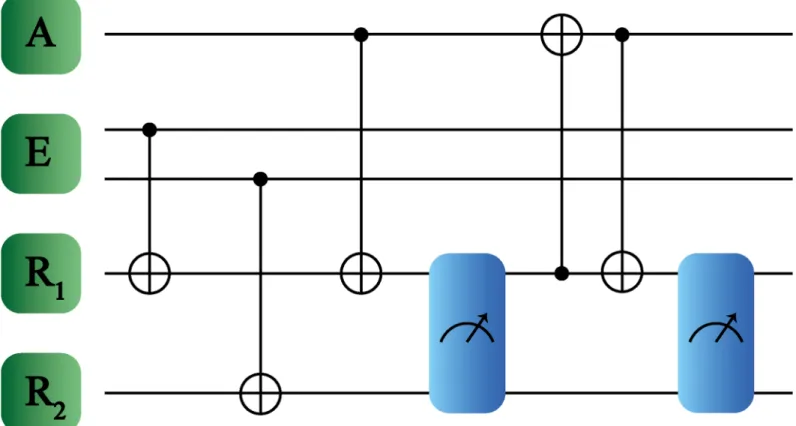
The proposed quantum protocol is shown inFig 4. Here, one two-level system forms the agent, while register and environment are constituted each by two qubits. Each environment qubit interacts with one qubit from the register, such that this interaction updates the registers conditionally to the environment information. Then, one part of the register subspace is also upgraded conditionally to the agent state. Subsequently, we perform a measurement on the register subspace, such that depending on the measurement outcomes we apply a conditional operation in the agent-register subspace until the agent adapts to a specific part of the environ-ment. To illustrate this, let us introduce a possible agent-register-subspace state which has the following form, jAi ¼a0 Aj0iAþa 1 Aj1iA ð48Þ jEi ¼a00 Ej00iEþa 01 Ej01iEþa 10 Ej10iEþa 11 Ej11iE ð49Þ jRi ¼ j0i1j0i2; ð50Þ jCi0¼ jAijEijRi: ð51Þ
This is done by applying a pair of CNOT gates in the environment-register subspaces, jCi1 ¼ UðCNOTE;R2ÞU CNOT ðE;R1ÞjCi0; jCi1 ¼ ða0 Aj0iAþa 1 Aj1iAÞ ða00 Ej00iEj0i1j0i2þa 01 Ej01iEj0i1j1i2þa 10 Ej10iEj1i1j0i2þa 11 Ej11iEj1i1j1i2Þ: ð52Þ
Subsequently, the registerR1is updated conditionally to the agent information. Therefore, a
CNOT gate is applied in the agent-register subspace, where the agent qubit is the control and the registerR1is the target,
jCi2 ¼ U CNOT ðA;R1ÞjCi1; jCi2 ¼ a 0 Aa 00 Ej0iAj00iEj0i1j0i2þa 0 Aa 01 Ej0iAj01iEj0i1j1i2 þa0 Aa 10 Ej0iAj10iEj1i1j0i2þa 0 Aa 11 Ej0iAj11iEj1i1j1i2 þa1 Aa 00 Ej1iAj00iEj1i1j0i2þa 1 Aa 01 Ej1iAj01iEj1i1j1i2 þa1 Aa 10 Ej1iAj10iEj0i1j0i2þa 1 Aa 11 Ej1iAj11iEj0i1j1i2: ð53Þ
Fig 4. Quantum reinforcement learning for larger environment systems. The systems involved are denoted as agent A, environment E and registersR1,R2, where E
contains now two qubits while A just one. The logical gates applied between the different subsystems are CNOT gates. In this case, to obtain maximal learning fidelity, it is required to perform two separate measurements denoted by the blue boxes.
Afterwards, we perform a measurement on the register subspace. In this case, the wave func-tion is projected into the four possible measurement outcomes,
M1 ¼ ða 0 Aa 00 Ej0iAj00iEþa 1 Aa 10 Ej1iAj10iEÞj0i1j0i2 ¼ ða0 Aa 00 Ej0iAj0iE1þa 1 Aa 10 Ej1iAj1iE1Þj0iE2j0i1j0i2; M2 ¼ ða 0 Aa 01 Ej0iAj01iEþa 1 Aa 11 Ej1iAj11iEÞj0i1j1i2 ¼ ða0 Aa 01 Ej0iAj0iE1þa 1 Aa 11 Ej1iAj1iE1Þj1iE2j0i1j1i2; M3 ¼ ða 1 Aa 00 Ej1iAj00iEþa 0 Aa 10 Ej0iAj10iEÞj1i1j0i2 ¼ ða1 Aa 00 Ej1iAj0iE1þa 0 Aa 10 Ej0iAj1iE1Þj0iE2j1i1j0i2; M4 ¼ ða 0 Aa 11 Ej0iAj11iEþa 1 Aa 01 Ej1iAj01iEÞj1i1j1i2 ¼ ða0 Aa 11 Ej0iAj1iE1þa 1 Aa 01 Ej1iAj0iE1Þj1iE2j1i1j1i2: ð54Þ
As we can see, the projective measurement on the register subspace produces that agent and one part of the environment subspace (E1) is in an entangled state. At this stage, we can apply
the rewarding criterion which consists in performing a CNOT gate operation in the register-agent subspace. The register qubitR1is the control and the agent is the target,
M1a¼U CNOT ðR1;AÞM1¼ ða 0 Aa 00 Ej0iAj0iE1þa 1 Aa 10 Ej1iAj1iE1Þj0iE2j0i1j0i2; M2a¼U CNOT ðR1;AÞM2¼ ða 0 Aa 01 Ej0iAj0iE1þa 1 Aa 11 Ej1iAj1iE1Þj1iE2j0i1j1i2; M3a¼U CNOT ðR1;AÞM3¼ ða 1 Aa 00 Ej0iAj0iE1þa 0 Aa 10 Ej1iAj1iE1Þj0iE2j1i1j0i2; M4a¼U CNOT ðR1;AÞM4¼ ða 0 Aa 11 Ej1iAj1iE1þa 1 Aa 01 Ej0iAj0iE1Þj1iE2j1i1j1i2: ð55Þ
Finally, we perform a CNOT gate in the agent-register subspace to obtain orthogonal measure-ment outcomes. The qubit agent is the control and the qubit registerR1is the target, according
to M1b¼U CNOT ðA;R1ÞM1a¼a 0 Aa 00 Ej0iAj00iEj0i1j0i2þa 1 Aa 10 Ej1iAj10iEj1i1j0i2; M2b¼U CNOT ðA;R1ÞM2a¼a 0 Aa 01 Ej0iAj01iEj0i1j1i2þa 1 Aa 11 Ej1iAj11iEj1i1j1i2; M3b¼U CNOT ðA;R1ÞM3a¼a 1 Aa 00 Ej0iAj00iEj1i1j0i2þa 0 Aa 10 Ej1iAj10iEj0i1j0i2; M4b¼U CNOT ðA;R1ÞM4a¼a 1 Aa 01 Ej0iAj01iEj1i1j1i2þa 0 Aa 11 Ej1iAj11iEj0i1j1i2: ð56Þ
In this quantum reinforcement learning protocol, we perform interactions between the envi-ronment and the register subspaces. Nevertheless, the agent is updated only regarding the information encoded in registerR1. Thus, the maximal learning fidelity is achieved with
respect to the first qubit of the environment.
Let us now consider another configuration similar to the one studied previously in this arti-cle, where the register is formed by a larger number of subsystems than the environment. Here, additionally, the environment we consider is larger than the agent. We prove that, for this system configuration, maximal learning fidelity between the agent and one part of the environment is achieved in one rewarding process. For this configuration, the maximal fidelity does not depend on the entanglement present in the agent-environment subspace. The general
agent-register-environment state is jAi ¼a0 Aj0iAþa 1 Aj1iA; ð57Þ jEi ¼ ða0 Ej0iE1þa 1 Ej1iE1Þj0iE2þ ðb 0 Ej0iE1þb 1 Ej1iE1Þj1iE2; ð58Þ jRi ¼ j0i1j0i2j0i3j0i4; ð59Þ jCi0¼ jAijEijRi: ð60Þ
The quantum protocol consists in updating the registersR1,2conditionally to the environment
stateE1,2, jCi1 ¼ U CNOT ðE2;R2ÞU CNOT ðE1;R1ÞjCi0; jCi1 ¼ ða 0 Aj0iAþa 1 Aj1iAÞða 0 Ej0iE1j0iE2j0i1j0i2j0i3j0i4þa 1 Ej1iE1j0iE2j1i1j0i2j0i3j0i4 þb0Ej0iE1j1iE2j0i1j1i2j0i3j0i4þb 1 Ej1iE1j1iE2j1i1j1i2j0i3j0i4Þ: ð61Þ
After this, we also update the information of the registersR3,4conditionally to the environment
stateE1,2, jCi2 ¼ UðCNOTE2;R4ÞU CNOT ðE1;R3ÞjCi1; jCi2 ¼ ða 0 Aj0iAþa 1 Aj1iAÞða 0 Ej0iE1j0iE2j0i1j0i2j0i3j0i4þa 1 Ej1iE1j0iE2j1i1j0i2j1i3j0i4 þb0Ej0iE 1j1iE2j0i1j1i2j0i3j1i4þb 1 Ej1iE1j1iE2j1i1j1i2j1i3j1i4Þ: ð62Þ
Now, the registerR1is updated conditionally to the agent state, jCi3 ¼ UðCNOTA;R1ÞjCi2; jCi3 ¼ a 0 Aa 0 Ej0iAj0iE1j0iE2j0i1j0i2j0i3j0i4þa 0 Aa 1 Ej0iAj1iE1j0iE2j1i1j0i2j1i3j0i4 þa0 Ab 0 Ej0iAj0iE1j1iE2j0i1j1i2j0i3j1i4þa 0 Ab 1 Ej0iAj1iE1j1iE2j1i1j1i2j1i3j1i4 þa1 Aa 0 Ej1iAj0iE1j0iE2j1i1j0i2j0i3j0i4þa 1 Aa 1 Ej1iAj1iE1j0iE2j0i1j0i2j1i3j0i4 þa1 Ab 0 Ej1iAj0iE1j1iE2j1i1j1i2j0i3j1i4þa 1 Ab 1 Ej1iAj1iE1j1iE2j0i1j1i2j1i3j1i4: ð63Þ
Then, the next step would consist in updating a part of the register subspace from the informa-tion encoded in the other part. However, this step is not necessary because the number of terms inEq (63)is smaller than all the possible measurement outcomes in the register sub-space. Thus, the register is always projected onto orthogonal measurement outcomes. On the other hand, we update the agent state from the information encoding in the registerR1.
There-fore, we perform a CNOT gate in the register-agent subspace, where the registerR1is the
con-trol and the agent is the target,
jCi4 ¼ U CNOT ðR1;AÞjCi3; jCi4 ¼ a 0 Aa 0 Ej0iAj0iE1j0iE2j0i1j0i2j0i3j0i4þa 0 Aa 1 Ej1iAj1iE1j0iE2j1i1j0i2j1i3j0i4 þa0 Ab 0 Ej0iAj0iE1j1iE2j0i1j1i2j0i3j1i4þa 0 Ab 1 Ej1iAj1iE1j1iE2j1i1j1i2j1i3j1i4 þa1 Aa 0 Ej0iAj0iE1j0iE2j1i1j0i2j0i3j0i4þa 1 Aa 1 Ej1iAj1iE1j0iE2j0i1j0i2j1i3j0i4 þa1 Ab 0 Ej0iAj0iE1j1iE2j1i1j1i2j0i3j1i4þa 1 Ab 1 Ej1iAj1iE1j1iE2j0i1j1i2j1i3j1i4: ð64Þ
By measuring the register subspace, we obtain that agent and environment qubitE1achieve
maximal fidelity.
Quantum reinforcement learning for mixed states
Let us consider now the situation where the environment evolves under a noisy mechanism (for qubit states, noisy mechanisms can be depolarizing noise as well as amplitude damping). In this case, the density matrix describing the environment state reads
r¼ r00 r01 r 01 r11 ! : ð65Þ
We focus now our attention in the application of the quantum reinforcement learning proto-col in this type of state. We will show that, by adding more registers, two main results will be obtained. Firstly, even though the environment is in a mixed state, the learning fidelity will be maximal for any measurement outcome in the register basis. Additionally, the measurement outcomes provide relevant information about the coherences of the mixed state. To apply the quantum protocol, we express the mixed state in term of its (non-unique) purification, such as
jCEþei ¼ ffiffiffiffiffiffi r00 p j0iEþ r10 ffiffiffiffiffiffi r00 p j1iE " # je1i þ ffiffiffiffiffiffiffiffiffiffiffiffiffiffiffiffiffiffiffiffiffiffi r11 jr10j 2 r00 s " # j1iEje2i; ð66Þ jcei ¼ rffiffiffiffiffiffi10 r00 p je1i þ ffiffiffiffiffiffiffiffiffiffiffiffiffiffiffiffiffiffiffiffiffiffi r11 jr10j 2 r00 s 2 4 3 5je 2i ! jCEþei ¼ ffiffiffiffiffiffi r00 p j0iEje1i þ ffiffiffiffiffiffi r11 p j1iEjcei: ð67Þ
Here,jceiis a normalized vector in the purification Hilbert space. As we can see, the coeffi-cient of the quantum state written in its extended Hilbert space (environment + purification) depends only on the diagonal terms of the mixed state. Moreover, to obtain additional infor-mation about the mixed state, we need to perform unitary transforinfor-mations on it in such a way that the information related to the coherences is in the diagonal of the state after the transfor-mation. To be more specific, we need to perform unitary transformations such that the mixed state can be written as follows,
r!UyrU y y ¼ 1 2 1þ ðr01þr 01Þ r11 r00þ ðr01 r 01Þ r11 r00 ðr01 r 01Þ 1 ðr01þr 01Þ ! ; ð68Þ ~ r!UxrU y x ¼ 1 2 1 iðr01 r 01Þ r01þr 01þiðr11 r00Þ r01þr 01 iðr11 r00Þ 1þiðr01 r 01Þ ! : ð69Þ
To carry out this task, we need to add three more registers, where each of them has the func-tion to encode informafunc-tion of diagonal, real, and imaginary part of the coherence terms, respectively. A possible state for the space composed of agent, mixed environment and register
is given by jAi ¼a0 Aj0iAþa 1 Aj1iA; ð70Þ jCEþei ¼ ffiffiffiffiffiffi r00 p j0iEje1i þ ffiffiffiffiffiffi r11 p j1iEjcei ð71Þ jRi ¼ j0i1j0i2 1 ffiffiffi 3 p ðj1i3j0i4j0i5þ j0i3j1i4j0i5þ j0i3j0i4j1i5Þ ð72Þ jCi0¼ jAijCEþeijRi: ð73Þ
The first step is to apply a unitary transformation, which is conditional to the state of the regis-terR3,R4andR5. In case that the register state is |1i3|0i4|0i5, we apply the transformation
U1¼IR3IR4IR5. If the register state is in the state |0i3|1i4|0i5, we apply the transformation
U2¼IR3UyIR5. Finally, if the register state is in the state |0i3|0i4|1i5the unitary
transfor-mation is given byU3 ¼IR3IR4Ux. Hence, the state after this transformation is given by
unitary transformation in the environment state according to
jCi1 ¼ jAijcEþeij0i1j0i2j1i3j0i4j0i5þ jAiUyjcEþeij0i1j0i2j0i3j1i4j0i5 þjAiUxjcEþeij0i1j0i2j0i3j0i4j1i5; jC1i ¼ 1 ffiffiffi 3 p ða0 Aj0iAþa 1 Aj1iAÞ½ð ffiffiffiffiffiffi r00 p j0iEje1i þ ffiffiffiffiffiffi r11 p j1iEjceiÞj0i1j0i2j1i3j0i4j0i5 þ ffiffiffiffiffiffiffiffiffiffiffiffiffiffiffiffiffiffiffiffiffiffiffiffiffi 1 2þReðr01Þ r j0iEje1i þ ffiffiffiffiffiffiffiffiffiffiffiffiffiffiffiffiffiffiffiffiffiffiffiffiffi 1 2 Reðr01Þ r j1iEjcei ! j0i1j0i2j0i3j1i4j0i5 þ ffiffiffiffiffiffiffiffiffiffiffiffiffiffiffiffiffiffiffiffiffiffiffiffiffi 1 2þImðr01Þ r j0iEje1i þ ffiffiffiffiffiffiffiffiffiffiffiffiffiffiffiffiffiffiffiffiffiffiffiffiffi 1 2 Imðr01Þ r j1iEjcei ! j0i1j0i2j0i3j0i4j1i5: ð74Þ
Afterwards, we apply the quantum protocol as we did in the first section. Namely, we first update the register conditionally to the information of the environment. Then, we update the registerR1conditionally to the information of the agent. Subsequently, to obtain orthogonal
measurement outcomes we perform CNOT gates in the register subspace (R1is the control
registerR1(where A is the target andR1is the control), jCi5 ¼ 1ffiffiffi 3 p a0 A ffiffiffiffiffiffi r00 p j0iAj0iEje1ij0i1j0i2j1i3j0i4j0i5 þa0 A ffiffiffiffiffiffi r11 p j1iAj1iEjceij1i1j0i2j1i3j0i4j0i5 þa1 A ffiffiffiffiffiffi r00 p j0iAj0iEje1ij1i1j1i2j1i3j0i4j0i5 þa1 A ffiffiffiffiffiffi r11 p j1iAj1iEjceij0i1j1i2j1i3j0i4j0i5 þa0 A ffiffiffiffiffiffiffiffiffiffiffiffiffiffiffiffiffiffiffiffiffiffiffiffiffi 1 2þ Reðr01Þ r j0iAj0iEje1ij0i1j0i2j0i3j1i4j0i5 þa0 A ffiffiffiffiffiffiffiffiffiffiffiffiffiffiffiffiffiffiffiffiffiffiffiffiffi 1 2 Reðr01Þ r j1iAj1iEjceij1i1j0i2j0i3j1i4j0i5 þa1 A ffiffiffiffiffiffiffiffiffiffiffiffiffiffiffiffiffiffiffiffiffiffiffiffiffi 1 2þ Reðr01Þ r j0iAj0iEje1ij1i1j1i2j0i3j1i4j0i5 þa1 A ffiffiffiffiffiffiffiffiffiffiffiffiffiffiffiffiffiffiffiffiffiffiffiffiffi 1 2 Reðr01Þ r j1iAj1iEjceij0i1j1i2j0i3j1i4j0i5 þa0 A ffiffiffiffiffiffiffiffiffiffiffiffiffiffiffiffiffiffiffiffiffiffiffiffiffi 1 2þ Imðr01Þ r j0iAj0iEje1ij0i1j0i2j0i3j0i4j1i5 þa0 A ffiffiffiffiffiffiffiffiffiffiffiffiffiffiffiffiffiffiffiffiffiffiffiffiffi 1 2 Imðr01Þ r j1iAj1iEjceij1i1j0i2j0i3j0i4j1i5 þa1 A ffiffiffiffiffiffiffiffiffiffiffiffiffiffiffiffiffiffiffiffiffiffiffiffiffi 1 2þ Imðr01Þ r j0iAj0iEje1ij1i1j1i2j0i3j0i4j1i5 þa1 A ffiffiffiffiffiffiffiffiffiffiffiffiffiffiffiffiffiffiffiffiffiffiffiffiffi 1 2 Imðr01Þ r j1iAj1iEjceij0i1j1i2j0i3j0i4j1i5 : ð75Þ
This quantum reinforcement learning protocol exhibits two features. First, by performing projective measurements on registersR1,R2andR3, we recover the result studied in the first
section, i.e., the learning fidelity is maximal independently of the measurement outcomes in the register subspace. The second feature is that, for specific measurement outcomes in a part of the register subspace, we obtain information about the population (diagonal) and the coher-ences (off-diagonal) of the mixed state. This feature can be used in problems such as partial cloning in cases where the system in which we can extract information evolves under loss mechanisms.
Analysis of implementation in quantum technologies
An interesting result obtained in this manuscript is that in most of the cases, for the considered quantum reinforcement learning protocols, adding more registers improves the rewarding process. That is, via a purely unitary evolution, without coherent feedback, a maximally posi-tively-correlated agent environment state is achieved, in the sense that the final agent contains the same quantum information as the considered final environment. This means that the agent has acquired the needed information about the environment and accordingly modified it, being this a quantum process. In our formalism, typically, one measurement at the end of the protocol is enough to obtain maximal learning fidelity in one iteration of the process. In this sense, several quantum architectures could benefit of this fact, given that coherent feed-back is not needed in this case. For instance, we focus our attention in two prominent plat-forms, namely, trapped ions and superconducting circuits.
Trapped ions
As we have pointed out along the manuscript, the performance of our proposed quantum pro-tocols is based on the quality of the quantum gates between different subsystems. In this case, the realization of high-fidelity quantum gates is essential to perform the quantum protocol proposed here. Technological progress in trapped ions has enabled to implement single [49] and two-qubit quantum gates [50] with a large fidelity. For the single-qubit gate, e.g., a Beryl-lium hyperfine transition can be driven with microwave fields or lasers, being the error associ-ated with single-qubit gates below 10−4. For two-qubit gates, the use of either microwaves or a laser beam with modulated amplitude allows for the interaction of both qubits (electronic lev-els of, e.g., Beryllium or Calcium ions) at the same time. Adiabatic elimination of the motion allows one to obtain maximally entangled states of both ions. The fidelity of trapped-ion two-qubit gates can reach nowadays above 99.9% [51,52]. Trapped-ion technologies offer long coherences times, which can reach up to the range of seconds [53] for Calcium atoms. In addi-tion, this platform enables state preparation and readout with high fidelity [39,54,55]. Here, the use of hyperfine states and the microwave fields improve the optical pumping fidelity and improve the relaxation timeT1allowing to obtain fidelity readouts of 99.9999% [54].
Superconducting circuits
As in trapped ions, the technological progress in superconducting circuits has grown signifi-cantly in the latter years. For instance, artificial atoms whose coherence times are in the micro-second range have been built in coplanar [43] and 3D architectures [44]. On the other hand, integrated Josephson quantum processors allows one to implement quantum gates between two-level systems even in cases where the qubits do not have identical frequencies, as well as making them interact via a quantum bus [56]. The Xmon qubits achieve two-qubit gate fideli-ties above 99% [41,42]. These technological progresses have developed feedback loop control in this platform. This feedback protocol relies on high fidelity readout, as well as on condi-tional control on the outcome of a quantum non-demolition measurement [45,46]. Even though in the quantum reinforcement learning protocols in this paper coherent feedback is not required, this may be a useful ingredient in other quantum reinforcement learning propos-als [23].
Discussion
In summary, we propose a protocol to perform quantum reinforcement learning which does not require coherent feedback and, therefore, may be implemented in a variety of quantum technologies. Our learning protocol, being mostly unitary (except with the final register mea-surement) considers learning in a loose sense: while it does not depend on feedback, the proto-col achieves its aim regardless of the initial state of agent and environment. In this aspect, it is general, and obtains a similar goal than Ref. [23] without the need of feedback, enabling its implementation in a variety of quantum platforms. We also point out that one may employ different performance measures than the one considered here, depending on the agent possi-ble aims. Adding more registers than in previous proposals in the literature [23], the rewarding criterion can be applied at the end of the protocol, while agent and environment need not be measured directly, although only via the registers. We also obtain that when the considered systems are composed of qudits, the number of steps needed to obtain maximal learning fidel-ity is fixed in each qudit dimension and scales polynomially with the number of qudit subsys-tems. We consider as well environment states which are mixtures, while the agent can also in this case acquire the appropriate information from them. Theoretically, all the cases consid-ered of qubit, multiqubit, qudit, and multiqudit, have many similarities. Even though the