Zurich Open Repository and
Archive
University of Zurich
Main Library
Strickhofstrasse 39
CH-8057 Zurich
www.zora.uzh.ch
Year: 2015
Eco-evolutionary feedbacks during experimental range expansions
Fronhofer, Emanuel A ; Altermatt, Florian
Abstract: Understanding biological range expansions and invasions is of great ecological and economical
interest. Importantly, spatial dynamics can be deeply affected by rapid evolution depending on the
eco-logical context. Using experimental evolution in replicated microcosm landscapes and numerical analyses
we show experimentally that the ecological process of range expansions leads to the evolution of increased
dispersal. This evolutionary change counter-intuitively feeds back on (macro-)ecological patterns
affect-ing the spatial distribution of population densities. While existaffect-ing theory suggests that densities decrease
from range cores to range margins due to K-selection, we show the reverse to be true when competition is
considered explicitly including resource dynamics. We suggest that a dispersal-foraging trade-off, leading
to more ‘prudent’ foraging at range margins, is the driving mechanism behind the macroecological pattern
reported. In conclusion, rapid multi-trait evolution and eco-evolutionary feedbacks are highly relevant
for understanding macroecological patterns and designing appropriate conservation strategies.
DOI: https://doi.org/10.1038/ncomms7844
Posted at the Zurich Open Repository and Archive, University of Zurich
ZORA URL: https://doi.org/10.5167/uzh-110527
Journal Article
Published Version
The following work is licensed under a Creative Commons: Attribution 4.0 International (CC BY 4.0)
License.
Originally published at:
Fronhofer, Emanuel A; Altermatt, Florian (2015). Eco-evolutionary feedbacks during experimental range
expansions. Nature Communications, 6:6844.
Received 1 Oct 2014
|
Accepted 4 Mar 2015
|
Published 22 Apr 2015
Eco-evolutionary feedbacks during experimental
range expansions
Emanuel A. Fronhofer
1
& Florian Altermatt
1,2
Understanding biological range expansions and invasions is of great ecological and
economical interest. Importantly, spatial dynamics can be deeply affected by rapid evolution
depending on the ecological context. Using experimental evolution in replicated microcosm
landscapes and numerical analyses we show experimentally that the ecological process of
range expansions leads to the evolution of increased dispersal. This evolutionary change
counter-intuitively feeds back on (macro-)ecological patterns affecting the spatial distribution
of population densities. While existing theory suggests that densities decrease from range
cores to range margins due to
K
-selection, we show the reverse to be true when competition
is considered explicitly including resource dynamics. We suggest that a dispersal-foraging
trade-off, leading to more ‘prudent’ foraging at range margins, is the driving mechanism
behind the macroecological pattern reported. In conclusion, rapid multi-trait evolution and
eco-evolutionary feedbacks are highly relevant for understanding macroecological patterns
and designing appropriate conservation strategies.
DOI: 10.1038/ncomms7844
OPEN
1Eawag: Swiss Federal Institute of Aquatic Science and Technology, Department of Aquatic Ecology, U¨ berlandstrasse 133, CH-8600 Du¨bendorf, Switzerland. 2Institute of Evolutionary Biology and Environmental Studies, University of Zurich, Winterthurerstrasse 190, CH-8057 Zu¨rich, Switzerland. Correspondence
R
ange shifts and biological invasions are increasing in
frequency, likely due to anthropogenic habitat conversion,
species introductions or climate change
1–4. While it is
ecologically and economically highly relevant to predict the
spatiotemporal dynamics of species’ ranges, this task remains
challenging
5–7as populations experiencing novel environments
can undergo rapid evolution
8,9, which may lead to complex
eco-evolutionary dynamics
10.
Current theory suggests that spread and dispersal rates should
increase at range margins due to spatial selection
11,12and kin
competition
13. Spatial selection simply refers to an ecological
filter effect implying that faster individuals arrive first at range
margins and profit from reduced competition. The second
mechanism, kin competition, is known to select for increased
dispersal in general
14, and at range margins in particular, since
kin structure is high due to repeated founder effects
13.
There is growing comparative evidence for such increases in
dispersal at range margins
11from studies on the spread of bush
crickets
15, invasive cane toads
16or ladybirds
17, for example.
However, existing empirical data are correlative and natural range
expansions or invasions are typically unreplicated, limiting our
ability to draw generalities and infer causality.
Besides predicting increased dispersiveness, current theory
states that population densities should decline towards range
margins. This pattern is thought to be due to evolutionary effects
resulting from well documented life history trade-offs between
dispersiveness, carrying capacity (proxy for competitive ability)
and reproduction
18. Such trade-offs emerge as dispersal is
generally recognized as costly
19which, if resources are limited,
should lead to a reduction in other fitness-relevant traits, such as
competitive ability. Consequently, Burton
et al.
18predict
populations in range cores to exhibit low reproduction but high
densities (high carrying capacities,
K
) due to
K
-selection. By
contrast, populations at range margins experiencing
r
-selection
should be characterized by high growth rates and low densities.
To experimentally disentangle the eco-evolutionary
conse-quences of range expansions, we studied replicated range
expansions using well controlled microcosm landscapes and the
freshwater ciliate
Tetrahymena
cf.
pyriformis
feeding on bacteria
as resources
20,21. The microcosm experiments recreated a
biological invasion or range expansion into an uninhabited
linear system of interconnected patches. Our experimental set-up
allowed for active movement and dispersal of
Tetrahymena
between patches and therefore the potential occurrence of
corresponding
evolutionary
changes.
Note
that
in
such
experimental evolution approaches the selective pressures (for
example, spatial selection,
r
- and
K
-selection) are an emergent
phenomenon of the experimental set-up. Using video analysis, we
tracked population densities, dispersal rates as well as movement
and morphology of
Tetrahymena
individuals in the range core
and at the expanding range margin over a period of 24 days
(doubling time of the study organism is 4–5 h)
20,21. Subsequent
common garden experiments allowed us to disentangle effects
due to genetic changes from effects due to variation in
environmental conditions
22. Note that phenotypic changes
attributed to environmental conditions can be the consequence
of phenotypic plasticity
23or of parental effects
24, for example,
and may be just as adaptive as genetic changes.
While we directly quantified movement and dispersal as
described above, we additionally performed common garden
growth experiments after the end of the experimental evolution
phase to gain insights into concurrent fitness-relevant changes in
other life history traits to infer trade-offs. Density-dependent
growth is a good proxy for fitness and, as described above, Burton
et al.
18provide theoretical predictions regarding the concurrent
evolution of dispersal, reproduction (growth at low population
densities) and carrying capacity (proxy for competitive ability,
that is, growth at high population densities). Therefore, in a first
step, we fit a simple logistic
r
–
K
growth model (see equation (1))
to the data and extracted the relevant parameters (growth rates,
r
,
and carrying capacities,
K
). Yet, the notion of carrying capacities
has repeatedly been shown to be misleading and mechanistically
difficult to justify in the context of life history evolution
25,26(for
Tetrahymena
see Luckinbill
27). A logistic growth model may not
provide good fitness estimates when the underlying resource
dynamics are relevant, since an implicit assumption of these
models is that resources are always at equilibrium
28,29. This
equilibrium assumption may be violated when consumer and
resource dynamics occur at similar timescales, for example.
In a second step, we therefore compare the simple logistic
growth model with a more mechanistic consumer–resource
model. We use a Rosenzweig–MacArthur model
30, a modified
Lotka–Volterra model with a type II functional response and
logistic resource growth (see equations (2 and 3)), where the
consumer population grows depending on foraging success (the
functional response, which describes foraging success in relation
to the amount of resources available) and an assimilation
coefficient, which translates foraging success into offspring
numbers. In this latter model, we define fitness as growth
depending on resource availability.
We additionally developed an evolutionary modelling
frame-work analogous to the consumer–resource model. With these
numerical analyses, we theoretically explore the consequences of
eco-evolutionary dynamics occurring during a biological invasion
or range expansion into a linear landscape. As described above,
Burton
et al.
18predict decreasing population densities from range
cores to range margins in a model of a biological invasion using
the logistic growth framework and a three-way trade-off between
dispersal,
r
and
K
. To make our models comparable, we here also
assume that dispersal is costly, an assumption that is generally
valid
19, and trades off with other fitness-relevant attributes, here
foraging success (the functional response). Our modelling work
allows us to formally capture the mechanisms that we are
suggesting to be responsible for our experimental findings and to
explicitly put them in the context of existing modelling
predictions. Simultaneously, such a close feedback between
experiments and models allows us to theoretically validate our
interpretations and to generalize them.
Using this dual approach, which combines experimental
evolution and modelling, we find an evolutionary increase of
dispersal and movement during range expansions and a
counter-intuitive increase of population densities from range cores to
range margins. We interpret this spatial density pattern as the
consequence of an eco-evolutionary feedback loop, which
involves a life history trade-off between dispersal and foraging.
We conclude that more mechanistic models are needed to
understand and potentially predict the dynamics of species’ range
expansions and biological invasions.
Results
Experimental evolution of dispersal and movement
. During the
replicated experimental invasions (Supplementary Fig. 1)
move-ment velocity of individuals and overall dispersal rates of
popu-lations (Fig. 1a,b and Supplementary Fig. 2a,b) increased at range
margins over time. We observed a significant, 30% increase in
velocity (Fig. 1a,c) at the range margin at the end of the evolution
phase (Fig. 1a), which led to a change in dispersal rates from
o
1% to
B
20% (Fig. 1b). This good correspondence between
velocity and spatial dispersal is due to the fact that the turning
angle distributions did not differ between populations in the
range core and at the range margin (Supplementary Fig. 2b).
In concert with velocity and dispersal, body sizes increased at
range margins (Supplementary Fig. 2c,d).
The
observed
differences
in
velocity
(Fig.
1a,b
and
Supplementary Fig. 2a,b) could be the result of genetic changes
or of phenotypic plasticity and non-genetic changes (for example,
parental effects) related to environmental differences. To separate
the relative importance of these two types of factors we repeated
the velocity measurements in all populations from the range
core and the range margin after 2 days of common garden
environment (2 days correspond to
B
10 doubling time periods
in our study organism). We thereby confirmed that the increased
velocity was in a significant part due to evolved, genetic
differences (
B
26% of the increase; Fig. 1c; dark shaded part of
the bars), while there was also a part of phenotypic plasticity or
non-genetic effects (Fig. 1c; light shaded part of the bars).
The spatial distribution of population densities
. Besides
tracking evolutionary changes in movement, dispersal and
morphology during the experimental range expansions we also
recorded ecological parameters, more precisely population
densities. With regards to the spatial distribution of population
densities, theoretical work predicts reduced densities at range
margins, as described above. We experimentally found the exact
opposite pattern (Fig. 2): in our experiments, populations at the
range margin reached higher densities during the expansion
phase (Fig. 2c) as well as higher equilibrium densities in a
common garden growth experiment (Fig. 2a and Supplementary
Fig. 3) in comparison with populations from the range core.
As above, the growth experiment reported in Fig. 2a was
initialized after a 2-day common garden period and the results
likely capture genetic changes resulting from the selective
pressures experienced during the experimental range expansion.
Using a logistic growth model (Fig. 2a, dashed lines) we therefore
would infer that populations at range margins exhibit higher
carrying capacities and lower growth rates compared with range
cores (for parameter estimates extracted from the model see
Supplementary Table 1).
Importantly, the population dynamics observed in the
common garden growth experiment (Fig. 2a) were significantly
better explained by a consumer–resource model (Fig. 2a,
continuous dark lines; equations (2 and 3)) than by the logistic
growth model (Fig. 2a, dashed dark lines; equation (1)). Using
this consumer–resource framework, the estimates of growth as a
function of the amount of available resources (our proxy for
fitness) derived from the fitted model indicate higher growth in
the less dispersive range core populations (Fig. 2b, blue line; see
Supplementary Table 1 for the fitted values): individuals in the
range core grew at a faster rate in comparison with individuals
from the range margin, given the same amount of resources. This
difference can be mainly attributed due to changes in foraging
success (the functional response; see Supplementary Fig. 3c) as
the fitted consumer–resource model suggests. In general, changes
in both parameters of the functional response (maximum amount
of resources consumed,
a
; and foraging efficiency, 1/
b
) can lead to
the demographic differences we observe between populations in
the range core and at the range margin, while the assimilation
coefficient (
e
) has a different effect (Supplementary Fig. 5).
Modelling range expansions and dispersal-foraging trade-offs
.
Finally, and in addition to these experimental findings, we report
theoretical evidence from a newly developed evolutionary model
of a population of consumers expanding their range. Our model,
which includes resource dynamics explicitly and a trade-off
between dispersal rate and the functional response for the
con-sumer (foraging efficiency and maximum amount of resources
consumed), captures the ecological and evolutionary dynamics
that occur during an invasion into a linear landscape inhabited by
resources only. Our results show that the eco-evolutionary
dynamics resulting from the concurrent evolution of dispersal
and the functional response lead to higher population densities at
the range margin in comparison with the range core (Fig. 3a and
Supplementary Figs 10–12). This result, as well as the evolution of
higher dispersal rates (Fig. 3b) and lower foraging efficiencies at
range margins (Fig. 3c), is in good accordance with the empirical,
experimental evolution results reported above (Figs 1 and 2). For
a detailed sensitivity analysis, see Supplementary Figs 6–15.
Discussion
As predicted by theory and in good accordance with comparative
evidence, we show experimentally that biological invasions or
range expansions select for increased movement and dispersal
(Fig. 1). This evolutionary increase in mobility is likely due to
spatial selection
11,12and potentially also to kin competition
13. In
addition to these changes in mobility, we also report changes in
(marco)ecological patterns that unfold during a range expansion,
more precisely in the spatial distribution of population densities.
Interestingly, the experimentally (Fig. 2a,c) and theoretically
(Fig. 3a) observed distribution of population densities across a
species’ range seems counter-intuitive, as population densities
increase from low densities in range cores to high densities at
range margins. Current theory on range expansions fails to
explain the latter result: Burton
et al.
18, for example, predict the
opposite effect due to a trade-off between dispersal and
competitive ability (carrying capacity).
0.2 0.4 0.6 0.8 0 10 15 20 25 −60 −12 0 8 30
***
***
Range margin Range core 0 24 0**
Velocity (mm s –1 ) Dispersal rate ((4 h) –1 ) 0.3 0.2 0.1 Time (days) Time (days) 5 Relative chan g e in velocity (%)Figure 1 | Experimental evolution of dispersal and movement strategies across six replicated range expansions.(a) Change in movement velocity of individuals in the range core and at the range margin (mean±s.e.; six replicates) over the experimental time period. Dark lines are LMM fits (time:N¼156, df¼150.72,t¼5.75,Po0.001; range position:N¼156, df¼150.73,t¼ 1.41,P¼0.16; time-range position interaction:N¼156, df¼150.73,t¼ 12.0,Po0.001). (b) Dispersal rates (proportion individuals dispersed) significantly increased in the populations at the range margin between day 0 and 24 (median and quartiles; GLMM:N¼12, z¼2.69,P¼0.007), showing that increased velocity translates into higher dispersal rates. (c) The observed differences in movement velocity at the end of the evolution experiment (30% increase at the range margin and 60% decrease in the range core, mean±s.e.; total height of the bars, that is, dark and light coloured areas) remained significant after two days (B10 doubling time periods) of common garden (8% increase and 12% decrease, only darker shaded area of the bars; LMM, time:N¼24, df¼6.32,t¼1.14, P¼0.3; range position:N¼24, df¼14.94,t¼2.11,P¼0.052; time-range position interaction:N¼24, df¼14.94,t¼ 4.25,Po0.001). Stars indicate significance levels (*:o0.05, **:o0.01, ***:o0.001).
We here argue that our results, and increased population
densities at range margins in general
31,32, are possibly reflecting a
common phenomenon overseen by previous work due to the
frequent linking of competitive ability and fitness to carrying
capacity in a logistic growth framework. It is well known that
logistic growth models, which capture density dependence and
competition for resources using the concept of carrying
capacities, are descriptive
33. Such models are fundamentally not
flexible enough to account for the complexities of consumer–
resource interactions underlying density dependence
34as they
implicitly assume that resource dynamics are always at
equilibrium
28,29.
We suggest that more mechanistic models of growth and
competition are necessary to understand and predict consumer
demography: competition for resources is best considered
in a consumer–resource framework
29,35where growth and
competitive ability are captured by the functional response,
describing resource consumption in relation to the amount of
resources available, and by the assimilation coefficient, describing
how consumed resources are translated into offspring production.
Our empirical results support this argument since the consumer–
resource model explains the population dynamics depicted in
Fig. 2a significantly better than a simple logistic growth model.
Consequently, using the concept of carrying capacities (
K
) to
generate predictions may be misleading
25,26and
K
may not be
universally valid as a fitness proxy. Using a framework that
explicitly takes resource dynamics into account, Matessi and
Gatto
29show that ‘
K
-selection’ will actually not maximize
K
but
minimize resource availability (note the parallel to Tilman’s
R
*concept
33). This occurs because natural selection will maximize
feeding rates, a behaviour known as ‘imprudent predation’, which
does not lead to maximal consumer densities. A reduced
exploitation of resources (‘prudent predation’
36), however, may
lead to an increase in consumer population densities
34,37.
Using such a mechanistic consumer–resource framework, we
can explain why population densities were higher at range
margins compared with range cores (Fig. 2). In range cores,
natural selection will favour strategies that maximize feeding rates
(Fig. 2b, Supplementary Fig. 3b,c) and as a consequence minimize
resource availability. Yet, the ecological process of a range
Population density (individuals
ml –1 ) 0 10,000 20,000 0 Range margin Range core Resource items available (K) 0 0.5 1 1.5 0 0.1 0.2 0 15 25 0 20,000 2 4 6 8 Time (days) Growth rate (h –1 ) 5 Time (days) Population density (individuals
ml
–1
)
Figure 2 | Evolution of growth and competitive ability.(a) Growth curves (mean±s.e.; six replicates) for populations in the range core and at the range margin measured after the end of the experimental evolution phase and two days of common garden (B10 doubling time periods) are better explained by a consumer–resource model (continuous lines; Rosenzweig–MacArthur model including logistic resource growth and a type II functional response for the consumers) than by logistic growth only (dashed lines;DAIC(core)¼3.19,DAIC(margin)¼4.87). (b) Growth rates (fitness) inferred from the consumer– resource model fitted inaas a function of the availability of resources. Individuals in range core populations (blue) exhibited higher growth rates than individuals at the range margin (dashed line: resource carrying capacity). These differences were mainly due to changes in foraging success. Note that thex axis is in units of resource carrying capacity. (c) The significantly higher population densities during the range expansion (mean±s.e.; GLMM, time: N¼156,z¼3.00,P¼0.003; range position:N¼156,z¼2.20,P¼0.028; time-range position interaction:N¼156,z¼ 6.00,Po0.001) at the range margin compared with the range core are most likely the consequence of changes in growth rates (fitness) shown inb.
0 20 40 60 80 100
0 10,000 20,000
Space (patches)
Dispersal rate or foraging efficiency
Core pop. size Dispersal rate Foraging efficiency 0.0 0.4 0.8 Time (generations) Dispersal rate 0 25 50 75 100 Resource items available (K) 0 1 2 0 0.5 1 1.5 Range margin Range core Population density
(individuals per patch)
Resource items
consumed
(1E−4
K
per generation)
Figure 3 | Numerical analyses exploring the concurrent evolution of dispersal and foraging efficiency.(a) The spatial density profile (black line, grey shading; mean±s.d., 100 replicate simulations) shows high population densities at the range margin (approximately patches 75–100) in comparison with the range core (approximately. patches 0–20). This phenomenon is not due to spatial oscillations resulting from higher resource availability at range margins (compare mean range core density with dynamics at the range margin; blue dashed line). The density profile results from the evolution of higher dispersal rates at the range margin (brown dotted-dashed line; seebfor temporal dynamics), which trades off against foraging efficiency (type II functional response; green dashed-dotted line; see alsoc). Parameters:amax¼0.03;e¼700; 1/bmax¼0.02; l0¼4;K¼50;m¼0;dmax¼3.
expansion leads to the evolution of increased movement and
dispersal at range margins (Fig. 1), which seems to trade-off
against foraging success (a component of the functional response;
Fig. 2; Supplementary Figs 3b,c and 5). In analogy to ‘prudent
predation’, this reduces resource depletion at range margins in
comparison with range cores which in turn sustains higher
population densities. Our data (Fig. 2a, c), especially the inferred
resource-dependent fitness (Fig. 2b) and the respective functional
responses (Supplementary Fig. 3b) support this interpretation.
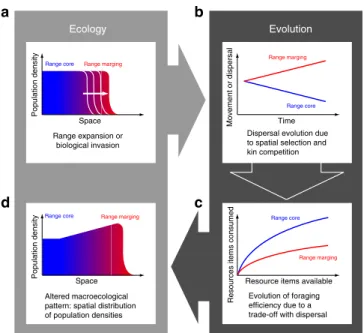
Such a non-trivial eco-evolutionary feedback loop (Fig. 4) can
only be understood when resource dynamics are taken into
account, and not under the assumptions implicit in logistic
growth models.
We substantiated our claims by developing an evolutionary
model that allows us to analyse the eco-evolutionary dynamics
occurring throughout a species’ range under the assumption that
dispersal trades off with components of the functional response.
Our model supports the generality of our empirical findings
(Fig. 3, Supplementary Figs 6–12): during the ecological process
of range expansions, selection for high dispersal is leading to a
decrease in foraging efficiency (Fig. 3, Supplementary Figs 10–12),
which subsequently alters the ecological consumer–resource
dynamics and is then culminating in higher population densities
at the range margin compared with range core areas (Fig. 3a,
Supplementary Fig. 9; for a summary, see Fig. 4). This density
pattern results from strong resource depletion in the range core
due to the evolution of increased foraging efficiency.
Importantly, our analysis is consistent with the general notion
that the spatial distribution of population densities along a
species’ range results from a trade-off between dispersal and
competitive ability
18. Yet, we show that a mechanistic model
taking eco-evolutionary feedbacks into account is needed to
predict the resulting macroecological patterns correctly (Fig. 4).
Our work also highlights the importance of choosing appropriate
fitness proxies depending on the study system’s properties. Our
results and interpretations are valid for all systems in which
resource and consumer dynamics are linked and occur at similar
timescales.
The evolutionary changes we observe occurred at rather short
timescales. As we initialized our experiment with a genetically
diverse consumer population, the evolutionary effects observed
here may be primarily due to selection acting on standing genetic
variation. Of course, we cannot exclude the occurrence of (rare)
mutation events, especially since the experiment covered a time of
over 100 doubling time periods (24 days; doubling time: 4–5 h;
see Supplementary Table 1). By contrast, our work, both
experimental and theoretical does not include the possibility of
resource evolution. Eco-evolutionary dynamics, potentially
lead-ing to fundamental changes in demographic patterns such as
phase shifts in predator–prey cycles, have been well documented
in predator–prey systems that allow for prey evolution
38,39. The
eco-evolutionary effects of predator–prey co-evolution have
recently been explored experimentally by Hiltunen and Becks
40.
These authors for example show that predator co-evolution feeds
back on ecological parameters leading to increased population
sizes and further fundamentally alter the direction of
eco-evolutionary dynamics. While resources will certainly evolve in
natural range cores, possibly altering population dynamics, we
suggest that during range expansions or invasions even rapid
resource evolution will mainly impact populations well behind
the range front. Of course, this will depend on the speed of range
expansion relative to the speed of resource evolution. Further
eco-evolutionary effects, for example, related to the occurrence
of novel resources disrupting consumer–resource co-evolution
remain to be studied in detail. Nevertheless, our results
presumably driven by a trade-off between dispersal and
foraging success in consumers will hold true as long as
increased dispersal is selected for.
Taken together, our experimental findings and the numerical
analyses may help explain similar density patterns observed in
natural range expansions and biological invasions, such as in cane
toads
32or limpets
31, and the observation that range contractions
often occur from range core areas rather than from range
margins
41. Note that demography may also be influenced by
specific abiotic gradients
42,43, which we do not consider here.
Our results have important implications for conservation and
management decisions. Most conservation effort is spent on
populations situated in the core of a species’ distribution
41. Yet, as
population densities, which we found to be highest at range
margins, are positively correlated with species’ persistence,
conservation and management efforts may be more efficient at
range margins rather than in range core habitats. By contrast,
non-margin populations may be more promising candidates
when the focus of conservation is on genetic diversity. In the
context of biological invasions, the evolution of increased
dispersiveness
implies
that
spread
accelerates,
causing
increasing damage, and that containment measures are most
feasible and successful as early as possible.
Methods
Study organism
.
We used the freshwater ciliateTetrahymenacf.pyriformis(Supplementary Fig. 1b) as a model organism20,21. This protist species is well
suited for experimental evolution approaches22as individuals are small in
size (hereB35±5 along the major body axis), exhibit high growth rates
(doubling timeB4–5 h) and reach high equilibrium densities (B5,000–15,000
individuals ml1)20,44–46. We keptTetrahymenaboth for maintenance and during
the experiments in bacterized protist medium (Protozoan pellets; Carolina
Biological Supply; 0.46 g l1; withSerratia fonticola,Bacillus subtilisand
Population density Population density Evolution Ecology Range expansion or biological invasion
Dispersal evolution due to spatial selection and kin competition Range core Range core Range core Range core Range marging Range marging Range marging Range marging Time
Resource items available Evolution of foraging efficiency due to a trade-off with dispersal Space
a
b
d
c
Space Altered macroecological pattern: spatial distribution of population densities
Movement or dispersal
Resources items consumed
Figure 4 | Schematic summary of our empirical and theoretical findings illustrating the importance of eco-evolutionary feedbacks during range expansions and biological invasions.The ecological process of a range expansion or biological invasion (a) leads to the evolution of increased dispersal at range margins due to spatial selection and kin competition (b). If dispersal trades off with growth, more specifically foraging success (type II functional response) this results in high foraging efficiencies in range cores and low foraging efficiencies at range margins (c). These evolutionary changes finally feed back and alter ecological patterns, here the spatial distribution of population densities (d). High foraging efficiencies lead to a rapid depletion of resources in range cores implying lower population densities in comparison with range margins.
Brevibacillus brevisas bacterial resources; see also Supplementary Fig. 4), following
generally established protocols21,45,47–49.
Previous work usingTetrahymenaand bacteria for experimental evolution50–52
focused on prey resistance traits and used clonalTetrahymenapopulations, which
prevented rapid evolutionary changes as a consequence of selection on standing
genetic variation (but see Hiltunen and Becks40). By contrast, theTetrahymena
stock used in our experiments (originally obtained from Carolina Biological Supply) was kept in large volumes (100 ml), regularly transferred to fresh medium
and restocked to conserve standing genetic variation53and to allow rapid
evolution. During these transfers, bottlenecks were avoided (always410,000
individuals were transferred).
Microcosm landscapes
.
All experiments were carried out in two-patch systems (see Supplementary Fig. 1a) consisting of two 20 ml vials (Sarstedt) connected by silicone tubes (inside diameter: 4 mm; VWR) and stopcocks (B. Braun Discofix) tocontrol connectivity (length of tubingþstopcock: 6 cm). At day 0 of the
experi-ment, the start patch was filled withTetrahymenaat equilibrium density (B10,000
individuals ml1) from a fresh stock culture and the target patch received only
bacterized medium, while the connecting tube remained closed. Subsequently, stopcock controllers were opened and dispersal was allowed for 4 h, after which stopcocks were closed again. This time period was chosen after preliminary experiments to guarantee that dispersal events are rare, that is, below 5%. There-after, all individuals in the target patch (‘range margin’) were transferred to a new two-patch system and, after a growth phase of one day, the procedure was repeated. This allowed us to track ecological and evolutionary dynamics of the travelling range front without requiring extremely long landscapes in which the medium
ages, becomes anoxic and resource availability is difficult to control20. In addition,
populations at the range margin were always confronted with bacteria from stock cultures, which precludes that observed changes are due to resource evolution at the range margin. In range cores, bacteria from the stock culture were regularly added to avoid such changes. Note that the transfer is here a purely technical aspect and does not impact the ecological or evolutionary dynamics, except that it precludes individuals from moving backwards in the landscape. This set-up, especially the discrete growth phases, which allows population at the range margin to regrow before the next dispersal event, reduces the confounding effects of
density-dependent movement and Allee effects23,54, which could alter invasion
dynamics. For simplicity, we will also ignore this aspect in the modelling framework presented below. We compare this ‘range margin’ with control populations (‘range core’) in the exact same two-patch systems in which dispersal was not allowed to happen. In Supplementary Figs 2–3, we also provide data for the populations of the starting patches (‘residents only’). These starting populations have experienced strong selection against dispersal due to our experimental set-up (Supplementary Fig. 1). This does not correspond to the general situation in a genuine range core. We therefore chose to be conservative and to use the control for comparison. Note that our results and conclusions are not impacted qualitatively by this choice. All treatments were replicated six times and run for 24 days, that is, there were 12 discrete phases of dispersal and growth. The sample
size was chosen based on previous experiments49and the repeatability of the
experimental system. The experiment required no randomization or blinding.
Common garden and life history parameters
.
Life history data were collected at the end of the experiment after a 2-day common garden phase (doubling time of Tetrahymenain our experiment: 4–5 h; see Supplementary Table 1). At the beginning of the common garden, protists were put into fresh bacterized medium (10-fold dilution of the samples) to reduce the impact of potential ‘maternal’ effects and plastic differences between populations from the range core and from the range margin. Thereafter, growth curves were recorded for all replicates over a period of 10 days. Note that the common garden also avoids that the observed effects are due to differential resource evolution in range core and range margin populations, as freshly bacterized medium was used.Data collection
.
Data collection and sampling was effectuated once per dispersal and growth phase after dispersal. The growth curves at the end of the experiment were sampled once per day (twice in the beginning). Sampling volume was 0.5 ml, which was immediately replaced with the same amount of fresh bacterized medium (the effect of this replacement is analysed theoretically in the SupplementaryFig. 8). For the growth curves, sampling volume was only 150ml that was not
replaced to maintain the same growth conditions. Data can be downloaded from Dryad (www.datadryad.org; DOI: 10.5061/dryad.6246r).
We used video analysis to measure densities and to collect data on morphology (size, aspect-ratio) and movement strategies (velocities, turning angle distribution,
Supplementary Fig. 1c). Following Pennekamp and Schtickzelle55, we used the free
image analysis software ImageJ (version 1.46a) with the MOSAIC particle tracker
plugin56. For video recording (length: 20 s; that is, 500 frames), we used a Nikon
SMZ1500 stereo-microscope (30-fold magnification) with a Hamamatsu Orca
Flash 4 video camera (sample volume: 19ml sample height: 0.5 mm). In a first step,
the image analysis procedure determines the location of moving particles of a predefined size range (determined through preliminary trials to be an area between 20 and 200 pixels) for every frame of the video by subtracting the information from
two subsequent frames (‘difference image’). In a second step, these locations are relinked by the MOSAIC ImageJ plugin to obtain individual movement paths (link distance: 15 pixels; link range: 3; Supplementary Fig. 1c). For further details, please
refer to the protocol described in detail by Pennekamp and Schtickzelle55.
From the recorded movement paths, we derived velocity and circular s.d. of the turning angle distribution using the statistical software R (version 3.1.0; packages ‘adehabitatLT’ version 0.3.16 and ‘circular’ version 0.4-7). Only movement paths of individuals that could be observed during at least 4 s were include in our analysis. Changes in velocity and turning angles result in changes in overall displacement and subsequently dispersal. As the width of the turning angle distribution did not differ between the treatments (see Supplementary Fig. 2b) we only analyse movement velocity.
Statistical analysis
.
All statistical analyses were performed with linear mixed models or generalized linear mixed models where appropriate, using the statistical software R (version 3.1.0; package ‘lmerTest’ version 2.0–6). Movement velocities were analysed at the population level (mean values over all individuals in one sample) using linear mixed models (LMMs) with time and range position (range core or margin) as interacting fixed effects. To account for repeated measures of the replicate microcosms over time, we included time as a pseudo-replicate within eachreplicate as random effects57. An analogous analysis was performed for the s.d. of
the distribution of turning angles, body size (length of the major axis) and aspect ration (ratio of major to minor axis) and population densities. The latter were analysed using a generalized linear mixed model (GLMM) with a Poisson error structure.
Dispersal rates were analysed as ratios with a generalized linear mixed model (GLMM) and a binomial error structure. Time was used as a fixed effect. As above, replicate was included as a random effect as we compared dispersal rates from day 0 and 24 of the same replicates. To account for overdispersion, we added an observation-level random effect where necessary.
Fitting logistic growth and consumer–resource models
.
Growth curves were analysed by fitting both logistic growth functions and a Rosenzweig–MacArthurconsumer–resource model30to the population density data collected after to
common garden phase. The fit of the models was compared using the Akaike Information Criterion.
To fit logistic growth functions of the form NðtÞ ¼ K
1þear0t ð1Þ
witha¼ln K
Nð0Þ1
, we used mean population size values across replicates and a non-linear least square approach (function ‘nls’ and the self-starting logistic function ‘SSlogis’ in R version 3.1.0).
As described in the introduction, the concept of a carrying capacity has been repeatedly shown to be potentially misleading and difficult to interpret
mechanistically25,26(forTetrahymenasee Luckinbill27). We therefore chose to
complement our analysis with a mechanistic model of limited population growth. We fitted a Rosenzweig–MacArthur consumer–resource model where the
consumer dynamics forTetrahymenaare then defined as follows:
dT
dt ¼
ea
bþNNTdTT ð2Þ
withTas the population size of the consumerTetrahymena,eas the assimilation
coefficient,aas the maximum amount of resources (N) consumed andbas the
half-saturation constant of the type II functional response. 1/bcan then be
interpreted as the foraging efficiency. dTis the consumer’s death rate. The resource
dynamics are defined as: dN dt ¼r0 1 N K N a bþNNT ð3Þ
wherer0is the resource growth rate andKits carrying capacity. As we fit the model
only to the consumer data, the parametersr0andKare fixed to values estimated
from bacterial growth data (r0¼0.24;K¼36Eþ06; Supplementary Fig. 4). The
differential equations were solved (function ‘ode’ of the ‘deSolve’ package in R version 3.1.0) and the model was fit by minimizing the residuals using the Levenberg–Marquardt algorithm (function ‘nls.lm’ of the ‘minpack.lm’’ package in R version 3.1.0). The growth rate as a function of resource availability (N) is
calculated as the difference between birth and death rate: ea
bþNNdT. General overview of numerical analyses
.
To simulate the eco-evolutionarydynamics of dispersal (for an overview see Clobertet al.58) and the concurrent
evolution of the functional response we developed a stochastic, individual-based
simulation framework similar to models by Burtonet al.18, Fronhoferet al.59or
Kubischet al.10This very simple model is neither designed to reproduce nor to
predict the empirical results quantitatively. Therefore, it is neither parametrized with data obtained from the experiments nor did we perform any fitting of the model. The model is uniquely thought to provide qualitative support for the soundness of our reasoning regarding relevant mechanisms and processes.
The simulated landscape is linear with a length of 100 discrete habitat patches. For simplicity, we assume discrete natal dispersal and reproduction phases as well as non-overlapping generations for the consumer populations. Consumers are characterized by three traits: an emigration rate (d) as well as the maximum amount of resources that can be consumed (a) and the foraging efficiency (1/b) of the type II functional response (see equations (2–3)). These three traits are linked
through a life history trade-off as in Burtonet al.18Resources experience logistic
growth60and, for simplicity, do not disperse.
Initially, consumers are only present in the first five patches at the very left of a landscape (range core). A burn-in phase of 1,000 generations allows the genetic algorithm (see below) to find evolutionarily stable dispersal rates and functional responses. Afterwards, the range expansion is allowed to proceed into the remaining 95 patches to the landscape. During the range expansion, we record local population densities as well as the evolutionarily stable dispersal rates and functional responses.
Dispersal-foraging trade-off
.
We assume that dispersal trades off with compe-titive ability (for a recent overview of trait correlations related to dispersal, that is,dispersal syndromes, see Stevenset al.61). In contrast to previous work18, we do not
assume carrying capacity to be a proxy for competitive ability. Our model is more mechanistic in this respect as we implemented a trade-off between dispersal ability and the functional response (equations (2–3)).
Every individual is thus characterized by its relative investment in (1) dispersal
(fd), (2) the maximum amount of resources that can be consumed (fa), (3) foraging
efficiency (f1/b) and (4) into other, non-specified activities (felse). We added
the fourth category to relax the very strict assumption that lower dispersal automatically leads to higher foraging efficiency and vice versa. We will not further analyse this category as it usually evolves to be close to zero.
We define maximal values for dispersal (dmax) and for parameters of the
functional response (amax, 1/bmax) which allows us to calculate the individual
dispersal rates and functional responses as follows:
di¼fd;idmax ð4Þ
ai¼fa;iamax ð5Þ
1=bi¼f1=b;i1=bmax ð6Þ
withfd,iþfa,iþf1/b,iþfelse¼1 andias the focal individual.
Note that a four-way trade-off, including the assimilation coefficient (e), may also be possible. To explore the robustness of our results with regard to such changes we ran additional analyses of such a four-way trade-off including the assimilation coefficient (e) and were able to recover the qualitative results characteristic of Fig. 3 (see Supplementary Fig. 7). This indicates that the assimilation coefficient cannot evolve to much higher values to compensate for increased depletion of resources in the range core without leading to population
extinction (consumer evolution is mostly stabilizing; see Abrams62for a review).
Note that we have also analysed non-linear trade-off functions (convex and concave) in a simplified model version including only a trade-off between dispersal rate and foraging efficiency (1/b) and could demonstrate the qualitative robustness of our results (Supplementary Figs 14 and 15).
Evidently, alternative models that do not take into account consumer–resource
dynamics could assume different trade-off structures61or mechanisms of
importance. Pachepsky and Levine63suggest that populations at the range margin
may be more frequently subject to elevated levels of competition than commonly assumed. Consequently, from an evolutionary perspective the concurrent evolution of higher dispersal, less sensitivity to crowding (resulting in higher equilibrium densities) and higher reproductive rates would be advantageous. Note that while we do observe higher equilibrium densities at the range margin in the experimental data (Fig. 2), we do not find higher reproductive rates (Fig. 2 and Supplementary Table. 1). As the consumer–resource model explains the experimental results significantly better than a logistic growth model, we decided to use a mechanistic model in a foraging framework.
Resource population dynamics and consumer foraging
.
Local resource population dynamics follow logistic growth according to the model provided byBeverton and Holt60:
Nx;t¼Nx;t1l0
1
1þaNx;t1
ð7Þ
withNx,tas the resource population size in patchxat timet,l0as the growth rate
anda¼l01
K whereKis the carrying capacity.
Consumers forage after resource growth and individually harvest the amount of resources defined by their specific functional response (equations (2–3)). Harvesting occurs either until all consumers have foraged or until no resources remain. After each individual foraging event, the amount of resources available is updated. To avoid artifacts, the order of foraging for consumers is randomized locally.
Our model captures resource dynamics in a very simplified way. Two aspects of our experimental set-up are not included in our standard model: (1) the addition of resources (bacterized medium) to compensate for volume loss due to sampling and
(2) the formation of bacterial biofilms that makes a certain amount of resources not available for consumption but allows resource reproduction, that is, replenishment. Both factors render resource dynamics slightly independent of consumer dynamics, which should stabilize the system. To test whether our conclusions are robust to such changes in resource dynamics, we ran additional numerical analyses and could show that our results remain qualitatively unchanged (Supplementary Fig. 8). These results seem even more in accordance with our empirical data, especially the increased stability of population dynamics in the range core (compare Fig. 3 and Supplementary Fig. 8).
Furthermore, we do not assume resource evolution, which, given our experimental set-up and especially the addition of resources from a stock culture, is a valid assumption. For a recent review of eco-evolutionary dynamics resulting
from consumer and resource evolution, see Kochet al.38and literature cited
therein.
Consumer dispersal
.
We assume dispersal to be natal and, for simplicity, to occur only for the consumers. The individual dispersal rate is defined as in equation (4) and determines the probability of reaching one of the two neighbouring patches in the linear landscape, provided the individual survivesthe dispersal event. The latter process is captured by a dispersal cost parameter (m).
The dispersal costs summarize all possible risk, time, opportunity or energetic costs
linked to dispersing19. As our experimental system does not include such dispersal
costs, we do not consider this parameter further in our analysis. Our results are not qualitatively impacted by non-zero dispersal mortalities (Supplementary Fig. 13) as long as dispersal costs do not prevent the evolution of increased dispersal at range margins.
Note that, for simplicity, we assume no plasticity in the dispersal trait. Yet, it is
well known that inTetrahymenadispersal is a plastic trait which exhibits density
dependence, for example, refs 23,54. AsTetrahymenasuffers from an Allee effect,
negatively density-dependent dispersal can be found for low densities. Nevertheless, our experimental set-up, which allows for discrete growth phases after dispersal minimizes the importance of this aspect of density-dependent dispersal. For a theoretical analysis of the effects of density-dependent dispersal on
range dynamics see Kubischet al.10,64.
Consumer reproduction and the genetic algorithm
.
Individuals are assumed to produce a number of offspring in relation to their individual foraging success and a constant assimilation coefficient as defined in equation (2). To include demo-graphic stochasticity, this value is used as the mean of a Poisson distribution from which the realized number of offspring is drawn.Every offspring inherits its traits (fd,i,fa,i,f1/b,iandfelse,i) from its parent
individual. During this process the values may mutate according to a fixed
mutation rate (pmutation¼0.001). If such a mutation occurs, the inherited trait value
is changed by adding a normally distributed random number with mean zero and s.d. 0.2. If trait values happen to become negative during this process, they are reset to zero; we do not assume any upper boundaries. Subsequently, the trait values are
renormalized to satisfyfd,iþfa,iþf1/b,iþfelse,i¼1.
Simulation experiments
.
As described above, initially only the leftmost five patches of any linear landscape are populated with consumers. The traits of these individuals are initialized randomly between zero and one and renormalized subsequently (see above). During the burn-in phase (1,000 generations), these values are allowed to reach evolutionarily stable combinations. To avoid artifacts due to the landscape’s boundaries, we initially wrap the first five patches to a circle during the burn-in phase. Afterwards, we assume reflecting boundary conditions. Simulations were run for a maximum of 5,000 generations or until the range expansion reached the end of the world. Note that this always happened before generation 5,000. All simulation experiments were replicated 20 times. Thefollowing parameter values were tested: resource carrying capacityK¼50; resource
growth ratel0¼{1.5, 2, 4, 6, 8, 10}; dispersal mortalitym¼{0, 0.01, 0.1, 0.5};
maximal dispersal ratedmax¼{2, 3, 4}; maximal amount of resourcesamax¼{0.01,
0.02, 0.03}; maximal foraging efficiency 1/bmax¼{0.01, 0.02, 0.03}; assimilation
coefficiente¼{700, 800, 900, 1,000}. Please see Supplementary Figs 6–15 for a
sensitivity analysis. Computer code can be downloaded from Dryad (DOI: 10.5061/ dryad.6246r).
References
1. Hill, J. K., Thomas, C. D. & Huntley, B. Climate and habitat availability
determine 20th century changes in a butterflys range margin.Proc. R. Soc.
B-Biol. Sci.266,1197–1206 (1999).
2. Parmesan, C.et al.Poleward shifts in geographical ranges of butterfly species
associated with regional warming.Nature399,579–583 (1999).
3. Parmesan, C. & Yohe, G. A globally coherent fingerprint of climate change
impacts across natural systems.Nature421,37–42 (2003).
4. Kelly, A. E. & Goulden, M. L. Rapid shifts in plant distribution with recent
5. Melbourne, B. A. & Hastings, A. Highly variable spread rates in replicated
biological invasions: fundamental limits to predictability.Science325,
1536–1539 (2009).
6. Hastings, A.et al.The spatial spread of invasions: new developments in theory
and evidence.Ecol. Lett.8,91–101 (2005).
7. Perkins, A. T., Phillips, B. L., Baskett, M. L. & Hastings, A. Evolution of dispersal and life history interact to drive accelerating spread of an invasive
species.Ecol. Lett.16,1079–1087 (2013).
8. Hanski, I. Eco-evolutionary dynamics in a changing world.Ann. N. Y. Acad.
Sci.1249,1–17 (2012).
9. Ellner, S. P. Rapid evolution: from genes to communities, and back again? Funct. Ecol.27,1087–1099 (2013).
10. Kubisch, A., Holt, R. D., Poethke, H. J. & Fronhofer, E. A. Where am I and why? Synthesising range biology and the eco-evolutionary dynamics of
dispersal.Oikos123,5–22 (2014).
11. Phillips, B. L., Brown, G. P. & Shine, R. Life-history evolution in range-shifting
populations.Ecology91,1617–1627 (2010).
12. Shine, R., Brown, G. P. & Phillips, B. L. An evolutionary process that assembles
phenotypes through space rather than through time.Proc. Natl Acad. Sci. USA
108,5708–5711 (2011).
13. Kubisch, A., Fronhofer, E. A., Poethke, H. J. & Hovestadt, T. Kin competition as
a major driving force for invasions.Am. Nat.181,700–706 (2013).
14. Hamilton, W. D. & May, R. M. Dispersal in stable habitats.Nature269,
578–581 (1977).
15. Thomas, C. D.et al.Ecological and evolutionary processes at expanding range
margins.Nature411,577–581 (2001).
16. Phillips, B. L., Brown, G. P., Webb, J. K. & Shine, R. Invasion and the evolution
of speed in toads.Nature439,803–803 (2006).
17. Lombaert, E.et al.Rapid increase in dispersal during range expansion in the
invasive ladybirdHarmonia axyridis.J. Evol. Biol.27,508–517 (2014).
18. Burton, O. J., Pillips, B. L. & Travis, J. M. J. Trade-offs and the evolution of
life-histories during range expansion.Ecol. Lett.13,1210–1220 (2010).
19. Bonte, D.et al.Costs of dispersal.Biol. Rev.87,290–312 (2012).
20. Giometto, A., Rinaldo, A., Carrara, F. & Altermatt, F. Emerging predictable
features of replicated biological invasion fronts.Proc. Natl Acad. Sci. USA111,
297–301 (2014).
21. Altermatt, F., Bieger, A., Carrara, F., Rinaldo, A. & Holyoak, M. Effects of connectivity and recurrent local disturbances on community structure and
population density in experimental metacommunities.PLoS ONE6,e19525
(2011).
22. Kawecki, T. J.et al.Experimental evolution.Trends Ecol. Evol.27,547–560
(2012).
23. Fronhofer, E. A., Kropf, T. & Altermatt, F. Density-dependent movement
and the consequences of the allee effect in the model organismTetrahymena.J.
Anim. Ecoldoi:10.1111/1365-2656.12315 (2015).
24. Bitume, E. V., Bonte, D., Ronce, O., Olivieri, I. & Nieberding, C. M. Dispersal
distance is influenced by parental and grand-parental density.Proc. R. Soc.
B-Biol. Sci.281,1061 (2014).
25. Reznick, D., Bryant, M. J. & Bashey, F. r- and K-selection revisited: the role
of population regulation in life-history evolution.Ecology83,1509–1520
(2002).
26. Mallet, J. The struggle for existence: how the notion of carrying capacity, K, obscures the links between demography, darwinian evolution, and speciation. Evol. Ecol. Res.14,627–665 (2012).
27. Luckinbill, L. S. Selection and the r/K continuum in experimental populations
of protozoa.Am. Nat.113,427–437 (1979).
28. MacArthur, R. Species packing and competitive equilibrium for many species. Theor. Popul. Biol.1,1–11 (1970).
29. Matessi, C. & Gatto, M. Doesk-selection imply prudent predation?Theor.
Popul. Biol.25,347–363 (1984).
30. Rosenzweig, M. L. & MacArthur, R. H. Graphical representation and stability
conditions of predator-prey interactions.Am. Nat.97,209–223 (1963).
31. Gilman, S. A test of Brown’s principle in the intertidal limpetCollisella scabra
(gould, 1846).J. Biogeogr.32,1583–1589 (2005).
32. Brown, G. P., Kelehear, C. & Shine, R. The early toad gets the worm: cane toads
at an invasion front benefit from higher prey availability.J. Anim. Ecol.82,
854–862 (2013).
33. Tilman, D. Resources: a graphical-mechanistic approach to competition and
predation.Am. Nat.116,362–393 (1980).
34. Abrams, P. A. Will small population sizes warn us of impending extinctions? Am. Nat.160,293–305 (2002).
35. Joshi, A. & Mueller, L. D. Evolution of higher feeding rate inDrosophiladue to
density-dependent natural selection.Evolution42,1090–1093 (1988).
36. Slobodkin, L. B. Prudent predation does not require group selection.Am. Nat.
665–678 (1974).
37. Abrams, P. A. When does greater mortality increase population size? the long
history and diverse mechanisms underlying the hydra effect.Ecol. Lett.12,
462–474 (2009).
38. Koch, H., Frickel, J., Valiadi, M. & Becks, L. Why rapid, adaptive evolution
matters for community dynamics.Front. Ecol. Evol.2, 17 (2014).
39. Hiltunen, T., Hairston, N. G., Hooker, G., Jones, L. E. & Ellner, S. P. A newly discovered role of evolution in previously published consumer-resource
dynamics.Ecol. Lett.17,915–923 (2014).
40. Hiltunen, T. & Becks, L. Consumer co-evolution as an important component of
the eco-evolutionary feedback.Nat. Commun.5,5226 (2014).
41. Channell, R. & Lomolino, M. V. Dynamic biogeography and conservation of
endangered species.Nature403,84–86 (2000).
42. Sagarin, R. D., Gaines, S. D. & Gaylord, B. Moving beyond assumptions to
understand abundance distributions across the ranges of species.Trends Ecol.
Evol.21,524–530 (2006).
43. Sexton, J. P., McIntyre, P. J., Angert, A. L. & Rice, K. J. Evolution and ecology of
species range limits.Annu. Rev. Ecol. Evol. Syst.40,415–436 (2009).
44. Fjerdingstad, E., Schtickzelle, N., Manhes, P., Gutierrez, A. & Clobert, J.
Evolution of dispersal and life history strategies -Tetrahymenaciliates.BMC
Evol. Biol.7,133 (2007).
45. Carrara, F., Altermatt, F., Rodriguez-Iturbe, I. & Rinaldo, A. Dendritic connectivity controls biodiversity patterns in experimental metacommunities. Proc. Natl Acad. Sci. USA109,5761–5766 (2012).
46. Giometto, A., Altermatt, F., Carrara, F., Maritan, A. & Rinaldo, A. Scaling body
size fluctuations.Proc. Natl Acad. Sci. USA110,4646–4650 (2013).
47. Morin, P. Productivity, intraguild predation, and population dynamics in
experimental food webs.Ecology80,752–760 (1999).
48. Haddad, N. M.et al.Species’ traits predict the effects of disturbance and
productivity on diversity.Ecol. Lett.11,348–356 (2008).
49. Altermatt, F.et al.Big answers from small worlds: a user’s guide for protist
microcosms as a model system in ecology and evolution.Methods Ecol. Evol.
6,218–231 (2015).
50. Meyer, J. R. & Kassen, R. The effects of competition and predation on
diversification in a model adaptive radiation.Nature446,432–435 (2007).
51. Friman, V.-P., Jousset, A. & Buckling, A. Rapid prey evolution can alter the
structure of predator-prey communities.J. Evol. Biol.27,374–380 (2013).
52. Friman, V.-P. & Buckling, A. Effects of predation on real-time host-parasite
coevolutionary dynamics.Ecol. Lett.16,39–46 (2013).
53. Cadotte, M. W. Competition-colonization trade-offs and disturbance effects at
multiple scales.Ecology88,823–829 (2007).
54. Pennekamp, F., Mitchell, K. A., Chaine, A. S. & Schtickzelle, N. Dispersal
propensity inTetrahymena thermophilaciliates - a reaction norm perspective.
Evolution68,2319–2330 (2014).
55. Pennekamp, F. & Schtickzelle, N. Implementing image analysis in laboratory-based experimental systems for ecology and evolution: a hands-on guide. Methods Ecol. Evol.4,483–492 (2013).
56. Sbalzarini, I. & Koumoutsakos, P. Feature point tracking and trajectory analysis
for video imaging in cell biology.J. Struct. Biol.151,182–195 (2005).
57. Crawley, M. J.The R Book(John Wiley & Sons Inc, 2013).
58. Clobert, J., Baguette, M., Benton, T. G. & Bullock, J. M.Dispersal Ecology and
Evolution(Oxford Univ. Press, 2012).
59. Fronhofer, E. A.et al.Picky hitch-hikers: vector choice leads to directed
dispersal and fat-tailed kernels in a passively dispersing mite.Oikos122,
1254–1264 (2013).
60. Beverton, R. J. H. & Holt, S. J.On the Dynamics of Exploited Fish Populations
(Chapman & Hall, 1957).
61. Stevens, V. M.et al.A comparative analysis of dispersal syndromes in terrestrial
and semi-terrestrial animals.Ecol. Lett.17,1039–1052 (2014).
62. Abrams, P. A. The evolution of predator-prey interactions: theory and
evidence.Annu. Rev. Ecol. Evol. Syst.31,79–105 (2000).
63. Pachepsky, E. & Levine, J. M. Density dependence slows invader spread in
fragmented landscapes.Am. Nat.177,18–28 (2011).
64. Kubisch, A., Poethke, H. J. & Hovestadt, T. Density-dependent dispersal and
the formation of range borders.Ecography34,1002–1008 (2011).
Acknowledgements
We would like to thank Pravin Ganesanandamoorthy for help with performing the experiments. This paper benefited from ideas contributed by Blake Matthews, Martin Ackermann and Jonathan Levine. Funding is from Eawag (to E.A.F.) and the Swiss National Science Foundation, Grant No. 31003A_135622 and PP00P3_150698 (to F.A.).
Author contributions
E.A.F. and F.A. designed the research; E.A.F. performed the experiments, analysed data and developed the stochastic modelling framework; E.A.F. and F.A. wrote the paper.
Additional information
Supplementary Informationaccompanies this paper at http://www.nature.com/ naturecommunications
Competing financial interests:The authors declare no competing financial interests.
Reprints and permissioninformation is available online at http://npg.nature.com/ reprintsandpermissions/
How to cite this article:Emanuel A. Fronhofer & Florian Altermatt. Eco-evolutionary feedbacks during experimental range expansions.Nat. Commun.6:6844 doi: 10.1038/ ncomms7844 (2015).
This work is licensed under a Creative Commons Attribution 4.0 International License. The images or other third party material in this article are included in the article’s Creative Commons license, unless indicated otherwise in the credit line; if the material is not included under the Creative Commons license, users will need to obtain permission from the license holder to reproduce the material. To view a copy of this license, visit http://creativecommons.org/licenses/by/4.0/