Deep Roots:
Improving CNN Efficiency with Hierarchical Filter Groups
Yani Ioannou
1Duncan Robertson
2Roberto Cipolla
1Antonio Criminisi
21
University of Cambridge,
2Microsoft Research
Abstract
We propose a new method for creating computation-ally efficient and compact convolutional neural networks (CNNs) using a novel sparse connection structure that re-sembles a tree root. This allows a significant reduction in computational cost and number of parameters compared to state-of-the-art deep CNNs, without compromising ac-curacy, by exploiting the sparsity of inter-layer filter de-pendencies. We validate our approach by using it to train more efficient variants of state-of-the-art CNN architec-tures, evaluated on the CIFAR10 and ILSVRC datasets. Our results show similar or higher accuracy than the baseline architectures with much less computation, as measured by CPU and GPU timings. For example, for ResNet 50, our model has 40% fewer parameters, 45% fewer floating point operations, and is 31% (12%) faster on a CPU (GPU). For the deeper ResNet 200 our model has 48% fewer pa-rameters and 27% fewer floating point operations, while maintaining state-of-the-art accuracy. For GoogLeNet, our model has 7% fewer parameters and is 21% (16%) faster on a CPU (GPU).
1. Introduction
This paper describes a new method for creating compu-tationally efficient and compact convolutional neural net-works (CNNs) using a novel sparse connection structure that resembles a tree root. This allows a significant reduc-tion in computareduc-tional cost and number of parameters com-pared to state-of-the-art deep CNNs without compromising accuracy.
It has been shown that a large proportion of the learned weights in deep networks are redundant [1], a property that has been widely exploited to make neural networks smaller and more computationally efficient [2], [3]). It is unsurpris-ing then that regularization is a critical part of trainunsurpris-ing such networks using large datasets [4]. Without regularization deep networks are susceptible to over-fitting.
Regulariza-tion may be achieved by weight decay or dropout [5]. Fur-thermore, a carefully designed sparse network connection structure can also have a regularizing effect. Convolutional Neural Networks (CNNs) [6], [7] embody this idea, using a sparse convolutional connection structure to exploit the lo-cality of natural image structure. In consequence, they are easier to train.
With few exceptions, state-of-the-art CNNs for image recognition are largely monolithic, with each filter operat-ing on the feature maps of all filters on a previous layer. In-terestingly, this is in stark contrast to what we understand of biological neural networks, where we see “highly evolved arrangements of smaller, specialized networks which are in-terconnected in very specific ways” [8].
Recently, learning a low-rank basis for filters was found to improve generalization while reducing the computational complexity and model size of a CNN with only full rank filters [9]. However, this work addressed only the spatial extents of the convolutional filters (i.e.handwin Fig.1a). In this work we will show that a similar idea can be ap-plied to the channel extents –i.e. filter inter-connectivity – by usingfilter groups[4]. We show that simple alterations to state-of-the-art CNN architectures can drastically reduce computational cost and model size without compromising accuracy.
2. Related Work
Most previous work on reducing the computational com-plexity of CNNs has focused on approximating convolu-tional filters in the spatial (as opposed to the channel) do-main, either by using low-rank approximations [9]–[13], or Fourier transform based convolution [14], [15]. More gen-eral methods have used reduced precision number repre-sentations [16] or compression of previously trained mod-els [17], [18]. Here we explore methods that reduce the computational impact of the large number of filter channels within state-of-the art networks. Specifically, we consider decreasing the number of incoming connections to nodes.
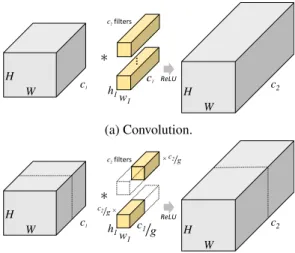
c2filters h1w 1 c1 … c1 H W H2 c2 W2 H W ReLU (a) Convolution. c2filters h1w 1 c1 H W H2 c2 W2 H W ×c2ൗg ൗ c1g ൗ c2g× ReLU
(b) Convolution with filter groups.
Figure 1:Filter Groups. (a) Convolutional filters (yellow) typically have the same channel dimensionc1 as the input feature maps (gray) on which they operate. However, (b) with filter grouping, g independent groups of c2/g filters operate on a fractionc1/gof the input feature map channels, reducing filter dimensions fromh×w×c1 to h×w×c1/g. This change does not affect the dimensions of the input and output feature maps but significantly reduces computational complexity and the number of model parameters.
0.6 0.8 1 1.2 ·109 18% 19% 20% 2 groups no groups 4 groups
Model Parameters (# floats)
T
op-5
V
al.
Error
Figure 2: AlexNet Filter Groups. Model Parametersvs. top-5 error for variants of the AlexNet model on ILSVRC image classification dataset. Models with moderate num-bers of filter groups have far fewer parameters, yet surpris-ingly maintain comparable error.
AlexNet Filter Groups. Amongst the seminal contribu-tions made by Krizhevsky, Sutskever, and Hinton [4] is the use of ‘filter groups’ in the convolutional layers of a CNN (see Fig. 1). While their use of filter groups was necessi-tated by the practical need to sub-divide the work of train-ing a large network across multiple GPUs, the side effects are somewhat surprising. Specifically, the authors observe that independent filter groups learn a separation of respon-sibility (colour features vs. texture features) that is consis-tent over different random initializations. Also surprising, and not explicitly stated in [4], is the fact that the AlexNet network has approximately 57% fewer connection weights
than the corresponding network without filter groups. This is due to the reduction in the input channel dimension of the grouped convolution filters (see Fig. 2). Despite the large difference in the number of parameters between the mod-els, both achieve comparable accuracy on ILSVRC – in fact the smaller grouped network gets≈1% lower top-5 valida-tion error. This paper builds upon these findings and extends them to state-of-the-art networks.
Low-dimensional Embeddings. Lin, Chen, and Yan [19] proposed a method to reduce the dimensionality of con-volutional feature maps. By using relatively cheap ‘1×1’ convolutional layers (i.e. layers comprisingdfilters of size 1×1×c, whered < c), they learn to map feature maps into lower-dimensional spaces, i.e. to new feature maps with fewer channels. Subsequent spatial filters operating on this lower dimensional input space require significantly less computation. This method is used in most state of the art networks for image classification to reduce computation [2], [20]. Our method is complementary.
GoogLeNet. In contrast to much other work, Szegedy, Liu, Jia,et al.[2] propose a CNN architecture that is highly optimized for computational efficiency. GoogLeNet uses, as a basic building block, a mixture of low-dimensional embeddings [19] and heterogeneously sized spatial filters – collectively an ‘inception’ module. There are two dis-tinct forms of convolutional layers in the inception mod-ule, low-dimensional embeddings (1×1) and spatial (3×3, 5×5). GoogLeNet keeps large, expensive spatial convolu-tions (i.e. 5×5) to a minimum by using few of these filters, using more 3×3 convolutions, and even more 1×1 filters. The motivation is that most of the convolutional filters re-spond to localized patterns in a small receptive field, with few requiring a larger receptive field. The number of filters in each successive inception module increases slowly with decreasing feature map size, in order to maintain computa-tional performance. GoogLeNet is by far the most efficient of-the-art network for ILSVRC, achieving near state-of-the-art accuracy with the lowest computation/model size. However, we will show that even such an efficient and opti-mized network architecture benefits from our method. Low-Rank Approximations. Various authors have sug-gested approximating learned convolutional filters using tensor decomposition [11], [13], [18]. For example, Jader-berg, Vedaldi, and Zisserman [11] propose approximating the convolutional filters in a trained network with represen-tations that are low-rank both in the spatial and the channel domains. This approach significantly decreases computa-tional complexity, albeit at the expense of a small amount of accuracy. In this paper we are not approximating an ex-isting model’s weights but creating a new network
architec-1 W H c m filters H W … m d H W d filters c w 1 1 m * * … 1 h … c
Figure 3: Learning a (Spatial) Basis for Filters. Learn-ing a linear combination of mostly small, heterogeneously sized spatial filters [9]. Note that all filters operate on allc
channels of the input feature map.
ture with explicit structural sparsity, which is then trained from scratch.
Learning a Basis for Filters Our approach is connected with that of Ioannou, Robertson, Shotton, et al. [9] who showed that replacing 3×3×c filters with linear combi-nations of filters with smaller spatial extent (e.g. 1×3×c, 3×1×cfilters, see Fig.3) could reduce the model size and computational complexity of state-of-the-art CNNs, while maintaining or even increasing accuracy. However, that work did not address the channel extent of the filters.
3. Root Architectures
In this section we present the main contribution of our work: the use of novel sparsely connected architectures re-sembling tree roots – to decrease computational complexity and model size compared to state-of-the-art deep networks for image recognition.
Learning a Basis for Filter Dependencies It is unlikely that every filter (or neuron) in a deep neural network needs to depend on the output of all the filters in the previous layer. In fact, reducing filter co-dependence in deep networks has been shown to benefit generalization. For example, Hin-ton, Srivastava, Krizhevsky,et al.[5] introduceddropoutfor regularization of deep networks. When training a network layer with dropout, a random subset of neurons is excluded from both the forward and backward pass for each mini-batch. Furthermore, Cogswell, Ahmed, Girshick,et al.[21] observe a correlation between the covariance of hidden unit activations and overfitting. To explicitly reduce the covari-ance of hidden activations, they train networks with a loss function, based on the covariance matrix of the activations in a hidden layer.
Instead of using a modified loss, regularization penalty, or randomized network connectivity during training to pre-vent co-adaption of features, we take a much more direct approach. We use filter groups (see Fig.1) to force the net-work to learn filters with only limited dependence on previ-ous layers. Each of the filters in the filter groups is smaller
c2filters … c2 1 h1w 1 c1 … c1 H W c2 c3 H W H2 W2 H W ReLU c3filters 1 ReLU
(a) Convolution withdfilters of shapeh×w×c.
c2filters … 1 h1w 1 c1 H W c2 c3 H W H2 W2 H W ×c2ൗg ൗ c1g ReLU c2 ൗ c2g× c3filters 1 ReLU
(b) Root-2 Module: Convolution with d filters ing = 2 filter
groups, of shapeh×w×c/2. c2filters … c3filters 1 1 h1w 1 c1 H W c2 c3 H W H2 W2 H W ×c2ൗg ൗ c2g× ReLU c2 ×c2ൗg ൗ c1g ൗ c2g× ReLU
(c) Root-4 Module: Convolution with dfilters ing = 4 filter
groups, of shapeh×w×c/4.
Figure 4: Root Modules. Root modules (b), (c) compared to a typical set of convolutional layers (a) found in ResNet and other modern architectures. Grey blocks represent the feature maps over which a layer’s filters operate, while col-ored blocks represent the filters of each layer.
in the channel extent, since it operates on only a subset of the channels of the input feature map.
This reduced connectivity also reduces computational complexity and model size since the size of filters in fil-ter groups are reduced drastically, as is evident in Fig.4. Unlike methods for increasing the efficiency of deep net-works by approximating pre-trained existing netnet-works (see
§2), our models are trained from random initialization us-ing stochastic gradient descent. This means that our method can also speed up training and, since we are not merely ap-proximating an existing model’s weights, the accuracy of the existing model is not an upper bound on accuracy of the modified model.
Root Module The basic element of our network architec-ture, aroot module, is shown in Fig.4. A root module has a given number of filter groups, the more filter groups, the fewer the number of connections to the previous layer’s out-puts. Each spatial convolutional layer is followed by a low-dimensional embedding (1×1 convolution). Like in [9], this configuration learns a linear combination of the basis filters (filter groups), implicitly representing a filter of full channel depth, but with limited filter dependence.
Table 1: Network-in-Network. Filter groups in each con-volutional layer.
Model conv1 conv2 conv3
a b c a b c a b c 5×5 1×1 1×1 5×5 1×1 1×1 3×3 1×1 1×1 Orig. 1 1 1 1 1 1 1 1 1 root-2 1 1 1 2 1 1 1 1 1 root-4 1 1 1 4 1 1 2 1 1 root-8 1 1 1 8 1 1 4 1 1 root-16 1 1 1 16 1 1 8 1 1
Table 2:Network-in-Network CIFAR10 Model FLOPS ×108 Param. ×105 Accuracy CPU (ms) GPU (ms) Orig. 2.22 9.67 0.9211 39.0 0.623 root-2 1.64 7.37 0.9209 31.2 0.551 root-4 1.23 4.55 0.9202 27.6 0.480 root-8 1.03 3.15 0.9215 24.4 0.482 root-16 0.93 2.45 0.9167 23.0 0.475
4. Results
Here we present image classification results obtained by replacing spatial convolutional layers within existing state-of-the-art network architectures with root modules (de-scribed in§3) .
4.1. Improving Network in Network on CIFAR-10
Network in Network (NiN) [19] is a near state-of-the-art network for CIFAR-10 [22]. It is composed of 3 spatial (5×5, 3×3) convolutional layers with a large number of fil-ters (192), infil-terspersed with pairs of low-dimensional em-bedding (1×1) layers. As a baseline, we replicated the stan-dard NiN network architecture as described by Lin, Chen, and Yan [19] but used state-of-the-art training methods. We trained using random 32×32 cropped and mirrored im-ages from 4-pixel zero-padded mean-subtracted imim-ages, as in [20], [23]. We also used the initialization of He, Zhang, Ren,et al.[24] and batch normalization [25]. With this con-figuration, ZCA whitening was not required to reproduce validation accuracies obtained in [19]. We also did not use dropout, having found it to have little effect, presumably due to our use of batch normalization, as suggested by Ioffe and Szegedy [25].To assess the efficacy of our method, we replaced the spatial convolutional layers of the original NiN network with root modules (as described in§3). We preserved the original number of filters per layer but subdivided them into groups as shown in Table1. We considered the first of the
0.2 0.4 0.6 0.8 1.0 ·106 7.8% 8.0% 8.2% 8.4% 8.6% 8.8% ·10−2 2 4 8 16 2 4 8 16 2 4 8 16 Model Parameters Error
NiN Root Tree Column
1.0 1.2 1.4 1.6 1.8 2.0 2.2 ·108 7.8% 8.0% 8.2% 8.4% 8.6% 8.8% ·10−2 2 4 8 16 2 4 8 16 2 4 8 16 FLOPS (Multiply-Add) Error
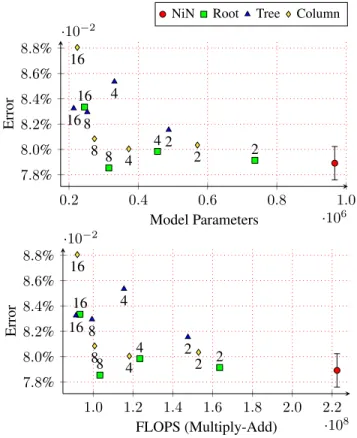
Figure 5: Network-in-Network CIFAR10 Results. Spa-tial filters (3×3, 5×5) are grouped hierarchically. The best models are closest to the origin. For the standard network, the mean and standard deviation (error bars) are shown over 5 different random initializations.
pair of existing 1×1 layers to be part of our root modules. We did not group filters in the first convolutional layer – since it operates on the three-channel image space, it is of limited computational impact compared to other layers. Re-sults are shown in Table2and Fig.5for various network ar-chitectures1. Compared to the baseline architecture, the root
variants achieve a significant reduction in computation and model size without a significant reduction in accuracy. For example, the root-8 architecture gives equivalent accuracy with only 46% of the floating point operations (FLOPS), 33% of the model parameters of the original network, and approximately 37% and 23% faster CPU and GPU timings (see§5for an explanation of the GPU timing disparity).
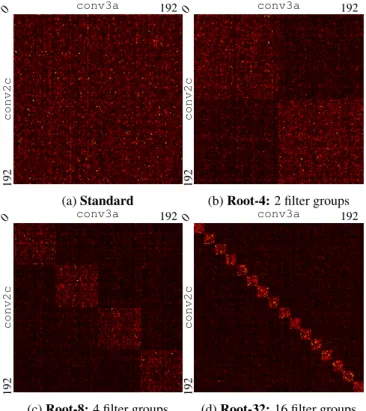
Figure 6 shows the inter-layer correlation between the adjacent filter layersconv2candconv3ain the network architectures outlined in Table1as evaluated on the CIFAR test set. The block-diagonalization enforced by the filter
1Here (and subsequently unless stated otherwise) timings are per image
for a forward pass computed on a large batch. Networks were implemented using Caffe (with CuDNN and MKL) and run on an Nvidia Titan Z GPU and 2 10-core Intel Xeon E5-2680 v2 CPUs.
0 192 192 conv3a conv2c (a)Standard 0 192 192 conv3a conv2c
(b)Root-4:2 filter groups
0 192
192
conv3a
conv2c
(c)Root-8:4 filter groups
0 192
192
conv3a
conv2c
(d)Root-32:16 filter groups
Figure 6: Inter-layer Filter Correlation. The block-diagonal sparsity learned by a root-module is visible in the correlation of filters on layersconv3aandconv2cin the NiN network.
group structure (as illustrated in Fig.1) is visible, more so with larger number of filter groups. This shows that the net-work learns an organization of filters such that the sparsely distributed strong filter relations, visible in 6aas brighter pixels, are grouped into a denser block-diagonal structure, leaving a visibly darker, low-correlated background. See
§A.2for more images, and an explanation of their deriva-tion.
4.2. Grouping Degree with Network Depth
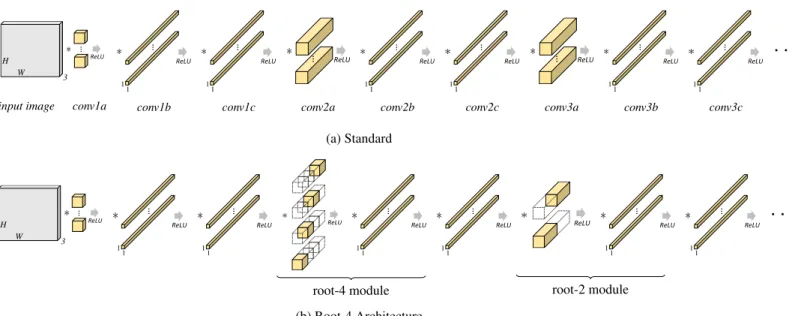
An interesting question concerns how the degree of grouping in our root modules should be varied as a func-tion of depth in the network. For the NiN-like architectures described earlier, we might consider having the degree of grouping: (1) decrease with depth after the first convolu-tional layer, e.g. 1–8–4 (‘root’); (2) remain constant with depth after the first convolutional layer, e.g. 1–4–4 (‘col-umn’); or (3) increase with depth,e.g. 1–4–8 (‘tree’).
To determine which approach is best, we created variants of the NiN architecture with different degrees of grouping per layer. Results are shown in Fig.5(numerical results are included in§A.1). The results show that the so-called root topology (illustrated in Fig.7) gives the best performance,
Table 3:ResNet 50. Filter groups in each conv. layer. Model conv1 res2{a–c} res3{a–d} res4{a–f} res5{a–c}
7×7 1×1 3×3 1×1 3×3 1×1 3×3 1×1 3×3 Orig. 1 1 1 1 1 1 1 1 1 root-2 1 1 2 1 1 1 1 1 1 root-4 1 1 4 1 2 1 1 1 1 root-8 1 1 8 1 4 1 2 1 1 root-16 1 1 16 1 8 1 4 1 2 root-32 1 1 32 1 16 1 8 1 4 root-64 1 1 64 1 32 1 16 1 8
providing the smallest reduction in accuracy for a given re-duction in model size and computational complexity. Sim-ilar experiments with deeper network architectures have delivered similar results and so we have reported results for root topologies. This aligns with the intuition of deep networks for image recognition subsuming the deformable parts model. If we assume that filter responses identify parts (or more elemental features), then there should be more fil-ter dependence with depth, as more parts (filfil-ter responses) are assembled into complex concepts.
4.3. Improving Residual Networks on ILSVRC
Residual networks (ResNets) [20] are the state-of-the art network for ILSVRC. ResNets are more computationally efficient than the VGG architecture [26] on which they are based, due to the use of low-dimensional embeddings [19]. ResNets are also more accurate and quicker to converge due to the use of identity mappings.4.3.1 ResNet 50
As a baseline, we used the ‘ResNet 50’ model [20] (the largest residual network model to fit onto 8 GPUs with Caffe). ResNet 50 has 50 convolutional layers, of which one-third are spatial convolutions (non-1×1). We did not use any training augmentation aside from random crop-ping and mirroring. For training, we used the initialization scheme described by [24] modified for compound layers [9] and batch normalization [25]. To assess the efficacy of our method, we replaced the spatial convolutional layers of the original network with root modules (as described in§3). We preserved the original number of filters per layer but subdi-vided them into groups as shown in Table3. We considered the first of the existing 1×1 layers subsequent to each spa-tial convolution to be part of our root modules.
Results are shown in Table4and Fig.8for various net-work architectures. Compared to the baseline architecture, the root variants achieve a significant reduction in compu-tation and model size without a significant reduction in ac-curacy. For example, the best result by accuracy(root-16),
ReLU … H W 3 … ReLU 1 1 … ReLU 1 1 … ReLU … ReLU 1 1 … ReLU 1 1 … ReLU … ReLU 1 1 … ReLU 1 1
· · ·
input image conv1a conv1b conv1c conv2a conv2b conv2c conv3a conv3b conv3c
(a) Standard ReLU … H W 3 … ReLU 1 1 … ReLU 1 1 ReLU … ReLU 1 1 … ReLU 1 1 ReLU … ReLU 1 1 … ReLU 1 1
· · ·
root-4 module root-2 module (b) Root-4 Architecture
Figure 7:Network-in-Network Root Architecture.The Root-4 architecture as compared to the original architecture for all the convolutional layers. Colored blocks represent the filters of each layer. Here we don’t show the intermediate feature maps over which a layer’s filters operate, or the final fully connected layer, out of space considerations (see Fig.4). The decreasing degree of grouping in successive root modules means that our network architectures somewhat resemble plant roots, hence the name root.
Table 4:ResNet 50 Results. Model FLOPS ×109 Param. ×107 Top-1 Acc. Top-5 Acc. CPU (ms) GPU (ms) Orig. 3.86 2.55 0.730 0.916 621 11.6 root-2 3.68 2.54 0.727 0.912 520 11.1 root-4 3.37 2.51 0.734 0.918 566 11.3 root-8 2.86 2.32 0.734 0.918 519 10.7 root-16 2.43 1.87 0.732 0.918 479 10.1 root-32 2.22 1.64 0.729 0.915 469 10.1 root-64 2.11 1.53 0.732 0.915 426 10.2
exceeds the baseline accuracy by 0.2% while reducing the model size by 27% and floating-point operations (multiply-add) by 37%. CPU timings were 23% faster, while GPU timings were 13% faster. With a drop in accuracy of only 0.1% however, the root-64 model reduces the model size by 40%, and reduces the floating point operations by 45%. CPU timings were 31% faster, while GPU timings were 12% faster.
4.3.2 ResNet 200
To show that the method applies to deeper architectures, we also applied our method to ResNet 200, the deepest network for ILSVRC 2012. To provide a baseline we used code
im-Table 5:ResNet-200 Results
Model FLOPS×1012 Param.×107 Top-1 Acc. Top-5 Acc.
Orig. 5.65 6.25 0.7804 0.9377 root-2 5.64 6.24 0.7832 0.9408 root-4 5.46 6.06 0.7806 0.9393 root-8 4.84 4.91 0.7795 0.9374 root-16 4.43 3.98 0.7814 0.9399 root-32 4.23 3.51 0.7793 0.9370 root-64 4.13 3.28 0.7790 0.9396
plementing full training augmentation to achieve state-of-the-art results2. Table5shows the results, top-1 and top-5
error are for center cropped images. The models trained with roots have comparable or lower error, with fewer pa-rameters and less computation. The root-64 model has 27% fewer FLOPS and 48% fewer parameters than ResNet 200.
4.4. Improving GoogLeNet on ILSVRC
We replicated the network as described by Szegedy, Liu, Jia, et al.[2], with the exception of not using any training augmentation aside from random crops and mirroring (as supported by Caffe [27]). To train we used the initialization of [24] modified for compound layers [9] and batch
1.6 1.8 2 2.2 2.4 2.6 ·107 7% 8% 9% 2 4 8 16 32 64
Model Parameters (# Floats)
T
op-5
Error
ResNet 50 All Filters
(a)Model Parametersvs. Top-5 Error.
2.5 3 3.5 ·109 7% 8% 9% 2 4 8 16 32 64 FLOPS (Multiply-Add) T op-5 Error
(b)FLOPS (Multiply-Add)vs. Top-5 Error.
10 10.2 10.4 10.6 10.8 11 11.2 11.4 11.6 7% 8% 9% 2 4 8 16 32 64 GPU Forward (ms) T op-5 Error
(c)GPU Forward Timevs. Top-5 Error.
450 500 550 600 7% 8% 9% 2 4 8 16 32 64 CPU Forward (ms) T op-5 Error
(d)CPU Forward Timevs. Top-5 Error.
Figure 8: ResNet-50 Results. Models with filter groups have fewer parameters, and less floating point operations, while maintaining error comparable to the baseline.
ization without the scale and bias [25]. At test time we only evaluate the center crop image.
While preserving the original number of filters per layer, we trained networks with various degrees of filter grouping, as described in Table7. While the inception architecture is relatively complex, for simplicity, we always use the same number of groups within each of the groups of different fil-ter sizes, despite them having different cardinality. For all of the networks, we only grouped filters within each of the ‘spatial’ convolutions (3×3, 5×5).
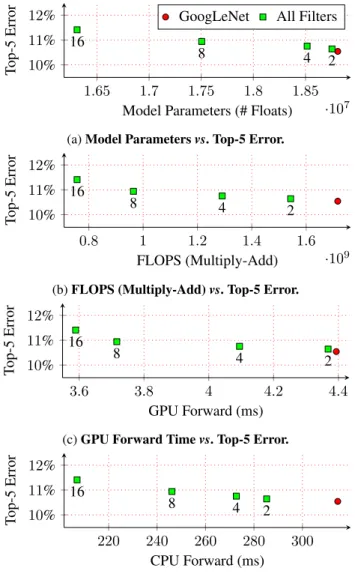
As shown in Table6, and plotted in Fig.9, our method
Table 6:GoogLeNet Results. Model FLOPS ×109 Param. ×107 Top-1 Acc. Top-5 Acc. CPU (ms) GPU (ms) Orig. 1.72 1.88 0.694 0.894 315 4.39 root-2 1.54 1.88 0.695 0.893 285 4.37 root-4 1.29 1.85 0.693 0.892 273 4.10 root-8 0.96 1.75 0.691 0.891 246 3.72 root-16 0.76 1.63 0.683 0.886 207 3.59 Table 7: GoogLeNet. Filter groups in each convolutional layer and Inception module (incp.)
Model conv1conv2 incp. 3{a,b} incp. 4{a–e} incp. 5{a,b}
7×7 1×1 3×3 1×1 3×3 5×5 1×1 3×3 5×5 1×1 3×3 5×5 Orig. 1 1 1 1 1 1 1 1 1 1 1 1 root-2 1 1 2 1 1 1 1 1 1 1 1 1 root-4 1 1 4 1 2 2 1 1 1 1 1 1 root-8 1 1 8 1 4 4 1 2 2 1 1 1 root-16 1 1 16 1 8 8 1 4 4 1 2 2
shows significant reduction in computational complexity – as measured in FLOPS (multiply-adds), CPU and GPU tim-ings – and model size, as measured in the number of floating point parameters. For many of the configurations the top-5 accuracy remains within 0.5% of the baseline model. The highest accuracy result, is 0.1% off the top-5 accuracy of the baseline model, but has a 0.1% higher top-1 accuracy – within the error bounds resulting from training with dif-ferent random initializations. While maintaining the same accuracy, this network has 9% faster CPU and GPU timings. However, a model with only 0.3% lower top-5 accuracy than the baseline has much higher gains in computational efficiency – 44% fewer floating point operations (multiply-add), 7% fewer model parameters, 21% faster CPU and 16% faster GPU timings.
While these results may seem modest compared to the results for ResNet, GoogLeNet is by far the smallest and fastest near state-of-the-art model ILSVRC model. We be-lieve that more experimentation in using different cardinal-ities of filter grouping in the heterogeneously-sized filter groups within each inception module will improve results further.
5. GPU Implementation
Our experiments show that our method can achieve a sig-nificant reduction in CPU and GPU runtimes for state-of-the-art CNNs without compromising accuracy. However, the reductions in GPU runtime were smaller than might have been expected based on theoretical predictions of
com-1.65 1.7 1.75 1.8 1.85 ·107 10% 11% 12% 2 4 8 16
Model Parameters (# Floats)
T
op-5
Error
GoogLeNet All Filters
(a)Model Parametersvs. Top-5 Error.
0.8 1 1.2 1.4 1.6 ·109 10% 11% 12% 2 4 8 16 FLOPS (Multiply-Add) T op-5 Error
(b)FLOPS (Multiply-Add)vs. Top-5 Error.
3.6 3.8 4 4.2 4.4 10% 11% 12% 2 4 8 16 GPU Forward (ms) T op-5 Error
(c)GPU Forward Timevs. Top-5 Error.
220 240 260 280 300 10% 11% 12% 2 4 8 16 CPU Forward (ms) T op-5 Error
(d)CPU Forward Timevs. Top-5 Error.
Figure 9: GoogLeNet Results. Models with filter groups have fewer parameters, and less floating point operations, while maintaining error comparable to the baseline.
putational complexity (FLOPs). We believe this is largely a consequence of the optimization of Caffe for existing net-work architectures (particularly AlexNet and GoogLeNet) that do not use a high degree of filter grouping.
Caffe presently parallelizes over filter groups by using multiple CUDA streams to run multiple CuBLAS matrix multiplications simultaneously. However, with a large de-gree of filter grouping, and hence more, smaller matrix mul-tiplications, the overhead associated with calling CuBLAS from the host can take approximately as long as the matrix computation itself. To avoid this overhead, CuBLAS pro-vides batched methods (e.g. cublasXgemmBatched), where many small matrix multiplications can be batched to-gether in one call. Jhurani and Mullowney [28] explore in
depth the problem of using GPUs to accelerate the multi-plication of very small matrices (smaller than 16×16), and show it is possible to achieve high throughput with large batches, by implementing a more efficient interface than that used in the CuBLAS batched calls. We have modified Caffe to use CuBLAS batched calls, and achieved signifi-cant speedups for our root-like network architectures com-pared to vanilla Caffe without CuDNN, e.g. a 25% speed up on our root-16 modified version of the GoogleNet archi-tecture. However, our optimized implementation still is not as fast as Caffe with CuDNN (which was used to generate the results in this paper), presumably because of other un-related optimizations in the (proprietary) CuDNN library. Therefore we suggest that direct integration of CuBLAS-style batching into CuDNN could improve the performance of filter groups significantly.
6. Future Work
In this paper we focused on using homogeneous filter groups (with a uniform division of filters in each group), however this may not be optimal. Heterogeneous filter groups may reflect better the filter co-dependencies found in deep networks. Learning a combined spatial [9] and chan-nel basis, may also improve efficiency further.
7. Conclusion
We explored the effect of using complex hierarchical ar-rangements of filter groups in CNNs and show that impos-ing a structured decrease in the degree of filter groupimpos-ing with depth – a ‘root’ (inverse tree) topology – can allow us to obtain more efficient variants of state-of-the-art net-works without compromising accuracy. Our method ap-pears to be complementary to existing methods, such as low-dimensional embeddings, and can be used more effi-ciently to train deep networks than methods that only ap-proximate a pre-trained model’s weights.
We validated our method by using it to create more efficient variants of state-of-the-art Network-in-network, GoogLeNet, and ResNet architectures, which were evalu-ated on the CIFAR10 and ILSVRC datasets. Our results show similar accuracy with the baseline architecture with fewer parameters and much less compute (as measured by CPU and GPU timings). For Network-in-Network on CI-FAR10, our model has 33% of the parameters of the orig-inal network, and approximately 37% (23%) faster CPU (GPU) timings. For ResNet 50, our model has 40% fewer parameters, and was 31% (12%) faster on a CPU (GPU). For ResNet 200 our model has 27% fewer FLOPS and 48% fewer parameters. Even for the most efficient of the near state-of-the-art ILSVRC network, GoogLeNet, our model uses 7% fewer parameters and is 21% (16%) faster on a CPU (GPU).
References
[1] M. Denil, B. Shakibi, L. Dinh, M. Ranzato, and N. de Freitas, “Predicting parameters in deep learning,” in Neural Information Processing Systems (NIPS), 2013, pp. 2148–2156. arXiv:1306 . 0543(cit. on p.1).
[2] C. Szegedy, W. Liu, Y. Jia, P. Sermanet, S. Reed, D. Anguelov, D. Erhan, V. Vanhoucke, and A. Rabi-novich, “Going deeper with convolutions,” in Com-puter Vision and Pattern Recognition (CVPR), 2015 (cit. on pp.1,2,6).
[3] E. Denton, W. Zaremba, J. Bruna, Y. LeCun, and R. Fergus, “Exploiting linear structure within convolu-tional networks for efficient evaluation,” in ArXiv, 2014, pp. 1–11. arXiv:1404.0736(cit. on p.1). [4] A. Krizhevsky, I. Sutskever, and G. E. Hinton,
“Im-agenet classification with deep convolutional neural networks,” inAdvances In Neural Information Pro-cessing Systems, P. L. Bartlett, F. C. N. Pereira, C. J. C. Burges, L. Bottou, and K. Q. Weinberger, Eds., 2012, pp. 1–9,ISBN: 9781627480031. arXiv:1102. 0183(cit. on pp.1,2).
[5] G. E. Hinton, N. Srivastava, A. Krizhevsky, I. Sutskever, and R. R. Salakhutdinov,Improving neu-ral networks by preventing co-adaptation of feature detectors, 2012. arXiv:1207.0580(cit. on pp.1,
3).
[6] K Fukushima, “Neocognitron: a self-organizing neu-ral network model for a mechanish of pattern recog-nition unaffected by shifts in position,” Biological Cybernetics, vol. 36, pp. 193–202, 1980 (cit. on p.1). [7] Y Lecun, L Bottou, Y Bengio, and P Haffner, “Gradient-based learning applied to document recog-nition,” Proceedings of the IEEE, vol. 86, no. 11, pp. 2278–2324, 1998,ISSN: 0018-9219 (cit. on p.1).
[8] M. Minsky and S. Papert, Perceptrons. MIT press, 1988 (cit. on p.1).
[9] Y. Ioannou, D. P. Robertson, J. Shotton, R. Cipolla, and A. Criminisi, “Training cnns with low-rank filters for efficient image classification,” in Inter-national Conference on Learning Representations, 2016 (cit. on pp.1,3,5,6,8).
[10] F. Mamalet and C. Garcia, “Simplifying convnets for fast learning,” inArtificial Neural Networks and Machine Learning–ICANN 2012, Springer, 2012, pp. 58–65 (cit. on p.1).
[11] M. Jaderberg, A. Vedaldi, and A. Zisserman, “Speed-ing up convolutional neural networks with low rank expansions.,” inBritish Machine Vision Conference, 2014 (cit. on pp.1,2).
[12] A. Sironi, B. Tekin, R. Rigamonti, V. Lepetit, and P. Fua, “Learning separable filters,”IEEE Transactions on Pattern Analysis and Machine Intelligence, vol. 37, no. 1, pp. 94–106, 2015,ISSN: 01628828 (cit. on
p.1).
[13] V. Lebedev, Y. Ganin, M. Rakhuba1, I. Oseledets, and V. Lempitsky, “Speeding-up convolutional neu-ral networks using fine-tuned cp-decomposition,” International Conference on Learning Representa-tions (ICLR), vol. abs/1412.6, pp. 1–10, 2015. arXiv: arXiv:1412.6553v2(cit. on pp.1,2).
[14] M. Mathieu, M. Henaff, and Y LeCun, “Fast train-ing of convolutional networks through ffts,” Inter-national Conference on Learning Representations (ICLR), pp. 1–9, 2014. arXiv: arXiv : 1312 . 5851v5(cit. on p.1).
[15] O. Rippel, J. Snoek, and R. P. Adams, “Spectral rep-resentations for convolutional neural networks,” Ad-vances in Neural Information Processing Systems 28, pp. 2440–2448, 2015, ISSN: 10495258. arXiv: 1506.03767(cit. on p.1).
[16] S. Gupta, A. Agrawal, K. Gopalakrishnan, and P. Narayanan, Deep learning with limited numerical precision, 2015. arXiv:1502.02551(cit. on p.1). [17] W. Chen, J. T. Wilson, S. Tyree, K. Q. Weinberger,
and Y. Chen, “Compressing neural networks with the hashing trick,” in Proceedings of The 32nd In-ternational Conference on Machine Learning, F. R. Bach and D. M. Blei, Eds., ser. JMLR Proceed-ings, vol. 37, JMLR.org, 2015, pp. 2285–2294,ISBN: 9781510810587. arXiv:1504.04788(cit. on p.1). [18] Y.-D. Kim, E. Park, S. Yoo, T. Choi, L. Yang, and D. Shin, “Compression of deep convolutional neu-ral networks for fast and low power mobile applica-tions,” inInternational Conference on Learning Rep-resentations (ICLR), 2016, pp. 1–16. arXiv:1511. 06530(cit. on pp.1,2).
[19] M. Lin, Q. Chen, and S. Yan, “Network in network,” ArXiv preprint, vol. abs/1312.4, p. 10, 2013. arXiv: 1312.4400(cit. on pp.2,4,5).
[20] K. He, X. Zhang, S. Ren, and J. Sun, “Deep resid-ual learning for image recognition,” Arxiv.Org, vol. 7, no. 3, pp. 171–180, 2015,ISSN: 1664-1078. arXiv: 1512.03385(cit. on pp.2,4,5).
[21] M. Cogswell, F. Ahmed, R. B. Girshick, L. Zitnick, and D. Batra, “Reducing overfitting in deep networks by decorrelating representations.,” in International Conference on Learning Representations, 2016 (cit. on p.3).
[22] A. Krizhevsky, “Learning multiple layers of features from tiny images,” Univ. Toronto, Technical Report, 2009, pp. 1–60. arXiv:arXiv:1011.1669v3(cit. on pp.4,11).
[23] I. J. Goodfellow, D. Warde-Farley, M. Mirza, A. Courville, and Y. Bengio, “Maxout networks,” in Proceedings of the 30th International Conference on Machine Learning (ICML), vol. 28, 2013, pp. 1319– 1327. arXiv:1302.4389(cit. on p.4).
[24] K. He, X. Zhang, S. Ren, and J. Sun, “Delving deep into rectifiers: surpassing human-level perfor-mance on imagenet classification,” inIEEE Confer-ence on Computer Vision and Patern Recognition (ICCV), IEEE, 2015, pp. 1026–1034, ISBN: 978-1-4673-8391-2. arXiv:1502 . 01852(cit. on pp.4–
6).
[25] S. Ioffe and C. Szegedy, “Batch normalization: ac-celerating deep network training by reducing inter-nal covariate shift.,” inProceedings of the 32 nd In-ternational Conference on Machine Learning, Lille, France, 2015, 2015 (cit. on pp.4,5,7).
[26] K Simonyan and A Zisserman, “Very deep convo-lutional networks for large-scale image recognition,” inEprint ar{X}iv:arXiv:1409.1556v5, 1409 (cit. on p.5).
[27] Y. Jia, E. Shelhamer, J. Donahue, S. Karayev, J. Long, R. Girshick, S. Guadarrama, and T. Darrell, “Caffe: convolutional architecture for fast feature embedding,”ACM International Conference on Mul-timedia, pp. 675–678, 2014,ISSN: 10636919. arXiv: 1408.5093(cit. on p.6).
[28] C. Jhurani and P. Mullowney, “A gemm interface and implementation on nvidia gpus for multiple small matrices,”Journal of Parallel and Distributed Com-puting, vol. 75, pp. 133–140, 2015 (cit. on p.8).
![Figure 3: Learning a (Spatial) Basis for Filters. Learn- Learn-ing a linear combination of mostly small, heterogeneously sized spatial filters [9]](https://thumb-us.123doks.com/thumbv2/123dok_us/10233275.2927246/3.918.462.820.112.379/figure-learning-spatial-filters-combination-heterogeneously-spatial-filters.webp)