LTSmin: High-Performance
Language-Independent Model Checking
Gijs Kant,1,? Alfons Laarman,1,2,§ Jeroen Meijer,1 Jaco van de Pol,1
Stefan Blom1,‡ and Tom van Dijk1,k
1 Formal Methods and Tools, University of Twente, The Netherlands 2
Formal Methods in Systems Engineering, Vienna University of Technology, Austria
Abstract. In recent years, theLTSminmodel checker has been extended with support for several new modelling languages, including probabilis-tic (Mapa) and timed systems (Uppaal). Also, connecting additional language front-ends or ad-hoc state-space generators toLTSminwas sim-plified using custom C-code. From symbolic and distributed reachability analysis and minimisation,LTSmin’s functionality has developed into a model checker with multi-core algorithms for on-the-fly LTL checking with partial-order reduction, and multi-core symbolic checking for the modal
µ-calculus, based on the multi-core decision diagram packageSylvan. InLTSmin, the modelling languages and the model checking algorithms are connected through a Partitioned Next-State Interface (Pins), that allows to abstract away from language details in the implementation of the analysis algorithms and on-the-fly optimisations. In the current paper, we present an overview of the toolset and its recent changes, and we demonstrate its performance and versatility in two case studies.
1
Introduction
TheLTSminmodel checker has a modular architecture which allows a number of modelling language front-ends to be connected to various analysis algorithms, through a common interface. It provides both symbolic and explicit-state anal-ysis algorithms for many different languages, enabling multiple ways to attack verification problems. This connecting interface is calledPartitioned Next-State Interface (Pins), the basis of which consists of a state-vector definition, an initial state, a partitioned successor function (NextState), and labelling functions.
Pinsdefines an implicit state space, abstracting away from modelling language
details.
The main difference with other language interfaces, such as theOpen/Cæsar interface [21] of CADP [22] and the CESMI interface of DiVinE [3], is the structure that Pinsexposes by exporting dependencies between thepartitioned
?
Supported by the NWO under grant 612.000.937 (VOCHS). §
Supported by the Austrian National Research Network S11403-N23 (RiSE) of the Austrian Science Fund (FWF) and by the Vienna Science and Technology Fund (WWTF) grant VRG11-005.
‡
Partially funded by NWO under grant 612.063.817 (SYRUP). k
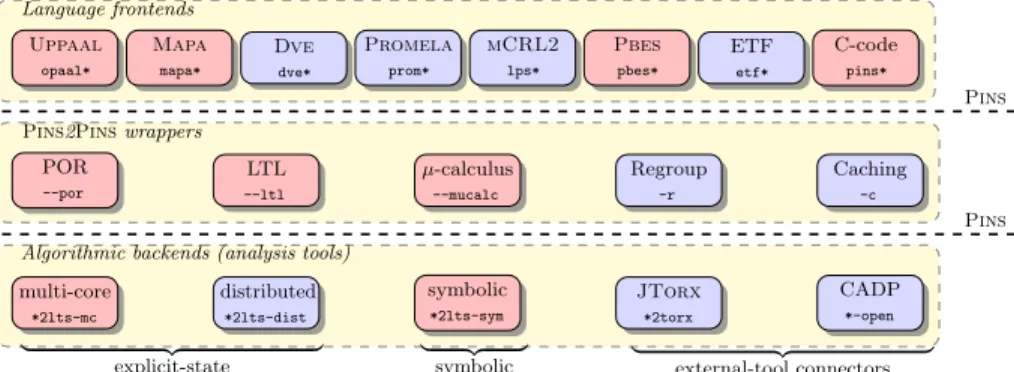
Language frontends
Pins2Pinswrappers
Algorithmic backends (analysis tools)
Uppaal opaal* Mapa mapa* Dve dve* Promela prom* mCRL2 lps* Pbes pbes* ETF etf* C-code pins* Pins POR --por LTL --ltl µ-calculus --mucalc Regroup -r Caching -c Pins multi-core *2lts-mc distributed *2lts-dist symbolic *2lts-sym JTorx *2torx CADP *-open | {z }
explicit-state |symbolic{z } | external-tool connectors{z }
Fig. 1:LTSmin’sPinsarchitecture.
successor function and the variables in the state vector in the form ofdependency matrices. Our approach is also dissimilar fromNuSMV’s [9], where the transi-tionrelation is specified directly, imposing restrictions on the language. In the past, we have shown that these dependencies enable symbolic reachability using BDDs/MDDs with multiple orders of magnitude performance improvement [7, 8] as well as (explicit-state) distributed reachability with state compression [6].
Recently, we extendedPinswith separate read and write dependency matri-ces, special state labels for guards, and guard/transition dependency matrices. This extended interface, which we callPins+, enables further performance im-provements for the symbolic tools [40] and on-the-fly partial-order reduction (POR) [32] for the explicit-state tools.Pins+will be presented in Section 2.
LTSminoffers extensive analysis of implicit state spaces throughPins:
reacha-bility analysis, including deadlock detection, action detection and invariant/asser-tion checking, but since recently also verificainvariant/asser-tion of Linear Time (LTL) and modalµ-calculus properties. The toolset and its architecture have been previ-ously presented in, e.g., [7], [5] and [8]. This article covers the changes since then. An up-to-date overview ofLTSminis in Figure 1; this paper focuses on the pink (dark) boxes. The toolset is open source.3
The languages supported byLTSmin are listed in Table 1, including newly added support for probabilistic (Mapa) and timed systems (Uppaal) and for boolean equation systems with data types (Pbes). New is also the possibility to add a new language front-end by providing a dynamically loaded.so-library implementing thePins interface. These additions will be presented in Section 3.
Table 1: Languages supported byLTSmin. Uppaal Timed automata.
Mapa Process algebra for Markov automata from theScooptool. Dve The modelling language of theDiVinEmodel checker. Promela The modelling language of theSpinmodel checker. mCRL2 Process algebra.
Pbes Parameterised Boolean Equation Systems. Etf Built-in symbolic format.
3
In the explicit-state tools, new multi-core algorithms provide scalable LTL checking with POR and state compression. The symbolic tools have been ex-tended with the multi-coredecision diagram(DD) packagesSylvanandLDDmc, enabling multi-core symbolic analysis algorithms by parallelising their DD op-erations. A symbolic parity game solver has been added, enabling multi-core symbolicµ-calculus checking. These additions will be described in Section 4 and 5.
2
The
Pins
-architecture of
LTSmin
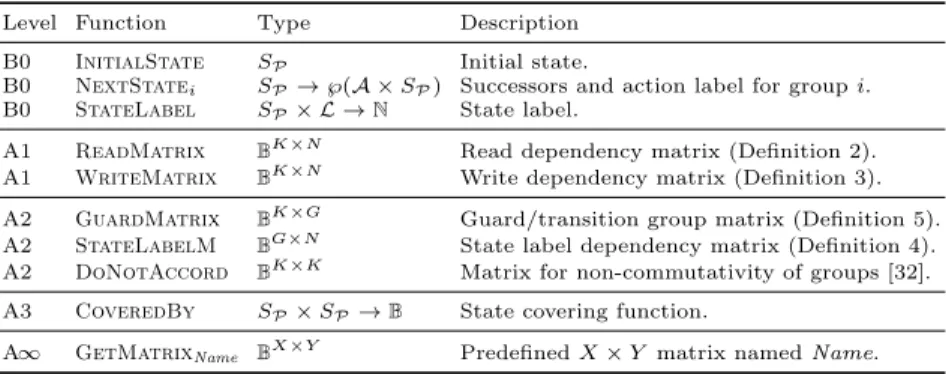
The starting point of our approach is a generalised implicit model of systems, called thePartioned Next-State Interface (Pins). An overview ofPinsfunctions is in Table 2. The functionsInitialState,NextStateandStateLabelare mandatory, as well as the state vector lengthN, the number of transition groups K, and the names and types of labels, slots and actions. Together, these give rise to a transition system, see Section 2.1.
On top of this basic Pins interface, we distinguish several axes of exten-sions, A1 till A∞, which together form the extended Pins+ interface. These extensions allow to expose enough structure, in the form of information about dependency relations, to enable high-performance algorithms. The first axis of such information is provided by the functions labelled A1: the read and write dependency matrices (see [40]). LTSmin’s POR layer (see Section 4.3) requires guards, exported as special state labels, and theGuardMatrix,StateLabelM
and DoNotAccord dependency matrices – the functions labelled A2. The definitions of the dependencies and guards are given in Section 2.2.
The simulation relation over states provided by theCoveredBy function, labelled A3, allows powerful subsumption abstraction [14] in our algorithms. Timed language formalisms allow such abstractions as described in Section 3.2. In the future, a symmetry-reduction layer, a la [17], could implementCoveredBy.
Other named matrices, can be added to the genericGetMatrixfunction, which we label A∞. This is used to increase POR’s precision and facilitate statistical systems such as withMapa(see Section 3.1).
We writeMatrix(x) as shorthand for{y|(x, y)∈Matrix}.
Table 2: Functions inPins+are divided along multiple axes.
Level Function Type Description
B0 InitialState SP Initial state.
B0 NextStatei SP →℘(A ×SP) Successors and action label for groupi.
B0 StateLabel SP× L →N State label.
A1 ReadMatrix BK×N Read dependency matrix (Definition 2). A1 WriteMatrix BK×N Write dependency matrix (Definition 3).
A2 GuardMatrix BK×G Guard/transition group matrix (Definition 5). A2 StateLabelM BG×N State label dependency matrix (Definition 4). A2 DoNotAccord BK×K Matrix for non-commutativity of groups [32]. A3 CoveredBy SP×SP →B State covering function.
2.1 Partitioned transition systems
InPins, states are vectors ofN values. We writehx1, . . . , xNi, for vector variables, or simplyxfor the state vector. Each position j in the vector (1≤j≤N) is called aslotand has a unique identifier and a type, which are used in the language front-ends to specify conditions and updates. TheNextStatefunction, which computes the successors of a state, is partitioned in K disjunctive transition groups, such that NextState(x) =S
1≤i≤KNextStatei(x). We have action labelsa∈ A and a set ofM state labelsL. A model, available throughPins, gives rise to aPartitioned Transition System (PTS).
Definition 1. A PTS is a structureP =
SP,→P,s0, L, where
– SP =S1× · · · ×SN is the set of statess∈SP, which are vectors ofN values,
– →P =SKi=1→i is the labelled transition relation, which is a union of theK
transition groups →i⊆SP× A ×SP (for1≤i≤K),
– s0=s01, . . . , s0N∈SP is the initial state, and
– L:SP × L →Nis a state labelling function.
We write s −→a i t when (s, a,t) ∈ →i for 1 ≤ i ≤ K, and s a
−→P t when (s, a,t)∈ →P. ConsideringLas binary state labels,L(s)denotes the set of labels that hold in states, i.e. we defineL(s) :={`| L(s, `)6= 0}.
When the LTL layer is used, the output PTS is interpreted as a B¨uchi automaton, where accepting states are marked using a special state label. When using theµ-calculus layer or thePbesfront-end, the output PTS is interpreted as a parity game, where two state labels encode the player and the priority. When using the Mapa front-end, the output is a Markov automaton, where transitions are decorated with labels, representing hyperedges with rates. For all these interpretations, the samePinsinterface is used.
2.2 Dependencies and guards
The partitioning of the state vector intoslots and of the transition relations into transition groups, enables to specify thedependencies between the two, i.e., which transition groups touch which slots of the vector.
Previously, we used a single notion of dependency; now we distinguish read, write and label dependencies [32, 40]. The read and write dependencies allow to project state vectors to relevant slots only, improving performance of both caching, state compression and the symbolic tools. Label dependencies enable POR. The following definitions apply to each PTSP =
SP,→P,s0, L.
Definition 2 (Read independence).Transition groupi is read-independent from state slotj, if for all s,t∈SP withs→it, we have:
∀rj∃rj0 ∈Sj: hs1, . . . , rj, . . . , sNi →it1, . . . , r0j, . . . , tN∧r0j∈ {rj, tj} ,
i.e., whatever value rj we plug in, the transition is still possible, the values tk (k6=j) do not depend on the value ofrj, and the value of state slotj is either copied (r0j=rj) or overwritten (r0j=tj).
Definition 3 (Write independence).Transition groupiis write-independent from state slotj, if:
∀s,t∈SP: hs1, . . . , sj, . . . , sNi →iht1, . . . , tj, . . . , tNi ⇒(sj=tj) ,
i.e., state slot j is never modified in transition groupi.
Definition 4 (Label independence). Labell∈ Lis independent from state slotj, if:
∀s∈SP, tj∈Sj:L(hs1, . . . , sj, . . . , sNi, l) =L(hs1, . . . , tj, . . . , sNi, l) .
Definition 5 (Guards). Transition guards are represented as a subset of labels
G ⊆ L. To each transition group we associate a set of guards. The guards associated with groupi, denoted G(i), are evaluated conjunctively, i.e., transition group i is only enabled in state s if all guards g ∈ G(i) hold: if s →i t then
G(i)⊆L(s).
We have provided semantic requirements for read, write and label indepen-dence relations. The language front-end must provide these dependency matrices. It can approximate dependencies using static analysis, for instance by checking occurrence of variables in expressions. Note that it is always safe to assume that groups/labels do depend on a state slot.
3
Language front-ends
LTSminalready supported the languagesmCRL2[11], DiVinE[3], andSpin’s Promela [26] (through SpinS [4]). Since recently, also Mapa, Uppaal and
Pbesare available, as well as the ability to load a model from a binary.so-file, all of which will be discussed in the current section.
3.1 MAPA: Markov Automata Process Algebra
For verification of quantitative aspects of systems, we support Mapa:Markov Automata Process Algebra. MA’s are automata with non-deterministic choice, probabilistic choice and stochastic rates, generalizing LTS, PA, MDP and CTMC. TheScooptool [43] offers state-space generation forMapaspecifications, apply-ing several reduction techniques. It is part of theMaMa toolchain [25] for the quantitative analysis of Markov automata.LTSminhas been extended with a
Mapalanguage module based onScoop, allowing for high-performance state space generation for Mapa specifications. This language module uses Pins+ A∞to add aninhibit matrix and aconfluence matrix. The maximum progress assumption in the semantics of Markov automata forbids taking stochastic rate transitions when some action-labelled transition is enabled. This has been im-plemented using ainhibit matrix: when the higher priority transition is enabled, other transitions are inhibited. The distributed and symbolic tools ofLTSmin have been extended to handle inhibit matrices for Mapa. The distributed tool also includes confluence reduction.
3.2 Uppaal: Timed Automata
The langague frontend for Uppaal timed automata is based on Opaal [12]. The C-code generated byOpaal implements the Pins+ A3 interface. Timed automata require symbolic states to handle time, for whichOpaalrelies on the difference bounds matrices from the DBM-library. This is supported byPins, by dedicating two reserved state slots for a pointer to a symbolic time abstraction. Subsumption abstraction can prune large parts of the PTS on-the-fly.LTSmin
checks if two states subsume each other (svt) via theCoveredBy-relation in
Pins+, which is implemented by a call to the DBM-library. The reduced state
space only consists ofv-maximal states. Sincev is a simulation relation [14], the reduced PTS is a valid abstraction of the original PTS. The reachability algorithms in the multi-core tool perform this abstraction (opaal2lts-mc -u2). To maintainv-maximal states, the pointers to the DBMs are stored in a separate lockless multi-map [12].
A new LTL model checking algorithm with subsumption [36] is also supported, by extending the multi-corecndfsalgorithm (see Section 5.1).
3.3 PBES: Parameterized Boolean Equation Systems
Parameterised Boolean Equation Systems (Pbess) extend Boolean equations with nested fixed points and data parameters. [24, 39] Several verification tasks are mapped toPbess by themCRL2and CADP toolsets, such as model checking modalµ-calculus properties and equivalence checking. ThemCRL2toolset offers various tools for manipulating and solvingPbess. LTSminnow provides high-performance generation of parity games fromPbess [29], by viewing them as PTSs with special labels for players and priorities. ThePbeslanguage module is available via thepbes2lts-*tools. The generated parity games can be solved by the means described in Section 5.
3.4 C-code via the dlopen interface
TheUNIX/POSIX dlopen-interface allows to specify a model or a language directly in C. We show an example of how this can be done for the Sokoban game board in Figure 2. The goal of sokoban is for the player (@) to move all boxes ($)
# # # # # #.$@ # # # # # # Fig. 2: Example board in the room to destination locations (.) without hitting walls (#). This behavior is implemented in the functionnext state in List-ing 1. For each place in the board, we reserve one slot in the state vector. We add a state labelgoal, to distinguish states where the game is finished. Finally, aninitial statefunction is defined, and functions returning dependency matrices. These need to be set using the GBset*functions in Listing 2. Setting the name of the plugin is also required.sokoboard.cis then compiled as shared library: gcc -shared -o sokoboard.so dlopen-impl.o sokoboard.o.
To analyse the reachability of the goal label, call, e.g., the multi-core tool: pins2lts-mc sokoboard.so --invariant="!goal" --trace=solution.gcf.
Listing 1: sokoboard.c void next_state(int group, int* src,
void (*callback)(int* dst, int action)) { int dst[3]; int action;
memcpy(dst, src, 3); if (group == 0
&& src[1] == EMPTY && src[2] == MAN) { dst[1] = MAN; dst[2] = EMPTY;
action = WALK_LEFT; callback(dst, action); }
else if (group == 1
&& src[1] == MAN && src[2] == EMPTY) { dst[1] = EMPTY; dst[2] = MAN;
action = WALK_RIGHT; callback(dst, action); }
else if (group == 2 && src[0] == EMPTY && src[1] == BOX && src[2] == MAN) { dst[0] = BOX; dst[1] = MAN;
dst[2] = EMPTY; action = PUSH_LEFT; callback(dst, action);
} }
int state_label(int* src, int label)
{return label == LABEL_GOAL && src[0] == BOX;}
int* initial_state() { return {EMPTY, BOX, MAN}; }
int* read_matrix() { return {{0,1,1}, {0,1,1}, {1,1,1}}; } int* write_matrix() { return {{0,1,1}, {0,1,1}, {1,1,1}}; } int* label_matrix() { return {{1,0,0}}; } Listing 2: dlopen-impl.c #include <ltsmin/pins.h> #include <ltsmin/dlopen-api.h> #include <sokoboard.h>
char pins_plugin_name[] = "sokoban"; void pins_model_init(model_t m) { GBsetInitialState(m, initial_state()); GBsetNextStateLong(m, next_state); GBsetStateLabelLong(m, state_label); GBsetDMInfoRead(m, read_matrix()); GBsetDMInfoMustWrite(m, write_matrix()); GBsetStateLabelInfo(m, label_matrix()); }
4
Intermediate layers
Between language front-ends and the model checking back-ends, pins2pins -wrappers provide performance optimisations, state space reductions, and support for verification of LTL andµ-calculus properties. The caching layerreduces the number of next-state calls to the language module by storing the projected results of previous calls. The regrouping layerprovides variable reordering, useful for the symbolic analysis tool, and reduces overhead by merging transition groups. The current section describes recent innovations in the intermediate layers, which are all language-independent and agnostic of the underlying model checking algorithm.
4.1 The LTL layer
LTSminsupports Linear Time Logic (LTL) formulae defined by the grammar:
λ::=true|false|v==n|!λ|[]λ|<>λ|Xλ|λ&&λ|λ||λ|λ->λ|λ<->λ|λUλ|λRλ The negated formula is translated to a B¨uchi automaton usingltl2ba[23]. The product of the PTS and the B¨uchi automaton is computed on-the-fly, i.e., the layer does not perform reachability in advance. Instead, it wraps theNextState function of a language module in its ownNextStatefunction, which synchronises the translated B¨uchi automaton on the state labels or slot values of successor states (the expressionv==ncan refer to a label or a slot namedv). The synchronised
successors are then passed to the analysis algorithm. A label added by the layer allows the algorithm to distinguish B¨uchi accepting states. On-the-fly accepting cycle detection algorithms are described in Section 5.1.
4.2 The µ-calculus layer
The modalµ-calculus layer supports formulae defined by the grammar: ϕ::=true|false| {v=e} |!{v=e} |ϕ&&ϕ|ϕ||ϕ|Z|σZ. ϕ|[α]ϕ|<α>ϕ , where v is a state variable, e is a value, σ ∈ {mu,nu} is a minimal (mu) or maximal (nu) fixpoint operator, andαis an action label.
Theµ-calculusPins2Pinslayer reads a modal µ-calculus propertyϕfrom a file, provided using the--mucalcoption, and generates a parity game, which is the productP ×ϕof the formula and a systemP that is explored throughPins. Like the B¨uchi automaton, this game is generated on-the-fly. The explicit-state tools can write the parity game to a file which can be converted to a format that is readable by the toolspgsolver[20] andpbespgsolve (frommCRL2). The symbolic tools can write the game to a file, which can be solved by the newLTSmin tool spgsolver. The symbolic tools also have an alternative implementation for µ-calculus model checking (available through the--mu option), which is a fixpoint algorithm applied to the system after reachability. This implementation also supports CTL* through the translation in [13] (the--ctl-staroption).
4.3 The partial-order reduction layer
Partial-Order Reduction (POR, [30, 44]) greatly reduces a PTS by pruning irrele-vant interleavings.LTSminimplements POR as an intermediate layer (cf. Fig-ure 1). This POR layer (--por) wraps the next-state function of any language module, and provides a reduced state space to any analysis tool by replacing it with anon-the-fly reduction function:PorState(s)⊆NextState(s).
We rephrased the stubborn set method [44] in terms of guards [32] to achieve language independence. For any state, a set of (enabled or disabled) stubborn transitions is computed, andPorState(s) corresponds to the enabled stubborn transitions. The stubborn set should (1) contain at least one enabled transition if one exists; (2) contain all non-commuting transitions for theenabled selected transitions; and (3) contain anecessary-enabling setof transitions for thedisabled selected transitions.
To compute stubborn sets,LTSminneeds structural model information via the
Pins+A2 interface. For effective POR, we extendedPinstransitions with guards (Definition 5). In particular, a language module must declare when transitions commute, and the dependencies of guards (Definition 4). The former is declared with theDoNotAccord:BK×K-matrix. It should satisfy:
Definition 6 (Do-not-accord). Transition groupsi andj are according, if
∀s, si, sj∈s:s→isi∧s→jsj ⇒ ∃t∈s:si→j t∧sj→it Otherwise, they must be declared conflicting in the DoNotAccordmatrix.
Next, the POR layer derives an enabling relation from the provided de-pendency information. A transition ican only enable guardg, if iwrites to a variable thatgdepends on:EnableMatrixK×G ≡ {(i, g)|WriteMatrix(i)∩
StateLabelM(g)6=∅}. A set of necessary-enabling transitions for a disabled
transitionj can then be found by selectingone disabled guardgofj and taking all transitions that may enableg:EnableMatrix(g).
Optionally, these notions can be further refined by the language module for more reduction, by providing additionalPins+A∞matrices. For example, the language module can compute a detailedEnableMatrixby static analysis on assignment expressions and guards, or aDisableMatrixand a co-enabled-matrixon guards to leverage the power ofnecessary disabling sets [32].
LTSmincontains heuristics to compute small stubborn sets efficiently. The user can select a fast heuristic search (--por=heur) or the subset-minimal deletion algorithm (--por=del). POR preserves at least all deadlock states. The multi-core algorithms inLTSminpreserves all liveness properties, but this requires additional interaction with the LTL layer (to know the visible state properties) and the analysis algorithm (to avoid the so-called ignoring problem, see Section 5.1).
The POR layer is incompatible with the symbolic analysis tool, since after partial-order reduction all locality and dependence information is lost. The distributed analysis tool currently only supports POR for deadlock detection.
5
Algorithmic back-ends
LTSminhasdistributed [6],multi-core[12, 19, 35, 37], andsymbolic[16] back-ends. Furthermore, connectors to the model-based testing toolJTorx, are available as the *2torx tools, and to the CADP toolset, through the Open/Cæsar
interface, as the*-opentools. Since its early origins, LTSminhas a sequential (ltsmin-reduce) and a distributed (ltsmin-reduce-dist) reduction tool. Both provide strong and branching bisimulation minimisation, while the sequential tool also supports divergence sensitivity, cycle elimination and minimisation modulo lumping. In the current section, we highlight the multi-core algorithms for explicit-state and symbolic model checking, and the symbolic parity game solver.
5.1 Multi-core reachability, POR and LTL checking
Since [37],LTSmin’s multi-core tools were extended beyond reachability analysis, while improving state compression.
At the basis of our multi-core algorithms is still a lockless hash or tree table (--state=table/tree) for shared state storage coupled with a dynamic load bal-ancer [33,34]. However, state compression has been enhanced by extending the tree with a concurrent Cleary compact hash table [10, 45] (--state=cleary-tree), regularly yielding compressed sizes of 4 bytes per state [35, Tab. 11.4] without compromising completeness.Incremental tree compression[35, Sec. 3.3.4] uses the
WriteMatrixfromPins+to limit the number of hash computations, ensuring
LTSmin’s state storage provides ample flexibility for different search orders,
enabling LTL verification by traditional linear-time algorithms, in particular nested depth-first search (NDFS). The cndfsalgorithm (--strategy=cndfs) runs multiple semi-independent DFS searches which are carefully synchronised in the backtrack [19].dfsfifo (--strategy=dfsfifo) combines this with
breadth-first search to find livelocks, an important subet of LTL [31]. The latter algorithm avoids theignoring problem in POR [18], but the combination of POR and full LTL was until recently not possible in multi-coreLTSmin.
The ignoring problem occurs when POR consistently prunes the same relevant action infinitely often [18]. It can be solved by fully exploring one statesalong each cycle in the PTS (PorState(s) := NextState(s)). The problem of detecting cycles while constructing the PTS on-the-fly is usually solved with DFS [18], which is hard to parallelise [2]. Exploiting the DFS-based parallel algorithms, this problem is efficiently solved with a newparallel cycle proviso[38] (--proviso=cndfs). Cycles are exchanged with the POR layer viaPins.
We have shown before [4, 31] that our multi-core reachability approach ex-hibits almost ideal scalability up to 48 cores, even for very fast NextState implementations, like SpinS. cndfs outperforms [4, 19] other algorithms for multi-core LTL model checking [1, 27]. For further information on multi-core algorithms and data structures, see [35].
5.2 Multi-Core decision diagrams
The symbolic back-end ofLTSminhas been improved in several ways.First, it has been extended with the multi-core decision diagram packagesSylvanand
LDDmc [16] (--vset=sylvan/lddmc). Second, two parallel reachability algo-rithms have been added, based on the task-based parallelism frameworkLace[15, 16].Third, the distinction between read and write dependencies inPins+improves the symbolic algorithms by reducing the size of transitions relations [40].
5.3 Symbolic parity game solving
We implemented Zielonka’s recursive algorithm [46] using decision diagrams, which is available in the symbolic tools (--pg-solve) or stand-alone inspgsolver. The tool solves symbolic parity games, generated by the symbolic tool, and returns whether the game has a winning strategy for player0. When the game has been generated using the µ-calculus layer, this answer corresponds to whetherP |=ϕ.
6
Case studies
The following two case studies demonstrate the use of having both explicit-state and symbolic approaches to attack problems. The second case also demonstrates the power of µ-calculus model checking for solving games.4
4
Installation instructions and case-study data:https://github.com/utwente-fmt/ ltsmin-tacas2015. We usedLTSminv2.1 on AMD Opterons with Ubuntu 14.04.
6.1 Attacking the RERS Challenge
LTSminparticipated in the RERS [28, 42] challenges of 2012, 2013 [41] and 2014,
winning several first prizes. The flexibility ofLTSmin allowed us to address the RERS challenge problems from different angles. We will discuss three ways to connectLTSminto the challenge problems. We also demonstrate how LTSmin’s backend tools check for assertion errors and temporal properties.
Each RERS problem consists of a large C-program, encoding a system of Event-Condition-Action rules. The program operates in an infinite loop modifying the global state. In each iteration, the program gets an input from a small alphabet and checks for assertion errors. If the condition of one of the rules is met, it generates an output symbol and changes the state for the next iteration. LinkingLTSmin to RERS programs. In the first approach, a RERS C-program is translated to a modelling language that is already supported byLTSmin. We took this approach in 2012, by translating RERS programs toPromelaand to
mCRL2. The translations are rather straightforward, since the ECA-rules can
be readily reverse-engineered from the C-programs.
A fundamentally different approach is to create a new language module for (a subclass of) C-programs. This was our approach in 2013 and 2014. In 2013, we just wrapped the body of the main-loop into a single, monolithic next-state function, compiled in a separate binary (.sofile). This is a robust solution, since the original code is run during model checking.
This monolithic approach worked fine for multi-core model checking. However, it leads to a lack of “locality”: there is only one transition, which reads and writes all state variables. In order to apply symbolic model checking, our 2014 approach was to adapt the C-language module, by providing a separate transition group for each ECA rule, checking its conditions and applying the state change. Edge labels are added, to indicate the input and output values and the assertion violations. In this partitioned view, every transition group only touches a couple of variables, enabling symbolic model checking. WithSylvanlinked toLTSmin, RERS 2014 was the first large case to which we applied multi-core symbolic model checking.
Using LTSmin to check properties. We show here how LTSmin can be used to check properties of Problem2.c from the RERS challenge 2014. The original C-code is optimized and transformed as indicated above. We assume that the transformed code is compiled and available in a shared objectProblem.so.
In the following dialogue, we request the symbolic model checker to find all actions with prefixerror. Flag--no-exitavoids thatLTSminexits after finding the first error. We also request to store concrete error traces in a subdirectory and print one of them in human readable format.LTSminquickly finds 23 errors. > pins2lts-sym Problem.so --action=error --trace=Error/ --no-exit
pins2lts-sym: writing to file: Error/error_6.gcf pins2lts-sym: writing to file: Error/error_8.gcf ^C
> ltsmin-printtrace Error/error_6.gcf | grep action | cut -f3 -d= "input_3" "output_20" ... "input_3" "output_26" "error_6"
Actually, the state space of this example is very big and LTSmin keeps searching for more errors. In order to do an exhaustive search, we throw more power, by using the parallel BFS strategy andSylvan’s (enlarged) multi-core multi-way decision diagrams [16]. We also request static variable reordering, to keep the MDDs small. With --when, we request timing information. The following experiments are run on a 48-core machine with 132 GB RAM. The parallel symbolic model checker ofLTSmincomputes the full state space within 2 minutes. All 1.75 billion states, divided over 480 BFS levels, are stored in about 1 million MDD nodes.
> pins2lts-sym Problem.so --order=par-prev --regroup=gs --when \ --vset=lddmc --lddmc-tablesize=30 --lddmc-cachesize=28 pins2lts-sym: Using 48 CPUs
pins2lts-sym, 28.076: level 90 is finished pins2lts-sym, 113.768: level 480 is finished
pins2lts-sym: ... 1750528171 (~1.75e+09) states, 1158486 BDD nodes
Alternatively, we may decide to switch to theexplicit-statemulti-core reachabil-ity engine [33]. We request a strict breadth-first strategy, to facilitate comparison with the symbolic run. To squeeze the maximum out of our machine, we combine recursive tree compression [34] with Cleary’s compact hashing [10, 45]. Within a minute we learn that there are no new errors up to depth 90.LTSminis able to traverse the full state space exhaustively within 5 minutes, generating over 1.75 billion states and 2.4 billion transitions.
> pins2lts-mc Problem.so --strategy=sbfs --state=cleary-tree --when pins2lts-mc(23/48), 46.067: ~90 levels ~125829120 states ~191380560 trans pins2lts-mc( 0/48), 296.759: Explored 1750528171 states 2445589869 trans
The explicit multi-core tool can also check LTL properties, using multi-core NDFS (cndfs, [19]). The LTL formula refers to integer variables in the original C-programa94anda95. With--ltl-semantics=ltsminwe insist on checking infinite paths only, i.e., we don’t consider traces that end in an assertion error. The violated trace can be printed as above, and will end in a lasso.
> pins2lts-mc Problem.so --ltl=’a94==9 U a95==12’ \
--strategy=cndfs --ltl-semantics=ltsmin --trace=Error/ltl.gcf pins2lts-mc( 0/48): Accepting cycle FOUND at depth 11!
pins2lts-mc( 3/48): Writing trace to ltl.gcf
6.2 Solving Connect Four
We explore the Connect Four game, originally played on a 7×6 board between two players:yellow andred, which is available in the examples directory of mCRL2. For the first run, we reduced the board size to 5×4, for which the model has 7,039,582 states.
rrrrrrrrrrrrrrrrrrrr+ rrrrrrrrrrrrrrrrrrrr+ +----+----+----+----+ --+----+----+----+--+ -+----+----+----+---+ ----+----+----+----++ ---+----+----+----+-+ +----+----+----+----+ --+----+----+----+--+ -+----+----+----+---+ ----+----+----+----++ ---+----+----+----+-+ (a) Monolithic. +----+----+----+----+ --+----+----+----+--+ -+----+----+----+---+ ----+----+----+----++ ---+----+----+----+-+ rrrr--- ---r---r---r---r-- r---r---r---r-- r----r----r----r--- ---rrrr--- ---rrrr--- -rrrr--- ----r---r---r---r- -r---r---r---r- -r----r----r----r---- -r----r----r----r---- ---rrrr--- ---rrrr--- ---rrrr--- ---r----r----r----r-- ---r----r----r----r-- ---rrrr-(b) Separated. Fig. 3: Matrix. The matrix is in Fig. 3a. LTS generation usinglps2lts
(mCRL2) takes 85 seconds and 539 MB. Using 16 cores, multi-coreLTSmintakes 22 seconds and 63 MB. But sym-bolicLTSminneeds 124 seconds.
This is caused by the monolithic summands in the spec-ification (the dense rows in Figure 3a), representing the winning condition. We split the condition in separate parts and let the game continue after a winning move has been done. The matrix of the problem becomes more sparse, see Figure 3b. Note that the four r’s in a row correspond to the four winning tiles. The symbolic tool now generates a different state space of the same game (5,464,758 states) in less than a second.mCRL2takes 88 seconds for this version. The exploration time of LTSmin for a 6×5 board is 2.4 seconds, for 9.78×10⁹ states in 41,239 MDD nodes.
Next, we generate a PBES withmCRL2, to encode the µ-calculus property (in file yellow wins.mcl) that player Yellow has a winning strategy, and solve it withLTSmin:
mu X . [Wins(Red)]false && <Move>(<Wins(Yellow)>true || [Move]X) > lps2pbes -s -f yellow_wins.mcl four5x4.lps four5x4.pbes > pbes2lts-sym --mcrl2=-rjitty --regroup=gs --pg-solve \
--vset=lddmc --order=par-prev four5x4.pbes
For the 5×4-boardmCRL2 takes 193 seconds, but the symbolic tool ofLTSmin 77 seconds, to compute that the starting player has no winning strategy.
7
Discussion
There are several toolsets that take a similar approach, supporting a generic interface, or offer similar, multi-core or symbolic, analysis algorithms. The table below provides a brief qualitative comparison of the available types of algorithms and the supported logics. The last column indicates wether multiple input languages are supported, and if so, through which interface.
The Pins interface is the main differentiator of LTSmin. It is sufficiently general to support a wide range of modelling languages. At the same time, the
Toolset multi-coredistributedsym bolic
µ-calculusLTL POR confluenceLanguage LTSmin yes yes yes yes yes yes yes any(Pins) mCRL2[11] no no no yes no no yes fixed
CADP [22] no yes no yes* no no yes any(Open/C) DiVinE[3] yes yes no no yes yes no any(CESMI)
Spin yes yes no no yes yes no fixed
NuSMV[9] no no yes no yes no no fixed * CADP supportsµ-calculus formulae up to alternation depth 2.
dependency matrices provide sufficient structural model information to exploit locality in the analysis algorithms. As a consequence,LTSminis the only language-agnostic model checker that supports on-the-fly symbolic verification and full LTL model checking with POR. Due to the modular architecture, the user can freely choose a verification strategy depending on the problem at hand.
References
1. Barnat, J., Brim, L., Roˇckai, P.: A Time-Optimal On-the-Fly Parallel Algorithm for Model Checking of Weak LTL Properties. In: ICFEM’09. LNCS, vol. 5885, pp. 407–425. Springer (2009)
2. Barnat, J., Brim, L., Roˇckai, P.: Parallel Partial Order Reduction with Topological Sort Proviso. In: SEFM 2010. pp. 222–231. IEEE (2010)
3. Barnat, J., et al.: DiVinE 3.0 – An Explicit-State Model Checker for Multithreaded C & C++ Programs. In: CAV 2013. LNCS, vol. 8044, pp. 863–868. Springer (2013) 4. van der Berg, F.I., Laarman, A.W.: SpinS: Extending LTSmin with Promela through
SpinJa. In: PDMC 2012. ENTCS, vol. 296, pp. 95–105 (2013)
5. Blom, S.C.C., van de Pol, J.C., Weber, M.: Bridging the Gap between Enumerative and Symbolic Model Checkers. TR-CTIT-09-30, University of Twente (2009) 6. Blom, S., Lisser, B., van de Pol, J., Weber, M.: A Database Approach to Distributed
State-Space Generation. Journal of Logic and Computation 21(1), 45–62 (2009) 7. Blom, S., van de Pol, J.: Symbolic Reachability for Process Algebras with Recursive
Data Types. In: ICTAC 2008. LNCS, vol. 5160, pp. 81–95. Springer (2008) 8. Blom, S., van de Pol, J., Weber, M.: LTSmin: Distributed and Symbolic Reachability.
In: CAV 2010. LNCS, vol. 6174, pp. 354–359. Springer (2010)
9. Cimatti, A., et al.: NuSMV Version 2: An OpenSource Tool for Symbolic Model Checking. In: CAV 2002. LNCS, vol. 2404. Springer (2002)
10. Cleary, J.G.: Compact Hash Tables Using Bidirectional Linear Probing. IEEE Transactions on Computers C-33(9), 828–834 (1984)
11. Cranen, S., et al.: An Overview of the mCRL2 Toolset and Its Recent Advances. In: TACAS 2013. LNCS, vol. 7795, pp. 199–213. Springer (2013)
12. Dalsgaard, A.E., et al.: Multi-core Reachability for Timed Automata. In: FORMATS 2012. LNCS, vol. 7595, pp. 91–106. Springer (2012)
13. Dam, M.: Translating CTL* into the modalµ-calculus. Report ECS-LFCS-90-123, LFCS, University of Edinburgh (1990)
14. Daws, C., Tripakis, S.: Model checking of real-time reachability properties using abstractions. In: TACAS 1998. LNCS, vol. 1384, pp. 313–329. Springer (1998) 15. van Dijk, T., van de Pol, J.C.: Lace: non-blocking split deque for work-stealing. In:
MuCoCoS 2014. LNCS, vol. 8806, pp. 206–217 (2014)
16. van Dijk, T., van de Pol, J.C.: Sylvan: Multi-core Decision Diagrams. In: TACAS 2015. Springer (2015)
17. Emerson, E.A., Wahl, T.: Dynamic symmetry reduction. In: TACAS 2005. LNCS, vol. 3440, pp. 382–396. Springer (2005)
18. Evangelista, S., Pajault, C.: Solving the Ignoring Problem for Partial Order Reduc-tion. STTT 12, 155–170 (2010)
19. Evangelista, S., et al.: Improved Multi-core Nested Depth-First Search. In: ATVA 2012. LNCS, vol. 7561, pp. 269–283. Springer (2012)
20. Friedmann, O., Lange, M.: PGSolver (2008),https://github.com/tcsprojects/ pgsolver
21. Garavel, H.: OPEN/CÆSAR: An open software architecture for verification, simu-lation, and testing. In: TACAS 1998. LNCS, vol. 1384, pp. 68–84. Springer (1998) 22. Garavel, H., Lang, F., Mateescu, R., Serwe, W.: CADP 2011: a toolbox for the
construction and analysis of distributed processes. STTT 15(2), 89–107 (2013) 23. Gastin, P., Oddoux, D.: Fast LTL to B¨uchi Automata Translation. In: CAV 2001.
LNCS, vol. 2102, pp. 53–65. Springer (2001)
24. Groote, J.F., Willemse, T.A.C.: Model-checking processes with data. Science of Computer Programming 56(3), 251–273 (2005)
25. Guck, D., et al.: Analysis of Timed and Long-Run Objectives for Markov Automata. Logical Methods in Computer Science 10(3) (2014)
26. Holzmann, G.J.: The model checker SPIN. IEEE TSE 23, 279–295 (1997) 27. Holzmann, G.J.: Parallelizing the SPIN Model Checker. In: SPIN 2012, LNCS, vol.
7385, pp. 155–171. Springer (2012)
28. Howar, F., et al.: Rigorous examination of reactive systems. STTT 16(5) (2014) 29. Kant, G., van de Pol, J.: Generating and Solving Symbolic Parity Games. In:
GRAPHITE 2014. EPTCS, vol. 159, pp. 2–14 (2014)
30. Katz, S., Peled, D.: An efficient verification method for parallel and distributed programs. In: REX Workshop. LNCS, vol. 354, pp. 489–507. Springer (1988) 31. Laarman, A., Farag´o, D.: Improved On-The-Fly Livelock Detection. In: NFM 2013.
LNCS, vol. 7871, pp. 32–47. Springer (2013)
32. Laarman, A., Pater, E., van de Pol, J.C., Hansen, H.: Guard-based partial-order reduction. STTT pp. 1–22 (2014)
33. Laarman, A., van de Pol, J., Weber, M.: Boosting Multi-Core Reachability Perfor-mance with Shared Hash Tables. In: FMCAD 2010. pp. 247–255. IEEE (2010) 34. Laarman, A., van de Pol, J., Weber, M.: Parallel Recursive State Compression for
Free. In: SPIN 2011. LNCS, vol. 6823, pp. 38–56. Springer (2011)
35. Laarman, A.: Scalable Multi-Core Model Checking. Ph.D. thesis, University of Twente (2014)
36. Laarman, A., Olesen, M.C., Dalsgaard, A.E., Larsen, K.G., van de Pol, J.: Multi-core Emptiness Checking of Timed B¨uchi Automata Using Inclusion Abstraction. In: CAV 2013, LNCS, vol. 8044, pp. 968–983. Springer (2013)
37. Laarman, A., van de Pol, J., Weber, M.: Multi-Core LTSmin: Marrying Modularity and Scalability. In: NFM 2011. LNCS, vol. 6617, pp. 506–511 (2011)
38. Laarman, A., Wijs, A.: Partial-Order Reduction for Multi-Core LTL Model Checking. In: HVC 2014. LNCS, vol. 8855, pp. 267–283. Springer (2014)
39. Mateescu, R.: Local Model-Checking of an Alternation-Free Value-Based Modal Mu-Calculus. In: VMCAI 1998 (1998)
40. Meijer, J.J.G., Kant, G., van de Pol, J.C., Blom, S.C.C.: Read, Write and Copy Dependencies for Symbolic Model Checking. In: HVC 2014. LNCS, vol. 8855, pp. 204–219. Springer (2014)
41. van de Pol, J., Ruys, T.C., te Brinke, S.: Thoughtful brute-force attack of the RERS 2012 and 2013 Challenges. STTT 16(5), 481–491 (2014)
42. RERS – Rigorous Examination of Reactive Systems,http://rers-challenge.org/
43. Timmer, M.: Efficient modelling, generation and analysis of Markov automata. Ph.D. thesis, University of Twente (2013)
44. Valmari, A.: Eliminating Redundant Interleavings During Concurrent Program Verification. In: PARLE, LNCS, vol. 366, pp. 89–103. Springer (1989)
45. van der Vegt, S., Laarman, A.W.: A parallel compact hash table. In: MEMICS 2011. LNCS, vol. 7119, pp. 191–204. Springer (2012)
46. Zielonka, W.: Infinite Games on Finitely Coloured Graphs with Applications to Automata on Infinite Trees. Theoretical Computer Science 200(1–2), 135–183 (1998)