Independent Set Problems on Hypergraphs
Elena Losievskaja
Doctor of Philosophy
December 2009
School of Computer Science
Reykjavík University
Ph.D. DISSERTATION
Independent Set Problems on Hypergraphs
by
Elena Losievskaja
Thesis submitted to the School of Computer Science
at Reykjavík University in partial fulfillment
of the requirements for the degree of
Doctor of Philosophy
December 2009
Thesis Committee:
Magnús Már Halldórsson, Supervisor
Professor, Reykjavík University, Iceland
Sven Þórarinn Sigurðsson
Professor, University of Iceland, Iceland
Bjarni Vilhjálmur Halldórsson
Associate Professor, Reykjavík University, Iceland
Mario Szegedy
Professor, Rutgers University, USA
Hadas Shachnai, Examiner
Independent Set Problems on Hypergraphs
Elena Losievskaja
December 2009
Abstract
This thesis deals with approximation algorithms for the Maximum
Indepen-dent Set and the Minimum Hitting Set problems on hypergraphs. As a
hyper-graph is a generalization of a hyper-graph, the question is whether the best known
approximations on graphs can be extended to hypergraphs.
We consider greedy, local search and partitioning algorithms. We introduce
a general technique, called
shrinkage reduction
, that reduces the worst case
analysis of certain algorithms on hypergraphs to their analysis on ordinary
graphs. This technique allows us to prove approximation ratios for greedy
and local search algorithms for the Maximum Weak Independent Set problem
on weighted and unweighted bounded-degree hypergraphs. For the weighted
case we improve bounds using a simple partitioning algorithm. We also
con-sider two variations of the max-greedy algorithms for the Maximum Strong
Independent Set problem.
We describe an SDP-based approach for the Maximum Weak Independent
Set problem on bounded-degree hypergraphs. Our approach is to use
semi-definite technique to sparsify a given hypergraph and then apply
combina-torial algorithms to find a large independent set in the resulting sparser
in-stance. Using this approach we obtain the first performance ratio that is
sublinear in terms of the maximum or average degree of the hypergraph. We
extend this result to the weighted case and give a similar bound in terms
of the average weighted degree in a hypergraph, matching the best bounds
known for the special case of graphs.
We present several randomized and deterministic algorithms for the
Maxi-mum Weak Independent Set problem in a semi-streaming model. All our
semi-streaming algorithms require only one pass over the stream and most
of them resemble on-line algorithms in maintaining a feasible solution at all
times. We introduce the
on-line minimal space
semi-streaming model and
give lower and upper bounds for deterministic and randomized algorithms in
this model.
óháð mengi í ofurnetum
Elena Losievskaja
Desember 2009
Útdráttur
Þessi ritgerð fjallar um bestunaraðferðir fyrir ofurnet, eða nánar tiltekið um
nálgunarreiknirit fyrir verkefnin
stærsta óháða mengi
(e. maximum
inde-pendent set) og
minnsta skurðmengi
(e. minimum hitting set) á ofurnetum.
Ofurnet eru útvíkkun á netum, og því er spurningin hvort þekktar
nálgu-naraðferðir fyrir net megi einnig útvíkka fyrir ofurnet.
Við skoðum fyrst reiknirit sem byggja á gráðugu vali, staðbundinni bestu,
og skiptingu. Við kynnum nýja almenna smækkunaraðferð sem gerir okkur
kleift að yfirfæra nálgunarniðurstöður fyrir net sem byggja á gráðugu vali
og staðbundinni bestun yfir á vegin og óvegin ofurnet með takmarkaða
há-marksgráðu. Fyrir vegin ofurnet bætum við nálgunina enn frekar með því að
nota einfalda skiptingaraðferð. Við skoðum einnig tvær útgáfur af gráðugri
aðferð til að finna stærsta
sterka
óháð mengi í ofurneti.
Við lýsum síðan aðferð sem beitir hálfákveðinni bestun til að gera
ofur-netið fyrst rýrara og nýtir síðan samtektareiknirit á rýra ofur-netið. Með þessari
aðferð fáum við út fyrstu nálgunarniðurstöður sem vaxa hægar en línulega
sem fall af hámarks- eða meðaltalsgráðu ofurnetsins. Við útvíkkum þessar
niðurstöður fyrir vegin ofurnet, og fáum sambærilegar niðurstöður sem fall
af veginni meðalgráðu.
Í síðasta hluta ritgerðarinnar snúum við okkur að bunuvinnslu (e.
stream-ing algorithms
). Þá koma leggir netsins í runu, en reikniritið getur aðeins
geymt lítinn hluta netsins. Við leiðum út ýmis slembin og ákvörðunarbundin
reiknirit fyrir stærsta óháða mengi í netum og ofurnetum. Allar aðferðirnar
krefjast aðeins einnar yfirferðar yfir strauminn og eru flestar raðbundnar (e.
online
) að því leyti að gildri lausn er sífellt viðhaldið. Við kynnum nýtt líkan
fyrir bunuvinnslu á netum sem krefst raðbundinnar vinnslu með lágmarks
plássþörf, og gefum efri og neðri mörk fyrir reiknirit í því líkani.
Acknowledgements
I would like to thank all people who were with me through all these years of hard work for their support, encouragement and belief in me.
First of all, it is my supervisor, Magnús Már Halldórsson, without his guidance, inspira-tion, gentle criticism and enormous support it would be impossible for me to complete this dissertation. I’m infinitely grateful to him for sharing with me his knowledge and wisdom, for his valuable advice, comments and suggestions, for many interesting discus-sions related to research and beyond, for his ability of being demanding and patient at the same time, for teaching me to follow high standards in research and never give up. I would like to thank the members of my PhD committee and the examiner, Sven Sig-urðsson, Bjarni Halldórsson, Mario Szegedy and Hadas Shachnai, whose comments and suggestions helped me in improving my dissertation. I am also thankful to all my coau-thors and colleagues at Reykjavík University, University of Iceland, University of Bergen and University of Rome "La Sapienza" for their collaboration and great work experi-ence.
I would like to acknowledge the Iceland Research Fund for supporting my work with grants 50006022 and 70009021, and the Research Fund of University of Iceland.
Finally, I express my endless gratitude and love to my family and friends. To my parents, Nina and Lev, for their infinite love and belief in me, for wise thoughts and advise, for huge support and encouragement in everything I do - for all this and much more I am forever grateful to them. To my husband, Tómas Davíð, for being a very special person in my life, for always making me smile and reminding me to look on the bright side of life, for sharing all wonderful and difficult moments with me, it would be tremendously hard to accomplish this work without him. I am a very fortunate person to have truly good friends, and I am enormously grateful to all of them for their support and love, for all moments of fun we have together. Many thanks to all of you.
Publications
The following work was published during my Ph.D. studies. This dissertation is partially based on papers 1, 4, 5 and 6 below:
1. G. Agnarsson, M. M. Halldórsson and E. Losievskaja, SDP-Based Algorithms for Maximum Independent Set Problems on Hypergraphs, In Proc. of 36th Interna-tional Colloquium on Automata, Languages and Programming (ICALP), 12-23, 2009.
2. M. R. Fellows, F. V. Fomin, D. Lokshtanov, E. Losievskaja, F. A. Rosamond and S. Saurabh, Parameterized Low-distortion Embeddings - Graph metrics into lines and trees CoRR abs, 0804.3028, 2008.
3. M. R. Fellows, F. V. Fomin, D. Lokshtanov, E. Losievskaja, F. A. Rosamond and S. Saurabh, Distortion Is Fixed Parameter Tractable,In Proc. of 36th International Colloquium on Automata, Languages and Programming (ICALP), 463-474, 2009.
4. M. M. Halldórsson and E. Losievskaja, Independent Sets in Bounded-Degree Hy-pergraphs,In Proc. of 10th International Workshop on Algorithms and Data Struc-tures (WADS), 263-274, 2007.
5. M. M. Halldórsson and E. Losievskaja, Independent sets in bounded-degree hyper-graphs,Discrete Applied Mathematics, 157(8): 1773-1786, 2009.
6. B. V. Halldórsson, M. M. Halldórsson, E. Losievskaja and Mario Szegedy, Semi-streaming algorithms on hypergraphs,Manuscript, 2009.
Contents
List of Figures xiii
List of Abbreviations xv 1 Introduction 1 1.1 Definitions . . . 1 1.2 Optimization Problems . . . 4 1.2.1 Definitions . . . 4 1.2.2 Applications . . . 6 1.2.3 Hardness . . . 7 1.3 Algorithmic Approaches . . . 8 1.3.1 Approximation Algorithms . . . 9 1.3.2 Algorithmic Techniques . . . 9 1.4 Computational Models . . . 14 1.4.1 Off-line Model . . . 14 1.4.2 On-line Model . . . 14 1.4.3 Streaming Model . . . 15 1.5 Related Work . . . 16 1.5.1 Inapproximability . . . 16 1.5.2 Approximations . . . 17
1.6 Original Contribution of the Thesis . . . 19
1.7 Structure of the Thesis . . . 22
2 Combinatorial Algorithms 25 2.1 Shrinkage Reduction . . . 25
2.2 Local Search . . . 26
2.3 Greedy . . . 30
2.3.1 Weak Independent Set . . . 30
2.4 Partitioning . . . 45 2.5 Conclusions . . . 46 3 SDP Algorithms 47 3.1 Semidefinite Programming . . . 47 3.1.1 Preliminaries . . . 47 3.1.2 Sparsifying Algorithm . . . 48 3.1.3 Analysis . . . 48 3.2 Greedy Algorithm . . . 51 3.3 Randomized Algorithm . . . 54 3.4 Conclusions . . . 56 4 Streaming Algorithms 57 4.1 Permutation-based Algorithms . . . 57 4.2 Partitioning Algorithms . . . 62
4.3 Minimal Space Algorithms . . . 66
4.4 Conclusions . . . 72
List of Figures
1.1 Example of a solution toV P −IS . . . 12
1.2 Example ofvector rounding . . . 12
1.3 Summary of the results forIS in off-line model . . . 21
1.4 Summary of the results forIS in semi-streaming model . . . 22
2.1 The algorithmHSIC . . . 28
2.2 The algorithmHSQUAREIMP . . . 29
2.3 The algorithmMAXDEGREEGREEDY . . . 30
2.4 The algorithmMINDEGREEGREEDY . . . 36
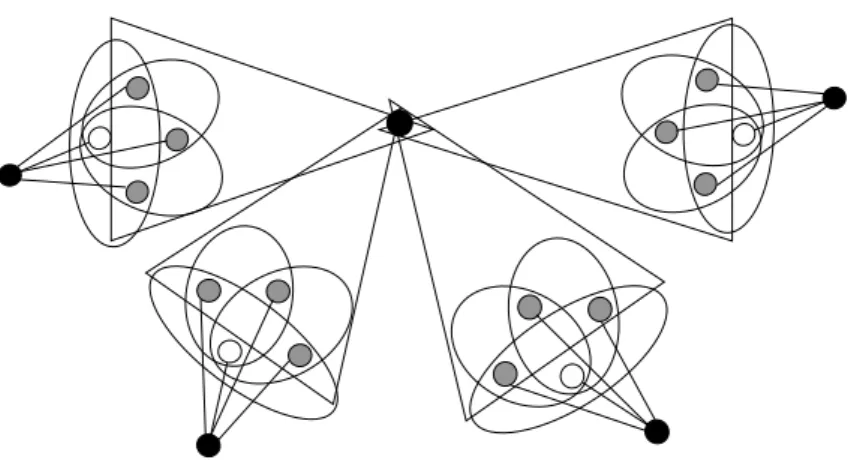
2.5 Example of a hard 3-regular hypergraph forMINDEGREEGREEDY . . . 37
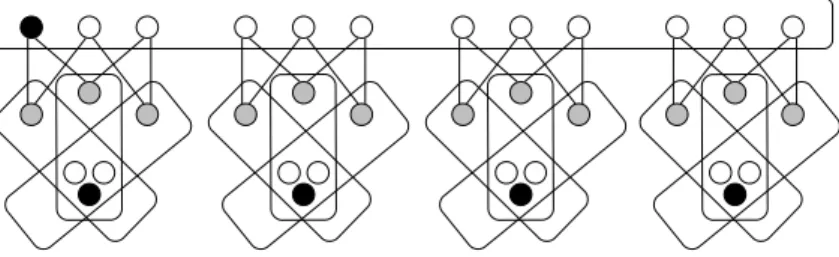
2.6 Example of a hard 4-regular hypergraph forMINDEGREEGREEDY . . . 38
2.7 Example of a hard hypergraph forMAXDEGREEGREEDYSIS . . . 41
2.8 Example of a hard regular hypergraph forMAXNEIGHBORGREEDYSIS . . 42
2.9 Part of a hard regular uniform hypergraph forMAXNEIGHBORGREEDYSIS 44 3.1 The sparsifying algorithmSPARSEHYPERGRAPH . . . 49
4.1 The algorithmRANDOMOFFLINE . . . 58
4.2 The off-line algorithmRANDOMONFLYPERMUTE . . . 58
4.3 The algorithmRANDOMPARTIALPERMUTE . . . 60
4.4 The algorithmRANDOMPARTITIONAPRIORI . . . 62
4.5 The algorithmRANDOMPARTITIONONLINE . . . 64
4.6 The algorithmDETSPARSEHYPERGRAPH . . . 65
4.7 The algorithmDETPARTITIONS . . . 66
4.8 The algorithmRANDOMDELETE . . . 69
List of Abbreviations
G graph H hypergraph G a collection of graphs H a collection of hypergraphs V a vertex set E a set of edges n number of vertices m number of edges r rank of a hypergraph d(v) the degree of a vertexvD(v) the weighted degree of a vertexv d∗(v) the hyperdegree of a vertexv
D∗(v) the weighted hyperdegree of a vertexv
d the average degree
D the weighted average degree d∗ the average hyperdegree
D∗ the weighted average hyperdegree ∆ the maximum degree
∆∗ the maximum hyperdegree
N(v) the neighborhood of a vertexv IS Maximum (Weak) Independent Set SIS Maximum Strong Independent Set
W IS Maximum Weighted (Weak) Independent Set V C Minimum Vertex Cover
HS Minimum Hitting Set
α(H) the size of a maximum independent set α(H, w) the weight of a maximum independent set
lnn natural logarithm ofn
Chapter 1
Introduction
A hypergraph H consists of a set V of vertices and a set E of edges, where an edge connects an arbitrary number of vertices. As an edge inHis a subset of V, hypergraphs are sometimes referred to as set systems or set collections. In this work we consider a hypergraph as a generalization of a graph (a graph is defined by a setV of vertices and a setEof edges, where an edge connects a pair vertices).
The generalization often leads to simplification and provides an insight why some prob-lems are hard to solve or approximate. A single statement on hypergraphs can unify sev-eral theorems on graphs [8] and gives a new tool in exploring different graph properties. Moreover, studying hypergraph properties helps to reveal the hard part of the problems on graphs, improve existing results and design new solutions to known combinatorial problems.
This thesis deals with optimization problems on hypergraphs using various algorithmic approaches and computational models. We begin by introducing the main definitions, approaches and models.
1.1 Definitions
Ahypergraph H is a pair (V, E), whereV = {v1, . . . , vn} is a discrete set of vertices
andE = {e1, . . . , em} is a collection of subsets ofV, or (hyper)edges. If V and E are
finite sets, then a hypergraphH(V, E) isfinite, otherwise H isinfinite. Edges in E are arbitrary subsets ofV, and therefore can contain arbitrary number of vertices. Thesize, or thecardinality,|e|of an edgee∈E is the number of vertices ine. An edge of sizetis called at-edge. Then, therankrof a hypergraph H is the maximum edge size inH. A
hypergraph isr-uniformif all edges have the same cardinalityr. AgraphGis a special case of hypergraphs, more precisely graphs are 2-uniform hypergraphs.
There exist several types of hypergraphs depending on how the set E of edges is de-fined. A hypergraphH isdirected, if every edge in E is an ordered set, otherwiseH is
undirected. A hypergraph H is a multihypergraph, if E is a multiset of (not necessar-ily distinct) vertices, i.e. E contains multiple edges and an edge in E may contain the same vertex more than once. Sometimes, a multihypergraph also allowsloops, which are sets containing a single vertex. As opposed to a multihypergraph, asimple hypergraph contains only unique edges of size at least 2, every edge is a set of distinct vertices and no edge is a subset of another edge. In this work we considerundirected simple finite
hypergraphs.
The hypergraphs can be "dense" (have many edges) and "sparse" (have few edges), the "density" of a hypergraphH(V, E)is described by the degrees of the verticesinV. Let dt(v) = |{e|v ∈ e,|e| =t}|bet-degree of a vertexv, or the number oft-edges incident
on v. We denote by ∆t = max
v∈V dt(v) and
¯
dt = (
P
v∈V dt(v))/|V| the maximum and the
averaget-degree in a hypergraph, respectively. The degreed(v) = Pr
t=2dt(v)of a vertex
v is then the total number of edges incident on v. We denote by ∆ = max
v∈V d(v) and
¯
d = (P
v∈V d(v))/|V| themaximumand the average degreein a hypergraph, respectively.
A hypergraphHisregular, if every vertex inE is of the same degree∆.
Further, we can refine the degrees in hypergraphs to reflect the fact that edges in a hyper-graph can be of different sizes. Letd∗(v) = Pr
t=2dt(v)
1
t−1 be thehyperdegreeof a vertexv. We denote by∆∗ = max
v∈V d
∗(v)andd¯∗ = (P
v∈V d
∗(v))/|V|themaximumand theaverage hyperdegreein a hypergraph, respectively. Note, in a hypergraph d(v) ≥ d∗(v) always holds for any vertexv, with equality holding only in graphs.
A hypergraphH(V, E)isweightedif every vertex inV is assigned a weight, such weights might represent costs, lengths, capacities or any other quantity depending on the problem. The weight of a hypergraph w(H) is then the total weight of the vertices. Formally, given a function f : V → R that assigns weights to the vertices of H, let w(H) =
w(V) = P v∈V w(v). We define D(v) = w(v)d(v) and ¯ D = P v∈V w(v)d(v)/ P v∈V w(v)to
be theweighted degreeof a vertexv and theaverage weighted degreeinH, respectively. Similarly, we define D∗(v) = w(v)d∗(v) and D∗ = (P
v∈V D
∗(v))/(P
v∈V w(v))to be the
weighted hyperdegreeof a vertexv and theweighted average hyperdegreeinH, respec-tively.
A vertexuis a neighborof a vertexv, if there exist an edgee ∈ E that includes bothu andv. Given a vertexv ∈ V, we denote by N(v)a set of neighbors ofv. Let Nt(v) =
{u ∈ V : ∃e ∈ E,{u, v} ⊆ e,|e| = t}be theset of neighbors of v in edges of size t. Given a setU ⊆ V, letN(U) ={v ∈V\U :∃u ∈U,∃e ∈E,{u, v} ⊆ e}be theset of neighbors of vertices inU.
A hyperclique is a hypergraph in which each vertex is a neighbor of all other vertices. Note, that a hyperclique need not be a uniform hypergraph. By analogy with a graph being a 2-uniform hypergraph, a clique is a 2-uniform hyperclique.
Ann-staris a tree onn+ 1nodes with one node of degreen(therootof the star) and the others of degree 1 (theendpointsof the star).
Finally, we introduce some operations on vertices and edges in a hypergraph. Bydeleting a vertexv from an edgeewe mean the operation of replacingebye\ {v}. Bydeleting a vertexvfrom a hypergraphH we mean just one operation:V =V\{v}, and bydeleting v with all incident edgeswe mean two operations: V =V\{v}andE =E\{e∈ E|v ∈ e}.
We say that a hypergraphH0(V0, E0)is induced inH(V, E) onV0 ⊆ V, if E0 = {e ∈
E|e ⊆ V0}. A subhypergraph H(V0) is a hypergraph H0(V0, E0) induced in H(V, E) on the vertex setV0 ⊂ V. The dual of a hypergraph H is a hypergraph H∗ where for each edge in H there is a vertex in H∗ and for each vertex v in H there is an edge
e∗ in H∗ formed by the vertices in H∗ corresponding to the edges incident on v, i.e.
e∗ ={e
i ∈E|v ∈ei}.
There are several subsets of vertices in hypergraphs with special properties, namely: in-dependent setsand hitting sets. Anindependent set in H is a subset of V that doesn’t contain any edge ofH, also referred to as aweak independent set[8].
WEAKINDEPENDENTSET: a setIw ⊆V such that∀e∈E :|e∩Iw|<|e|.
If an independent set inH intersects any edge inE in at most one element, then it is said to be astrong independent set[8].
STRONG INDEPENDENT SET: a setIs ⊆V such that∀e∈E :|e∩Is| ≤1.
It follows from these definitions that a strong independent set is a special case of a weak independent set. In the case of graphs (2-uniform hypergraphs), there is no distinction between weak and strong independent sets. In the remainder of the thesis, when we say an independent set, we mean a weak independent set, unless otherwise is stated.
The vertices not contained in a weak independent set form avertex cover, or ahitting set. In other words, ahitting setis a subset ofV that intersects every edge ofHin at least one vertex.
HITTINGSET: a setS ⊆V such that∀e∈E :|e∩S| ≥1.
A hitting set in graphs is usually referred to as a vertex cover. A hitting set is closely related to aset cover, which is a subset ofEthat covers all vertices inV.
SET COVER: a setC ⊆E such that∀v ∈V ∃e∈C :v ∈e.
Thus, a hitting set inHis equivalent to a set cover in the dualH∗.
In the remainder, we letHandGbe the collections of all hypergraphs and graphs, respec-tively. We denote byH a hypergraph inHand byGa graph inG, respectively.
1.2 Optimization Problems
1.2.1 Definitions
Acomputational problemΠ =<I,S >consists of a setI ofproblem instancesand a set
Soffeasible solutions, where for each problem instanceI ∈ Ithere is a feasible solution S ∈ S. The problem instanceI is a particular input string toΠand the feasible solution Sis the output string corresponding toI.
A decision problem Πd =< I,{0,1} > is a computational problem where a feasible
solution to a given instanceIofΠcan be either1(’yes’) or0(’no’). In other words,Πdis
a problem of deciding whetherIhas a required property or not. For example, the decision problemk-INDEPENDENT SET asks whether a given hypergraph H has an independent
set of sizek, and if there exist an independent set of sizek in H, then the answer is 1 (’yes’), otherwise -0(’no’).
Anoptimization problemΠo =< I,S, w, goal >is a computational problem which also
has a functionw : S → Rthat assigns a cost to every solution inS (usually we assume that costs are non-negative), and agoal that defines whether Πo is a minimization or a
maximization problem. In other words,Πo is a problem of finding a feasible solution to
a given problem instance I of maximum or minimum cost depending on the goal. For example, the optimization problem MAXIMUMINDEPENDENTSETasks for a maximum
con-sists of all independent sets inH and the goal is to find an independent set of maximum cardinality or weight.
In this work we consider the following computational problems: The decision problem k-(WEAK) INDEPENDENTSET:
given a hypergraphH(V, E)and an integerk, doesH have a (weak) independent set of sizek?
and the optimization problems MAXIMUM (WEAK) INDEPENDENTSET(IS):
given a hypergraphH(V, E),
find a maximum cardinality (weak) independent set inH.
MAXIMUM WEIGHTED (WEAK) INDEPENDENTSET (W IS):
given a weighted hypergraphH(V, E),
find a (weak) independent set inH of maximum weight.
The decision problem k-STRONG INDEPENDENT SET:
given a hypergraphH(V, E)and an integerk, doesH have a strong independent set of sizek?
and the optimization problems MAXIMUM STRONG INDEPENDENTSET (SIS):
given a hypergraphH(V, E),
find a maximum cardinality strong independent set inH.
MAXIMUM WEIGHTED STRONG INDEPENDENTSET (W SIS):
given a weighted hypergraphH(V, E),
find a strong independent set inH of maximum weight.
The decision problem k-HITTINGSET:
given a hypergraphH(V, E)and an integerk, doesH have a hitting set of sizek?
and the optimization problem MINIMUM HITTINGSET (HS):
given a hypergraphH(V, E),
find a minimum cardinality hitting set inH.
The decision problem k-SET COVER:
given a hypergraphH(V, E)and an integerk, doesH have a set cover of sizek?
and the optimization problem MINIMUM SET COVER(HS):
given a hypergraphH(V, E),
find a minimum cardinality set cover inH.
As mentioned above, in graphs there is no distinction between strong and weak indepen-dent sets, and the MAXIMUM INDEPENDENT SET problem on graphs is denoted by IS.
For a unweighted hypergraphH, we denote byα(H)the size of a maximum independent set inH. For a weighted hypergraphH, we denote byα(H, w)the weight of a maximum independent set inH.
1.2.2 Applications
IS,HS,SCare all of fundamental interest, both in practical and theoretical aspects. They arise in various applications in data mining, image processing, database design, parallel computing and many others.
An example of the MAXIMUMINDEPENDENTSETproblem is the problem of scheduling
the poster presentation. Suppose the students are going to present the posters of their work, where each poster can have more than one student as an author and each student can have more than one poster. The goal is to assign as many posters as possible to the same time slot conditioning that each student can present at most one poster in the same time slot. We construct a hypergraph with a vertex for each poster and an edge for each student, then a maximum strong independent set represents the maximum number of posters that can be presented at the same time.
An example of the MINIMUM HITTING SET problem is the problem of hiring teachers
at the school. Suppose teachers apply for positions with the lists of courses they can teach, the school administration then tries to hire the least possible number of teachers so that each course in the school program is taught by at least one teacher. We construct a
hypergraph with a vertex for each teacher and an edge for each course, then a minimum hitting set represents the minimum group of teachers that need to be hired to teach all courses at this school.
An example of the MINIMUMSETCOVERproblem is the virus testing problem. Suppose
we have a set of viruses and a collection of strings of 20 or more consecutive bytes from viruses specific only for viruses, each such string may be common in several viruses. The goal is to find a minimum set of strings that need to be searched for to confirm the presence of viruses. We construct a hypergraph with a vertex for each virus and an edge for each string of bytes, then a minimum set cover represents the minimum set of strings such that each virus is presented by at least one string in this set.
1.2.3 Hardness
All computational problems can be divided into classes depending on how much time or/and space is needed to find an optimal solution. One of the fundamental complexity classes, P or P T IME, contains all decision problems that can be solved in time poly-nomial in the size of the problem instance using deterministic Turing machine. Turing machine is a computational model which can simulate the logic of any algorithm. In a
deterministic Turing machinefor any given configuration (described by the current state and the input symbol) there is at most one possible transition (described by the next state, output symbol and the move of the tape). It means that for any given input to a determin-istic Turing machine there is at most one possible output. In anon-deterministic Turing machine for any given configuration there may be more than one possible transition. It means that for any given input to a non-deterministic Turing machine there may be more than one possible output. Non-deterministic Turing machine accepts a problem instance, i.e. outputs the answer ’yes’, if at least one of possible outputs of its computational pro-cess results in ’yes’. All decision problems that can be solved in time polynomial in the size of the problem instance usingnon-deterministic Turing machineform the complexity classNP. Alternatively, the class NP is defined as the class of decision problems, so-lutions to which can be verified in polynomial time using deterministic Turing machine. It follows that,P is a subset of NP; the question whether P = NP is one of the most important question in computer science and it still remains open.
Among all problems inNP there is a special class of problems, so called NP-complete
problems. NP-complete problems have a special property, namely: if any single NP -complete problem can be solved in polynomial time by deterministic Turing machine, then so can be solved every problem inNP. By this reason,NP-complete problems are
considered to be the hardest problems inNP. All problems we consider in this work, k -INDEPENDENTSET,k-HITTINGSET,k-SETCOVERandk-VERTEXCOVER, are known
to beNP-complete [41]. A decision problem only answers the question whether a given problem instance has a solution of sizek, while the corresponding optimization problem has to find an optimal solution (not only its size), it means that the above optimization problems are at least as hard as their decision versions.
Given that no algorithm finds an optimal solution for NP-complete problems in polyno-mial time under the assumption P 6= NP, the question is then how well we can ap-proximate an optimal solution to the corresponding optimization problem. Numerous results in approximation area can be split into two categories: approximation algorithms and inapproximability results. Let us first discuss approximation algorithms and then the inapproximability results.
1.3 Algorithmic Approaches
Many fundamental problems on graphs and hypergraphs are difficult to solve in polyno-mial time, among them are the MAXIMUMINDEPENDENTSET, the MINIMUMHITTING
SET, the MINIMUM SET COVERand the MINIMUMVERTEX COVERproblems. Unless
P =NP, it is very unlikely that there exist an algorithm that solves any of these problems in time less than exponential in the size of the problem instance (i.e. graph or hypergraph size).
The computational challenge of solving hard computational problems gave rise to two main approaches in computation: approximation and exact algorithms. The difference between these two approaches is the tradeoff between the running time of the algorithm and the quality of the solution it outputs.
Approximationalgorithms find a feasible solution fast (usually in polynomial time), but the solution is not guaranteed to be optimal; we are interested in bounding the approxi-mation ratio of such algorithms, which is a relationship between the cost of the solution found by the algorithm on a given instance and the cost of an optimal solution on that instance maximized over all problem instances.
Exactalgorithms always find an optimal solution, usually in exponential time; in this case we are interested in reducing the running time of the algorithm.
1.3.1 Approximation Algorithms
Approximationalgorithms are algorithms that find approximate solutions to optimization problems (usually in polynomial time). As opposed to approximation algorithms,optimal
algorithms find optimal solutions. Approximation algorithms are essential for problems in NP\P, since these problems are unlikely to admit polynomial-time optimal algorithms, unlessP = NP. However, approximation algorithms are also very useful for problems that do have polynomial-time optimal algorithms, but where these optimal algorithms may take too long for large inputs.
Approximation algorithms are characterized by their approximation ratio and absolute error. Suppose we have a maximization problemΠ. For a given problem instanceI and a given approximation algorithmA, letOP T(I)andALG(I)be the costs of an optimal solution and the cost of the solution produced byA, respectively. The approximation al-gorithmAhas aapproximation ratioρforΠif OP TALG((II)) ≤ρfor any problem instanceI. In other words, the approximation ratioρofAis defined asρ= max
∀I
OP T(I)
ALG(I). An
approxima-tion ratio is sometimes called arelative performance guaranteeor a performance ratio. The approximation algorithmAhas anabsolute error%forΠifOP T(I)−ALG(I)≤% for any problem instance I. In other words, the absolute error % of A is defined as % = max
∀I (OP T(I)−ALG(I)). An absolute error is sometimes called anabsolute
per-formance guarantee.
For a minimization problemΠ the approximation ratio and absolute error are defined as ρ= max
∀I
ALG(I)
OP T(I) and%= max∀I (ALG(I)−OP T(I)), respectively.
In what follows, we will consider only the approximation ratio. An algorithmAis said to be aρ-approximation algorithm for a problemΠ, if the approximation ratio of AforΠis ρ.
There are several techniques used in algorithm design. Let us give a brief outline of the techniques used in this work.
1.3.2 Algorithmic Techniques
Greedy
Agreedy algorithmis an algorithm that obtains a solution to a problem by making a se-quence oflocally optimal choices, i.e. choices that seem to be the best at the moment. The idea is that a locally optimal choice will hopefully lead closer to a globally opti-mal choice. A greedy algorithm is somewhat "shortsighted" in the sense that it makes
a decision based only on the information at hand without considering the effect of these decisions in the future. The disadvantage of a greedy algorithm is that it never reconsiders its decision no matter how bad it may look later. As a result, many optimization problems can not be solved optimally with this approach. On the other hand, greedy algorithms are simple, straightforward, easy to invent and implement, and usually time efficient, which make them very useful in attacking hard problems in real-life applications. Even if in general greedy algorithms are not optimal, there are examples when greedy algorithms always find optimal solutions such as Kruskal’s and Prim’s algorithms for finding mini-mum weight spanning tree.
Local Search
Alocal searchalgorithm is an algorithm which starts with an (arbitrary) feasible solution and continually replaces it by a better solution while possible. The idea is that an algo-rithm searches for a better solution in the restricted "local" set of feasible solutions, called thesearch space, and therefore it takes polynomial time to find a better solution (if the algorithm would search in unrestricted search space, then it will essentially perform an exhaustive search, which may take exponential time). The search space depends on the current solution, and so it changes from iteration to iteration. Usually, the search space is defined to be aneighborhoodof the current solutionS, where theneighborhoodofS is a set of solutionsΓ(S)produced by aneighboring functionΓ. In other words, a neigh-boring functionΓ defines which feasible solutions can be obtained from a solution Sby changing some components ofS. Hence, a local search algorithm iteratively improves a current solution by moving to a better solution in its neighborhood. The search for a better solution terminates either (i) when the current solution is the best possible in the current search space, and so no improvement can be made or (ii) when the improvement over several iterations is negligibly small or (iii) after predetermined number of iterations. Essentially, a local search algorithm finds a local optimal solution which might not be a global optimal solution. Nevertheless, the local search approach is usually very efficient in terms of time, and therefore is widely applied to tackle hard problems in various fields such as, for example, artificial intelligence, engineering, bioinformatics.
Partitioning
Apartitioningalgorithm is an algorithm which splits a given instance of a problemΠinto disjoint partitions, finds solution in each partition and outputs the best solution found. Usually, but not necessarily, the partitions are all of the same size. Often the size of
partitions is such thatΠ can be solved optimally on each partition in polynomial time. Surprisingly, this simple approach gives one of the best approximation algorithms for some hard optimization problems [29, 30]. Partitioning is also often used in combination with other approximation algorithms.
Semidefinite Programming
Semidefinite programmingrefers to an optimization problem that can be expressed as:
SEMIDEFINITE PROGRAMSDP
MAXIMIZE W •X
SUBJECT TO Aj •X =bj, 1≤j ≤m X º0
where the variableX ∈ Sn, andSn is the space of real symmetric n×n matrices; the
vectorb ∈ Rm and the matricesW, A
j ∈ Sn, for all j = 1. . . m, are given problem
pa-rameters [52]. The inequalityX º0means thatXis positive semidefinite, andW•X de-notes the inner product of matricesW andX, which is defined asW•X = Pn
i=1
n
P
j=1wijxij.
SDP can be solved within an additive error of² for any² > 0in time polynomial in n andlog (1/²)[25].
One of the properties of positive semidefinite matrices states that ifXis positive semidef-inite, there exists an×nmatrixU such thatX =UUT, whereU can be found using an
incomplete Cholesky factorization ofX (in general this factorization is not polynomial time computable, but can be approximated to any desired degree in polynomial time). Let
u1, . . . ,un be the columns of U (we might need to normalize them to obtain unit-length
vectors). Then,SDP can be rewritten as avector program[57]:
VECTOR PROGRAMV P
MAXIMIZE W •X
SUBJECT TO Aj •X =bj, 1≤j ≤m
|ui|=1, 1≤i≤n
ui ∈Rn, 1≤i≤n
wherexij ={ui·uj}for all1≤i≤j ≤n. V P is equivalent toSDP [57].
We use vector programs to solve optimization problems on hypergraphs. For example, consider the MAXIMUM INDEPENDENT SET (IS). Given a hypergraph H(V, E), let I
1 ≤ i ≤ n, and a unit-length vector u0 such thatui = u0 if vi ∈ I, and ui = −u0,
otherwise. Then,IS can expressed as a vector program as following: V P −IS MAXIMIZE P vi∈V 1+ui·u0 2 SUBJECT TO P vi, vj∈V 1≤i < j≤ |V| ui·uj + P vi∈V ui·u0 ≤ |e|(|e2|−3), ∀e∈E |ui|= 1, 1≤i≤ |V| ui ∈Rn, 1≤i≤n
An example of a solution toV P −IS is given in Fig.1.1.
Figure 1.1: Example of a solution toV P −IS.
Given vectorsu1, . . . ,un as a solution toV P −IS, we need to obtain a integer solution y1, . . . , ynsuch thatyi = 1, ifvi ∈I, andyi =−1, otherwise, for1≤i≤n. This can be
done using avector roundingor ahyperplane rounding[24, 32, 42]. Invector rounding
we take a random unit-length vectorr ∈ Rnand some positive constant c, and for each
iwe letyi = 1ifui·r > c, andyi = −1, otherwise. An example of vector roundingis
shown in Fig. 1.2.
Figure 1.2: Example ofvector rounding, all vertices above the hyperplane (marked by bigger circles) defined by the vectorrare included in the independent set.
Inhyperplane rounding we takelogcrandom hyperplanes through the origin inRn, and
for eachiwe letyi = 1ifui ·rj >0for all1≤j ≤logc, whererj is the normal of the
hyperplanej, andyi =−1, otherwise.
Semidefinite programming is a relatively new approach in optimization algorithms, but has turned out to be a very powerful technique that gives some of the best approximation algorithms for several optimization problems [32, 42].
Randomized Algorithms
Arandomizedalgorithm is an algorithm whose input consists of two parts: an instance of a problem and a sequence of random bits; where the random bits determine the choices made by the algorithm and the output solution. It means that if we run the same random-ized algorithmAon the same input several times, the behavior ofAmay differ between runs. The difference between runs is either in the found solution (if the algorithm does not guarantee to always find an optimal solution) or in the complexity of the algorithm (if the algorithm always finds an optimal solution), for example in the running time or in the working space used by the algorithm. Hence, the performance of a randomized algorithm (the output, the running time or the working space) is arandom variable. For the opti-mization problems considered in this work there is no randomized algorithm that always produces an optimal solution, and so we deal with randomized algorithms whose output solutions are random variables. The aim is then to design such a randomized algorithm that produces a good approximation of an optimal solution with high probability. It is also important to note that the error probability of a randomized algorithm can be significantly reduced by running the algorithm on the same input a number of times with a new random sequence in each run.
Randomized algorithms can be more efficient in terms of time and space and simpler to design and implement than deterministic algorithms. For some problems (for exam-ple, primality testing) randomized algorithms are so efficient that they have become some of the most popular and widely used approaches in every day applications. Some ran-domized algorithms can be turned into deterministic algorithms usingderandomization
1.4 Computational Models
A computationalor processing model defines how a problem instance (called input) is presented to an algorithm, how much time and space are available to the algorithm to make a decision on the final solution and whether the algorithm can revise its decisions. In this work we consideroff-line,on-lineandstreamingmodels of computation.
1.4.1 Off-line Model
In anoff-linemodel the algorithm is given the whole input data in the beginning. Usually an off-line model does not imply any limitations on working space and time, it is allowed to revise taken decisions at any step and it is not required to keep a feasible solution at any time during the execution. Anoff-linealgorithm is an algorithm processing data according to an off-line model. An off-line algorithmAis characterized by its approximation ratio (as defined in Section 1.3.1).
1.4.2 On-line Model
In an on-line model the input data are presented to the algorithm piece-by-piece, the algorithm is forced to take decisions on-fly without a possibility to revise them later. On-line models represent situations when requests come in a sequence and each request needs to be handled as fast as possible, for example, in scheduling problems, booking and renting systems.
One of the important features of the on-line model is that an algorithm never knows what is going to come next, and so it has to take decisions based on the data that has arrived so far. Another important feature of on-line algorithms is that an on-line algorithm always maintains a feasible solution for the input data it has received so far. If the behavior of an on-line algorithm is predetermined, we call such an algorithm deterministic on-line algorithm. If an on-line algorithm uses a sequence of random bits to guide its behavior, then we call such an algorithmrandomizedon-line algorithm.
The order in which input data are presented to an on-line algorithm when analyzing its behavior is determined by anadversary. The goal of adversary is to present the input data in such a way that will force an on-line algorithm to take bad decisions most of the time. In this thesis we consider onlyoblivious adversaries. Theoblivious adversaryorders the input data in advance, before presenting them to the on-line algorithm.
The performance ratio of an on-line algorithm is evaluated viacompetitive analysis, the performance ratio is then called thecompetitive ratio. An on-line algorithm with the com-petitive ratioρis referred to as a ρ-competitive algorithm. The idea of competitive anal-ysis is to compare the solution found by an on-line algorithm with a given adversary to a solution found by an optimal off-line algorithm with the same adversary. LetE[ALG(I)] be the expected cost of the solution produced by an algorithmAon the input dataI gener-ated by the oblivious andE[OP T(I)]be the expected cost of the solution produced by an optimal off-line algorithm on the same input dataI, with the expectation taken over the random choices made byA. Then, the competitive ratioρof an on-line algorithmAwith the oblivious adversary is defined asρA = max
∀I
OP T(I)
E[ALG(I)] (for a minimization problem the
ratios are reversed).
1.4.3 Streaming Model
In the classicalstreaming model [36, 48, 49], the data is presented sequentially in form of a data stream, one item at a time, and the working space (the memory used by the algorithm), is significantly less than the size of the data stream. Streaming algorithms are similar to on-line algorithms in the sense that the input data is revealed one item at a time, but are restricted by space rather than the maintenance of a single feasible solution. The main parameters of the streaming model are the size of the working spaceS(in bits), the numberP of passes over the stream and the timeT needed to process each data item in the stream. In the classical model the spaceS as well as the timeT are required to be sublinear inN, the size of the data stream, preferablylogt(N)for some small constantt; the numberP of passes is required to be a constant, preferably one or two.
The motivation for the streaming model comes from practical application related to the management of massive data sets such as, for example, real-time network traffic, on-line actions, telephone call records [23], where the input data are huge and arrive at a very high rate. It means that it is impossible to store the entire input and for each data item in the stream the decision has to be made quickly.
There are a number of results for algorithms in the classical streaming model, mostly on computing statistics for a stream, such as frequency moments [4] andLp norms [38].
There have been attempts to study classical graph problems, where the graph (or the hy-pergraph) is presented as a stream. In this case, a data item in the stream often represents an edge or a vertex along with its neighbors. In the former case the data stream is called an
adjacency stream; in the latter case the data stream is called anincidence stream[5]. The data items in the stream usually arrive in an arbitrary order. However, there has not been
much success with solving graph problems in the classical streaming model, an exception being the problem of counting triangles in a graph [5]. In fact, it was proven that for many graph properties it is impossible to determine whether a given graph has the property in single pass usingo(n)of space, wherenis the number of vertices in the graph [22]. Difficulties with solving most problems on graphs (and hypergraphs) led to the extensions of the classical streaming model. One such extension is thesemi-streamingmodel [48]. In the semi-streaming model the constraint on the working space is relaxed toO(nlogt n), wherenis the number of vertices in the graph (hypergraph) andtis a constant. It means that the algorithm has enough memory to store the vertices with some limited informa-tion about them, but not necessarily the edges in the graph (hypergraph). Many struc-tural graph problems can be solved or approximated within one or two passes in a semi-streaming model, for example determining whether a graph is connected [17] and finding a maximum matching [46].
1.5 Related Work
1.5.1 Inapproximability
Inapproximability results define how well a givenNP-complete problem can be approx-imated ifP 6=NP. These results are more on the negative side, because essentially they state the impossibility of getting a better approximation unlessP = NP. However, in-approximability results are as important as approximation algorithms because for a given optimization problem corresponding toNP-complete decision problemΠand an approx-imation algorithmAforΠ, they tell us ifAis the best possible forΠifP 6=NP.
For our problems the following inapproximability results have been shown, where all the results assume thatP 6= NP. The MAXIMUM INDEPENDENT SET problem is not
ap-proximable within|V|1−² for any² > 0[35]. In bounded-degree hypergraphs the MAX
-IMUM INDEPENDENT SET problem is not approximable within∆/2O
³√
log ∆
´
[56]. As we mentioned before, the MINIMUM HITTING SET problem is equivalent to the MINI -MUM SET COVERproblem in the dual hypergraph. Thus, both the MINIMUM HITTING
SETand the MINIMUMSET COVERproblems are equivalent in terms of optimization, in
particular inapproximability results hold for both problems. Namely, the MINIMUMHIT -TING SET and the MINIMUM SET COVERproblems are not approximable withinclogn
for some c[50]. In hypergraphs of rankr the MINIMUM HITTING SET problem is not
withinlnr−O(ln lnr) [56]. As for the VERTEX SET problem, it is not approximable
within 1.1666 [34], the same bound holds in case of bounded-degree hypergraphs if∆is sufficiently large [16].
1.5.2 Approximations
Hypergraph problems tend to be more difficult to solve than the corresponding graph problems, with the MAXIMUMINDEPENDENT SET problem being a typical case.
TheSISproblem in hypergraphs can be turned into an independent set problem in graphs by replacing each hyperedge with a clique (assuming that the hypergraph has no single-tons which cannot belong to any independent set). The reason for considering the problem as a hypergraph problem is that the degrees in the hypergraph can be much smaller than in the corresponding clique graph. If the hypergraph is of degree∆, then the correspond-ing clique graph contains no∆ + 1-claw, where ak-claw is an induced star onk edges. The work of Hurkens and Schrijver [37] established that a natural local improvement method attains an approximation ratio of k/2 +², for any fixed ² > 0, on k + 1-claw free graphs, see also [26]. Another local search algorithm by Berman [9] approximates weightedISin(k+ 1)-claw free graphs within a factor of(k+ 1)/2, which implies also a ∆/2-approximation. A strong hardness result ofΩ( ∆
ln ∆)is known forSIS, due to Hazan,
Safra and Schwartz [33]. The focus of our study of SIS is to consider natural greedy methods and establish tight bounds on their approximation ratio.
For the IS problem, the best approximation ratio known in general graphs, in terms of the numbernof vertices, isO(n(log logn)2/log3n)[20], while in hypergraphs the ratio
is onlyO(n/logn), which has a rather trivial argument [27]. In terms of the maximum degree∆, a ratio of∆is trivial for both graphs and hypergraphs, This ratio was slightly improved by greedy and local search algorithms, and the best improvement is achieved by SDP algorithms.
One of the most popular heuristics forIS,HSandSC is themax-greedyalgorithm. For IS the max-greedy algorithm repeatedly deletes a vertex of maximum degree with all incident edges from a hypergraph, until the edge set of the hypergraph is empty. This algorithm approximates unweightedIS in graphs within a factor of ∆+2
3 [31]. For SC
the max-greedy algorithm repeatedly adds to the cover the set with the largest number of uncovered elements. In spite of its simplicity, it is in various ways also one of the most effective. Johnson [40] and Lovász [45] showed that it approximates the MINIMUM SET
COVERproblem withinHn ≤ lnn+ 1factor, which was shown by Feige [19] to be the
functions [60] also yield equivalent ratios, and under numerous variations on the objective function the max-greedy algorithm does still achieve the best known/possible approxima-tion ratio, e.g. Sum Set Cover [21] and Entropy Set Cover [14]. Bazgan, Monnot, Paschos and Serrière [6] studied adifferential approximation ratioof the max-greedy algorithm, which measures how many sets arenotincluded in the cover. When viewed on the dual hypergraph, this is equivalent to studying the approximation ratio of the greedy set cover algorithm forIS. They proved that when modified with a post-processing phase, it has a approximation ratio of at most∆/1.365 and at least (∆ + 1)/4. Caro and Tuza [13] showed that the max-greedy algorithm applied to IS in r-uniform hypergraphs always finds a weak independent set of size at leastΘ³n/∆r−11
´
. Thiele [55] extended their re-sult to non-uniform hypergraphs and gave a lower bound on the size of an independent set found by a similar greedy algorithm as a complicated function of the number of edges of different sizes incident on each vertex in a hypergraph. Somewhat opposite to the max-greedyalgorithm is the min-greedy algorithm, which for IS adds a vertex of minimum degree to the solution, deletes this vertex from the hypergraph, and if there are vertices with loops, deletes such vertices with all edges incident on them; this process is repeated until the vertex set is empty. This algorithm approximates unweightedISin graphs within a factor of ∆+1
2 [31], and has until now not been studied on hypergraphs.
Another popular algorithm design technique is local search. Local search gives the best approximations known of weighted and unweighted IS in bounded-degree graphs for small values of ∆, due to Berman [9] and Berman and Fujito [10]. Bazgan, Monnot, Paschos and Serrière [6] considered a simple 2-OPT local search algorithm to approxi-mateIS in hypergraphs and proved a tight bound of(∆ + 1)/2. To our best knowledge there have been no results on local search algorithm in hypergraphs.
Yet another simple approach in approximation algorithm design is partitioning. This ap-proach yields d(∆ + 1)/3e approximation to the weighted IS in graphs, as shown in [26]. In spite of its simplicity, partitioning has not been used before to approximateISin hypergraphs.
One of the most powerful approximation approach for hard optimization problems in-volves the use of semi-definite programming (SDP). It is responsible for the best ratio known for IS in graphs ofO(∆ log log ∆/log ∆) [26]. It is also involved in the com-plementary vertex cover problem [32], both in graphs and in hypergraphs. Yet, it has failed to yield much success forIS in hypergraphs, except for some special cases. One intuition may be that hyperedges result in significantly weaker constraints in the semi-definite relaxation than the graph edges. The special cases where it has been successful — 2-colorabler-uniform hypergraphs [26] and 3-uniform hypergraphs with a huge
in-dependence number [43] — have properties that result in strengthened constraints. The usefulness of SDP for generalIS has remained open.
One of the earliest works on graph problems in streaming models considered finding a vertex with the largest number of neighbors and the maximum local degree [36], counting the number of triangles [5] and estimating common neighborhoods [12] using the classi-cal streaming model. These results were the first ones to show that most graph problems are unlikely to be solved in the classical streaming model due to the restricted working space. The attention then turned to the semi-streaming model. There is a number of approximation algorithms for the maximum bipartite graph matching (weighted and un-weighted cases), diameter and shortest paths [22] and min-cut [1]. Harder problems, such asIS,HSandSC are yet to be considered in the semi-streaming model.
1.6 Original Contribution of the Thesis
In this work we mainly focus on the MAXIMUMINDEPENDENTSETproblem. Known
ap-proximation algorithms suggest several directions and research questions. A key question is to what extent approximation ratios forIS in graphs can be matched in hypergraphs. This can be asked in terms of different degree parameters, such as maximum degree, average degree, hyperdegree, etc. Given that graphs are 2-uniform hypergraphs and r -uniform hypergraphs have certain nice properties, the question is also how well we can handle uniform and non-uniform hypergraphs. Our main results are on the MAXIMUM
INDEPENDENTSETproblem.
Shrinkage reduction.
First, we describe a general technique that reduces the worst case analysis of certain algorithms on hypergraphs to their analysis on ordinary graphs. Given an approximation algorithmA, this technique, called shrinkage reduction, truncates a hypergraph H to a graph G such that an optimal solution on H is also an optimal solution in G, and A produces the same worst case approximate solution onH andG. This technique can be applied to a wide class of algorithms and problems on hypergraphs.
Greedy algorithms.
Using the shrinkage reduction technique we show that the max-greedy algorithm forIS has a approximation ratio of(∆ + 1)/2on hypergraphs, improving the bounds obtained by Bazgan et al. [6]. In addition, while their analysis required a post-processing phase, our bound applies to the greedy algorithm alone. This bound is slightly worse than the approximation ratio of the max-greedy algorithm on graphs. We also give the analysis of
the mix-greedy algorithm on hypergraphs, showing that it achieves only a ratio of∆−1, significantly worse than on graphs. Inr-uniform hypergraphs the approximation ratio of the greedy algorithms is improved toΘ³∆r−11
´
(the max-degree greedy algorithm) and 1 + ∆−1
r (the min-degree greedy algorithm).
Local search algorithms.
We extend several local search graph algorithms to the hypergraph case. In particular, using shrinkage reduction technique, we show that thet-OPT algorithm, which repeatedly tries to extend the current solution by deleting t elements while addingt+ 1 elements, approximatesIS on hypergraphs within∆/2 +²(t), where lim
t→∞²(t) = 0. We also extend the local search graph algorithm of Berman and Fürer [11] for unweightedIS and the local search graph algorithm of Berman [9] for weightedIS to the hypergraph case and obtain a(∆ + 1)/2approximation for weightedISand(∆ + 3)/5 +²approximation for unweightedIS. All these local search algorithms achieve the same approximation ratio on hypergraphs as on graphs.
Partitioning algorithms.
We apply a simple partitioning approach [29, 30] to IS on hypergraphs and prove the bound ofd(∆ + 1)/3eforW IS.
Semidefinite programming algorithms.
We derive the firsto(∆)-approximation forIS in hypergraphs matching the
O(∆ log log ∆/log ∆)-approximation for the special case of graphs. Our approach is to use an SDP formulation to sparsify the part of the instance formed by 2-edges, followed by a combinatorial algorithm on the resulting sparser instance. This is extended to obtain an identical bound in terms of the average degreed¯of an unweighted hypergraph. As part of the method, we also obtain ak5/2−1/kd¯1−1/k+o(1)-approximation for hypergraphs with
independence number at leastn/k. We generalize the results to weighted hypergraphs. In that case, no non-trivial bound is possible in terms of the average degree alone, so we turn our attention to a weighted version. We give aO( ¯Dlog log ¯D/log ¯D)-approximation for IS. We apply two combinatorial algorithms to hypergraphs with few 2-edges. One is a greedy algorithm analyzed by Caro and Tuza [13] for ther-uniform case and Thiele [55] for the non-uniform case. The bound obtained in [55] is in general unwieldy, but we can show that it gives a good approximation when the number of 2-edges has been reduced. The other is a simple randomized algorithm analyzed by Shachnai and Srinivasan [54] achieving the same ratio as the greedy algorithm. This randomized algorithm can be derandomized as shown in [47].
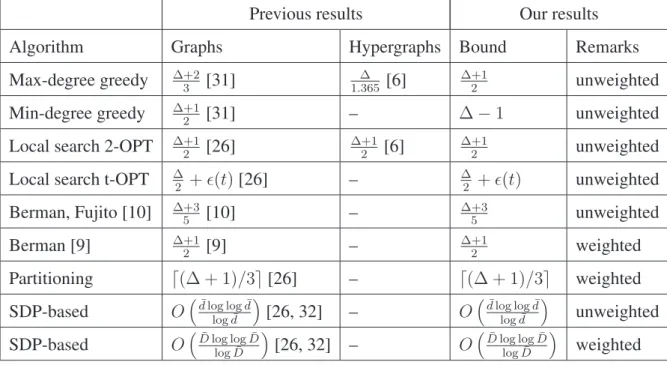
Previous results Our results Algorithm Graphs Hypergraphs Bound Remarks Max-degree greedy ∆+2 3 [31] ∆ 1.365 [6] ∆+1 2 unweighted Min-degree greedy ∆+1 2 [31] – ∆−1 unweighted
Local search 2-OPT ∆+1
2 [26] ∆+12 [6] ∆+12 unweighted
Local search t-OPT ∆
2 +²(t)[26] – ∆2 +²(t) unweighted Berman, Fujito [10] ∆+3 5 [10] – ∆+35 unweighted Berman [9] ∆+1 2 [9] – ∆+12 weighted Partitioning d(∆ + 1)/3e[26] – d(∆ + 1)/3e weighted SDP-based O³d¯log log ¯log ¯d d´[26, 32] – O³d¯log log ¯log ¯d d´ unweighted SDP-based O³D¯log log ¯D
log ¯D ´ [26, 32] – O³D¯log log ¯D log ¯D ´ weighted
Figure 1.3: Summary of the results forIS in off-line model.
Streaming algorithms.
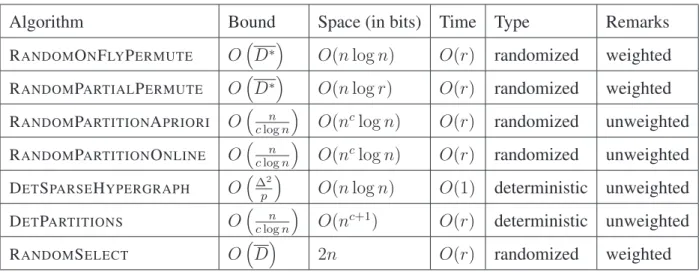
We consider algorithms in the semi-streaming model that use one pass over the stream and at mostO(r)time to process every edge in the stream. First, we describe two randomized algorithms: the permutation-based algorithm finds an independent set of expected weight Ω³wD(V∗)
´
in bounded-degree hypergraphs using O(nlogn) bits of total working space; the partition-based algorithm approximatesIS withinO³ n
clogn
´
for any constantc > 0 in unbounded-degree hypergraphs usingO(nclogn) total working space. The working
space of the first algorithm can be improved toO(nlogr)bits. The second algorithm can be modified to be a variation of on-line randomized preemptive algorithm with the same approximation factor and the same size of the working memory. Next, we present two deterministic algorithms: the first one works for bounded-degree hypergraphs and finds an independent set of sizeΩ³pn
∆2 ´
usingO(nlogn)space, wherepis the smallest edge size in a given hypergraph; the second algorithm works for unbounded-degree hypergraphs and approximatesISwithinO³ n
clogn
´
for any constantc >0usingO(nc+1)space.
Finally, we define anon-line minimal spacestreaming model, in which the working space is limited to two bits per vertex and the algorithm must maintain a feasible solution at all times. We prove lower bounds for randomized and deterministic algorithms in this model and present a randomized online minimal space streaming algorithm that finds an
independent set of expected weightΩ³w(¯V)
D
´
using two bits of memory per vertex , i.e. in total 2n bits of working memory.
The summary of the main results forISin semi-streaming model is given in Fig. 1.4. All algorithms use one pass over the stream.
Algorithm Bound Space (in bits) Time Type Remarks
RANDOMONFLYPERMUTE O
³
D∗´ O(nlogn) O(r) randomized weighted
RANDOMPARTIALPERMUTE O
³
D∗´ O(nlogr) O(r) randomized weighted
RANDOMPARTITIONAPRIORI O
³
n clogn
´
O(nclogn) O(r) randomized unweighted
RANDOMPARTITIONONLINE O
³
n clogn
´
O(nclogn) O(r) randomized unweighted
DETSPARSEHYPERGRAPH O
³
∆2
p
´
O(nlogn) O(1) deterministic unweighted
DETPARTITIONS O ³ n clogn ´ O(nc+1) O(r) deterministic unweighted RANDOMSELECT O ³ D´ 2n O(r) randomized weighted
Figure 1.4: Summary of the results forISin semi-streaming model.
Strong independent sets.
ForSISwe describe two greedy algorithms: one constructs an independent set by select-ing vertices of minimum degree; the other selects vertices with the fewest neighbors. We show that both algorithms have a approximation ratio of∆and that this bound is tight. In r-uniform hypergraphs the approximation ratio of both greedy algorithms is improved to ∆− ∆−1
r .
1.7 Structure of the Thesis
The remainder of the thesis is organized as follows:
- Chapter 2 introduces the shrinkage reduction technique and gives the analysis of max-greedy, min-degree, local search and partitioning algorithms. The greedy al-gorithms forSIS on uniform and non-uniform hypergraphs are presented there as well.
- Chapter 3describesSDP-based algorithms. First, it is explained how the number of 2-edges in hypergraphs can be reduced using SDP technique. Next, approxi-mation ratio for the greedy and randomized algorithms are proved on hypergraphs with few 2-edges. Finally, the combination of SDP and combinatorial algorithms is outlined.
- Chapter 4 presents semi-streaming algorithms. First, we analyze several random-ized permutation and partition-based algorithms. We prove approximation ratios for bounded and unbounded hypergraphs. Next we describe deterministic algorithms for bounded and unbounded hypergraphs. Finally, we define an online streaming model and we prove lower bounds for online streaming randomized and determin-istic algorithms.
- Chapter 5 summarizes the results and outlines open problems and possible direc-tions for further research.