https://dx.doi.org/10.22161/ijaers/3.11.12 ISSN: 2349-6495(P) | 2456-1908(O)
Optimization of Drilling Process Parameters on
Die Steel (H13) using Carbide Coated Drill by
Design of Experiment Concept
J. Ganesh
1, P.Renukadevi
2, P.Vijayakumar
3, T.T.M.Kannan
41
P.G.Scholar, Department of Mechanical Engineering Prist University, Thanjavur, India 2,3
Assistant professor, Department of Mechanical Engineering Prist University, Thanjavur, India 4
Associate professor,Department of Mechanical Engineering, Indra Ganesan college of Engineering, Trichy, India Abstract—This experimental work presents the optimization
of process parameter of surface roughness with using coated carbide drill on H13 steel. Taguchi design of experiments was implemented for executing the process parameter of Drilling process on H13 steel plates. The drilling parameters including 2 Factors such as spindle speed (rpm) and feed rate (mm/min) are optimized using response performance characteristic of surface roughness of H13 die steel plates.H13 steel play an important role in many applications such as Shaft, axle, gears and fasteners due to their strength to weight ratio. The process parameters of spindle speed and feed rate are influenced by machining accuracy during drilling process. The main objectives of experimental works have been identified by lower roughness during drilling process of H13 steel plates.
Orthogonal array (L16) of Taguchi Design of experiments
and Analysis of Variance (ANOVA) are utilized to analyze the effect of drilling parameters on Quality of drilled holes. The result of experiments indicate is a dominating parameter of surface roughness of H 13 steel plates in Drilling process.
Keywords— H13, Drilling Parameters, Taguchi, DOE, S/N ratio, ANOVA.
I. INTRODUCTION
Drilling is a process used to produce holes from surface to inside solid parts. The tool is rotated and also moved in the axial direction. Drilling is used to create a round or an oval hole. It is accomplished by a rotating tool that usually have two or four helical cutting edges. The tool is fed in a direction parallel to the axis of rotation into the work piece to form the round shaped hole. Drilling is an operation in which holes are produced or refined by bringing a rotating cutter with cutting edges at the lower extreme end is in contact with the work piece.
II. EXPERIMENTAL DETAILS 2.1 H 13 steel
In this Experimental work H13 die steel is used as work piece .Generally H13 steel are hard and tough to be machined. The chemical composition and Mechanical properties of H13 steel plates are shown in Table 1 and 2.
https://dx.doi.org/10.22161/ijaers/3.11.12 ISSN: 2349-6495(P) | 2456-1908(O) H13 die steel is widely used in the tool and die industry
because of its resistance to wear at high-temperature it remains in temper. It has high thermal fatigue and ability to be hardened at high temperature. These properties make it is a material of choice for hot working application such as die-casting upset dies, inserts, cores, ejector pins, plunger, sleeve, slide, forging die, extrusion die, dummy blocks and mandrels. In particular, die-casting is the process of producing metal part by forcing molten metal into a mold or die which is usually made of metal. Over a period, the part produced by this process may be unacceptable because of failure of the die primarily due to fatigue, erosion and reaction of the molten material with the die material.
H13 tool steel is a versatile chromium-molybdenum hot work steel that is wide utilized in hot working die and cold
work die tooling applications. The recent hardness (hot strength) of H13 resists more thermal fatigue and cracking that happens as the results of, cyclic heating and cooling process in hot work tool and die applications. Due to its wonderful combination of high toughness and resistance to thermal fatigue, cracking (also called heat cracking) H13 is used for additional hot work in tooling application it performs better than the other tool steel material. Because of its high toughness and really sensible stability in heat treatment, H13 die steel is additionally utilized in a spread of cold work tooling applications. In these applications, H13 provides higher hardenability and higher wear resistance than common alloy steels like H11,H12 materials
Table .1: CHEMICAL COMBINATION OF H13 GRADE DIE STEEL
C Mn P S Si Cr V W Mb Fe
0.37% 0.71% 0.01% 0.013% 0.94% 4.88% 0.96% 0.17% 1.68% 99.63%
Table.2: MECHANICAL PROPERTIES OF H13 DIE STEEL
Young’s Modulus Poisson’s ratio Density Modulus of
Elasticity
Bulk modulus
210 GPa 0.29 7.8 g/cm3 220 GPa 150 GPa
2.2 Machine detailsThe drilling operations have been carried out on a CNC MILL MT250 Machining Center, (Make-MTAB Educational equipment ltd,(India) is shown in fig1. The CNC vertical machining centre equipped with a range of variable spindle speed up to 4000 rpm, and 2HP motor drive was used for experimentation
The process parameters that were chosen for experimentation are given as under:
1) Spindle speed (rpm) 2) Feed (mm/rev.)
https://dx.doi.org/10.22161/ijaers/3.11.12 ISSN: 2349-6495(P) | 2456-1908(O)
Fig.2: H13steel drilled specimen (L16)
Coated carbide drill bit of 12mm diameter is used to making drill hole on H13 steel plates are shown in fig 2.The drill is having a flute helix angle of 118˚degree.The tool of double helical flute is used.
2.4 Taguchi design of experiment
Taking Spindle speed and feed rate are as an input parameter and surface Roughness is taken as response parameter of drilling process of H13 steel plates. Here 2factors and 4 levels of drilling process parameter are used as design of experiment in L 16 orthogonal array is shown in table 3
Table.3: L 16 Orthogonal Array
Spindle speed Feed
1 1 1 2 1 3 1 4 2 1 2 2 2 3 2 4 3 1 3 2 3 3 3 4 4 1 4 2 4 3 4 4
III. RESULT AND DISCUSSION
The experimental work conducted on H13 Die steel with various process parameters as per design of experiment. The drilling process are performed by Carbide coated drill. The result of drilling process parameter are analyzed by signal to Noise ratio.The surface roughness values are measured by Surface roughness tester the corresponding values are shown in table 4.
Table.4: Taguchi L16 OA with Surface Roughness values of H 13 Die Steel
SPINDLE SPEED
FEED SURFACE FINISH SNRA1
1 1 7.32 -17.2902
1 2 5.86 -15.3580
1 3 6.86 -16.7265
https://dx.doi.org/10.22161/ijaers/3.11.12 ISSN: 2349-6495(P) | 2456-1908(O) 2 1 3.58 -11.0777 2 2 3.47 -10.8066 2 3 3.39 -10.6040 2 4 3.18 -10.0485 3 1 6.24 -15.9037 3 2 5.94 -15.4757 3 3 4.93 -13.8569 3 4 4.52 -13.1028 4 1 4.64 -13.3304 4 2 4.48 -13.0256 4 3 4.24 -12.5473 4 4 4.02 -12.0845
After conducting experiment on H 13 steel plates in drilling process. The most important and influence parameter are represent by response table (Table 5).It indicate spindle speed is an influence parameter of H13 die steel for achieving lower surface roughness in drilling process.
Table.5: Response table of H13 Die steel drilled plates
Level Spindle speed Feed
1 -16.42 -14.40 2 -10’63 -13.67 3 -14.58 -13.43 4 -12.75 -12.89 DELTA 5.79 1.51 RANK 1 2
Fig.3: S/N ratio for H13 die steel
Figure 3 represents signal to noise ratio of H 13 die steel plates during drilling process. It also indicate 2 nd level of spindle speed and 4 th level of feed rate produce lower surface roughness. The H 13 steel plates is suitable for manufacturing dies with high accuracy and toughness.
4 3 2 1 -1 0 -1 1 -1 2 -1 3 -1 4 -1 5 -1 6 -1 7 4 3 2 1 s p in d le s p e e d M e a n o f S N r a ti o s fe e d M a in E f f e c t s P lo t f o r S N r a t io s D a t a M e a n s S i g n a l - t o -n o i s e : S m a l l e r i s b e t t e r
https://dx.doi.org/10.22161/ijaers/3.11.12 ISSN: 2349-6495(P) | 2456-1908(O)
Table.6: Analysis of variance value of Surface roughness of H13 Die steel
Source D F ADJ SS ADJ MS F-VALUE P-VALUE
Spindle speed 3 23.342 7.7805 38.49 0.000
Feed 3 1.610 0.5366 2.65 0.112
Error 9 1.819 0.2021
Total 15 26.770
Table 6 shows that Spindle speed is a dominating parameter in drilling process on H13 die steel plates based on higher value of F value. It produce better surface finish and dimensional tolerance by using carbide coated drill. The R sq values (93.20 %) indicate the most significant of process parameter and experiments are conducted in efficient method.
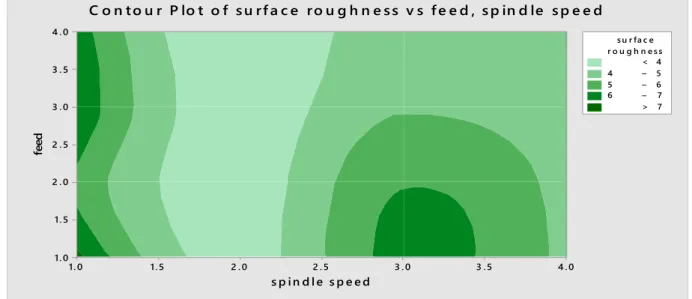
The contour plot shows (fig 5) that lower surface roughness is achieved in drilling process with significant.
Fig.5: Contour plot of surface roughness of H13 die steel
IV. CONCLUSION
In this experiment work of H13 die steel on drilling process, it conclude the following
H13 provide good machinablity property and produce reasonable surface roughness.
Drilling parameter is optimized by signal to noise ratio and analyzed by in Anova.
Drilling parameter of H13 steel are dependent on the implement in hot die making process.
H13 steel may used in production of heavy machinery, Power machinery die works and press tools.
The optimum parameter of H13 steel on drilling process are the second speed (600rpm) and fourth feed rate (0.016mm/rev) and a response parameter of surface roughness of 3.18 microns
REFERENCES
[1] Paul, A.; Kappor, S.G. & Devor R.E. (2005). Chisel Edge and Cutting Lip Shape Optimization for
Improved Twist Drill Point Design, International Journal of Machine Tools & Manufacture, 45, pp.421-431.
[2] RP Rampersad, Hareland, G., and Boonyapaluk, P.: “Drilling Optimization Using Drilling Dataand Available Technology,” paper SPE 27034 presented at the SPE LAPEC Conference, Buenos Aires, 27-29 April, 2009.
[3] B.Y. Lee, H.S. Liu and Y.S. Tarng, (2006). Modeling and Optimization of Drilling Process. Department of Mechanical Manufacture Engineering, National Huwei Institute of Technology, Huwei, 632, pp. 1-9.
[4] C. Sanjay, M.L. Neema and C.W. Chin, (2005). Modeling of Tool Wear in Drilling by Statistical Analysis and Artificial Neural Network, Journal of Materials Processing Technology, 170, pp. 494–500. [5] Chandrasekharan V., Kappor S.G. and DeVor R.E, A
Mechanistic Approach to Predicting the Cutting Forces in Drilling: with Application to Fiber- Reinforced Composite Materials, ASME J. Eng. Ind., (117),559–570. s p i n d l e s p e e d fe e d 4 . 0 3 . 5 3 . 0 2 . 5 2 . 0 1 . 5 1. 0 4 . 0 3 . 5 3 . 0 2 . 5 2 . 0 1. 5 1. 0 > – – – < 4 4 5 5 6 6 7 7 r o u g h n e s s s u r fa c e C o n t o u r P lo t o f s u r f a c e r o u g h n e s s v s f e e d , s p in d le s p e e d
https://dx.doi.org/10.22161/ijaers/3.11.12 ISSN: 2349-6495(P) | 2456-1908(O) [6] Paul, A.; Kappor, S.G. & Devor R.E. (2005). Chisel
Edge and Cutting Lip Shape Optimization for Improved Twist Drill Point Design, International Journal of Machine Tools & Manufacture, 45, pp.421-431.
[7] RP Rampersad, Hareland, G., and Boonyapaluk, P.: “Drilling Optimization Using Drilling Data and Available Technology,” paper SPE 27034 presented at the SPE LAPEC Conference, Buenos Aires, 27-29 April, 2009.
[8] B.Y. Lee, H.S. Liu and Y.S. Tarng, (2006). Modeling and Optimization of Drilling Process. Department of Mechanical Manufacture Engineering, National Huwei Institute of Technology, Huwei, 632,pp. 1-9.
[9] Kadam M.S., Pathak S.S.Experimental Analysis and Comparative Performance of Coated and Uncoated Twist Drill Bit Dry Machining International Journal of Research in Mechanical Engineering and Technology Vol. 1, Issue 1, Oct. 2011.
[10]S.A. Jalali and W.J. Kolarik, (2001). Tool life and Mach Inability Models for Drilling Steels, International Journal of Machine Tools & Manufacture, 31 (3), pp. 273–282.