SELECTING STUDENTS
FOR MEDICAL EDUCATION
EXPLORING NOVEL APPROACHES
Selecting Students for
Medical Education
Exploring novel approaches
Susanna Magdalena Lucieer
Selecting Students for Medical Education: Exploring novel approaches Thesis, Erasmus University Rotterdam, the Netherlands
ISBN: 978-94-6299-165-1
Cover design: Maya Krijgsman, Eigenwijs Ontwerp Lay-out: Maya Krijgsman, Eigenwijs Ontwerp Printing: Ridderprint BV, Ridderkerk
Copyright © S. Lucieer, 2015
All rights reserved. No part of this publications may be reproduced, stored in a retrieval system, or transmitted, in any form or by any means, electronic, mechanical, photocopying, recording or otherwise, without written permission of the author or, when appropriate, of the copyright-owning journals for previously published chapters.
Selecting Students for
Medical Education
Exploring novel approaches
Het selecteren van studenten
voor de geneeskundeopleiding
Verkenning van nieuwe benaderingen
Proefschrift
ter verkrijging van de graad van doctor aan de
Erasmus Universiteit Rotterdam
op gezag van de rector magnificus
Prof.dr. H.A.P. Pols
en volgens besluit van het College van Promoties.
De openbare verdediging zal plaatsvinden op
woensdag 6 januari 2016 om 15.30 uur
door
Susanna Magdalena Lucieer
geboren te Rotterdam
Promotiecommissie
Promotoren Prof.dr.ir. A.P.N. Themmen
Prof.dr. R.M.J.P. Rikers
Overige leden Prof.dr. M. de Hoog
Prof.dr. G.W.C. Paas
Contents
Chapter 1 General introduction 7
Chapter 2 Non-cognitive selected students do not outperform 25
lottery-admitted students in the pre-clinical stage of
medical school
Chapter 3 Self-regulated learning and academic performance in 41
medical education
Chapter 4 The development of self-regulated learning in the 63
pre-clinical stage of medical school: a comparison between a lecture-based and a problem-based curriculum
Chapter 5 Identifying deliberate practice activities in residency 81 training
Chapter 6 Identification of factors associated with 101 performance during surgical residency training
Chapter 7 General discussion 115
Chapter 8 Summary 129
Chapter 9 Samenvatting 135
Dankwoord 143
Papers and Presentations 151
Curriculum Vitae 157
GENERAL INTRODUCTION
Chapter 1
Ch
ap
ter 1
G
en
era
l in
tro
duc
tio
n
8Medical schools have the responsibility of educating future doctors who are able to provide optimal healthcare (Bullimore, 1992; Hughes, 2002). However, for various reasons only a limited number of places is available to educate future doctors: 1) a high quality education needs to be ensured (Burch, 2009; Lievens, Ones, & Dilchert, 2009; Mitchell, 1990), 2) the education is expensive, and 3) the number of places to educate future doctors needs to be in tune with the eventual needs for society (Whitehouse, 1997). Since the number of applicants highly exceeds the number of places available, medical schools all over the world have to select their students. In Canada, the United States, the United Kingdom, and the Netherlands, only 1:3 – 1:17 applicants are accepted for medical school (DUO, 2015; Razack, Maguire, Hodges, & Steinert, 2012). It is important for medical schools that the applicants they do admit, will be able to successfully complete the medical programme and deliver optimal healthcare (Albanese, Snow, Skochelak, Huggett, & Farrell, 2003; Basco, Lancaster, Gilbert, Carey, & Blue, 2008; Bullimore, 1992; Burch, 2009; Kulatunga-Moruzi & Norman, 2002; Mitchell, 1990; Prideaux, et al., 2011).
The stakes of medical student selection are thus high, but the selection is a challenging and complex process. The majority of the applicants are still adolescents while medical schools aim to select applicants who are able to provide optimal healthcare at least six or more years later. Furthermore, all applicants share many characteristics, which makes it difficult to distinguish relevant characteristics in the applicants. Without a suitable preparatory training or high grades, applicants are not allowed to participate in the selection (McManus, Smithers, Partridge, Keeling, & Fleming, 2003; ten Cate, 2007). The homogeneous character of the applicant pool increases the difficulty of deciding who should be accepted, and who should be rejected for medical school. In order to demonstrate the complexity of medical schools’ selection processes, this general introduction will provide an overview of the methods used in medical student selection and will discuss the methods’ strengths and shortcomings. Subsequently, since the current selection methods are not optimal, concepts from outside the medical field will be discussed.
MEDICAL SCHOOL SELECTION: AN OVERVIEW
Medical student selection has a long standing history. Medical schoolsstarted to select applicants in the early twentieth century, after Abraham Flexner (Flexner, 1909) recommended to increase the quality of medical education by insisting that applicants should have a strong, scientific basis (Anderson, 2011; Irby, Cooke, & O’Brien, 2010; Krupa, 2010). These days, medical schools have created a selection policy based on desired characteristics of medical school entrants in terms of academic standards and personal qualities (Powis, 1994). These selection policies entail a wide range of selection methods that aim to measure cognitive and non-cognitive attributes, in order to identify candidates who possess the required characteristics, and to reject those who do not (Powis, 1994).
Methods that are frequently used to examine the cognitive capabilities of medical school applicants include the pre-university (secondary school) and undergraduate grade point average (GPA; Cohen-Schotanus, et al., 2006; Ferguson, James, & Madeley, 2002) and aptitude tests, such as the Medical College Admission Test (MCAT; Eskander, Shandling, & Hanson, 2013). Studies have indicated that both the pre-university GPA (pu-GPA; Baars, 2009; Cohen-Schotanus, et al., 2006; Lambe & Bristow, 2011; McManus, et al., 2005) and the undergraduate GPA (Ferguson, et al., 2002; Harnett & Willingham, 1980) provide significant predictive value for medical school performance, especially during earlier years. However, a decreasing predictive effectiveness in later years of education make the pu-GPA and the undergraduate GPA a less valuable measure for future career performance (McManus, et al., 2003; Mitchell, 1990; Salvatori, 2001). As to the MCAT, this test aims to measure the applicants’ preparedness for medical school (Donnon, Paolucci, & Violato, 2007; Eskander, et al., 2013). The MCAT shows a reasonable good predictive value for academic performance in medical school (Mitchell, 1990). Combined with the undergraduate GPA, it accounts for up to 23% of the variance in scores obtained at medical school examinations (Ferguson, et al., 2002; Violato & Donnon, 2005), still leaving a large proportion of the variance unexplained.
From the 1970s onward, methods aiming to measure non-cognitive capabilities were introduced in the selection processes of medical schools since non-cognitive skills have become increasingly important for medical doctors (Benbassat & Baumal, 2007; Bullimore, 1992; Dore, et al., 2006; Eva, Rosenfeld, Reiter, & Norman, 2004; Hughes, 2002; Lievens, et al., 2009; Mahon, Henderson, & Kirch, 2013; Nieuwhof, 2004). Patients want to be involved in the decision-making process, ask questions and discuss treatments with their physicians. This requires a medical doctor to possess strong communication skills, to be empathic and have professional integrity (Haidet, et al., 2002; Pulvirenti, McMillan, & Lawn, 2014; Stewart, 2001). In addition, team-based working has become the standard for medical doctors, also increasing the importance of good communication skills (Mahon, et al., 2013). However, in comparison to selection tests that measure cognitive attributes, more controversy exists concerning the reliability and validity of selection methods that aim to measure non-cognitive attributes (Hughes, 2002). Selection methods aiming to measure the non-cognitive capabilities of applicants are, among others, interviews (Eva, Reiter, Rosenfeld, & Norman, 2004a; Harasym, Woloschuk,
10
Ch
ap
ter 1
G
en
era
l in
tro
duc
tio
n
Mandin, & Brundin-Mather, 1996; Kreiter, Yin, Solow, & Brennan,2004; Lambe & Bristow, 2011; Salvatori, 2001), letters of motivation and recommendation (Ferguson, James, O’Hehir, Sanders, & McManus, 2003; Leichner, Eusebio-Torres, & Harper, 1981), tests that aim to measure integrity and empathy (Dore, et al., 2009; Patterson, Ashworth, et al., 2012), and questionnaires that measure an applicants’ personality and motivation (Balogun, Karacoloff, & Farina, 1986; Bore, Munro, & Powis, 2009; Cremonini, 2010; Morgeson, et al., 2007; Powis, 2015).
The uncertainty concerning the reliability and validity of these non-cognitive measures arises from several sources. Although some methods look promising, most methods have many shortcomings. Concerning interviews (Kreiter, et al., 2004; Roberts, Zoanetti, & Rothnie, 2009), a large range in interviewer variability exists and personal factors such as the applicants’ gender and background as well as the interviewer expectations are potential sources of bias (Eva, Reiter, et al., 2004a; Salvatori, 2001). However, there is evidence that the use of more structured interviews increases the validity (Courneya, et al., 2005). In addition, the Multiple Mini Interview (MMI) technique (Eva, Reiter, et al., 2004a; Eva, Rosenfeld, et al., 2004; Salvatori, 2001), with many short interviews, multiple examiners per applicant and training of the examiners (Bullimore, 1992; Harasym, et al., 1996) will increase the reliability (Burch, 2009; Eva, et al., 2009; Hofmeister, Lockyer, & Crutcher, 2009). Nevertheless, the ability of the MMI to predict clinical performance is unclear and further research is required (Burch, 2009; Lambe & Bristow, 2011). In addition, a limitation of interviews is that it is not practical to invite the large number of applicants who apply. To limit the number of applicants that needs to be interviewed, an extra pre-interview non-cognitive screening test could be used, such as the Computer-based Multiple Sample Evaluation of Noncognitive Skills (CMSENS). The CMSENS is also known as CASPer and shows satisfactory correlations with the MMI (Dore, et al., 2009). Motivation letters and letters of reference (Ferguson, et al., 2003; Leichner, et al., 1981) have a very low predictive validity (Ferguson, et al., 2003; Leichner, et al., 1981; Salvatori, 2001), as it turns out to be difficult to establish a decent scoring system to compare the letters (Ferguson, et al., 2002) and they rarely distinguish one applicant from another (Spina, Smith, Marciani, & Marshall, 2000). Nevertheless, the Situational Judgment Test (SJT), which aims to measure professional attributes such as professional integrity (Becker, 2005; Whetzel & McDaniel, 2009) and empathy (Lievens & Patterson, 2011; Patterson, Ashworth, et al., 2012), is promising. In an SJT, applicants are presented with descriptions of situations they might encounter during medical school or on the job. The applicants are asked to judge the appropriateness of given responses (Oostrom, Born, Serlie, & van der Molen, 2010; St-Sauveur, Girouard, & Goyette, 2014). The SJT shows good levels of reliability, predictive validity and incremental validity for integrity and empathy (Patterson, Ashworth, et al., 2012). In contract to the SJT, personality and motivation questionnaires are criticized because of their possible lack of reliability and the opportunity for applicants to respond in a socially desirable manner (Arthur, 2001). Nonetheless, some studies have shown a positive correlation between personality and academic performance (Ackerman, Premuzic, & Furnham, 2011; Chamorro-Premuzic & Furnham, 2003; Furnham, Chamorro-Chamorro-Premuzic, & McDougall, 2002; Lievens, Coetsier, de Fruyt, & de Maeseneer, 2002; Lievens, et al., 2009), and others have stated that questionnaires that determine the student’s motivation could be of interest as well (Ferguson, et al., 2002; Gagne & St Pere, 2002).
However, an important critical note needs to be made about the evaluation of the predictive value of selection methods. The predictive validity of selection methods is mostly examined by investigating the relation between selection measures and grades obtained during medical school, i.e. on examination of basic science and clinical knowledge. While the relation between cognitive measures and academic performance makes sense, the relation between non-cognitive measures and medical school performance is less appropriate. A student does not need to possess non-cognitive qualities to pass the majority of the examinations, and a high predictive validity between non-cognitive qualities and academic performance should thus not be expected (Powis, 2009). Only, a better criterion to judge the predictive validity of non-cognitive measures is not easily available.
Concluding, selecting applicants with the desired characteristics for medical school appears to be challenging. Cognitive measures are able to predict up to 23% of the variance in academic performance (Ferguson, et al., 2002; Violato & Donnon, 2005), still leaving a large proportion unexplained. Additionally, the majority of the non-cognitive measures appears to lack the desired reliability and validity (Balogun, et al., 1986; Morgeson, et al., 2007; Salvatori, 2001; Siu & Reiter, 2009) and methods to measure the predictive validity should be reconsidered (Powis, 2009). Therefore, further research on selection methods that are able to select those applicants who do possess the required academic standards and personal qualities is essential.
THINKING OUTSIDE THE BOX
Obviously, the challenge of selecting the right person is not limited to the context of medical school admission. Extensive research on selection has been performed in the area of personnel assessment and organizational psychology. Here, multiple factors have been identified that relate to outstanding performance, and that can be used to select the most promising applicant for a specific job. Personality, in particular the Big Five personality trait conscientiousness, and general cognitive ability show a consistent positive relation with job performance (Schmidt, 2002; Schmitt, 2012; Tracey, Sturman, & Tews, 2007). The importance of cognitive ability even increases with job complexity, providing the highest validity for highly complex professions, including attorneys and pilots (Hunter & Hunter, 1984; Schmitt, 2012). In addition, other factors that are found to relate to general job performance are self-efficacy and self-monitoring (Bhatti, Battour, & Ismail, 2013; Holton, Bates, & Ruona, 2000; Stajkovic & Luthans, 1998). While the importance of cognitive ability is widely acknowledged in medical school selection and some researchers also suggest to use personality measures, the use of the factors self-efficacy and self-monitoring is less common. Self-self-efficacy and self-monitoring belong, together with planning, reflection, evaluation and effort, to a broader concept, named self-regulated learning (Boekaerts, Printrich, & Zeidner, 2000; Ertmer & Newby, 1996; Hong & O’Neil, 2001). Someone is considered to be a self-regulated learner when he or she is behaviourally, metacognitively and motivationally proactive in his or her learning process (Jonker, Elferink-Gemser, Toering, Lyons, & Visscher, 2010; Wolters, 1998; Zimmerman, 1986). Self-regulated learners take active control of their learning activities
12
Ch
ap
ter 1
G
en
era
l in
tro
duc
tio
n
and their learning is very efficient (Brydges, Nair, Ma, Shanks, & Hatala, 2012; Ertmer & Newby, 1996; Lycke, Grøttum, & Strømsø, 2006). As a result, they update themselves more easily with all developments in their field of expertise, take more initiative to solve problems, and when needed, show more effort and persistency (Bhatti, et al., 2013; Hong & O’Neil, 2001). These qualities are important for all knowledge intensive professions (Bhatti, et al., 2013), and are, since the dynamic and extensive character of the medical field appears to be a significant hurdle to stay up to date for many practitioners (Carrier & Morin, 2014; Mooney, 1993), strongly emphasized in the medical field. The burden of the combination of patient care, administration, research and educational responsibilities often hinders the medical doctors’ ability to keep abreast of the many developments in their fields of expertise, while being updated is required to provide high quality patient care (Brydges & Butler, 2012; Greveson & Spencer, 2005). Thus, one’s efficacy and one’s ability to monitor their learning are, together with other self-regulated learning activities, very valuable skills in the medical field. It might therefore be interesting to investigate the possibility to select applicants for medical school based on these characteristics.
However, it is important to note that, in contrast to general cognitive ability and personality, the ability to self-regulate ones learning is not “fixed” but develops gradually (van der Stel & Veenman, 2010, 2014). For example, young children are not able to monitor their learning process, but this skill becomes more and more sophisticated during young adulthood (van der Stel, Veenman, Deelen, & Haenen, 2010). Some researchers argue that these skills do not arise naturally but develop best in an inspiring and goal-oriented environment (Boekaerts, et al., 2000). As the majority of medical school applicants are adolescents, it is likely that their self-regulated learning skills will not be fully developed yet. Hence, before applying these measures to medical school selection procedures, the potential development of these self-regulated learning skills during medical school should be ensured.
Another captivating approach is the expert performance perspective: why do some people perform much better than others do? A considerable amount of research has been done on expert performance in several domains of complex human behaviour. Examples are: music (Ericsson, 1996), arts (Ericsson, 1996), athletics (Côté, Deakin, & Baker, 2005; Ericsson, 2013; Hodges, Kerr, Starkes, Weir, & Nananidou, 2004), chess (Charness, Tuffiash, Krampe, Reingold, & Vasyukova, 2005), typing (Ericsson, 2008), within insurance companies (Sonnentag & Kleine, 2000), and in a few medical areas such as medical diagnosis and surgery (Ericsson, 2004; Schmidt & Rikers, 2007). Interestingly, these studies have shown that not necessarily cognitive abilities or stable characteristics of a person, but a shared set of behaviours led to outstanding performances. Thus, a person will not excel without prolonged commitment to training and performance. This notion is central to the deliberate practice theory (Baker, 2014; Ericsson, Krampe, & Tësch-Romer, 1993; Ericsson, Nandagopal, & Roring, 2009; Roring & Charness, 2007). Deliberate practice refers to a set of highly structured activities specifically designed to improve performance (Ericsson, 2004; Ericsson, et al., 1993). This kind of practice is prolonged, very structured, often not enjoyable nor leading to immediate rewards. Instead, it takes much effort and a person needs to have long-term goals (Ericsson, 2004;Ericsson, 2008; Ericsson, et al., 1993). As a consequence, not everyone is able to engage in deliberate
practice and to reach the top level. Research on the role of deliberate practice in the medical field is scarce. The expert approach attempts to describe performance under standardized conditions and representative tasks wherein superior performance can be demonstrated and reproduced (Ericsson & Smith, 1991). But since in the medical field performance is influenced by patient variability and personalized care, it is difficult to identify representative tasks that can be reproduced under standardized conditions (Ericsson, 2004). Nevertheless, in the view of medical school selection, the expert approach is interesting to explore. Whenever knowledge is available on what, or which characteristics or behaviours, makes someone perform well in the field of medicine, the next step is to identify which applicants share these characteristics and behaviours, since these applicants are probably able to reach top positions in the medical field.
Another lesson to be learned from other domains is the necessity of having a predictor-criterion relationship. Thorndike, a renowned psychologist and researcher in personnel selection, already described in 1949 that: “The key to effective research in personnel selection and classification is an adequate measure of proficiency on the job. Only when proficiency measures can be obtained for the individuals who have been tested is it possible to check the effectiveness of test and selection procedure.” Thorndike’s statement remains as true today as it was in 1949: an adequate measure of proficiency on the job is required to truly measure the effectiveness of the used selection methods (Schmitt, 2012). Unfortunately, in many fields, including medicine, no such adequate measure of proficiency exists. That is, we do not have a definition of a good medical doctor. Reasons for the absence of such a definition are that attributes of good doctors are not very well specified or agreed upon (Benbassat & Baumal, 2007; Powis, 1994). In addition, differences in perceptions of good doctors exist (Hurwitz, Kelly, Powis, Smyth, & Lewin, 2013). A possible approach could be to take patients’ outcome after treatment as a quality measure. However, many factors influence a patient’s outcome, such as the patient’s age, gender, medical history and type of disease (McGaghie, 1990). Furthermore, not all medical doctors are involved in direct treatment of patients and since medical doctors mostly work in teams (Mahon, et al., 2013), it is difficult to determine to what extent successful patient outcome can be credited to a single medical doctor. Medical school selection committees thus face a “criterion- problem” (Schmitt, 2012); they aim to select future well-performing medical doctors, but they do not know what constitutes a well-performing medical doctor. Consequently, it is not possible to measure whether there is a relationship between the outcome of the selection methods, and performance as a medical doctor. Therefore, medical schools have chosen a pragmatic approach by selecting potentially good students opposed to potentially good doctors (Powis, 1994), despite only moderate and weak relations have been found between academic performance and performance on knowledge tests in the early stages of the professional career (Hamdy, et al., 2006) and only predictors for short term professional performance are available (Drenth, 2004; Tamblyn, et al., 2002; Taylor, Price, Richards, & Jacobsen, 1965).
In the personnel assessment and organizational psychology domain, overall job performance is measured and refers to the overall contribution of a single employee to the organization. Overall job performance includes task performance, contextual performance, and avoidance of counterproductive behaviours. As many factors influence
14
Ch
ap
ter 1
G
en
era
l in
tro
duc
tio
n
performance, overall job performance is most optimally and most frequently assessed via supervisory ratings (Schmitt, 2012). Contrary to many other professions, medical doctors often have no supervisors since the majority of them works in medical groups, is solo practice owner, independent contractor, or has ownership stake in a multi-specialty practice (Hawkinds, 2014; Healthcare, 2015). Assessment by peers is less attractive since previous research shows that peers are always able to judge the performance of their colleagues. While some researchers are positive about the use of peer-reviews (Brundage, et al., 2013; Epstein & Hundert, 2002), others showed that some of the peer-identified experts did not perform better than novices on tasks that were central to their expertise, as for example weather forecasts or treatment of psychotherapy patients (Ericsson, 2009; Ericsson & Lehman, 1996). There is one category of medical doctors who do have supervisors: residents in specialty training. Residents have completed medical school and perform many medical duties while they are in specialty training, but since they are in training, their job performance in continuously monitored. Hence, residency training provides the most optimal opportunity to investigate the relationship between selection measures and job performance.
OUTLINE OF THIS THESIS
Following the previous paragraphs, two aspects will be addressed in this thesis. First, non-cognitive capabilities become more and more important in the medical field, but the predictive value of non-cognitive measures is not well established and further insight is highly required (Balogun, et al., 1986; Morgeson, et al., 2007; Salvatori, 2001; Siu & Reiter, 2009). Second, as selecting the right person is not limited to medical school selection, information from the fields of personnel assessment and organizational psychology will be used to determine what medical student selection can learn from this.
Part 1: Cognitive versus non-cognitive selection
The study represented in Chapter 2 entered the discussion of the predictive value of cognitive and non-cognitive selection methods. Non-cognitive capabilities are increasingly required in the medical field as it is acknowledged that medical care implies more than medical knowledge, notwithstanding the limited predictive validity of non-cognitive selection methods. However, as no previous studies have measured the effect of cognitive versus non-cognitive selection on academic performance under similar conditions, it is impossible to truly compare the predictive validity of different selection methods. In Chapter 2, a unique experiment is described that enabled the comparison of academic performance of cognitive selected students and non-cognitive selected students, to a control group, i.e. lottery-admitted students.
Part 2: Thinking outside the box
In the second part of this thesis, views from personnel assessment and organizational psychology are investigated in order to determine whether they can be applied to medical school selection. In Chapters 3 and 4, the importance of self-regulated learning has been addressed. Firstly, in Chapter 3, the potential development of self-regulated learning
skills during the pre-clinical stage of medical school and the relation between self-regulated learning skills and academic performance was investigated. Students from the first and third year of medical school were asked to complete a questionnaire containing questions about their study behaviour. Subsequently, the relation between their learning behaviour and their study results in the first and third year was assessed.Secondly, in Chapter 4, the influence of the learning environment, i.e. the medical curriculum, on the potential development of self-regulated learning skills, was addressed. Second and sixth semester students from two Brazilian medical schools completed a questionnaire that compared the effect of the curriculum on the development of self-regulated learning skills.
In Chapter 5, the role of expert performance during residency training was examined. In many other domains of human endeavour, outstanding performances are reached by those who engage in prolonged, deliberate practice. In order to investigate the relation between aspects of deliberate practice and performance as a resident, supervisor judgments of residents from four different specialty programmes (i.e. anaesthesiology, internal medicine, paediatrics and surgery), were compared to residents’ responses regarding their behaviour during residency training.
Chapter 6 has a more specific focus: surgical residency performance. Since no criterion of a good medical doctor is available, medical school are not able to investigate whether the selection methods they use identify those candidates will perform well in the medical profession. However, residents are assessed in the scope of their training. This enables investigating the relation between selection methods and proficiency on the job of residents, who are almost independent medical specialists. In this study, pre-training variables were derived from the files of residents in surgery training and compared to their performance. Two different measures were used as indicators of performance: the overall judgment and scores on knowledge tests.
Finally, in Chapter 7, the findings of the different studies are summarized and important considerations for medical school selection are discussed, followed by suggestions for further research. 16
Ch
ap
ter 1
G
en
era
l in
tro
duc
tio
n
REFERENCES GENERAL INTRODUCTION
Ackerman, P. L., Chamorro-Premuzic, T., & Furnham, A. (2011). Trait complexes and academic achievement: Old and new ways of examining personality in educational contexts. British Journal of Educational Psychology, 81(1), 27-40. Albanese, M., Snow, M., Skochelak, S., Huggett, K., & Farrell, P. (2003). Assessing
personal qualities in medical school admissions. Academic Medicine, 78(3),
313-321.
Anderson, W. D. (2011). Outside looking in: observations on medical education since the Flexner Report. Medical Education, 45(1), 29-35.
Arthur, W., Woehr, D.J., Graziano, W.G. (2001). Personality testing in employment settings - Problems and issues in the application of typical selection
practices. Personnel Review, 30(5-6), 657-676.
Baars, G. J. A. (2009). Factors related to student achievement in medical school. Thesis: Erasmus University Rotterdam, the Netherlands.
Baker, J. (2014). 20 years later: deliberate practice and the development of expertise in sport. International review of sport and exercise psychology, 7(1), 135-137.
Balogun, J. A., Karacoloff, L. A., & Farina, N. T. (1986). Predictors of academic achievement in physical therapy. Physical Therapy, 66(6), 976-980.
Basco, W. T., Jr., Lancaster, C. J., Gilbert, G. E., Carey, M. E., & Blue, A. V. (2008). Medical school application interview score has limited predictive validity for performance on a fourth year clinical practice examination. Advances in Health Sciences Education : theory and practice, 13(2), 151-162. Becker, T. E. (2005). “Development and validation of a situational judgment test
of employee integrity.” International Journal of Selection and Assessment,13(3): 225-232.
Benbassat, J., & Baumal, R. (2007). Uncertainties in the selection of applicants for medical school. Advances in Health Sciences Education, 12(4), 509-521. Bhatti, M. A., Battour, M. M., & Ismail, A. R. (2013). Expatriates adjustment and job
performance: an examination of individual and organizational factors. The international journal of productivity and performance management, 62(7), 694-717.
Boekaerts, M., Printrich, P. R., & Zeidner, M. (2000). Handbook of self-regulation (2 ed.). Burlington, USA: Elsevier Academic Press.
Bore, M. R., Munro, D. & Powis, D. A. (2009). A comprehensive model for the selection of medical students. Medical Teacher, 31(12), 1066-1972.
Brundage, M., Foxcroft, S., McGowan. T., Guteirrez, E., Sharpe, M, & Warde, P. (2013). A survey of radiation treatment planning peer-review activities in a provincial radiation oncology programme: current practice and future directions. BMJ Open 3(e003241), 1-8.
Brydges, R., & Butler, D. (2012). A reflective analysis of medical education research on self-regulation in learning and practice. Medical Education, 46(1), 71-79.
Brydges, R., Nair, P., Ma, I., Shanks, D., & Hatala, R. (2012). Directed self regulated learning versus instructor regulated learning in simulation training. Medical
Education, 46(7), 648-656.
Bullimore, D. D. W. (1992). Selection interviewing for medical school admission. Medical Education, 26(5), 347-349.
Burch, V. C. (2009). Medical school admissions: where to next? Advances in Health Sciences Education : theory and practice, 14(2), 153-157.
Carrier, A., & Morin, C. (2014). Enabling students’ self-regulation and teachers’ feedback in concept mapping. Medical Education, 48(5), 523-524.
Chamorro-Premuzic, T., & Furnham, A. (2003). Personality predicts academic per formance: Evidence from two longitudinal university samples. Journal of Research in Personality, 37(4), 319-338.
Charness, N., Tuffiash, M., Krampe, R., Reingold, E., & Vasyukova, E. (2005). The role of deliberate practice in chess expertise. Applied Cognitive Psychology, 19(2), 151-165.
Cohen-Schotanus, J., Muijtjens, A. M., Reinders, J. J., Agsteribbe, J., van Rossum, H. J., & van der Vleuten, C. P. (2006). The predictive validity of grade point average scores in a partial lottery medical school admission system. Medical Education, 40(10), 1012-1019.
Côté, J., Deakin, J., & Baker, J. (2005). Expertise in ultra-endurance triathletes early sport involvement, training structure, and the theory of deliberate practice. Journal of Applied Sport Psychology, 17(1), 64-78.
Courneya, C. A., Wright, K., Frinton, V., Mak, E., Schulzer, M., & Pachev, G. (2005). Medical student selection: choice of a semi-structured panel interview or an unstructured one-on-one interview. Medical Teacher, 27(6), 499-503. Cremonini, L., van Niekerk, W. & Vossensteyn, H. (2010). Selective admission in
higher education: risks and limiting conditions. Center for Higher Education Policy Studies, 1-8.
Donnon, T., Paolucci, E. O., & Violato, C. (2007). The predictive validity of the MCAT for medical school performance and medical board licensing examinations: a meta-analysis of the published research. Academic Medicine, 82(1), 100-106.
Dore, K. L., Hanson, M., Reiter, H. I., Blanchard, M., Deeth, K., & Eva, K. W. (2006). Medical school admissions: enhancing the reliability and validity of an autobiographical screening tool. Academic Medicine, 81(10 Suppl), S70-73. Dore, K. L., Reiter, H. I., Eva, K. W., Krueger, S., Scriven, E., Siu, E., Hildsen, S.,
Thomas, J. & Norman, G.R. (2009). Extending the interview to all medical school candidates--Computer-Based Multiple Sample Evaluation of Noncognitive Skills (CMSENS). Academic Medicine, 84(10 Suppl), S9-12. Drenth, P. (2004). Selectie aan de poort van het hoger onderwijs. Tijdschrift voor
Hoger Onderwijs & Management(4), 48-51.
DUO. (2015). Decentrale selectie: Selectie door universiteit of hogeschool. Retrieved 27-05-2015, from https://www.duo.nl/particulieren/stu
dent-hbo-of-universiteit/loten/decentrale-selectie.asp
Epstein, R. M. & Hundert, E. M. (2002). Defining and assessing professional competence. JAMA, 287(2), 226-235.
Ericsson, K. A. (1996). The road to excellence: The acquisition of expert performance in the arts and sciences, sports and games (Vol. 1). Mahwah, USA: Lawrence Erlbaum Associates.
18
Ch
ap
ter 1
G
en
era
l in
tro
duc
tio
n
Ericsson, K. A. (2004). Deliberate practice and the acquisition and maintenance of expert performance in medicine and related domains. Academic Medicine Research in Medical Education Proceedings of the Forty-Third Annual Conference November 7-10, 2004, 79(10), S70-S81.
Ericsson, K. A. (2008). Deliberate practice and acquisition of expert performance: a general overview. Academic Emergency Medicine, 15(11), 988-994.
Ericsson, K. A. (2009). The Cambridge handbook of expertise and expert performance: edited by K. Anders Ericsson ... [et al.]. New York [etc.]: Cambridge University Press.
Ericsson, K. A. (2013). Training history, deliberate practice and elite sports performance: An analysis in response to Tucker and Collins review-what makes champions? British journal of sports medicine, 47(9), 533-535.
Ericsson, K. A., Krampe, R. T., & Tësch-Romer, C. (1993). The role of deliberate practice in the acquisition of expert performance. Psychological Review, 100(3), 363-406.
Ericsson, K. A., & Lehman, A. C. (1996). Expert and exceptional performance: Evidence of maximal adaptation to task constraints. Annual Review of Psychology, 47, 273-305.
Ericsson, K. A., Nandagopal, K., & Roring, R. W. (2009). Toward a science of exceptional achievement: attaining superior performance through deliberate practice.
Annual report the New York Academy of Sciences, 1172, 199-217.
Ericsson, K. A., & Smith, J. (1991). Toward a general theory of expertise: prospects and limits. Cambridge [etc.]: Cambridge University Press.
Ertmer, P. A., & Newby, T. J. (1996). The expert learner: Strategic, self-regulated, and reflective. Instructional Science, 24(1), 1-24.
Eskander, A., Shandling, M., & Hanson, M. D. (2013). Should the MCAT exam be used for medical school admissions in Canada? Academic Medicine, 88(5), 572-580.
Eva, K. W., Reiter, H. I., Rosenfeld, J., & Norman, G. R. (2004a). The ability of the multiple mini-interview to predict preclerkship performance in medical school. Academic Medicine, 79(10), S40-S42.
Eva, K. W., Reiter, H. I., Trinh, K., Wasi, P., Rosenfeld, J., & Norman, G. R. (2009). Predictive validity of the multiple mini-interview for selecting medical trainees. Medical Education, 43(8), 767-775.
Eva, K. W., Rosenfeld, J., Reiter, H. I., & Norman, G. R. (2004). An admissions OSCE: the multiple mini-interview. Medical Education, 38(3), 314-326. Ferguson, E., James, D., & Madeley, L. (2002). Factors associated with success
in medical school: systematic review of the literature. British Medical Journal, 324(7343), 952-957.
Ferguson, E., James, D., O’Hehir, F., Sanders, A., & McManus, I. C. (2003). Pilot study of the roles of personality, references, and personal statements in relation to performance over the five years of a medical degree. British Medical Journal, 326(7386), 429-432.
Flexner, A. (1909). Adjusting the College to American Life. Science, 29(740), 361-372.
Furnham, A., Chamorro-Premuzic, T., & McDougall, F. (2002). Personality, cognitive ability, and beliefs about intelligence as predictors of academic
performance. Learning and Individual Differences, 14(1), 47-64.
Gagne, F., & St Pere, F. (2002). When IQ is controlled, does motivation still predict achievement? Intelligence, 30(1), 71-100.
Greveson, G. C., & Spencer, J. A. (2005). Self-directed learning – the importance of concepts and contexts. Medical Education, 39(4), 348-349.
Haidet, P., Dains, J. E., Paterniti, D. A., Hechtel, L., Chang, T., Tseng, E., Rogers, J.C. (2002). Medical student attitudes toward the doctor–patient relationship. Medical Education, 36(6), 568-574.
Hamdy, H., Prasad, K., Anderson, M. B., Scherpbier, A., Williams, R., Zwierstra, R., Cuddihy, H. (2006). BEME systematic review: Predictive values of measurements obtained in medical schools and future performance in medical practice. Medical Teacher, 28(2), 103-116.
Harasym, P. H., Woloschuk, W., Mandin, H., & Brundin-Mather, R. (1996). Reliability and validity of interviewers’ judgments of medical school candidates. Academic Medicine, 71(1 Suppl), S40-42.
Harnett, R. T., & Willingham, W. W. (1980). The Criterion Problem: What measure of success in graduate education? Applied Psychological Measurement,
4(3), 281-291.
Hawkinds, M. (2014). 2014 Survey of America’s physicians practice patterns & perspectives. Retrieved 15/05/2015, 2015, from http://www.physicians foundation.org/uploads/default/2014_Physicians_Foundation_Biennial_ Physician_Survey_Report.pdf
Healthcare, J. (2015). A profile of physicians’ practice environments.
Retrieved 15/01/2015, 2015, from http://www.jacksonhealthcare.com/ media-room/articles/physician-trends/physician-data-on-practice-evironment -workload-and-patient-access/
Hodges, N. J., Kerr, T., Starkes, J. L., Weir, P. L., & Nananidou, A. (2004). Predicting performance times from deliberate practice hours for triathletes and swimmers: what, when, and where is practice important? Journal of Experimental Psychology: Applied, 10(4), 219-237.
Hofmeister, M., Lockyer, J., & Crutcher, R. (2009). The multiple mini-interview for selection of international medical graduates into family medicine residency
education. Medical Education, 43(6), 573-579.
Holton, E. F., Bates, R. A., & Ruona, W. E. A. (2000). Development of a generalized learning transfer system inventory. Human Resource Development Quarterly, 11(4), 333-360.
Hong, E., & O’Neil, H. F. (2001). Construct validation of a trait self-regulation model. International Journal of Psychology, 36(3), 186-194.
Hughes, P. (2002). Can we improve on how we select medical students? Journal of the Royal Society of Medicine, 95 (1), 18-22.
Hunter, J. E., & Hunter, R. F. (1984). Validity and utility of alternative predictors of job performance. Psychological Bulletin, 96(1), 72-98.
Hurwitz, S., Kelly, B., Powis, D., Smyth, R., & Lewin, T. (2013). The desirable qualities of future doctors - a study of medical student perceptions. Medical Teacher, 35(7), e1332-e1339.
Irby, D. M., Cooke, M., & O’Brien, B. C. (2010). Calls for reform of medical education by the Carnegie Foundation for the Advancement of teaching:
20
Ch
ap
ter 1
G
en
era
l in
tro
duc
tio
n
1910 and 2010. Academic Medicine, 85(2), 220-227.
Jonker, L., Elferink-Gemser, M. T., Toering, T. T., Lyons, J., & Visscher, C. (2010). Academic performance and self-regulatory skills in elite youth soccer players. Journal of Sports Sciences, 28(14), 1605-1614.
Kreiter, C., Yin, P., Solow, C., & Brennan, R. (2004). Investigating the reliability of the medical school admissions interview. Advances in Health Sciences Education, 9(2), 147-159.
Krupa, C. (2010). Medical education still evolving 100 years after Flexner report. American Medical News, p. 22.
Kulatunga-Moruzi, C., & Norman, G. R. (2002). Validity of admissions measures in predicting performance outcomes: the contribution of cognitive and non-cognitive dimensions. Teaching and learning in medicine, 14(1), 34-42. Lambe, P., & Bristow, D. (2011). Predicting medical student performance from
attributes at entry: a latent class analysis. Medical Education, 45(3), 308-316. Leichner, P., Eusebio-Torres, E., & Harper, D. (1981). The validity of reference letters
in predicting resident performance. Journal of Medical Education, 56(12), 1019-1021.
Lievens, F., Coetsier, P., de Fruyt, F., & de Maeseneer, J. (2002). Medical students’ personality characteristics and academic performance: a five-factor model perspective. Medical Education, 36(11), 1050-1056.
Lievens, F., Ones, D. S., & Dilchert, S. (2009). Personality scale validities increase throughout medical school. Journal of Applied Psychology, 94(6), 1514- 1535. Lievens, F., & Patterson, F. (2011). The validity and incremental validity of
knowledge tests, low-fidelity simulations, and high-fidelity simulations for predicting job performance in advanced-level high-stakes selection. Journal of Applied Psychology, 96(5), 927-940.
Lycke, K. H., Grøttum, P., & Strømsø, H. I. (2006). Student learning strategies, mental models and learning outcomes in problem-based and traditional curricula in medicine. Medical Teacher, 28(8), 717-722.
Mahon, K. E., Henderson, M. K., & Kirch, D. G. (2013). Selecting tomorrow’s physicians: The key to the future health care workforce. Academic Medicine, 88(12), 1806-1811.
McGaghie, W. C. (1990). Qualitative variables in medical school admission. Academic Medicine, 65(3), 145-149.
McManus, I. C., Powis, D. A., Wakeford, R., Ferguson, E., James, D., & Richards, P. (2005). Intellectual aptitude tests and A levels for selecting UK school leaver entrants for medical school. British Medical Journal, 331(7516), 555-559.
McManus, I. C., Smithers, E., Partridge, P., Keeling, A., & Fleming, P. R. (2003). A levels and intelligence as predictors of medical careers in UK doctors: 20 year prospective study. British Medical Journal, 327(7407), 139-142.
Mitchell, K. J. (1990). Traditional predictors of performance in medical school. Academic Medicine, 65(3), 149-158.
Mooney, C. Z. (1993). Bootstrapping: Christopher Z. Mooney, Robert D. Duval (Vol. no. 07-095). Newbury Park, [Calif.]: SAGE.
Morgeson, F. P., Campion, M. A., Dipboye, R. L., Hollenbeck, J. R., Murphy, K., &
Schmitt, N. (2007). Reconsidering the use of personality tests in personnel
selection contexts. Personnel Psychology, 60 (3), 683-729.
Nieuwhof, M. G. H., ten Cate, O., Oosterveld, P. & Soethout, M. B. M. (2004). Measuring Strenght of Motivation for Medical School. Medical Education Online, 9(16), 1-7.
Oostrom, J., Born, M., Serlie, A., & van der Molen, H. (2010). Webcam testing: Validation of an innovative open-ended multimedia test. European Journal
of Work and Organizational Psychology, 19(5), 532-550.
Patterson, F., Ashworth, V., Zibarras, L., Coan, P., Kerrin, M., & O’Neill, P. (2012). Evaluations of situational judgement tests to assess non-academic attributes in selection. Medical Education, 46(9), 850-868.
Powis, D. A. (1994). Selecting medical students. Medical Education, 28(5), 443-469. Powis, D.A. (2015). Selecting medical students: An unresolved challenge. Medical
Teacher, 37(3), 252-260.
Prideaux, D., Roberts, C., Eva, K., Centeno, A., McCrorie, P., McManus, C., Patterson, F., Powis, D., Tekian, A. & Wilkinson, D. (2011). Assessment for selection for the health care professions and specialty training: consensus statement and recommendations from the Ottawa 2010 Conference. Medical Teacher, 33(3), 215-223.
Pulvirenti, M., McMillan, J., & Lawn, S. (2014). Empowerment, patient centred care and self-management. Health Expectations, 17(3), 303-310.
Razack, S., Maguire, M., Hodges, B., & Steinert, Y. (2012). What might we be saying to potential applicants to medical school? Discourses of excellence, equity, and diversity on the web sites of Canada’s 17 medical schools. Academic Medicine, 87(10), 1323-1329.
Roberts, C., Zoanetti, N., & Rothnie, I. (2009). Validating a multiple mini-interview question bank assessing entry-level reasoning skills in candidates for graduate-entry medicine and dentistry programmes. Medical Education, 43(4), 350-359.
Roring, R. W., & Charness, N. (2007). A multilevel model analysis of expertise in chess across the life span. Psychology and Aging, 22(2), 291-299.
Salvatori, P. (2001). Reliability and validity of admissions tools used to select students for the health professions. Advances in health sciences education: theory and practice, 6(2), 159-175.
Schmidt, F. L. (2002). The role of general cognitive ability and job performance: Why there cannot be a debate. Human Performance, 15(1-2), 187-210. Schmidt, H. G., & Rikers, R. M. J. P. (2007). How expertise develops in medicine: Knowledge encapsulation and illness script formation. Medical Education, 41(12), 1133-1139.
Schmitt, N. (Ed.). (2012). The Oxford handbook of personnel assessment and selection (1 ed.). New York: Oxford University Press.
Siu, E., & Reiter, H. I. (2009). Overview: what’s worked and what hasn’t as a guide towards predictive admissions tool development. Advances in Health Sciences Education : theory and practice, 14(5), 759-775.
Sonnentag, S., & Kleine, B. M. (2000). Deliberate practice at work: A study with insurance agents. Journal of Occupational and Organizational Psychology 73(1), 87-102.
Spina, A. M., Smith, T. A., Marciani, R. D., & Marshall, E. O. (2000). A survey of
22
Ch
ap
ter 1
G
en
era
l in
tro
duc
tio
n
resident selection procedures in oral and maxillofacial surgery. Journal of Oral and Maxillofacial Surgery, 58(6), 660-666.
St-Sauveur, C., Girouard, S., & Goyette, V. (2014). Use of situational judgment tests in personnel selection: Are the different methods for scoring the response options equivalent? International Journal of Selection and Assessment, 22(3), 225-239.
Stajkovic, A. D., & Luthans, F. (1998). Self-efficacy and work-related performance: A meta-analysis. Psychological Bulletin, 124(2), 240-261.
Stewart, M. (2001). Towards a global definition of patient centred care: The patient should be the judge of patient centred care. BMJ: British Medical Journal, 322(7284), 444-445.
Taylor, C. W., Price, P. B., Richards, J. M., Jr., & Jacobsen, T. L. (1965). An investigation of the criterion problem for a group of medical general practitioners. Journal of Applied Psychology, 49(6), 399-406.
ten Cate, O. (2007). Medical education in the Netherlands. Medical Teacher, 29(8), 752-757.
Tracey, J. B., Sturman, M. C., & Tews, M. J. (2007). Ability versus personality: Factors that predict employee job performance. Cornell Hotel and Restaurant Ad ministration Quarterly, 48(3), 313-322.
van der Stel, M., & Veenman, M. V. J. (2010). Development of metacognitive skillfulness: A longitudinal study. Learning and Individual Differences, 20(3), 220-224.
van der Stel, M., & Veenman, M. V. J. (2014). Metacognitive skills and intellectual ability of young adolescents: a longitudinal study from a developmental perspective. European journal of Psychology of Education, 29(1), 117-137. van der Stel, M., Veenman, M. V. J., Deelen, K., & Haenen, J. (2010). The increasing role of metacognitive skills in math: a cross-sectional study from a developmental perspective. Zentralblatt für Didaktik der Mathematik, 42(2), 219-229.
Violato, C., & Donnon, T. (2005). Does the medical college admission test predict clinical reasoning skills? A longitudinal study employing the medical council of Canada clinical reasoning examination. Academic Medicine, 80(10), S1-3. Whetzel, D. L., McDaniel, M.A. (2009). Situational judgment tests: an overview of
current research. Human resource management review, 19(3): 188-202. Whitehouse, C. (1997). Pre-medicine and selection of medical students. Medical
Education, 31(S1), 3-6.
Wolters, C. A. (1998). Self-regulated learning and college students’ regulation of motivation. Journal of Educational Psychology June, 90(2), 224-235.
Zimmerman, B. J. (1986). Becoming a Self-Regulated Learner: Which are the key subprocesses? Contemporary Educational Psychology, (11), 307-313.
Susanna M. Lucieer
Karen M. Stegers-Jager
Remy M.J.P. Rikers
Axel P.N. Themmen
Advances in Health Sciences Education (2015)
DOI 10.1007/s10459-015-9610-4
NON-COGNITIVE SELECTED
STUDENTS DO NOT OUTPERFORM
LOTTERY-ADMITTED STUDENTS
IN THE PRE-CLINICAL STAGE OF
MEDICAL SCHOOL
Chapter 2
ABSTRACT
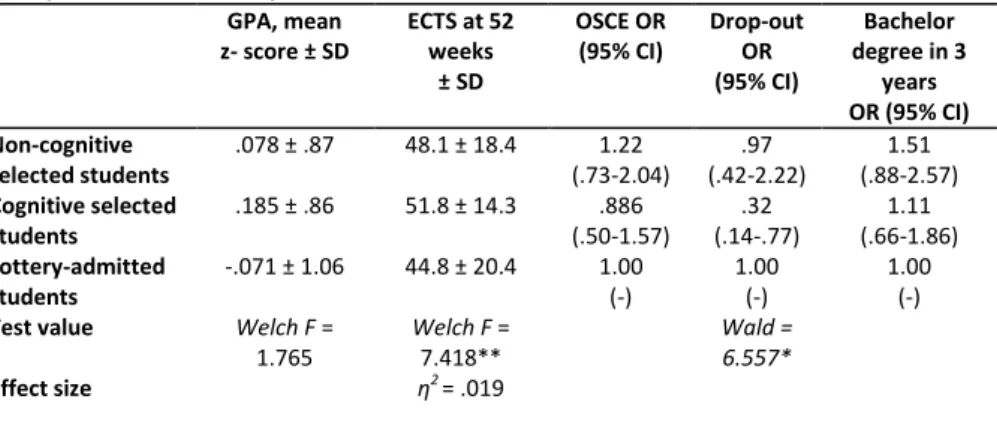
Medical schools all over the world select applicants using non-cognitive and cognitive criteria. The predictive value of these different types of selection criteria, however has never been investigated within the same curriculum while using a control group. We therefore set up a study that enabled us to compare the academic performance of three different admission groups, all composed of school leaver entry students, and all enrolled in the same Bachelor programme: students selected on non-cognitive criteria, students selected on cognitive criteria and students admitted by lottery. First-year GPA and number of course credits (ECTS) at 52 weeks after enrolment of non-cognitive selected students (N = 102), cognitive selected students (N = 92) and lottery-admitted students (N = 356) were analysed. In addition, the chances of dropping out, the probability of passing the third-year OSCE, and of completing the Bachelor programme within three years were compared. Although there were no significant differences between the admission groups in first-year GPA, cognitive selected students had obtained significantly more ECTS at 52 weeks and dropped out less often than lottery-admitted students. Probabilities of passing the OSCE and completing the Bachelor programme within three years did not significantly differ between the groups. These findings indicate that the use of only non-cognitive selection criteria is not sufficient to select the best academically performing students, most probably because a minimal cognitive ability is needed to succeed in medical school.
26
Ch
ap
ter 2
N
on-cog
ni
tiv
e s
ele
cte
d s
tuden
ts do n
ot o
utp
er
for
m...
INTRODUCTION
Medical schools all over the world select students as the number of applicants highly exceeds the number of available places. In Canada, the United States, the United Kingdom, and the Netherlands, chances to be admitted to medical school range from six to 33 percent (Razack, et al., 2012; DUO, 2014a). In addition, medical education is expensive for both student and society, and medical schools have the responsibility of educating future medical doctors who are able to provide optimal healthcare (Hughes, 2002). It is therefore important to select those applicants who will be able to successfully complete the programme and will become well-performing medical doctors (Albanese, et al., 2003; Basco, et al., 2008; Burch, 2009; Kulatunga-Moruzi & Norman, 2002; Mitchell, 1990).
A variety of selection instruments has been used to admit the most promising applicants to medical school. These instruments range from cognitive selection tools, such as the pre-university grade point average (pu-GPA; Ferguson, et al., 2002; Siu & Reiter, 2009) and aptitude tests such as the Medical School Admission Test (MCAT; Albanese, et al., 2003; Kelly, et al., 2013) to selection instruments aiming to measure more non-cognitive capabilities of the applicants. Non-cognitive selection tools include regular interviews (Basco, et al., 2008; Burch, 2009), reference letters (Ferguson, et al., 2003; Siu & Reiter, 2009), motivation letters (Prideaux, et al., 2011; Salvatori, 2001), psychometric questionnaires (Arthur, 2001), Multiple Mini Interviews (Eva, Reiter, et al., 2004a; Eva, Rosenfeld, et al., 2004), and Situational Judgment Tests (Lievens, 2013; Patterson, Lievens, Kerrin, Zibarras, & Carette, 2012). The reliability and validity of these selection instruments differ widely, and while research has shown that mainly the pu-GPA and MCAT have, especially in a combined form, a reasonable predictive value for performance during medical school (Albanese, et al., 2003; Dunleavy, Kroopnick, Dowd, Searcy, & Zhao, 2013; Ferguson, et al., 2002), several non-cognitive selection tools appear not to be so reliable and valid (Basco, et al., 2008; Burch, 2009; Ferguson, et al., 2003; Salvatori, 2001). With respect to interviews, a large interviewer variability exists and personal factors such as gender and background of the applicant, as well as expectations of the interviewer, are sources of bias (Eva, Reiter, Rosenfeld, & Norman, 2004b; Salvatori, 2001). Problems with reference and motivation letters are the absence of a scoring system to compare the letters (Ferguson, et al., 2002) and that they rarely distinguish one applicant from another (Spina, et al., 2000). The use of psychometric questionnaires for selection procedures is also criticized, because of the possible lack of reliability and the risk of obtaining desirable answers (Arthur, 2001). Although the first results on the MMI and SJT are promising (Dore, et al., 2010; Eva, Rosenfeld, et al., 2004; Koczwara, et al., 2012), further research is needed to establish the long-term predictive value of these non-cognitive selection tools.
Whereas much research has been conducted on the predictive validity of selection tools, only a few studies included a control group to compare the performance of the selected students to (O’Neill, Hartvigsen, Wallstedt, Korsholm, & Eika, 2011; Urlings-Strop, Stegers-Jager, Stijnen, & Themmen, 2013; Urlings-Strop, Stijnen, Themmen, & Splinter, 2009; Urlings-Strop, Themmen, Stijnen, & Splinter, 2011). In addition, the predictive
value of the selection tools might also depend on the curriculum employed by the medical school (Edwards, Friedman, & Pearce, 2013), which limits the generalizability of the findings and the possibility to compare the selection methods. It would thus be valuable to determine the independent contribution of non-cognitive and cognitive selection methods to academic performance in the presence of a control group, allowing a comparison of all groups under similar circumstances.
While many medical schools in the world select 100% of their applicants, the situation in the Netherlands is different, as at the time of the current study a maximum of 50% of the students were selected by the medical schools (Urlings-Strop, et al., 2011), although the percentage of selected students is expected to rise also in the Netherlands in view of recent policy changes phasing out the lottery practice (DUO, 2014b). In the Netherlands, applicants currently have three possibilities to be admitted to medical school: direct access, selection, and lottery. Direct access is provided to those applicants who obtained a pu-GPA of ≥ 8.0, on a scale from 1-10, where students need to score at least a 5.5 to pass. Regarding the students admitted by selection, each medical school employs its own particular, local selection procedure. Finally, non-selected students are admitted via a national lottery system that is weighted for secondary school performance, i.e. applicants are assigned to a lottery batch depending on their pu-GPA, with increasing odds to be admitted with increasing pu-GPA. Applicants who failed to be admitted by the local selection procedure are allowed to participate in the national lottery, which means they still have a chance to enter medical school. This provides a unique opportunity to create a control group of non-selected, but lottery-admitted medical school students. A few studies have already taken advantage of this situation and studied the effect of selection on academic performance (Hulsman, et al., 2007; ten Cate, 2002; Urlings-Strop, et al., 2013; Urlings-Urlings-Strop, et al., 2009; Urlings-Urlings-Strop, et al., 2011). However, some of these studies were conducted during the development of procedures when selection for medical school was first allowed in the Netherlands, resulting in a relatively small number of selected students (1.5-6.2%), which might have influenced their findings (Hulsman, et al., 2007; ten Cate, 2002). These studies showed that selected students were more committed to healthcare during their first two years of medical school but did not perform better (Hulsman, et al., 2007), and that cognitive requirements do have some predictive value for academic performance (ten Cate, 2002). Research conducted at our own medical school showed that a selection procedure existing of a non-cognitive step followed by a cognitive one led to the inclusion of students who received higher grades during clerkships and dropped out less often than students who were admitted by lottery (Urlings-Strop, et al., 2009; Urlings-Strop, et al., 2011). In addition, one of the studies by Urlings-Strop and colleagues showed that success in a cognitive selection step related to a lower dropout rate, while higher grades during clerkships related to success on non-cognitive selection criteria (Urlings-Strop, et al., 2013). However, here, only those applicants who met the non-cognitive requirements were allowed to participate in the following cognitive step of the selection procedure, which made it impossible to measure the effect of cognitive or non-cognitive selection in isolation. A final study is from researchers in Denmark. They investigated the difference in dropout between students who were admitted on either their pu-GPA or on their results in a selection procedure. In this selection procedure, applicants were judged upon motivation,
28
Ch
ap
ter 2
N
on-cog
ni
tiv
e s
ele
cte
d s
tuden
ts do n
ot o
utp
er
for
m...
qualifications, general knowledge, and performance in an admission interview. This study showed that students who were selected dropped out less often compared to the students who were admitted on the basis of their pu-GPA (O’Neill, Hartvigsen, Wallstedt, Korsholm, & Eika, 2011). However, this study only focused on dropout and not on other measures of academic performance.
In the current study, we aimed to examine the effect of either non-cognitive or cognitive selection in isolation on academic performance using the lottery-admitted group as a control group. In this manner, the contribution of non-cognitive selection criteria and cognitive selection criteria could be measured independently among students who followed the same curriculum and could be compared to the lottery-admitted students. We expect all selected students to drop out, voluntary or academically dismissed, less often than the students who were admitted by lottery, as previous studies showed that students who had to put effort in their admission, dropped out less often, irrespective of their success in the selection procedure (O’Neill, et al., 2011; Urlings-Strop, et al., 2013). In addition, we expect the non-cognitive selected students to pass the third-year objective structured clinical examination (OSCE) more often than the other admission groups since previous research showed that success on non-cognitive criteria was related to higher clerkship grades (Urlings-Strop, et al., 2011). Next to this, we were interested to investigate whether there were other differences in academic performance, e.g., grade point average and number of course credits, between the non-cognitive selected students, the cognitive selected students and the lottery-admitted students.
METHODS Context
This study was performed at the Erasmus MC Medical School in Rotterdam, the Netherlands. Everyone who has finished a pre-university secondary school level, with a combination of subjects obligatory for medicine, or who has similar qualifications, is allowed to apply to medical school in the Netherlands (ten Cate, 2007). Normally, in the local selection procedure of the Erasmus MC Medical School, applicants are selected if they succeed in two, consecutive, selection rounds: a non-cognitive (i.e. quality and quantity of their extracurricular activities before application) and a cognitive round (i.e. their scores on a set of five cognitive tests covering a medical subject). The cognitive round was limited to those who met a cut-off value in the first, non-cognitive, round. As regards the extracurricular activities, applicants must have spent at least four hours per week for a minimum of one year on a) voluntary work-related activities in healthcare, b) a managerial position in for example a school board or c) have achieved an outstanding performance in sports, science, literature or art. The rationale behind selecting applicants upon their extracurricular activities is that these applicants are able to distinguish themselves from others, by showing through their behaviour the motivation and ambition to carry out other activities as well as the ability to combine these activities with their secondary education (Urlings-Strop, et al., 2009). In the cognitive step, the applicants’ level of cognitive ability and academic study skills was measured by their performance on five different cognitive tests. Test subjects include arithmetic, anatomy, scientific reading, logical thinking, and one test based on a medical subject referring to two lectures applicants have attended.
Once students are admitted to medical school, they follow an integrated and theme-oriented curriculum that comprises a three year Bachelor programme followed by a three year Master programme. The Bachelor of Medicine is divided into thematic blocks of 4–16 weeks, which are organized around pathophysiological systems and cover subjects starting from the basic sciences up to and including clinical practice. Per academic year, students can achieve a maximum of 60 European Credits (ECTS). ECTS are a standard for comparing student workload in the European Union and reflects successfully completed exams and assignments (Kuncel, Kochevar, & Ones, 2014). Students who quit voluntarily within the first two years of enrolment, or who do not meet the requirements set by medical school, i.e. having earned all first-year ECTS by the end of the second-year of enrolment, are considered dropouts.
Participants
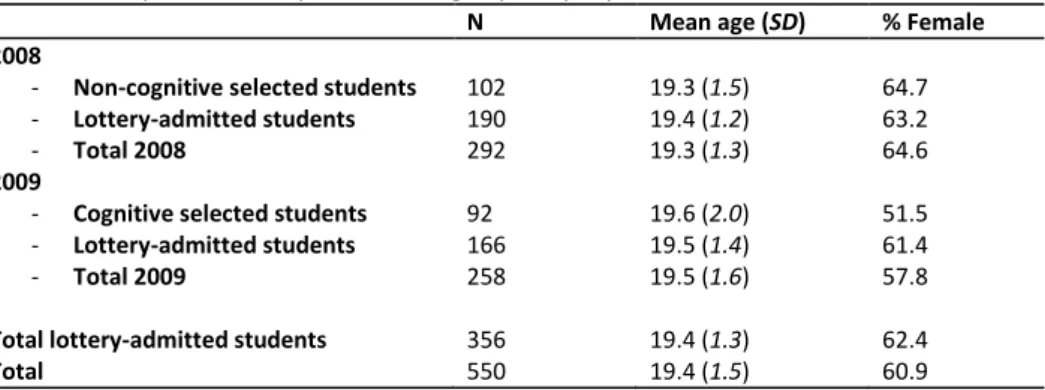
In the present study, we included students who started in 2008 and in 2009 at Erasmus MC medical school, and were admitted by selection or lottery. Those who were directly admitted based upon their pu-GPA (≥ 8.0) were excluded from this analysis since these students had not participated in either selection or lottery and their numbers are small (< 10%). In total, 550 students (Mage= 19.4, SD = 1.5) were included; 102 non-cognitive selected students, 92 cognitive selected students and 356 lottery-admitted students. No significant differences in age, gender and pu-GPA were found between the admission groups and cohorts (see Table 1).
30