Dominance-based Rough Set Approach
Data Analysis Framework
jMAF - Dominance-based Rough Set Data Analysis Framework
http://www.cs.put.poznan.pl/jblaszczynski/Site/jRS.html
Jerzy Bªaszczy«ski, Salvatore Greco, Benedetto Matarazzo, Roman Sªowi«ski, Marcin Szel¡g
[email protected]March 18, 2009
Contents
1 Introduction 2
2 Basic Concepts of Dominance-based Rough Set Approach 2
2.1 Decision Table . . . 3
2.2 Dominance cones as granules of knowledge . . . 3
2.3 Approximation of ordered decision classes . . . 4
2.4 Quality of approximation . . . 5
2.5 Reduction of attributes . . . 5
2.6 Decision Rules . . . 5
2.7 Variable Consistency Dominance-based Rough Set Approaches . . . 6
3 Example of Use 7 3.1 Running jMAF . . . 7
3.2 Decision Table . . . 7
3.3 Data File . . . 8
3.4 Opening isf File . . . 9
3.5 Calculation of Dominance Cones . . . 9
3.6 Calculation of Approximations . . . 10
3.7 Induction of Decision Rules . . . 12
3.8 Classication . . . 14 4 Exemplary Applications of Dominance-based Rough Set Approach 16
5 Glossary 17
1 Introduction
jMAF is a Rough Set Data Analysis Framework written in Java language. It is based on java Rough Set (jRS) library. jMAF and jRS library implement methods of analysis provided by the Dominance-based Rough Set Approach and Variable Consistency Dominance-based Rough Set Approach. In the following, we give basics of these two approaches and we provide an example of jMAF usage that is meant to instruct novice users.
2 Basic Concepts of Dominance-based Rough Set Approach
Dominance-based Rough Set Approach (DRSA) is dened for problems with background knowledge about ordinal evaluations of objects from a universe, and about monotonic relationships between these evaluations, e.g. the larger the mass and the smaller the distance, the larger the gravity or the greater the debt of a rm, the greater its risk of failure. Precisely, the monotonic relationships are assumed between evaluation of objects on condition attributes and their assignment to decision classes. The monotonic relationships
are also interpreted as monotonicity constraints, because the better the evaluation of an object, the better should be the decision class the object is assigned to. For this reason, classication problems of this kind are called ordinal classication problems with monotonicity constraints. Many real-world classication problems fall into this category. Typical examples are multiple criteria sorting and decision under uncertainty, where the order of value sets of attributes corresponds to increasing or decreasing order of preference of a decision maker. In these decision problems, the condition attributes are called criteria.
Although DRSA is a general methodology for reasoning about data describing ordinal classication problems with monotonicity constraints, in this manual, we shall use the vocabulary typical for multiple criteria sorting problems.
2.1 Decision Table
Let us consider a decision table including a nite universe of objects (solutions, alternatives, actions) U
evaluated on a nite set of condition attributesF ={f1, . . . , fn}, and on a single decision attributed.
Table 1: Exemplary decision table with evaluations of students
Student f1 - Mathematics f2 - Physics f3- Literature d- Overall Evaluation
S1 good medium bad bad
S2 medium medium bad medium
S3 medium medium medium medium
S4 good good medium good
S5 good medium good good
S6 good good good good
S7 bad bad bad bad
S8 bad bad medium bad
The set of the indices of attributes is denoted by I={1, . . . , n}. Without loss of generality, fi:U → <
for each i = 1, . . . , n, and, for all objects x, y ∈ U, fi(x) ≥ fi(y) means that x is at least as good as y
with respect to attribute i, which is denoted by x i y. Therefore, it is supposed that i is a complete
preorder, i.e. a strongly complete and transitive binary relation, dened onU on the basis of quantitative
and qualitative evaluations fi(·). Furthermore, decision attribute d makes a partition of U into a nite
number of decision classes, Cl={Cl1, . . . , Clm}, such that eachx∈U belongs to one and only one classClt,
t = 1, . . . , m. It is assumed that the classes are preference ordered, i.e. for all r, s = 1, . . . , m, such that r > s, the objects from Clr are preferred to the objects from Cls. More formally, if is a comprehensive
weak preference relation on U, i.e. if for all x, y ∈ U, xy reads x is at least as good as y, then it is
supposed that
[x∈Clr, y∈Cls, r>s]⇒xy,
wherexy meansxy andnot yx.
The above assumptions are typical for consideration of an ordinal classication (or multiple criteria sorting) problem. Indeed, the decision table characterized above, includes examples of ordinal classication which constitute an input preference information to be analyzed using DRSA.
The sets to be approximated are called upward union and downward union of decision classes, respectively:
Cl≥t = [ s≥t Cls, Cl≤t = [ s≤t Cls, t= 1, ..., m.
The statementx∈Cl≥t reads xbelongs to at least classClt, whilex∈Cl≤t reads xbelongs to at most
class Clt. Let us remark thatCl≥1 =Cl
≤
m=U,Cl
≥
m=ClmandCl≤1=Cl1. Furthermore, for t=2,...,m, Cl≤t−1=U−Cl≥t and Cl≥t =U−Cl≤t−1.
2.2 Dominance cones as granules of knowledge
The key idea of DRSA is representation (approximation) of upward and downward unions of decision classes, by granules of knowledge generated by attributes being criteria. These granules are dominance cones in the attribute values space.
xdominates y with respect to set of attributes P ⊆F (shortly, xP-dominates y), denoted by xDPy, if
for every attributefi∈P,fi(x)≥fi(y). The relation ofP-dominance is reexive and transitive, i.e., it is a
partial preorder.
Given a set of attributesP ⊆I andx∈U, the granules of knowledge used for approximation in DRSA
are:
• a set of objects dominatingx, called P-dominating set, DP+(x)={y∈U: yDPx},
• a set of objects dominated byx, called P-dominated set, DP−(x)={y∈U: xDPy}.
Let us recall that the dominance principle requires that an objectxdominating objectyon all considered
attributes (i.e. xhaving evaluations at least as good asy on all considered attributes) should also dominate y on the decision (i.e. xshould be assigned to at least as good decision class as y). Objects satisfying the dominance principle are called consistent, and those which are violating the dominance principle are called inconsistent.
2.3 Approximation of ordered decision classes
TheP-lower approximation of Cl≥t, denoted by P(Cl≥t), and theP-upper approximation ofCl≥t, denoted
byP(Cl≥t ), are dened as follows (t= 2, ..., m):
P(Cl≥t ) = {x∈U :D+P(x)⊆Cl ≥ t }, P(Cl≥t ) = {x∈U :D−P(x)∩Cl ≥ t 6=∅}.
Analogously, one can dene theP-lower approximation and theP-upper approximation ofCl≤t as follows
(t= 1, ..., m−1): P(Cl≤t ) = {x∈U :D−P(x)⊆Cl ≤ t }, P(Cl≤t ) = {x∈U :D+P(x)∩Cl ≤ t 6=∅}.
The P-lower and P-upper approximations so dened satisfy the following inclusion property, for all P⊆F: P(Cl≥t )⊆Cl ≥ t ⊆P(Cl ≥ t ), t= 2, . . . , m, P(Cl≤t )⊆Cl≤t ⊆P(Cl≤t ), t= 1, . . . , m−1.
TheP-lower andP-upper approximations ofCl≥t andCl≤t have an important complementarity property,
according to which,
P(Cl≥t )=UP(Cl≤t−1) and P(Cl≥t )=UP(Cl≤t−1), t=2,...,m, P(Cl≤t )=UP(Clt≥+1) and P(Cl≤t )=UP(Clt≥+1), t=1,...,m1.
The P-boundary of Cl≥t and Cl≤t, denoted by BnP(Cl≥t) and BnP(Cl≤t), respectively, are dened as
follows: BnP(Cl≥t) =P(Cl ≥ t )P(Cl ≥ t ), t= 2, . . . , m, BnP(Cl≤t) =P(Cl ≤ t )P(Cl ≤ t ), t= 1, . . . , m−1.
2.4 Quality of approximation
For every P ⊆F, the quality of approximation of the ordinal classication Cl by a set of attributes P is
dened as the ratio of the number of objects P-consistent with the dominance principle and the number
of all the objects inU. Since the P-consistent objects are those which do not belong to anyP-boundary BnP(Cl≥t), t = 2, . . . , m, or BnP(Cl≤t), t = 1, . . . , m −1, the quality of approximation of the ordinal
classication Cl by a set of attributesP, can be written as
γP(Cl) = U− S t=2,...,m BnP(Clt≥) ! |U| = U − S t=1,...,m−1 BnP(Clt≤) ! |U| .
γP(Cl)can be seen as a degree of consistency of the objects fromU, where P is the set of attributes being
criteria and Cl is the considered ordinal classication.
Moreover, for every P ⊆F, the accuracy of approximation of union of ordered classes Cl≥t, Cl≤t by a
set of attributesP is dened as the ratio of the number of objects belonging toP-lower approximation and P-upper approximation of the union. Accuracy of approximation αP(Clt≥), αP(Cl≤t)can be written as
αP(Cl≥t) = P(Cl ≥ t ) |P(Clt≥)|, αP(Cl ≤ t) = P(Cl ≤ t) |P(Cl≤t)|.
2.5 Reduction of attributes
Each minimal (with respect to inclusion) subsetP ⊆F such thatγP(Cl) =γF(Cl)is called a reduct of Cl,
and is denoted byREDCl. Let us remark that for a given setU one can have more than one reduct. The
intersection of all reducts is called the core, and is denoted byCORECl. Attributes inCORECl cannot be
removed from consideration without deteriorating the quality of approximation. This means that, in setF,
there are three categories of attributes:
• indispensable attributes included in the core,
• exchangeable attributes included in some reducts, but not in the core,
• redundant attributes, neither indispensable nor exchangeable, and thus not included in any reduct.
2.6 Decision Rules
The dominance-based rough approximations of upward and downward unions of decision classes can serve to induce a generalized description of objects in terms of if . . . , then . . . decision rules. For a given upward or downward union of classes, Cl≥t or Cl≤s, the decision rules induced under a hypothesis that objects
belonging to P(Cl≥t) or P(Cls≤) are positive examples, and all the others are negative, suggest a certain assignment to classCltor better, or to classCls or worse, respectively. On the other hand, the decision
rules induced under a hypothesis that objects belonging to P(Clt≥)or P(Cl≤s) are positive examples, and
all the others are negative, suggest a possible assignment to classCltor better, or to classCls or worse,
respectively. Finally, the decision rules induced under a hypothesis that objects belonging to the intersection
P(Cls≤)∩P(Cl≥t)are positive examples, and all the others are negative, suggest an approximate assignment to some classes betweenClsandClt (s < t).
In the case of preference ordered description of objects, setU is composed of examples of ordinal
classi-cation. Then, it is meaningful to consider the following ve types of decision rules:
1) certain D≥-decision rules, providing lower prole descriptions for objects belonging toP(Cl≥t ):
if fi1(x)≥ri1 and . . . and fip(x)≥rip,then x∈Cl
≥
t ,
{i1, . . . , ip} ⊆I,t= 2, . . . , m,ri1, . . . , rip∈ <;
2) possible D≥-decision rules, providing lower prole descriptions for objects belonging toP(Cl≥t ):
if fi1(x)≥ri1 and . . . and fip(x)≥rip,then x possibly belongs to Cl
≥
t ,
{i1, . . . , ip} ⊆I,t= 2, . . . , m,ri1, . . . , rip∈ <;
3) certain D≤-decision rules, providing upper prole descriptions for objects belonging toP(Cl≤t):
if fi1(x)≤ri1 and . . . and fip(x)≤rip,then x∈Cl
≤
t ,
4) possible D≤-decision rules, providing upper prole descriptions for objects belonging toP(Cl≤t):
if fi1(x)≤ri1 and . . . and fip(x)≤rip,then x possibly belongs to Cl
≤
t ,
{i1, . . . , ip} ⊆I,t= 1, . . . , m−1,ri1, . . . , rip∈ <;
5) approximate D≥≤-decision rules, providing simultaneously lower and upper prole descriptions for
objects belonging to Cls∪Cls+1∪. . .∪Clt, without possibility of discerning to which class:
if fi1(x) ≥ ri1 and . . . and fik(x) ≥ rik and fik+1(x) ≤ rik+1 and . . . and fip(x) ≤ rip, then x ∈
Cls∪Cls+1∪. . .∪Clt,
{i1, . . . , ip} ⊆I,s, t∈ {1, . . . , m},s < t, ri1, . . . , rip∈ <.
In the premise of a D≥≤-decision rule, there can be fi(x)≥ri and fi(x)≤r0i, whereri≤ri0, for the
samei∈I. Moreover, if ri=ri0, the two conditions boil down to fi(x) =ri.
Since a decision rule is a kind of implication, a minimal rule is understood as an implication such that there is no other implication with the premise of at least the same weakness (in other words, a rule using a subset of elementary conditions and/or weaker elementary conditions) and the conclusion of at least the same strength (in other words, a D≥- or a D≤-decision rule assigning objects to the same union or sub-union
of classes, or a D≥≤-decision rule assigning objects to the same or smaller set of classes).
The rules of type 1) and 3) represent certain knowledge extracted from data (examples of ordinal clas-sication), while the rules of type 2) and 4) represent possible knowledge; the rules of type 5) represent doubtful knowledge, because they are supported by inconsistent objects only.
Given a certain or possible D≥-decision ruler≡if fi1(x)≥ri1and . . . and fip(x)≥rip,then x∈Cl
≥
t,
an object y ∈ U supports r if fi1(y)≥ ri1 and . . . and fip(y) ≥rip. Moreover, object y ∈ U supporting decision ruleris a base of riffi1(y) =ri1 and . . . and fip(y) =rip. Similar denitions hold for certain or possible D≤-decision rules and approximate D≥≤-decision rules. A decision rule having at least one base is
called robust. Identication of supporting objects and bases of robust rules is important for interpretation of the rules in multiple criteria decision analysis. The ratio of the number of objects supporting a rule and the number of all considered objects is called relative support of a rule. The relative support and the condence ratio are basic characteristics of a rule, however, some Bayesian conrmation measures reect much better the attractiveness of a rule [21].
A set of decision rules is complete if it covers all considered objects (examples of ordinal classication) in such a way that consistent objects are re-assigned to their original classes, and inconsistent objects are assigned to clusters of classes referring to this inconsistency. A set of decision rules is minimal if it is complete and non-redundant i.e., exclusion of any rule from this set makes it incomplete.
Note that the syntax of decision rules induced from rough approximations dened using dominance cones, is using consistently this type of granules. Each condition prole denes a dominance cone inn-dimensional
condition space<n, and each decision prole denes a dominance cone in one-dimensional decision space
{1, . . . , m}. In both cases, the cones are positive for D≥-rules and negative for D≤-rules.
Let us also remark that dominance cones corresponding to condition proles can originate in any point of <n, without the risk of their being too specic. Thus, contrary to traditional granular computing, the
condition space<n need not be discretized.
Procedures for rule induction from dominance-based rough approximations have been proposed in [19]. The following section 3 presents example of use of jMAF for sorting problem (called also multi-criteria classication or ordered classication with monotonicity constraints). The surveys [13, 14, 15, 31, 32] include applications of DRSA.
2.7 Variable Consistency Dominance-based Rough Set Approaches
In DRSA, lower approximation of a union of ordered classes contains only consistent objects. Such a lower approximation is dened as a sum of dominance cones that are subsets of the approximated union. In practical applications, however, such a strong requirement may result in relatively small lower approxima-tions. Therefore, several extensions of DRSA have been proposed. These extensions relax the condition for inclusion of an object to the lower approximation. Variable Consistency Dominance-based Rough Set Approaches (VC-DRSA) include to lower approximations objects which are suciently consistent. Dierent measures of consistency may be applied in VC-DRSA. Given a user-dened threshold value, extended lower approximation of a union of classes is dened as a set of objects for which the consistency measure satises that threshold.
Several denitions of VC-DRSA have been considered in the literature so far. In the rst papers concern-ing VC-DRSA [11, 20], consistency of objects have been calculated usconcern-ing rough membership measure [26, 36]. Then, in order to ensure monotonicity of lower approximation with respect to the dominance relation, the
idea of the rst papers have been extended in the work [2]. Recently, it has been pointed out that it is rea-sonable to require that consistency measure used in the denition of the lower approximation satises some properties of monotonicity [4]. Resulting variable consistency approaches, employing monotonic consistency measures, are called Monotonic Variable Consistency Dominance-based Rough Set Approaches [3, 4].
3 Example of Use
We present a didactic example which illustrates application of jMAF in data analysis.
3.1 Running jMAF
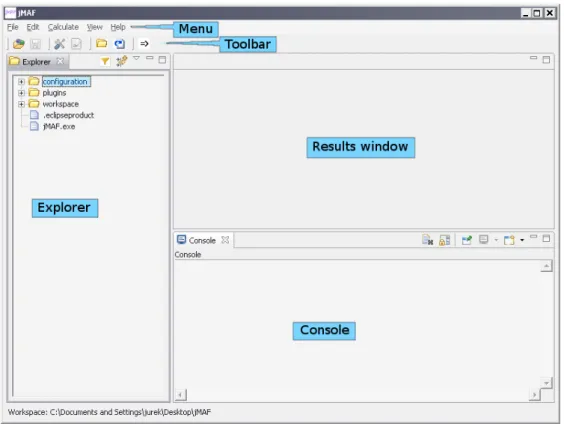
You may nd jMAF executable le in the location where you have unpacked the zip le that can be down-loaded from http://www.cs.put.poznan.pl/jblaszczynski/Site/jRS.html. Please launch this le. A moment later you will see main jMAF window on your desktop. It should resemble the one presented in Figure 1.
Figure 1: jMAF main window
Now you have jAMM running in workspace folder located in the folder where it was launched from. You can check the content of workspace folder by examining the explorer window. The main jMAF window is divided into 4 sub windows: topmost menubar and toolbar, middle explorer and results window and bottom console window. There is also a status line at the bottom.
3.2 Decision Table
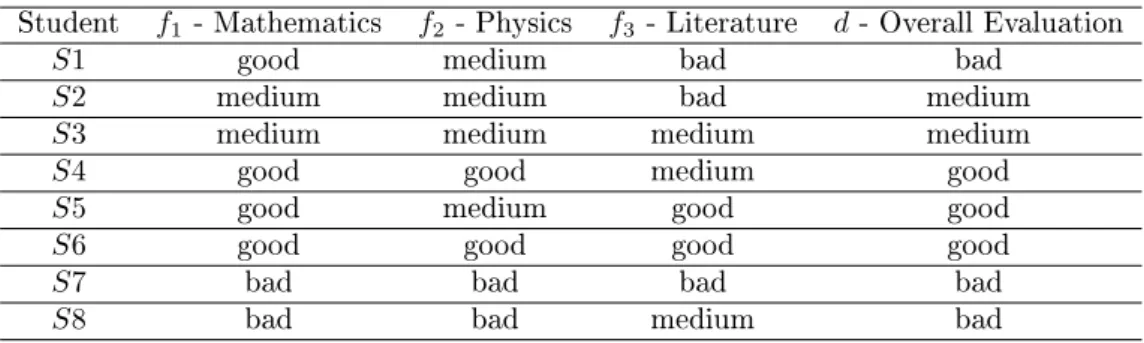
Let us consider the following ordinal classication problem. Students of a college must obtain an overall evaluation on the basis of their achievements in Mathematics, Physics and Literature. These three subjects are clearly criteria (condition attributes) and the comprehensive evaluation is a decision attribute. For simplicity, the value sets of the attributes and of the decision attribute are the same, and they are composed of three values: bad, medium and good. The preference order of these values is obvious. Thus, there are three preference ordered decision classes, so the problem belongs to the category of ordinal classication. In order to build a preference model of the jury, DRSA is used to analyze a set of exemplary evaluations of students provided by the jury. These examples of ordinal classication constitute an input preference information presented as decision table in Table 2.
Note that the dominance principle obviously applies to the examples of ordinal classication, since an improvement of a student's score on one of three attributes, with other scores unchanged, should not worsen the student's overall evaluation, but rather improve it.
Table 2: Exemplary decision table with evaluations of students (examples of ordinal classication) Student Mathematics Physics Literature Overall Evaluation
S1 good medium bad bad
S2 medium medium bad medium
S3 medium medium medium medium
S4 good good medium good
S5 good medium good good
S6 good good good good
S7 bad bad bad bad
S8 bad bad medium bad
Observe that student S1 has not worse evaluations than student S2 on all the considered condition attributes, however, the overall evaluation of S1 is worse than the overall evaluation of S2. This violates the dominance principle, so the two examples of ordinal classication, and only those, are inconsistent. One can expect that the quality of approximation of the ordinal classication represented by examples in Table 2 will be equal to0.75.
3.3 Data File
As the rst step you should create a le containing data from the data table. You have now two choices -you may use spreadsheet-like editor or any plain text editor. For this example, we will focus on the second option.
Run any text editor that is available on your system installation. Enter the text shown below.
**ATTRIBUTES
+ Mathematics : [bad, medium, good] + Physics : [bad, medium, good] + Literature : [bad, medium, good] + Overall : [bad, medium, good] decision: Overall **PREFERENCES Mathematics : gain Physics : gain Literature : gain Overall : gain **EXAMPLES
good medium bad bad medium medium bad medium medium medium medium medium good good medium good good medium good good good good good good bad bad bad bad bad bad medium bad **END
Now, save the le as students.isf (for example in the jMAF folder). At this moment you are able to open this le in jMAF.
3.4 Opening isf File
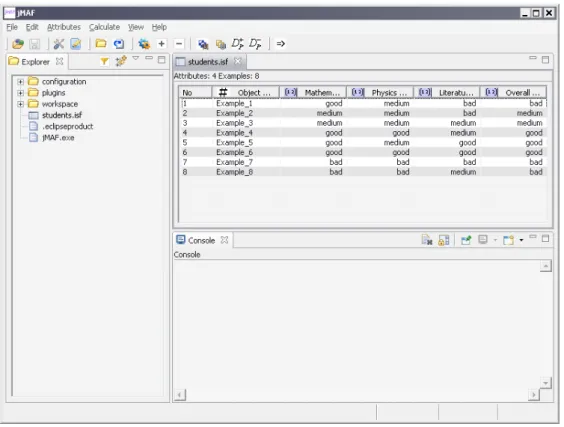
Use File | Open to open isf le. You will see a typical le open dialog. Please select your newly created
le. Alternatively, you can double click le in the explorer window if you have saved it in the workspace folder. If the le is not visible in explorer window, try right clicking on the explorer window and select from the context menu Refresh or Switch workspace to choose dierent workspace folder.
Figure 2: File students.isf opened in jMAF
3.5 Calculation of Dominance Cones
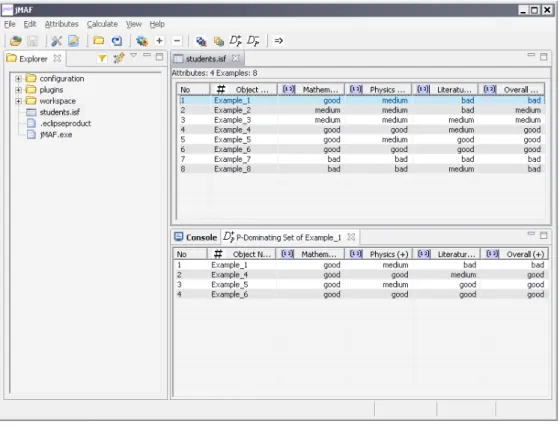
One of the rst steps of data analysis using rough set theory is calculation of dominance cones (P-dominating
sets andP-dominated sets). To perform this step, you can select an example from the isf le in results window
and use Calculate | P-Dominance Sets | Calculate dominating set or Calculate | P-Dominance
Sets | Calculate dominated set. You can also use these options from the toolbar menu. The resulting
Figure 3: P-dominating cone of Example1
Figure 4: P-dominated cone of Example1
3.6 Calculation of Approximations
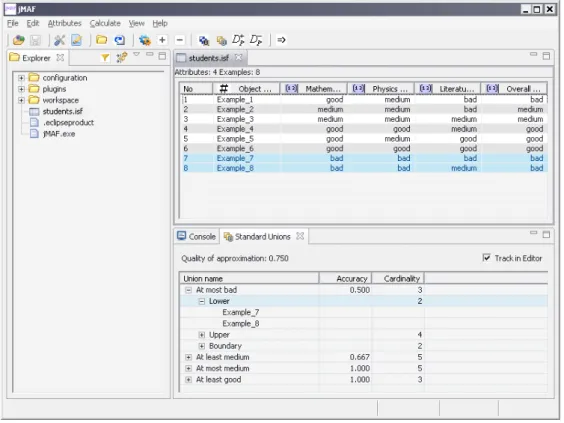
The next step in rough set analysis is calculation of approximations. Use Calculate | Unions of classes | Standard unions of classes to calculate DRSA unions and their approximations. Now, you should see
Figure 5: Input dialog for calculation of approximations
Leave default value of the consistency level parameter if you are looking for standard DRSA analysis. You can also set consistency level lower than one, to perform VC-DRSA analysis. This part is however not covered by this guide. You should see the result as presented in Figure 6.
Figure 6: Approximations of unions of classes
You can navigate in Standard Unions window to see more details concerning calculated approximations (they are presented in Figure 7).
As you can see, quality of approximation equals0.75, and accuracy of approximation in unions of classes ranges from 0.5 to 1.0. Lower approximation of union "at most" bad includes S7 and S8. Please select Track in Editor option to track your selection from Standard Unions window in the results window.
Figure 7: Details of approximations of unions of classes
3.7 Induction of Decision Rules
Given the above rough approximations, one can induce a set of decision rules representing the preferences of the jury. We will use one of the available methods - minimal covering rules (VC-DOMLEM algorithm).The idea is that evaluation proles of students belonging to the lower approximations can serve as a base for some certain rules, while evaluation proles of students belonging to the boundaries can serve as a base for some approximate rules. In the example we will consider, however, only certain rules.
To induce rules use Calculate | VC-DOMLEM algorithm. You will see a dialog with parameters of
rule induction that is presented in Figure 8. Leave default values of these parameters to perform standard rule induction for DRSA analysis.
Figure 8: Dialog with parameters of rule induction
To select where the result le with rules will be stored please edit output le in the following dialog (presented in Figure 9).
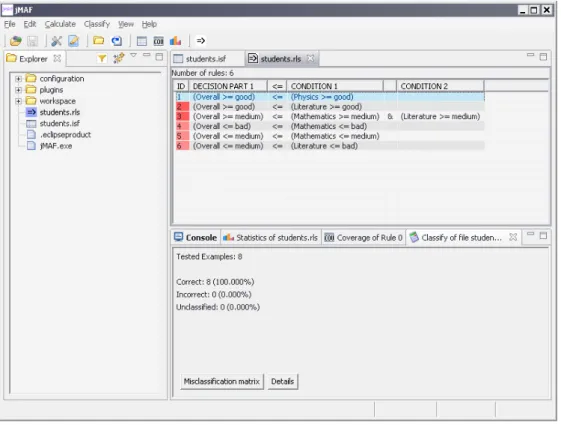
The resulting rules are presented in results window (see Figure 10).
Statistics of a rule selected in results window can be show by selecting Open Statistics View associated with selected rule from toolbar or from the context menu (right click on a rule). Statistics of the rst rule are presented in Figure 11.
Figure 9: Dialog with parameters of rule induction
Figure 10: Decision rules
Figure 11: Statistics of the rst decision rule
Figure 12: Coverage of the rst decision rule
3.8 Classication
Usually data analyst wants to know what is the value of induced rules, i.e., how good they can classify objects. Thus, we proceed with an example of reclassication of learning data table for which rules were induced. To perform reclassication use Classify| Reclassify learning examples. You will see a dialog
with classication options. Select VCDRSA classication method as it is presented in Figure 13. Should you want to know more about VC-DRSA method, please see [1].
Figure 13: Dialog with classication method
The results of classication are presented in a summary window as it is shown in Figure 14. Use Details button to see how particular objects were classied. The resulting window is presented in Figure 15. In this window, it is possible to see rules covering each of the classied examples and their classication.
Figure 15: Details of classication
Column Certainty in Fig. 15 refers to classication certainty score calculated in a way presented in [1].
4 Exemplary Applications of Dominance-based Rough Set
Ap-proach
There are many possibilities of applying DRSA to real life problems. The non-exhaustive list of potential applications includes:
• decision support in medicine: in this area there are already many interesting applications (see, e.g.,
[27, 22, 23, 35]), however, they exploit the classical rough set approach; applications requiring DRSA, which handle ordered value sets of medical signs, as well as monotonic relationships between the values of signs and the degree of a disease, are in progress;
• customer satisfaction survey: theoretical foundations for application of DRSA in this eld are available
in [16], however, a fully documented application is still missing;
• bankruptcy risk evaluation: this is a eld of many potential applications, as can be seen from promising
results reported e.g. in [33, 34, 8], however, a wider comparative study involving real data sets is needed;
• operational research problems, such as location, routing, scheduling or inventory management: these
are problems formulated either in terms of classication of feasible solutions (see, e.g., [7]), or in terms of interactive multiobjective optimization, for which there is a suitable IMO-DRSA [18] procedure;
• nance: this is a domain where DRSA for decision under uncertainty has to be combined with
interac-tive multiobjecinterac-tive optimization using IMO-DRSA; some promising results in this direction have been presented in [17];
• ecology: assessment of the impact of human activity on the ecosystem is a challenging problem for
which the presented methodology is suitable; the up to date applications are based on the classical rough set concept (see, e.g., [29, 6]), however, it seems that DRSA handling ordinal data has a greater potential in this eld.
5 Glossary
Multiple attribute (or multiple criteria) decision support aims at giving the decision maker (DM) a recommen-dation concerning a set of objectsU (also called alternatives, actions, acts, solutions, options, candidates,...)
evaluated from multiple points of view called attributes (also called features, variables, criteria,...). Main categories of multiple attribute (or multiple criteria) decision problems are:
• classication, when the decision aims at assigning objects to predened classes, • choice, when the decision aims at selecting the best object,
• ranking, when the decision aims at ordering objects from the best to the worst.
Two kinds of classication problems are distinguished:
• taxonomy, when the value sets of attributes and the predened classes are not preference ordered, • ordinal classication with monotonicity constraints (also called multiple criteria sorting), when the
value sets of attributes and the predened classes are preference ordered, and there exist monotonic relationships between condition and decision attributes.
Two kinds of choice problems are distinguished:
• discrete choice, when the set of objects is nite and reasonably small to be listed,
• multiple objective optimization, when the set of objects is innite and dened by constraints of a
mathematical program.
If value sets of attributes are preference-ordered, they are called criteria or objectives, otherwise they keep the name of attributes.
Criterion is a real-valued functionfi dened on U, reecting a worth of objects from a particular point
of view, such that in order to compare any two objectsa, b ∈ U from this point of view it is sucient to
compare two values: fi(a)andfi(b).
Dominance: objectais non-dominated in set U (Pareto-optimal) if and only if there is no other object binU such thatbis not worse thanaon all considered criteria, and strictly better on at least one criterion.
Preference model is a representation of a value system of the decision maker on the set of objects with vector evaluations.
Rough set in universeU is an approximation of a set based on available information about objects ofU.
The rough approximation is composed of two ordinary sets, called lower and upper approximation. Lower approximation is a maximal subset of objects which, according to the available information, certainly belong to the approximated set, and upper approximation is a minimal subset of objects which, according to the available information, possibly belong to the approximated set. The dierence between upper and lower approximation is called boundary.
Decision rule is a logical statement of the type if..., then..., where the premise (condition part) species values assumed by one or more condition attributes and the conclusion (decision part) species an overall judgment.
References
[1] Bªaszczy«ski, J., Greco, S., Sªowi«ski, R.: Multi-criteria classication - A new scheme for application of dominance-based decision rules, European Journal of Operational Research, 3 (2007) 1030-1044 [2] Bªaszczy«ski, J., Greco, S., Sªowi«ski, R, Szel¡g, M.: On Variable Consistency Dominance-based Rough
Set Approaches. In: LNAI, vol. 4259, Springler-Verlag, Berlin 2006, pp. 191-202
[3] Bªaszczy«ski, J., Greco, S., Sªowi«ski, R, Szel¡g, M.: Monotonic Variable Consistency Rough Set Approaches. In: J. Yao, P. Lingras, W. Wu, M. Szczuka, N. J. Cercone, D. l¦zak (eds.): Rough Sets and Knowledge Technology, LNAI, vol. 4481, Springer-Verlag, 2007, pp. 126-133
[4] Bªaszczy«ski, J., Greco, S., Sªowi«ski, R, Szel¡g, M.: Monotonic Variable Consistency Rough Set Approaches. (submitted)
[5] Figueira, J., Greco, S., Ehrgott, M. (eds.), Multiple Criteria Decision Analysis: State of the Art Surveys, Springer, Berlin, 2005
[6] Flinkman, M., Michaªowski, W., Nilsson, S., Sªowi«ski, R., Susmaga, R., Wilk, S.: Use of rough sets analysis to classify Siberian forest ecosystem according to net primary production of phytomass, INFOR, 38 (2000) 145-161
[7] Gorsevski, P.V., Jankowski, P.: Discerning landslide susceptibility using rough sets. Computers, Envi-ronment and Urban Systems, 32 (2008) 53-65
[8] Greco, S., Matarazzo, B., Sªowi«ski, R.: A new rough set approach to evaluation of bankruptcy risk, in C. Zopounidis (ed.), Operational Tools in the Management of Financial Risks, Kluwer, Dordrecht, 1998, pp. 121-136
[9] Greco, S., Matarazzo, B., Sªowi«ski, R.: The use of rough sets and fuzzy sets in MCDM, chapter 14 in T. Gal, T. Stewart, T. Hanne (eds.), Advances in Multiple Criteria Decision Making, Kluwer, Boston, 1999, pp. 14.1-14.59
[10] Greco S., Matarazzo, B., Sªowi«ski, R.: Rough approximation of a preference relation by dominance relations. European J. Operational Research, 117 (1999) 63-83
[11] Greco, S., Matarazzo, B., Sªowi«ski R.: Rough sets theory for multicriteria decision analysis, European J. of Operational Research, 129 (2001) 1-47
[12] Greco, S., Matarazzo, B., Slowinski, R.: Multicriteria classication. [In]: W. Kloesgen, J. Zytkow (eds.), Handbook of Data Mining and Knowledge Discovery. Oxford University Press, 2002, chapter 16.1.9, pp. 318-328
[13] Greco, S., Matarazzo, B., Sªowi«ski, R.: Dominance-based Rough Set Approach to Knowledge Discovery, (I) - General Perspective, (II) - Extensions and Applications, chapters 20 and 21 in N. Zhong, J. Liu, Intelligent Technologies for Information Analysis, Springer, Berlin, 2004, pp. 513-612
[14] Greco, S., Matarazzo, B., Sªowi«ski, R.: Decision rule approach, chapter 13 in J. Figueira, S. Greco, M. Ehrgott (eds.), Multiple Criteria Decision Analysis: State of the Art Surveys, Springer, Berlin, 2005, pp. 507-563
[15] Greco, S., Matarazzo, B., Sªowi«ski, R.: Dominance-based Rough Set Approach as a proper way of handling graduality in rough set theory. Transactions on Rough Sets VII, LNCS 4400, Springer, Berlin, 2007, pp. 36-52
[16] Greco, S., Matarazzo, B., Sªowi«ski, R.: Customer satisfaction analysis based on rough set approach. Zeitschrift für Betriebswirtschaft, 16 (2007) no.3, 325-339
[17] Greco, S., Matarazzo, B., Sªowi«ski, R.: Financial portfolio decision analysis using Dominance-based Rough Set Approach. Invited paper at the 22nd European Conference on Operational Research (EURO XXII), Prague, 08-11.07.2007
[18] Greco, S., Matarazzo, B., Sªowi«ski, R.: Dominance-based Rough Set Approach to Interactive Multi-objective Optimization, chapter 5 in J.Branke, K.Deb, K.Miettinen, R.Slowinski (eds.), MultiMulti-objective Optimization: Interactive and Evolutionary Approaches. Springer, Berlin, 2008
[19] Greco, S., Matarazzo, B., Sªowi«ski, R., Stefanowski, J.: An algorithm for induction of decision rules consistent with dominance principle, in W. Ziarko, Y. Yao (eds.): Rough Sets and Current Trends in Computing, LNAI 2005, Springer, Berlin, 2001, pp. 304-313
[20] Greco, S., Matarazzo, B., Sªowi«ski R., Stefanowski, J.: Variable Consistency Model of Dominance-based Rough Sets Approach. In: W. Ziarko, Y. Yao (eds.): Rough Sets and Current Trends in Com-puting, LNAI, vol. 2005, Springler-Verlag, Berlin 2001, pp. 170-181
[21] Greco, S., Pawlak, Z., Sªowi«ski, R.: Can Bayesian conrmation measures be useful for rough set decision rules? Engineering Applications of Articial Intelligence, 17 (2004) 345-361
[22] Michaªowski, W., Rubin, S., Sªowi«ski, R., Wilk, S.: Mobile clinical support system for pediatric emergencies. Journal of Decision Support Systems, 36 (2003) 161-176
[23] Michaªowski, W., Wilk, S., Farion, K., Pike, J., Rubin, S., Sªowi«ski, R.: Development of a decision algorithm to support emergency triage of scrotal pain and its implementation in the MET system. INFOR, 43 (2005) 287-301
[24] Pawlak, Z.: Rough Sets, International Journal of Computer and Information Sciences, 11 (1982) 341-356
[25] Pawlak, Z.: Rough Sets, Kluwer, Dordrecht, 1991
[26] Pawlak, Z., Skowron, A., Rough Membership Functions. In: R. R. Yager, M. Fedrizzi and J. Kacprzyk (eds.): Advances in the Dempster-Shafer Theory of Evidence, Wiley, New York 1994, pp. 251-271 [27] Pawlak, Z., Sªowi«ski, K., Sªowi«ski, R.: Rough classication of patients after highly selective vagotomy
for duodenal ulcer. International Journal of Man-Machine Studies, 24 (1986) 413-433
[28] Pawlak, Z., Sªowi«ski, R.: Rough set approach to multi-attribute decision analysis. European J. of Operational Research, 72 (1994) 443-459
[29] Rossi, L., Sªowi«ski, R., Susmaga, R.: Rough set approach to evaluation of stormwater pollution. International Journal of Environment and Pollution, 12 (1999) 232-250
[30] Sªowi«ski, R.: Rough set learning of preferential attitude in multi-criteria decision making, in J. Ko-morowski, Z. W. Ras (eds.), Methodologies for Intelligent Systems, LNAI 689, Springer, Berlin, 1993, pp. 642-651
[31] Sªowi«ski, R., Greco, S., Matarazzo, B.: Rough set analysis of preference-ordered data, in J.J. Alpigini, J.F. Peters, A. Skowron, N. Zhong (eds.), Rough Sets and Current Trends in Computing, LNAI 2475, Springer, Berlin, 2002, pp. 44-59
[32] Sªowi«ski, R., Greco, S., Matarazzo, B.: Dominance-based rough set approach to reasoning about ordinal data, keynote lecture in M.Kryszkiewicz, J.F.Peters, H.Rybiñski, A.Skowron (eds.), Rough Sets and Intelligent Systems Paradigms. LNAI 4585, Springer, Berlin, 2007, pp. 5-11
[33] Sªowi«ski, R., Zopounidis, C.: Application of the rough set approach to evaluation of bankruptcy risk. International Journal of Intelligent Systems in Accounting, Finance and Management 4 (1995) 27-41 [34] Sªowi«ski, R., Zopounidis, C., Dimitras, A.I.: Prediction of company acquisition in Greece by means of
the rough set approach. European Journal of Operational Research, 100 (1997) 1-15
[35] Wilk, S., Sªowi«ski, R., Michaªowski, W., Greco, S.: Supporting triage of children with abdominal pain in the emergency room. European Journal of Operational Research, 160 (2005) 696-709
[36] Wong, S. K. M., Ziarko, W.: Comparison of the probabilistic approximate classication and the fuzzy set model. Fuzzy Sets and Systems, vol. 21, 1987, pp. 357-362