Testing and certification of automated
vehicles (AV) including cybersecurity
and artificial intelligence aspects
A review on testing and
certification of AV with
specific
focus
on
cybersecurity and artificial
intelligence aspects
Baldini, G. 2020
This publication is a Science for Policy report by the Joint Research Centre (JRC), the European Commission’s science and knowledge service. It aims to provide evidence-based scientific support to the European policymaking process. The scientific output expressed does not imply a policy position of the European Commission. Neither the European Commission nor any person acting on behalf of the Commission is responsible for the use that might be made of this publication. For information on the methodology and quality underlying the data used in this publication for which the source is neither Eurostat nor other Commission services, users should contact the referenced source. The designations employed and the presentation of material on the maps do not imply the expression of any opinion whatsoever on the part of the European Union concerning the legal status of any country, territory, city or area or of its authorities, or concerning the delimitation of its frontiers or boundaries.
Contact information Name: Gianmarco Baldini
Address: European Commission, Joint Research Centre, Via Enrico Fermi 2749 Email: [email protected] Tel.: +39 0332 78 6618 EU Science Hub https://ec.europa.eu/jrc JRC121631 EUR 30472 EN
PDF ISBN 978-92-76-26818-5 ISSN 1831-9424 doi:10.2760/86907
Luxembourg: Publications Office of the European Union, 2020 © European Union, 2020
The reuse policy of the European Commission is implemented by the Commission Decision 2011/833/EU of 12 December 2011 on the reuse of Commission documents (OJ L 330, 14.12.2011, p. 39). Except otherwise noted, the reuse of this document is authorised under the Creative Commons Attribution 4.0 International (CC BY 4.0) licence (https://creativecommons.org/licenses/by/4.0/). This means that reuse is allowed provided appropriate credit is given and any changes are indicated. For any use or reproduction of photos or other material that is not owned by the EU, permission must be sought directly from the copyright holders.
All content © European Union, 2020, except: Figure 3 and Figure 5 Source: https://www.pegasusprojekt.de/en/about-PEGASUS
How to cite this report: Baldini, G., Testing and certification of automated vehicles including cybersecurity and artificial intelligence aspects, EUR 30472 EN, Publications Office of the European Union, Luxembourg, 2020, ISBN 978-92-76-26818-5, doi:10.2760/86907, JRC121631.
Contents
Foreword ... 3 Acknowledgements ... 4 Executive summary ... 5 1 Introduction ... 7 1.1 Problem statement ... 71.2 Scope of the report ... 8
1.3 Structure of the report ... 8
2 Testing and certification of autonomous vehicles: a multidisciplinary approach ... 9
2.1 Testing framework ... 10
2.2 Review of the state of art ... 11
2.2.1 Regulatory/Policy frameworks ... 11
2.2.2 Standardization activities ... 12
2.2.3 Industry activities ...13
2.2.4 Research studies ... 14
2.3 Summary of the challenges for testing and certification ... 15
3 Assessment of cybersecurity aspects for testing of autonomous vehicles ... 16
3.1 Identification of the key processes and roles ... 17
3.2 Identification of the key processes and allocation to roles ... 19
3.3 Cybersecurity testing of AVs ... 22
3.3.1 Analysis of UNECE GRVA WG29 regulation on Cybersecurity and Cyber Security Management System ... 23
3.3.2 Analysis of UNECE GRVA WG29 regulations on Software Updates and Software Updates Management Systems ... 24
3.4 Organizational Audit ... 26
3.5 Cybersecurity Threat Monitoring and reporting ... 26
3.6 Potential approaches/techniques for cybersecurity testing of automated vehicles ... 27
4 Testing and certification of artificial intelligence in automated vehicles... 30
4.1 Role of ML/DL algorithm in AVs and ADS ... 30
4.2 Role of the virtual and real testing environment for AI/ML algorithms ...31
4.3 Robustness of ML/DL against adversarial effects in autonomous vehicles ... 34
4.4 Testing and certification of the AV regarding Artificial Intelligence (AI) ... 35
4.5 Lifecycle of AVs: update of ML/DL algorithms aftermarket deployment ... 36
5 Scenarios for testing and certification of automated vehicles ...38
5.1 Scenario language ...38
5.2 Real and virtual testing of AV ... 39
5.3 Evaluation metrics for scenario language definition. ... 39
5.4.1 Scenarios Filtering ... 40
5.4.2 Scenarios Classification ... 41
5.4.3 Desirable qualities for a Scenario Database ... 42
5.4.4 A list of existing scenario databases ... 42
5.5 Processes for the scenario database ... 43
6 Recommendations ... 45
6.1 Summary table of the recommendations ... 45
6.2 Discussion... 46 7 Conclusions ... 48 References ... 49 List of abbreviations ... 59 List of definitions ... 60 List of figures ... 63 List of tables ... 64
Foreword
Autonomous/Automated vehicles (AVs) are becoming a reality. Prototyping and testing of autonomous vehicles technologies is increasingly happening around the world. The safe deployment of autonomous vehicles includes many different technologies, competences and processes, which must be tested and evaluated with a high degree of accuracy because the safety in road transportation may be at risk. At the same time, machine learning and artificial intelligence is becoming increasingly important in the digital world and this is an essential element of autonomous vehicles. The robustness of machine learning and artificial intelligence must be tested both against unintentional and intentional adversarial events. The latter may be due to cybersecurity threats, which can become present in the evolution of the road transport including the future deployment of AVs. Before AVs are actually deployed in the road infrastructure, all these aspects must be evaluated and tested with a rigorous process, which can be quite cumbersome due to the complexity of AVs as cyber physical system and the road infrastructure context where AVs have to operate. To gain a better understanding of these aspects and how they are linked among them, DG.JRC.E3 has started a study on testing and certification of autonomous vehicles with a focus on artificial intelligence and cybersecurity, whose output is this report.
Acknowledgements
I acknowledge the colleagues of DG JRC E.3 (in particular Jose Luis Ramos Hernandez), DG JRC C.4 (in particular Maria Cristina Galassi and Biagio Ciuffo) and DG GROW.C.4 for their valuable input to the report, for reviewing it and for providing relevant references used in this report.
Authors
Executive summary
This report focuses on the testing and certification of autonomous vehicles (AV) and the technologies and components used in their implementation. Autonomous vehicles are very complex cyber physical systems composed by many inter-connected components like sensors, actuators and artificial intelligence processors. They are supposed to operate with high accuracy and safety with limited presence of human drivers or completely in their absence (i.e., driverless cars). In addition, they are supposed to be robust against unintentional or intentional malfunctions, which can be caused by cybersecurity threats as vehicles will be increasingly connected, which can be exploited by cybersecurity attackers.
The report reviews the existing activities at global and European level for testing and certification of autonomous vehicles with a particular focus on the current revision of the UNECE regulatory framework. Then, the report focuses on three separate elements of testing of automated vehicles: a) definition of processes for cybersecurity testing and mitigation of cybersecurity threats, b) testing and evaluation of artificial intelligence components of the automated vehicles and c) definition of database scenarios and languages for testing of automated vehicles. These areas have been selected because they address gaps in the policy support analysis needed by DG GROW C.4.
On each of these areas, the report identifies key recommendations at regulatory and standardization level.
Policy context
Type approval of vehicles is a specific concept of Type Approval applied to the automotive sector. The current regulatory framework for Type Approval of motor vehicles is centered on the United Nation’s World Forum for Harmonization of Vehicle Regulations, which is charged with creating unified automotive standards and regulations to facilitate international trade.
The revision of the UNECE regulations for automated vehicles has been the focus of the work of Working Party 29 (WP29), which is a unique worldwide regulatory forum within the institutional framework of the UNECE Inland Transport Committee. In particular, Working Party on Automated/Autonomous and Connected Vehicles (GRVA) was created on June 2018 to revise the Type approval regulation for the future automated/autonomous and connected vehicles with a list of priorities, which included definition of Functional Requirements (“FRAV”), Validation Method for Automated Driving ("VMAD"), Cyber security (and software updates), ADAS and Braking Systems.
Key conclusions
Type approval (including testing and certification) of automated vehicles may be a very complex task where there are still many open questions at regulatory, industry and research level. This report proposes a set of recommendations for policy makers, standardization bodies, industry and research communities to foster an adequate testing of automated vehicles before they are deployed in the market. Main findings
This report provides a set of recommendations in the different different areas of cybersecurity, artificial intelligence, software update in AV and scenarios defintion for Type Approval of AVs.
Regarding cybersecurity aspects, the report recommends a review of existing accreditation schemes in Europe to verify if they are adequate to support the auditing of the Cyber Security Management System (CSMS) of AV manufacturers. In addition, the report recommends the set-up of a vulnerability database and an associated process for the reporting of threats and vulnerabilities in AV (for all levels of automation) at European level.
Regarding Artificial Intelligence in AV this report recommends the definition of harmonized metrics to evaluate the test coverage of artificial intelligence algorithms and to improve research efforts to make the AI components in AVs more robust against adversary machine learning.
Regarding the design and implementation of software update in AV, this report recommends an increase in research and standardization efforts to improve the efficiency and coverage of of software testing in particular for the software update. Efficiency is needed to support a rapid assessment and deployment of
software updates in the AVs present in the field. Coverage is needed to ensure that sotware updates are tested in the widest set of scenarios and contexts.
Regarding the Type approval of AV, various recommendations are put forward. One recommendation requires the definition of a common scenario database based on a common language at European level and the definition of common processes with a clear definition of roles for the main stakeholders in the AV domain. Another recommendation is to support the definition of adequate metrics for the selection and filtering of scenarios. In addition, this report recommends the definition of a process to collect information from the market, which can be used to improve the scenario definition and the scenario database.
Related and future JRC work
This report is related to other reports produced by the JRC in the area of road transportation, artificial intelligence, cybersecurity and type approval. In particular, it is related to the ‘The future of road transport - Implications of automated, connected, low-carbon and shared mobility’ (EC 2019c) for the aspects or road transportation. This report is related to the JRC report investigating the robustness of Artificial Intelligence in the digital domain (Robustness and Explainability of Artificial Intelligence (EC 2020b)). Regarding Cybersecurity aspects in the digital society, this report is related to the report ‘Cybersecurity, our digital anchor’ (EC 2020c). Regarding the aspects of type approval of automotive vehicles, this report is related to (Galassi 2020a).
The JRC will continue to support DG GROW and DG MOVE in the evolution of road transport with a particular focus on the Type Approval of AV, cybersecurity aspects and the application of Artificial Intelligence in AV.
1
Introduction
Autonomous or automated driving (in the rest of this report the two terms are used in the same meaning) is a new technology, which has the promise to change dramatically our life. One of the main current references on automated driving (SAE 2016a) defines 6 levels of automated driving starting from level 0 with no automation to level 6, which is the fully automated vehicles. There are already in the market Autonomous Vehicles (AV) up to level 3 and level 4 are expected to be in the market in the next 3-4 years (Bhutani 2018).
At the same time, the automotive industry is changing rapidly in different dimensions: the increasing shift to electric vehicles, the application of different forms of connectivity to modern vehicles (DSRC and cellular connectivity), the greater sensitivity to cybersecurity and privacy concerns. All these changes will integrate each other in ways yet to be seen.
Regulators are facing this evolving scenario and they have the challenge to formulate adequate policies which (on one side) ensure the safety of citizens and (on another side) foster the development and deployment the market and innovation in AVs industry. One important aspect, which is addressed in this report, is the testing of AVs (i.e., Type Approval or homologation), which is expected to be evolve and/or be integrated in the current regulatory framework of Type Approval (UN 1958), (EC 2019b).
The validation and verification of AVs poses interesting challenges: in particular the testing of the Artificial Intelligence (AI) components, which is supposed to replace the human driver component. Testing of cybersecurity aspects is also quite important because a cybersecurity threat to AVs may produce significant safety hazards.
Regulators, standardization bodies and industry have already started to look at testing of AVs (see Section 2.2 for a review of the current activities). The aim of this report is to investigate and summarize the current activities in this area and analyze in detail specific testing aspects including the assessment of the AI component of the AVs, testing of cybersecurity, definition of AV testing scenarios and related scenario database.
Note: a definition of the concepts identified in this report is provided in the List of Definitions at the end of this report.
1.1
Problem statement
Autonomous driving systems will be one of the most complex systems ever implemented and they aim to replicate the driving capabilities of human beings. AVs are arguably going to be heavily based on artificial intelligence algorithms in a cyber-physical system. Even if AI has achieved remarkable capabilities in many areas, their application to a domain where safety aspects are relevant requires additional care. In particular, AV needs to be carefully evaluated before their deployment in the market. This is a novel area of work and it presents many challenges. The main challenge is to guarantee a complete coverage of testing for all the possible driving situations. This is a slow and costly process, which could hamper the market deployment of these technologies. Moreover, we cannot allow untested vehicles to be deployed on the road. This trade-off is one of the most significant challenge for testing and certification of AVs. Another significant challenge is that, AVs may be based on updatable software which may subject to another testing and certification phase. From this point of view, a fine balance must be reached between the need to deliver software updates to the AVs in time to support their operational needs and the need to properly test the software update before distribution to AVs. This aspect is particularly important for the software update and testing of AI algorithms, which implement the cognitive capabilities of the AV and which are directly related to safety hazards on the road.
Finally, the potential of cybersecurity attacks should also be addressed as cybersecurity can generate significant safety hazards when the driver is absent or not full in control. Even if government, industry and research communities have increased their attention to cybersecurity aspects of AVs (e.g., identification of threats and vulnerabilities), cybersecurity testing of AVs is a novel area, which still requires further developments.
1.2
Scope of the report
The scope of this report is to analyze in detail the challenges identified in the problem statement above. In particular, the report identifies and analyzes the most significant challenges in the testing and certification of AVs at the technical level for three specific aspects: cybersecurity testing, testing of the artificial intelligence component in AV and definition of the database scenarios to drive the Type Approval process of AVs. The report focuses on these specific aspects because they are considered the highest priorities for the testing of automated vehicles (see Section 2) and because they address gaps in the policy support analysis for the upcoming Type Approval regulations in Europe for AVs.
The scope of this report is not to provide a comprehensive view on the evolution of the Type Approval for AVs. This aspect is addressed in other JRC reports. See for example (Galassi 2020a).
This report does not address specific organizational aspects related to the assessment of AV manufacturers or other stakeholders involved in the Type Approval process.
This report has been produced to support DG GROW.C.4 for the drafting of policies for the Type Approval of automated vehicles in Europe.
1.3
Structure of the report
● Section 2 describes the overall framework for testing and validation of autonomous vehicles and a description of the main components. This section also provides a review on the current regulatory, industry and standardization activities on testing and validation of AVs.
● Section 3 This section focuses on the risk assessment process, cybersecurity certification and secure software update processes, which may part of the future Type Approval framework.
● Section 4. This section focuses on the specific aspect of testing and certification of the artificial intelligence (AI) component in the AV. In particular, it deals on the aspects related to robustness of the artificial intelligence algorithms against intentional and unintentional malfunctions.
● Section 5. This section focuses on the definition of scenarios for AVs focuses on the definition of scenario for the testing of AVs including cybersecurity and AI aspects. Coverage of testing scenarios, the ratio of real and simulated scenarios and metrics for scenario evaluation are the aspects addressed in this section.
● Section 6 provides recommendations to policy makers and standardization bodies based on the results of the analysis.
2
Testing and certification of autonomous vehicles: a multidisciplinary
approach
Testing and certification of AVs may require a multidisciplinary approach which includes a variety of disciplines. AVs are still essentially machines, represented in their simplest form as a combination of a vehicle body, wheels, tires and some method (e.g., electric or fuel based) of propulsion. The absence of the human driver component makes the verification and validation of AVs before market deployment a complex task. Testing of AVs should include assessment of cyber physical design of the AVs, testing of the AI components, cybersecurity assessment, evaluation of the quality of the sensors and certification of the methods to update the AVs functions (e.g., software update). This is not an exhaustive list as all the human driving functions must be assessed.
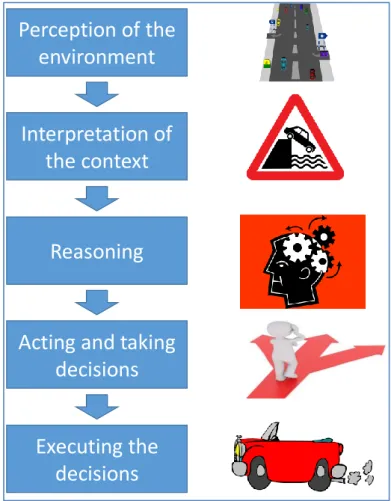
To replicate the human driving functions, the AVs must implement a set of functions, which are pictorially described in the following Figure 1.
Figure 1 The different functions of Automated Vehicles
A brief description of the different functions of automated vehicles is shown below:
Perception of the environment. This function is responsible to collect information from the road infrastructure using the sensors, which are installed in the vehicle: cameras, LIDARs, Inertial Measurement Units (IMU) and so on. This may include also messages received from the road infrastructure or other vehicles through wireless communication means.
Interpretation of the context. This function is responsible to interpret the data received from the sensors and prepare it for the reasoning process. For example, the interpretation of a sign is part of this function.
Reasoning. This function includes all the Artificial Intelligence (AI) subtasks, which must create a cohesive understanding from the interpretations created by the function below. For example, the interpretation of the image of a pedestrian crossing the road must be correlated with the current speed information received from the odometer to understand if a decision must be taken.
Perception of the
environment
Interpretation of
the context
Reasoning
Acting and taking
decisions
Executing the
decisions
Acting and taking decision. This function is responsible to make a decision from the output of the reasoning function. Taking the example of the reasoning function, this function may decide to turn the vehicle left or right, braking or both actions.
Executing the decisions. This function is responsible to execute the decision taken in the previous function above. For example, the AV may decide to brake.
Theoretically all these functions must be tested in the Type Approval/homologation phase of the AV. There are a number of challenges to achieve this objective as discussed in following subsection 2.3. For example, the decision of an AV in a specific scenario must not only be correct (e.g., the pedestrian is avoided) but also executed in a timely fashion (e.g., change of collision course with another vehicle is executed in a specific time). It is also difficult to anticipate a priori all the potential situations where an AV can be involved.
Each of these functions mentioned above can also be the target for a cybersecurity attack, which may hamper the behavior of the AVs in the road, with the risk of safety hazards or non-conformance to regulations.
2.1
Testing framework
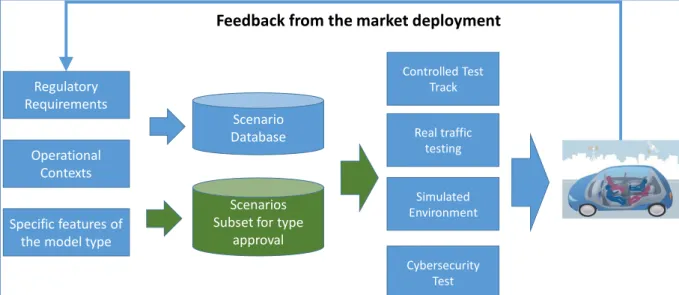
To introduce some of the concepts, which are described more in detail in the rest of this report, we provide a high-level overview of what could be the main components of a testing framework in the Figure 2 below. Some of the testing activities will be described more in detail in the rest of the report.
Figure 2 Potential Type Approval phases
A brief description of each phase is reported below. Some of the phases will be further described in the rest of this report:
Requirements definition. The requirements from regulations at international level (UNECE 2020a), (UNECE 2020b) (see subsection 2.2.1) can be used to drive the definition of scenarios together with other sources of information including the operational contexts (urban environment, highways) where the AVs must operate.
Database of scenarios. A database scenario is created either at government level or for the specific manufacturer. Depending on the specific model type of AV (commercial vehicle or passenger vehicle), specific scenarios should/could be selected from the overall set of scenarios.
Testing. Each scenario can be used in a different testing environment: a controlled test track environment, real traffic testing in a normal traffic environment or a simulated environment. Regulatory
Requirements
Operational Contexts
Specific features of the model type
Scenario Database
Scenarios Subset for type
approval Controlled Test Track Simulated Environment Cybersecurity Test Real traffic testing
Some scenarios are specific for cybersecurity testing to assess the robustness of the AV against cybersecurity threats.
Feedback from the market deployment. After the deployment phase, information from the performance of the AV in the field can be used as a feedback to the definition of high level requirements for the creation or update of existing testing scenarios.
2.2
Review of the state of art
This subsection aims to review the state of art in different areas: regulatory and policy frameworks, report from industry and industry association and from the research community. A subsection on the current standardization activities in this sector (e.g., SAE) is also included.
2.2.1 Regulatory/Policy frameworks
Type Approval of vehicles is a specific concept of Type Approval applied to the automotive sector. The current regulatory framework for Type Approval of motor vehicles is centered on the United Nation’s World Forum for Harmonization of Vehicle Regulations, which is in the charge of creating unified automotive standards and regulations to facilitate international trade. Currently, under the auspices of the Forum, more than 100 separate regulations applicable to passenger vehicles have been developed. Three UN Agreements, adopted in 1958, 1997 and 1998, provide the legal framework allowing Contracting Parties (member countries) attending the WP.29 sessions to establish regulatory instruments concerning motor vehicles and motor vehicle equipment.
The revision of the UNECE regulations for automated vehicles has been the focus of the work of Working Party 291 . As described in the WP29 web site: “The UNECE World Forum for Harmonization of Vehicle Regulations (WP.29) is a unique worldwide regulatory forum within the institutional framework of the UNECE Inland Transport Committee”.
In particular, Working Party on Automated/Autonomous and Connected Vehicles (GRVA) was created on June 2018 to revise the Type approval regulation for the future automated/autonomous and connected vehicles with a list of priorities (the following test is extracted from (UNECE 2020c)), which included definition of Functional Requirements (“FRAV”), Validation Method for Automated Driving ("VMAD"), Cyber security (and software updates), ADAS and braking Systems. This report focuses only on specific aspects of the revision of automated vehicles. Recently (June 2020) the regulations for cybersecurity (UNECE 2020a) and Over The Air (OTA) software update in automated vehicles (UNECE 2020b) have been approved by the GRVA steering board and they are discussed in this report in Section 2.2.1.
In the European Union, Type Approval is regulated by ECE Regulations and by Decision 97/836/EC (EC 1997). As described in (EC 2007), “when the Community has decided to apply on a compulsory basis a UNECE Regulation for the purpose of EC vehicle type-approval in accordance with Article 4(4) of Decision 97/836/EC, the annexes to the Frame Directive shall be amended as appropriate in accordance with the regulatory procedure with scrutiny referred to in Article 40(2) .The UNECE Regulations listed in Part II of Annex IV are recognised as being equivalent to the corresponding separate directives or regulations in as much as they share the same scope and subject matter. Where the Community has decided to apply a new UNECE Regulation or a UNECE Regulation as amended, Part II of Annex IV shall be amended as appropriate”.
We also note that automotive EC Directives and ECE Regulations require third party approval - testing, certification and production conformity assessment by an independent body. Each member state is required to appoint an Approval Authority to issue the approvals, and a Technical Service to carry out the testing to the Directives and Regulations.
The testing of essential operational and safety systems in automobiles is also the focus of national new car assessment programs (NCAPs). The NCAPs have been established in the late 1970s by the U.S. National Highway Traffic Safety Administration (NHTSA), NCAPs have been subsequently adopted by the
automotive industry in other parts of the world, including the European New Car Assessment Program (Euro NCAP)2.
Even if it is not a regulation, the US report “Preparing for the Future of Transportation: Automated Vehicles 3.0” (USDOT 2018) provides important recommendations on potential regulatory actions by the US Department of Transportation. In particular, the report claims that it is important to have federal regulations for AV, even if in general the U.S.A. does not have any unique federal regulations and only provides guidelines to the state governments. The primary focus of (USDOT 2018) is on safety and the integration of AVs with the existing road infrastructure and other modes of transportation. State, local, and tribal jurisdictions are identified as responsible for “licensing human drivers, registering motor vehicles, enacting and enforcing traffic laws, conducting safety inspections, and regulating motor vehicle insurance and liability” as well as “planning, building, managing and operating transit and the roadway infrastructure”.
In Europe, (EC 2016) described the overall strategy for cooperative, connected and automated mobility, thus supporting the integration of connectivity and automated vehicles technologies. A list of specific actions are identified in the communications to foster the definition of compliance assessment process, support for hybrid connectivity, ensuring safety and security in the operation of cooperative, connected and automated technologies and so on. The actions are linked to on-going European projects like C-ROADS (CC-ROADS 2020).
The European Commission(EC) also launched GEAR 2030 in 2016 to explore solutions to AV-related issues, and in February 2017 the group made recommendations for using Event Data Recording (EDR) devices. In May 2016, the European Parliament recommended that the EC should create a mandatory insurance scheme to safeguard full compensation for victims of AV accidents and a legal status should be created for all robots to determine liability in accidents.
Since 2018, the JRC Sustainable Transport Unit in DG JRC supports the Commission (DG GROW) in the evaluation of different innovative approaches to be introduced in the new AVs type-approval legislation for the safety certification of automated vehicles. The JRC SAFE-TYPE project was setup in this framework and defines the objectives in terms of desktop and experimental research activities, as well as outreaching activities and collaboration in internationals working groups, including contribution to UNECE GRVA activities. See (Galassi 2020a) and (Galassi 2020b) for further details.
2.2.2 Standardization activities
Standardization bodies have started to investigate the development and testing of automated vehicles and their activities are reported here.
ISO 26262, “Road vehicles – Functional safety.” (ISO 26262) was originally published by the International Organization for Standardization (ISO) in 2011 and represents an adaptation of IEC 61508, “Functional safety of electrical/ electronic/programmable electronic safety-related systems.” The safety requirements in ISO 26262 are based on a qualitative assessment of specific risks linked to the malfunction of electrical and electronic systems under anticipated operating scenarios.
SAE has been also particularly active in the area of automated vehicles and cybersecurity. SAE J3016 (SAE 2016) has defined the levels of automated vehicles, which are commonly used in literature. SAE J3061 (SAE 2016a) establishes a set of high-level guiding principles for Cybersecurity as it relates to cyber-physical vehicle systems like automated vehicles. At the time of writing this report (August 2020), the standard is still under development but it should be finalized soon.
The ISO/SAE DIS 21434 “Road vehicles — Cybersecurity engineering”, which is also under development at the time of writing this report (October 2020) defines requirements for cybersecurity risk management regarding engineering for concept, development, production, operation, maintenance, and decommissioning for road vehicle electrical and electronic (E/E) systems, including their components and interfaces. While the standard is for modern automotive vehicles in general, it can also be applied to automated vehicles (UNECE 2020a).
Note that a more extensive study of the mapping of standards applicable to cybersecurity in automated vehicles in provided in Section 3 of this report.
2.2.3 Industry activities
Industry has been obviously involved in the development and production of AVs in recent years with levels 2 and 3 of automation already deployed in the road that provides significant competitiveness advantages to the AV manufacturers.
In this subsection, we briefly report on positions papers produced by industry representatives or industry associations in relation to regulatory aspects and more precisely on testing/certification of AVs.
ACEA produced a position paper in 2019 (ACEA 2019) “Roadmap for the deployment of automated driving in the European Union”, which identifies a time plan and key regulations, which should be defined for the deployment of AVs in the market. Some of the regulations are already in place (Cybersecurity Act) but others should be created ex-novo. The proposed set of regulations are identified within their context (international or European) and a for a wide range of aspects: safety, cybersecurity and so on.
The author in (TUV 2020) focuses on the regulatory aspects for the homologation of AV. The position paper reviews the current regulatory status and claims that there are still significant regulatory gaps to be fulfilled. Then, the position paper proposes a six-point approach for developing future homologation and approval regulations for automated vehicles, which is based on:
1. Establish scenario-based testing approach as state of the art.
2. Establish a comprehensive and globally-accessible database for testing scenarios. 3. Determine the criticality metrics essential to safe automated operation.
4. Integrate simulation into the homologation process and recognize the validity of virtual methods in regulatory approval schemes.
5. Enforce the assessment of functional safety in the certification or homologation process. 6. Use real-world driving as a final validation of operational safety.
BMW e-book on autonomous vehicles (BWM 2020) also gives some indications on the potential regulations actions. One key recommendation is that manual, automated, and self-driving modes each need their own regulation because humans and machines are too different in their reaction times and in how they perceive and analyze traffic situations for the application of the same set of regulations. In addition, automated vehicles and humans learn about traffic regulations in different way. In particular, AV must be able to learn traffic regulations using machine interpretable language, which should not leave space to ambiguities. There are also interoperability issues on traffic regulations definitions across different jurisdictions, which can be relatively easy to interpret by human beings through signs, but AVs may also receive the rules in a digital format (see also (Baldini 2020) for a discussion on machine interpretable traffic regulations and a potential deployment approach).
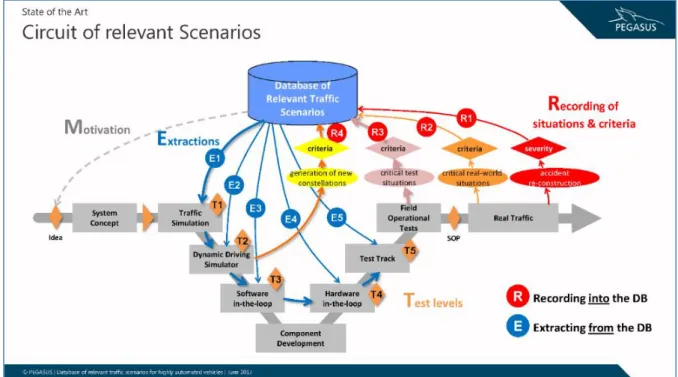
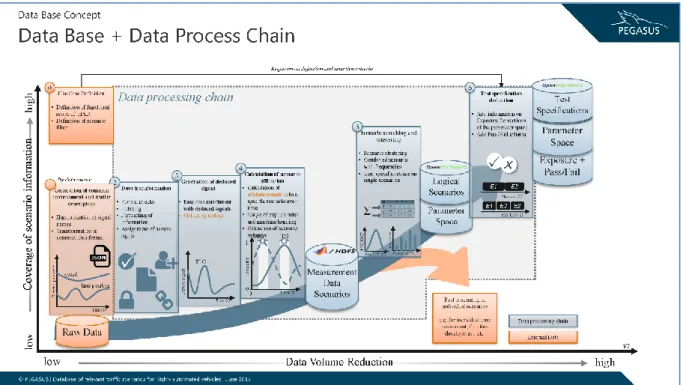
The PEGASUS project was promoted by German Federal Ministry for Economic Affairs and Energy (BMWi) for the establishment of generally accepted quality criteria, tools and methods as well as scenarios and situations for the release of highly-automated driving functions. Its objective is to develop and demonstrate methods, criteria, tools and guidelines to safeguard highly automated driving functions (Level 3), in order to facilitate the rapid implementation of automated driving into practice (PEGASUS, 2020). In particular, the PEGASUS project has defined a comprehensive framework for the verification and validation of automated vehicles like the one shown in Figure 3 below, which describes the overall flows and key components of the framework.
Figure 3 PEGASUS framework for verification and validation of automated vehicles (From (PEGAGUS 2020))
2.2.4 Research studies
In this section, we report on recent studies on the comparison of regulatory frameworks for automated vehicles. Because automated vehicles technologies and related regulations activities are quite recent, only studies in the period 2018-2020 are evaluated.
The conclusions of the references study are reported. This does not imply the acceptance of the conclusions by the author of this report and/or the European Commission.
(Taeihagh 2019) have conducted an extensive review of the regulatory activities (or lack of them) in various parts of the world with specific focus on liability, cybersecurity, privacy and societal impact. The conclusions by the authors of the study show that a number of regulatory challenges must still be resolved. In particular, the liability scheme is not clear on who/which entity should take the liability in case of an AV accident. The societal impact on the job destruction (e.g., commercial vehicle drivers and taxi drivers) due to the introduction of AVs was also pointed out as a priority for government. The study highlighted the risk for cybersecurity and privacy and pointed out to various initiatives to mitigate related threats through a combination of regulations, best practices and standards to be adopted.
A study and comparison among regulatory frameworks for automated vehicles is also available in (Lee 2020), The report compares existing government activities and recent regulatory actions around the world. In particular, the study examines in detail the regulatory activities by USA (with a focus on California), Europe (with a focus on Germany) and Australia. The study highlighted some potential challenges not only related to safety and liability aspects due to malfunctions of AVs, but also issues in the public acceptance of AV technologies in the field. Then, the study reports various best practices, which could be adopted (and which are also related to testing, which is the scope of this report) including:
On-road testing of vehicles should have at least one human safety driver who is ready to take control to maximize safety until the on-road testing of AVs is more advanced.
The requirement of a black box for safety investigations, which is already implemented in some countries, would help to improve knowledge and to determine liability in the event of an accident.
Test drivers of AV and remote monitors should be able to deactivate the system easily and at any time.
(Shladover 2019) reports on the experiences and lessons learnt from the initial regulation activities and testing of AV in the state of California in USA. The authors of the study identified some specific certification challenges (which are also discussed in the rest of this report):
It is important and difficult to distinguish between the capabilities or competency and the functional safety of the automated driving system because these are developed and deployed in a different way. Competency describes how well the automation behaves when dealing with hazards in the normal external driving environment, while functional safety describes how well the system deals with internal faults and failures”.
It is not clear if the certification should be performed by an independent third party, by the manufacturer itself through a self-certification or by the government as a specific type of independent third party. Each of these approaches has advantage and disadvantages.
It is difficult to ascertain if an automated vehicle system is sufficiently safe that it should be permitted to use public roads on a regular basis.
Some of the challenges identified by the authors are summarized in the following subsection 2.3.
2.3
Summary of the challenges for testing and certification
We summarize the challenges for testing and certification identified in the previous sections:
Regulations for testing of automated vehicles should be harmonized at international level (this challenge is currently addressed by UNECE WP29 GRVA)
Testing in real traffic conditions requires special conditions and training for the test drivers and manufacturers because the AV is not yet Type Approved in the testing phase and software failures may create safety hazards.
Testing of AVs is a very complex task, which should be addressed using different testing phases and environments.
Testing coverage is difficult to determine a-priori in comparison to the Type Approval of conventional vehicles as the space of potential scenarios could be unlimited.
Cybersecurity testing is particularly important in the testing of AV because of the safety hazards and the potential absence or limited presence of a human controller.
Because AV can be dependent on software updates to improve the AI components of the AV, periodic testing and calibration should be performed during the lifecycle of the AV. This is also needed because AI algorithms are dependent on the quality of the data originating by the sensors which could degrade in time.
Some of these challenges will be further discussed in the rest of this report in relation to cybersecurity testing, testing of artificial intelligence and scenario database.
3
Assessment of cybersecurity aspects for testing of autonomous vehicles
Assessment of cybersecurity aspects for autonomous vehicle is a wide area, which can involve different processes and roles. It is also an emerging discipline because AV are still mostly in a prototype phase regarding the highest levels of automation (level 5 of SAE automated vehicles levels) but lower levels of automation are already deployed and there is an increasing awareness of cybersecurity threats of AVs, also because of the parallel introductions of different forms of connectivity in modern vehicles, which can extend the surface attack. The reason is that cybersecurity attackers do not need to physically access the vehicle to implement the attack, but they can connect remotely through the connectivity link. One example of this possibility was shown by (Miller 2015), where researchers were able to perform a remote attack against an unaltered 2014 Jeep Cherokee which resulted in physical control of some components of the vehicle.
Then, the aim of this section is firstly to provide a high level view of the cybersecurity aspects in AVs and what types of processes should be set up including risk assessment and vulnerability analysis. In many cases, existing standards in the cybersecurity domain can be customized and tailored to the AV context to support the implementation of these processes. In other cases, standards, which were started specifically for the AV context, are still under development at the time of writing this report.
Then, the section discusses specific aspects like the secure development and engineering process (which must be evaluated in the audit process), the aspects related to software and hardware integrity, how the lifecycle of autonomous vehicles is related to cybersecurity aspects (when an update must be performed and how the cybersecurity certification is affected). Deployment aspects are also considered: definition of organization and capabilities needed by specific elements of the AV operational framework. Related standards are also identified.
Three main sets of processes are identified:
1. A set of processes for the cybersecurity testing and certification of the AV type focuses on the identification of the main risks, threat scenarios and testing of the potential mitigation techniques and solutions, which are adopted by the manufacturer.
2. A set of processes for the cybersecurity assessment of the manufacturer is needed to ensure that specific standards for the design and development of AVs are met. The validation of these sets of processes is part of the audit process.
3. Regarding the lifecycle of the AVs, a set of processes should also be set in place to support a trusted environment, which is robust against cybersecurity threats. These processes include security checks for third party providers, workshops, passengers and drivers (at levels of automation less than 5) when they interact with AVs.
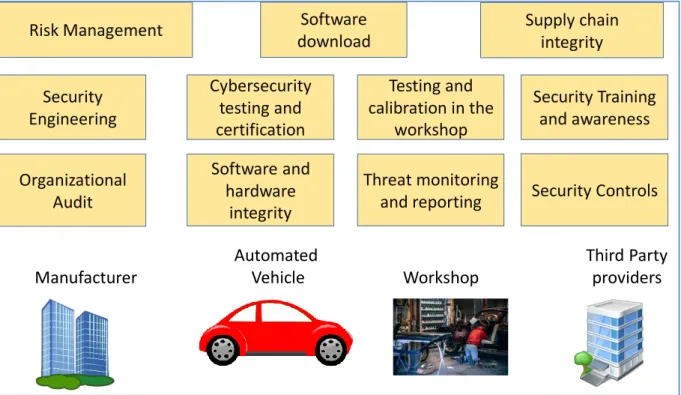
Figure 4 shows the overall schema of the different processes, which can participate in the overall assessment of the AVs and the other parties involved in the AV context.
To summarize, the structure of this section is following:
Section 3.1 identifies the key processes and roles involved in the cybersecurity aspects of automated vehicles.
Section 3.2 provides the potential applicability of key processes to the identified roles and entities (e.g., AVs).
Section 3.3 describes more in detail how the cybersecurity testing process of AVs (including verification and validations aspects) can be implemented.
Section 3.4 describes more in detail the assessment of organizations including the audit process.
Section 3.5 describes the processes involved in the monitoring of cybersecurity threats and vulnerabilities including market surveillance of AVs for cybersecurity aspects.
3.1
Identification of the key processes and roles
Figure 4 identifies the main processes to be established to address cybersecurity aspects of AVs.
Figure 4 Main processes, roles and entities for cybersecurity aspects of AVs
The following main roles and entities are identified:
Manufacturer. It is the manufacturer of the AVs.
Automated Vehicle. It is the AV, whose type must be submitted to Type Approval (including cybersecurity testing).
Third party providers are application providers which can have telematics interfaces to the AVs. They can include insurance companies or other commercial companies.
Workshop. It is the workshop where the maintenance and periodic checks of the AVs is performed. It can be a vehicle manufacturer workshop or a certified workshop.
Additional roles/entities, which can be involved are:
Law enforcement, which can also be involved in cybersecurity accidents when they are related to the infringement of regulations or when such accidents can jeopardize the conformance of AVs to such regulations.
Automated vehicles components manufacturer and suppliers, which are responsible to provide components to the AVs manufacturers and they may satisfy specific security requirements defined by the manufacturers. In other words, they are the suppliers in the AV supply chain.
Passengers/drivers, which may be involved in cybersecurity and privacy aspects and who may be victim or cause of a cybersecurity threat to the AVs.
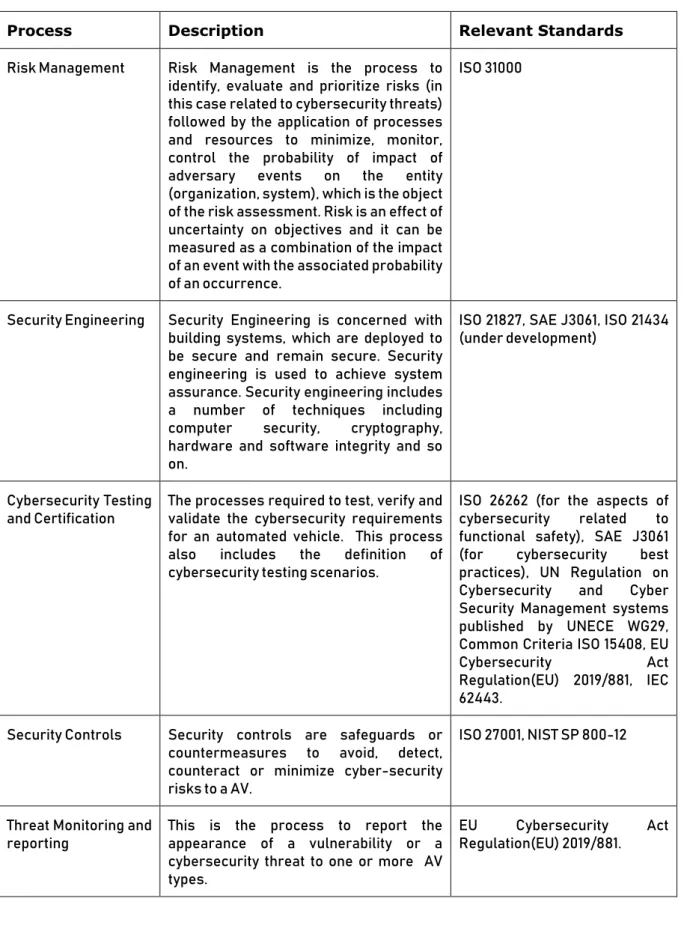
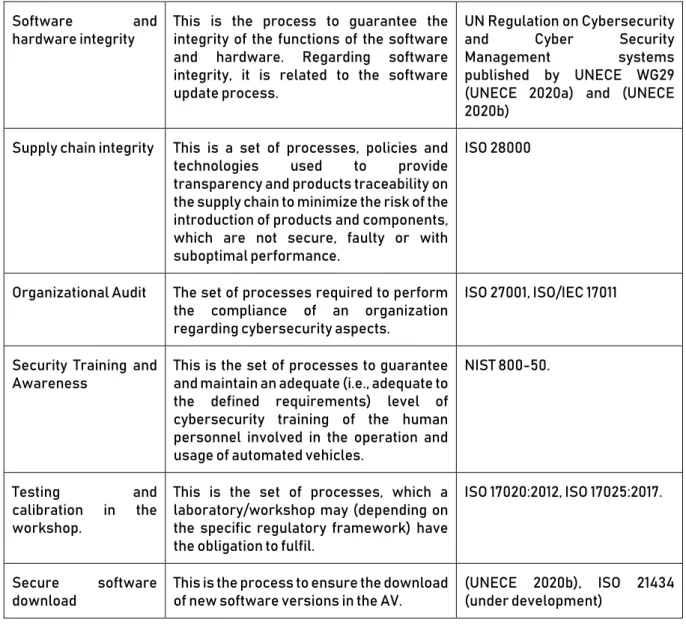
The following Table 1 shows the main processes and entities and a potential proposal on how the processes can be allocated among them. It also describes how relevant standards can be associated to the processes.
The following key processes are identified and described in the following Table 1.
Automated
Vehicle
Manufacturer
Workshop
Third Party
providers
Risk Management
Cybersecurity
testing and
certification
Security
Engineering
Testing and
calibration in the
workshop
Security Training
and awareness
Software and
hardware
integrity
Threat monitoring
and reporting
Security Controls
Organizational
Audit
Supply chain
integrity
Software
download
Note: the listing of specific relevant standards does not imply that the cited standard should be part of the identified process. The column Relevant Standards is only used to list standards, which could potentially be applied to the process described in the same row of Table 1.
Table 1 Main processes and relevant standards
Process Description Relevant Standards
Risk Management Risk Management is the process to identify, evaluate and prioritize risks (in this case related to cybersecurity threats) followed by the application of processes and resources to minimize, monitor, control the probability of impact of adversary events on the entity (organization, system), which is the object of the risk assessment. Risk is an effect of uncertainty on objectives and it can be measured as a combination of the impact of an event with the associated probability of an occurrence.
ISO 31000
Security Engineering Security Engineering is concerned with building systems, which are deployed to be secure and remain secure. Security engineering is used to achieve system assurance. Security engineering includes a number of techniques including computer security, cryptography, hardware and software integrity and so on.
ISO 21827, SAE J3061, ISO 21434 (under development)
Cybersecurity Testing
and Certification The processes required to test, verify and validate the cybersecurity requirements for an automated vehicle. This process also includes the definition of cybersecurity testing scenarios.
ISO 26262 (for the aspects of cybersecurity related to functional safety), SAE J3061 (for cybersecurity best practices), UN Regulation on Cybersecurity and Cyber Security Management systems published by UNECE WG29, Common Criteria ISO 15408, EU Cybersecurity Act Regulation(EU) 2019/881, IEC 62443.
Security Controls Security controls are safeguards or countermeasures to avoid, detect, counteract or minimize cyber-security risks to a AV.
ISO 27001, NIST SP 800-12
Threat Monitoring and
reporting This is the process to report the appearance of a vulnerability or a cybersecurity threat to one or more AV types.
EU Cybersecurity Act Regulation(EU) 2019/881.
Software and
hardware integrity This is the process to guarantee the integrity of the functions of the software and hardware. Regarding software integrity, it is related to the software update process.
UN Regulation on Cybersecurity and Cyber Security Management systems published by UNECE WG29 (UNECE 2020a) and (UNECE 2020b)
Supply chain integrity This is a set of processes, policies and technologies used to provide transparency and products traceability on the supply chain to minimize the risk of the introduction of products and components, which are not secure, faulty or with suboptimal performance.
ISO 28000
Organizational Audit The set of processes required to perform the compliance of an organization regarding cybersecurity aspects.
ISO 27001, ISO/IEC 17011
Security Training and
Awareness This is the set of processes to guarantee and maintain an adequate (i.e., adequate to the defined requirements) level of cybersecurity training of the human personnel involved in the operation and usage of automated vehicles.
NIST 800-50.
Testing and calibration in the workshop.
This is the set of processes, which a laboratory/workshop may (depending on the specific regulatory framework) have the obligation to fulfil.
ISO 17020:2012, ISO 17025:2017.
Secure software
download This is the process to ensure the download of new software versions in the AV. (UNECE 2020b), ISO 21434 (under development)
3.2
Identification of the key processes and allocation to roles
This subsection describes in detail the specific processes, which should be adopted to implement the needed cybersecurity processes for testing and certification of autonomous vehicles
Table 2 Potential applicability of processes for roles/entities in the context of cybersecurity of AVs
Process es Manu factu rer Worksh o p Third Party pro vi ders Law E nfor ceme nt Au tomate d vehicl es comp on en ts manuf actu rer Passen ger s /drivers Risk Management X X X X X Security Engineering X X X
Cybersecurity Testing and
Certification X X X
Security Controls X X X
Threat Monitoring and reporting X X X X X X
Software and Hardware integrity X X
Supply chain integrity X X
Organizational Audit X X X
Security Training and Awareness X X X X X X Testing and calibration in the
workshop. X X
Notes on Table 1:
Risk Management processes may be applicable to any organization involved in the development, production and deployment of automated vehicles including the market surveillance (which is the reason why law enforcement is involved).
Security engineering process may be applicable to any organization involved in development; in particular vehicle manufacturers.
Cybersecurity testing and certification is applicable to the automated vehicles because they are the object of the testing, but other entities (workshop) may be involved as well.
In this specific context, security controls are applicable to entities involved in the product and maintenance of automated vehicles.
Threat monitoring and reporting involves all the identified roles/entities because each role can report on identified vulnerabilities of an AV. Law enforcement is also involved because, law enforcers can find out in the field about cybersecurity threats, which impact conformance to regulations.
Software and hardware integrity mostly involves manufacturers but also the automated vehicle itself because techniques could be implemented in the vehicle to make it more robust against cybersecurity threat affecting the integrity of its components (e.g., monitoring the integrity of the software modules in the ECU).
Supply chain integrity mostly affects the AV manufacturer and the supplier of components.
Organizational audit mostly impacts organizations involved in the development of the AV, its maintenance (workshop) or the applications interfacing with it.
Security training and awareness may impact organizations involved in the maintenance of the AV (manufacturer, components suppliers or workshop), which may interface to AVs for the provision of services (third party providers), to monitor its compliance to road regulations (law enforcement) or even drivers/passengers because misuse of the AVs functions can lead to cybersecurity vulnerabilities.
The process to ensure the testing and calibration capabilities, including the competence of the human personnel, is related to workshops. Manufacturers are also included here because manufacturers workshops may be present as well.
Software download involves the secure (in terms of integrity) download of the software from the manufacturer backend systems to the AV. It may also include download of third party software if approved by the AV manufacturer (UNECE 2020b).
There are dependencies among the different processes, which are described in the following bulleted list:
Risk Management is directly linked to most of the other processes:
o The identification and definition of risks drives the definition of the tests used for
verification and validation. It also drives the certification of the AV from the cybersecurity point of view.
o It drives the definition of requirements for the supply chain integrity. For example, it drives the definition of the tracking and tracing requirements along the supply chain since such requirements are used to mitigate risks that the components of the AV are not secure.
o It drives the definition of the security controls to mitigate risks related to vulnerabilities.
o It drives the definition of requirements for secure software download in relation to risks due to cybersecurity threats impacting the integrity of the download software.
o It can be used to define the competence of workshops for accurate and complete periodic testing and calibration.
o It shapes requirements for cybersecurity engineering.
o It drives the definition of requirements for software and hardware integrity to mitigate risks related to tampering of software and hardware components in the vehicle.
o It can impose specifications for the training of personnel to mitigate cybersecurity risks.
o Risk management is directly linked to organizational audit because the organization must prove to an auditor that risks are properly managed.
Threat monitoring and reporting
o This process collects information on new vulnerabilities and threats as a feedback to the risk management process.
o Information of executed threats can be collected by workshops and reported by them if they have adequate competence.
o The collection of information may require vehicle forensics capability which should be part of the cybersecurity engineering design.
Software and hardware integrity
o The integrity of software is directly related to the software download process because the entire chain of software download and activation must be made secure.
o The integrity of the hardware is directly related to the supply chain integrity process not only from the suppliers to the manufacturer but also to the workshops for parts replacement.
Organizational audit
o The audit of the organization can also include the assessment of the security engineering processes, supply chain integrity and security training.
Testing and calibration in the workshop
o Testing and calibration in the workshop requires capabilities, which can be obtained with
adequate training. This is particularly important for cybersecurity aspects, which is a new competence area for workshop personnel.
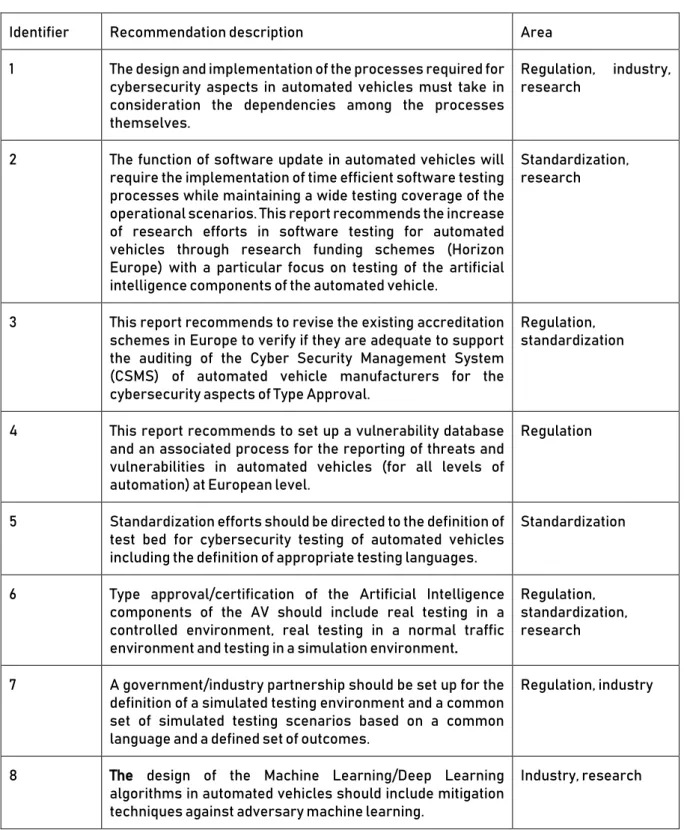
The development of each of the identified processes implies that these dependencies should be addressed, thus the following recommendation:
3.3
Cybersecurity testing of AVs
Testing and certification of autonomous vehicles for cybersecurity aspects is a research area, which can include many different elements from other disciplines because AV are in essence cyber physical systems where computing platforms (e.g., ECU) can be subject to cybersecurity attacks. Then, the existing techniques and research literature in computer security can be adapted to this context as well. On the other side, AVs are cyber-physical systems where the output of the algorithms executing in the computing platforms hosting the AI algorithms, are used to control a physical object (the AV), which must navigate in the road infrastructure without causing harm to its occupants, other vehicles in the road and pedestrians. In comparison to conventional computer security, testing for cybersecurity of AV must take in consideration the safety hazards, which may derive from cyber physical threats.
Even if the task of cybersecurity testing and certification of AVs can benefit from techniques and approaches from other domains, it still remains a complex task where rigorous processes must be set in place not only for the initial deployment of the AV but also during its lifetime as operational conditions may change: AVs can benefit from software updates, which can enhance its functions and robustness but also sensors and actuators may degrade in time.
Government, industry and research communities have started to investigate testing and certification of cybersecurity requirements in parallel to functional testing of AVs, which is also a very complex task. Ideally, cybersecurity testing on AVs should not be performed separately from functional testing but it is also true that cybersecurity testing may require a different set of tools and procedures. In many cases, cybersecurity testing of AVs has been considered as an evolution of cybersecurity testing of modern vehicles, which have already implemented lower levels of automation for specific functions (ENISA 2019). At regulatory level, an important milestone has been reached in June 25, 2020 with the formal approval in UNECE GRVA WG29, of two new regulations (UNECE 2020a) and (UNECE 2020b) on automotive cybersecurity. In the press release3, UNECE stated that “The two new UN Regulations, adopted yesterday by UNECE’s World Forum for Harmonization of Vehicle Regulations, require that measures should be implemented across 4 distinct disciplines: Managing vehicle cyber risks; Securing vehicles by design to mitigate risks along the value chain; Detecting and responding to security incidents across vehicle fleet; Providing safe and secure software updates and ensuring vehicle safety is not compromised, introducing a legal basis for so-called “Over-the-Air” (O.T.A.) updates to on-board vehicle software”. In fact, the two new regulations were based on two specific technical reports: the first on testing the cybersecurity of automated vehicles and the second on the integrity of the software download function. The regulations are expected to be finalized and published in early 2021 and apply to the 54 contracting parties (states/countries, which do not include US or Canada). Once the regulations enter into force, OEMs in the member states will be required to implement specific cybersecurity and software-update practices and capabilities for Vehicle Type approvals.
We note that DG.JRC.E.3 substantially contributed to the drafting of these regulations by providing contributions, comments and corrections to the draft version of the regulations during the drafting meetings.
Because of the importance of these two new regulations, the following paragraphs describe more in detail some of the processes identified in the regulations (they include most of the processes identified in Section 3.1).
3
http://www.unece.org/info/media/presscurrent-press-h/transport/2020/un-regulations-on-cybersecurity-and-software-updates-to-pave-the-way-for-mass-roll-out-of-connected-vehicles/doc.html
Recommendation 1: The design and implementation of the processes required for cybersecurity aspects in automated vehicles must take in consideration the dependencies among the processes themselves.
The following subsection 3.3.1 analyzes UNECE GRVA WG29 regulations on cybersecurity aspects (UNECE 2020a) and subsection 3.3.2 analyzes UNECE GRVA WG29 regulation on Software Updates and Software Updates Management Systems (UNECE 2020b).
3.3.1 Analysis of UNECE GRVA WG29 regulation on Cybersecurity and Cyber Security Management System
One key aspect of the regulation (UNECE 2020a) is that it does not describe specific technical details (e.g., a specific cryptographic algorithm) but it identifies and defines high level processes to which manufacturers and other entities must be compliant. In some specific cases, where additional technical details are needed, the regulation delegates their definition to standards (e.g., ISO/SAE 21434). This approach is probably based on two main considerations. The first consideration is that cybersecurity aspects in AV deal mostly with processes and roles definition rather than the specific technology. The second consideration is that technological advancements in AV may trigger regulation obsolescence or the need to revise periodically the regulations, which could become a challenging task. Because of the dynamic nature of the automotive cyber environment, detailed technical measures could be counterproductive.
The regulation adopts a similar approach to the separation in different process areas described in Section 3 of this report:
a) Type Approval of AVs,
b) set up of processes and audit of the manufacturer.
The area related to monitoring/market surveillance is described in a limited way in the regulation and it mostly focused on the problem to provide software update (in the software OTA regulation) in a secure way (i.e., to support the integrity of the software, authentication of the software provider and confidentiality of the transmitted data).
Point a) (Type approval of the AVs) involves actually testing the vehicle and certifying that the design of vehicle architecture, the risk assessment procedures, and the implementation of cybersecurity controls were executed correctly. In this approval process, an authority tests an individual type of vehicle to check if the cybersecurity measures were actually implemented.
Annex 5 of the regulation provides a list of vulnerabilities or attack methods related to the threats and potential mitigation techniques, which shall be considered for risk assessment and mitigations to be implemented by vehicle manufacturers. The words “shall be considered” mean that content of Annex 5 is not binding but it can be useful for the implementation of the risk assessment.
Point b) focuses on definition and description of Cyber Security Management Systems (CSMS, the namesake of the regulation) and includes cybersecurity requirements for an OEM’s organizational structure, processes, and governance. CSMS certification demands evidence (i.e., audit) from the OEM, including test reports and threat modeling, in order to prove that due diligence was done in ensuring cybersecurity measures throughout the lifecycle of the vehicle.
Point a) is discussed more in detail in this subsection. Point b) is discussed in detail in Section 3.4
As mentioned before, the support for monitoring and reporting of cybersecurity vulnerabilities and attacks is somewhat limited but it is anyway discussed in Section 3.5. of the regulation (UNECE 2020a). Vehicle Type requirements detail the various steps a manufacturer must take for Type Approval and then, in Sections 8-10 of (UNECE 2020a), the regulation explains that the Vehicle Type approval must be maintained throughout the entire lifecycle of the vehicle including the potential modification of vehicles and the extension of a vehicle if it impacts the vehicle’s technical performance with respect to cybersecurity aspects. It is important to note that in order for an OEM to receive Vehicle Type approval, it must first complete the CSMS approval.
The regulation does not identify a list of binding technical specifications, which must be fulfilled for Type Approval, but Section 5 of cybersecurity regulation states that: “Approval Authorities shall grant, as appropriate, Type Approval with regard to cyber security, only to such vehicle types that satisfy the requirements of this Regulation” and then the requirements areas are specified, which include
“Implement appropriate cyber security measures in the design of the vehicle type” and “Log data to support the detection of cyber-attacks and provide data forensic capability to enable analysis of attempted or successful cyber-attacks”. The manufacturer must perform a risk assessment process: “(clause 7.3.3. of [1]. The vehicle manufacturer shall identify the critical elements of the vehicle type and perform an exhaustive risk assessment for the vehicle type and shall treat/manage the identified risks appropriately” and “clause 7.3.4. of (UNECE 2020a). the vehicle manufacturer shall protect the vehicle type against risks identified in the vehicle manufacturer’s risk assessment”.
As described before, Annex 5 of the regulation (UNECE 2020a) identifies key vulnerabilities, which should be used by the manufacturer in their risk assessment process.
The reported vulnerabilities are similar to vulnerabilities reported in other sources, which analyzed cybersecurity threats in modern vehicles (ENISA 2019), (Petit 2014). The list of specific vulnerabilities can be classified in the specific following categories:
Threats to vehicles regarding their communication channels
Threats to vehicles regarding their update procedure
Threats to vehicles regarding unintended human actions facilitating a cyber-attack.
Threats to vehicles regarding their external connectivity and connections
Threats to vehicle data/code
Vulnerabilities are also listed for the back end servers, which can be used to collect the data from the vehicles.
Mitigation solutions are also proposed to address these threats and vulnerabilities, but it is up to the manufacturer to adopt them or not.
As written before, the regulation does not mandate a specific testing solution. Subsection 3.6 will elaborate on the potential testing techniques, which could be implemented.
3.3.2 Analysis of UNECE GRVA WG29 regulations on Software Updates and Software Updates Management Systems
Regulation (UNECE 2020b) provides a framework for the automotive sector to put in place the necessary processes for (the following text is extracted from the UNECE web site):
Identifying the hardware and software versions, which are legitimate for a vehicle type;
Identifying software relevant for Type Approval;
Verifying that the software on a vehicle component (e.g., ECU) is what it should be;
Identifying interdependencies, especially with regards to software updates;
Identifying vehicle targets and verifying their compatibility with a software update;
Assessing if a software update affects the Type Approval or legally defined parameters (including adding or removing a function). In this context, parameters (e.g., the hyper-parameters of the machine learning algorithm used in the visual analysis) are part of the software;
Assessing if an update affects safety or safe driving;
Informing vehicle owners of updates;
Documenting all the above.
All of these will be audited by national technical services or homologation authorities.
Software update in (UNECE 2020b) is generally meant as the complete set of operations of software download, integrity checking, software activation and reporting on the software update status.
The Type Approval principles under the 1958 Agreement (UN 1958) mean that manufacturers will need to demonstrate, prior to putting vehicles on the market, that they fulfil the following requirements: