Florida International University
FIU Digital Commons
FIU Electronic Theses and Dissertations University Graduate School
9-18-2015
Modeling, Designing, and Implementing an
Ad-hoc M-Learning Platform that Integrates Sensory
Data to Support Ubiquitous Learning
Hien M. Nguyen
Florida International University, [email protected]
Follow this and additional works at:http://digitalcommons.fiu.edu/etd
Part of theComputer Sciences Commons
This work is brought to you for free and open access by the University Graduate School at FIU Digital Commons. It has been accepted for inclusion in FIU Electronic Theses and Dissertations by an authorized administrator of FIU Digital Commons. For more information, please [email protected].
Recommended Citation
Nguyen, Hien M., "Modeling, Designing, and Implementing an Ad-hoc M-Learning Platform that Integrates Sensory Data to Support Ubiquitous Learning" (2015).FIU Electronic Theses and Dissertations.Paper 2297.
FLORIDA INTERNATIONAL UNIVERSITY
Miami, Florida
MODELING, DESIGNING, AND IMPLEMENTING AN AD-HOC M-LEARNING PLATFORM THAT INTEGRATES SENSORY DATA TO SUPPORT UBIQUITOUS
LEARNING
A dissertation submitted in partial fulfillment of
the requirements for the degree of
DOCTOR OF PHILOSOPHY in COMPUTER SCIENCE by Hien Nguyen 2015
ii To: Interim Dean Ranu Jung
College of Engineering and Computing
This dissertation, written by Hien Nguyen, and entitled, Modeling, Designing, and Implementing an Ad-Hoc M-Learning Platform that Integrates Sensory Data to Support Ubiquitous Learning, having been approved in respect to style and intellectual content, is referred to you for judgment.
We have read this dissertation and recommend that it be approved.
_______________________________________ S.S. Iyengar _______________________________________ Kia Makki _______________________________________ Deng Pan _______________________________________ Naphtali Rishe _______________________________________ Kang Yen _______________________________________ Niki Pissinou, Major Professor
Date of Defense: September 18, 2015
The dissertation of Hien Nguyen is approved.
_______________________________________ Interim Dean Ranu Jung College of Engineering and Computing
_______________________________________ Dean Lakshmi N. Reddi University Graduate School
iii
© Copyright 2015 by Hien Nguyen
iv DEDICATION
I would like to dedicate this dissertation to:
My wife, Dung Phan-Nguyen, and our parents, for their continued support of my education and career. Without their patience, understanding, support, and most of all love, the completion of this work would not have been possible.
Our closest friend, Tran Dang and her family, for their great support of me from start to finish.
v
ACKNOWLEDGMENTS
I would like to express my deepest appreciation to my academic parents and advisors: Dr. Niki Pissinou and Dr. Kia Makki for their excellent guidance, unbelievable support to open my mind in the mobile learning research fields and ultimately I was able to
complete this dissertation. Without their supervision, advice, and help, it would have not been possible. They mentored and encouraged me to stay focused to complete the
research work. They inspired me as great professors who I look up to pursue and perform well in my academic career. Dr. Pissinou and Dr. Makki have spent many of their
valuable hours during weekday and weekend to provide me numerous discussions, great lectures, feedback to my research work. They helped and guided me on related research topics to become a better thinker and a better researcher. I am also grateful to be a FIU graduate student because I have been able to use many great learning resources at the library and at the school of Computing and Information Sciences, just to name a few.
I would like to also thank my committee members—Dr. S. S. Iyengar, Dr. Deng Pan, Dr. Naphtali Rishe, and Dr. Kang Yen—for their support and motivation to finish my research. Thanks to Ebtissam Wahman, the Research Experience Undergrad (REU) student I mentored during the ten-week summer research experience in 2014 at FIU, and Nguyen Minh Vo Le, an IntelliMath associate, for the fruitful discussions and work resulting in a successful paper publication.
Most importantly, none of this would have been possible without the love and patience of my wife, Dung Phan-Nguyen, and our parents: Dung Van Nguyen, Nam Thi Van, Viet Phan, Kim Hue Pham. They have been a constant source of love, concern, support and
vi
strength all these years. I thank them for their loving support and understanding throughout my academic journey. They helped me to stay focused on my graduate work and all academic matters as well as accomplishments. I would like to express my heart-felt gratitude to all members of my immediate family and my wife’s family for their incredible support. I would like to thank our best friend, Tran Dang, and her entire family for their support and care that helped me to overcome challenges and setbacks. I deeply appreciate the generosity, the way they believed in me and how they encouraged me to keep learning and moving forward throughout this endeavor.
I would like to give a special mention for the mental support given by the Buddhist monk/Zen master, Vien Thuc, aunt Kim Thuan Nguyen and uncle Thu Minh Nguyen who we all met and introduced master Vien to me. They all helped me to stay calm and focused. The Zen way helped me to write this dissertation and over one hundred fifty Zen poems. Their constant encouragement and incessant inspiration enabled me to stay focused to complete the research and writing of this dissertation.
Last but not least, I appreciate the grant and financial support of the National Science Foundation (Award Number: 1407067 and 1263124), Department of Homeland Security (Award #2008-ST-062-000012) that funded parts of the research discussed in my dissertation.
vii
ABSTRACT OF DISSERTATION
MODELING, DESIGNING, AND IMPLEMENTING AN AD-HOC M-LEARNING PLATFORM THAT INTEGRATES SENSORY DATA TO SUPPORT UBIQUITOUS
LEARNING
by
Hien Nguyen
Florida International University, 2015
Miami, Florida
Professor Niki Pissinou, Major Professor
Learning at any-time, at anywhere, using any mobile computing platform learning (which we refer to as “education in your palm”) empowers informal and formal education. It supports the continued creation of knowledge outside a classroom, after-school programs, community-based organizations, museums, libraries, and shopping malls with under-resourced settings. In doing so, it fosters the continued creation of a cumulative body of knowledge in informal and formal education. Anytime, anywhere, using any device computing platform learning means that students are not required to attend traditional classroom settings in order to learn. Instead, students will be able to access and share learning resources from any mobile computing platform, such as smart phones, tablets using highly dynamic mobile and wireless ad-hoc networks. There has been little research on how to facilitate the integrated use of the service description, discovery and integration resources available in mobile and wireless ad-hoc networks including description schemas
viii
and mobile learning objects, and in particular as it relates to the consistency, availability, security and privacy of spatio-temporal and trajectory information. Another challenge is finding, combining and creating suitable learning modules to handle the inherent constraints of mobile learning, resource-poor mobile devices and ad-hoc networks.
The aim of this research is to design, develop and implement the cutting edge context-aware and ubiquitous self-directed learning methodologies using ad-hoc and sensor networks. The emphasis of our work is on defining an appropriate mobile learning object and the service adaptation descriptions as well as providing mechanisms for ad-hoc service discovery and developing concepts for the seamless integration of the learning objects and their contents with a particular focus on preserving data and privacy. The research involves a combination of modeling, designing, and developing a mobile learning system in the absence of a networking infrastructure that integrates sensory data to support ubiquitous learning. The system includes mechanisms to allow content exchange among the mobile ad-hoc nodes to ensure consistency and availability of information. It also provides an on-the-fly content service discovery, query request, and retrieving data from mobile nodes and sensors.
ix
TABLE OF CONTENTS
CHAPTER PAGE
CHAPTER 1: INTRODUCTION ... 1
1.1 Problem Statements ... 2
1.2 Goals and Objectives ... 4
1.3 Summary of Contributions ... 4
1.4 Scope and Limitations ... 5
1.5 Outline of the Dissertation ... 6
CHAPTER 2: RELATED WORK ... 7
2.1 Mobile “On-the-fly” Learning ... 10
2.2 Learning Objects (LOs) ... 10
2.2.1 Learning Object in E-Learning ... 11
2.2.1.1 LOM ... 11
2.2.1.2 SCORM... 12
2.2.1.3 Project Tin Can ... 12
2.2.2 Learning Objects in M-Learning ... 13
2.3 Authoring Tools and LMS ... 14
2.3.1 MASLO... 14
2.3.2 Mobilogue ... 14
2.3.3 GoMo Learning ... 15
2.3.4 Treasure HIT ... 15
2.4 Peer-to-Peer and Ad-hoc Networking ... 15
2.4.1 Bluetooth Based E-Learning ... 16
2.4.2 Proem ... 17
2.4.3 Mobile Chedar ... 17
2.4.4 Peer2Me ... 18
CHAPTER 3: MODELING, DESIGNING MOBILE LEARNING SYSTEM FOR AD-HOC NETWORKS ... 19
x
3.2 M-Learning System Model in Mobile Wireless and Ad-hoc Networks ... 20
3.3 Conceptual Design for the Adaptive Mobile Learning System Architecture .... 23
3.4 Technical Design Details of the Adaptive Mobile Learning Object and its Hybrid Mobile Learning System ... 32
3.5 Conclusions ... 39
CHAPTER 4: ENABLE ON-THE-FLY LEARNING FOR MOBILE AD-HOC WIRELESS NETWORKS USING BAYESIAN THEORY AND MOBILE LEARNING OBJECT AUTHORING TOOL ... 41
4.1 On-the-fly Learning ... 43
4.2 Exploiting Bayesian Theory to Support On-the-fly M-Learning ... 46
4.2.1 Motivation Scenario ... 46
4.2.2 Architecture of Mobile Wireless Ad-hoc Learning ... 49
4.2.3 Conceptual System Architecture... 50
4.2.4 Generating GLOS ... 51
4.3 Methodology ... 54
4.3.1 Approach ... 54
4.3.2 Network Structure ... 56
4.3.3 Lightweight System ... 57
4.3.4 Mobile Learning Object (mLO) ... 58
4.3.5 Metadata ... 63
4.3.6 System Architecture ... 65
4.4 Implementation... 71
4.4.1 iOS mobile application prototype ... 71
4.4.2 Cross-platform application ... 76
4.5 Conclusions ... 77
CHAPTER 5: MOBILE LEARNING OBJECT AND M-LEARNING SYSTEM IMPLEMENTATION ... 79
5.1 Introduction ... 79
5.2 System Design and Specification ... 79
5.2.1 Mobile Learning Object ... 81
xi
5.2.3 File Sharing ... 83
5.2.4 Search Files ... 84
5.2.5 File Download ... 85
5.2.6 Bluetooth Ad-hoc Messaging ... 86
5.2.7 Hybrid Solution ... 87
5.2.8 The Assumptions Used in the Implementation ... 88
5.2.9 The Implementation Platform ... 89
5.3 Low Level Implementation ... 91
5.3.1 Mobile Learning Object ... 91
5.3.2 Privacy and Group Policy ... 95
5.3.3 Shared Files ... 101
5.3.4 Search Files ... 104
5.3.5 File Download ... 109
5.3.6 Bluetooth Ad-hoc Messaging ... 113
5.3.7 Hybrid Solution ... 117
5.4 Testing and Validation ... 123
5.5 Result Discussion and Conclusion ... 127
CHAPTER 6: CONCLUSIONS AND FUTURE WORK ... 128
6.1 Conclusions ... 128
6.2 Future Work ... 129
REFERENCES ... 132
APPENDICES ... 140
xii
LIST OF TABLES
TABLE PAGE
4.1 High level description of our algorithm ...51
5.1 Mobile Learning Object Class ...94
5.2 Creating Group Permission from Device A to Device B ...96
5.3 The Group_Policy Class ...101
5.4 Shared Files ...103
5.5 Source Code to Share a File ...104
5.6 Searching File ...106
5.7 Display Paired Device List ...107
5.8 Search File Source Code ...109
5.9 Download File ...111
5.10 Send a command request to download a file ...112
5.11 Read to download file and write to store file ...113
5.12 Bluetooth Chat ...115
5.13 Sending a Chat Message Source Code...116
5.14 Show and Reply a Chat Message Source Code ...117
xiii
5.16 Chat Message Source Code (Replication Change Event) ...122
5.17 Chat Message Source Code (Couchbase Synchronize) ...123
xiv
LIST OF FIGURES
FIGURE PAGE
3.1 Relationship between different types of cyber learning ...19
3.2 General Model of Cyber Learning ...20
3.3 Abstraction of the mobile ad-hoc learning platform ...22
3.4 High Level Mobile Learning System Application Architecture ...23
3.5 Event Processing Architecture ...26
3.6 Complex/Multi-Level Event Processing Architecture ...27
3.7 Ad-hoc System Metadata Extractor Architecture ...28
3.8 Hybrid System Metadata Extractor Architecture ...29
3.9 Lightweight Sensor Data Stream Analyzer Architecture ...30
3.10 Mobile Learning Object Structure ...30
3.11 Adaptive Mobile Learning Application Design Architecture ...34
3.12 Mobile Learning Object Creator (MLO) ...36
3.13 Adaptive Mobile Learning Object (AMLO) ...37
3.14 Learning Object Data Communication Architecture ...38
3.15 System Design Model for the Hybrid Mobile Learning Ad-hoc and Wireless Network Architecture ...39
xv
4.2 Correlation Transformation of Events to GLOS. ...52
4.3 .mlo file structure layout ...59
4.4 Algorithm of Mobile Learning Object Creation and Storage ...63
4.5 Mobile learning object metadata (mLOM). ...65
4.6 High-level system architecture. mLO, mobile learning object. ...68
4.7 Mobile Leaning Object Request Algorithm ...70
4.8 Prototype in iOS App Screenshot ...72
4.9 Metadata View and mLO Options View ...76
5.1 Overview of a communication between sender and receiver nodes ...80
5.2 Mobile Learning Object Structure (MLO) ...80
5.3 Privacy and Group Policy Assignment Diagram ...82
5.4 File Sharing Diagram ...84
5.5 Searching Files Diagram ...84
5.6 Downloading a File Diagram ...85
5.7 Mobile Ad-hoc Chat/Messaging via Bluetooth Diagram ...86
5.8 The Couchbase Mobile Solution for iOS and Android ...87
5.9 Hybrid Solution for using MLO in Ad-hoc and Wireless Networks ...88
xvi
5.11 Creating Group and Permission Flowchart ...97
5.12 Share Files or Documents Flowchart ...102
5.13 Searching Files or Document Flowchart ...105
5.14 Request to Download Files or Document Flowchart ...110
5.15 Bluetooth Messaging Flowchart ...114
5.16 Couchbase Mobile Synchronization Architecture ...120
xvii
ABBREVIATIONS AND ACRONYMS
M-Learning Mobile Learning
E-Learning Electronic Learning
U-Learning Ubiquitous Learning
P2P Peer-to-Peer
LO Learning Object
CMS Content Management System
LMS Learning Management System
SCORM Sharable Content Object Reference Model
LOM Learning Object Metadata
SOAP Simple Object Access Protocol
IEEE Institute of Electrical and Electronic
ADL Distributed Learning Initiative
API Application Programming Interface
QR Code Quick Response Code
CSS Cascading Style Sheet
HTML Hypertext Markup Language
xviii PAN Personal Area Network
LAN Local Area Network
WLAN Wireless Local Area Network
WAN Wide Area Network
J2ME Java Micro Edition
MLA Mobile Learning Application
MLO Mobile Learning Object
AMLO Adaptive Mobile Learning Object
SLE Learning and Sensing Environment
AE Adaptation Engine
ISO International Organization for Standardization
GPRS General Packet Radio Service
GSM Global System for Mobile communication
XML Extensible Markup Language
JSON Javascript Object Notion
SQL Structure Query Language
MD Mobile Device
xix
SRM Searching and Ranking Module
DMM Data Management Module
RRM Request and Response Module
NP Neighbor Profile
GUI Graphical User Interface
IDE Integrated Development Environment
JDK Java Development Kit
SDK Software Development Kit
1 CHAPTER 1: INTRODUCTION
The 21st century Information Technology (IT) users are digitally savvy users who depend extensively on mobile technologies for everyday life and learning. These users dependence on technology has fostered “learning mediated by networked computing and communications technologies where the forms of steering of learning can arise in a hybrid manner from a variety of personal, educational or collective sources and designs ” referred to as “cyber-learning” [46]. Cyber-learning encompasses many forms of learning including e-learning [18] and M-Learning [51, 45, 31-35].
M-learning uses mobile devices, sensors and wireless transmissions [45] to provide anytime and anywhere access to content as well as just in-time training or review of content. It delivers any-time, anywhere device learning (which we fondly refer to as “education in your palm” [4, 51]) and empowers informal science education. M-learning supports mobility, collaboration, advanced personalized learning experiences and on-the-fly interaction with adaptive feedback among users and real-world situations [53, 63, 64]. It also provides access to learning modules, hence fostering the continued creation of a cumulative body of knowledge in formal or informal education. Anytime, anywhere, any device learning means that users are not required to attend classes like in a traditional school. Instead of coming to class or a library to gain knowledge, the users/learners should be able to access learning modules from their computers or mobile devices. These devices may be attached to a high performance fixed or wireless network, ad-hoc networks, wireless sensor networks. Under these situations, users would need to find suitable modules and combine them freely.
2
Furthermore, users will be more successful and more likely to stay on task if they have the opportunity to cooperate and communicate with their fellow users. While this can easily be achieved in a traditional classroom setting, it is far more challenging to provide adequate means of this support in a teaching environment as the one described here [41, 51, 56]. To realize the vision we must foster emerging technologies and develop new collaborative modes, media richness, and virtual worlds which can facilitate and support inter-operability between heterogeneous local and specialized systems [9, 10, 51]. M-learning is still in its infancy because much of the research is theoretical in nature [41, 42]. M-learning can be taken place at anytime, anywhere, on any-device, and platform with or without the predetermined locations. Existing cyber-learning systems are ineffective due to many technological challenges associated with ad-hoc or peer-to-peer networking. This includes limitations posed by the inherent characteristics of wireless systems such as transmission interferences, bandwidth, limited resources as well as content inconsistencies of sharable content objects because of rapid updates (here today, outdated tomorrow) and semantic knowledge representation among learning objects among others.
1.1 Problem Statements
The problem under investigation is in the area of mobile learning in ad-hoc networks. In other words, the core theme of our research emphasizes M-Learning solutions for ad-hoc and sensor networks. More precisely, the study focuses on modeling and designing adaptive M-Learning mechanisms for building and delivery content using privacy centric in an ad-hoc network where mobile devices in the M-Learning system have limited resources. Their connections are infrastructureless, meaning only ad-hoc on-the-fly connections among those mobile nodes. Currently, M-Learning systems are depended on
3
the underlined infrastructures, wired and wireless networks that are used the inter-networking technologies as a multi-tier system dependent to allow mobile users/learners to access and retrieve the learning materials. Therefore, there is a lack of M-Learning solution that allow mobile learners to connect, collaborate and learn via the mobile ad-hoc network where no network infrastructure is available. There have been works on mobile learning systems where mobile users get access to retrieve the learning content on-the-go via reliable infrastructure wireless networks such as WiFi or their cellular network carriers. However, those solutions are not viable when there are only ad-hoc connections available among mobile nodes. A complete M-Learning solution is a dynamic solution where mobile users can use their mobile devices to access, request, or retrieve their on-the-fly content, anywhere and anytime. Thus, a service discovery, efficiency adaptive mechanisms to request and retrieve content with privacy centric are needed. The effort to solve the problem in this dissertation is divided into the flowing sub-problems:
1. Modeling, designing, and developing a mobile learning system in an ad-hoc network:
a. Defining efficiently mechanisms to allow content exchange among the mobile ad-hoc nodes to ensure consistency and availability of information.
b. Providing on-the-fly content service discovery, query request, and retrieving data from mobile nodes and sensors.
4 1.2 Goals and Objectives
This section describe the goals of this research contained in this dissertation, including specific, measurable objectives that must be attained in order to satisfy those goals.
Research Goals:
The aim of this research is to model, design, develop, and prototype a M-Learning system solution to be used in an ad-hoc network environment utilizing adaptive learning object mechanism with content privacy centric.
Research Objectives:
The emphasis objectives of our work are on defining appropriate mobile learning objects and their adaptation descriptions as well as providing mechanisms for ad-hoc service discovery and developing concepts for the seamless integration of the learning objects and their contents with a particular focus on preserving data and privacy.
1.3 Summary of Contributions
M-Learning is in high demand and is among the top 14 challenging research topics in the 21st century [1, 9, 46, 65]. Our research will shed light on how ad-hoc networking and wearable sensing technology can enable new forms of informal educational practices that actively engage student-centered learning to support anywhere, anytime learning. Our research may lead to technological advancements that will allow more personalized learning experiences and allow on-the-fly access to learning resources anytime and anywhere [37, 38]. Since our research is one of the first M-Learning works that focuses
5
on ad-hoc network, it is expected to shed light on how emerging technologies can enable new forms of educational practices. This dissertation establishes the following novel contributions in the area of mobile learning:
1. Creation of an adaptive and reusable approach to building mobile learning objects
2. Modeling and Designing a M-Learning system using learning objects in an ad-hoc network environment
Prototyping our M-Learning system solution that works in a mobile learning hybrid wireless and ad-hoc network environments.
1.4 Scope and Limitations
The scope of this dissertation is confined to the investigation of modeling and designing an ad-hoc mobile learning platform. Although, we try to adhere to the IEEE standards of learning object, we neither promote specific learning management systems, nor do we suggest that the underlying platform used in this dissertation for mobile learning in ad-hoc network produces the best results. Rather, the modeling, designing, and developing M-Learning system presented in this dissertation, is one of the first of its kind, and it is the primary focus of the work. The use of mobile ad-hoc, wireless networks, and technologies along with concepts regarding learning objects are used to build the presented approach.
Furthermore, findings identified in this dissertation hold across the investigated learning management system projects. It may not be possible to extend the findings of the study involving other open-source software and database management languages to
6
proprietary learning management system due to the different development practices adopted by current commercial entities. Further validations with both open-source and propriety learning management software systems are necessary to help us extend the research work to the next level
1.5 Outline of the Dissertation
The rest of this dissertation is organized as follows: Chapter 2 provides the background and related work on the problem under investigation. Chapter 3 focuses on the modeling and designing of an ad-hoc mobile learning system. We present the development of the mobile learning object authoring tool in chapter 4. The proof of concept of sharing a mobile learning object in infrastructure-less platform, used to demonstrate its potential uses is presented in Chapter 5. Chapter 6 concludes the research investigation and discusses future work.
7 CHAPTER 2: RELATED WORK
Research on e-learning was instruction focused proceeding along several directions including proposing generic e-learning models, content management systems, standards and tools, learning objects and ontologies. Learning management systems [2] were designed to manage learning content by maintaining and organizing context that could be delivered in various formats such as WBT, CBT, etc. The system allowed instructors to organize, assemble, approve, publish and deliver content. In general, these types of management systems are considered to be instructional centered in that they facilitate the instructor in managing and delivering instructional material by managing content. A Content Management System [2] (CMS) is a computer program that allows publishing, editing, modifying and centrally maintaining content. Such systems also provide procedures to manage workflow in a collaborative management. However their functionalities are limited in that they are not efficiently developed or interoperated. They don’t support the transfer of content along different learning management systems nor can they create searchable learning content libraries or media repositories across different learning management platforms. The development of these learning systems was followed by the emergence of numerous learning tools, such as authoring, screen capturing, content packaging and meta-data editing, synchronous communication, etc. [2].
To support the sharing of learning modules across different platforms two standards were introduced: The Sharable Content Object Reference Model (SCORM) [5] and Learning Object Meta Data Model (LOM). SCORM provides a platform for developing, packaging and delivering high quality training materials for online training courses. It is
8
composed of three modules: the aggregation model, run time environment and sequencing and navigation. The SCORM framework specifies how to develop and deploy content objects that can be shared and contextualized to suit the needs of the learner. It provides a tag content for later discovery and access in a distributed environment. Identification of an object and knowing where it resides are different things. SCORM is silent about how discovery and access is to be implemented.
Any digital resource that can be freely adapted and reused to mediate learning is defined as a learning object [11,12]. Learning objects are like Legos in that they are digital or non-digital entities that can be grouped and reused or referenced during technology supported learning. The functionality of learning objects is limited however because learning objects are not really interchangeable, have inconsistent classifications and therefore can’t be found, may become obsolete sooner than anticipated and are rigid. Also learning objects are e-learning system dependent. Thus there are many barriers to using learning objects including the structure of their repositories, quality of learning objects in the repositories, their granularity as well as privacy, openness and sharing concerns. Learning objects are still an evolving definition. Clearly learning objects are not designed for ad-hoc networks and wearable learning.
Semantic knowledge representations across learning objects are described through ontologies. Ontologies and semantic repositories enhance learning material distribution and retrieval within learning management systems. The construction of ontologies is governed by the Resource Description Framework which provides for describing identified things. Semantic repositories use ontologies as sematic schemata to automatically reason about the queried data. They incorporate numerous data sources and provide a simple and
9
quick querying mechanism against diverse or rich data schemata. Semantic repositories are highly effective for data interoperability but are ineffective for M-Learning applications because the semantic webs are not yet fully developed.
The largest body of research works in cyber-learning centers around e-learning management systems [2, 7, 8]. Most recently some efforts focused on M-Learning but most of the research is on instructional designs and focuses on fixed, infrastructure based wireless networks. Research on M-Learning focuses on proposing information services for M-Learning or 3-tier based system architectures [1]. For example, introducing an AXML data and web service integration architecture focuses on the application layer of M-Learning services and in particular on how to effectively find suitable services and how to efficiently use the services found. In particular, it uses the notion of a service ring for service discovery by grouping devices offering similar services to rings, where the notion of “similarity” is derived from the ontology. One member of the ring acts as the leader. Still this work is limited and relies on identifying group leaders who are assumed to be permanently stationed in a wireless environment. They proposed a three tier context-ware for pervasive e-learning where the 1st tier includes the mobile devices and intelligent agents, the 2nd tier contains the information stations and the 3rd tier is the information station center. This solution acts more like a client/proxy/server solution rather than a truly ad-hoc network. The Simple Object Access Protocol (SOAP) is also a peer-to-peer learning system but does not scale well for ad-hoc networks.
In sum, much of the research on cyber-learning focuses on e-learning systems. More recently some papers addressed the issue of M-Learning but are not comprehensive enough for use in an ad-hoc network platform. Furthermore, very few papers focus on
10
algorithms to detect learner profiles and learning object references or “on-the-fly” learning objects.
2.1 Mobile “On-the-fly” Learning
Multiple definitions of the term M-Learning have been performed covering a wide variety of aspects. Some definitions identify the M-Learning as the mere evolution of e-learning, while others define it as an independent trend that is originated in the ubiquitous nature of the actual communication systems and identify M-Learning as location-independent and situation-location-independent [4]. We will interpret M-Learning as the latter definition.
M-learning supports mobility, collaboration, advanced personalized learning experiences, and on- the-fly interaction with adaptive feedback among users and real-world situations. It also provides access to learning modules, hence fostering the continued creation of a cumulative body of knowledge in formal or informal education. Anytime, anywhere, any device learning means that a student is not required to attend classes like in a traditional school. Instead of going to class or a library to gain knowledge, the student would be able to access learning modules from her or his computer or any other device such as a smartphone or a sensor [3].
2.2 Learning Objects (LOs)
A LO can include anything that has educational value – digital or non-digital such as a case study, film, simulation, audio, video, animation, graphic image, map, or book so long as the object can be contextualized by individual learners. The learner must be able to make meaningful connections between the LO and his or her experiences of knowledge he
11
or she previously mastered. For the purpose of e-learning and M-Learning, a LO is digital in nature [5]. Because of its digital nature, the notion of platform independence (reusability, interoperability, and accessibility) becomes a vital issue. Reusability is the ability of the LO to be used over and over in different instructional contexts. Reusability of a LO depends upon interoperability and accessibility. Interoperability is the ability of the LO to function in various environments regardless of the platform. Accessibility is the ability of the learning object to be accessed by learners in any location regardless of the learner experience, or the type of platform the learner uses. The notion of platform independence requires following a set of standards. These standards contribute to reusability, interoperability, and accessibility [5]. A few widely used examples of these standards are Institute of Electrical and Electronics Engineers (IEEE) Learning Object Metadata (LOM) and Advanced Distributed Learning Initiative (ADL)’s Sharable Content Object Reference Model (SCORM).
2.2.1 Learning Object in E-Learning 2.2.1.1 LOM
In 2002, the IEEE Learning Technology Standard Committee proposed a LOM standard (IEEE 1484.12.1-2002 LOM v1.0) to provide a unified description of LO resources. By using LOM, LOs can be retrieved and acquired easily and precisely among various LMS. The LOM is now serving as the principal standard internationally to specify LOs. LOM is mainly composed of nine categories: general, life cycle, meta-metadata, technical, education, rights, relation, annotation, and classification. These categories are
12
used to annotate LOs in a comprehensive manner. Each category has its own subcategories and specific vocabularies to describe LOs in detail [6].
2.2.1.2 SCORM
In 1997, the United States Department of Defense and the White House Office of Science and Technology Policy launched the ADL. The ADL initiative aims to establish a new distributed learning environment that permits the interoperability of learning tools and course content on a global scale. As a foundation for accomplishing those goals, ADL’s SCORM aims to foster the creation of reusable learning content as ‘instructional objects’˙I within a common technical frame-work for computer-based and Web-based learning. SCORM was developed to solve these problems: move a Web-based course from one LMS to a different LMS, reuse Web-based learning content in different Web-based courses, and define the logical flow sequence of Web-based learning activities in an interoperable, repeatable way. SCORM is defined in four books: the Overview Book, the Run-Time Environment Book, the Content Aggregation Model Book, and the Sequencing and Navigation Book. The Overview Book describes the model as a whole, and the other three books describe specific capabilities in technical detail [2].
2.2.1.3 Project Tin Can
Project Tin Can, also created by ADL, was the first step toward supporting the next generation of SCORM. The Tin Can API is merely one of several components of the next generation of SCORM. The first major effort of the Tin Can API was to determine the different types of verbs and activities appropriate for learning as adopted from the activity stream specification actor-verb-activity or I-did-this model. The Tin Can API can be
13
thought of as the communication component of the next generation of SCORM just as the Run-Time Environment was the communication component of legacy SCORM. In addition, communities of practice are expected to enforce certain behaviors and taxonomies by creating their own vocabulary profiles. A virtual world training community may define hundreds of verbs that relate to the large context of training in another world [7].
2.2.2 Learning Objects in M-Learning
A LO can include anything that has educational value – digital or non-digital such as a case study, film, simulation, audio, video, animation, graphic image, map, or book so long as the object can be contextualized by individual learners. The learner must be able to make meaningful connections between the LO and his or her experiences or knowledge he or she previously mastered. For the purpose of e-learning and m-learning, a LO is digital in nature [5]. Because of its digital nature, the notion of platform independence (reusability, interoperability, and accessibility) becomes a vital issue. Reusability is the ability of the LO to be used over and over in different instructional contexts. Reusability of a LO depends upon interoperability and accessibility. Interoperability is the ability of the LO to function in various environments regardless of the platform. Accessibility is the ability of the learning object to be accessed by learners in any location regardless of the learner experience, or the type of platform the learner uses. The notion of platform independence requires following a set of standards. These standards contribute to reusability, interoperability, and accessibility [5]. A few widely used examples of these standards are Institute of Electrical and Electronics Engineers (IEEE) Learning Object Metadata (LOM) and Advanced Distributed Learning Initiative (ADL)’s Sharable Content Object Reference Model (SCORM).
14 2.3 Authoring Tools and LMS
2.3.1 MASLO
The Mobile Access to Supplemental LOs system is an open-source tool for m- learning developed by the Academic Advanced Distributed Learning Co-Lab at the University of Wisconsin. Content authors use a desktop or laptop computer running Microsoft Windows (Microsoft, Redmond, WA, USA) and Mac OS X (Apple, Cupertino, CA, USA), or Linux to create or curate materials by forming content packs. These packs can contain text, image, audio, video, or simple quiz content. The system includes an automatic check on file size to help ensure that users are aware when they are creating a pack that might be too big to download over a 3G connection, or even just bulky enough that it will take up an inordinate amount of space on a user’s device. After creating a content pack, the learning expert can preview the pack and then publish it to a cloud-based server solution. Once a content pack is posted to the cloud, content creators or content managers have options depending on their desired use of the system and how it’s been configured. Finally, after content has been posted to the cloud and any subsequent review or pricing is complete, learners can download content packs to their iOS or Android device by simply selecting a pack they want to retrieve from the content store. Learners can then access their content packs on or offline in any location they choose to [8].
2.3.2 Mobilogue
Mobilogue is an M-Learning tool for authoring and deploying learning content with location awareness and guidance on mobile devices. The application covers informal learning settings like field trips and museum visits, as well as formal classroom settings.
15
Physical locations are associated with QR codes that are scanned by the application and used to obtain supporting learning content stored in a remote server [9].
2.3.3 GoMo Learning
GoMo Learning is a commercial content authoring tool for multi-device content delivery by utilizing Web technologies (hypertext markup language (HTML), JavaScript, and cascading style sheets (CSS). It supports a collaborative and Web-based creation of content that can be delivered as an HTML package or a native application for different devices. GoMo-created scenarios do not support location-based content delivery [9]. 2.3.4 Treasure HIT
Treasure-HIT is a research project that works on a treasure hunt game mechanics. The system offers an authoring environment for teachers to create station-based activities for GPS-identified locations with associated content, tasks, and feedback for the learners. These games are shared through a repository and can be run on mobile phones in the field. Treasure-HIT also uses Web technologies for content visualization on the devices, thus making it platform-independent [9].
2.4 Peer-to-Peer and Ad-hoc Networking
Recent hardware advances in embedded mobile devices such as mobile phones have enabled us to envision new applications and services based on the context and the collaboration between the mobile devices and fixed infrastructures available around us. Technologies for peer-to-peer networking include fixed and wireless network technologies, for example, Bluetooth, wireless local area network, WiMax, general packet radio service, and Universal Mobile Telecommunications System, allowing devices both to be mobile
16
and to interconnect with mobile or fixed peer-to-peer infrastructures [10]. The capability for ad hoc wireless device-to-device communication between ubiquitous mobile devices such as smartphones and laptop computers opens up the possibility of exciting new types of networking applications. From a practical technological point of view, the capabilities of short-range communication devices over unlicensed links are improving exponentially, in terms of performance measures such as cost, power consumption, throughput, and spectral efficiency. The throughput available on a short-range wireless communication channel operating on an unlicensed band is often far greater than what is available over a long-distance wired communication channel, and is, moreover, free to the user. It is thus a compelling engineering problem to design a self-contained wireless network whose communication resources consist exclusively of short-range unlicensed communication links. This has led to many proposals for wireless ad hoc network designs [11].
2.4.1 Bluetooth Based E-Learning
The Bluetooth based e-learning system proposed by Zhang et al. uses Bluetooth technology as the communication method. The system was developed using the Java API for Bluetooth Wireless Technology on Java platform, making it operating system- independent and device-independent. To be secure, the system uses both authentication and encryption to ensure safety during communications. In order to support the short range of Bluetooth (roughly 10 m), when a client is out of the serving area of the server, it needs to connect to the server via the help of other clients using ad hoc on-demand distance vector routing. In this case, the client will send connect-to-server request to its neighboring clients, which then forward the request to their neighbors. Upon receiving such a request, the server sends back a route reply to the client and the intermediate clients will forward the reply to
17
the requesting client. This way, the client will be able to connect to the server. If multiple replies are received via different routes, the route with minimum hop count will be selected for further communication [12]. Using Bluetooth to do similar work in an M-Learning environment would be useful and takes advantage of the mobile hardware technologies. 2.4.2 Proem
Proem is an open computing platform that provides a complete solution for developing and deploying peer-to-peer applications for mobile ad hoc networks. Its objectives included versatility, interoperability, platform independence, built-in security, and high-level development support [13]. Proem is currently no longer developed, but its objectives remain similar to the features our work aims to include.
2.4.3 Mobile Chedar
Mobile Chedar (CHEap Distributed ARchitecture) is an extension to the Chedar peer-to-peer network allowing mobile devices to access the Chedar network and also to communicate with other Mobile Chedar peers. Chedar is a peer-to-peer middleware designed for peer-to-peer applications. Mobile Chedar is implemented using Java 2 Micro Edition (Oracle, Redwood Shores, CA, USA) and uses Bluetooth as a transmission technology for connecting to other peers. Current Bluetooth implementations have the restriction that nodes can be connected to only one piconet at a time. Therefore, the only topology available for constructing Bluetooth network is star-shaped. One device functions as a master and others as slaves (hybrid architecture) [10].
18 2.4.4 Peer2Me
Peer2Me is an open-source project developing a framework for mobile collaborative applications on mobile phones. Peer2Me enables developers to create collaborative applications for mobile phones using network technologies such as Bluetooth while also using a hybrid peer- to-peer model. The architecture and concepts of Peer2Me are independent of the kind of personal area network (PAN) technology supported in the mobile device. The project was initiated to enable rapid development of proximity-based peer-to-peer applications for mobile devices on the J2ME platform [10].
Mobile Chedar and Peer2Me use the J2ME platform. However, J2ME is being phased out as more and more mobile devices move on to different operating systems, therefore making these systems outdated.
While there have been plenty of e-learning and M-Learning tools and implementations developed, most solutions still fall into a niche situation and are not generic enough to be taken out of the contexts for the applications they were designed for. Instead, we choose to provide an alternative to these systems, one that can take and improve upon the strengths of the previous mentioned methods and combine them into one system, while addressing and hopefully eliminating the weaknesses in those systems previously discussed.
19
CHAPTER 3: MODELING, DESIGNING MOBILE LEARNING SYSTEM FOR AD-HOC NETWORKS
3.1 Introduction
Figure 3.1: Relationship between different types of cyber learning
Figure 3.1 above depicts mobile learning as the harmonic convergence of e-learning and ubiquitous learning. It addresses the current elements of cyber education systems driven by current technological advances. E-learning has enabled many learners to access virtual classroom environments thus creating what is commonly referred to as distance learning. Ubiquitous learning is a separate but similar environment that is still being debated but nonetheless allows users to learn anytime and anywhere using any device that uses sensory technology or constantly collects data that is forwarded to its host. The mature technology of mobile learning allows the advancement of both e-learning and u-learning
Ad-hoc
Ubiquitous
Learning
Mobile
Learning
E-Learning
20
by combining elements from both environments and allowing learners to access and collect information anytime, anywhere via network infrastructures and mobile wireless ad-hoc networks. Mobile learning using ad-hoc networks is still a developmental field. This chapter further discusses modeling and designing mobile learning systems for ad-hoc networks.
Figure 3.2: General Model of Cyber Learning
3.2 M-Learning System Model in Mobile Wireless and Ad-hoc Networks
Figure 3.3 is a general learning system model that depicts how users with access to the internet connect to traditional e-learning servers. Mobile learning is considered a non-formal extension of the traditional non-formal structured learning environment. Typical e-learners use desktop or laptops with internet connections to access a web based classroom
Database
E-Learning
Server
INTERNET
Desktop Computers Notebook/Lap top Computers Cellular Network21
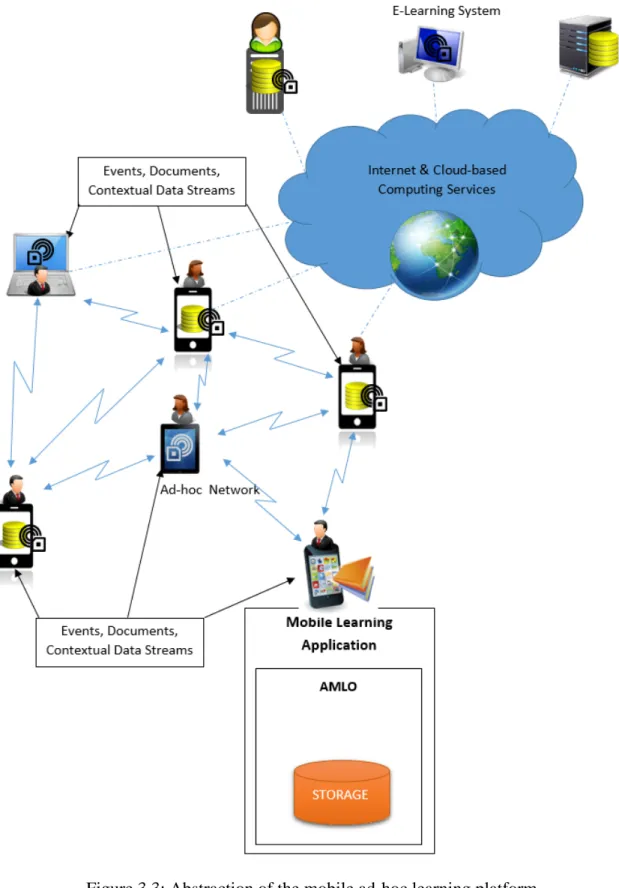
environment or learning applications. Thanks to the advancement of smart-phones and touch technologies, users are now able to access the same e-learning environments on the fly. However, these applications still depend heavily upon e-learning system network infrastructures for functionality. For example, users of current smart-phone learning applications can only use said applications if they are connected to a wireless networks or a cellular network. If a user is in a remote area or out of range of these connections the application will render itself useless. The incorporation of mobile ad-hoc networks into the current learning systems would enable true on the fly learning independent of cellular or wireless network connectivity. Figure 3.2 is also a conceptual design model for the hybrid mobile learning framework which can be used to understand at a high level of how mobile users can use their mobile devices such as mobile phones or tablets to exchange mobile learning objects in the absent of the wireless structure network. In this framework, we also include the capability of acquiring sensor data to enhance the learning experience. The mobile users will communicate among others via mobile wireless ad-hoc networks, possible using Bluetooth connection. This peer-to-peer network connection allow mobile users to connect, collaborate and exchange information to those closed distance.
22
23
3.3 Conceptual Design for the Adaptive Mobile Learning System Architecture
24
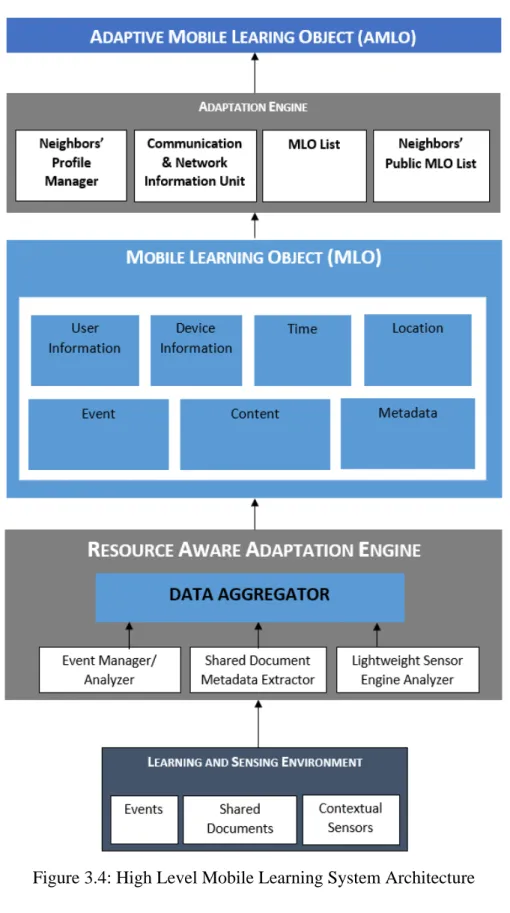
The proposed Mobile Learning System (MLS) Architecture given in figure 3.4 above is a high level abstraction of an adaptive context-aware mobile learning system architecture that supports our “on-the-fly” learning concept. The system is also to be used as a platform in a blended approached in an informal infrastructure and infrastructureless networks to allow mobile users to connect and share information via modules at anytime, anywhere. In a typical scenario, MLS is used to support just some basic learning and sharing when mobile users do not have access to the internet via WiFi or cellular networks but still require a temporary solution to connect and share learning material with their neighbor mobile devices. The MLS is not intended to replace or to support all mobile learning activities in the modern technological advancement of teaching and learning environment.
MLS is designed and organized as a mobile learning application that allow connectivity between mobile ad-hoc nodes as well as traditional client-server e-learning and M-Learning systems. Mobile users use their mobile devices to connect, communicate, and collaborate with their neighbor mobile devices via mobile learning objects. In this system, mobile learner role is considered dual role as a learning object consumer and producer dynamically. This concept is much different than the traditional mobile learning where users play a role of teach and students statically. Since we proposed the concept solution for mobile learning on the fly where learner use the ad-hoc network as communication architecture to allow them to consume and produce knowledge and information via mobile learning object anywhere, anytime.
25
Layers of the System
The MLS is comprised of several layers such as Learning and Sensing Environment (LSE), Resource Aware Adaptation Engine (RAAE), Mobile Learning Object (MLO), Adaptation Engine (AE), and the Adaptive Mobile Learning Object (AMLO). Each layer serves the layer above it and is served by the layer below it. The bottom layer is used to receive input from learning data, trigger events, and the contextual sensors. The learning data is any file or document that users would like to include to the learning object. An event is a command, or query request from the mobile users/owner to tell others what they want to do with the learning data. The event can be as simple as a command to request information about a particular learning object such as place, time, location or it can be as complex as the combination of several queries. The contextual sensors are those sensors that collect basic data and aggregate into a simple stream of input data to the MLS such as temperature, space, and time. Input data can be events, shared documents, or raw sensor data from the contextual sensors and it is treated as the feed-in data to the next layer called resource aware application engine. This layer consists of three components which are event manager/event analyzer, shared document metadata extractor, and lightweight sensor engine analyzer.
The event manager fetches the incoming events (where the event are either in the form of external source or internal source) and then places them into the corresponding event module at the above layer. In the typical ad-hoc network environment, mobile devices are faced with limited resources. Therefore, we propose to use the lightweight event processing method as describe in the algorithm below and in figure 3.5.
26 Lightweight Event Processing Algorithm:
Step 1: Lightweight Event Processing Unit (LEPU) receives a simple event from the event sources
Step 2: The LEPU checks against the predefined allowable event list. Step 3: If it is in the list, then process this event in step 4.
If it is not in the list, then do not process this event and go back to wait for the next incoming event in step 1.
Step 4: Add the metadata of this event to the metadata unit.
Figure 3.5: Simple Event Processing Architecture
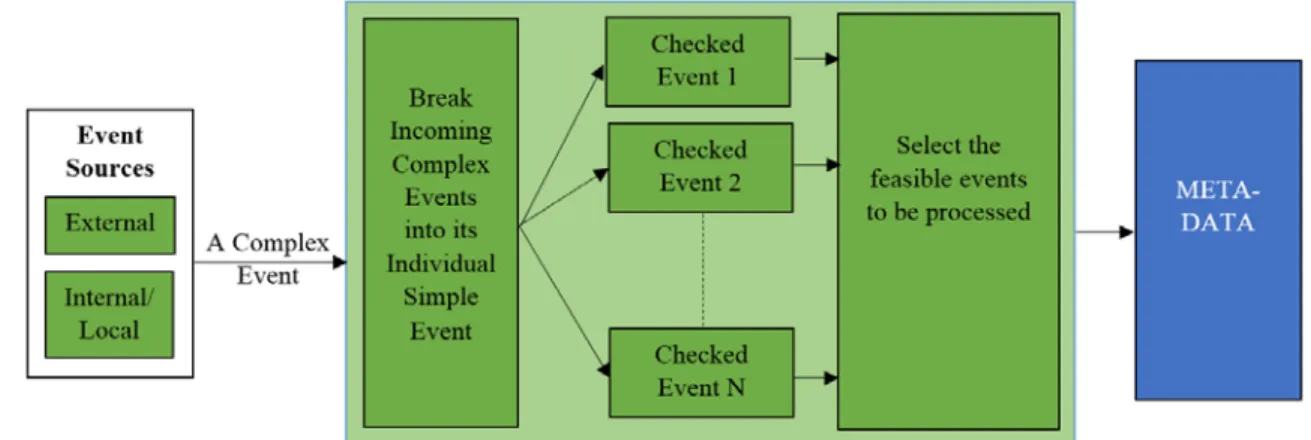
If the mobile device has the connection to the cloud which gives it a much more capabilities for processing complex events, then we can use the complex event processing architecture (see figure 3.6). Since the complex event processing unit (CEPU) is being processed on the cloud-based servers, we are able to take advantage of a more powerful distributed system that can be used to process those complex events in order to output the metadata which can be consumed by the next layer of MLS. The following is the proposed conceptual complex events processing algorithm.
27 CEPU Algorithm:
Step 1: CEPU receives complex events from the event sources
Step 2: The CEPU break those incoming complex events into simple events Step 3: Check each simple event against the feasible list.
If there is a match, then include that event into the selected event list to be to process.
If there is no match, then store it to the pending approval list to be checked later in order to be added to the feasible list.
Step 4: Select the feasible events to be processed.
Step 5: Add the metadata of these feasible events to the metadata unit.
Figure 3.6: Complex Event Processing Architecture
The second component of this layer is called document metadata extractor which is responsible to organize and classify the document property in two clearly defined areas called document content and document metadata. Document metadata is the data about the document such as title, subject, author/creator, keywords, description, date created, etc. There are two common methods to extract metadata, these are support vector machine
28
(SVM) and Conditional Random Fields (CRF) which they normally use either the rule-based approach or the machine-learning approach to quickly read and extract the metadata needed [74]. Our proposed M-Learning solution is primary for the ad-hoc network environment, we suggest to use the lightweight metadata extraction using rule-based approach due to the limitation of the ad-hoc networks as shown in figure 3.7. The suggested general extraction algorithm used in this document is given below:
Step 1: User selects a file or a document from the local storage of the mobile device Step 2: Checks the file format or the file extension
Step 3: Document/OCR processing is done via the rule-based technique Step 4: Output the metadata in a text file or XML file.
Figure 3.7: Ad-hoc System Metadata Extractor Architecture
In case if there is a possibility to connect to cloud, we suggest to use either the automated template-based or the rule-based for the hybrid solution in figure 3.8 since metadata extraction process can be quickly executed on the servers. This way, the document processing and metadata extractor process would be done externally at the server side to save processing power and battery life for the mobile devices which has limited resources compare to the more powerful and rich resources from the server. These solutions
29
have already been used for the automatic document extraction using support vector machines or conditional random fields. There are existing metadata tools that are currently available online such as Wget, EXIFtool, Metagoofil, Meltego, Meta-extractor which can be utilized to extract the document’s metadata.
Figure 3.8: Metadata Extractor Architecture
The third sub-component is called lightweight sensor data stream analyzer that is supposed to receive basic sensor data as an input in figure 3.9. Then it goes through the necessary steps to be able to process and extract the input sensor data and output as the metadata to feed into the next layer/component above. Now the metadata aggregator analyzes metadata to aggregate and distribute the received metadata to the mobile learning object level to include necessary information in those dimension of the mobile learning object. Once it is analyzed, then it is placed into the corresponding module like content, metadata, users, device, time, location.
30
Figure 3.9: Lightweight Sensor Data Stream Analyzer Architecture
The data output from the analyzer/extractor will be fed into the metadata aggregator to create a well-structured metadata which includes those adaptable categories such as user information, device information, time, location, event, actual data content, and metadata of the mobile learning object as in figure 3.10. The category list can be updated to exclude or include more category names depending on the users need.
31
The layer above the MLO layer is the adaptation engine layer which consists of the following four components:
1. Neighbors’ Profile Manager (NPM),
2. Communication and Network Information (CNI) , 3. MLO List
4. Neighbors’ Public MLO List.
Neighbors’ Profile Manager contains the information about the currently connected neighbors. Also this component keeps track of the previously searched keywords from its neighbors. This information will be helpful when a neighbor user can quickly obtain information about this user so that they can share the related MLO. Communication and Network Information component contains the network related information about the current mobile node (such as the number of nodes it is currently associated to, or the current level of its battery life, its computation capability, and its storage limitation.) The MLO list contains the list of one or more public MLOs which will be used to create a new object called Adaptive Mobile Learning Object (AMLO). Neighbors’ Public MLO List contains the public MLO list of the current neighbors of the mobile node. This adaptation mechanism is very useful because it shares the public MLO list of its neighbors with the intended mobile nodes which will use those information for their benefit. The output of the adaptation engine layer is the adaptive mobile learning object which will be used for sending and receiving information between the connected mobile devices.
32
3.4 Technical Design Details of the Adaptive Mobile Learning Object and its Hybrid Mobile Learning System
At the core level this system is comprised of mobile devices with capabilities of communication via Bluetooth, WiFi or GPRS/GSM Cellular networks. Our focus solution in this M-Learning system is mobile devices interconnected via ad-hoc network. Therefore, we suggest to use the common mobile ad-hoc architecture using Bluetooth where ad-hoc network can be formed anywhere, anytime with data rate that can be up to 2 Mbps among the nodes within distance of 30 to 100 feet. Once the connection is established, the data will be transferred among the nodes in the binary object format called Adaptive Mobile Learning Objects.
The underlying concept of this mobile learning object in ad-hoc network environment is to efficiently share and reuse the MLOs among the mobile devices instead of transferring files/documents. Typically, file sharing technique may involve compressed files which can be transferred over the wire or wireless medium from sender to receiver. This method can be inefficient due to high overhead bandwidth if mobile users keep sending heavy load of documents. For example, mobile device A asks mobile device B for a particular file such as “Lecture notes of Java in 2015”. Mobile device B immediately packs all the related documents into the compressed file and then send back that huge file to A. This common method is working well in the case that both mobile devices are using traditional wireless network and have full processing power as well as strong battery power. However, in the ad-hoc network environment, mobile devices have limited resources. In our approach, both sender and receiver devices are able to communicate directly via the binary AMLO objects. The lightweight transmission of AMLOs reduces
33
the overhead bandwidth requirements of traditional file transfer system which in turn enhances the connectivity between mobile devices and at the same time will increase the transmission efficiency.
In addition, our work has been extended to incorporate the hybrid solution which allows mobile devices to connect and share reusable AMLOs via the cloud based storage system. The storage system solution used in this research is a high-performance and scalable document-based database (NoSQL) which is designed to be well-adapted to the high demand in mobile wireless ad-hoc networks.
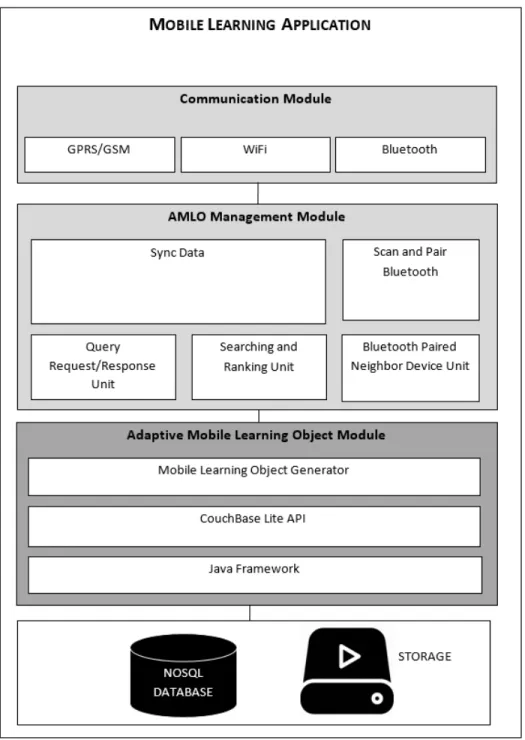
Figure 3.11 below depicts the adaptive mobile learning object architecture for our proposed system. This system consists of a communication module, an adaptive mobile learning object management module, an adaptive mobile learning object module, and a storage module.
The communication and networking module is the connection between mobile devices such as Bluetooth, WiFi, and cellular network. The adaptive mobile learning object management module processes and manages AMLO requests. This module consists of five individual components which are Sync Data, Query Request/Response Unit, Pairing Bluetooth Devices Unit, Paired Neighbor Devices Unit, and Searching and Ranking AMLO for adaptation purposes.
The sync data is a gateway which facilitates bidirectional, multi-master sync, mobile object replication protocol, and authorizes AMLO access. When an AMLO is shared through paired devices and then the connection is no longer available, the sync data from the sender can be automatically synced to the cloud-based server namely Couchbase.
34
However, as soon as the receiver mobile device gets connected back to the Couchbase server, the data will be synced to it automatically.
35
The query request and response unit receives request as an AMLO format and then processes the request and provides the response which is also in the AMLO format. The searching and ranking unit provides search history tracking services for both sender and receiver devices which also keeps track of searched keywords and rank them based on their usages. Bluetooth Paired Neighbor Devices Unit keeps the list of all the paired and connected devices.
Our proposed solution addresses the security and privacy issue regarding AMLO by creating three access levels which are classified as private, public, and protected. The private access rights does not allow any neighbor devices to search and query but the public access rights allows neighbors to access all public AMLOs. The protected access rights allows mobile hosts to create group level access among specified connected mobile devices.
The adaptive mobile learning object module consists of a AMLO generator, Couchbase Lite Application Programming Interface, and the Java programming framework. These components allow the application to create and manage AMLOs. The Couchbase Lite is an embedded JSON database that can work standalone, within a peer to peer network, or as a remote endpoint for Couchbase servers for synchronization purposes.
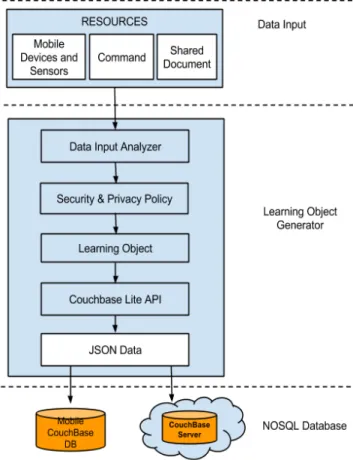
The storage module is a NoSQL database where AMLOs data file paths are stored. Figure 3.12 below depicts our Mobile Learning Object design architecture consisting of three layers. The first layer is the data input layer which serves as resources for the next layer. The resources are devices, sensors, commands and files. The second layer is the Learning Object Generator in which the data input analyzer takes information from the resources in the data input layer and verifies the security access rights. After
36
verifying the accessibility, it then creates a learning object that will be converted into a JSON data format via the Couchbase lite API. Once data is in the JSON format it can be sent to the storage in which a user can choose to store it locally on their mobile devices or save it onto the Couchbase server for offline synchronization to paired devices.
Figure 3.12 Mobile Learning Object Design Architecture
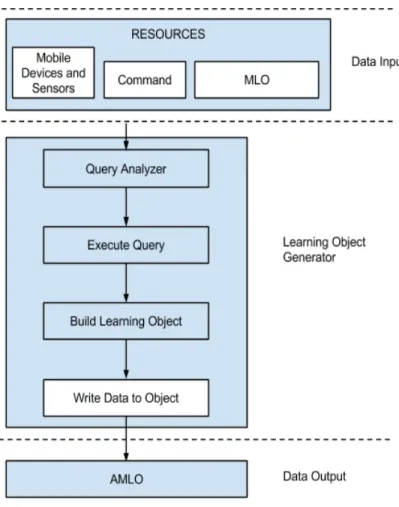
Figure 3.13 depicts the Adaptive Mobile Learning Object design architecture. The creation of MLO and AMLO upon first glance are similar due to the similar functions of the three layers. The AMLO design architecture is more efficient because AMLOs are created to adapt. In the data input layer the learning object data is the MLO that was described in figure 3.12. The learning object generator layer has 4 main components. Query
37
analyzer which analyzes the learning object data input, then execute the query. Once the result is completed, the next step will be to build the adaptive mobile learning object that writes the data results to the JSON object and then output the AMLO onto the third layer.
38
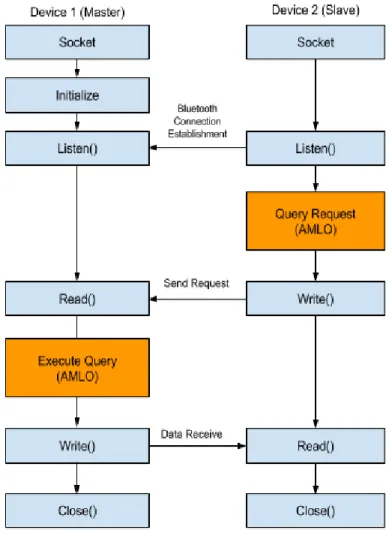
Figure 3.14 Learning Object Data Communication Architecture
Figure 3.14 is the learning object data communication object architecture which is based on the standard bluetooth architecture. One mobile device plays the role of “master” and the other mobile device functions as a “slave” to the master device. Both devices must activate their bluetooth capabilities to initiate communication and pairing. Once the connection is established the master device listens for requests from other slave mobile devices. The slave device generates a learning object request and then sends the query request in the format of an AMLO. The master device receives the AMLO request and executes a query AMLO and responds to the slave device with the results of the query in
39
the AMLO format through which the slave device is granted access rights to the results. Once the AMLO is transferred the process starts over and the slave is able to request another AMLO from the master until the devices are disconnected or are out of range.
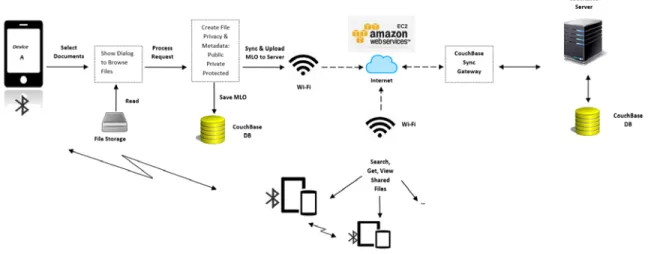
Figure 3.15 below depicts our proposed system design model for a hybrid mobile learning ad-hoc and wireless network architecture. This model addresses the ability to transfer mobile learning objects over ad-hoc network and additionally an option to transfer those objects over the Internet to share the reusable mobile learning object to improve the system communication efficiency.
Figure 3.15: System Design Model for the Hybrid Mobile Learning Ad-hoc and Wireless Network Architecture
3.5 Conclusions
In conclusion, throughout this chapter we present a novel mobile learning design model for mobile ad-hoc and wireless networks. Mobile learning is the harmonic convergence of e-learning and ubiquotous learning. The unique concept of our solution compared to the standard mobile learning solution is not only the adaptive mobile learning
40
object but also design to work in mobile ad-hoc environment. The incorporation of mobile ad-hoc networks into the current learning systems enables true on the fly learning independed of cellular or wireless network connectivity. The transmission of AMLO via bluetooth increases efficiency of the typical file transfer process. The lightweight transmission of AMLOs reduces the overhead bandwidth of traditional file trasfer mediums and enhances connectivity between mobile devices in order to make it faster for mobile users to transfer files over the mobile ad-hoc networks. The hybrid solution allows mobile devices to connect and share reusable AMLOs via the cloud-based storage system on a scalable document-based database. Our design incorporates an off line synchronization feature using the Couchbase sync gateway that allows mobile devices to synchronize to the NoSQL server. This high performance document-based database is well adapted to the demand of mobile ad-hoc and wirless networks environments where mobile users are constantly surrounded by the heavy traffic of information and constantly on the move. One of the unique features of our learning object designed solution is the ability to modify access rights on AMLOs into the subcategories of private, public or protected. Thus, it is improving the security and privacy of the file transfer process among mobile device users.