Procedia Computer Science 79 ( 2016 ) 483 – 489
1877-0509 © 2016 The Authors. Published by Elsevier B.V. This is an open access article under the CC BY-NC-ND license (http://creativecommons.org/licenses/by-nc-nd/4.0/).
Peer-review under responsibility of the Organizing Committee of ICCCV 2016 doi: 10.1016/j.procs.2016.03.062
ScienceDirect
7th International Conference on Communication, Computing and Virtualization 2016
Novel Content Based Image Classification Method Using LBG
Vector Quantization Method with Bayes and Lazy Family Data
Mining Classifiers
Neha R. Kasat
a,Dr. Sudeep D. Thepade
baStudent,Department of information technology, Pimpri chinchwad college of engineering, Pune, 411044, India bProfessor,Department of information technology, Pimpri chinchwad college of engineering, Pune, 411044, India
Abstract
Image Classification is important step in Image retrieval. Multimedia Classification gaining importance due to increase in number of application. Many approaches has been used for image classification. This paper proposes Image Classification approach using LBG vector quantization method with Bayes and Lazy family data mining classifiers. Here Experimentation is done using 6 data mining classifier and 7 codebook sizes. Total 42 variations are performed on a Test database. 500 images is used as an Image set to compute the classification accuracy. 74.77%performance is observed by Bayes Net classifier of Bayes Family with 128 Codebook size of LBG.
© 2016 The Authors. Published by Elsevier B.V.
Peer-review under responsibility of the Organizing Committee of ICCCV 2016.
Keywords: Content Based Image Classification, Vector Quantization, LBG codebook algorithm,Classifiers Bayes, Lazy.
1. Introduction
Classification is nothing but dividing things into groups. So we can say that Categorization of Images with respect to its content is Content Based Image Classification .Trend of multimedia (Images, Videos) is increasing day by day and this creates the need of Image Classification. Image classification simplifies the work with Images by providing multiple images of same category. Image Classification is crucial when it comes to Decision making for statistical data (e.g. Presence of water or forest in wide geographic area). It is also important in the field of studying the variety of different types of life found on Earth and the variations within species (Bio-Diversity). Different Image classification techniques have been proposed in literature. Sine, Cosine, Walsh Transforms are used for
* Corresponding author. E-mail address: [email protected]
© 2016 The Authors. Published by Elsevier B.V. This is an open access article under the CC BY-NC-ND license (http://creativecommons.org/licenses/by-nc-nd/4.0/).
484 Neha R. Kasat and Sudeep D. Thepade / Procedia Computer Science 79 ( 2016 ) 483 – 489
Image classification [1]. Block Truncation Coding is performed on images for classification [3]. Kekre, Hartley, Slant and Haar Transforms are also used for classification [2].Color spaces are used for classification [4].
2. LBG codebook in Vector Quantization
Vector quantization has been used in various applications such as data compression, image segmentation, content based image retrieval and face recognition. Vector quantization deals with process of clustering. There is various method of clustering. Codebook is the set of values computed with the help of vector quantization algorithm. In this paper we are using Codebook for colour images. The image is divided in three colour plans. Each plan is further divided into fixed size blocks and that forms a training vector. Suppose for 2*2 blocks, it will generated 12 values four of each colour plane. The centroid C1 is calculated to from Initial code vector. Two vectors v1 and v2 are generated by adding and subtracting error. Euclidean distance is calculated with v1 and v2, two clusters are formed based on nearest of v1 and v2.This procedure is repeated for these two clusters to generate four new clusters. And again repeated until the required codebook size is reached.
3. Lazy Family Data Mining Classifiers
Lazy Family Data Mining Classifiers [2] supports incremental learning. It contains some classifiers such as IB1, IBK, K-Star, LWL, LBR. It takes less time for training and more time for predicting. For our data set we have used IB1 and IBK algorithms.
4. Bayes Family Data Mining Classifiers
Bayes Family data mining classifiers are used for classification [1]. It is a statistical classifier. It contains some classifiers such as AODE, ADOEsr, Naive Bayes, Bayesian Net, Naive Bayes Simple, Naïve Bayes updatable, Naive Bayes Multinomial. It contains finite set of feature vector values. No single algorithm is there, for training the classifiers, there is a family of algorithms based on common principle. It uses numerical and categorical data. It is very effective for huge data and it is applicable to classification, spam and filtering.
5. Proposed Content Based Image Classification Technique Using LBG and Data Mining Classifiers.
Similar to multiple methods of image classification, the classification can also be performed using LBG and Data mining Classifiers. In the proposed work LBG Codebook generation algorithm is applied on colour images. A initial vector of colour image is formed. Clusters are formed of size
ʹ
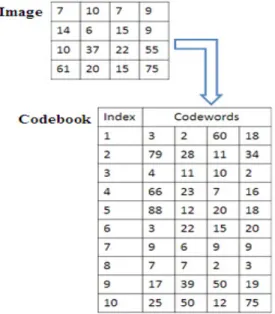
Calculating centroid of each clusters and form a Codebook.Fig. 1
.
Feature vector using codebookImage Classification is performed in two steps feature extraction and classification.
Fig. 2
.
Proposed CBIC processTraining dataset is supplied to Feature Vector,for Feature extraction using LBG algorithm.Feature vector is given to the classifier for Training.Then query image is provided to Feature vector,features are extracted and given to trained
486 Neha R. Kasat and Sudeep D. Thepade / Procedia Computer Science 79 ( 2016 ) 483 – 489
classifier for classification.Classification, classifies the image as per its belonging class.
6. Expirimentation Environment
In proposed method Wang Image database is used which is splited in traning and testing dataset each of 320 and 40 respectively,with 8 different classes. Platform used for feature extraction was Matlab on computer with Intel core i5 processor and 4 GB RAM. For classification Weka Tool is used.
Accuracy is the only performance measure to compare the techniques.Seven different codebook sizes and six classifiers are used.Total 7*6 combinations are carried out for finding result
7. Result and Discussion
In Proposed technique 42 variations are Exprimented on 500 Images with 320 Training set Images and 180 Testing set Images.Traning and Testing images are spread across 8 catagories namely Buses, Roses, Dino, Beachs, Horses, Elephants ,Mountains & etc.
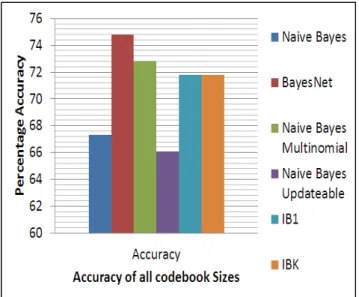
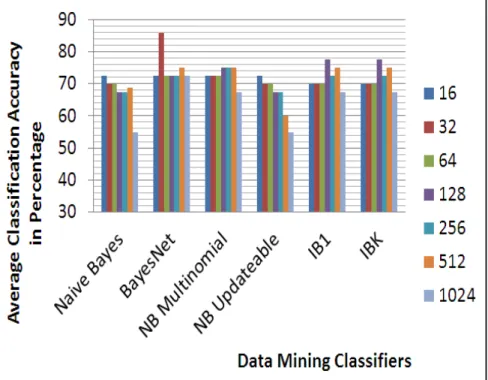
Bayes Net gives best over all result 74.77% for all codebook sizes. Codebook size 128 performs better with all the classifiers, it gives 72.5% result.
Table 1.The Table shows Average acurracy with respect to classifiers.
Classifiers Average Accuracy
Naive Bayes 67.32
Bayes Net 74.77
Naive Bayes Multinomial 72.85
Naive Bayes Updateable 66.071
IB1 71.78
IBK 71.78
Above table shows the Average accuracy for all codebook sizes with all Classifiers. Bayes Net Classifiers gives best result.
Fig. 3. Average Accuracy with respect to Classifiers.
Table 2.The Table shows Average Accuracy with respect to Codebook size.
Codebook size Average Accuracy 16 71.25 32 70 64 70 128 72.5 256 70 512 71.88 1024 61.25
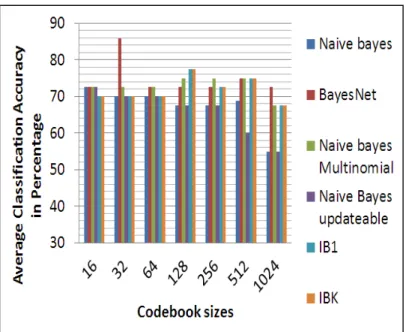
Above Table shows Average Accuracy for all the codebook size. Codebook size 128 gives highest accuracy of all other codebook sizes.
488 Neha R. Kasat and Sudeep D. Thepade / Procedia Computer Science 79 ( 2016 ) 483 – 489
Table 3.The Table conatins all the Experimentation results with all classifiers and codebook sizes.
Classifiers
Codebook size
16
32
64
128
256
512
1024
Naive
Bayes
72.5
70
70
67.5 67.5 68.75
55
Bayes Net
72.5 85.93 72.5 72.5 72.5
75
72.5
Naive
Bayes
Multinomial
72.5
72.5
72.5
75
75
75
67.5
Naïve
Bayes
updateable
72.5
70
70
67.5 67.5
60
55
IB1
70
70
70
77.5 72.5
75
67.5
IBK
70
70
70
77.5 72.5
75
67.5
Fig 5. Average Classfication Accuracy in Percentage with respect to Codebook Sizes.
8. Conclusion
Content Based Image Classification is important for improving the Accuracy of Image Retrival. Conventional Data Mining Classifiers are Experimented here on 500 images using 7 different Codebook (16,32, 64, 128 ,256 , 512 ,1024 ) of LBG vector quantization method to proposed Novel image classificationtechnique. Overall best codebook size is 128. Best family is Lazy with 71.78%. Best Data Mining Classifiers is Bayes Net.Overall best performance is observed by the proposed Image Classification technique is Bayes Net classifier with 128 codebook size.
References
1. Dr. Sudeep D. Thepade, Madhura M. Kalbhor, “Novel Data Mining based Image Classification with Bayes, Tree, Rule, Lazy and Function Classifiers using Fractional Row Mean of Cosine, Sine and Walsh Column Transformed Images.”2015 International Conference on Communication, Information & Computing Technology (ICCICT), Jan. 16-17, Mumbai, India
2. Dr. Sudeep D. Thepade, Madhura M. Kalbhor,”Extended Performance Appraise of Bayes, Function, Lazy, Rule, Tree Data Mining Classifier in Novel Transformed Fractional Content Based Image Classification.”2015 International Conference on Pervasive Computing (ICPC), Jan. 9-10. Pune, India.
3. Dr. Sudeep D. Thepade, Rik Das,” Performance Comparison of Feature Vector Extraction Techniques in RGB Color Space using Block Truncation Coding for Content Based Image Classification with Discrete classifiers.” INDICON 2014.
4. Ms. Sandhya R. Shinde, Ms. Sonali Sabale, Mr Siddhant Kulkarni, Ms. Deepti Bhatia, “Experiments on Content Based Image Classification using Color Feature Extraction”, 2015 International Conference on Communication, Information & Computing Technology (ICCICT), Jan. 16-17, Mumbai, India
5. Singh, V.P.,Srivastava, R.,“Design & performance Analysis of CBIR system Based on Image Classification using Feature Sets”, Futuristic Trends on Computational Analysis and Knowledge Management (ABLAZE), 2015 .