Research Report
Nonconscious Priming After
17 Years
Invulnerable Implicit Memory?
David B. Mitchell
Kennesaw State University
ABSTRACT—Individuals who saw pictures for 1 to 3 s in the laboratory were tested 17 years later by mail. Identifica-tion rates were significantly higher for fragments from these previously exposed targets than for novel fragments, whereas the same stimuli evoked no differences in control groups that had not been previously exposed to the pic-tures. Priming—the memorial advantage conferred by prior perceptual experience—was stable over the years (r5.51). Priming was dissociated from episodic memory, in that it was present even in subjects who reported no conscious recollection of their participation in the original laboratory session. These findings suggest that the per-ceptual representation system is an invulnerable memory system functioning below conscious awareness.
Over the past two decades, the longevity ofimplicit memory— memory without awareness—has been differentiated from the faster decay of explicit memory (conscious recollection). In 1982, Tulving, Schacter, and Stark discovered an extraordinary dissociation between recognition memory and implicit memory: Unlike explicit memory, which exhibited predictable deterior-ation, word-fragment-completion priming revealed virtually no decline over a 1-week interval. Following suit, other researchers found preserved priming over 6 weeks (Mitchell & Brown, 1988), 3 months (Drummey & Newcombe, 1995), 48 weeks (Cave, 1997), 16 months (Sloman, Hayman, Ohta, Law, & Tul-ving, 1988), and 22 months (Maylor, 1998).
Priming is measured by the difference in performance on trials with previously encountered stimuli and trials with novel stimuli, and is typically assessed without asking individuals to engage in recollection. Years before Tulving et al. (1982) made
their discovery, Gollin (1960) had reported that ‘‘visual recog-nition of incomplete objects’’ was unaltered over a 2-week delay, and Kolers (1976) had found ‘‘pattern-analyzing memory’’ after 13 to 15 months. However, the priming in both Gollin’s and Kolers’s paradigms represents facilitation of skills learned over many trials, whereas the studies in the era of Tulving et al. and beyond boasted long-lasting priming based on very brief ex-posures.
These findings are fascinating to students of memory for at least two reasons. First, the longevity of priming per se is noteworthy, given the target items’ specificity and brief expo-sure. Early studies investigated priming phenomena that lasted over seconds, minutes, or hours, and contemporaneous priming theories invoked the temporary activation of nodes or ‘‘logo-gens’’ (Morton, 1979). The notion of temporary activation was woefully inadequate to account for the quantum increase in priming longevity discovered in the 1980s. Second, such phenomenal priming had implications for multiple-memory-systems models (Mitchell, Brown, & Murphy, 1990; Tulving & Schacter, 1990). Specifically, because priming is preserved in amnesia, as well as for memories forgotten normally, it is now accepted as fact that the neurological systems serving implicit memory are separate from those involved in conscious recol-lection (Budson & Price, 2005; Roediger, Marsh, & Lee, 2002). One dimension that studies of very long-term priming (with the possible exception of Maylor, 1998) have in common is the use ofperceptualimplicit memory tasks (Roediger et al., 2002). Theoretically, perceptual processes are engaged when there is an overlap of physical features between a target and a test cue (e.g.,aardvark-aa_d_a_kin word-fragment completion). Thus, priming in perceptual tasks is facilitated by physical similarity, and can be diminished or even eliminated by physical changes between study and test. In contrast,conceptualprocesses are at work when semantic features overlap between study and test (e.g.,animalsas a test cue foraardvarkin category-exemplar generation). Priming in perceptual tasks is theorized to be Address correspondence to David B. Mitchell, Kennesaw State
Uni-versity, 1000 Chastain Rd., #5300, Kennesaw, GA 30144, e-mail: [email protected].
mediated by a perceptual representation system (Tulving & Schacter, 1990), and priming that is mediated by this system appears to be less affected by long retention intervals than is priming based on conceptual processes (Roediger & Geraci, 2005). Thus, picture-fragment identification—an unequivocally perceptual implicit task (Roediger & McDermott, 1993)—was employed in the present study.
In light of previous findings on the durability of priming, is it possible that priming is actually invulnerable to decay over time? More than 17 years ago—having found priming to be undiminished after an interval of 6 weeks—Brown and I wrote that ‘‘perhaps some residual effect of naming a picture persists indefinitely’’ (Mitchell & Brown, 1988, p. 220). The current investigation was conducted to push the envelope well beyond the longest interval previously tested (22 months), treating our audacious statement as a hypothesis. Individuals were asked to complete an implicit memory task (picture-fragment identifi-cation) involving pictures they had named in a laboratory study 17 years earlier.
METHOD
Subjects
Forty-eight students (ages 19–32,M522.3; 50% male) served in the original laboratory study at the University of Minnesota in 1982 (see Mitchell, 1989). Approximately 6 months later, 29 of these subjects returned questionnaires sent by mail. In 1999, a second questionnaire was mailed out; 12 subjects (now ages 36–46,M539.2; 58.3% female) responded. A control group (n521; ages 18–27,M520.0; 57.1% female) of naive subjects (i.e., not exposed to the original stimuli) was tested at Loyola University Chicago in 1999.
Materials
Black-and-white line drawings (Snodgrass & Vanderwart, 1980) constituted the original stimuli. These pictures were presented intact three times in the original laboratory session (named twice and seen again during an explicit recognition test; see Mitchell, 1989). In the current study, black-and-white picture fragments (Snodgrass & Corwin, 1988; completion rate at the 35th per-centile) were seen for the first time. Arranged in rows and columns on two sheets of paper (8 ½ in. 11 in.) were 70 fragments (18 18 mm each): 28 fragments corresponding to intact named pictures (targets), 28 corresponding to distractors from the recognition test,1and 14 novel foils (for assessing the baseline identification rate). Subjects were asked to identify as many fragments as possible by writing next to each fragment the name of the object corresponding to it. They were also asked to share any conscious recollections of their laboratory session 17 years earlier.
Procedure
In 1982, the original subjects completed implicit (picture nam-ing) and explicit (picture recognition) memory tasks in the lab-oratory. About 6 months later, they received an unexpected questionnaire requesting explicit recall of laboratory events. This first mailing (containing no picture stimuli) yielded a re-sponse rate of 60.4% (29 subjects; see Mitchell, 1999). Seven-teen years later (the current investigation), a second unexpected questionnaire including the picture-fragment identification test was mailed to these individuals. Twelve (41.4%) mailed com-pleted sheets back. The mean retention interval was 17.4 years (206–215 months). Various measures taken in 1982 (explicit memory, education, Wechsler Adult Intelligence Scale vocabu-lary, and picture-naming errors and priming) showed no reliable differences between the 12 subjects who responded in 1999 and the 17 who did not,ts(27)50.28 to 1.12,ps>.25.
RESULTS
Picture-Fragment Identification and Priming
Picture fragments corresponding to previously named pictures were identified at a mean rate of 56.0%, and new fragments were identified at a mean rate of 43.5%,t(11)53.927,prep5.986,
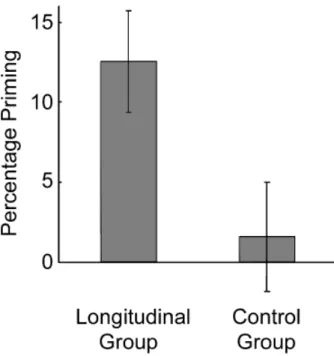
g51.59. The control group—who had seen none of the stimuli previously—identified the two types of fragments at similar levels, 58.1% for targets and 56.5% for foils,t(20) 5 0.476. Priming—the difference between correct identification rates for old and new fragments—was significantly greater for the longitudinal group (i.e., the original subjects;M512.5%) than the control group (M 5 1.6%), t(31) 5 2.145, prep 5 .927,
g 5 0.78 (see Fig. 1). Virtually all the longitudinal subjects showed priming above zero (11 of 12, or 92%), whereas only 43% (9 of 21) of the control subjects did (Fisher exactp5.009). Relative Priming
Snodgrass (1989) suggested that a relative priming measure (target rate – baseline rate/1.0 – baseline rate) should be used when groups exhibit different baseline rates. When priming was calculated using this formula, the difference between the lon-gitudinal and control groups was even greater: The lonlon-gitudinal group’s mean rose to 20.1%, whereas the control group’s mean dropped to 0.3%. Two outliers, one each in the longitudinal group ( 30%, 2.6SDs) and the control group ( 110%, 2.5
SDs), were identified. With these subjects excluded, corrected priming means were 24.7% and 5.2% for the longitudinal and control groups, respectively,t(24.4)5 2.16,prep5 .927,
g50.65.
Differential Fragment-Identification Rates
Because the groups had different identification rates, another analysis was conducted to further rule out item-selection con-founds (counterbalancing of targets and foils was not possible in 1
These distractors were omitted from analysis because they were not coun-terbalanced for codability in 1982.
this post hoc design). Although the longitudinal group evinced greater priming than the control group, this effect was (math-ematically) due to lower rates for foils, rather than higher rates for targets. (Of course, a valid assessment of baseline identifi-cation rate is crucial for an accurate assessment of priming.) Accordingly, individuals in the control group who had overall rates that were identical or similar to those of individuals in the longitudinal group were selected for this analysis. The 12 con-trol subjects with individual overall rates that were closest to the rates of the 12 longitudinal subjects had a mean overall identification rate of 50.4%, not significantly different from the longitudinal group’s mean of 49.7%,t(22)5 0.11. Unlike the longitudinal subjects, however, these individuals showed no reliable performance difference between targets and foils (Ms5 48.8% and 51.9%, respectively), t(11) 5 0.78. This sub-group’s mean priming score was slightly negative ( 3.1%), and only 3 of these subjects had priming scores above zero. This analysis suggests that any performance difference between targets and foils was not due to idiosyncratic characteristics of the particular pictures employed, but rather was due to prior experience (i.e., memory).
Aging Visual Perception
Studies have revealed a negative linear association between age and unprimed picture-fragment identification (e.g., Mitchell & Bruss, 2003). Thus, age-related declines were likely responsible for the fact that the longitudinal subjects’ identification rates were lower than those of the control subjects. This hypothesis was tested by recruiting 13 middle-aged individuals from
continuing-education classes at Kennesaw State University.2 This second control group was closer in age (32–51,M542.8) to the longitudinal subjects than the first control group was, and their unprimed identification rate (45.1%) was closer as well (cf. 43.5%). Like the younger control group, they did not identify target fragments (49.4%) at a significantly higher rate than foils,
t(12)50.79. Their relative priming ( 6.1%) was also not sig-nificantly different from zero,t(12)5 0.41.
Dissociations Between Explicit and Implicit Memory Four subjects confessed that they had no conscious recollection of their laboratory visit 17 years earlier:
‘‘I’m sorry—I don’t really remember this experiment at all.’’ (36-year-old male, 22% priming)
‘‘I’m afraid I don’t recall participating at all.’’ (37-year-old female, 7% priming)
‘‘Don’t remember anything about it.’’ (36-year-old female, 33% priming)
‘‘Basically, I remember nothing about the experience . . . .’’ (46-year-old male, 14% priming)
Apparently, these individuals knew they had participated in psychology experiments during their undergraduate years, but could not remember this particular experience. Ironically, priming among these ‘‘amnesic’’ subjects was slightly higher (M 5 19.0%) than—but not significantly different from— priming among the subjects who remembered participating (M59.3%),t(10)5 1.51,p5.162.
Long-Term Stability
Picture-fragment identification was correlated with picture-naming priming measured 17 years earlier,r5.51, p5 .04 (one-tailed). Note that this association was found despite the fact that naming priming is a latency measure, whereas picture-fragment identification is an accuracy measure.
DISCUSSION
The present findings extend the known parameters of the lon-gevity of perceptual priming in at least three ways. First, the fact that priming is reliable after 17 years is newsworthy per se. Even though only 12 of the original subjects were located, 11 revealed robust priming. Furthermore, the magnitude of their priming is comparable to levels observed in standard laboratory studies with much shorter intervals. Corkin’s (1984) report of 12 years of savings (1968–1980) in the amnesic H.M.’s performance on the Gollin incomplete-figures test—although very impressive—in-volved multiple learning and testing trials. In the present study, the original stimuli were seen for a total of 1 to 3 s at most over Fig. 1.Mean picture-fragment identification priming in the longitudinal
group after 17 years and in a control group with no prior exposure. Error bars indicate standard error of the mean.
three instances (naming, naming repetition, recognition). Such fleeting glances 17 years earlier are hardly comparable to multiple extended learning trials.
Second, priming was unrelated to conscious recollection. ‘‘Amnesic’’ individuals exhibited as much priming as those who remembered participating in the original laboratory study. Al-though similar dissociations have been reported (Mitchell & Brown, 1988), in those cases the forgetting experienced by healthy subjects involved memory failure for specific items, rather than oblivion for the entire testing episode. Thus, the current data replicate findings with bona fide amnesics who exhibit semantic learning in the absence of episodic memory for study sessions (Shimamura & Squire, 1991).
Third, priming was found despite substantial changes in context (i.e., laboratory to ‘‘real world’’). Implicit memory tasks appear to be unaffected by changes in environmental context (e.g., indoors to outdoors; cf. McKone & French, 2001). Indeed, the context shift in the present study was not trivial.
Although the longevity of priming reported here sets a new record, some memory theorists (Freud notwithstanding) would not be surprised. As underscored by Roediger and Srinivas, anyone who has seen R.C. James’s famous black-and-white scene once will forever see the camouflaged Dalmatian (see p. 18 in Roediger & Srinivas, 1993). Advocating a ‘‘functionalist view’’ of memory, Jacoby (1988) proposed that people’s per-ceptual processes may be permanently changed as a result of experience. Indeed, the endurance displayed in picture-frag-ment identification priming may be limited to perceptual pro-cesses, as conceptual priming appears to be much more short-lived (Roediger & Geraci, 2005).
Implicit Brain Mechanisms
Recent functional magnetic resonance imaging research (Meister et al., 2005) revealed that ‘‘very-long-term’’ picture priming (6 weeks) was mediated by the left inferior frontal and inferior posterior temporal cortexes. Furthermore, this specific cortical activation was differentiated from shorter (1-day) acti-vation, which was restricted to posterior extrastriate and dorsal left inferior frontal areas. Although 6 weeks to 17 years is quite a stretch, the most parsimonious assumption at this point is that the same systems are involved in the apparently permanent priming demonstrated in the current study.
Novelty Detectors
Recent research has highlightednovelty-detectionmechanisms in hippocampal networks (Habib, McIntosh, Wheeler, & Tulving, 2003). These might be important mechanisms under-lying priming. If so, priming would be due more to suppression of new material than to facilitation of the familiar. Although all fragments in the present study were technically new, for the longitudinal subjects the foils had a greater proportion of novel geons than the target fragments did. As unlikely as it seems, it
may be that novelty responses can be triggered at any time and in any context (Dolan & Strange, 2002), rendering the length of the retention interval irrelevant, at least when memory is assessed via implicit perceptual tasks. Such a mechanism might account for the previously reported long-term priming effects reviewed earlier, as well as the present findings. Indeed, long-term picture priming in individuals with Alzheimer’s disease was impaired when facilitation alone was measured (i.e., decrease in latency from first to second naming), but was intact when previously named pictures were contrasted with novel pictures (Mitchell & Schmitt, 2006). Other long-term priming studies have also found that previously exposed subjects perform more poorly with new pictures than control subjects do (Drummey & Newcombe, 1995). Relative to middle-aged control subjects, the current longitudinal subjects exhibited both slight suppression of foils and enhanced identification rates for targets.
Conclusions
So, is priming truly immune to decay over time? Picture-frag-ment identification has been criticized for being vulnerable to contamination by explicit memory (Mitchell & Bruss, 2003). Explicit memory awareness would allow individuals who re-member particular items to use that information to aid their identification of specific pictures. It seems safe to assume, however, that after 17 years, contamination from any smidgeon of conscious recollection is not a viable explanation of long-term priming.
Acknowledgments—Some of these data were presented at the 17th annual convention of the American Psychological Society, Los Angeles, May 2005. I thank Deborah Garfin and Sarah McKeague Black for assistance with data collection, and Alan Brown, Fergus Craik, Reed Hunt, Sasha John, Elizabeth Maylor, Roddy Roediger, Frederick Schmitt, and Endel Tulving for constructive comments on earlier drafts of this article. Support for this research was provided by grants from the University of Minnesota, Duke University Medical Center, Southern Meth-odist University, the National Institute on Aging (Grant No. AG07854), the Foley Family Foundation, and the WellStar College of Health and Human Services.
REFERENCES
Budson, A.E., & Price, B.H. (2005). Memory dysfunction.New England Journal of Medicine,352, 692–699.
Cave, C.B. (1997). Very long-lasting priming in picture naming. Psy-chological Science,8, 322–325.
Corkin, S. (1984). Lasting consequences of bilateral medial temporal lobectomy: Clinical course and experimental findings in H.M.
Seminars in Neurology,4, 249–259.
Dolan, R.J., & Strange, B.A. (2002). Hippocampal novelty responses studied with functional neuroimaging. In L.R. Squire & D.L.
Schacter (Eds.),Neuropsychology of memory(3rd ed., pp. 204– 214). New York: Guilford Press.
Drummey, A.B., & Newcombe, N. (1995). Remembering versus know-ing the past: Children’s explicit and implicit memories for pic-tures.Journal of Experimental Child Psychology,59, 549–565. Gollin, E.S. (1960). Developmental studies of visual recognition of
incomplete objects.Perceptual and Motor Skills,11, 289–298. Habib, R., McIntosh, A.R., Wheeler, M.A., & Tulving, E. (2003).
Memory encoding and hippocampally-based novelty/familiarity discrimination networks.Neuropsychologia,41, 271–279. Jacoby, L.L. (1988). Memory observed and memory unobserved. In U.
Neisser & E. Winograd (Eds.),Remembering reconsidered: Eco-logical and traditional approaches to the study of memory (pp. 145–177). New York: Cambridge University Press.
Kolers, P.A. (1976). Reading a year later.Journal of Experimental Psychology: Human Learning and Memory,2, 554–565. Maylor, E.A. (1998). Retrieving names in old age: Short- and (very)
long-term effects of repetition.Memory & Cognition,26, 309–319. McKone, E., & French, B. (2001). In what sense is implicit memory ‘‘episodic’’? The effect of reinstating environmental context.
Psychonomic Bulletin & Review,8, 806–811.
Meister, I.G., Weidemann, J., Foltys, H., Brand, H., Willmes, K., Krings, T., Thron, A., To¨pper, R., & Boroojerdi, B. (2005). The neural correlate of very-long-term picture priming. European Journal of Neuroscience,21, 1101–1106.
Mitchell, D.B. (1989). How many memory systems? Evidence from aging. Journal of Experimental Psychology: Learning, Memory, and Cognition,15, 31–49.
Mitchell, D.B. (1999, August).Remembering memory testing: Repli-cating age and gender differences. Paper presented at the annual meeting of the American Psychological Association, Boston, MA. Mitchell, D.B., & Brown, A.S. (1988). Persistent repetition priming in picture naming and its dissociation from recognition memory.
Journal of Experimental Psychology: Learning, Memory, and Cognition,14, 213–222.
Mitchell, D.B., Brown, A.S., & Murphy, D.R. (1990). Dissociations between procedural and episodic memory: Effects of time and aging.Psychology and Aging,5, 264–276.
Mitchell, D.B., & Bruss, P.J. (2003). Age differences in implicit memory: Conceptual, perceptual, or methodological?Psychology and Aging,18, 807–822.
Mitchell, D.B., & Schmitt, F.A. (2006). Short- and long-term implicit memory in aging and Alzheimer’s disease.Aging, Neuropsychol-ogy, and Cognition,13, 611–635.
Morton, J. (1979). Facilitation in word recognition: Experiments causing change in the logogen model. In P.A. Kolers, M.E. Wrolstal, & H. Bonma (Eds.), Processing of visible language
(pp. 259–268). New York: Plenum.
Roediger, H.L., III, & Geraci, L. (2005). Implicit memory tasks in cognitive research. In A. Wenzel & D.C. Rubin (Eds.),Cognitive methods and their application to clinical research(pp. 129–151). Washington, DC: American Psychological Association.
Roediger, H.L., III, Marsh, E.J., & Lee, S.C. (2002). Kinds of memory. In D. Medin (Ed.),Stevens’ handbook of experimental psychology: Vol. 2. Memory and cognitive processes(3rd ed., pp. 1–41). New York: John Wiley & Sons.
Roediger, H.L., III, & McDermott, K.B. (1993). Implicit memory in normal human subjects. In F. Boller & J. Grafman (Eds.),
Handbook of neuropsychology(Vol. 8, pp. 63–131). Amsterdam: Elsevier.
Roediger, H.L., III, & Srinivas, K. (1993). Specificity of operations in perceptual priming. In P. Graf & M.E.J. Masson (Eds.),Implicit memory: New directions in cognition, development, and neuropsy-chology(pp. 17–48). Hillsdale, NJ: Erlbaum.
Shimamura, A.P., & Squire, L.R. (1991). The relationship between fact and source memory: Findings from amnesic patients and normal subjects.Psychobiology,19, 1–10.
Sloman, S.A., Hayman, C.A.G., Ohta, N., Law, J., & Tulving, E. (1988). Forgetting in primed fragment completion. Journal of Experi-mental Psychology: Learning, Memory, and Cognition,14, 223– 239.
Snodgrass, J.G. (1989). Sources of learning in the picture fragment completion task. In S. Lewandowsky, J.C. Dunn, & K. Kirsner (Eds.),Implicit memory: Theoretical issues(pp. 259–282). Hills-dale, NJ: Erlbaum.
Snodgrass, J.G., & Corwin, J. (1988). Perceptual identification thresholds for 150 fragmented pictures from the Snodgrass and Vanderwart picture set. Perceptual and Motor Skills, 67, 3–36.
Snodgrass, J.G., & Vanderwart, M. (1980). A standardized set of 260 pictures: Norms for name agreement, image agreement, familiar-ity, and visual complexity.Journal of Experimental Psychology: Human Learning and Memory,6, 174–215.
Tulving, E., & Schacter, D.L. (1990). Priming and human memory systems.Science,247, 301–306.
Tulving, E., Schacter, D.L., & Stark, H.A. (1982). Priming effects in word-fragment completion are independent of recognition mem-ory.Journal of Experimental Psychology: Learning, Memory, and Cognition,8, 336–342.
(RECEIVED11/29/05; REVISION ACCEPTED1/26/06; FINAL MATERIALS RECEIVED1/31/06)