DEVELOPING AND IMPLEMENTING AN
ADAPTIVE CONSERVATION STRATEGY:
A guide for improving adaptive management and sharing the
learning among conservation practitioners
developed by PRBO Conservation Science
with resource management partners
Acknowledgments
PRBO Conservation Science wishes to thank the David and Lucile Packard Foundation for the inspiration and support necessary to develop and disseminate this Guide. We are also grateful to the National Fish and Wildlife Foundation for its generous support. We wish to thank our many partners listed in Appendix 1, as well as others who may have been omitted from this list but with whom we have worked through Partners in Flight, the U.S. Shorebird Conservation Plan, the North American Waterbird Conservation Plan, the North American Waterfowl Management Plan joint ventures, and various other collaborative projects.
The authors wish to thank the following individuals for their extremely valuable contributions by participating in interviews and reviewing drafts of the case studies presented in Chapter 3:
George Buckner, Bureau of Land Management (BLM), Oregon/Washington State Office
Erick G. Campbell, BLM
Daniel Efseaff, Sacramento River Partners
Woody Elliott, California Department of Parks and Recreation Joy Fatooh, BLM Bishop Field Office
Greg Golet, The Nature Conservancy
Amy Hutzel, California State Coastal Conservancy Leah Kirk, Inyo County Water Department
Kent Livezey, U.S. Fish and Wildlife Service (formerly US Navy) Gary Milano, Inyo National Forest (USDA Forest Service) Maura Naughton, US Fish and Wildlife Service (FWS) Region 1
Denyse Racine, California Dept. of Fish and Game, Eastern Sierra Inland Desert Region
Joe Silveira, Sacramento River National Wildlife Refuge (FWS)
Fred Taylor, BLM, Oregon, Burns District, Three Rivers Resource Area
Finally, the authors wish to thank the following individuals for providing information and/or insightful comments on portions or this entire document in draft:
John Baker, PRBO Grant Ballard, PRBO Walter Briggs, U.S. Navy Ryan Burnett, PRBO Heather Chase, NFWF Alan Forkey, NRCS Tom Gardali, PRBO
Catherine Hickey, PRBO Skip Renchler, BLM Oregon Sandy Scoggin, PRBO Nils Warnock, PRBO Jennifer Wheeler, FWS
Steve Zack, The Wildlife Conservation Society
Table of Contents
PRBO Conservation Science ...iii
Executive Summary...iv
Chapter 1. What is an Adaptive Conservation Strategy? ...1
Birds as Indicators... 2
The Adaptive Conservation Strategy ... 3
Conservation Accounting ... 9
Chapter 1 References...10
CHAPTER 2. Case Studies of ACS Applied...13
The Sacramento River Restoration Feedback Loop ...14
Monitoring and Assessment Results...14
Adaptive Management Recommendations and Implementation ...16
Sacramento River Case Study References ...18
The Eastern Sierra –bridging jurisdictional boundaries...19
Monitoring and Assessment Results...20
Adaptive Management Recommendations and Implementation...21
Maintaining the Riparian Bird Conservation Plan as a “living” document...22
Eastern Sierra Case Study References...23
Shrubsteppe Habitat – gaining a wildlife perspective ...25
Monitoring and Assessment Results...27
Adaptive Management Recommendations and Implementation ...28
Shrubsteppe Case Study References...28
San Francisco Bay – Predicting the effects of management ...30
Implications of Habitat Conversion...31
Modeling Habitat Conversion...31
Habitat Conversion Model Case Study References...34
Developing an ACP - Seabirds of the California Current System ...35
Initiating Conservation Planning ...36
CCS Seabird Case Study References ...38
CHAPTER 3. “Pointers for Practitioners” ...40
I. Achieving Conservation Results...40
II. The Special Case of Long-term Monitoring ...43
III. Partnership Building ...44
IV. Communication...46
V. Fundraising...47
VI. Improving the ACS Approach...47
Chapter 3 References...51
Conclusion ...53
Appendix 1. Adaptive Conservation Strategy Partners ...54
Appendix 2. List of Adaptive Conservation Plans Applicable to California ...57
Appendix 3. How to Create an Adaptive Conservation Plan ...58
Appendix 4. Case Study Interview Questions ...62
PRBO Conservation Science
PRBO is a non-profit, membership organization dedicated to conserving birds, other wildlife and ecosystems through innovative scientific research and outreach. Working throughout the West, over 120 staff scientists and seasonal biologists study birds and ecosystems to protect and enhance biodiversity. Founded in 1965 as Point Reyes Bird Observatory, PRBO is an active leader in several national and international initiatives working to protect birds and ecosystems, including Partners in Flight, the US Waterbird Conservation Plan, the US Shorebird
Conservation Plan, the North American Waterfowl Management Plan regional Joint Ventures, and the North American Bird Conservation Initiative.
PRBO was recently honored with the 2003 Partners In Flight “Leadership Award” from the US Fish and Wildlife Service (FWS) as well as the 2002 national “Conservation Partner Award” from the USDA Forest Service (USFS) and the Bureau of Land Management (BLM).
This Guide
This guide to Developing and Implementing an Adaptive Conservation Strategy is based on the collective experience of conservation scientists and land and ocean managers working in California and other places in the American West over the last 30 years (a list of more recent partners is included in Appendix 1). It will be of interest to anyone striving to achieve tangible conservation results, including conservation groups, land trusts, watershed groups, conservation science organizations, private landowners, research stations, and natural resource management agencies at the local, state, national and international levels.
PRBO produced this guide because we have been leaders in developing Adaptive
Conservation Strategies through our participation in the continental bird conservation plans of North America. While PRBO’s original research efforts were focused on conserving bird populations, our research results over the years have demonstrated the value of birds as ecosystem indicators. From restoring wetlands to managing fisheries, bird science provides insights to help assess and promote effective wildlife and habitat management—management that results in and supports fully functioning ecosystems to sustain the greatest diversity and abundance of birds and other wildlife.
For example, PRBO conducted studies of birds in riparian habitat that was regenerating as a result of levee breaks in the Cosumnes floodplain/Central Valley, California, which led to a series of recommendations for riparian habitat restoration published as part of our research and the Riparian Bird Adaptive Conservation Plan in 2000 (see Appendix 2). Recommendations promote the use of natural processes, such as flooding, and planting restored sites in patches to mimic habitat structure that results from flooding. Riparian habitat created since then at
Cosumnes and elsewhere (based on recommendations from both the Riparian Plan and PRBO’s research there), has now been observed to contribute critical food resources to adjacent open floodplains that help sustain native fishes, including special-status species like Chinook salmon (Oncorhynchus tshawytscha) and Sacramento splittail (Pogonichthys macrolepidotus).
Executive Summary
From a conservation perspective, scientific data are only as valuable as the extent to which they are applied—whether to shed new light on key questions about the environment or to guide actual conservation projects. Among resource managers, there is a growing consensus about the need to identify management/restoration successes and mistakes and to learn from them. An Adaptive Conservation Strategy is a two-pronged approach that can help both conservation scientists and resource managers achieve these goals: it fosters applied science through true adaptive management on-the-ground and fosters “learning organizations” through the development of Adaptive Conservation Plans.
An Adaptive Conservation Strategy consists of adaptive management at the site-specific level and, in addition, Adaptive Conservation Plans that provide a systematic means of synthesizing data, sharing learning, and influencing policy across sites and ecosystems. In other words, an Adaptive Conservation Strategy recognizes that we all learn best by doing and by learning from the experience of others.
adaptive management
Adaptive Conservation Strategy = +
Adaptive Conservation Plans for sharing learning
An Adaptive Conservation Strategy emphasizes science-management teams practicing adaptive management. This approach means resource managers and scientists work together closely to identify important resource management questions and the monitoring regimes that are most likely to provide answers. Teams conduct standardized monitoring of bird species and
associated habitat features to evaluate conservation practices, results, and goals at multiple sites. Next, in a process that is more formal but nonetheless akin to the tradition of meeting face-to-face to “kick dirt,” science-management teams meet with one another and with others working on similar projects and in similar habitats. This process of systematically sharing learning
includes pooling standardized data from many sites, then sharing what has been learned with an even wider circle of conservation practitioners through the creation of Adaptive Conservation Plans (ACPs). ACPs are kept “alive” by regularly updating them with new data and analyses.
Birds as Indicators
PRBO’s approach to adaptive conservation planning has focused on the science and monitoring of bird populations because many bird species make excellent indicators of ecosystem health and integrity, and they are relatively easy to study. Internationally recognized protocols for measuring reproductive success and survival in birds means that bird monitoring programs can provide direct measures of the causes of population change, which can then be compared across sites. Moreover, many bird populations are still large enough to provide sufficient
sample sizes for statistical analysis across sites and/or regions. Bird monitoring in general is also cost-effective and can be conducted with low impact to birds and their habitats.
The Adaptive Conservation Strategy Defined
The steps of implementing an Adaptive Conservation Strategy are:
(1) Use adaptive management, stressing science-management teams at multiple sites within an ecosystem or with similar natural resources across ecosystems (e.g., riparian habitat).
a. Identify assumptions and set management goals (captured in site-specific adaptive resource management plans).
b. Implement management actions.
c. Monitor and analyze response to management.
d. Revise management, goals, or monitoring regime as indicated, and repeat the process.
(2) Share learning through Adaptive Conservation Plans.
a. Synthesize findings from multiple adaptively managed projects.
b. Develop an Adaptive Conservation Plan focused on the species, habitat, or ecosystem of interest. The plan incorporates findings from step 1, as well as peer-reviewed literature, gray literature, and expert opinion. Conservation plans advance recommendations to guide resource management and policy and are available on-line as well as in hard copy.
c. Disseminate and incorporate plan recommendationsinto resource
management and/or policy by partnering with or conducting outreach to appropriate audiences.
d. Reassess and revise both site-specific resource management plans/practices and Adaptive Conservation Plans, and repeat the process.
Adaptive management is a decades-old method of natural resource management that integrates design, management, and monitoring to systematically test assumptions in order to adapt and learn from experience (Salafsky et al 2001). True adaptive management is rarely implemented even though many resource planning documents call for it and numerous resource managers refer to it.
Adaptive Conservation Planning produces updateable web-based conservation plans and databases for wide dissemination. ACP recommendations address habitat management, restoration, protection, monitoring, research, policy, and education. Conservation
practitioners are given a powerful tool that allows them to avoid making others’ mistakes so they can begin generating new knowledge.
An Adaptive Conservation Strategy can also be applied as a means of evaluating the success of conservation efforts in biological terms. The goal of the relatively recent “conservation accounting” movement is to develop a process and set of measures that can be used to audit not only the financial, but also the ecological results of conservation projects. Organizations are applying bird science to audit if and how management and restoration efforts are succeeding in their conservation goals.
The Adaptive Conservation Strategy Applied
Chapter 2 presents five case studies chosen to illustrate some of the best examples of how an Adaptive Conservation Strategy has been applied in the field. They focus on illustrating science-management partnerships and conservation results at adaptively managed projects. The case studies presented include
• The Sacramento River Restoration Feedback Loop
• The Eastern Sierra – Bridging Jurisdictional Boundaries
• Shrubsteppe Habitat – Gaining a Wildlife Perspective
• San Francisco Bay – Predicting the Effects of Management
• Developing an ACP - Seabirds of the California Current System
Chapter 3 provides a list of suggestions and tips for conservation practitioners on how to maximize the benefits of implementing an Adaptive Conservation Strategy, with a focus on process and building partnerships. The material in this chapter is drawn from interviews of land management partners, PRBO project leaders, and the combined experience of the authors. Pointers cover the following topics: (1) achieving conservation results (2) the special case of long-term monitoring (3) partnership building (4) communication (5) fundraising and (6) improving the Adaptive Conservation Strategy approach. Appendix 3 provides a detailed step-by-step description of the process that has been successfully used to develop Adaptive
Conservation Plans for multiple habitat types in the state of California.
Song Sparrow, a Riparian Bird Conservation Plan focal species. Photo by Eric Preston.
After more than 30 years, hundreds of partnerships, and regional leadership roles in each of the four major continental bird conservation plans, PRBO Conservation Science and partners believe we have created a novel approach to conservation planning and assessment. Development of an Adaptive Conservation Strategy is a collaborative process. While it includes an adaptive management approach, it is more than that. It synthesizes and fully
integrates scientific knowledge into resource management across regions and ecosystems— from planning to monitoring measures of conservation success.
The crucial components of a successful Adaptive Conservation Strategy are collaboration, team work at the project level, keeping data current, information sharing, effective communication, flexibility (from all sides, including funders), and a results-oriented applied focus in monitoring, research, and management. The most fundamental point is that both conservation scientists and natural resource managers serve the same mission: facilitating and advancing successful, cost-effective conservation of the world’s precious natural heritage. An Adaptive Conservation Strategy provides a win-win approach for achieving this mission.
Chapter 1. What is an Adaptive Conservation Strategy?
Science and Practice: Fostering Conservation Results
In a world of diminishing natural resources, expanding human population, and limited budgets, it is essential that efforts to conserve biodiversity and manage wildlife habitats be guided by the best available scientific knowledge. This notion may seem self-evident. It is, nonetheless, an aspect of conservation practice that is constantly in need of improvement14,17,21. Science at its
best uses experimental methods and shares results widely. An Adaptive Conservation
Strategy is designed to foster precisely this approach.
An Adaptive Conservation Strategy includes adaptive management at the site-specific level combined with a process of Adaptive Conservation Planning across sites to more fully integrate scientific knowledge into resource management and share learning among conservation
practitioners. Adaptive management is a decades-old method of natural resource management that integrates design, management, and monitoring to systematically test assumptions in order to adapt and learn20. Adaptive Conservation Planning is the process of synthesizing monitoring
and assessment data from many projects to develop science-based conservation
recommendations that can then be shared across projects. Adaptive Conservation Strategies have focused on monitoring of bird populations because many bird species make excellent indicators of ecosystem health and integrity.
Adaptive Management Adaptive Conservation Strategy = +
Adaptive Conservation Plans
definition:
an Adaptive Conservation Strategy (ACS) consists of adaptive management at the site-specific level and, in addition, Adaptive Conservation Plans that provide a systematic means of synthesizing data, sharing learning, and influencing policy across sites, regions, and/or ecosystems.An Adaptive Conservation Strategy emphasizes science-management teams practicing adaptive management. Teams conduct standardized monitoring of bird species and their habitats to evaluate conservation practices, results, and goals at multiple sites. To systematically share learning, data from many adaptively managed sites are then pooled, synthesized, and disseminated by creating
species,
habitat,
or
ecosystem
Adaptive Conservation Plans. Adaptive Conservation Plans (ACPs) are regularly updated with new data and analyses. ACPs contain recommendations for habitat management, restoration, and protection as well as monitoring, research, policy, and education. An important goal is to implement recommendations at additional sites located throughout the habitat or ecosystem of interest. Plan data andrecommendations are also used to improve conservation programs, guide funding allocation, and refine resource management policies.
An ACS stresses recognition of the assumptions that underlie resource management; continual reassessment and broad sharing of conservation practices and results; and a collaborative multi-disciplinary approach that seeks to constantly improve and build
Birds as Indicators
What is the justification for developing an Adaptive Conservation Strategy based on birds? Many bird species make excellent indicators of various parameters of ecosystem health and ecological integrity. PRBO Conservation Science (PRBO) views bird population health as both a conservation goal in itself, and an indicator of the success of wildlife/habitat management and restoration.
The Laysan Albatross, a marine predator and indicator species. Photo by Eric Preston.
Good indicator species are those that are more sensitive to environmental change than others, and respond quickly and consistently to environmental stresses or enhancements4,5,15. Birds
make good indicators of habitat quality in a variety of ecosystems because they may be sensitive to a variety of physical and biological factors, including levels of primary and secondary
productivity in the system, the structural and species diversity of vegetation, and the size and connectivity of habitat patches11. They are numerous and conspicuous predators near the top
of the food chain. In the marine environment, they feed on the same prey as many other top predators, including large fish, sea turtles, seals, sea lions, and whales13.
Valuable indicators are also those that directly indicate a cause of change rather than simply the existence of change8,9, i.e., demographic measures such as rates of reproduction or mortality.
By monitoring demographic parameters of a wildlife population, some causes of declining trends or extirpated populations may often be identified, which can lead directly to the development of appropriate management actions to stop those declines. For this reason, an assessment of reproductive success and survival are important components of many bird monitoring programs. Reproductive success can be monitored through nest searching, which is also combined with detailed habitat features in the vicinity of the nest. Individuals can be captured, marked,
released, and re-sighted for survival analyses. The methods for collecting such data for birds are well-established and internationally standardized. The most useful indicator species are also those that have populations large enough to be easily monitored and to provide sufficient samples sizes for statistical analysis across sites and/or regions5.
Numerous bird species have many of the characteristics of efficient and effective indicators as
defined by The Nature Conservancy’s “Measures of Conservation Success” framework17:
• Biologically relevant (i.e., represent an accurate assessment of biodiversity health)
• Socially relevant (i.e., value is recognized by stakeholders)
• Anticipatory, providing early warning (i.e., indicate degradation before serious harm has occurred)
• Sensitive to anthropogenic stress and reflective of changes in stress without extreme variability
• Measurable (i.e., capable of being operationally defined and measured using a standard procedure)
• Cost-effective (i.e., inexpensive to measure, providing the maximum amount of information per unit effort).
Finally, indicators must be cost-effective and require low impact to the resource17, 21. Birds fit
this bill, as few organisms are more amenable to observation and identification (to species, sex, and/or age) by sight and sound. Birds often provide scientists with the best evidence of how humanity’s actions affect the world’s ecosystems and wildlife25.
“A very positive aspect of the monitoring program . . . is the fact that the link between habitat changes caused by restoration and the response of the riparian bird community is being evaluated. In fact, the songbird monitoring on Lower Clear Creek is the best example of an attempt to link restoration actions with a biological response of the target organisms that the Panel has seen during the Adaptive Management Forum.” - California Bay-Delta Authority (CALFED) Adaptive Management Forum Scientific and Technical Panel, 20031.
The Adaptive Conservation Strategy
The steps of implementing an Adaptive Conservation Strategy are:
(1) Use adaptive management, stressing science-management teams at multiple sites within an ecosystem or with similar natural resources across ecosystems (e.g., riparian habitat).
e. Identify assumptions and set management goals (captured in site-specific adaptive resource management plans).
f. Implement management alternatives.
g. Monitor and analyze response to management.
h. Revise management, goals, or monitoring regime as indicated, and repeat the process.
(2) Share learning through Adaptive Conservation Plans.
b. Develop an Adaptive Conservation Plan focused on the species, habitat, or ecosystem of interest. The plan incorporates findings from step a, as well as peer-reviewed literature, gray literature, and expert opinion. Conservation plans advance recommendations to guide resource management and policy and are available on-line as well as in hard copy.
c. Disseminate and incorporate plan recommendations into resource management and/or policy by partnering with or conducting outreach to appropriate audiences.
d. Reassess and revise both site-specific resource management plans/practices and Adaptive Conservation Plans, and repeat the process.
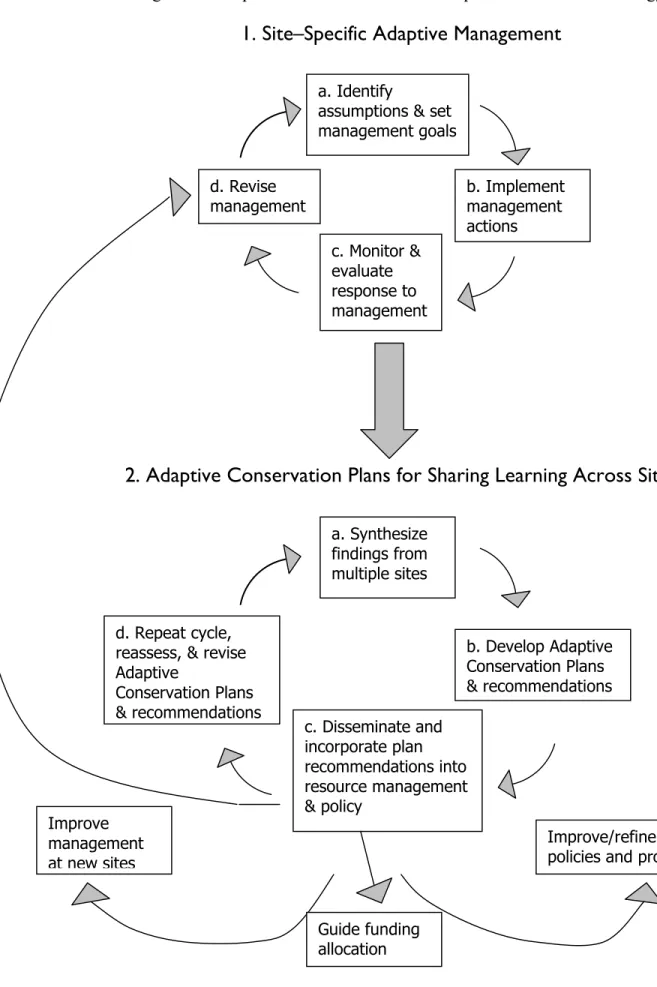
The Adaptive Conservation Planning cycle (Fig. 1) can be conceptualized as two separate iterative cycles that regularly exchange information and expertise: (1) the site-specific adaptive management cycle, where monitoring data are collected and Adaptive Conservation Plan (ACP) recommendations are implemented, and (2) the plan cycle, which develops ACPs with general goals of species, habitat, or ecosystem conservation and which cover a region containing many site-specific projects and their associated data.
Useful indicator species are those that have populations large enough to be easily monitored and to provide sufficient samples sizes for statistical analysis across sites and/or regions. Photo by Eric Preston.
Figure 1: Components and Process of an Adaptive Conservation Strategy
1. Site–Specific Adaptive Management
2. Adaptive Conservation Plans for Sharing Learning Across Sites
b. Implement management actions c. Monitor & evaluate response to management d. Revise management a. Synthesize findings from multiple sites b. Develop Adaptive Conservation Plans & recommendations c. Disseminate and incorporate plan recommendations into resource management & policy d. Repeat cycle, reassess, & revise Adaptive
Conservation Plans & recommendations
grams Improve/refine policies and pro
Guide funding allocation Improve management at new sites a. Identify
assumptions & set management goals
Adaptive Management
The approach to developing an Adaptive Conservation Strategy outlined in this guide is based on the general principles of adaptive management, a process for the management of natural resources that emphasizes interaction between managers and scientists. Because there is so much uncertainty inherent in our understanding of ecological systems,3,19,20 management
practices require continual monitoring and adaptation12. Adaptive management involves the
evaluation of alternative management actions through quantitative model building and/or experimentation, in which the results of previous actions are monitored and used to modify future management12, 19. It emphasizes the need to treat policies and decisions explicitly as
hypotheses and opportunities for learning rather than as final solutions2.
Passive adaptive management does not include controls, replication, or randomization. Active adaptive management employs management programs that are designed to experimentally compare selected policies or practices by evaluating alternative hypotheses about the system being managed3, 23, 24. Active adaptive management is a valuable component of an Adaptive
Conservation Strategy; however, an ACS also incorporates ecological insights gained from non-experimental monitoring projects (passive adaptive management) and basic research as well. True adaptive management is rarely implemented even though many resource planning documents call for it and numerous resource managers refer to it. “There are startlingly few examples in wildlife management in which the adaptive management ‘loop’ has been
completed9.” The reasons for this are many: an eagerness for quick “on-the-ground” results to
the exclusion of the effort and time required to assess long-term results; a focus on simple measures of success (for example, using seedling survival alone to measure the success of a forest restoration project planted to benefit wildlife); and the “build it and they will come” school of thought, which assumes that wildlife will respond favorably to most kinds of habitat restoration. An unwillingness to raise funds to cover the costs of monitoring and assessment is also sometimes a factor.
Perhaps the most important reason has been the breakdown of information sharing between scientist and manager. This breakdown may occur because managers and scientists do not view themselves as part of the same management team; because scientists have not sought to tie
monitoring and assessment programs directly to resource management9; and because many
managers think monitoring means only tracking population trends.
Science and Management Teams
A key premise of Adaptive Conservation Planning is that conservation practitioners and conservation scientists must work together as a team to ensure that questions and answers obtained from monitoring are relevant to natural resource management issues. From a conservation perspective, scientific data are only as valuable as the extent to which they are applied—whether to shed new light on key questions about the environment or to guide actual conservation projects.
Benefits to Conservation Biologists of the Team Approach26
• Every conservation scientist has a vested interest in working with land and ocean managers to ensure that their data are integrated into natural resource management decisions.
• Public land and ocean managers, in particular, can generate public outreach and conservation education opportunities otherwise unavailable to scientists, by providing controlled public access and interpretation of applied conservation science.
• Land and ocean management partners can help generate a source of matching funds, as well
as testimonials on the value of scientific work, to assist private scientists and organizations in fundraising efforts. Fundraising may often be more successful with collaborative
proposals that cover multiple jurisdictions.
Natural resource managers also benefit in many ways by teaming with science organizations to conduct adaptive management.
Benefits to Resource Managers of the Team Approach26
• Science partners can provide “turn-key” programs that supply expertise complementary to
that of a particular land or ocean management agency. Science organizations can also train land management staff in standardized monitoring and data analysis protocols.
• Science partners can tailor their monitoring and evaluation programs to answer questions of particular interest to habitat managers and to address new questions of interest as they arise.
• Several years of comprehensive ecological surveys can provide a huge increase in knowledge
about birds and other wildlife.
• Science partners may be able to provide continuity over the long-term by maintaining
datasets and enabling data sharing with a wider audience (i.e., they are not subject to the same shifting political winds). Since many Department of Interior agencies are now under a mandate to outsource whenever possible, science partners with established records of success are a logical choice for outsourcing.
• Partnerships between scientists and natural resource management agencies who have
jurisdiction over broad or adjoining areas can result in a wider context for interpreting research and monitoring results. Regional perspectives, landscape analyses, and greater statistical power can result when data are shared, compared, and analyzed across projects.
Adaptive Conservation Planning
The development of Adaptive Conservation Plans (sometimes titled Bird Conservation Plans), is actually an attempt to foster “learning projects” and “learning organizations.” i.e., to capture and share project learning with other practitioners so that they can avoid making the same mistakes over again and can begin generating new knowledge20,21. The ACP process makes this
possible by developing updateable conservation plans that pool the results of many adaptively managed projects, as well as the latest scientific literature and expert opinion, to develop a set of science-based conservation recommendations for specific habitat types or ecosystems.
An important assumption in creating ACPs is that management recommendations generated from pooled datasets can be applied in other similar habitats or sites within the bioregion and across bioregions (within reason—taking into account altitude, historic use, species occurrence, and biogeographic differences, for
example)10. In this way, habitat managers
who lack the resources for monitoring and assessment programs can still take
advantage of a wealth of knowledge from similar sites and from the literature. On the other hand, the recommendations can and should be tested at new sites
whenever possible through monitoring of birds and other wildlife response. As new data are generated at the project level, they are used to update and revise conservation plan recommendations as necessary. Plans also acknowledge the g in current knowledge and emphasize the need to test hypotheses and assum involved in conservation planning. Managers have access to all of this information, and much of the supp data, online.
aps ptions orting Standardized monitoring methodology of
birds and associated habitat parameters is thus a crucial component of an Adaptive Conservation Strategy6. Internationally standardized techniques for landbirds, as well as
seabirds and colonial nesters, have been defined18, 22. Standardized monitoring allows for
comparison and analysis of data across time and space (locally, regionally, and continentally), which is essential for the analyses of combined datasets that characteristically support ACPs. Standardized monitoring provides the “common language” for evaluating and guiding
management actions at multiple sites.
Standardized monitoring for all birds, including colonial nesters such as this Great Blue Heron, is a crucial component of ACP. Photo by Kim Kreitinger.
Programmatic/Policy Applications of Adaptive Conservation Plans
Increasingly, those who manage funding programs for conservation, whether in the private sector or in government, are seeking to ensure the best possible expenditures of scarce
conservation dollars. For example, the National Fish and Wildlife Foundation requests that bird habitat restoration and management proposals include information on how the proposed project addresses recommendations in the applicable Bird Conservation Plans developed by California Partners in Flight, PRBO, and other organizations. This information helps the
National Fish and Wildlife Foundation ensure that funded projects are contributing to broader conservation priorities27.
The Natural Resources Conservation Service (NRCS) in California, which is slated to receive millions of dollars annually for habitat conservation programs on private lands, has been partnering with PRBO and California Partners in Flight in the development of criteria for its Wildlife Habitat Incentives Program (WHIP). WHIP program objectives and funding criteria have incorporated key conservation principles and recommendations from three ACPs, the Riparian Bird
Conservation Plan, the Grassland Bird Conservation Plan, and the Southern Pacific Shorebird Conservation Plan. The top priority WHIP program objective in California is conservation of riparian habitat, with an emphasis on restoration and management of declining or threatened native habitats. Additionally, WHIP project ranking criteria based on adaptive conservation plan
recommendations include (1) an emphasis on restoration plantings establishing more than 2 species, with higher ranking for 5 or more
species; (2) an emphasis on benefits to neotropical migrants, grassland birds, and shorebirds; (3) an emphasis on a landscape perspective in which WHIP projects are ranked higher if located nearer to areas that are already under conservation management; (4) and an emphasis on habitat management practices during nesting season that do not disturb nesting birds28.
A priority for the WHIP program is the conservation of riparian habitat. Photo by Eric Preston.
Conservation Accounting
Unprecedented levels of federal, state, and local dollars are being spent on ambitious ecosystem restoration and management projects, including the California Bay-Delta Ecosystem, Central Valley wetlands, San Francisco Bay, the Salton Sea, and the Channel Islands Marine Reserve. This level of investment, combined with the new era of fiscal accountability and scarce conservation dollars, has spurred major environmental organizations and funders to begin developing a system of “conservation accounting” to measure the success of conservation efforts in biological terms7,17,21. The ultimate goal is to develop a process and set of measures
that can be used to audit not only the financial, but also the ecological results of conservation projects, thereby ensuring the most biodiversity bang for each conservation buck invested7.
It is imperative that managers continually ask, and answer, the question, “Are our efforts improving native wildlife values?” If this question is not regularly addressed, then
well-intentioned conservationists may not only waste scarce funds but may inadvertently contribute to wildlife and ecosystem decline6. An Adaptive Conservation Strategy provides a means of
“auditing” results of conservation investments by (1) using standardized monitoring across multiple projects; (2) focusing on bird species that are generally good indicators of ecosystem health and integrity; (3) providing a means of sharing and analyzing pooled datasets across multiple spatial and temporal scales; and (4) disseminating results widely to promote learning and greater success in conservation.
Chapter 1 References
1. Bilby, R. E., T. Dunne, M. C. Healey, R. A. Mussetter, N. L. Poff, P. L. Redmond, M. L. Scott, and C. A. Shaw (Adaptive Management Forum Scientific and Technical Panel). 2003. Lower Clear Creek Adaptive Management Forum Report. California Bay-Delta Authority and UC Davis Information Center for the Environment.
2. Blann, K. and S. S. Light. 2000. The key ingredients of an adaptive probe. Report contained in the Foundations of Success “Measuring Conservation Impact” database,
http://www.fosonline.org/fos/MCI_Database1.asp.
3. British Columbia Forest Service. 2000. Definitions of adaptive management. Government of British Columbia. (http://www.for.gov.bc.ca/hfp/amhome/Amdefs.htm).
4. Caro, T. M., and G. O'Doherty. 1999. On the use of surrogate species in conservation biology. Conservation Biology 13:805-814.
5. Chase, M. K., and G. R. Geupel. In press. The Use of Avian Focal Species for Conservation Planning in California. In Bird Conservation Implementation and Integration in the Americas: Proceedings of the Third International Partners in Flight Conference 2002 (C.J. Ralph and T.D. Rich, eds.). U.S.D.A. Forest Service, General Technical Report. 6. Cohen, E. M. 2003. Birds and Conservation Accounting. Manuscript for Special Session,
“Migratory Bird Conservation: A Foundation for Broader Wildlife Conservation?” Submitted to Transactions of the 68th North American Wildlife and Natural Resources
Conference, March, 2003, Winston-Salem, North Carolina.
7. Christensen, J., November 5, 2002. Fiscal Accountability Concerns Come to Conservation. The New York Times.
8. DeSante, D. F. 1991. Monitoring avian productivity and survivorship (MAPS): a sharp, rather blunt, tool for monitoring and assessing landbird populations. Pages 511-521 in D.R. Mccullough and R. H. Barrett, editors. Wildlife 2001: populations. Elsiveier Applied Science. New York, New York. USA.
9. Gibbs, J., H. Snell, and C. Causton. 1999. Effective monitoring for adaptive wildlife management: lessons form the Galápagos Islands. Journal of Wildlife Management 63:1055-1065.
10.Golet G. H. 2001. Book Review: The Riparian Bird Conservation Plan. Western Birds 32:184-185.
11. Griggs, T. and S. Small. 2000. Riparian Vegetation White Paper for CALFED. Draft of 27 March 2000. 64 pages. Available from [email protected].
12. Holling, C. S. (Editor). 1978. Adaptive Environmental Assessment and Management. John Wiley & Sons. Toronto.
13. Hyrenbach, K. H. and Pelagic Working Group. 2002. Pelagic Predators, Prey and Processes: Exploring the Scientific Basis for Offshore Marine Reserves. Proceedings of the First Pelagic Working Group Workshop. January 17, 2002. Santa Cruz,
prbo.org/marine/p4_report_0505.pdf
14. Johnson, R. C. Baxter, and S. Mott. 2003. A new paradigm for bird conservation – the role of applied science in conserving the full spectrum of North American birds through regional partnerships. Submitted to Transactions of the 68th North American Wildlife
and Natural Resources Conference, March, 2003, Winston-Salem, North Carolina. 15. Landres, P. B., J. Verner, and J. W. Thomas. 1988. Ecological uses of vertebrate indicator
species: A critique. Conservation Biology 2:316-328.
16. Nur, N., S. Jones, and G. R. Geupel. 1999. A statistical guide to data analysis of avian monitoring programs. US Department of the Interior, Fish and Wildlife Service, Biological Technical Publication BTP-R6001-1999, Washington, D.C.
17. Parrish, J. D., D. Braun, and R. Unnasch. In press. Are we conserving what we say we are? Measuring ecological integrity in evaluations of protected area management effectiveness. Bioscience.
18. Ralph, C. John; Geupel, Geoffrey R.; Pyle, Peter; Martin, Thomas E.; DeSante, David F. 1993.
Handbook of field methods for monitoring landbirds. Gen. Tech. Rep. PSW-GTR-144.
Albany, CA: Pacific Southwest Research Station, Forest Service, U.S. Department of Agriculture; 41 p. http://www.psw.fs.fed.us/publications/Documents/gtr-144/00-front.html.
19. Ringold, P. L., J. Alegria, R. L. Czaplewski, B. S. Mulder, T. Tolle, and K. Burnett. 1996. Adaptive monitoring design for ecosystem management. Ecological Applications 6:745-747.
20. Salafsky, N., R. Margoluis, and K. Redford. 2001. Adaptive management: A tool for conservation practitioners. Washington, D.C.: Biodiversity Support Program.
21. Salafsky, N., R. Margoluis, K. H. Redford and J. G. Robinson. 2002. Improving the practice of conservation: a conceptual framework and research agenda for conservation science. Conservation Biology 16(6):1469-1479.
22. Steinkamp, M., B. Peterjohn, V. Byrd, H. Carter, R. Lowe, and K. Mills. In prep. Breeding Season Survey Techniques for Seabirds and Colonial Waterbirds throughout North America. Information available from [email protected].
23. Walters, C. 1986. Adaptive management of renewable resources. MacMillan, New York, NY.
24. Wilhere, G. F. 2002. Adaptive Management in Habitat Conservation Plans. Conservation Biology 16:20-29.
25. Youth, H. 2003. Winged Messengers, the decline of birds. Worldwatch Paper 165. The Worldwatch Institute, Washington, DC.
26. Derived from a synthesis of case study interviews (see personal communications listed as sources in Chapter 2).
Personal Communications
27. Peter Stangel, Southeast Office Regional Director, National Fish and Wildlife Foundation, 5-03.
28. Alan Forkey, Natural Resources Conservation Service, 4-03.
CHAPTER 2. Case Studies of ACS Applied
Real life tends to be more complex and interesting than theory. The case studies presented here were chosen to illustrate some of the best examples of how Adaptive Conservation Strategies have been applied in the field. Case studies involved interviews with partners as well as PRBO project leaders (see Appendix 4 for a list of case study interview questions). These case studies focus on illustrating science-management partnerships at the project level. They illustrate how monitoring and stewardship at specific sites have improved or seek to improve conservation results and how project learning is shared through Adaptive Conservation Plans. The “Pointers for Practitioners” provided in Chapter 3 were also gleaned from these same case studies. However, the pointers concentrate on the process of establishing an Adaptive
Conservation Strategy, particularly high-functioning science-management teams, that will facilitate results such as those cited here.
The case studies presented include:
• The Sacramento River Restoration Feedback Loop
• The Eastern Sierra – Bridging Jurisdictional Boundaries
• Shrubsteppe Habitat – Gaining a Wildlife Perspective
• San Francisco Bay – Predicting the Effects of Management
• Developing an ACP - Seabirds of the California Current System
CASE STUDY:
The Sacramento River Restoration Feedback Loop
“PRBO has helped us to better understand the ecosystem needs of the avian community such that by implementing their management recommendations we were able to promote the recovery of a wide assemblage of species10.” –Greg
Golet, Senior Project Ecologist, The Nature Conservancy of California
by Gregg Elliott, Joanne Gilchrist, and Stacey Small
The leafy, shaded stretches of California’s biggest river are making a comeback as a result of the largest riparian planting projects undertaken in the West. Recognition of the importance of riverine vegetation to fish, birds and other wildlife has fostered unprecedented public
investments to address extensive losses of the shady zones along the Sacramento River. These investments are supporting the relatively new science of riparian habitat and floodplain
restoration, which includes planting of habitat, setting back levees, and restoring topography. PRBO has conducted landbird monitoring in Sacramento River riparian forest and restoration sites annually since 1993, in cooperation with The Nature Conservancy (TNC), U.S. Fish and Wildlife Service (USFWS) at the Sacramento River National Wildlife Refuge (NWR), and
California Partners In Flight (CPIF)5,9. Sacramento River Partners approached PRBO to monitor
additional restoration sites in 1999, and the California Department of Parks & Recreation added more sites in 20006,7,9. The overarching goal of this program is to collect species, diversity, and
nest success data in remnant, various-aged stands and restored riparian habitat patches. This effectiveness monitoring documents baseline conditions against which to measure future changes in habitat and bird populations, while facilitating the assessment of habitat restoration efforts. These data then provide a feedback mechanism for modifying and adapting new restoration techniques to achieve conservation success5.
“Simply making trees grow is not a successful restora ion project. We are trying to make wildlife habitat. As one of the first creatures to respond to new habitat, birds are an important indicator of project success. We hope to get both short-term and long-term knowledge from PRBO’s involvement. The benefit to conservation is that if we have a link between resto ation project implementation and bird response, we can improve future projects and become more targeted in our planting designs
t
r
6.” –Daniel
Efseaff, Restoration Ecologist, Sacramento River Partners
Monitoring and Assessment Results
• Point count data analyses indicate that bird communities are responding favorably to horticultural-based restoration efforts on the Sacramento River through recolonization of sites within the first eight years after planting. As Sacramento River riparian restoration sites have matured, native riparian bird species diversity has increased5.
• Results indicate specific responses of birds to habitat features that managers may use to direct conservation efforts. Optimizing habitat features that positively influence bird populations can help maintain remaining populations and perhaps restore extirpated populations1. Older, taller trees with good structure and high shrub and tree diversity
positively influenced bird diversity. High bird diversity was significantly correlated with box elder (in all years), valley oak, Fremont Cottonwood, elderberry, Gooding’s and sandbar willow, mugwort, wild grape, and black walnut.
• Results have shown that many species, primarily open cup nesting species and neotropical
migrants, are extirpated or occur in precariously low numbers. Demographic information suggests that these species have experienced unprecedented rates of cowbird parasitism (over 85% of Lazuli Buntings) and exceptionally low nest survivorship rates (less than 20% surviving to fledge young, about half of the national average for open-cup nesting species). Conversely, populations of all cavity nesters appear to be relatively healthy with high productivity1.
• Data analyses indicate that poor productivity may well be the demographic factor driving population declines of many open-cup nesting species in the Sacramento Valley5.
• Nest success was similar on both restoration and forest sites for three open-cup nesting species analyzed in depth: Lazuli Bunting, Spotted Towhee, and Black-headed Grosbeak (2 ground/shrub nesters and one mid-canopy nester, respectively). PRBO attributes low nest success on the Sacramento River to nest predation for most species and a combination of nest predation and Brown-headed Cowbird
parasitism for Lazuli Bunting1,5.
• Results indicate that landbirds respond to restoration conducted on a large spatial scale. The amount of riparian habitat surrounding a point (within 500 meters) had a significant effect on riparian bird diversity, while absolute patch size had no significant effect. In addition, very long, linear patches that encompass many acres of habitat but are confined to narrow strips along the banks of the river did not draw in the diversity of birds that smaller patches blocked together did. The implication for managers is clear: blocks of riparian habitat are more attractive to breeding birds than strings of habitat5.
• To date, the program has documented the
importance of nine different units of the
Sacramento River NWR both as breeding areas and as a migratory flyway for many species of songbirds5.
Black-headed Grosbeak, an open-cup nester, is vulnerable to nest predation along the Sacramento River. Photo by Brian L. Sullivan.
• Migration monitoring has established the importance of the Sacramento River to migrating
landbirds, both adult and young1,5.
• Data from the Sacramento River has contributed to two revisions of the Riparian Bird Plan,
including updating management recommendations based on results from earlier management trials3,9.
Adaptive Management Recommendations and Implementation
•
processes,
•
mplexity for breeding birds, with the goal
•
iver acramento River Partners now follow new guidelines whenever
• con-
surveys
• ted
•
on to protect nesting Spotted Towhees,
•
artners Recreation monitoring also resulted in changes to riparian
•
now routinely incorporate native grasses and forb species into restoration plantings6.
PRBO has submitted at least 23 recommendations to land managers along the river concerning restoration planting design, invasive exotic species control, physical timing of management activities, and adjacent agricultural land management5,4.
Initially, trees and shrubs were planted in a random layout, with every plant being different from its neighbor. PRBO suggested the importance of clumped planting distributions and the introduction of forbs to increase structural co
of increasing nest cover for open-cup nesters5,12.
Conservation recommendations highlighted timing of mowing for weed control on the restoration site is critical for ground- and shrub-nesting species. The Sacramento R NWR, TNC, and S
possible5,4,6,7,10,11,12.
The Sacramento River NWR and partners tact PRBO for specific land management projects that involve large-scale ground disturb- ance during the nesting season. Special
have been conducted in these cases11.
By 1999, TNC restoration plans incorpora many PRBO recommendations, including guidance related to establishing a native under- story, richness and density of shrub plantings, reconnecting floodplains to rivers, road removal, and the location and shape of restoration sites4,10.
TNC amended grazing plans to ensure that all cattle would be removed from more mature riparian restoration sites during the breeding seas
“PRBO provides sensible recommendations for management of wildland habitats based on rigorous data collection and analysis. PRBO provides a qualified presence that will be consistently available through the years that bird surveys are needed
–Woody Elli
7.”
ott, District Resource Ecologist, California Department of Parks and Recreation
“PRBO has proven expertise and commitment to bird conservation the National Wildlife Refuges. A natural partnership has developed and through this partnersh
to improve the health and biodiversity of the Sacramento R ecosystem, and see the return of historic breeding birds at Sacramento River National Wildlife Refuge11.” –
Joe Silveira, Wildlife B
and ip we hope iver
iologist, U.S. Fish and Wildlife Service
Common Yellowthroats, and Lazuli Buntings10,12.
By 2003, Sacramento River Partners had followed numerous recommendations related to planting design and management during the nesting season at eight sites (comprising a total of 573 acres). In addition to the recommendations listed above, Sacramento River P began including herbaceous plantings between rows of woody species plantings and designing shrub clumps to increase habitat structure in the understory. California Department of Parks and
restoration plantings6,7,12.
In an effort to directly address low productivity by creating cover for ground- and shrub nesting species, Sacramento River Partners and TNC
Bird response two years after riparian restoration
al y, when
ted
a rapid increase in numbers of both open-cup and c s
s he more than doubled (from 14 to 33)2.
An example of the type of management give-and-take that results from a healthy adaptive management approach is TNC’s Pine Creek restoration site where PRBO mapped individu species territories beginning in 1998. The partners worked together as a team to modify planting designs in a way that would be likely to increase the diversity of species breeding on the restoration sites during the early post-maintenance phase of restoration. Specificall TNC planted the site in 1999, they included dense shrub patches interspersed among
vegetation plantings to increase structural complexity of the understory (vegetation from the ground to about 2 meters) for the benefit of shrub-nesting species. In addition, clumps of old almond trees (with non-invasive rootstock) were left standing among newly planted riparian species to provide nesting and feeding habitat for cavity nesters. PRBO subsequently repor
avity-nesting breeding bird territorie between the first and second years
following planting: 12 new songbird specie established territories in year 2, while t total number of territories
0 1 2 3 4 5 6 7 8 9 AM G O AM R O A TFL BE W R BH G R BU O R CA LT DO W O HO F I LE G O LO S H NO M O NU W O OA T I SP T O W EBL WEKI W ESJ Species B re edi ng T er ri to ri es 2000 2001
“Our partners along the Sacramento River have been pioneers in making the connection between data collection and land
management. They were among the very first who were innovative enough to actually ta PRBO’s riparian data and put it to use fo conservation7.” – Geoff Geupel, Director,
Terrestria
k r
l Ecology Division, PRBO Conservation Science
er of bird breeding territories on TNC Pine Creek
e
Figure 2. Numb restoration site
Sacramento River Case Study References
1. Geupel, Geoffrey R., Grant Ballard, Nadav Nur, and Anne King. 1997. Population Status and Habitat associations of songbirds along the riparian corridors of the Lower Sacramento River: Results form 1995 field season and summary of results form 1993 to 1995. PRBO Contribution # 760.
2. Gilchrist, Joanne, Peter Pintz, and Stacy L. Small. 2002. Riparian bird communities in the Sacramento Valley: a report of the 2001 field season. A report to The Nature Conservancy, U.S. Fish and Wildlife Service, California Department of Parks and Recreation, and Sacramento River Partners. PRBO Contribution # 1041.
3. RHJV (Riparian Habitat Joint Venture). 2000. Version 1.0. The Riparian Bird Conservation Plan: a strategy for reversing the decline of riparian associated birds in California. California Partners in Flight. http://www.prbo.org/CPIF/Riparian/Riparian.html.
4. Small, Stacey L. 1998. Management recommendations to TNC and USFWS Sacramento River Riparian Restoration Sites, PRBO. Appendix 2 in Landbird response to riparian restoration on the Sacramento River System : Preliminary results of the 1997 and 1998 Field Season. Small, S., J. DeStabler, G. R. Geupel, and G. Ballard. PRBO Report to The Nature Conservancy and U.S. Fish & Wildlife Service. PRBO Contribution # 909. 5. Small, Stacey L., Nadav Nur, Anne Black, Geoffrey R. Geupel, Diana Humple, and Grant
Ballard. 2000. Riparian bird populations of the Sacramento River System, results from 1993-1999 field seasons. PRBO Report to The Nature Conservancy and
U.S. Fish & Wildlife Service.
Personal Communications
6. Daniel Efseaff, Restoration Ecologist, Sacramento River Partners, 3-12-03.
7. Woody Elliott, District Resource Ecologist, California Department of Parks and Recreation, 2-13-03.
8. Geoff Geupel, Terrestrial Ecology Division Director, PRBO Conservation Science, 5-03 9. Joanne Gilchrist, Field Biologist, PRBO Conservation Science, 10-02.
10. Greg Golet, Senior Ecologist, The Nature Conservancy, 2-18-03.
11. Joe Silveira, Wildlife Biologist, Sacramento River National Wildlife Refuge, U.S. Fish and Wildlife Service, 2-3-03.
CASE STUDY:
The Eastern Sierra –bridging jurisdictional boundaries
“We have worked together to bring the first large-scale systematic study of songbird ecology to the eastern Sierra. Our relationship has led to an exponential increase in knowledge about birds and bird habitat throughout our region, and over time we'll be able to make much use of it. Also, PRBO's work here owes its great strength to the fact that it encompasses every major watershed and every major land management jurisdiction, so BLM can proudly take its share of credit for any PRBO-influenced improvement in [regional] bird conservation throughout the eas a.2.”
ffice
tern Sierr
– Joy Fatooh, Wildlife Biologist, BLM Bishop Field O
by Gregg Elliott and Sacha Heath
When Joy Fatooh, wildlife biologist for the U.S. Bureau of Land Management’s (BLM) Bishop Field office, began conducting bird censuses in 1995,she had no inkling that her project would become the catalyst for a vast partnership extending far beyond BLM’s jurisdiction. In 1998, Joy began working with PRBO and the U.S. Forest Service (USFS) to obtain funding for a systematic
survey of birds in riparian habitats12,13,15. The partners
were successful, and by 2003, the Eastern Sierra Riparian Songbird Conservation Project had grown to encompass five major watersheds and every major land management jurisdiction within the Eastern Sierra, including federal, state, county, and some private lands. This project emphasizes coverage of riparian habitats on lands of the BLM, Inyo and Humboldt-Toiyabe National Forests (NF), Los Angeles Department of Water and Power (LADWP), Mono Lake Tufa State Reserve (MLTSR), California
Department of Fish and Game (CDFG), and Mono County along a 320 – kilometer stretch of the eastern Sierra Nevada. Initiated in 1998, the first phase of the project
“Dedicated individuals within Eastern Sierra land management agencies assure that input from outside sources is incorporated into their decision-making. Despite having the responsibility of managing hundreds of thousands of acres of land, these individuals have supported PRBO’s work and given it value13.” – Sacha Heath, PRBO
Biologist and Eastern Sierra Program Leader
emphasized Owens Valley alluvial fan habitats. The second phase, initiated in 2000, emphasized Mono Basin habitats. The newest phase, initiated in 2002, includes a 65-mile stretch of the Lower Owens River, which is scheduled to be rewatered in 20041,2,3,5,6,13. The same
standardized techniques and analyses are used in every case, which allows PRBO to examine pooled sets of data, greatly increasing the power to make scientifically valid management recommendations11.
The original objectives of the project were to collect baseline data in a relatively undocumented region by implementing a monitoring program utilizing standardized Partners In Flight (PIF) protocol to determine abundance, richness, diversity, breeding status, productivity, survivorship and habitat associations of songbirds in riparian habitats. Whenever possible, the data has been used to determine the effects of current management practices on riparian breeding songbirds in the region and to make recommendations that should enhance and protect bird populations. Another important element of the program was its emphasis on collaboration and training of
agency biologists and local groups, such as the Eastern Sierra Audubon Society, in bird monitoring techniques. The goal of this training is to facilitate ongoing data collection when initial projects are completed, or during times of inadequate funding. Objectives have changed slightly over the years to encompass new regions, new partners, more specific investigations, and a strong outreach and education component12,13.
“PRBO has brought valuable information to the project that Inyo County would be hard-pressed to do on its own. PRBO will be measuring wildlife response where water flows are managed to encourage native revegetation. I was impressed with work that PRBO had already done. People don’t always deliver what they are supposed to. In this world, it’s not always easy to find people you can count on14.” - Leah Kirk, Project coordinator, Inyo
County Water Dept.
Monitoring and Assessment Results
• Three years of point counts in the Mono Basin and Owens Valley have highlighted
that aspen is a significant conservation priority; it supports the most diverse
songbird populations and the highest abundance for several species. Aspens are not regenerating due to grazing and conifer encroachment (caused by a combination of grazing and fire suppression). BLM and the Inyo and Humboldt-Toiyabe NF have since expanded monitoring in aspen to document the value of aspen habitats to birds and gain insight into how their management actions (e.g., ensuring a complex
understory) are affecting habitat value for wildlife6,12,13.
Aspen habitats are threatened by grazing and conifer encroachment, thus are a significant conservation priority. Photo by Eric Preston.
• A bird community and habitat approach to monitoring can provide crucial information to programs targeted at sensitive species:
o 1998-2000 findings allowed PRBO to provide (1) Willow Flycatcher data
to the USFS Sierra Nevada Framework for the Inyo National Forest, and (2) comments on the use of this and other Willow Flycatcher data Sierra Nevada-wide. In 2001, three Willow Flycatcher nests were located on restoration sites in the Mono Basin. Surveys of the same drainage in 2002 revealed 8 territories and 3 nests. These are the first nests found on Mono Lake’s restoring tributary streams for this state endangered species since the early 1900s9.
o The collaborative efforts with Sierra Nevada Aquatic Research
Laboratory on the West Walker River led to discovery of two new bank swallow colonies, a state threatened species with limited breeding
distribution in California13.
o Discovery at Rush Creek on USFS and LADWP land of the densest
breeding Yellow Warbler population documented for California. Project data contributed greatly to the California Species of Special Concern account for Yellow Warbler6,13.
o Observations of Sage Grouse using riparian areas in the Mono Basin have
contributed to vital knowledge of habitat use by this isolated local population13.
• Eastside data established that mean breeding bird diversity was significantly higher in ungrazed riparian sites versus grazed sites on specific BLM streams13.
• PRBO reported songbird and habitat findings to the Conway Ranch Evaluation Working
group, a collaborative team of federal, state and county land agencies, non-profit conservation and historic preservation groups, and public utilities (Southern California Edison) in negotiations to settle pending decisions regarding proposed changes in water allocation in the northern Mono Basin13.
“We can only improve by designing projects with a holistic approach to the ecosystems we study, and interacting with researchers from other disciplines encourages this. In another vein, partnering with other non-profit conservation organizations keeps PRBO informed on local issues and has allowed us to focus some of our attention on the most pressing
conservation needs of the area13.” – Sacha Heath, PRBO Biologist and Eastern Sierra
Program Leader
Adaptive Management Recommendations and Implementation
“PRBO has helped tremendously in bringing groups together to take a larger look at conservation issues. They act as the central point to contact for developing a single large landscape level proposal for bird monitoring research. Having one central highly respected organization that takes on the role of coordinating
• Songbird habitat recommendations
provided in 2001 were well received by Mono Basin restoration ecologists, and influenced the 2002 planting design on Mono Basin creeks6,13.
• 1998-2002 findings have provided PRBO
with data to make recommendations and create dialogue with agency personnel regarding Brown-headed Cowbird trapping
in the Mono Basin. Specifically, gathering nest data was recommended before implementing a trapping program. Local preliminary results have since shown that parasitism alone may not be the largest threat to productive nesting and that not all species respond to parasitism equally; nest success of some species is actually higher for parasitized nests, while for others it is drastically reduced. Across the board, however, predation appears to be the greatest limiting factor to nest success, and monitoring and research efforts have expanded to address this13.
• USFS, BLM, and CDFG use nest-timing data, specific to each watershed and derived
from this project, when planning or authorizing any action (e.g., streambed alteration permits) that may disturb or remove vegetation or otherwise disrupt songbird breeding habitats 12,15,16.
• The collaborative relationships fostered by this project contributed greatly to the
addition of a songbird monitoring component to the Lower Owens River Project – a
restoration project slated to return water to 65 miles of the Owens River.13,14
• The USFS requested new assessments at important riparian areas designated within the
Sierra Nevada Forest Plan and at areas critical for Lahontan cutthroat trout. Watershed management plans will incorporate bird monitoring program findings and recommendations, as will forest plan revisions13,15.
.
Maintaining the Riparian Bird Conservation Plan as a “living” document
The Eastern Sierra project provides a good example Of how new findings from ongoing monitoring projects are incorporated into revised versions of CalPIF’s Bird Conservation Plans, ensuring that they remain “living documents” and illustrating the iterative nature of the ACP process. In 2002-03, the Riparian Bird Conservation Plan (RBCP) version 2 was developed, using data from sites throughout the state (i.e., across ecosystems)7. In the Sierra Nevada
bioregion, Eastside Project data were used to develop
initial “optimal” targets for species populations in riparian habitats, measured by density. These data also contributed to an assessment of how regional habitat and landscape characteristics affect riparian songbird abundance, diversity and productivity. For example, the data show that focal species diversity and abundance correlate with riparian width; however, width has no effect on Yellow Warbler nest success13.
“Working with several state, federal, and county agencies, non-profit conservation groups, other researchers and education professionals in the Eastern Sierra has been truly synergistic. Designing projects with them gives our work a sense of purpose beyond mere knowledge seeking13.” – Sacha
Heath, PRBO Biologist and Eastern Sierra Program Leader
Of equal importance, Eastside data is being contributed to national and state databases such as the Breeding Biology Research and Monitoring Database (BBIRD) the Monitoring Avian
Productivity and Survival (MAPS) database, and the CalPIF Study Site and Focal Species database (http://www.prbo.org/calpif/maps.html). This sharing of data contributes to bird conservation efforts on a much larger scale than a local land management agency can achieve – assuring the implementation of bird conservation at multiple scales13.