56 Available online at www.ijiere.com
International Journal of Innovative and Emerging
Research in Engineering
e-ISSN: 2394 - 3343 p-ISSN: 2394 - 5494
HONING MACHINE SYSTEM WITH PLC
Dipesh Topkhanewale
a,Krithika Rao
band Sonal Pawar
c Department of Electronics and Telecommunication, Akurdi, pune and India Department of Electronics and Telecommunication, Akurdi, pune and India Department of Electronics and Telecommunication, Pimpri, pune and India ABSTRACT:This research paper is based on the electronic retrofittment of the inner ring track of FGM honing machine using a new PLC and a HMI. In SKF India Limited which is one of the largest ball bearing company across the world. This system was previously controlled with the help of Messung PLC and it has been replaced by Mitsubishi PLC. Due to this productivity has increased, better and same quality goods are made.
Keywords: Honing, Messung PLC, Mitsubishi PLC, HMI, variable frequency drive, HMI.
I. INTRODUCTION
Automation is controlling the industrial machining process & reducing the need for human intervention or manpower requirement. Honing is the process that improves the surface texture and ensures proper surface appearance. This honing operation on inner track rings is one of the most important step in the production of ball bearing.
PLC is used to control functions of system and provides easy programming, proper control, and error-free work. The different programming used for PLCs are Sequential Function chart, Functional block diagram, structured Text, Instruction List and Ladder diagram. A program written for a PLC consists instructions to turn on and off outputs based on input conditions. When a PLC program is activated, it will run continuously as a loop for an indefinite period.
HMI makes controlling of the PLC easier and monitor data in a visual way. An HMI is typically local to one machine , and it is the interface method between the human and the machine. An operator interface is the interface method by which multiple equipment that are linked by a control system is accessed or controlled in a visual way. HMI is a modification of the original term MMI (man-machine interface)
The following table 1 compares the previous system with Messung plc and upgraded system with the Mitsubishi plc.
Sr.no Parameters Previous system with Messung PLC
Upgraded System with Mitsubishi PLC
1. MTTR (Mean time to repair)
More Less
2. Optically isolated inputs
Not present Present
3. Modification Difficult Easy
4. Scan time More Less
5. Production rate Less More
Table 1 comparison between previous system with Messung plc and upgraded system with the Mitsubishi plc. 1.1 Background
A formal PLC definition comes from the National Manufactures Association,
“A PLC is a digitally operated electronic system, designed for use on an industrial environment which uses a programmable memory for the internal storage of user oriented instruction for implementing specific function such as logic, sequencing, timing and arithmetic to control, through digital or analog inputs and output, various types of machines or process.”
PLC is a digital computer used for the automation of electromechanical process, such as control of machinery on factory lines. The PLC has input lines, to which sensors and input devices are connected to notify of events and output lines, to which actuators and outputs are connected to effect the event.
There are many advantages of PLC such as :
i. Smaller physical size than hard-wire solutions. ii. Easier and faster to make changes.
iii. PLCs have integrated diagnostics and override functions. iv. Diagnostics are centrally available.
57 vi. Applications can be duplicated faster and less expensively.[2]
1.2 Literature survey
Sr. no
Title of paper / magazine / sites / journal
Authors Keywords
1. PLC Controlled Low Cost Automatic Packing Machine Shashank Lingappa M.,Vijayavitha Bongale, Sreerajendra
Low Cost
Automation, plc
2. Automation of Packaging and Material Handling Using Programmable Logic Controller Joanna Marie M. Baroro, Melchizedek I. Alipio,Michael Lawrence T. Huang,Teodor M. Ricamara, Angelo A. Beltran Jr. Packaging, Programmable Logic Controller, Material Handling, Load, Sensor
3. PLC based Control System for Hardening and Tempering Furnace in Heat Treatment Plant Arghya Ganguly, Naveenkumar Kumbhare, Pooja Shinde, Jayashri P. Joshi
Messung PLC, Hardening and Tempering, Heat Treatment Plant, Mitsubishi HMI.
1.3 Motivation
Automation is a reducing the human control function to machine for : i. Increasing productivity.
ii. Reducing cost .
iii. Increase in safety working condition.
This upgradation ensures higher production rate and will reduce the downtime of the FGM Honing machine. Also the quality of the product will increase.
II. SYSTEM ARCHITECTURE
2.1 System overview
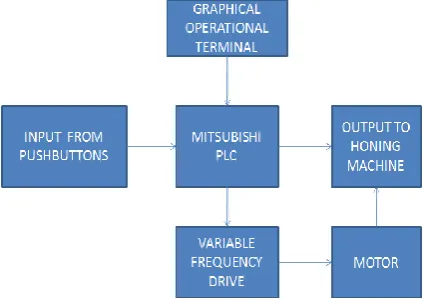
This paper proposes retrofittment of FGM honing maching machine using PLC with an HMI. In this system installation of a new MITSUBISHI PLC is done to ultimately reduce the downtime of FGM machine. Here FGM stands for :
i. F : Honing ii. G : Groove
iii. M : Type of control : PLC
58 Fig 2.1 Functional Block Diagram of the System.
2.2Honing
Honing is the machining process that produces a precision surface on a metal work piece by scrubbing an abrasive stone against it along a specified way. Honing is primarily used to improve the geometric form of a surface, but may also improve the surface texture.
Why Honing Is required?
i. Why Inner track honing is necessary?
To achieve high surface finish on the IR Track surface. ii. Why high surface finish of the IR Track is important?
To have smooth rolling of rollers on the track. iii. Why is the smooth rolling of rollers necessary?
To reduce the bearing noise and increase the bearing life. Main Blocks-
(A)MITSUBISHI Q PLC
MELSEC-Q Series: its powerful presence guides the Q Series to the top, where no PLC has ever been before. With its nano order speed basic commands processes, the next generation MELSEC-Q Series dramatically improves system and machine performance.
As equipment and manufacturing facilities continue to evolve on a daily basis, the series enables high-speed, high-accuracy and large volume data processing and machine control.[3]
(B)HUMAN MACHINE INTERFACE(HMI GOT 1000)
Graphical Operator Terminals (GOTs) can be used in conjunction with Mitsubishi Electric PLCs to both monitor and control entire factories
In addition to touch screen and colour options, Mitsubishi Electric GOTs incorporate many advanced features for easier process control including graphical representation of process information, as well as the ability to easily print directly from the GOT.[6]
(C) DRIVE FOR PLC(FR-E700):
The frequency converter FR-E700, ensures high level of driving performance.
It is the latest generation of Mitsubishi’s Micro Sized Variable Frequency Drives which provides the following features:
i. Top level driving performance in compact body. ii.Overriding operability
iii.Enhanced expandability iv.Ensured maintenance v.Environment friendly
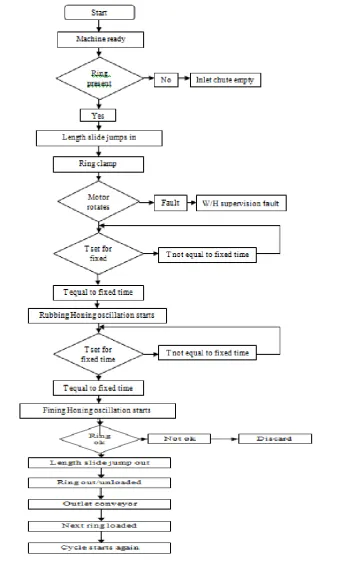
2.2 Working of the system
59 Fig 2.2 : Flowchart of the system
III. HARDWAREIMPLEMENTATION 1.Input Devices –
i. Proximity sensors:
A proximity sensor is a sensor able to detect the presence of nearby objects without any physical contact. A proximity sensor often emits an electromagnetic field or a beam of electromagnetic radiation (infrared, for instance), and looks for changes in the field or return signal
ii. Limit switches :
60 A push-button (also spelled pushbutton) or simply button is a simple switch mechanism for controlling some aspect of a machine or a process.
2. Output Devices – i. Pushers :
Pushers are used to push ring on the conveyor. ii. Length slide:
To hold the ring while honing operation. iii. Extractors :.
Extractors are used to extract the job from the table. iv. Conveyors :
The movement of the job from one part to other.
IV. APPLICATIONSANDFUTURESCOPE
3.1 Applications
The purpose of PLC in this system is to control and implement the Honing on the rings which is further used as part in bearings.
Pairs of tapered roller bearings are used in car and vehicle wheel bearings where they must cope simultaneously with large vertical (radial) and horizontal (axial) forces
3.2 Future scope
This application can be extended for honing of various other types of rings also by changings its honing parameters. We can also is connected or operated through Ethernet.
CONCLUSIONS
The purpose of PLC in this system is to control and implement the Honing on the rings which is further used as part in bearings. Currently the FGM machine is operated on Messung PLC which is very complicated to replace and up-grade. The existing PLC is obsolete .It is no more available in the market.
The MITSUBISHI Q PLC from the leading automation offers high performance, flexibility, and advanced feature. Scanning time and maintenance time will be reduced by replacing messing PLC with MITSUBISHI Q PLC. Thus it will lead to increase in the production rate of bearing. And also there will be reduction in the downtime error.
ACKNOWLEDGMENT
All the accomplishments in the world require the effort of many people and this project is no different. Regardless of the source, we wish to express our gratitude to those who have contributed to the success of this project.We gratefully acknowledge and express heartfelt regards to all the people, who helped us in making the idea of the project, a reality. We express our gratitude towards Mrs.S.K.Gaikwad for their guidance. She showed a lot of interest in our project, as well as suggested solutions on our each problem and always cleared out our confusion.
We have been lucky to have an H.O.D like Dr. N.B Chopade, whose reviews, comments, corrections & suggestions have enormously enriched our project.
We are also grateful to our principal Dr. A.M.Fulambarkar for his constant encouragement and support .We are thankful to SKF INDIA.LTD for sponsoring our project and Mr.Shrikant Nimbalkar our company guide who guided us for this project.
Finally, we express our appreciation & sincere thanks to lab assistance, department of Electronics & Telecommunication, for their constant involvement at every step in the project which has leaded this project to the path of success.
REFERENCES
[1] W. BOLTON, PROGRAMMABLE LOGIC CONTROLLERS,FIFTH EDITION, NEWNES, 2009, CHAPTER 1
[2] M. A. Laughton, D. J. Warne (ed), Electrical Engineer's Reference book, 16th edition, Newnes, 2003 Chapter 16 Programmable Controller
[3] Programmable Logic Control By Huge Jack.Mitsubishi_Q00_Q00UJ_Q01_QJ71 User Manual.
[4] Malfait, A.; Reekman, R.; Belmans, R. (1994). "Audible Noise and Losses in Variable Speed Induction Motor Drives: Influence of the Squirrel Cage Design and the Switching Frequency". 29th Annual Meeting Proceedings of IEEE Industry Applications Society: 693–700.
[5] NEMA Standards Publication (2007). Application Guide for AC Adjustable Speed Drive Systems. Rosslyn, VA USA: National Electrical Manufacturers Association (now The Association of Electrical Equipment and Medical Imaging Manufacturers). p. 4. Retrieved Mar 27, 2008.