ISSN: 2008-6822 (electronic)
http://www.ijnaa.semnan.ac.ir
Classification of EEG-based motor imagery BCI by
using ECOC
Jahangir Mobarezpour, Reza Khosrowabadi, Reza Ghaderi , Keivan Navi
Institute for Cognitive and Brain Science, Shahid Beheshti University GC, Evin Sq, Tehran, Iran
Abstract
Accuracy in identifying the subjects intentions for moving their different limbs from EEG signals is regarded as an important factor in the studies related to BCI. In fact, the complexity of motor-imagination and low amount of signal-to-noise ratio for EEG signal makes this identification as a difficult task. In order to overcome these complexities, many techniques such as various feature extraction methods, learning algorithms, and classifier schemes have been developed in this regard. However, conducting more research is necessary for improvement. The present study aimed to use an ensemble learning approach to improve the performance of MI-BCI systems. Therefore, filter bank common spatial pattern (FBCSP), as a well-known feature extraction method, was used to produce separable features from EEG signals. Accordingly, error correcting output codes (ECOC) was applied on several learning algorithms to classify four classes of motor imagery tasks. The proposed ECOC ensemble technique was tested on the data set 2a from BCI competition IV. Based on the results, the ECOC can lead to an improvement by using the naive Bayesian parzen window algorithm, compared to the winner algorithm of BCI competition IV, which is superior to other selected state of the art algorithms.
Keywords: Brain computer interface (BCI); Error Correcting Output Codes (ECOC);
Electroencephalography (EEG); Motor imagery; Filter bank common spatial pattern (FBCSP)
2010 MSC: 26D15, 26D10.
1. Introduction
The present study aimed to focus on the classification algorithm used in brain computer interface (BCI) systems. First, BCI systems were created for disabled people to provide a non-muscular channel for controlling external devices with the brain electrical activities. For instance, it was used to control wheelchairs [1] or in neural prosthetics [2]. However, its applications in navigation for
∗Corresponding author
virtual environment [3, 4] or assisting in performing highly-demanding mental tasks [5, 6, 7, 8, 9] have been extended to healthy individuals during recent years.
In general, the brain activities could either be directly recorded from neural electrical activi-ties by using electro-corticography (ECOG), magneto-encephalography (MEG), EEG or from blood de/oxygenetion changes indirectly by using functional near infrared spectroscopy (fNIRS), and func-tional magnetic resonance imaging (fMRI). The ECOG is partially invasive while MEG, EEG, fNIRS, and fMRI are non-invasive methods and more safe in terms of surgery and infection. The EEG-based BCI is preferred to other existing methods since most of BCI applications require a noninvasive and portable system. Further, the EEG has been implemented in many other applications such as clini-cal diagnostics for epilepsy [10, 11, 12] , dementia [13, 14] , dyslexia [15], autism spectrum disorder [16, 17], biometric systems such as fraud detection [18, 19, 20, 21, 22], which can highlight its potential for the BCI studies.
The EEG signals are produced by the synchronous activity of clusters in neurons with similar spatial orientation, which could be recorded on the scalp. Typically, EEG is mixed with other non-cortical activities such as ECG, EMG, EOG, electrical power-line noises [23]. Thus, separating only the brain activities seems difficult. The EEG-based BCI systems either use evoked potentials or the spontaneous activities. In addition, the evoked potentials are generated in response to a standard sensory stimulation such as steady state visually evoked potentials (SSVEP) [24, 25] by which brain can generate electrical activity at the same (or multiples of) frequency of the visual stimulation. This approach is regarded as accurate but requires external stimulation and long training time although it is not appropriate for a long-term use. However, spontaneous BCI systems are based on mental imaginations, without any training or external stimulation. Further, the imagination of different limb movement can activate very close areas in the brain, leading to the difficulty of the separation task. In order to overcome this problem, a large number of techniques were developed to extract separable features from EEG signals [26, 27, 28]. Further, many learning algorithms with different schemas [29, 30, 31, 32] have been used to identify various mental tasks. By considering all the aforementioned issues, the present study aimed to use an ensemble learning approach to improve the performance of motor imagery (MI) BCI systems. Thus, filter bank common spatial pattern (FBCSP) was used to produce separable features from EEG signals. Accordingly, error correcting output codes (ECOC) was implemented with several learning algorithms to classify four classes of motor imagery tasks. Then, the proposed ECOC ensemble technique was tested on data set 2a from BCI competition IV (http://www.bbci.de/competition/iv). The data including four motor-imaginary class signals were recorded from nine subjects in two sessions during different days.
The concept of ECOC comes from information theory for the communication systems for the purpose of correcting noisy signals. Then, it was used in machine learning for an improvement in classification accuracy, face verification [33, 34, 35], text classification [36, 37], handwritten recog-nition [38], and object recogrecog-nition [35]. Regarding the results of previous studies, the ECOC can reduce bias and variance of classification [39, 40, 41]. Therefore, it is hypothesized that the proposed ECOC technique may help us improve the best results achieved in BCI competition IV.
2. Materials and Method
In the present study, dataset 2a of the BCI competition IV was recruited. The dataset included EEG data recorded from nine subjects. A cue-based paradigm was applied for recording EEG data during four different motor imagery tasks including left hand (class 1), right hand (class 2), both feet (class 3), and the tongue (class 4) movement imagination. Data recording for each subject was performed in two sessions on different days. Each session included six runs separated by short breaks and each run contained 48 trials (12 for each of the four classes). Finally, 288 trials were yielded per each session.
The subjects were sitting in a comfortable armchair in front of a computer screen. In the beginning of each session, approximately 5-min EEG was recorded to estimate electrooculogram (EOG) artefact. The 5-min recording consisted of three blocks including (1) two minutes for eyes-open resting state by looking at a fixation cross on the screen, (2) one minute for eyes-closed resting state, and (3) one minute for eye movements. In the next procedure, motor imagery tasks were performed. At the beginning of each trial (t = 0s), a fixation cross appeared on the black screen. In addition, a short acoustic warning tone was presented. After two seconds (t = 2s), a cue in the form of an arrow pointing either to the left, right, down or up (corresponding to one of the four classes left hand, right hand, foot, and tongue) appeared and remained on the screen for 1.25 seconds. The cue prompted the subjects to perform the desired motor imagery task without providing any feedback. In the next procedure, the subjects were asked to conduct the motor imagery task until disappearing the fixation cross from the screen at t = 6s. Finally, each trial was followed by a short break, where the screen was black again. Fig. 1 illustrates the experimental paradigm.
Figure 1: Experimental paradigm used for data collection in the BCI completion IV, dataset 2a [42]
2.1. Data recording
purpose. Finally, a visual inspection was conducted on all data by an expert and accordingly the trials involving artifacts were remarked [27, 44] .
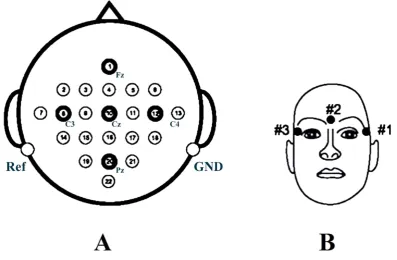
Figure 2: Montage of electrodes used for data collection in the BCI completion IV, dataset 2a. (A) Placement of EEG electrodes according to the international 10-20 system, (B) Placement of EOG electrode
2.2. Feature extraction by filter bank common spatial pattern (FBCSP)
The EEG signal is usually contaminated with artifacts, which are either easily removed by an appropriate filtering (e.g., notch filtering at 50/60 Hz for the powerline noise) or suppressed by using source decomposition techniques such as independent component analysis (ICA) [45, 46]. However, some artifacts could not be removed by the above-mentioned methods such as the effect of volume conduction and skull tissue. The skull tissue acts as a low-pass filter [47], which causes localized cortical sources, which are originated by a cognitive/motor task, and dominated by widely spread sources. In addition to the low-pass filtering effect of the skull, the conductive surface area of each electrode acts as low pass spatial filter, which can eliminate the signal components with wavelengths shorter than the electrode diameter. The combined effect of the skull tissue and the conductive surface of electrodes enable us to sample the EEG signal spatially without aliasing. In order to avoid spatial aliasing completely, the electrode diameter should be selected either equal to the edge-to-edge distance between the electrode conductors or spread of gel layer. In addition, the approach of estimating local sources could be performed by common spatial patterns (CSP). The CSP method was first applied in BCI studies for binary classification purpose (left- and right-hand movements) (48-50). This algorithm applies spatial filters on a set of training data in order to maximize inter-class variance while minimizing intra-class variances [48, 50].
CSP (FBCSP), as a well-known feature extraction algorithm in BCI research,, was implemented in the present study [54].
In the next procedure, the EEG signals were filtered to 9 bands of 4 Hz, from 4 to 40 Hz without overlap, and accordingly CSP method was separately used for each band. Finally, two features for each band and totally 18 features from all bands were calculated.
2.3. Classification
Now, the extracted features should be classified by using a learning algorithm. In this study, the Naive Bayesian Parzen Window (NBPW) method was selected as the main learning algorithm. The NBPW is a stable and non-iterative classifier, which is appropriate for combining with ECOC technique [55]. In addition, a good performance with FBCSP features was observed in the field of BCI [54]. Further, the results were compared with other well-known classifiers such as support vector machines (SVM) [31], linear discriminant analysis (LDA) [31], and K-nearest neighbour (KNN) [31]. The NBPW approach can use any feature vector f, which classify the classes by equation (2.1),
b
C = arg max Ci
P(Ci|f) (2.1)
whereCi denotes the class labels andP(Ci|f) presents the probabilityf related to the classCi. The
P(Ci|f) is determined by using the Bayes rule as described in the following equation.
P(Ci|f) =
P(f|Ci)P(Ci)
P(f) =
P(f|Ci)P(Ci) ∑
iP(f|Ci)P(Ci)
(2.2)
The NBPW method assumes that the elements of the feature vectorsf = [f1, . . . , fE] are independent. Thus,P(f|Ci) can be calculated as follows;
P(f|Ci) = E ∏
f=1
P(ff|Ci) (2.3)
where P(ff|Ci) is estimated by using Parzen windowing method [56] presented in the following equation.
P(ff,i|Cb) = 1
nCb
∑
k∈TCb
ϕ(ff,i−fi,k, w)
where nc denotes the number of data samples in class C, Tb Cb represents a part of the training data related to classCb , fk is considered as the feature value of the kth trial ofTCb fromfi, andϕ indicates the smoothing kernel function with smoothing parameter of w. The univariate Gaussian kernel was utilized according to the equation (2.4) as the kernel function.
ϕ(f, w) = √1 2πe
− (
f2
2w2
)
(2.4)
2.4. Error correcting output codes (ECOC)
As it was already mentioned, the ECOC ensemble learning approach is applied to improve the classification accuracy of the MI-BCI system. The ECOC consists of encoding and decoding. Dif-ferent designs have been used for encoding and decoding [57]. In the encoding phase, an M ×N
dimensional matrix called “matrix code” is formed, where M denotes the number of classes and N
represents the binary classifiers. Each row of matrix code is a code word for a class. The unlabelled data are classified after training binary classifiers with the assigned labels in the decoding phase. Typically, a class label is assigned to the data by calculating its closeness to the code-word defined in matrix code. The closest code word is defined as the target class.
The ECOC in classification requires both rows and columns of the matrix code in order to be separated well like when it is computed by the hamming distance [58]. The row separation helps the classes to be maximally far apart from each other while the column separation ensures that the learned bits are uncorrelated so that the errors in each bit can be independent from others. Therefore, an error may not proceed to other bits if an error occurs in a bit. In this regard, different types of coding have been introduced so far [39, 40] and the results of some studies indicated that BoseChaudhuriHocquenghem (BCH) codes could produce a better performance [40]. In the present study, the BCH-ECOC method was implemented using a software package introduced by Escalera et al [57].
A BCH code word has the length of (2n−2) for multiclass classification problem, where n presents the number of classes. The second half of the BCH code word is considered as complementary for the first half, which is used in unstable binary classifiers to reduce the variation of the results. However, the NBPW used in this study was considered as a stable classifier algorithm. Therefore, a reduction of (2n−1−1) occurs in the length of BCH code word. Thus,, the code word length should be 7 by
considering four classes of motor imagination. As shown in Table 1, the coding is independent from the classes and the distances between the classes are equal. In addition, Hamming method, defined
Table 1: BCH-ECOC matrix code for 4 classes of motor imaginations
code words binary classifiers
Class 1 1 1 1 0 0 1 0
Class 2 1 1 0 0 1 0 1
Class 3 0 0 1 0 1 1 1
Class 4 0 1 1 1 0 0 1
in equation (2.5) was used for the decoding purpose.
HD(x, yj) = n ∑
j=1
1−sign(xj ·yj i)
2 (2.5)
where x denotes the output code word of the test data, and yi presents the code word from matrix code corresponding to class Ci. The minimum Hamming distance determines the target class.
3. Results
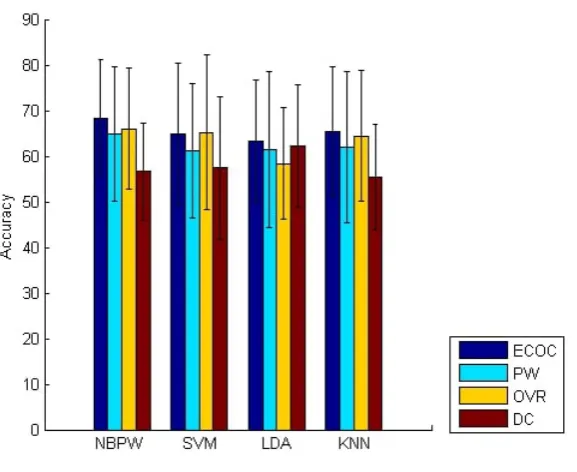
Several classification schemas by using different learning algorithms such as ECOC, DC, PW and OVR were implemented in the present study. Then, inter-subject classification accuracy of the proposed EEG-based MI-BCI system was compared for discriminating four classes of motor imaginations (left hand, right hand, both feet, and tongue). As shown in Table 2and Fig. 3, the ECOC method had better performance, compared to other methods. In addition, the ECOC method demonstrated higher classification accuracy, compared to other methods by using NBPW, LDA, KNN classifiers. Further, the MI-BCI system by using NBPW learning algorithm with ECOC technique could outperform other methods.
Table 2: Inter-subjects classification accuracy of the EEG-based MI-BCI system for discrimination of 4 classes of motor imaginations (mean±std)
Feature
Classifier
Classifier scheme NBPW SVM LDA KNN
FBCSP with 22 channels
ECOC 68.36±13.47 64.93±16.46 63.31±14.35 65.35±14.28 PW 64.93±14.76 57.37±15.65 61.42±17.07 61.88±16.56 OVR 66.05±13.23 65.24±16.87 58.33±12.24 64.47±14.32 DC 56.83±10.67 57.37±15.65 62.35±13.41 55.40±11.51
Abbreviations: NBPW Naive Bayesian parsons window, SVM Support vector machine, LDA Linear discriminant analysis, KNN K-nearest neighbors, ECOC Error correcting output code, PW Pair-wise, OVR One versus rest, DC Divide and concur, FBCSP Filter bank common spatial pattern, MI-BCI Motor imagery brain computer interface.
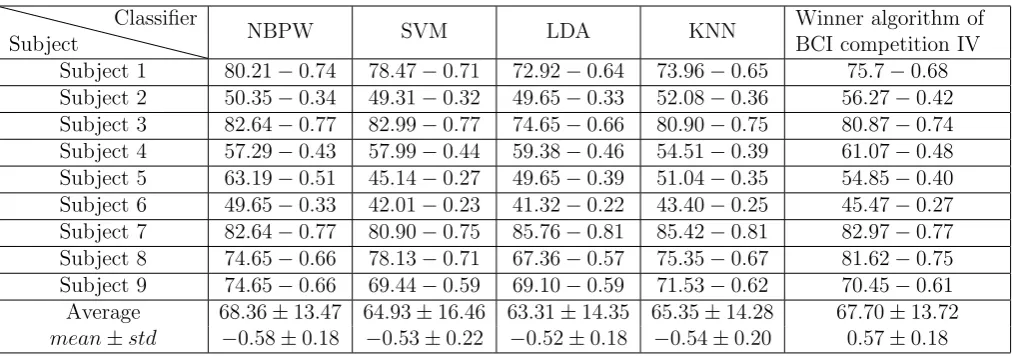
Furthermore, the ECOC results indicated a slight improvement, compared to the winner algorithm of the BCI Competition IV (http://bbci.de/competition/iv/results) (Table 3).
Table 3: Intra-subject classification accuracy and kappa factor of the EEG-based MI-BCI system for discrimination of 4 classes of motor imaginations using ECOC technique
Subject
Classifier
NBPW SVM LDA KNN Winner algorithm of
BCI competition IV Subject 1 80.21−0.74 78.47−0.71 72.92−0.64 73.96−0.65 75.7−0.68 Subject 2 50.35−0.34 49.31−0.32 49.65−0.33 52.08−0.36 56.27−0.42 Subject 3 82.64−0.77 82.99−0.77 74.65−0.66 80.90−0.75 80.87−0.74 Subject 4 57.29−0.43 57.99−0.44 59.38−0.46 54.51−0.39 61.07−0.48 Subject 5 63.19−0.51 45.14−0.27 49.65−0.39 51.04−0.35 54.85−0.40 Subject 6 49.65−0.33 42.01−0.23 41.32−0.22 43.40−0.25 45.47−0.27 Subject 7 82.64−0.77 80.90−0.75 85.76−0.81 85.42−0.81 82.97−0.77 Subject 8 74.65−0.66 78.13−0.71 67.36−0.57 75.35−0.67 81.62−0.75 Subject 9 74.65−0.66 69.44−0.59 69.10−0.59 71.53−0.62 70.45−0.61 Average 68.36±13.47 64.93±16.46 63.31±14.35 65.35±14.28 67.70±13.72 mean±std −0.58±0.18 −0.53±0.22 −0.52±0.18 −0.54±0.20 0.57±0.18
Kappa factor=(Obtained classification accuracy Chance classification)/(1- Chance classification )
As this table shows, the average of intra-subject classification accuracy by using the NBPW classifier with ECOC method is 68.36±13.47 (kappa factor: 0.58±0.18), which is slightly higher than the result of competition winner as 67.70±13.72 (kappa factor: 0.57±0.18).
4. Conclusion
Extracting useful information from EEG signals, along with their assignment to a unique mental task is considered as the objective of BCI research, which is not an easy task. The task is more difficult while working on the identification of motor imaginations. The motor imagery tasks acti-vate small part of cortex called primary motor region. Therefore, the information related to motor imaginations of various limbs is highly overlapped, which is regarded as a big challenge for their identification. Therefore, extracting separable features and improving learning algorithms can help us to overcome this challenge since the ECOC technique has a potential to reduce bias and variance of classification [38, 40, 41]. In the present study, we hypothesized that using an ensemble learning algorithm called ECOC can improve the performance of the MI-BCI systems. Based on the results, a slight improvement occurred, compared to the results of the best algorithm used in BCI completion IV, which could confirm the hypothesis. It is hoped that the findings could be regarded as an asset for further improvement of the BCI systems.
Conflicts of interest:
Authors do not claim any conflict of interest.
References
[2] Muller-Putz GR, Scherer R, Pfurtscheller G, Rupp R. EEG-based neuroprosthesis control: a step towards clinical practice. Neurosci Lett. 2005;382(1-2):169-74.
[3] Pfurtscheller G, Leeb R, Keinrath C, Friedman D, Neuper C, Guger C, et al. Walking from thought. Brain Res. 2006;1071(1):145-52.
[4] Zhao Q. ZL, Cichocki A. . EEG-based asynchronous BCI control of a car in 3D virtual reality environments. Chinese Science Bulletin. 2009;54(1):78-87.
[5] Gerson AD, Parra LC, Sajda P. Cortically coupled computer vision for rapid image search. IEEE Trans Neural Syst Rehabil Eng. 2006;14(2):174-9.
[6] Khosrowabadi Reza QC, Ang Kai Keng ,Tung Sau Wai , Heijnen Michel editor A Brain-Computer Interface for classifying EEG correlates of chronic mental stress. Proceedings of International Joint Conference on Neural Networks; 2011; San Jose, California, USA.
[7] Parra L. C. CC, Gerson A. D. , Dyrholm M. , Luo A. , Wagner M. , Philiastides M. G. , Sajda P. . Spatiotemporal linear decoding of brain state. Signal Process Mag. 2008:107-15.
[8] Parra LC, Spence CD, Gerson AD, Sajda P. Response error correction–a demonstration of improved human-machine performance using real-time EEG monitoring. IEEE Trans Neural Syst Rehabil Eng. 2003;11(2):173-7. [9] Wang J. PE, Hanna B. , Jiang Y. , Sajda P. , Chang S. . Brain state decoding for rapid image retrieval. Int Conf
on Multimedia; Beijing, China2009. p. 945-54.
[10] Gotman J. Automatic recognition of epileptic seizures in the EEG. Electroencephalogr Clin Neurophysiol. 1982;54(5):530-40.
[11] H. O. Optimal classification of epileptic seizures in EEG using wavelet analysis and genetic algorithm. Signal Processing. 882008. p. 1858-67.
[12] Le Van Quyen M, Martinerie J, Navarro V, Boon P, D’Have M, Adam C, et al. Anticipation of epileptic seizures from standard EEG recordings. Lancet. 2001;357(9251):183-8.
[13] Bonanni L, Thomas A, Tiraboschi P, Perfetti B, Varanese S, Onofrj M. EEG comparisons in early Alzheimer’s disease, dementia with Lewy bodies and Parkinson’s disease with dementia patients with a 2-year follow-up. Brain. 2008;131(Pt 3):690-705.
[14] Stam CJ, Jelles B, Achtereekte HA, Rombouts SA, Slaets JP, Keunen RW. Investigation of EEG non-linearity in dementia and Parkinson’s disease. Electroencephalogr Clin Neurophysiol. 1995;95(5):309-17.
[15] Dornhege M, Hinterberger, McFarland, Muller. Toward Brain-Computer Interfacing: The MIT Press; 2007. [16] Khosrowabadi Reza QC, Keng Angc Kai , Wahabd Abdul , Chen Shen-Hsing Annabel Dynamic screening of
autis-tic children in various mental states using pattern of connectivity between brain regions. Applied Soft Computing 2015;32:33546.
[17] Oberman LM, Hubbard EM, McCleery JP, Altschuler EL, Ramachandran VS, Pineda JA. EEG evidence for mirror neuron dysfunction in autism spectrum disorders. Brain Res Cogn Brain Res. 2005;24(2):190-8.
[18] Marcel S, Millan Jdel R. Person authentication using brainwaves (EEG) and maximum a posteriori model adap-tation. IEEE Trans Pattern Anal Mach Intell. 2007;29(4):743-52.
[19] Palaniappan R, Mandic DP. Biometrics from brain electrical activity: a machine learning approach. IEEE Trans Pattern Anal Mach Intell. 2007;29(4):738-42.
[20] Paranjape R. B. MJ, Benedicenti L. , Koles Z. . The electroencephalogram as a biometric Conference on Electrical and Computer Engineering; Canadian: IEEE; 2001. p. 1363-6.
[21] R. P. Electroencephalogram signals from imagined activities: A novel biometric identifier for a small population. Lecture Notes in Computer Science; 2006.
[22] Yeom S.-K. SH-I, Lee S.-W. . Person authentication from neural activity of face-specific visual self-representation, Pattern Recognition2013.
[23] Delorme Arnaud FT, Serby Hilit , Makeig Scott EEGLAB Tutorial 2006.
[24] Allison BZ MD, Wolpaw JR, Vaughan TM, Schalk G, Zheng SD, Moore MM An independent SSVEP BCI, Society of Neuroscience. Society of Neuroscience, 35th annual meeting; WASHINGTON, DC.2005.
[25] Muller-Putz GR, Pfurtscheller G. Control of an electrical prosthesis with an SSVEP-based BCI. IEEE Trans Biomed Eng. 2008;55(1):361-4.
[26] Brodu N, Lotte, F., and Lecuyer. Comparative Study of Band-Power Extraction Techniques for Motor Imagery Classification. Computational Intelligence, Cognitive Algorithms, Mind, and Brain IEEE; 2011. p. 1-6.
[27] Brunner C. NM, Leeb R. , Graimann B. , Pfurtscheller G. . Spatial filtering and selection of optimized components in four class motor imagery EEG data using independent components analysis Pattern Recognition Letters. 2007;28(8):957-64.
[29] Cano-Izquierdo JM, Ibarrola J, Almonacid M. Improving motor imagery classification with a new BCI design using neuro-fuzzy S-dFasArt. IEEE Trans Neural Syst Rehabil Eng. 2012;20(1):2-7.
[30] Hu S. TQ, Cao Y. , Zhang J. , Kong W. Motor imagery classification based on joint regression model and spectral power. Neural Computing and Applications. 2012:1-6.
[31] Lotte F, Congedo M, Lecuyer A, Lamarche F, Arnaldi B. A review of classification algorithms for EEG-based brain-computer interfaces. J Neural Eng. 2007;4(2):R1-R13.
[32] Pfurtscheller G, Brunner C, Schlogl A, Lopes da Silva FH. Mu rhythm (de)synchronization and EEG single-trial classification of different motor imagery tasks. Neuroimage. 2006;31(1):153-9.
[33] Hatami Nima ER, Ghaderi Reza ECOC-based training of neural networks for face recognition. IEEE Conference on Cybernetics and Intelligent Systems: IEEE; Ghaderi.
[34] Kittler J. GR, Windeatt T. , Matas J. Face Verification Using Error Correcting Output Codes. Image and Vision Computing. 2003;21:1163-9.
[35] Zhang Xiao LL, Shum Heung-Yeung Spectral Error Correcting Output Codes for Efficient Multiclass Recognition. IEEE 12th International Conference on Computer Vision: IEEE; 2009.
[36] Adeva Juan Jose Garcia BUC, Calvo Rafael Alejandro. Accuracy and Diversity in Ensembles of Text Categorisers. CLEI Electronic Journal. 2005;8(2).
[37] Rayid G. Using Error-Correcting Codes for Efficient Text Classification. 17th International Conference on Machine Learning2000. p. 303-10.
[38] Zhoua Jie PH, Suenc Ching Y. . Data-driven decomposition for multi-class classification. Pattern Recognition Letters. 2008;41.
[39] Amornsamankul Somkid PJ, Kraipeerapun Pawalai Solving Multiclass Classification Problems using Combining Complementary Neural Networks and Error Correcting Output Codes. Mathematics and Computers in Simula-tion. 2011;5(3).
[40] Reza G. Arranging simple neural networks to solve complex classification problems: Surrey; 2000.
[41] T. Windeatt RG. Coding and decoding strategies for multi-class learning problems. Information Fusion. 2003;4(1):11-21.
[42] Tangermann M, Muller KR, Aertsen A, Birbaumer N, Braun C, Brunner C, et al. Review of the BCI Competition IV. Front Neurosci. 2012;6:55.
[43] Fatourechi M, Bashashati A, Ward RK, Birch GE. EMG and EOG artifacts in brain computer interface systems: A survey. Clin Neurophysiol. 2007;118(3):480-94.
[44] Naeem M, Brunner C, Leeb R, Graimann B, Pfurtscheller G. Seperability of four-class motor imagery data using independent components analysis. J Neural Eng. 2006;3(3):208-16.
[45] Jung TP, Makeig S, Westerfield M, Townsend J, Courchesne E, Sejnowski TJ. Removal of eye activity artifacts from visual event-related potentials in normal and clinical subjects. Clin Neurophysiol. 2000;111(10):1745-58. [46] Vigario R, Sarela J, Jousmaki V, Hamalainen M, Oja E. Independent component approach to the analysis of
EEG and MEG recordings. IEEE Trans Biomed Eng. 2000;47(5):589-93.
[47] Nunez P. L. SR. Electric fields of the brain: the neurophysics of EEG. 2 ed: Oxford University Press; 2006. [48] Blankertz B. TR, Lemm S. , Kawanabe M. , Muller K. R. . Optimizing spatial filters for robust EEG single-trial
analysis. Signal Process. 2008:41-56.
[49] Fukunaga K. Introduction to statistical pattern recognition. 2nd ed. Boston: Academic Press; 1990. xiii, 591 p. p.
[50] Ramoser H, Muller-Gerking J, Pfurtscheller G. Optimal spatial filtering of single trial EEG during imagined hand movement. IEEE Trans Rehabil Eng. 2000;8(4):441-6.
[51] Gurkok H. NA. Brain-computer interfaces for multimodal interaction: A survey and principles. Human - Computer Interaction. 2012;28(5):292-307.
[52] Nicolas-Alonso LF, Gomez-Gil J. Brain computer interfaces, a review. Sensors (Basel). 2012;12(2):1211-79. [53] Sanei S. CJA. EEG Signal Processing: Wiley; 2007.
[54] Ang KK, Chin ZY, Wang C, Guan C, Zhang H. Filter Bank Common Spatial Pattern Algorithm on BCI Com-petition IV Datasets 2a and 2b. Front Neurosci. 2012;6:39.
[55] Park Sang-Hyeun FJ. Efficient implementation of class-based decomposition schemes for Nave Bayes. Machine Learning. 2014;96(3):295-309.
[56] E. P. On estimation of a probability density function and mode. The annals of mathematical statistics. 1962;33(3):1065-76.
[57] Escalera Sergio PO, Radeva Petia Error-Correcting Ouput Codes Library. Journal of Machine Learning Research 2010;11:661-4.
Intelligence Research. 1995;2:263-82.
[59] Dornhege G, Blankertz B, Curio G, Muller KR. Boosting bit rates in noninvasive EEG single-trial classifications by feature combination and multiclass paradigms. IEEE Trans Biomed Eng. 2004;51(6):993-1002.
[60] Dornhege G, Blankertz B, Krauledat M, Losch F, Curio G, Muller KR. Combined optimization of spatial and temporal filters for improving brain-computer interfacing. IEEE Trans Biomed Eng. 2006;53(11):2274-81. [61] Dornhege G. BB, Curio G. , Mller K.-R. Increase Information Transfer Rates in BCI by CSP Extension to
![Figure 1: Experimental paradigm used for data collection in the BCI completion IV, dataset 2a [42]](https://thumb-us.123doks.com/thumbv2/123dok_us/8897417.1828721/3.595.99.385.448.570/figure-experimental-paradigm-used-data-collection-completion-dataset.webp)