Iranian Rehabilitation Journal, Vol. 12, No. 20, June 2014
Original Article
The effects of Consecutive Supervised Functional Lumbar Stabilizing
exercises on the Postural Balance and Functional Disability in low
back pain
Noureddin Karimi, PhD.; Ailin Talimkhani
*; Zahra Mosallanezhad, PhD.
Amir Massoud Arab, PhD.; Roshanak Keshavarz
University of Social Welfare and Rehabilitation Sciences, Tehran, Iran
Objectives: The aim of this study was to examine the effects of consecutively supervised core stability training on postural control and functional disability in female patients with non-specific chronic low back pain.
Methods: Twenty nine female participants with non-specific chronic low back pain participated in the study. They were randomly divided into two groups: experimental group (10 days consecutively core stability exercises under physical therapist‘s supervision) and control group (without intervention). Before and after the intervention, stability situations, pain intensity and functional disability were assessed with Biodex, visual Analogue Scale, Oswestry and Quebec questionnaire scales respectively. Data were analyzed by using statistical methods, independent T test and ANCOVA.
Results: The study results indicated no statistically significant differences in all variables except age between two groups before intervention. Analysis by ANCOVA showed a significant difference in disability, pain intensity, Overall Stability Index with Double Leg Eyes Closed, Anterior-Posterior Stability Index with Double Leg Eyes Closed and Medio-Lateral Stability Index with Double Leg Eyes Closed scores between two groups after intervention. However, other variable differences were not significant while these changes were greater in the intervention group.
Discussion: The present study indicates that consecutively supervised core stability training is an effective approach in pain relief and improving postural control in female patients with non-specific chronic low back pain.
Keywords: low back pain, stability training, postural balance, functional disability, Pain
Submitted: 12 December 2013 Accepted: 17 March 2014
Introduction
Low Back Pain (LBP) is one of the most common musculoskeletal disorders and one of the most common causes of absenteeism from work in today's societies (1). Overall, about one out of two person‘s reports experiencing back pain at least once a year. It is the fifth common cause of patients visiting physicians in the United States (2). In the developed countries, it is the most important concern because of the costly treatment, long-term off-work for employees and even pre mature retirement (2). There is also evidence that LBP is more frequently observed in young adult women (3). In spite of the widespread studies to diagnose LBP, its main cause is not known. Over the past decade, researchers have identified associations between neuro musculoskeletal disorders such as LBP and underlying neuromuscular
repetitions, severity and type of exercise. There is controversy on the greater efficacy of exercise among researchers (8). Nowadays, short- and long-term consequences designate that precise lumbar stabilizing therapy may reduce recurrent pain episodes (9). Specific lumbar-stabilizing therapy includes changing muscle recruitment patterns (10, 11). Several authors have argued that feed forward postural adjustments can be trained. Tsao and Hodges (11) demonstrated that persistent improvements in feed forward activation can be achieved with the training of isolated voluntary contractions. The results of their study show persistence of motor control changes following training and demonstrate that this training approach leads to motor learning of automatic postural control strategies (11). Because of the economic problems, many patients tend to go back to normal life activities, as soon as possible. So, short- term stabilizing controlled spinal trainings appear to be important in patients with LBP
.
However, the particular effectiveness of short- term versus long- term programs is not clear (12). Since few studies have investigated the effects of consecutively supervised core stability training in order to improve the performance of postural control and increasing functional disability, the aim of this research was to achieve the effects of consecutively supervised core stability training on postural control and functional disability in female patients with non-specific chronic low back pain.Methods
In a clinical trial study, individuals with non-specific chronic LBP were randomly selected in two groups of women: interventional group (N=15, average age: 21.13 (SD = 1.88) years old, average height: 159.2 (SD = 5.18) cm, average weight: 54.6 (SD = 8.7) kg) and control group (N=14, average age: 25.92 (SD= 5.58) years old, average height: 160.71 (SD = 6.95 ) cm, average weight: 57.78 (SD = 9.45) kg). All participants were randomly selected from a sample of all young women referring to the physiotherapy clinics.
Criterion for selection was that patients with non- specific chronic LBP should have a history of persistent LBP for more than eight weeks or during the last year they had experienced LBP at least three times, alternately, while each time lasted more than a week. During consecutive training for 10 days, if the pain was too much or the patient's problem was serious, she would be removed from investigation. Excluding criteria of participation in this study were: History of fractures or dislocations in the spine and
extremities, damage to intervertebral disc, dysfunction of hip joints, history of anterior knee pain, recent episodes of ankle sprain, surgery, tumors, infections, radiculopathy, rheumatoid arthritis, anatomical abnormalities, dizziness, impaired vision, uncontrolled metabolic disorders, neurological conditions and taking medication one week prior to testing session. Patients were selected based on entry criteria and interventional group carried out stabilizing trainings under supervision of the therapist for 10 consecutive days. Control group in this period were not under any treatment. Before and after the intervention, balance level, functional disability and pain intensity were measured in both groups in order to see the effects of consecutively supervised core stability trainings on the mentioned parameters.
Ethical considerations have been respected and the voluntary consent was obtained from participants. This study was approved by the human subjects committee at the University of Social Welfare and Rehabilitation Sciences.
Instrumentation: To evaluate the postural control system, BBS (Biodex Balance System, NY, USA) was used. The subject stood on a platform of BBS in the upright position and the test option was chosen from monitor screen after the apparatus was turned on. The individual features including height, weight, dominant leg and test features including test time, vision situation and instability level of movable platform were recorded in the two-leg position and one-leg position of standing while the instability level varied from 3 to 6 and 4 to 8, respectively. Then, the subject was asked to try to keep the pointer in the monitor screen in the center of the circle for some seconds. The subject was allowed to change the location of her leg and chose the best position in which she can do the procedure best. Then the movable platform was released and the person was asked to keep her balance for 15 seconds in different situations of Double Leg Eyes Open (DLEO), Double Leg Eyes Closed (DLEC), and Single Leg Eyes Open (SLEO).
Therapeutic interventions: One of the main strategies of this study is to introduce a rapid therapeutic method. Stages and types of trainings performed were from simple to complex and from stereotyped to the functional patterns, respectively. In this investigation, only short term effects of exercises were considered and their long-term effects have not been addressed. In stability training group, women with chronic non-specific LBP, performed the treatment program during 10 days consecutively under physical therapist supervision. Training procedure is as follows (16):
1- Description of the importance of training and how to stabilize the spine with muscle activation mechanisms.
2- patient learns how to act deep stabilizing muscles of the trunk and spine (e.g. Tr.A, Multifidus), independently from the superficial muscles using palpation and pressure biofeedback
3- this stage of training includes teaching and practicing tonic cocontractions of the Tr.A and multifidus muscles during single limb movements and then cross limb movements in different positions
4- In the next stage, the subject performs the tonic contractions of the Tr.A and multifidus muscles in equilibrium activities (like standing on a balance board and using Swiss Ball).
5- The final stage of exercise is tonic contractions of the Tr.A and multifidus muscles in functional activities, such as walking on treadmill with adjustable velocity in terms of person‘s ability. Data Analysis:To analyze data statistically, we used SPSS version 16. Kolmogrove- Smirnove test showed that variables have normal distribution. Analysis of Covariance (ANCOVA) test was used to analyze the variables. Statistical significant was attributed to P value less than 0.05.
Results
Indices related to mean and standard deviation of age, height, weight and body mass index variables are shown in table (1) T-test results show that the variable of age is significant between the intervention and control groups. This means that the variable of age as confounder was.
Table 1 . Mean and standard deviation of age, height, weight and body mass index in the intervention and control groups
Variables The mean and standard deviation Average difference test results
The control group training group
Age 25.92± 5.85 1. 88±21.13 4.79 significant P = 0.01
Height 160.71± 6.95 5.18 ± 159.20 1.51 Non-significant P=0.510
Weight 57.75±9.45 54.60 ± 8.70 3.18 Non-significant P=0.353
BMI 22.34±3.22 21.6 ± 3.80 0.73 Non-significant P=0.578
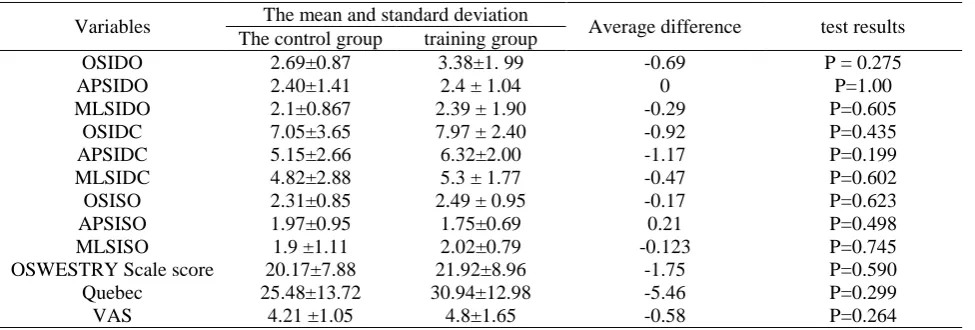
Indicators of mean and standard deviation of Biodex balance indicator variables, questionnaire and pain score in both groups are shown in table (2) Independent T-test results show that there is no
significant difference in quantitative variables between two mentioned groups, before the therapeutic procedure.
Table 2 . Mean and standard deviation of Biodex related to stability indicators, the questionnaire scores and pain intensity in interventional and control groups before the therapeutic procedure
Variables The mean and standard deviation Average difference test results
The control group training group
OSIDO 2.69±0.87 3.38±1. 99 -0.69 P = 0.275
APSIDO 2.40±1.41 2.4 ± 1.04 0 P=1.00
MLSIDO 2.1±0.867 2.39 ± 1.90 -0.29 P=0.605
OSIDC 7.05±3.65 7.97 ± 2.40 -0.92 P=0.435
APSIDC 5.15±2.66 6.32±2.00 -1.17 P=0.199
MLSIDC 4.82±2.88 5.3 ± 1.77 -0.47 P=0.602
OSISO 2.31±0.85 2.49 ± 0.95 -0.17 P=0.623
APSISO 1.97±0.95 1.75±0.69 0.21 P=0.498
MLSISO 1.9 ±1.11 2.02±0.79 -0.123 P=0.745
OSWESTRY Scale score 20.17±7.88 21.92±8.96 -1.75 P=0.590
Quebec 25.48±13.72 30.94±12.98 -5.46 P=0.299
Frequency and relative frequency of qualitative variables such as marital status, dominant leg balance test, the location and extent of pain in two groups are shown in table (3) Chi-square test results
indicate that both intervention and control groups in the qualitative features are similar and there is no significant difference between the two groups.
Table 3 . Comparison of two groups at baseline with regard to qualitative variables
Variables Situations Frequency Relative frequency
test results
control group training group control group training group
Marital Status Single 10 14 71.4 93.3 P = 0.119
Married 4 1 28.6 6.7
Dominant leg Right 12 14 85.7 92.9 P=0.541
Left 2 1 14.3 7.1
Location of pain Lumbar 10 13 71.4 86.7 P=0.311
Lumbar.pelvic 4 2 28.6 13.3
The extent of pain
Unilateral 2 0 14.3 0
P=0.222
Bilateral 1 3 7.1 20
Middle 11 12 78.6 80
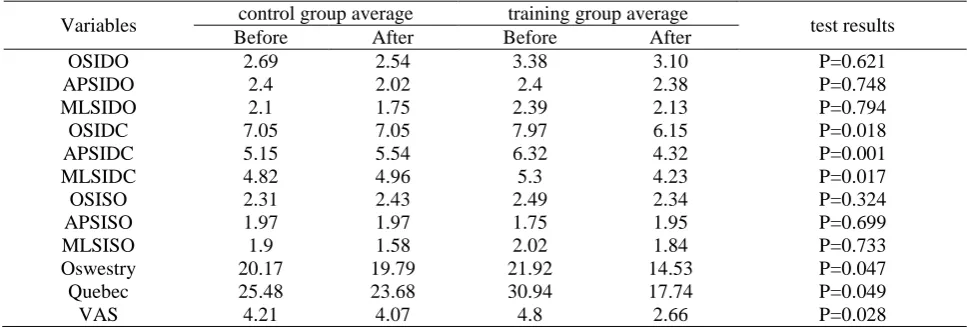
Average of Biodex stability indices, pain and questionnaire scores in both groups before and after intervention have been shown in table (4) Test results of ANCOVA (with adjustment of the underlying variables of age), show that only 6 variables including Overall Stability Index with Double Leg Eyes Closed (OSIDC), Anterior-Posterior Stability Index with Double Leg Eyes
Closed (APSIDC) and Medio-Lateral Stability Index with Double Leg Eyes Closed (MLSIDC) ,VAS pain score, Quebec and Oswestry score scale results are also significant (P<0.0001) and didn‘t display significant differences between the two groups in other situations while these changes were greater in the intervention group.
Table 4 .Comparison of interventional and control groups before and after the intervention
Variables control group average training group average test results
Before After Before After
OSIDO 2.69 2.54 3.38 3.10 P=0.621
APSIDO 2.4 2.02 2.4 2.38 P=0.748
MLSIDO 2.1 1.75 2.39 2.13 P=0.794
OSIDC 7.05 7.05 7.97 6.15 P=0.018
APSIDC 5.15 5.54 6.32 4.32 P=0.001
MLSIDC 4.82 4.96 5.3 4.23 P=0.017
OSISO 2.31 2.43 2.49 2.34 P=0.324
APSISO 1.97 1.97 1.75 1.95 P=0.699
MLSISO 1.9 1.58 2.02 1.84 P=0.733
Oswestry 20.17 19.79 21.92 14.53 P=0.047
Quebec 25.48 23.68 30.94 17.74 P=0.049
VAS 4.21 4.07 4.8 2.66 P=0.028
Abbreviation: OSIDO = Overall Stability Index with
Double Leg Eyes Open; APSIDO = Anterior-Posterior Stability Index with Double Leg Eyes Open; MLSIDO = Medio-Lateral Stability Index with Double Leg Eyes Open; OSIDC = Overall Stability Index with Double Leg Eyes Closed; APSIDC = Anterior-Posterior Stability Index with Double Leg Eyes Closed; MLSIDC = Medio-Lateral
Discussion
Results showed that stabilizing exercises reduced pain and improved the level of functional disability. As well, training program improved the postural stability indices. However, these results presented a significant difference only in the two-leg standing with eyes closed, and didn‘t display significant difference between the two groups in other situations. Central nervous system predicts effects of movements on the body and adjusts the working muscles according to it. A complex deep muscles system in the trunk area, spine and pelvic, such as pelvic floor muscles, Tr.A muscles, multifidus, and diaphragm and intervertebral communications are effective on back firmness control, stability and back pain. Stabilizing therapeutic training programs in recent researches and this study emphasize on local and the deep muscles of the spine and trunk.
Additional studies have investigated the efficient nerve-muscle control in trunk stability, proper coordination of trunk muscle forces in order to control the spine relating to desired postural trunk control (4). These findings are confirmed by other studies (9-12, 16). Some studies have reported opposing results (17-19). Arokoski et al (19) conducted a study on the stability exercises in which local muscle activity was not focused on, during 12 weeks in patients with chronic LBP and concluded that exercises had no effect on the abdominal and para-spinal muscle activities or on pain and functional disability indices.
Vasselien et al (18) showed Abdominal muscle feed forward activation in patients with chronic LBP (N=109) was largely unaffected by 8 weeks of core stability training that may be explained Large individual variations in activation pattern of the deep abdominal muscles may justify exploration of differential effects in subgroups of LBP. However, one of the major differences between this study and others was emphasizing on continuous and intensive training in order to determine lumbar muscles arrangements so that facilitation, supervised learning and continuous repetition help to retrain muscles and improve motor control.
Impaired back motor control is a mechanism that is likely to predispose LBP. This hypothesis have been supported by findings which suggest patients with LBP show longer latency in muscle responses during sudden trunk loading compared with healthy individuals (20). Consecutively supervised core stability trainings are an effective approach in retraining deep local stabilizing muscles (e.g. Tr.A,
multifidus) due to facilitation of feed forward postural mechanism which, in turn, results in the improvement of neuromuscular control, postural control and lumbo-pelvic stability (16). Karimi et al (16) showed that consecutively supervised core stability trainings helps to improve patient‘s postural control. Their studies were on men patients without control group. Tsao and Hodges (11) found that isolated voluntary contractions of deep trunk muscles influenced on changes of feed forward mechanism of muscles. They used different tool (electro-myogragphy) on 7 subjects without control group.
Training repeated isolated voluntary contractions of Tr.A and multifidus muscles is an effective approach in the management of chronic LBP (10, 11). It can be said that in these exercises, attention to the proprioceptive signs by brain, increases first at conscious level and then automatically (11). Unlike this study, researchers have examined co-contraction training of trunk muscles in non-isolated manner. They concluded that these exercises had no effect on feed forward mechanism of deep local stabilizing trunk muscles (21, 22). Short-term and long-term effects of exercise in reducing pain and improving functional disability also has been described in other studies (12, 23, 24). In this study, the effect of only short-term exercises was investigated. However, the particular effectiveness of short-term versus long- term programs is not clear (12). Just like any other researches, the present study inevitably has limitations; there was no possibility of therapist blindness and local lumbar - pelvic stabilization were not evaluated. However, pressure biofeedback devices were used to train the patients during stabilizing trainings. It was not possible to follow patients for long periods (in order to realize the long term effects of exercise).
Conclusion
According to the results of this study, consecutively supervised stabilizing exercises were recognized as appropriate treatment leading to increased performance and decreased pain in young women with chronic non-specific LBP. Training program improved the postural stability indices in patients with chronic non-specific LBP. These results presented a significant difference only in the two-leg standing with eyes closed and didn‘t display significant differences between the two groups in other situations while these changes were greater in the intervention group.
Consecutively supervised functional lumbar stabilizing exercises is aimed at reducing pain and functional disability and improving postural control. These exercises can be effective in preventing postural instability in healthy subjects. Finally, further studies are needed to explore the effects of these exercises in LBP patients.
Acknowledgments
We thank Department of Physical Therapy, University of Social Welfare and Rehabilitation Sciences , for assistance in this project.
References
1. Hoy D, Brooks P, Blyth F, Buchbinder R. The epidemiology of low back pain. Best Practice & Research Clinical Rheumatology. 2010;24(6):769-81.
2. Kelsey J, White A, Pastides H, Bisbee G. The impact of musculoskeletal disorders on the population of the United States. The Journal of Bone & Joint Surgery. 1979;61(7):959-64.
3. Andersen LB, Wedderkopp N, Leboeuf-Yde C. Association
between back pain and physical fitness in adolescents. Spine. 2006;31(15):1740-4.
4. Radebold A, Cholewicki J, Polzhofer GK, Greene HS. Impaired postural control of the lumbar spine is associated with delayed muscle response times in patients with chronic idiopathic low back pain. Spine. 2001;26(7):724-30. 5. Panjabi MM. Clinical spinal instability and low back pain.
Journal of electromyography and kinesiology. 2003; 13(4):371-9.
6. Brumagne S, Cordo P, Lysens R, Verschueren S, Swinnen S. The role of paraspinal muscle spindles in lumbosacral position sense in individuals with and without low back pain. Spine. 2000;25(8):989-94.
7. Mann L, Kleinpaul JF, Pereira Moro AR, Mota CB, Carpes FP. Effect of low back pain on postural stability in younger women: Influence of visual deprivation. Journal of bodywork and movement therapies. 2010;14(4):361-6. 8. Standaert CJ, Weinstein SM, Rumpeltes J.
Evidence-informed management of chronic low back pain with lumbar stabilization exercises. The spine journal. 2008;8(1):114-20.
9. Rasmussen-Barr E, Nilsson-Wikmar L, Arvidsson I.
Stabilizing training compared with manual treatment in sub-acute and chronic low-back pain. Manual therapy. 2003;8(4):233-41.
10.Tsao H, Hodges PW. Immediate changes in feedforward postural adjustments following voluntary motor training. Experimental brain research. 2007;181(4):537-46.
11.Tsao H, Hodges PW. Persistence of improvements in postural strategies following motor control training in people with recurrent low back pain. Journal of electromyography and kinesiology. 2008;18(4):559-67.
12.Kofotolis N, Kellis E. Effects of two 4-week
proprioceptive neuromuscular facilitation programs on muscle endurance, flexibility, and functional performance in women with chronic low back pain. Physical therapy. 2006;86(7):1001-12.
13.Karimi N, Ebrahimi I, Kahrizi S, Torkaman G. Evaluation of postural balance using the biodex balance system in subjects with and without low back pain. Pakistan Journal of Medical Sciences. 2008;24(3):372.
14.Jensen MP, Karoly P, Braver S. The measurement of clinical pain intensity: a comparison of six methods. Pain. 1986; 27(1): 117-26.
15.Mousavi SJ, Parnianpour M, Mehdian H, Montazeri A, Mobini B. The Oswestry disability index, the Roland-Morris disability questionnaire, and the Quebec back pain disability scale: translation and validation studies of the Iranian versions. Spine. 2006;31(14):E454-E9.
16.Karimi N, Ebrahimi I, Ezzati K, Kahrizi S, Torkaman G, Arab AM. The effects of consecutive supervised stability training on postural balance in patients with chronic low back pain. Pakistan J Med Sci. 2009;25(2):177-81.
17.Mills JD, Taunton JE, Mills WA. The effect of a 10-week training regimen on lumbo-pelvic stability and athletic performance in female athletes: a randomized-controlled trial. Physical Therapy in Sport. 2005;6(2):60-6.
18.Vasseljen O, Unsgaard-Tøndel M, Westad C, Mork PJ. Effect of core stability exercises on feed-forward activation of deep abdominal muscles in chronic low back pain: a randomized controlled trial. Spine. 2012; 37(13): 1101-8. 19.Arokoski JP, Valta T, Kankaanpää M, Airaksinen O.
Activation of lumbar paraspinal and abdominal muscles during therapeutic exercises in chronic low back pain patients. Archives of physical medicine and rehabilitation. 2004;85(5):823-32.
20.Radebold A, Cholewicki J, Panjabi MM, Patel TC. Muscle response pattern to sudden trunk loading in healthy individuals and in patients with chronic low back pain. Spine. 2000;25(8):947-54.
21.Hall L, Tsao H, MacDonald D, Coppieters M, Hodges PW. Immediate effects of co-contraction training on motor control of the trunk muscles in people with recurrent low back pain. Journal of electromyography and kinesiology. 2009;19(5):763-73.
22.Tsao H, Druitt TR, Schollum TM, Hodges PW. Motor training of the lumbar paraspinal muscles induces immediate changes in motor coordination in patients with recurrent low back pain. The Journal of Pain. 2010;11(11):1120-8. 23.Cecchi F, Molino-Lova R, Chiti M, Pasquini G, Paperini
for the treatment of chronic low back pain: a randomized trial with one-year follow-up. Clinical rehabilitation. 2010;24(1):26-36.
24. Ferreira ML, Ferreira PH, Latimer J, Herbert RD, Hodges PW, Jennings MD, et al. Comparison of general exercise,