VOLUME 40, ARTICLE 17, PAGES 431
,
462
PUBLISHED 5 MARCH 2019
https://www.demographic-research.org/Volumes/Vol40/17/ DOI: 10.4054/DemRes.2019.40.17
Research Article
Comparing same- and different-sex relationship
dynamics: Experiences of young adults in
Taiwan
Zhiyong Lin
Wei-hsin Yu
Kuo-hsien Su
© 2019 Zhiyong Lin, Wei-hsin Yu & Kuo-hsien Su.
This open-access work is published under the terms of the Creative Commons Attribution 3.0 Germany (CC BY 3.0 DE), which permits use, reproduction, and distribution in any medium, provided the original author(s) and source are given credit.
1 Introduction 432
2 Research on the dynamics of same-sex unions 434
3 The Taiwanese context 436
4 Methods 439
4.1 Data 439
4.2 Variables and analytic strategies 441
5 Results 445
6 Conclusions 452
7 Acknowledgments 455
Comparing same- and different-sex relationship dynamics:
Experiences of young adults in Taiwan
Zhiyong Lin1
Wei-hsin Yu2
Kuo-hsien Su3
Abstract
BACKGROUND
Few studies of same-sex relationships are able to capture the dynamics of these relationships from formation to dissolution, and even fewer provide evidence on these dynamics in a non-Western context.
OBJECTIVE
Using retrospective relationship history data collected from a nationally representative sample of young adults, this study compares the processes of forming and terminating relationships between same- and different-sex couples in Taiwan, an Asian society featuring both strong parental influences on children’s mate selection and an ongoing legislative effort to legalize same-sex marriage.
RESULTS
Results from event history models show that factors associated with relationship formation and dissolution are largely similar for same- and different-sex unions and that same-sex relationships do not have higher dissolution rates. Nevertheless, premarital coresidence with parents, which is likely to amplify parental influences on children’s mate selection, deters the entry into and accelerates the dissolution of same-sex relationships more than it does different-sex relationships. Moreover, same-sex relationships are more heterogamous in family economic background, but more homogamous in age and education level, than different-sex ones.
1 Department of Sociology and Maryland Population Research Center, University of Maryland, College Park,
USA. Email:[email protected].
2 Department of Sociology and Maryland Population Research Center, University of Maryland, College Park,
USA.
CONTRIBUTION
This study is among the first to provide evidence on the dynamics of same- and different-sex relationships in a non-Western context. Aside from a few differences between same- and different-sex relationships related to parental influences, our study provides strong evidence that same- and different-sex couples experience intimacies in similar ways – even in a relatively conservative cultural context like Taiwan.
1. Introduction
Demographers have long been interested in the diversity of family forms (Biblarz and Savci 2010; Cherlin 2004). With the increasing visibility of same-sex unions, an emerging literature has been focusing on the similarities and differences between same-and different-sex unions (Kurdek 2006; Moore same-and Stambolis-Ruhstorfer 2013; Peplau and Fingerhut 2007). Some researchers show that same-sex couples experience a level of stability similar to that of different-sex couples in the United States (Manning, Brown, and Stykes 2016), leading to the argument that close dyadic relationships work in similar ways, irrespective of sexual orientation (Gates 2015; Kurdek 2006). Others, by contrast, reveal significant differences between same- and different-sex couples. In some European countries, for example, same-sex couples have higher dissolution rates than different-sex ones (Andersson et al. 2006; Lau 2012; Wiik, Seierstad, and Noack 2014). In the United States, the partners of same-sex unions resemble each other less than those of different-sex unions do (Schwartz and Graf 2009). Adding to the debate about similarities between same- and different-sex unions, research further shows that the extent of similarity may depend on social and cultural contexts. Living in US states more supportive of same-sex relationships, for example, is associated with higher levels of formation and lower levels of dissolution of such relationships (Manning, Brown, and Stykes 2016; Prince, Joyner, and Manning 2017).
during which individuals may begin to express their sexual orientation through relationship formation. Relationships during this period are important because they exert significant influences on future individual development and union formation (Collins, Welsh, and Furman 2009; Sassler 2010). To provide a comprehensive understanding of how the dynamics of same- and different-sex relationships are similar or different, we further ask whether same- and different-sex unions differ in how much the two partners resemble each other in sociodemographic characteristics and whether this resemblance contributes to relationship stability to the same extent in the two types of unions.
Not only is our study the first to provide evidence about same-sex relationships in a non-Western context, but our use of detailed relationship history data to examine relationship dynamics also improves upon existing research in several ways. First, despite a few studies comparing the levels of stability between same-sex and different-sex unions (Lau 2012; Manning, Brown, and Stykes 2016), a comprehensive analysis of same-sex relationship dynamics, from their formation to dissolution, remains rare (Bennett 2017). By examining factors associated with the formation and dissolution of same-sex relationships, as well as comparing partner similarities between same- and different-sex unions, our study considerably enhances our understanding of same-sex relationship dynamics. Second, prior research on the stability of same-sex relationships commonly observes same-sex couples who have already formed their relationships at the time of interview, failing to assess the relationship stability from the beginning of the union (i.e., left-censoring) (e.g., Manning et al. 2016). Our study, in contrast, overcomes this shortcoming by analyzing individuals’ complete relationship histories through early adulthood. Third, most existing studies use data from same-sex cohabiting unions (Jepsen and Jepsen 2002; Lau 2012; Manning, Brown, and Stykes 2016) or married couples/registered partnerships (Andersson et al. 2006; Noack, Seierstad, and Weedon-fekjær 2005; Wiik, Seierstad, and Noack 2014). Such research faces the potential problem of differential selectivity of same- and different-sex couples into marriage or cohabitation. The inclusion of all intimate relationships in this study helps avoid this problem.
strong influences on children’s relationship formation and stability. Our analysis of Taiwan can therefore shed light on same-sex relationship dynamics for similar cultural contexts in which traditional family values and parental control over unmarried children remain prevalent.
2. Research on the dynamics of same-sex unions
Intimate partnering is one of the most important life course events during young adulthood. Romantic relationships experienced in adolescence and early adulthood, in particular, are thought to shape future development of personal identities and peer relations (Collins, Welsh, and Furman 2009; Crosnoe and Johnson 2011; Montgomery 2005), in addition to being highly relevant to the formation and quality of intimate relationships in later adulthood (Meier and Allen 2009; Raley, Crissey, and Muller 2007; Sassler 2010). With the increasing acceptance of same-sex unions in Western countries (Bennett 2017; Sassler 2010), research on relationship experiences has expanded to include same-sex relationships in recent years. Most studies examining same-sex relationship dynamics center on union stability and its determinants, with explicit comparisons to different-sex unions. The argument for comparable dissolution patterns between same- and different-sex unions generally highlights that all intimate unions share similar dynamics (Gates 2015; Kurdek 2006). Sexual orientation therefore should not affect how couples relate to each other and decide whether to continue the union. At the same time, the minority stress perspective, which focuses on stressors that are uniquely associated with being members of socially stigmatized groups (Frost and Gola 2015; Meyer 2003), provides a contradictory account. Specifically, this perspective contends that same-sex couples face more barriers and challenges in forming and maintaining high-quality relationships than do different-sex couples, due to social environments that are hostile to and stressful for sexual minorities (Cao et al. 2017). More than different-sex couples, same-sex couples face stressors deriving from such sources as intrapersonal appraisals (e.g., self-concealment or self-stigma), interpersonal events (e.g., opposition of family and friends), and structural conditions (e.g., norms and policies) (Hatzenbuehler et al. 2014; Leblanc, Frost, and Wight 2015; Mohr and Daly 2008). These stressors may be interactive or additive in how they influence same-sex people’s relationship functioning and well-being.
taking relevant socioeconomic characteristics into account (Andersson et al. 2006; Noack, Seierstad, and Weedon-fekjær 2005; Wiik, Seierstad, and Noack 2014). Cohabiting same-sex couples in Britain also experience a higher dissolution rate than different-sex couples who are cohabiting or married (Lau 2012). Conversely, using cohabitation samples in the United States, Manning and colleagues (2016) demonstrate similar levels of stability between same- and different-sex cohabiting couples. As Joyner and colleagues (2017) argue, the mixed results may be related to different samples and reference groups selected across different studies. Most prior research compares cohabiting or registered same-sex couples with married/cohabiting different-sex couples, with only one or two exceptions. Considering the different cohabitation rates across countries, as well as between same-sex and different-sex couples (Carpenter and Gates 2008), it is possible that cohabiting couples are selected differently based on sexual orientation.
Although much research on same-sex relationship dynamics centers on dissolution rates, the formation of an intimate relationship, a well-studied topic in the literature concerning heterosexual unions, constitutes another key part of relationship dynamics. Because studies of same-sex unions rarely focus on their formation, we know relatively little about whether the factors that promote or impede the formation of different-sex relationships are the same as those for same-sex ones (Prince, Joyner, and Manning 2017). As involvement in intimate relationships is important to the health and well-being of both same- and different-sex-oriented people (Liu, Reczek, and Brown 2013; Sassler 2010), it is critical to pay attention to the formation of same-sex relationships as well.
Forming a same-sex relationship is not just an individual mate-searching behavior; rather, it is tightly linked to individuals’ family contexts. Previous research shows that the family of origin continues to influence same-sex union formation even in the West. Evidence from Britain, for example, shows that moving away from parents for education and employment leads young adults to begin their search for same-sex partners (Strohm 2010). A study in Denmark finds that individuals who grow up in nonintact families, in which parents are less available to monitor children’s mate selection, are more likely to enter same-sex marriages (Frisch and Hviid 2006). Among sexual-minority individuals in the United States, those who have come out to their parents are more likely to form a same-sex union than those who have not (Prince, Joyner, and Manning 2017). Despite the argument for the importance of family influences, to our knowledge, no existing research has explicitly compared parental influences on the formation rates of same- and different-sex relationships.
likely among same-sex unions than different-sex ones. The first concerns meeting opportunities. Because of the much smaller pool of potential partners, same-sex-oriented people may have greater difficulty finding someone like themselves (Schwartz and Graf 2009). Second, since their unions are nontraditional, individuals with a same-sex orientation are thought to have less conventional preferences for partners, leading to greater tolerance of partner heterogeneity (Potârcă, Mills, and Neberich 2015). At the same time, however, other researchers argue that same-sex couples might be more homogeneous than different-sex unions because how they relate to each other is not affected by the gender hierarchy in society, resulting in their more egalitarian preferences (Verbakel and Kalmijn 2014). Empirically, same-sex unions are found to be more heterogamous with respect to age in a few European countries and the United States, but this pattern does not extend to their educational levels (Andersson et al. 2006; Schwartz and Graf 2009; Verbakel and Kalmijn 2014).
Other than understanding how same-sex-oriented people may have different partner preferences, another reason to study differences in couple homogeneity by sexual orientation is that such differences may also account for any discrepancy in stability between same- and different-sex relationships. Because more heterogamous unions likely feature greater differences in attitudes, lifestyles, and beliefs between the partners, they tend to have poorer relationship quality and thus higher dissolution rates (Schwartz 2013). Most research on the associations between matching patterns and relationship outcomes, however, focuses on different-sex couples. One exception is Manning and colleagues’ (2016) study of same-sex cohabiting couples in the United States. These researchers find that educationally heterogamous unions face modestly higher dissolution risks, whereas age heterogamy and interracial unions are not tied to higher dissolution risks. Two other studies examining socioeconomic differences within couples indicate that equal earnings within unions reduce the likelihood of breakups for same-sex couples but increase this likelihood for different-sex couples (Kalmijin, Loeve, and Manting 2007; Weisshaar 2014). All of these studies, however, are based on cohabiting or married/registered couples, and thus the findings might not be generalizable to contexts with relatively low cohabitation rates and where same-sex partnership is not legalized.
3. The Taiwanese context
Western countries, where unmarried couples frequently cohabit (Manning, Brown, and Payne 2014), Taiwan, akin to other East Asian countries, has a relatively low level of premarital cohabitation, despite increasing marriage postponement (Raymo et al. 2015). While demographers have proposed various explanations for the rapid marriage declines in a number of East Asian countries (Boling 2008; Jones 2007; Raymo and Iwasawa 2005), Yu and Kuo’s (2016) recent study of Japan, which shares Taiwan’s patterns of cohabitation and marriage, specifically indicates a close connection between relationship formation and marriage entry. As these researchers argue, young people’s lack of romantic involvement to a great extent accounts for their delayed entry into marriage. Understanding relationship dynamics is therefore potentially important to explaining demographic trends in Taiwan.
Existing research on the formation or dissolution of relationships in Taiwan, or elsewhere in Asia, is scarce. The potentially close connection between relationship and marriage formation, however, suggests that previous research on the determinants and patterns of marriage formation in Taiwan and other East Asian countries with similar cultural and demographic characteristics is likely to shed light on relationship dynamics, especially for different-sex couples, in Taiwan. More than in Western countries, studies of marriage formation in East Asia have emphasized parental influences (Raymo et al. 2015). Although the tradition of arranging marriages for their children has declined, East Asian parents continue to facilitate their children’s marriages by providing monetary support to children when they enter marriage (Lin and Pei 2016) or by becoming involved in children’s mate selection (Wang and Chen 2017). In Taiwan, parental expectations still exert some degree of influence on children’s choice of mate, as well as affect children’s perceptions of their relationship quality (Chen and Chen 2014; Tsay and Wu 2006).
Part of the reason Taiwanese parents remain influential in regard to their children’s marriage formation is Taiwan’s high level of parent–child coresidence before marriage. Similar to their counterparts in some Southern European and other East Asian countries, adult children in Taiwan expect and are expected to remain in the parental home until marriage (Yu and Kuo 2016; Zeng et al. 1994), unless their job or school makes commuting from the parental home infeasible (Huang 2013; Nauck, Gröpler, and Yi 2017). This family practice, combined with the rising age of marriage, leads more than one-half of young adults in Taiwan to live in their parental home at age 30, which is drastically different from Western countries, such as the United States and Germany, where nearly 90% of young adults have left the parental home by the same age (Nauck, Gröpler, and Yi 2017).
homosexuality has been increasing, with Taiwan about to make legislative changes to enable same-sex marriage,4 this acceptance is far less common among older adults
(Cheng, Wu, and Adamczyk 2016). That is to say, parents of today’s young adults in Taiwan are likely to disapprove of their children’s same-sex relationships. If pressure from parents or other family members serves as a stressor that could accelerate the dissolution of same-sex relationships, as indicated by the minority stress perspective (Cao et al. 2017; Meyer 2003), then we should observe a higher dissolution rate of same-sex relationships in the Taiwanese context, especially among those living with their parents.
Premarital coresidence, as a proxy for parental influences on children, may also differentially affect same- and different-sex relationship formation. Previous research demonstrates that Taiwanese men and women living with parents actually experience a greater delay in their first marriage than those not living with parents (Yu, Su, and Chiu 2012). A recent study further suggests that this delay may have to do with coresident children’s lower likelihood of forming relationships (Yu and Kuo 2016). The argument for the deterrent effect of coresidence on different-sex relationship formation specifically focuses on coresident children’s lower psychological need for companionship, resulting in their higher standards for romantic partners. In the case of same-sex-oriented people, coresidence with parents may even more strongly discourage relationship formation, as they simultaneously may face disapproval from their parents.
In addition to how parents may shape children’s paces of entering marriage, previous research on marriage formation in Taiwan also indicates a strong tendency of assortative mating (Tsay 1996). Although the traditional gender norm favoring the husband having higher status than the wife leads a sizable proportion of Taiwanese women to marry men who are older and more educated than themselves, the percentages of relationships that feature educational and age homogamy have increased steadily in Taiwan (Cheng 2014; Chu and Yu 2010). Furthermore, previous research indicates a strong tendency for people in Taiwan to marry those from a similar family socioeconomic background (Chu and Yu 2010). Parents’ relatively great influence on children’s marriage choices is thought to partly contribute to this high level of family background homogamy, as parents, following the tradition of arranging marriage with a family of equivalent socioeconomic standing, are likely to prefer such a mating pattern more than their children (Tsay and Wu 2006).
Another dimension of assortative mating in Taiwan has to do with ethnicity, with each main ethnic group demonstrating a strong tendency to marry within the group (Tsay and Wu 2006). To provide some background, the ethnic divides in Taiwan mainly follow the timing of arriving on the island. The Aborigines were in Taiwan the
4 On May 24, 2017, Taiwan’s constitutional court ruled that same-sex couples have the legal right to marry,
earliest, followed by Han Chinese migrating from coastal China in the 16th and 17th
centuries. The Han are further divided into Hokkien and Hakka, based on their original region and dialect. Another ethnic group, Mainlanders, consists of Chinese migrants who arrived around 1949 with the Kuomintang government, after its loss of the civil war, and these migrants’ descendants. As of the early 2000s, more than 80% of Taiwanese were married to a member of their own ethnic group (Tsay and Wu 2006).
Given the likely close link between romantic relationships and marriages in Taiwan, one would expect different-sex relationships to have considerable levels of couple similarities in age, education, ethnicity, and family background, just like different-sex marriages. Regarding our question of how same-sex relationships may differ in this aspect, however, the level of couple homogeneity may depend on the specific characteristic in question. Because same-sex couples are not affected by the gender norm that prefers the male partner in a relationship to have higher status than the female partner, same-sex unions may be more homogamous with respect to age and education. For ethnicity and family economic status, however, not only might same-sex-oriented people be more tolerant, as claimed by researchers using Western cases (Potârcă, Mills, and Neberich 2015; Schwartz and Graf 2009), but, in the context of Taiwan, they might also be subject to less parental pressure to find partners from comparable family backgrounds. As same-sex marriage is still illegal in Taiwan, parents’ preference for their children to marry someone from a similar family background, so that they can keep the kinship homogeneous, would not apply to same-sex relationships. Thus, same-same-sex relationships may be less homogamous in ethnicity and family economic status.
4. Methods
4.1 Data
The data used in this study is from the Taiwan Education Panel Survey and Beyond (TEPS-B), conducted by a team of researchers at National Chengchi University, National Taiwan University, and Academia Sinica in Taiwan, with funding from the Ministry of Science and Technology in Taiwan. The TEPS-B is a follow-up survey of the Taiwan Education Panel Survey (TEPS), which collected data from a nationally representative sample of 20,055 seventh-grade students in 2001 and followed a subsample of them through 12th grade (the TEPS core sample, consisting of 4,261
TEPS-B collected information from 5,172 Taiwanese men and women, who, altogether, can be considered a nationally representative sample of young adults born in 1988– 1989 (Kuan 2017).
Despite being from one specific cohort, the TEPS-B data is exceptionally rich. In addition to gathering full educational and residential histories, the TEPS-B asked all respondents to report detailed information on current and previous romantic relationships that had lasted one month or more since age 15, including the month and year they began and ended each relationship. Such information enables us to analyze the paces and patterns of entering and exiting relationships for all respondents from mid-adolescence to early adulthood. Although retrospective life history data faces the potential problem of recall errors, we believe that such errors are likely few in our data on romantic relationships because the TEPS-B respondents were relatively young, and most of them had just one or two romantic relationships to report.5 The TEPS-B did not
include questions about respondents’ sexual orientation, but it asked respondents to report the sex and other characteristics (e.g., age, education, ethnicity, and family economic status) of each romantic partner. Based on these responses, we can determine whether a relationship is a same- or different-sex one. In an exploratory analysis, we found that among those reporting having had any same-sex relationship, their romantic partners tended to all be same-sex ones, with few reporting both same- and different-sex relationships over time. This consistency provides us with some confidence that the same-sex relationships recorded in our sample are unlikely to result from coding or reporting errors. The detailed information about each romantic partner also enables us to compare the matching patterns between same- and different-sex unions.
To conduct the statistical analysis that utilizes respondents’ life history information, we converted the retrospective data into person-month observations, with time-varying information for each respondent. Because our focus is on romantic relationships since age 15, we constructed the person-month sample from the month when respondents turned 15 years of age through the month of the interview. The 5,172 respondents in the sample reported 8,482 relationships in total. After excluding observations with missing values on key variables, the analytical sample contains 8,306 relationships (with 332 same-sex ones) and 568,209 person-months.
Unlike previous studies, which mostly focus on cohabiting/married same-sex couples, our data enables us to capture all romantic relationships respondents experienced since age 15. This study can therefore provide a comprehensive view of relationship dynamics, from formation to dissolution. Our focus on romantic
5 We should also note that retrospective data is widely used in previous studies on romantic relationship
relationships, instead of cohabiting unions, is also more appropriate for non-Western contexts, where cohabiting is relatively rare.6 As with many other studies of same-sex
unions (Umberson et al. 2015), however, we are limited by the modest number of same-sex relationships in our sample. Also akin to previous research, we face potential social desirability bias; that is, some same-sex relationships might not have been reported because respondents felt less comfortable reporting such relationships (Lau 2012). These potential limitations notwithstanding, the percentage of same-sex unions in the TEPS-B is quite similar to that in other studies of Western countries. In the TEPS-B, same-sex relationships account for 4% (332/8,306) of all romantic unions, compared to 3% (263/8,437) in a British study (Lau 2012), 5% (126/2,283) in one US study (Manning, Brown, and Stykes 2016), and 2% (335/14,005) in another US study (Joyner, Manning, and Bogle 2017).
Consistent with the US finding that men report fewer same-sex relationships than women (England 2016), our sample also includes more female same-sex unions than male ones. Specifically, out of the 332 same-sex relationships, 236 involve women and 96 involve men. Given the potentially different social desirability bias between men and women engaged in same-sex relationships, in an exploratory analysis, we fitted models separately for men and women. Although some modest gender differences in same-sex relationship dynamics were observed, regarding our primary research concern, whether same- and different-sex relationship dynamics significantly differ, the results were consistent regardless of whether we separated or combined men and women in the statistical models. Because of the modest number of same-sex relationships in our sample, combining men and women in the analysis, as do most prior studies of same-sex unions (Lau 2012; Manning, Brown, and Stykes 2016), has the benefit of providing greater statistical power. We therefore decided not to separate the sample by gender in the analysis.
4.2 Variables and analytic strategies
To investigate how same- and different-sex relationships differ in the patterns of formation, dissolution, and couple homogeneity, the statistical analysis in this study contains three parts, with different dependent variables for each part. First, we conduct an event history analysis of Taiwanese young adults’ paces of transitioning into a same-sex or different-same-sex romantic relationship (Yamaguchi 1991). Specifically, we use competing-risk discrete-time hazard models, which employ the multinomial logit regression technique, to estimate the odds of individuals entering into a same-sex or
6 As our data indicates, cohabitation experiences are rather uncommon for both same- and different-sex
different-sex relationship at a given month, conditional on the event not occurring before that time. We code the dependent variable for this part of the analysis as 1 if respondents started a different-sex relationship at month t and as 2 if they began a same-sex relationship; otherwise we code it as 0. To ensure that the predictors used to study the entry into a relationship precede the transition, we use independent variables at month t–1 to predict the relationship entry at t. Because only the person-months subject to the risk of entering a relationship can be included in event history models, this part of the analysis is restricted to the person-months when respondents were not in any relationship (364,576 person-months).
Second, to show whether same- and different-sex relationships differ in the levels of couple homogeneity, we fit a series of binary logit regression models predicting whether respondents’ relationships are homogamous in age, education, ethnicity, and family economic status, conditional on their entering a relationship. That is, only the person-months when respondents entered a relationship are selected for this part of the analysis (n = 8,306). For the dependent variables for this set of models, we create binary indicators of age, education, ethnicity, and family homogamy, defined as the couple being the same age, having reached equivalent educational levels, reporting the same ethnic origin, and having similar family economic conditions, respectively, at the time of entering the relationship (coded as 1). We code these outcome variables as 0 if the relationship is heterogamous in age, education, ethnicity, and family economic status, respectively, or if respondents did not know the attribute of concern for their partner.7 Previous research on assortative mating uses various age differences as cutoffs
when defining age homogamy (Qian and Qian 2014; Tsay and Wu 2006). In an exploratory analysis not presented here, we tried the different cutoffs (from one to four years of age difference), and the results were consistent regardless of the cutoffs. We measure education homogamy based on the highest levels of education that respondents and their partners had achieved at the time. Specifically, we consider a relationship as homogamous if the couple’s highest educational levels were both: (1) high school or less, (2) technical or general university, or (3) postgraduate school. Regarding ethnicity, the TEPS-B asked respondents to report their father’s ethnic origin, a typical way for
7 In an earlier analysis, we separated heterogamous couples from those where partners’ information is
young adults to identify their ethnicity (and to be identified as such) in Taiwan.8 For the
partner’s ethnicity, we rely on respondents’ reports. Following previous research on ethnic homogamy (Tsay and Wu 2006), we divide respondents and their partners into four major ethnic groups: (1) Hokkien, (2) Hakka, (3) Mainlanders, and (4) Aborigines. As to family background homogamy, we measure it based on respondents’ reports of how their romantic partners’ family economic status compared to their own. We consider cases where respondents reported having similar or same family economic conditions as their partners as being homogamous.
The third part of the statistical analysis focuses on union dissolution, once again using an event history approach (Yamaguchi 1991). We select all the person-months during which respondents were subject to the risk of union dissolution – that is, when respondents were in a relationship – and use discrete-time hazard rate models to estimate the odds for their relationship to end at a given month, conditional on it not having occurred earlier. We measure the dependent variable for this part of the analysis based on respondents’ reports of when each of their relationships ended. Among the 8,306 relationships in our analytical sample, 5,930 were terminated by survey time. A total of 203,633 person-months, during which respondents reported being in a relationship, are included in the event history models predicting relationship dissolution.
With respect to the independent variables for our analysis, a key predictor included in most of our models is whether a relationship is a same-sex one. We determine this relationship characteristic based on respondents’ reports of the sex of their partners. For about 22% of respondents, who never had any relationship, we cannot tell their sexual orientation. As a result, we can include the indicator of same-sex status only in the models restricted to the person-months during which respondents were in a relationship (i.e., the parts of analysis that focus on whether a relationship is homogamous and the pace at which a relationship dissolves).
The rest of the independent variables are similar across different parts of the analysis. To begin, we use coresidence with parents to gauge parental influences on children’s relationship dynamics. We measure coresidence with parents based on respondents’ self-reported residential histories, with a dummy variable indicating whether respondents lived with at least one parent in a given month.
We also include several other time-variant variables that may shape relationship dynamics, such as age, educational level, school enrollment, personal income, and level of urbanization of the area in which respondents lived. Age is measured in three categories: age 17 and younger, 18 to 22 years of age, and age 23 and older.
8 Following the patrilineal cultural norm, Taiwanese children’s ethnic origins are typically classified in the
Educational level is measured as the highest level that respondents had attended at the time, in six categories: (1) general high school, (2) vocational high school, (3) junior college, (4) technical college, (5) university, and (6) postgraduate school. We also construct a binary indicator of whether respondents were enrolled in school during the observed month, since being in school may facilitate more opportunities to meet romantic partners. We measure personal income based on respondents’ reports of the initial wage of each job they had since age 15. To prevent the results from being overly influenced by outliers, we take the natural logarithm of the reported wage (in New Taiwanese dollars).9 Because the level of urbanization of the area where respondents
live may affect the chances to meet romantic partners, as well as their beliefs and preferences about romantic relationships and views on same-sex relationships, we further control for the level of urbanization. The TEPS-B asked respondents to report the ZIP code of their residence since age 15. After matching the ZIP code information with the categorization of urbanization level commonly used in major social surveys in Taiwan (Chang, Tu, and Liao 2012), we further divide the residential area into three categories: (1) large metropolitan areas, (2) other urban localities, and (3) rural areas.10
The models also control for respondents’ gender and whether any of their parents have high school or more education. Given that previous research finds that number of siblings is related to the timing of marriage (Yu, Su, and Chiu 2012), we further introduce respondents’ number of siblings into the models. In addition, we control for the number of romantic relationships experienced up to the observed month in the models, as those with more prior relationships may enter or exit relationships at a faster pace and be choosier about their partners’ characteristics.
For the event history models, we also include the duration of being exposed to the risk of the event of interest. Specifically, for the models predicting the entry into a same- or different-sex relationship, duration is measured as the number of months since respondents turned age 15 or since they exited the last relationship if they had any other relationship prior to that month. Because our preliminary analysis indicated a quadratic effect of the duration of singlehood on the odds of transitioning to a romantic relationship, we use both duration and duration squared in the event history models predicting relationship formation. For the models predicting relationship dissolution, the duration of exposure is measured as the number of months since respondents
9 We added NT$1 (equivalent to about three cents in US currency) before taking the logarithm, so that the
transformation would not exclude person-months during which respondents reported no income.
10 In Chang, Tu, and Liao’s (2012) original categorization of urbanization levels in Taiwan, each ZIP code
entered the relationship. Different from the models about relationship formation, we use only duration in the models predicting dissolution, as an exploratory analysis showed a linear – not curvilinear – association between the union’s duration and its dissolution. Finally, because our event-history data may include multiple relationship episodes from the same respondents, we further cluster the standard errors by individuals to allow for arbitrary within-person correlation.
5. Results
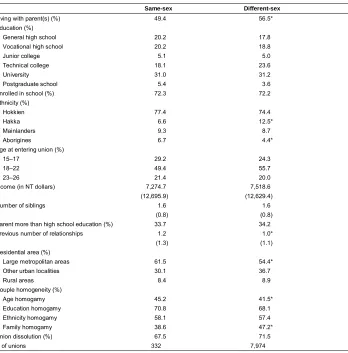
Table 1: Descriptive statistics of same-sex and different-sex couples
Same-sex Different-sex
Living with parent(s) (%) 49.4 56.5*
Education (%)
General high school 20.2 17.8
Vocational high school 20.2 18.8
Junior college 5.1 5.0
Technical college 18.1 23.6
University 31.0 31.2
Postgraduate school 5.4 3.6
Enrolled in school (%) 72.3 72.2
Ethnicity (%)
Hokkien 77.4 74.4
Hakka 6.6 12.5*
Mainlanders 9.3 8.7
Aborigines 6.7 4.4*
Age at entering union (%)
15–17 29.2 24.3
18–22 49.4 55.7
23–26 21.4 20.0
Income (in NT dollars) 7,274.7 7,518.6
(12,695.9) (12,629.4)
Number of siblings 1.6 1.6
(0.8) (0.8)
Parent more than high school education (%) 33.7 34.2
Previous number of relationships 1.2 1.0*
(1.3) (1.1)
Residential area (%)
Large metropolitan areas 61.5 54.4*
Other urban localities 30.1 36.7
Rural areas 8.4 8.9
Couple homogeneity (%)
Age homogamy 45.2 41.5*
Education homogamy 70.8 68.1
Ethnicity homogamy 58.1 57.4
Family homogamy 38.6 47.2*
Union dissolution (%) 67.5 71.5
N of unions 332 7,974
Note: Values for categorical variables are in percent. The mean values, followed by standard deviations in parentheses, are presented for all other variables. *Indicates a significant difference (p < 0.05) from same-sex couples based on chi-square test or t-test.
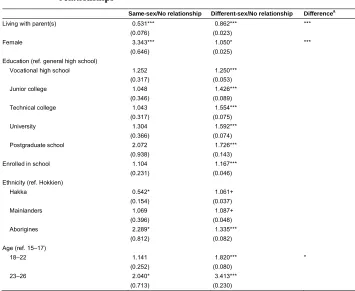
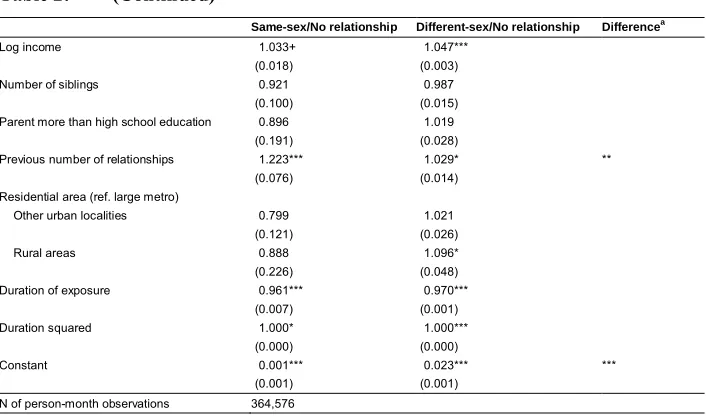
Consistent with previous research showing that coresidence with parents delays marriage formation (e.g., Yu and Kuo 2016), the results indicate that young Taiwanese adults living in the parental home enter romantic relationships at a slower pace. The odds ratios of parent–child coresidence, however, differ for entering different types of relationships. Whereas the odds for those coresiding with their parents to enter a different-sex relationship in any given month are about 14% less than those who do not live with parents, the odds for the former to enter a same-sex relationship are nearly 47% less than the odds for those who have left the parental home. As the third column in Table 2 shows, the odds of entering a different-sex relationship are significantly different from those of entering a same-sex relationship (p < 0.001). Thus, living with parents deters entry into same-sex relationships much more than it does different-sex relationships.
Table 2: Competing-risk event history models predicting entry into romantic relationships
Same-sex/No relationship Different-sex/No relationship Differencea
Living with parent(s) 0.531*** 0.862*** ***
(0.076) (0.023)
Female 3.343*** 1.050* ***
(0.646) (0.025)
Education (ref. general high school)
Vocational high school 1.252 1.250***
(0.317) (0.053)
Junior college 1.048 1.426***
(0.346) (0.089)
Technical college 1.043 1.554***
(0.317) (0.075)
University 1.304 1.592***
(0.366) (0.074)
Postgraduate school 2.072 1.726***
(0.938) (0.143)
Enrolled in school 1.104 1.167***
(0.231) (0.046)
Ethnicity (ref. Hokkien)
Hakka 0.542* 1.061+
(0.154) (0.037)
Mainlanders 1.069 1.087+
(0.396) (0.048)
Aborigines 2.289* 1.335***
(0.812) (0.082)
Age (ref. 15–17)
18–22 1.141 1.820*** *
(0.252) (0.080)
23–26 2.040* 3.413***
Table 2: (Continued)
Same-sex/No relationship Different-sex/No relationship Differencea
Log income 1.033+ 1.047***
(0.018) (0.003)
Number of siblings 0.921 0.987
(0.100) (0.015)
Parent more than high school education 0.896 1.019
(0.191) (0.028)
Previous number of relationships 1.223*** 1.029* **
(0.076) (0.014)
Residential area (ref. large metro)
Other urban localities 0.799 1.021
(0.121) (0.026)
Rural areas 0.888 1.096*
(0.226) (0.048)
Duration of exposure 0.961*** 0.970***
(0.007) (0.001)
Duration squared 1.000* 1.000***
(0.000) (0.000)
Constant 0.001*** 0.023*** ***
(0.001) (0.001)
N of person-month observations 364,576
Note: Results are presented in odds ratios, with values in parentheses representing cluster-corrected robust standard errors.a Indicates whether the odds ratios for forming same- and different-sex relationships are statistically different. ***p< 0.001, **p< 0.01, *p< 0.05, +p< 0.10 (two-tailed tests).
Next, we present results from a series of binary logit regression models predicting whether respondents’ relationships are homogamous in age, education, ethnicity, and family economic status, conditional on respondents’ entering a relationship (Table 3). To conserve space, we show only odds ratios for sexual orientation, even though the models control for all the other variables predicting relationship formation included in Table 2. The results indicate that same-sex couples are more homogamous in age and education, while less homogamous in family economic background, than heterosexual couples. There is no difference in the tendency of ethnic homogamy between the two types of relationships. To be specific, for age homogamy, the odds of the partners being similar in age is 28% higher among same-sex couples than among their heterosexual counterparts. Similarly, same-sex couples’ odds of educational homogamy are 32% higher than those of different-sex couples. By contrast, the odds that the two partners in the union come from families with comparable economic conditions are about 25% less for same-sex couples than for heterosexual ones.
Table 3: Partial results from logit models predicting relationship homogamy on various characteristics
Age Education Ethnicity Family
homogamy homogamy homogamy homogamy
Same-sex 1.282* 1.324* 0.936 0.746*
(0.151) (0.188) (0.138) (0.109)
Log-likelihood –5,142 –4,346 –4,569 –5,689
N of observations 8,306 8,306 8,306 8,306
Note: Results are based on logistic models predicting relationship homogamy, which also include coresidence with parents, gender, educational level, school enrollment, ethnicity, age, personal income, number of siblings, previous number of relationships, parents’ education, and residential area as predictors. Results are presented in odds ratios, with values in parentheses representing cluster-corrected robust standard errors. ***p< 0.001, **p< 0.01, *p< 0.05, +p< 0.10 (two-tailed tests).
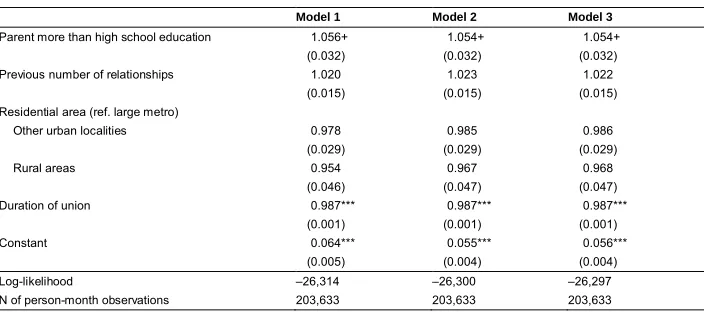
parents accelerates union dissolution considerably more for same- than for different-sex relationships. Among young Taiwanese in different-sex relationships, the odds for those living with parents to exit their relationships at a given month are 16% higher than the odds for those living independently. Conversely, among those in same-sex relationships, the odds of terminating the relationship are 63% higher if they live with parents (1.156 * 1.412 = 1.632).
Table 4: Discrete-time event history models predicting union dissolution
Model 1 Model 2 Model 3
Same-sex 1.030 1.050 0.880
(0.073) (0.073) (0.091)
Living with parent(s) 1.172*** 1.156***
(0.036) (0.036)
Same-sex × Living with parent(s) 1.412*
(0.203)
Female 0.755*** 0.748*** 0.748***
(0.021) (0.021) (0.021)
Education (ref. general high school)
Vocational high school 1.012 1.019 1.019
(0.048) (0.048) (0.048)
Junior college 0.757*** 0.777*** 0.780***
(0.056) (0.058) (0.058)
Technical college 0.663*** 0.686*** 0.686***
(0.037) (0.038) (0.038)
University 0.637*** 0.672*** 0.671***
(0.034) (0.036) (0.036)
Postgraduate school 0.425*** 0.458*** 0.457***
(0.039) (0.042) (0.042)
Enrolled in school 1.256*** 1.266*** 1.267***
(0.054) (0.054) (0.054)
Ethnicity (ref. Hokkien)
Hakka 1.014 1.017 1.017
(0.041) (0.041) (0.041)
Mainlanders 1.008 1.007 1.006
(0.048) (0.048) (0.048)
Aborigines 0.855* 0.890 0.895
(0.060) (0.063) (0.063)
Age (ref. 15–17)
18–22 0.199*** 1.248*** 1.248***
(0.064) (0.068) (0.068)
23–26 0.112 1.143+ 1.142+
(0.085) (0.087) (0.087)
Log income 0.995 0.994+ 0.994+
(0.003) (0.003) (0.003)
Number of siblings 0.970+ 0.973+ 0.972+
Table 4: (Continued)
Model 1 Model 2 Model 3
Parent more than high school education 1.056+ 1.054+ 1.054+
(0.032) (0.032) (0.032)
Previous number of relationships 1.020 1.023 1.022
(0.015) (0.015) (0.015)
Residential area (ref. large metro)
Other urban localities 0.978 0.985 0.986
(0.029) (0.029) (0.029)
Rural areas 0.954 0.967 0.968
(0.046) (0.047) (0.047)
Duration of union 0.987*** 0.987*** 0.987***
(0.001) (0.001) (0.001)
Constant 0.064*** 0.055*** 0.056***
(0.005) (0.004) (0.004)
Log-likelihood –26,314 –26,300 –26,297
N of person-month observations 203,633 203,633 203,633
Note: Results are presented in odds ratios, with values in in parentheses representing cluster-corrected robust standard errors. ***p < 0.001, **p< 0.01, *p< 0.05, +p< 0.10 (two-tailed tests).
Also about the patterns of union dissolution, the final part of our analysis examines whether couple homogeneity contributes to relationship stability differently for same-and different-sex couples. Table 5 shows partial results from discrete-time logit models predicting same-sex and different-sex couples’ union dissolution, with the addition of variables measuring union homogamy (in age, education, ethnicity, and family economic status) and interaction terms between homogamy variables and the same-sex indicator. The models also include all the other variables predicting union dissolution included in Table 4. Models 1 and 2 indicate that age homogamy is hardly associated with the pace of relationship dissolution, and this result does not differ between same-and different-sex couples. Perhaps romantic relationships formed from middle adolescence to young adulthood tend not to feature a great age gap between the two partners, leading to less difference between couples who are homogamous in age and those who are not during this stage.
for the argument that close dyadic relationships work in similar ways irrespective of sexual orientation.
Table 5: Partial results from event history models predicting dissolution of unions with different matching patterns
Model 1 Model 2 Model 3 Model 4 Model 5 Model 6 Model 7 Model 8
Same-sex 1.050 1.027 1.054 1.050 1.039 1.052 1.025 0.984
(0.073) (0.104) (0.074) (0.124) (0.073) (0.098) (0.072) (0.089)
Age homogamy 0.994 0.992
(0.028) (0.028)
Same-sex × Age homogamy 1.044
(0.142)
Education homogamy 0.835*** 0.835***
(0.026) (0.027)
Same-sex × Education homogamy (0.145)1.006
Ethnicity homogamy 0.735*** 0.736***
(0.023) (0.024)
Same sex × Ethnicity homogamy (0.129)0.977
Family homogamy 0.732*** 0.729***
(0.019) (0.020)
Same-sex × Family homogamy (0.149)1.120
Log-likelihood –26,298 –26,298 –26,279 –26,279 –26,248 –26,248 –26,230 –26,230
N of person-month observations 203,633 203,633 203,633 203,633 203,633 203,633 203,633 203,633
Note: Results are based on discrete-time hazard rate models predicting union dissolution, which also include duration of union, coresidence with parents, gender, educational level, school enrollment, ethnicity, age, personal income, number of siblings, previous number of relationships, parents’ education, and residential area as predictors. The estimates are presented in odds ratios, with values in parentheses indicating cluster-corrected robust standard errors. ***p< 0.001, **p< 0.01, *p< 0.05, +p< 0.10 (two-tailed tests).
6. Conclusions
parental intervention in children’s mate selection leads to greater relationship instability for same-sex couples in Taiwan, we find no significant differences between young people’s paces of exiting same- and different-sex relationships.
Our result that the level of relationship stability does not differ between same- and different-sex couples in Taiwan is parallel to recent US findings (e.g., Manning et al. 2016) while differing from evidence based on European countries (e.g., Lau 2012). It is noteworthy, however, that many of the previous studies showing different levels of relationship stability by sexual orientation either compare cohabiting couples with married/registered couples or focus only on cohabiting unions. Unlike such studies, our comparison of same- and different-sex relationships uses all romantic relationships formed from mid-adolescence to early adulthood, without requiring individuals to select themselves into cohabiting unions or marriages. Given the potential problem of differential selectivity of same- and different-sex couples into marriage or cohabitation, our relationship-based analysis is far less likely subject to bias. Therefore, our finding that same- and different-sex relationships have similar levels of stability is especially important and useful in addressing the relevant debate.
Even though we do not find differences in relationship stability between same- and different-sex couples in Taiwan, some of our results suggest that parents, when able to influence children’s mate selection, may still discourage same-sex relationships. Specifically, our models indicate that coresidence with parents deters entry into same-sex romantic relationships more than different-same-sex relationships. Coresidence also accelerates the dissolution of same-sex relationships more than different-sex ones. Same-sex-oriented young adults who live with their parents appear to be more sensitive to their parents’ disapproval of same-sex unions, hence encountering greater difficulties forming and maintaining romantic relationships. The results about coresidence are somewhat consistent with the minority stress perspective, if we view having parents in close proximity as a stressor. Rather than sexual minority groups being generally subject to greater stress, however, we suggest that their relationships are more at risk when they are in close contact with members of an older generation, which tends to find same-sex relationships unacceptable. As premarital coresidence is common in many parts of the world (Yu and Kuo 2016), our results about coresidence and same-sex unions have general implications for understanding how social norms regarding living arrangements may slow the rises in same-sex unions in those parts of the world.
statuses within the union but prescribe similar economic backgrounds of the two families connected through the couple. Whereas previous research comparing the patterns of assortative mating among same- and different-sex couples in the West often focuses on how same-sex couples are limited by having fewer available mates (e.g., Schwartz and Graf 2009), our finding of their lower tendency of homogamy in family economic background in Taiwan suggests that they may be less restricted in other ways. As in many Asian societies, marriage in Taiwan is viewed as a union between two families, not just individuals in love. Societies with such a view tend to highlight the importance of finding romantic partners from similar family economic backgrounds. Same-sex-oriented people, however, are less likely to be under the same pressure, because marriage is still illegal and hence cannot be the destination for a same-sex relationship. Overall, this study paints a mixed picture for how parental influence may determine same-sex relationships in Taiwan. On the one hand, young adults living in the same household with their parents appear to encounter greater difficulties forming and maintaining same-sex relationships than those living independently. On the other hand, same-sex-oriented people seem to benefit from being less bound by parental preferences for their partners’ characteristics; they can potentially be more autonomous in mate selection.
account for the stronger association between living independently and forming a same-sex relationship. Besides, this difference cannot easily explain why coresidence accelerates the termination of same-sex relationships more than it does different-sex ones, given that all those already in relationships should be similarly interested in romantic relationships.
A third limitation is that our sample of same-sex couples includes more lesbian than gay couples, perhaps as a result of different social desirability bias between men and women engaged in same-sex relationships. Although the main results were consistent regardless of whether we separated or combined gay and lesbian couples in the statistical models, future research will benefit from larger samples that enable scholars to further distinguish and systematically compare relationship dynamics between gay and lesbian couples (e.g., Joyner, Manning, and Bogle 2017).
Despite these limitations, findings from our study have important policy implications for societies in which homosexuality is still highly stigmatized and same-sex marriage remains illegal. Aside from a few differences between same- and different-sex relationships related to parental influences, our study provides strong evidence that same- and different-sex couples experience intimacies in similar ways – even in a relatively conservative cultural context like Taiwan. Thus, arguments that would deny equal rights for legal marriage based on the assumption that same- and different-sex unions differ in their meanings of intimacy have no legitimate foundation. To the extent that marriage is considered a reasonable destination for heterosexual intimate relationships, marriage should also be an option for same-sex relationships.
7. Acknowledgments
References
Adamczyk, A. and Cheng, Y.A. (2015). Explaining attitudes about homosexuality in Confucian and non-Confucian nations: Is there a ‘cultural’ influence? Social Science Research 51: 276–289.doi:10.1016/j.ssresearch.2014.10.002.
Andersson, G., Noack, T., Seierstad, A., and Weedon-fekjær, H. (2006). The demographics of same-sex marriages in Norway and Sweden. Demography
43(1): 79–98.doi:10.1353/dem.2006.0001.
Bennett, N.G. (2017). A reflection on the changing dynamics of union formation and dissolution. Demographic Research 36(12): 371–390. doi:10.4054/DemRes.
2017.36.12.
Biblarz, T.J. and Savci, E. (2010). Lesbian, gay, bisexual, and transgender families.
Journal of Marriage and Family 72(3): 480–497.doi:10.1111/j.1741-3737.2010.
00714.x.
Boling, P. (2008). Demography, culture, and policy: Understanding Japan’s low fertility. Population and Development Review 34(2): 307–326. doi:10.1111/
j.1728-4457.2008.00221.x.
Cao, H., Zhou, N., Fine, M., Liang, Y., Li, J., and Mills-Koonce, W.R. (2017). Sexual minority stress and same-sex relationship well-being: A meta-analysis of research prior to the U.S. nationwide legalization of same-sex marriage.Journal of Marriage and Family 79(5): 1258–1277.doi:10.1111/jomf.12415.
Carpenter, C. and Gates, G.J. (2008). Gay and lesbian partnership: Evidence from California.Demography 45(3): 573–590.doi:10.1353/dem.0.0014.
Chang, Y.-H., Tu, S.-H., and Liao, P.-S. (2012).Report on the Taiwan Social Change Surveys. Taipei: Institue of Sociology, Academia Sinica.
Chen, Y.-H. and Chen, H. (2014). Continuity and changes in the timing and formation of first marriage among postwar birth cohorts in Taiwan. Journal of Family Issues 35(12): 1584–1604.doi:10.1177/0192513X14538026.
Cheng, Y.A. (2014). Changing partner choice and marriage propensities by education in post-industrial Taiwan, 2000–2010.Demographic Research 31(33): 1007–1042.
doi:10.4054/DemRes.2014.31.33.
Cheng, Y.A., Wu, F.F., and Adamczyk, A. (2016). Changing attitudes toward homosexuality in Taiwan, 1995–2012.Chinese Sociological Review 48(4): 317–
Cherlin, A.J. (2004). The deinstitutionalization of marriage. Journal of Marriage and Family 66(4): 848–861.doi:10.1111/j.0022-2445.2004.00058.x.
Chu, C.Y.C. and Yu, R.-R. (2010). Understanding Chinese families: A comparative study of Taiwan and Southeast China. Oxford: Oxford University Press.
Collins, W.A., Welsh, D.P., and Furman, W. (2009). Adolescent romantic relationships.
Annual Review of Psychology 60: 631–652. doi:10.1146/annurev.psych.60.
110707.163459.
Crosnoe, R. and Johnson, M.K. (2011). Research on adolescence in the twenty-first century. Annual Review of Sociology 37: 439–460.
doi:10.1146/annurev-soc-081309-150008.
DGBAS (2016).Statistical yearbook of the Republic of China 2016. Taipei: Directorate General of Budget, Accounting and Statistics.
England, P. (2016). Sometimes the social becomes personal: Gender, class, and sexualities. American Sociological Review 81(1): 4–28. doi:10.1177/00031224
15621900.
Frisch, M. and Hviid, A. (2006). Childhood family correlates of heterosexual and homosexual marriages: A national cohort study of two million Danes.Archives of Sexual Behavior 35(5): 533–547.doi:10.1007/s10508-006-9062-2.
Frost, D.M. and Gola, K.A. (2015). Meanings of intimacy: A comparison of members of heterosexual and same-sex couples. Analyses of Social Issues and Public Policy 15(1): 382–400.doi:10.1111/asap.12072.
Gates, G.J. (2015). Marriage and family: LGBT individuals and same-sex couples.
Future of Children 25(2): 67–87.doi:10.1353/foc.2015.0013.
Hatzenbuehler, M.L., Bellatorre, A., Lee, Y., Finch, B.K., Muennig, P., and Fiscella, K. (2014). Structural stigma and all-cause mortality in sexual minority populations.
Social Science and Medicine 103: 33–41.doi:10.1016/j.socscimed.2013.06.005. Hsu, C.-Y. and Yen, C.-F. (2017). Taiwan: Pioneer of the health and well-being of
sexual minorities in Asia. Archives of Sexual Behavior 46(6): 1577–1579.
doi:10.1007/s10508-017-1036-z.
Jepsen, L.K. and Jepsen, C.A. (2002). An empirical analysis of the matching patterns of same-sex and opposite-sex couples. Demography 39(3): 435–453.doi:10.1353/
dem.2002.0027.
Jones, G.W. (2007). Delayed marriage and very low fertility in Pacific Asia.Population and Development Review 33(3): 453–478. doi:10.1111/j.1728-4457.2007.001
80.x.
Joyner, K., Manning, W., and Bogle, R. (2017). Gender and the stability of same-sex and different-sex relationships among young adults. Demography 54(6): 2351– 2374.doi:10.1007/s13524-017-0633-8.
Kalmijin, M., Loeve, A., and Manting, D. (2007). Income dynamics in couples and the dissolution of marriage and cohabitation. Demography 44(1): 159–179.
doi:10.1353/dem.2007.0005.
Kuan, P.-Y. (2017). Transition from school to work: An introduction to Taiwan Education Panel Survey and its follow-up project. Journal of the Chinese Statistical Association 55: 25–41.
Kurdek, L.A. (2006). Differences between partners from heterosexual, gay, and lesbian cohabiting couples. Journal of Marriage and Family 68(2): 509–528.
doi:10.1111/j.1741-3737.2006.00268.x.
Lau, C.Q. (2012). The stability of same-sex cohabitation, different-sex cohabitation, and marriage. Journal of Marriage and Family 74(5): 973–988. doi:10.1111/
j.1741-3737.2012.01000.x.
Leblanc, A.J., Frost, D.M., and Wight, R.G. (2015). Minority stress and stress proliferation among same-sex and other marginalized couples. Journal of Marriage and Family 77(1): 40–59.doi:10.1111/jomf.12160.
Lin, Z. and Pei, X. (2016). Intergenerational exchange of resources and elderly support in rural China. International Journal of Aging and Human Development 83(2): 108–127.doi:10.1177/0091415016647728.
Liu, H., Reczek, C., and Brown, D. (2013). Same-sex cohabitors and health: The role of race-ethnicity, gender, and socioeconomic status. Journal of Health and Social Behavior 54(1): 25–45.doi:10.1177/0022146512468280.
Manning, W.D., Brown, S.L., and Stykes, J.B. (2016). Same-sex and different-sex cohabiting couple relationship stability. Demography 53(4): 937–953.
doi:10.1007/s13524-016-0490-x.
Meier, A. and Allen, G. (2009). Romantic relationships from adolescence to young adulthood: Evidence from the national longitudinal study of adolescent health.
The Sociological Quarterly 50(2): 308–335. doi:10.1111/j.1533-8525.2009.
01142.x.
Meyer, I.H. (2003). Prejudice, social stress, and mental health in lesbian, gay, and bisexual populations: Conceptual issues and research evidence. Psychological Bulletin 129(5): 674–697.doi:10.1037/0033-2909.129.5.674.
Mohr, J.J. and Daly, C.A. (2008). Sexual minority stress and changes in relationship quality in same-sex couples.Journal of Social and Personal Relationships 25(6): 989–1007.doi:10.1177/0265407508100311.
Montgomery, M.J. (2005). Psychosocial intimacy and identity: From early adolescence to emerging adulthood. Journal of Adolescent Research 20(3): 346–374.
doi:10.1177/0743558404273118.
Moore, M.R. and Stambolis-Ruhstorfer, M. (2013). LGBT sexuality and families at the start of the twenty-first century. Annual Review of Sociology 39: 491–507.
doi:10.1146/annurev-soc-071312-145643.
Nauck, B., Gröpler, N., and Yi, C.-C. (2017). How kinship systems and welfare regimes shape leaving home: A comparative study of the United States, Germany, Taiwan, and China. Demographic Research 36(38): 1109–1148. doi:10.4054/
DemRes.2017.36.38.
Noack, T., Seierstad, A., and Weedon-fekjær, H. (2005). A demographic analysis of registered partnerships (legal same-sex unions): The case of Norway.European Journal of Population 21(1): 89–109.doi:10.1007/s10680-005-3626-z.
Peplau, L.A. and Fingerhut, A.W. (2007). The close relationships of lesbians and gay men. Annual Review of Psychology 58: 405–424. doi:10.1146/annurev.psych.
58.110405.085701.
Prince, B.F., Joyner, K., and Manning, W.D. (2017). Sexual minorities, social context, and union formation. Bowling Green: Center for Family and Demographic Research (Bowling Green State University Working Paper Series 2017-7). Qian, Y. and Qian, Z. (2014). The gender divide in urban China: Singlehood and
assortative mating by age and education.Demographic Research 31(45): 1337– 1364.doi:10.4054/DemRes.2014.31.45.
Raley, R.K., Crissey, S., and Muller, C. (2007). Of sex and romance: Late adolescent relationships and young adult union formation. Journal of Marriage and Family
69(5): 1210–1226.doi:10.1111/j.1741-3737.2007.00442.x.
Raymo, J.M. and Iwasawa, M. (2005). Marriage market mismatches in Japan: An alternative view of the relationship between women’s education and marriage.
American Sociological Review 70(5): 801–822. doi:10.1177/0003122405070
00504.
Raymo, J.M., Park, H., Xie, Y., and Yeung, W.J. (2015). Marriage and family in East Asia: Continuity and change. Annual Review of Sociology 41: 471–492.
doi:10.1146/annurev-soc-073014-112428.
Sassler, S. (2010). Partnering across the life course: Sex, relationships, and mate selection.Journal of Marriage and Family 72(3): 557–575.
doi:10.1111/j.1741-3737.2010.00718.x.
Sassler, S., Michelmore, K., and Qian, Z. (2018). Transitions from sexual relationships into cohabitation and beyond. Demography 55(2): 511–534. doi:10.1007/
s13524-018-0649-8.
Schwartz, C.R. (2013). Trends and variation in assortative mating: Causes and consequences. Annual Review of Sociology 39: 451–470.
doi:10.1146/annurev-soc-071312-145544.
Schwartz, C.R. and Graf, N.L. (2009). Assortative matching among same-sex and different-sex couples in the United States, 1990–2000. Demographic Research
21(28): 843–878.doi:10.4054/DemRes.2009.21.28.
Smits, J. and Park, H. (2009). Five decades of educational assortative mating in 10 East Asian societies.Social Forces 88(1): 227–255.doi:10.1353/sof.0.0241.
Tsay, R. (1996). Who marries who? The association between wives’ and husbands’ educational attainment and class in Taiwan. Proceedings of Humanities and Social Sciences 6(2): 258–277.
Tsay, R. and Wu, L. (2006). Marrying someone from an outside group: An analysis of boundary-crossing marriages in Taiwan. Current Sociology 54(2): 165–186.
doi:10.1177/0011392106056740.
Umberson, D., Thomeer, M.B., Kroeger, R.A., Lodge, A.C., and Xu, M. (2015). Challenges and opportunities for research on same-sex relationships.Journal of Marriage and Family 77(1): 96–111.doi:10.1111/jomf.12155.
Verbakel, E. and Kalmijn, M. (2014). Assortative mating among Dutch married and cohabiting same-sex and different-sex couples.Journal of Marriage and Family
76(1): 1–12.doi:10.1111/jomf.12084.
Wang, H. and Chen, M. (2017). Discourses on non-conforming marriages: Love in Taiwan.International Journal of Japanese Sociology 26(1): 52–66.doi:10.1111/
ijjs.12063.
Weisshaar, K. (2014). Earnings equality and relationship stability for same-sex and heterosexual couples.Social Forces 93(1): 93–123.doi:10.1093/sf/sou065. Wiik, K.A., Seierstad, A., and Noack, T. (2014). Divorce in Norwegian same-sex
marriages and registered partnerships: The role of children.Journal of Marriage and Family 76(5): 919–929.doi:10.1111/jomf.12132.
Yamaguchi, K. (1991).Event history analysis. Newbury: Sage.
Yu, W. and Kuo, J.C.-L. (2016). Explaining the effect of parent-child coresidence on marriage formation: The case of Japan. Demography 53(5): 1283–1318.
doi:10.1007/s13524-016-0494-6.
Yu, W., Su, K., and Chiu, C.-T. (2012). Sibship characteristics and transition to first marriage in Taiwan: Explaining gender asymmetries.Population Research and Policy Review 31(4): 609–636.doi:10.1007/s11113-012-9236-7.
Zeng, Y., Coale, A., Choe, M.K., Liang, Z., and Li, L. (1994). Leaving the parental home: Census-based estimates for China, Japan, South Korea, United States, France, and Sweden. Population Studies 48(1): 65–80. doi:10.1080/003247