Fat uptake evaluation in fried fish fillet by using Scanning
Electron Microscopy (SEM)
Moradi Y.
1, Bakar J.
2*, Man Y. Che.
2, kharidah S.
2Received: June 2009 Accepted: August 2009
Abstract
The aim of this study was to investigate the effects of breading materials and two different frying oils on the fat up-take in the fish fillets during frying process. Breaded and non-breaded black pomfret (Parastromateus niger) fillets were fried in sunflower oil and palm olein. Fat content by Soxhelet method and scanning electron microscopy (SEM) was studied. Results from Soxhelet method showed that fat content in the non-breaded fried fillets was significantly (P<0.05) higher than non-breaded fillets. This was confirmed by the SEM. Observations from the SEM micrographs showed that some gas cell can be seen in the breaded fried fillets. Presence of these cells in the non-breaded fillets resulted in the higher fat uptake than that of fish muscle fillets. Observation by the SEM also showed that the surfaces of the non-breaded fried fillets highly deformed. However, this deformation in the breaded fried fillets was significantly lower.
Key words: SEM, Fish fat content, Black pomfret, Breaded fish
1-Iranian Fisheries Research Organization (IFRO), No. 325, West Fatemi Ave., P. O. Box: 14155-6116, Tehran, Iran.
2-Faculty of Food Science and Technology, University Putra Malaysia434 , Serdang, Selangor,
Introduction
Internal structure and surface properties of materials can be studied by using scanning electron microscopy (SEM). By this technique cell size, shape and density can be calculated or estimated (Gao & Tan, 1996). SEM has been used as a tool to study the structural changes in many fried products such as tortilla chips (McDonough et al., 1993), battered squid rings (Llorca et al, 2001), apple chips (Shyuand Hwang, 2001), fish cracker (Kyaw et al, 2001) and fried wheat flour-based batters (Naruenartwongsakul et al., 2007). Deep fat frying is one of the cooking methods. In this method, foods are cooked by immersing them into the hot oil. Fried foods have a good flavor, appearance and crispy texture. The properties of fried foods can be affecting by the frying medium (Mallika et al., 2008). According to Bouchon et al. (2001) the overall oil uptake in the fried food is composed of three oil fractions: structural oil (absorbed during frying), penetrated surface oil (suctioned during cooling), and surface oil, although the first is often negligible because, as long as steam escapes from the food, a positive pressure prevents oil absorption into food. Structure of battered fried foods is very complicated. The structure of these foods is varied according to the batter materials, food substrate and frying condition (Fiszman & Salvador, 2003). Few studies investigated
microstructure of fried battered and breaded products. Microstructure of
battered squid rings was investigated by Llorca et al. (2001). They reported that the pre-fried and deep-fried foods had different internal structure. In pre-fired product, an interconnected structure was observed between the batter layer and the squid ring. However, no interconnected structure was found between the food substrate and batter in the deep-fried food. In another study, connection between the batter ingredients and food surface has been studied by (Mukprasirt et al., 2000). The objective of currents study was to evaluate the fat content of breaded and non-breaded fried black pomfret (Parastromateus niger) using SEM method. Since the fat content in the fried foods can be affected by the types of frying oils, two different oils, including sunflower oil (un-saturated oil) and palm olein (saturated oil) were compared for their impact on the fat-uptake in fried samples.
Materials and methods
Fifteen fresh Black pomfret fish (Parastromateus niger) weighing 350 ± 2.5g and 20 ± 2 cm in length were purchased from the Pasrar Brong market in Malaysia. The fish was manually filleted in both sides. Each piece of fillet was again cut into halves. The fillets were then washed under tap water and dripped dry for 10 min in a plastic basket. Six fillets were randomly packed in each polyethylene bag, stored at -20°C and used within 2 weeks. Sunflower (Lam Soon Edible Oils Sdn Bhd, Malaysia) and palm olein oil (Seri Murni, Thinkglobal
Food Processing, Malaysia) were purchased from the local supplier for frying.
Breading ingredients consisted of batter and bread crumbs. Battering materials included of wheat flour (with 9% protein), corn flour and salt purchased from local market. Wheat flour was produced by FFM Berhad Company; corn flour was manufactured by Fantes Marketing Sdn.Bhd, and bread crumbs (SWISS BEAR) was produced by Schweiz Zutaten Sdn.Bhd in Malaysia.
From 60 fillets, twelve raw fillets were used as the control. The
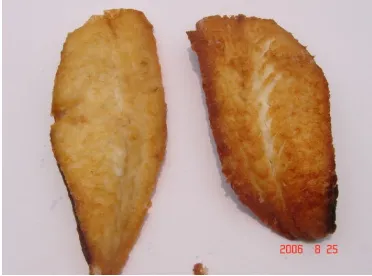
remaining 48 fillets were divided into equal groups of 24 fillets. One group was breaded and the other was not breaded. Twelve fillets of each group were deep-fried in sunflower oil and other 12 fillets were deep-fried in palm olein. After frying, fried fillets were allowed to drain in a strainer and cooled in room temperature for 10 min. After draining and cooling the non-breaded fried fillets were analyzed directly (Fig. 1) and for the breaded fried fillets; the breading materials were carefully removed from fish fillets (Fig. 2) and the fish fillets were then analyzed.
Figure 1: Non-breaded fried fish fillets Figure2: Breaded fried fish fillets
Wheat flour based batter was prepared in the Food Processing Lab by using 75% wheat flour (9g/100g protein), 24.5% corn flour (2g/100g protein) and 0.5% salt according to Fiszman & Salvador (2003) recommendation. All ingredients were mixed with the ratio of 1:1.4 (w/w) dry materials and cold tap water with a kitchen blender (National, MX-897
cool room (4 °C). The surfaces of thawed fillets were dabbed with paper towel they were then dipped into batter and excess batter was dripped off for 30s. Battered fillets were then breaded with bread crumbs.
Deep-fat frying was carried out in a 3 L capacity deep-fryer (PHILUX, Model Df30AIT). Sunflower oil and in palm olein were used as frying oils.
with a metal thermometer. The frying oil was used only once. The non-breaded and non-breaded fillets were fried for 2.5 and 3 min, respectively. Twelve pieces of breaded or non-breaded fillets were used for each experiment. Frying was performed in three batches and four fillets were fried in each batch. After frying, fried fillets were allowed to drain in a strainer for 5 min and cooled at room temperature for 10 min.
Total fat content was determined using the Soxhlet (AOAC, 1990). 2.5 g of wet – weight basis sample was extracted with petroleum ether 40-60°C boiling point for 8 h. All analysis was carried out in triplicate. The amounts of fat content were calculated based on wet basis and expressed to the dry weight of the samples of the samples.
For identification of the effects of breading on the oil uptake and microstructure of fillets during deep-fat frying, Scanning Electron Microscopy (SEM) study was performed on raw and fried samples. The SEM of the fillets was carried out according to Lloreca et al. (2003). Sample of about 10 mm³ was taken from the thickest part of the fillets. They were fixed in 4 % glutaraldehyde (pH, 7.2) at 4ºC for 24 h. They were then washed 3 times with 0.1 M sodium cacodylate buffer for 20 min for each washing. The samples were then post-fixed with 1% osmium tetraoxide at 4 ºC for 2 h. This was followed by another washing with 0.1 m sodium cacodylate buffer. Washing was repeated 3 times and
each washing was for 20 min. Samples were then dehydrated in a series of acetone dilutions of increasing concentration (35, 50, 75, 95, and 100 %), and then subjected to critical point drying in a critical point dryer (Bal-Tec CPD 030, Netherland) for 1.5 h. The dried samples were then coated with gold by a sputter coater (Bal-Tec SCD 005, Netherland).
Prepared samples were observed under the scanning electron microscope (LED 1455 VPSEM equipped with OXFORD LNCA ENERGY 300 EDX, UK) for observation of visual surface differences.
Viscosity of frying oils was measured according to Mecit et al. (2007) by using a viscometer (Model DV – II, BROODKFELD, USA) at room temperature (29 ºC). 16 ml of oil was used for each measurement and the measurements were carried out in triplicate.
Statistical software Minitab ® Release 14, Copyright 2003-2005 (Minitab Inc, Pennsylvania) was used to analyze the data in one way analysis of variance (ANOVA) with a tukey’s test (P<0.05) mean comparison for fat and moisture content of the samples.
Results
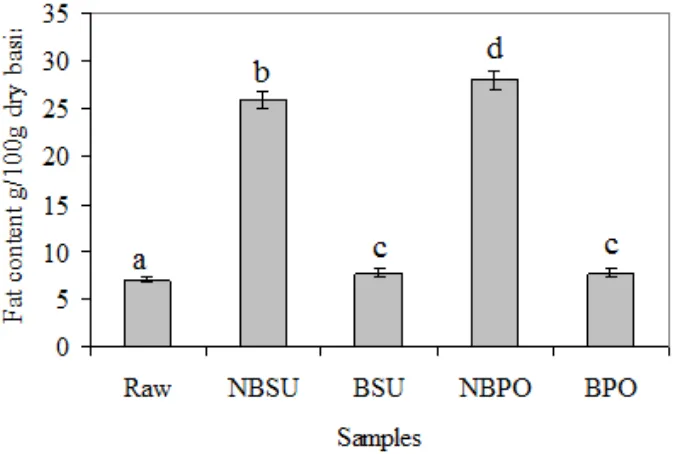
The fat content of different samples is shown in Fig. 3. Raw fillets had 7 g/100g fat content in dry weight edible portion. During the deep-fat frying, the fat content of all fried samples increased. In the non-breaded fillets, fat content increased between 19-20 g / 100g in dry matter after frying.
However, it increased less than 1 g / 100g in the fish muscle samples. Palm olein fried samples had significantly
(P<0.05) higher fat content than sunflower oil fried ones.
NBSU: Non-breaded fillets fried in sunflower oil, BSU: Breaded fillets fried in sunflower oil, NBPO: Non-breaded fillets fried in palm olein, BPO: Breaded fillets fried in palm olein
-Values are means ± deviations
-Values in the same column bearing different letters are significantly different (P<0.05).
Figure 3: Fat content in different samples (g/100g dry basis)
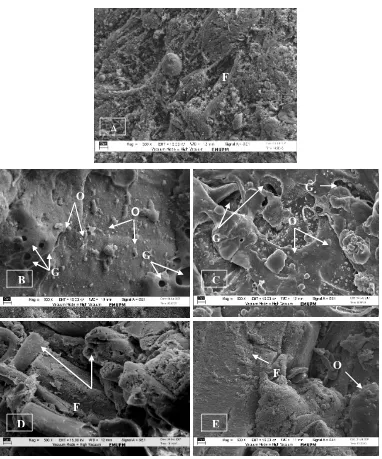
Observations of the raw sample (control) and fried fillets by SEM are as shown in Fig. 4. The surfaces of the non-breaded fried fillets in both frying oils (Fig 4, B & C) are highly deformed as compared to the raw sample (Fig 4, A) and the breaded fried fillets (Fig 4, D & E). The oil globules (O) can be seen as spherical shape (Lloreca et al., 2003) in the micrographs. Abundant oil globules in different sizes and irregular shapes
could be observed in these fillets. Many of gas cells (G) could be seen in these fillets. Observations made of on breaded fillets (Fig 4, D & E) were different from that of the non-breaded fried fillets. In these fillets, the surface was not obviously changed. Fish muscle filaments (F) could be identified easily and no observations of gas cells were made. A fewer oil globules (O) could be seen in these fillets.
O
O
G
G
F O
O F
G
O F
G
A
B C
D E
A: Raw fillet (control), B: non-breaded fillet fried in sunflower oil, C: non-breaded fillet fried in palm olein,
D: Breading removed fillets fried in sunflower oil, E: Breading removed fillets fried in palm olein
Figure 4: SEM micrographs of raw and fried non-breaded fillets (Magnification 500X). F: Fish filament, O: Oil globule, G: Gas cell
Discussion
Similar to previous studies we found that the presence of breading material prevents the oil uptake by the fillet (Fig. 3). Makinson et al. (1987) reported battering or battering plus bread crumbs reduced the fat absorption in fish sticks. It has been suggested that the use of coating has the potential to modify the amount of fat absorbed by deep-fat fried foods (Wills et al., 1981). Sánchez-Muinez et al. (1992) reported that fat penetration in fried food was heavily dependent on whether the food is fried in batter or not and in battered fish, fat did not penetrate into the food but remained on the outside coating. Results showed the types of frying oils also affected the oil uptake in the samples. Fried samples in sunflower oil contained lower fat than palm olein fried samples (Fig. 3). Similar results were observed by Fransisco et al. (1992). They reported that sardines when deep-fried for 4 min at 180 ºC in olive oil, sunflower oil and lard, the fat pike-up was found 39, 35 and 46/ g/ 100g of dry matter in olive oil, sunflower oil and lard fried samples , respectively. It was observed that higher viscosity of oil could cause the oil to adhere to the product surface (Moreira et al., 1997). A high oil viscosity and/or the use of hard fats will lead to less easy drainage of oil when the fried food is removed from the fryer and food temperature drops quickly (Rossi et al., 2007). In another work by Mecit et al. (2007)
hazelnut oil, they reported that fat uptake in fried potato was 41.28, 37.22 and 71.82 % for sunflower, corn and hazelnut oil, respectively. The viscosity of frying oil used in this study at room temperature was 42.7 cP, 43.7 cP and 54.9 cP for sunflower, corn and hazelnut oil, respectively. They concluded that higher fat content in hazelnut fried samples could be related to the higher viscosity of this oil. In our study the viscosity (at room temperature) of palm olein was higher (59.1 cP) than sunflower oil (46.3 cP), the higher fat uptake in palm olein fried samples could be explained to the higher viscosity of palm olein. Observations from the SEM micrographs showed that some gas cell (G) can be seen in the non-breaded fried fillets. This could be attributed to the effects of water vapor released from the fillets and the moisture loss during the deep-fat frying. Presence of gas cells (G) in the non-breaded fillets resulted in the higher fat uptake than that of fish muscle fillets. This was confirmed by the results which obtained by the Soxhelet method fat content determination (Fig. 3). No significant differences can be seen in terms of oil globules and gas cells in the surface of the fried fillets between the two frying oils.In conclusions; fat absorption of the fried fillets was strongly related to the breading process. The highest level of moisture loss and fat uptake were observed in
breading resulted in smaller oil uptake in the fish muscle fried in sunflower oil and palm olein. Higher fat uptakes were observed in non-breaded fried fillets for both oils. Observations of SEM micrographs indicated that non-breaded fried fillets had higher number of oil globule on their surfaces when compared to that of the non-breaded fried fillets.
References
AOAC. 1990. Official Methods of Analysis of the Association of Official Analytical Chemists, 15th ed. Washington, DC.
Bouchon, P., Hollins, P., Pearson, M., Pyle, D. L., and Tobin, M. J. 2001. Oil distribution in fried potatoes monitored by infrared microspectroscopy. Journal of Food Science and Technology, 66: 918-923.
Fiszman. S.M., & Salvador, A. 2003.
Recent developments in coating batters. Trends in Food Science and Technology, 14:339-407.
Fransisco, J., Sánchez-Muniz., Jesús, M. V., & Rafaela, M. 1992.
Deep-frying of sardines in different culinary fats. Changes in the fatty acids composition of sardines and frying fats. Journal of Agriculture Food Chemistry, 40: 2252-2256.
Gao, X., & Tan, J. 1996. Analysis of expanded-food texture by image processing, Part I: Geometric properties. Journal of Food Process Engineering, 19 (4): 425-444.
Kyaw, Z. Y., Cheow, C. S., Yu, S. Y., & Dzulkifly, M. H. 2001. The effect of pressure cooking on the microstructure and expansion of fish cracker (‘Keropok’). Journal of Food Quality, 24(3): 181-194.
Llorca E., Hernando I., Pérez-Munuera I., Fiszman S., Lluch M.A. 2001. Effect of frying on the
squid rings”. European Food Research and Technology, 213: 448-455.
Lloreca, E., Isabel, H., Isabel, P. M., Amparo, Q., Virginia, L., Susana M. F., et al. 2003. Effect
of batter formulation on lipid uptake during frying and lipid fraction of frozen battered squid. European Food Research and Technology, 216: 297-302.
Naruenartwongsakul, S., Chinnan, M. S., Bhumiratana, S., & Yoovidhya, T. 2008. Effects of cellulose ethers on the microstructure of fried wheat flour-based batters. LW. Food Science and Technology, 41(1): 109-118.
Makinson, J. H., Greenfild, H., Wong, M. L., & Wills, R. B. H. 1987. Fat uptake during deep-fat frying of coated and uncoated foods. Journal of Food Composition and Analysis, 1: 93-101.
Mallika, M., Pandey, M.C.,
Jayathilakan, K., Radhakrishna, K., Bawa A.S. 2008. Effect of fish (Catla catla) frying on the quality characteristics of sunflower oil. Food Chemistry,
106: 634 – 639.
McDonough, C., Gomez, M. H., Lee, J. K., Waniska, R. D., &
Rooney, L. W. 1993.
Environmental scanning electron microscopy evaluation of tortilla
fat frying. Journal of Food Science and Technology, 58(1):199-203.
Mecit, H.O., Serpil, S., & Gulum, S. 2007. Optimization of microwave frying of potato slices by using Taguchi technique. Journal of Food Engineering, 79: 83-91.
Mukprasirt, A., Herald, T. J., Boyle, D. L., & Rausch, K. D. 2000.
Adhesion of rice flour-based batter to chicken drumsticks evaluated by laser scanning confocal microscopy and texture analysis. Poultry Science, 79:1356-1363.
Moreira, R. G., Sun, X. Z., & Chen, Y. H. 1997. Factors affecting oil uptake in tortilla chips in deep-fat frying. Journal of Food Engineering, 31: 485-498.
Rossi, M., Alamprese, C., & Ratti, S.
2007. Tocopherols and
tocotrienols as free
radical-scavengers in refined vegetable oils and their stability during deep-fat frying. Food Chemistry, 102: 812–817.
Sánchez-Mufiiz, F. J., Viejo, J. M., and Medina, R. 1992. Deep-frying of sardines in different culinary fats. Changes in the fatty acids composition of sardines and frying fats. Journal of Agriculture of Food Chemistry, 40: 2252-2256.
Shyu, S. L., and Hwang, L. S., 2001.
Effects of processing conditions on the quality of vacuum fried apple chips. Food Research International, 34(23):133-142.
Wills, R. B. H., Wimalasiri, P. and
Greenfeield, H., 1981.
Composition of Australian Foods. Fried takeaway foods. Food Technology Australia 33: 26-27.