MODULATIONAL INSTABILITY OF THREE DIMENSIONAL WAVES IN A PLASMA WITH VORTEX ELECTRON DISTRIBUTION
H. DEMIRAY1,§
Abstract. In the present work, employing the three dimensional equations of a plasma composed of a cold electron fluid, hot electrons obeying a trapped /vortex-like distribution, and stationary ions, we study the amplitude modulation of an electron-acoustic waves by use of the conventional reductive perturbation method. Employing the field equations with fractional power type of nonlinearity, we obtained the three dimensional form of the modified nonlinear Schr¨odinger equation as the evolution equation of the same order of nonlinearity. The modulational instability of the homogeneous harmonic solution is investigated and the criteria for the instability is discussed as a function of the obliqueness angle.The numerical calculations show that the critical value of the wave number of the envelop wave increases with the wave numberkof the carrier wave and the obliqueness angleγ.
Keywords:Modified nonlinear Schr¨odinger equation, modulational instability, solitary waves. AMS Subject Classification: 83-02, 35Q51
1. Introduction
The concept of electro-acoustic mode had been conceived by Fried and Gould[1] during the numerical solutions of the linear electrostatic dispersion equation in an unmagnetized, homogeneous plasma. Besides the well-known Langmuir and ion-acoustic waves, they noticed the existence of a heavily damped acoustic-like solution of dispersion equation. It was later shown that in the presence of two distinct groups (cold and hot) of electrons and immobile ions, one indeed obtains a weakly damped electron-acoustic mode ( Watanabe and Taniuti[2] ), the properties of which significantly differ from those of the Langmuir waves.
To study the properties of electron-acoustic solitary wave structure Dubouloz et al.[3] considered a one-dimensional, unmagnetized collisionless plasma consisting of cold electrons, Maxwellian hot electrons and stationary ions. However, in practice, the hot electrons may not follow a Maxwellian distribution, due to the formation of phase space holes caused by the trapping of hot electrons in a wave potential. Accordingly, in most space plasma the hot elec-trons follow the trapped/vortex- like distribution (Abbasi et al.[4], Schamel[5,6]). Therefore, in the present work, we shall consider a plasma model consisting of a cold electron fluid, hot electrons obeying a non-isothermal (trapped/vortex-like) distribution, and stationary ions.
1
Isik University, Faculty of Arts and Sciences, Department of Mathematics, 34980 Sile, Istanbul, Turkey, e-mail: [email protected]; ORCID: https://orcid.org/0000-0001-8590-3396.
§ Manuscript received: May 22, 2017; accepted: Febrary 10, 2019.
TWMS Journal of Applied and Engineering Mathematics, Vol.9, No.3 cI¸sık University, Department of Mathematics, 2019; all rights reserved.
The propagation of small-but-finite amplitude waves in a one-dimensional ion-acoustic model had been studied by several researchers (see, for instance, Washimi and Taniuti[7] and one dimensional electron-acoustic model by Schamel[5, 6], Mamun and Shukla[8] by use of the classical reductive perturbation method (Taniuti [9] and Demiray [10, 11] by use of the modified PLK (Poincar´e, Lighthill-Kuo) method, wherein the contribution of higher order terms is also investigated.
Due to its central importance to the theory of quantum mechanics, the nonlinear equations of Schr¨odinger type are of great interest. They arise in many nonlinear problems such as water waves [12-14], waves in plasmas [15-19], nonlinear waves in fluid-filled elastic or viscoelastic tubes [20-22] and other nonlinear waves of similar nature. In all these works the nonlinear equations with integer power had been taken into consideration. However, when the nonlin-earity is of the type of fractional order of certain field quantities much more careful analysis of the problem has to be made.
In the present work, employing the three dimensional equations of a plasma composed of a cold electron fluid, hot electrons obeying a trapped /vortex-like distribution, and station-ary ions, we study the amplitude modulation of three dimensional nonlinear electron-acoustic waves through the use the reductive perturbation method. Due to nature of the problem, the field equations involve fractional nonlinearity (3/2) and they cause serious difficulties in amplitude modulation problems. Following the procedure outlined in Demiray [19], we ex-panded this nonlinear term of fractional order into Fourier cosine series of the phase function and obtained the three dimensional form of the modified nonlinear Schr¨odinger equation.The modulational instability of the homogeneous harmonic solution is investigated and the criteria for the instability is discussed as a function of the obliqueness angle. The numerical calcula-tions show that the critical value of the wave number of the envelop wave increases with the wave numberk of the carrier wave and the obliqueness angleγ.
2. Govening Equations
We consider a three-dimensional collisionless plasma consisting of stationary ions, a cold electron fluid and hot electrons obeying a trapped/vortex-like distribution. The dynamics of electron-acoustic waves is governed by the following equations:
∂n
∂t +
∂
∂x(nu) + ∂
∂y(nv) + ∂
∂z(nw) = 0, (1)
∂u ∂t +u
∂u ∂x+v
∂u
∂y +w
∂u
∂z −α
∂φ
∂x = 0, (2)
∂v ∂t +u
∂v ∂x +v
∂v
∂y +w
∂v ∂z −α
∂φ
∂y = 0, (3)
∂w ∂t +u
∂w
∂x +v
∂w
∂y +w
∂w
∂z −α
∂φ
∂z = 0, (4)
∂2φ
∂x2 +
∂2φ
∂y2 +
∂2φ
∂z2 =
n
α +nh−(1 +
1
α), (5)
where n is the normalized cold electron number density, nh is the normalized hot electron
number density, (u, v, w) are the cold electron fluid velocity components in cartesian coordi-nates, φis the electrostatic potential and the coefficient α is defined by α=nh0/n0 ; where
nh0 and n0 are the equilibrium values of the hot and cold electron number densities, respec-tively. The hot electron number densitynh, forβ <0 and small φ(φ <<1, can be expressed
by Schamel[5]
nh = 1 +φ−
4(1−β) 3√π φ
3/2+1 2φ
3. Modulation of nonlinear waves
In this section we shall study the amplitude modulation of three dimensional nonlinear waves propagating in such a plasma medium. For that purpose we introduce the following slow variables
ξ =(x−λt), η=y, ζ =z, τ =2t, (7)
where is a small parameter measuring the band width of superposed waves and λ is an unknown constant to be determined from the solution. The field variables are assumed to be functions of the fast (x, t) as well as the slow variables (ξ, η, ζ, τ). Then, the following differential relations hold true
∂
∂t →
∂
∂t−λ
∂ ∂ξ + 2 ∂ ∂τ, ∂ ∂x → ∂ ∂x+ ∂ ∂ξ, ∂ ∂y → ∂ ∂η, ∂ ∂z → ∂
∂ζ. (8)
For our future purposes it is convenient to assume that the field quantities can be expanded into a power series ofin the following form
n= 1 +4(n1+n2+2n3+...),
u=4(u1+u2+2n3+...),
v=5(v1+v2+2v3+...),
w=5(w1+w2+2w3+...)
φ=4(φ1+φ2+2φ3+...). (9)
Introducing the expansions (8) and (9) into the field equations (1)-(5) and setting the coeffi-cients of like powers ofequal to zero we obtain the following sets of differential equations:
O(4) equations:
∂n1
∂t +
∂u1
∂x = 0, ∂u1
∂t −α
∂φ1
∂x = 0,
∂2φ1
∂x2 −
n1
α −φ1 = 0. (10)
O(5) equations:
∂n2
∂t +
∂u2
∂x −λ
∂n1
∂ξ +
∂u1
∂ξ = 0, ∂u2
∂t −α
∂φ2
∂x −λ
∂u1
∂ξ −α
∂φ1
∂ξ = 0,
∂v1
∂t −α
∂φ1
∂η = 0, ∂w1
∂t −α
∂φ1
∂ζ = 0,
∂2φ2
∂x2 + 2
∂2φ1
∂x∂ξ −
n2
α −φ2= 0. (11)
O(6) equations:
∂n3
∂t +
∂u3
∂x −λ
∂n2 ∂ξ + ∂u2 ∂ξ + ∂n1 ∂τ + ∂v1 ∂η + ∂w1
∂ζ = 0,
∂u3
∂t −α
∂φ3
∂x −λ
∂u2
∂ξ −α
∂φ2
∂ξ +
∂u1
∂τ = 0,
∂v2
∂t −α
∂φ2
∂η −λ
∂v1
∂ξ = 0, ∂w2
∂t −α
∂φ2
∂ζ −λ
∂w1
∂ξ = 0,
∂2φ3
∂x2 + 2
∂2φ2
∂x∂ξ +
∂2φ1
∂ξ2 +
∂2φ1
∂η2 +
∂2φ1
∂ζ2 −
n3
α −φ3+
4(1−β) 3√π φ
3/2
3.1. Solution of the field equations. For the solution of the set (10) we write
(n1, u1, φ1) =Re[(N1, U1, ϕ1) exp(iθ)], θ=ωt−kx, (13) where N1, U1, ϕ1 are some complex functions depending on the slow variables ξ, η, ζ and τ and Re[.] stands for the real part of the corresponding complex variable. Introducing (13) into (10) we obtain
U1 =−α
k
ωϕ1, N1 =−α k2
ω2ϕ1, φ1 =ϕ1(ξ, η, ζ, τ), (14)
provided that the following dispersion relation holds true
ω2 = k
2
1 +k2, (15)
whereϕ1(ξ, η, ζ, τ) is an unknown complex function whose governing equation will be obtained later.
Introducing the solution (14) into the differential equation (11) we get
∂n2
∂t +
∂u2
∂x +α[ k ω(λ
k ω −1)
∂ϕ1
∂ξ exp(iθ) +c.c.] = 0, ∂u2
∂t −α
∂φ2
∂x +α[(λ k ω −1)
∂ϕ1
∂ξ exp(iθ) +c.c.] = 0, ∂v1
∂t −α[ ∂ϕ1
∂η exp(iθ) +c.c.] = 0, ∂w1
∂t −α[ ∂ϕ1
∂ζ exp(iθ) +c.c.] = 0, ∂2φ2
∂x2 −
n2
α −φ2−[2ik ∂ϕ1
∂ξ exp(iθ) +c.c.] = 0, (16)
where c.c. stands for the complex conjugate of the corresponding quantity. The form of equation(16) suggests us to seek the following type of solution
(u2, n2, φ2, v1, w1) =Re[(U2, N2, ϕ2, V1, W1) exp(iθ)], (17) whereU2, N2, ϕ2, V1, W1are some unknown complex functions of the slow variables (ξ, η, ζ, τ). Introducing (17) into the equation (16) we have
iωN2−ikU2+α
k ω(λ
k ω −1)
∂ϕ1
∂ξ = 0, iωU2+iαkϕ2+α(λ k ω −1)
∂ϕ1
∂ξ = 0,
N2 =−α(1 +k2)ϕ2−2iαk
∂ϕ1
∂ξ , V1 =−i α ω
∂ϕ1
∂η , W1=−i
α ω
∂ϕ1
∂ζ . (18)
Eliminating U2, N2, ϕ2 between the equation (18) and utilizing the dispersion relation we obtain
[kω+ k
ω(λ k ω −1)]
∂ϕ1
∂ξ = 0. (19)
In order to have a function ϕ1 depending on the variable ξ, the coefficient of ∂ϕ1/∂ξ must vanish
kω+ k
ω(λ k
ω −1) = 0, or λ= ω3
k3, (20)
where λ = dω/dk is the group velocity. Hence, from the solution of the equations (18) we obtain
U2 =−α
k ωϕ2+i
α ω(λ
k ω −1)
∂ϕ1
∂ξ , N2 =−α
k2
ω2ϕ2−2iαk
∂ϕ1
∂ξ ,
V1=−i
α ω
∂ϕ1
∂η , W1=−i
α ω
∂ϕ1
∂ζ , (21)
Introducing the solutions given in (14) and (21) into the equation (12) we obtain
∂n3
∂t +
∂u3
∂x +α
nk
ω(λ k ω −1)
∂ϕ2
∂ξ +i[2λk+
1
ω(λ k ω −1)]
∂2ϕ1
∂ξ2 −k 2 ω2 ∂ϕ1 ∂τ − i ω
∂2ϕ1
∂η2 −
i ω
∂2ϕ1
∂ζ2
o
exp(iθ) +c.c.= 0,
∂u3
∂t −α
∂φ3
∂x +α
n
(λk ω −1)
∂ϕ2
∂ξ −i
λ ω(λ
k ω −1)
∂2ϕ1
∂ξ2 −
k ω
∂ϕ1
∂τ o
exp(iθ) +c.c.= 0,
∂v2
∂t +α[i λ ω
∂2ϕ1
∂ξ∂η −
∂ϕ2
∂η ] exp(iθ) +c.c.= 0, ∂w2
∂t +α[i λ ω
∂2ϕ1
∂ξ∂ζ −
∂ϕ2
∂ζ ] exp(iθ) +c.c.= 0, ∂2φ3
∂x2 −
n3
α −φ3+
4(1−β) 3√π φ
3/2 1 +[−2ik∂ϕ2
∂ξ +
∂2ϕ1
∂ξ2 +
∂2ϕ1
∂η2 +
∂2ϕ1
∂ζ2 ] exp(iθ) +c.c.= 0. (22) For our future purposes we need only the equations related to the coefficients of exp(iθ) terms. In order to obtain such an equation we have to examine the term (φ1)3/2, appearing in the last expression of equation (22). Denoting the modulus ofϕ1 by|ϕ1|and the argument of it by s,φ1 can be expressed as
φ31/2=n|ϕ1|[
ei(s+θ)+e−i(s+θ)
2 ]
o3/2
=|ϕ1|3/2|cos3/2(s+θ). (23) In order to ensure that (φ1)3/2 remains real we must restrict the variation of (s+θ) as
|(s+θ)| ≤π/2. Since cos(s+θ) is a periodic function in (s+θ) we can expand the expression of (φ1)3/2 into a Fourier cosine series of the following form
φ31/2 =
∞
X
n=0
ancosn(s+θ), (24)
where the coefficient an is defined by
an=
4
π|ϕ1|
3/2d
n, dn=
Z π/2
0
cos3/2(s+θ) cosn(s+θ)d(s+θ). (25) For our future purposes we need only the coefficient ofa1 and the corresponding term of the Fourier series, which reads
4
π|ϕ1|
3/2d
1cos(s+θ) = 2
π|ϕ1|
3/2nexp[i(s+θ)] + exp[−i(s+θ)]o. (26) Notingϕ1=|ϕ1|exp(is), the equation (26) can be written in the following form
4
π|ϕ1|
3/2d
1cos(s+θ) = 2d1
π |ϕ1|
1/2[ϕ
1exp(iθ) +c.c.],
d1 =
Z π/2
0
(cosx)5/2dx. (27)
Inserting (27) into the equation (22), the equations related to the exp(iθ) terms take the following form
iωN3(1)−ikU3(1)+α nk
ω(λ k ω −1)
∂ϕ2
∂ξ
+i[2λk+ 1
ω(λ k ω −1)]
∂2ϕ1
∂ξ2 −i 1
ω( ∂2ϕ1
∂η2 +
∂2ϕ1
∂ζ2 )−
k2 ω2
∂ϕ1
∂τ o
iωU3(1)+iαkφ(1)3 +αn(λk ω −1)
∂ϕ2
∂ξ −i
λ ω(λ
k ω −1)
∂2ϕ1
∂ξ2 −
k ω
∂ϕ1
∂τ o
= 0,
N3(1)=α n
−(k2+ 1)φ(1)3 −2ik∂ϕ2
∂ξ +
∂2ϕ1
∂ξ2 +∂
2ϕ 1
∂η2 +
∂2ϕ1
∂ζ2 +
8(1−β)d1 3π√π |ϕ1|
1/2ϕ 1
o ,
iωV2+α[i
λ ω
∂2ϕ1
∂ξ∂η −
∂ϕ2
∂η ] = 0, iωW2+α[i λ ω
∂2ϕ1
∂ξ∂ζ −
∂ϕ2
∂ζ ] = 0, (28)
where forv2, w2, n3, u3 andφ3 we have sought solutions of the following form (v2, w2) =Re[(V2, W2) exp(iθ)],
(n3, u3, φ3) =Re[
∞
X
n=1
(N3(n), U3(n), φ(3n)) exp(inθ)]. (29) EliminatingN3(1), U3(1), φ(1)3 between the equations (28) we obtain the following evolution equa-tion
i∂ϕ1 ∂τ +µ1
∂2ϕ 1
∂ξ2 +µ2|ϕ1| 1/2ϕ
1−µ3(
∂2ϕ 1
∂η2 +
∂2ϕ 1
∂ζ2 ) = 0, (30) where the coefficientsµ1, µ2 and µ3 are defined by
µ1 =
3λk
2(1 +k2), µ2 =
4λkd1(1−β)
3(π)3/2 , µ3=
λ
2k. (31)
Carrying out the integral ford1, given in (27) numerically, the result is found to be d1 ≈0.72 .
3.2. Modulational instability. In this sub-section we shall study modulational instability of the plasma wave described by the 3D NLS equation (30). The NLS equation (30) has the trivial homogeneous solution
ϕ1=ϕ01exp(iµ2|ϕ01|1/2τ), (32)
whereϕ01 is a real constant representing the amplitude of the carrier wave. Now, we investigate the evolution of the small modulationδϕ1 defined by
ϕ1 = [ϕ01+δϕ1(ξ, η, ζ, τ)] exp(iµ2|ϕ01|1/2τ). (33) Substituting (33) into (30) and collecting the first order terms inδϕ1 we have
i ∂
∂τ(δϕ1) +µ1 ∂2
∂ξ2(δϕ1) +
µ2 4 |ϕ
0
1|1/2(δϕ1+δϕ1∗)
−µ3[ ∂ 2
∂η2(δϕ1) +
∂2
∂ζ2(δϕ1)] = 0, (34)
whereδϕ1∗is the complex conjugate ofδϕ1. Lettingδϕ1 =U+iV and (U, V) = (U0, V0) exp[i(Ωτ−
K1ξ−K2η−K3ζ)] +c.c. in equation (34) and separating the real and imaginary parts, we obtain the following coupled equations
[µ2|ϕ 0 1|1/2
2 +µ3(K 2
2 +K32)−µ1K12]U0−iΩV0 = 0,
where Ω is the modulational frequency, K1, K2, K3 are the components of the propagation direction vector andK =pK2
1 +K22+K32 is the modulational wave number. The following dispersion equation may be obtained from the equation (35)
Ω2 = [µ1K12−µ3(K22+K32)]2
n
1− µ2|ϕ
0 1|1/2
2[µ1K12−µ3(K22+K32)
o
. (36)
The modulational instability will occur when the following condition is satisfied
µ2|ϕ01|1/2 [µ1K12−µ3(K22+K32)]
>2. (37)
Denoting the tangent of the angle between the propagation direction and the ξ axis by γ we can write γ =pK22+K32/K1 and the dispersion equation (36) becomes
Ω2=K4[µ1−µ3γ 2 1 +γ2 ]
2[1− |ϕ01|1/2(1 +γ2) 2K2
µ2/µ1 1−γ2µ
3/µ1
]. (38)
The dispersion relation for one dimensional case may be obtained from (36), by settingK2=
K3= 0, as
Ω2 = (µ1K2)2[1−
|ϕ0 1|1/2µ2 2µ1K2
]. (39)
This is exactly the same with that of found in [18].
For the present problem µ2/µ1 > 0 for all values of the wave number k , therefore, the modulational instability occurs when
K2< Kc2= |ϕ 0 1|1/2µ2
2µ1
. (40)
For the general case the modulational instability may occur when the conditions 0< γ < γc
and K < Kc,γc and Kcare defined by
γc= (µ1/µ3)1/2, Kc=
h|ϕ0
1|1/2(1 +γ2)µ2/µ1 2(1−γγ22
c)
i1/2
. (41)
In this case the instability growth rate Γ may be defined by
Γ =µ1K2
(1− γγ22 c)
(1 +γ2)
h|ϕ0
1|1/2(1 +γ2)µ2/µ1 2K2(1−γ2
γ2 c)
−1i1/2. (42) For fixed wave numberk, the growth rate Γ is a function of γ and K . The maximum value of the growth rate occurs atK =Kc/
√
2 and the result is found to be
Γmax=
µ2|ϕ (0) 1 |1/2
4 . (43)
It is seen that the maximum growth rate is independent of the obliqueness angle γ and the wave numberK ; it simply is a function of the wave numberk .
3.3. Numerical results and discussion. For the illustration of the analytical results of the modulational instability problem we shall chooseβ =−0.5 andϕ0
1= 1. Then, the expressions of the critical obliqueness angle γc, the critical wave number Kc and the maximum growth
rate Γmax take the following form
γc= √
3k
√
1 +k2, Kc= 0.294
p
(1 +γ2)(1 +k2)
q
(1−(1+3kk22)γ2)
Figure 1. The variation of the critical obliqueness angle γc with the wave
numberk.
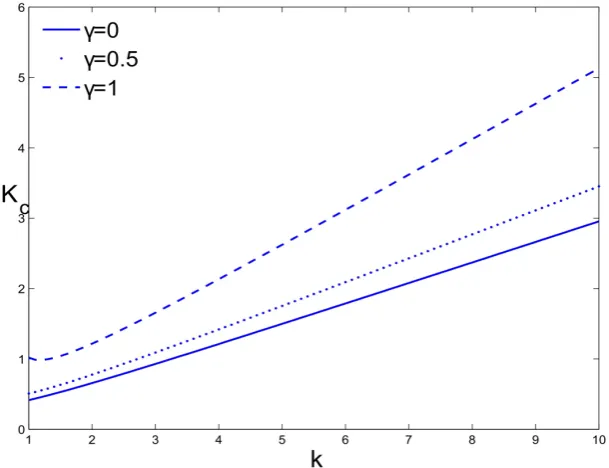
Figure 2. The variations of Kc with the wave numberkfor various
oblique-ness angleγ.
Γmax= 0.0647
k
(1 +k2)3/2. (44) The variations of the critical obliqueness angleγcwith the wave numberkis depicted on Figure
1. As is seen, γc increases with increasing wave number. In other words, the possibility of
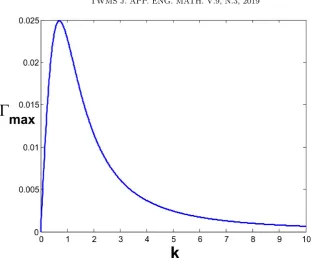
Figure 3. The variation of maximum growth rate Γmaxwith the wave number
k.
The variations ofKcwith wave number k for various values of the obliqueness angleγ are
shown on Figure 2. The critical wave numberKcincreases with the wave number (k) and the
obliqueness angle (γ). The result reveals that the most stable wave is the one dimensional waveγ = 0. As the angleγ increases the region of stability also increases.
The variation of maximum growth rate Γmax with wave number is illustrated in Figure 3.
As pointed out before, the maximum value of the growth rate is independent of the obliqueness angleγ and it simply depends on the wave numberk. It reaches its maximum value at about
kc= 1/ √
2 and in the region 0< k < kc, Γmax increases with kwhereas in the region k > kc
it decreases with the wave number.
4. Conclusion
In the present work, employing the three dimensional equations of a plasma composed of a cold electron fluid, hot electrons obeying a trapped /vortex-like distribution, and stationary ions, we studied the amplitude modulation of a three dimensional electron-acoustic waves. Due to the fractional nonlinearity (3/2) of the field equations, they cause serious difficulties in studying modulation problems. To surmount this difficulty, we expanded this nonlinear term of fractional order into Fourier cosine series of the phase function and obtained the three dimensional form of the modified nonlinear Schr¨odinger equation.The modulational instability of the homogeneous harmonic solution is investigated and the criteria for the instability is discussed as a function of the obliqueness angle and the wave number.
The numerical results show that the maximum obliqueness angle γc for the modulational
instability increases with the wave number k . Another parameter Kc for the modulational
instability increases with increasing wave number k and the obliqueness angle γ . As a final remark we should say that, the maximum growth rate Γmax is independent of the obliqueness
angle γ; it simply depends on the wave number k. Γmax increases with k up to kc = 1/ √
References
[1] Fried, B. D. and Gould, R. W., (1961), Longitudinal Ion Oscillation in a Hot Plasma, Phys. Fluids, 4, pp. 139-147.
[2] Watanabe, K. and Taniuti, T., (1977), Electron-Acoustic mode in Plasma of Two-Temperature Electrons, J. Phys. Soc. Japan, 43, pp. 1819-1820.
[3] Dubouloz, N., Pottelette, N., Malignre, M., and Truemann, R. A., (1972), Generation of Broadband Electrostatic Noise by Electron-Acoustic Solitons, Geophys. Res. Lett. 18, pp. 155-158.
[4] Abbasi, H., Tsintsadze, N. L. and Tskhakaya, D. D., (1999), Influence of Particle Trapping on the Prop-agation of Ion-Cyclotron Waves, Phys. Plasma, 6, pp. 2373-2379.
[5] Schamel, H., (1972), Stationary Solitary, Snoidal and Sinusoidal Ion-Acoustic Waves, Plasma Phys. 14, pp. 905-924.
[6] Schamel, H., (1973), A Modified Korteweg-De vries Equation for Ion-Acoustic Waves due to Resonant Electrons, J. Plasma Phys., 9, pp. 377-387.
[7] Washimi, H. and Taniuti, T., (1966), Propagation of Ion-Acoustic Solitary Waves of Small Amplitude, Phys. Rev. Lett., 17, pp. 996-998.
[8] Mamun, A. A. and Shukla, P. K., (2002), Electron-Acoustic Solitary Waves via Vortex Electron Distribu-tion, J. Geophysical Res., 107, A7.10.1029/2001JA009131.
[9] Taniuti, T., (1974), Reductive Perturbation Method and Far Fields of Wave Equations, Suppl. of Progress in Theoretical Phys., 55, pp. 1-35.
[10] Demiray, H., (2018), Higher Order Perturbation Expansion for Ion-Acoustic Solitary Waves with Q-Nonextensive Nonthermal Distribution, TWMS J. Appl. and Engr. Mathematics, V.8, pp. 438-447. [11] Demiray, H., (2012), Contribution of Higher Order Terms to the Nonlinear Shallow Water Waves, TWMS
J. Appl.and Engr. Mathematics, V.2, pp. 210-218.
[12] Johnson, R. S., (1997), A modern Introduction to the Mathematical Theory of Water Waves, Cambridge University Press, Cambridge.
[13] Dullin, H. R., Gottwald, Holm D. D., (2001), An Integrable Shallow Water Equation with Linear and Nonlinear Dispersion, Phys. Rev. Lett. 87, pp. 4501-4504.
[14] Kliakhandler, I., Trulsen K., (2000), On Weakly Nonlinear Modulation of Waves in Deep Water, Phys. Fluids, 12, pp. 2432-2437.
[15] Hue, J. K., (2005), Modulation of Multidimensional Waves in a Dusty Plasma, Physics of Plasmas, 12, 062313.
[16] Jukui, X., (2003) Modulational Instability of Ion Acoustic Waves in a Plasma Consisting of Warm Ions and Non-Thermal Electrons, Chaos, Solitons and Fractals, 18, pp. 849-853.
[17] Demiray, H., (2016), Modulation of Electron-Acoustic Waves in a Plasma with Kappa Distribution, Physics of Plasmas, 23, 032109.
[18] El-Labany, S. K., El-Taibany, W. F. and Zedan, N. A., (2017), Modulated Ion-Acoustic Waves in a Plasma with Cairns-Gurevich Distribution, Physics of Plasmas, 24, 112118.
[19] Demiray, H., (2015), Modulation of Electron-Acoustic Waves in a Plasma with Vortex-Electron Distribu-tion, Int. J. Nonlinear Sci. Numerical Simul., 16, pp. 61-66.
[20] Ravindran, R., Prasad, P. A., (1979), Mathematical Theory of Nonlinear Waves in a Fluid-Filled Vis-coelastic Tube, Acta Mech., 31, pp. 253-280.
[21] Demiray, H., (2001), Modulation of Nonlinear Waves in a Viscous Fluid Contained in an Elastic Tube, Int. J. Nonlinear Mech., 36, pp. 649-661.
[22] Antar, N., Demiray, H., (1999), Weakly Nonlinear Waves in a Pre-stressed Thin Elastic Tube Containing a Viscous Fluid, Int. J. Engr. Sci., 37, pp. 1859-1876.