R E S E A R C H
Open Access
Evolution of
Mutator
transposable elements
across eukaryotic diversity
Mathilde Dupeyron
*, Kumar S. Singh, Chris Bass and Alexander Hayward
*Abstract
Background:Mutator-like elements (MULEs) are a significant superfamily of DNA transposons on account of their: (i) great transpositional activity and propensity for insertion in or near gene sequences, (ii) their consequent high mutagenic capacity, and, (iii) their tendency to acquire host gene fragments. Consequently, MULEs are important genetic tools and represent a key study system for research into host-transposon interactions. Yet, while several studies have focused on the impacts of MULEs on crop and fungus genomes, their evolution remains poorly explored.
Results: We perform comprehensive bioinformatic and phylogenetic analyses to address currently available
MULE diversity and reconstruct evolution for the group. For this, we mine MULEs from online databases, and combine search results with available transposase sequences retrieved from previously published studies. Our analyses uncover two entirely new MULE clades that contain elements almost entirely restricted to arthropod hosts, considerably expanding the set of MULEs known from this group, suggesting that many additional MULEs may await discovery from further arthropod genomes. In several cases, close relationships occur between MULEs recovered from distantly related host organisms, suggesting that horizontal transfer events may have played an important role in the evolution of the group. However, it is apparent that MULEs from plants remain separate from MULEs identified from other host groups. MULE structure varies considerably across phylogeny, and TIR length is shown to vary greatly both within and between MULE groups. Our phylogeny suggests that MULE diversity is clustered in well-supported groups, typically according to host taxonomy. With reference to this, we make suggestions on how MULE diversity can be partitioned to provide a robust taxonomic framework.
Conclusions: Our study represents a considerable advance in the understanding of MULE diversity, host range and evolution, and provides a taxonomic framework for the classification of further MULE elements that await discovery. Our findings also raise a number of questions relating to MULE biology, suggesting that this group will provide a rich avenue for future study.
Keywords:MULE, MULEs, MuDR, Transposon, Horizontal transmission, Horizontal transfer, Phylogenetic analysis
Introduction
Mutatortransposable elements (TEs) are among the most
mutagenic transposons known, due to their very high rates of transposition and their bias for inserting near or
close to genes [1, 2]. The original Robertson’s Mutator
element (MuDR,‘Mutator Don Robertson’) was described
in maize, where Mutator lines can display mutation
fre-quencies ~ 50 times the background rate of spontaneous
mutation [3,4]. Given these qualities, theMutatorsystem
has a long history of usage in the field of genetic engineer-ing in both forward and reverse genetic screenengineer-ing, and has played an important role in shaping our understanding of
host-transposon co-evolutionary interactions [2].
Members of theMutatorDNA transposon superfamily
are termed ‘MULEs’ (Mutator-like elements) [5]. The
structure of MULEs resembles classic “cut-and-paste”
DNA TEs, with Terminal Inverted Repeats (TIRs) at each end enclosing a transposase domain containing a catalytic DDE motif, and often an additional zinc finger DNA-binding motif. However, MULE TIRs are typically considerably longer than those present in other DNA TE
© The Author(s). 2019Open AccessThis article is distributed under the terms of the Creative Commons Attribution 4.0 International License (http://creativecommons.org/licenses/by/4.0/), which permits unrestricted use, distribution, and reproduction in any medium, provided you give appropriate credit to the original author(s) and the source, provide a link to the Creative Commons license, and indicate if changes were made. The Creative Commons Public Domain Dedication waiver (http://creativecommons.org/publicdomain/zero/1.0/) applies to the data made available in this article, unless otherwise stated.
* Correspondence:[email protected];[email protected]
superfamilies, commonly being hundreds of base pairs in length. Meanwhile, some families of MULE appear to
lack TIRs completely (non-TIR MULEs) [6]. A further
characteristic of MULEs is the length of their target site duplications (TSDs), which are short direct repeats cre-ated following transposition, that occur immediately
out-side of the TIRs and are 8-11 bp in MULE elements [5].
An interesting feature of several MULEs is their acqui-sition of one or more additional open reading frames (ORFs). The first complete MULE element described in
maize contained two ORFs:mudrA, encoding the
trans-posase, and mudrB, encoding a protein of unknown
function that is apparently required for integration into
the maize genome [7, 8]. Other classes of MULE may
also contain additional ORFs, such as the mutB ORF
with a DNA binding role in the yeastMutylelement that
occurs in the same orientation as the transposase ORF
[9], or thevanBandvanCORFs in the arabidopsisHiun
element, which are divergent proteins with unknown
and anti-silencing functions, respectively [10]. It is often
assumed that additional ORFs originate from the host genome, as has been demonstrated in rice and several
other plant genomes [6, 11]. In plant genomes there are
large numbers of non-autonomous Mutator elements
known collectively as ‘Pack-MULEs’, that have lost their
transposase genes and instead carry fragments of host
genes [12]. Additionally, there is evidence that several
MULEs have undergone molecular domestication and become exapted by host genomes. For example, MULE-derived genes act as transcription factors that
modulate the light response in Arabidopsis [13, 14],
while the MULE-derived MUSTANG genes, which are
present in all flowering plants, are involved in diverse processes including flowering, growth and reproduction, and may have played an important role in early
angio-sperm evolution [15].
MULEs are best known from plant genomes, and
especially maize [7], but they also occur in a wide
range of eukaryotic genomes [2]. For example, over
the last 15 years, studies have described MULEs from diverse hosts, including several ascomycete species
[16], the yeast Yarrowia lipolytica [9], the Oomycete
genus Phytophthora [17], amoeba from the genus
Ent-amoeba [18], the excavate Trichomonas vaginalis [19],
diatoms [20], the mosquito Aedes aegypti [21], and
the trematode Schistosoma [22]. However, MULEs
were detected in the animal kingdom only recently
[23, 24], and in general very little remains known
about MULEs from metazoan genomes [21, 22].
In common with other DNA transposons, MULEs contain a DDE catalytic domain with structural features in common with other Class II TEs and the integrase
domain of Class I LTR-retrotransposons [25]. The DDE
domain is typically more highly conserved than other
regions, and DDE sequences are often employed in
phylogenetic analyses [26]. Analyses across DNA TE
di-versity utilising the DDE domain have indicated that
MULEs share the closest relationship to Pand hAT
ele-ments [26, 27]. Several phylogenetic analyses have also
attempted to reconstruct evolution within the MULE
superfamily [16, 18, 22, 24]. However, the most recent
consideration of MULE evolution was in 2011, where the transposase amino acid sequences of just 39 MULE elements from 26 host genomes resulted in the division of the included sequences into 6 families (MuDR,
TvCa-MULE, Curupira, EMULE, Hop/Jittery, and Phantom)
[22]. Given the recent accumulation of genome
sequen-cing data, we revisit the question of MULE evolution. We perform bioinformatic analyses to mine new mem-bers of the MULE superfamily, and phylogenetic ana-lyses to update and further investigate the evolutionary history of this important group of DNA TEs.
Results and discussion
Using a series of genomic database searches, we
recov-ered 1631 autonomous Mutator-like elements (MULEs)
present in the genomes of hosts from 178 species, across 6 major groupings of eukaryotic life (animals, fungi, amoeba, stramenopiles, parabasalids and plants). Based on the results of our phylogenetic analyses (Additional
file1), and the use of the ClusterPicker pipeline [28], we
divided MULE diversity into 50 major lineages, accord-ing to the fixed criteria of strict monophyly, clade
statis-tical support, and the genetic distance between
sequences. During our database searches, we detected several new groups of MULE elements, and a consider-able number of new elements from invertebrate host ge-nomes. We find that TE structure varies considerably across MULE diversity, with elements differing in the possession of additional zinc finger domains and DNA inserts, and varying greatly in TIR length (14-500 bp) and overall element length. Below we discuss our results, and the insights they provide into MULE evolution, host interactions, and MULE taxonomy.
Two novel MULE clades from invertebrate host genomes We identify two new MULE clades that we name
Ghost and Spectre which contain 16 and 53 novel
MULE sequences respectively, from the genomes of host species in 15 insect and arachnid genera (see
Groups 7 and 8, Additional file 1). One of these new
clades, Ghost, also includes four sequences from
cni-darian genomes. All sequences in the Ghost and
Spectre clades were recovered by BLAST searches,
using the transposase sequence of a newly identified
Spectre element as a query, except the 3 cnidarian
using the transposase sequence of MuDR-1_NV (see Methods).
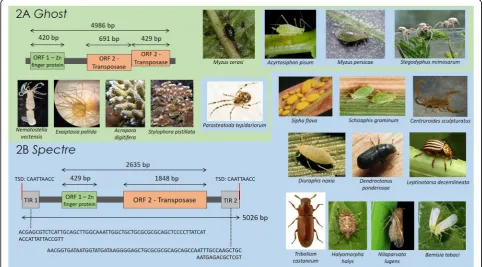
The Ghost clade contains sequences mined from the
genomes of the following aphid and spider species: pea
aphidAcyrtosiphon pisum, green peach aphidMyzus
per-sicae, black cherry aphid Myzus cerasi, common house
spiderParasteatoda tepidariorum, and African velvet
so-cial spider Stegodyphus mimosarum. Since the date of
the most recent common ancestor of insects and
arach-nids is very deep (~ 500-600MYA) [29], and the most
re-cent common ancestor of arthropods and cnidarians (i.e. Protostomia and Deuterostomia) is considerably more ancient, this host distribution pattern implies that at
least one horizontal transfer event ofGhostelements has
occurred within the clade, and across major branches of
host diversity. Further, given that Ghost spider MULEs
(from S. mimosarum and P. tepidariorum) are nested
within a Ghost clade containing 11 aphid MULEs, it is
likely that there have been further horizontral transmis-sion events between arachnids and insects. Aphids and spiders occupy a shared environment and have a close ecological relationship, and potential horizontal trans-mission events may have occurred via a mechanism
through predation for example [30–32]). A transmission
route linking echinoderms and arthropods is less obvi-ous, however, the relatively short branch length between MULEs from these taxa is otherwise hard to explain
(Additional file1). MULEs from additional host taxa that
provide a more obvious transmission route may be
iden-tified in the future. No complete Ghost elements were
recovered, and most elements in the clade were repre-sented by a DDE domain only. No TIRs were detected, and only three elements contain a zinc finger motif. The
most complete Ghost element originates from the
gen-ome of the black cherry aphid (M. cerasi), and is
anno-tated in Fig.1a. This element contains two open reading
frames: a 420 bp ORF containing a RING zinc finger do-main, and a truncated 1120 bp ORF containing the transposase. Despite its truncated transposase ORF, the DDE domain does not contain stop codons and aligns well with other sequences employed in phylogenetic ana-lyses. However, neither TIRs nor TSDs for this element could be identified. It is possible that this apparent lack of TIRs and TSDs may result from sequencing errors,
since the M. cerasigenome sequence is still provisional,
and the scaffold containing the most complete Ghost
element is very short, at just 4918 bp in length. The
remaining Ghost elements from aphid genomes were
also found in short scaffolds (Additional file2: Table S2),
which appear to represent repeat rich regions where suc-cessive elements have inserted into each other.
Dis-counting sequencing issues, Ghost MULEs may either
represent an additional group of non-TIR MULEs (see below), or an old and no longer active MULE family
where TIRs and TSDs have degraded. If the latter is the case, the intact DDE domains of these sequences may argue for their domestication for host purposes, other-wise it is unclear why other structural features should have been degraded but the DDE domain retained.
Elements in the Spectre clade were identified in the
same host genomes as Ghost elements, with the
excep-tion of the black cherry aphid (M. cerasi) and the
cnidar-ian hosts, and the addition of a number of arthropod
hosts: three aphid species (greenbug Schizaphis
grami-num, Russian wheat aphid Diuraphis noxia, yellow
sug-arcane aphidSipha flava), three true bugs (marmorated
stink bug Halyomorpha halys, brown planthopper
Nila-parvata lugens, silverleaf whitefly Bemisia tabaci), three
beetles (mountain pine beetle Dendroctonus ponderosae,
Colorado potato beetle Leptinotarsa decemlineata, red
flour beetleTribolium castaneum), and the Arizona bark
scorpion (Centruroides sculpturatus). One complete
Spectre element was identified, which originated from
the genome of the green peach aphid (M. persicae). The
complete element contains two ORFs, consisting of a
C2H2 zinc finger domain and a transposase, and two
perfect 74 bp TIRs, each flanked by an 8 bp TSD (please
see annotation in Fig. 1b). The discovery of an intact
transposase sequence and perfect TIRs and TSDs in Spectre suggests that this family is still active.
Identifica-tion of a clade of closely related Spectre elements with
short terminal branch lengths in the genome of the
Colorado beetle (L. decemlineata), suggests this genome
may contain a currently active group of elements, although we were unable to detect a fully complete Spectresequence in this host.
Our analyses greatly expand the number of known in-vertebrate genomes that host MULE elements. Further,
given the distribution of hosts observed in the Ghost
and Spectre clades, we suggest that many more MULEs
may await discovery in diverse arthropod genomes. Con-sequently, we anticipate that understanding of the host range and evolution of these families will increase con-siderably over coming years, as increasing numbers of invertebrate genomes are screened for transposons.
Evolution and host range of MULEs
In line with previous studies, we identified MULE ele-ments in the genomes of 6 diverse groups of eukaryotic life: animals, fungi, amoeba, stramenopiles, parabasilids, and plants. Such a wide diversity of distantly related hosts, alongside the observed branching pattern between
host groups (Additional file 1), suggests a history of
re-peated horizontal transfer for MULEs. While once con-sidered rare, horizontal transfer has recently become established as a strong force in shaping the distribution
and evolution of TEs [33]. Our phylogeny, where high
clade support unites hosts from diverse origins, suggests
a tendency for certain MULEs to jump between hosts from distantly related branches of the tree of life, such as stramenopiles and platyhelminthes (group 16), menopiles, arthropoda and tunicata (group 20), and stra-menopiles, plants and fungi (group 35) (Additional file
1). Remarkably, this last group includes MULEs from
host species belonging to three different taxonomic kingdoms. A shared environment and close ecological associations may promote such groupings, for example,
in groups 44 and 50, Phytophthora are widespread
fila-mentous generalist plant pathogens that share an
intim-ate relationship with their plant hosts [34], while
Chaetomium globossum (group 35) is a widespread
fun-gus that can colonise various habitats and cause
oppor-tunistic infections [35]. Similarly, a MULE previously
reported from the genome of a polydnavirus (viruses injected into insect hosts by parasitic wasps to suppress
host immunity) [24], clusters closely with other MULEs
isolated from diverse invertebrate genomes (group 20,
Additional file 1), including the jewel wasp (Nasonia
vitripennis) and the red flour beetle (Tribolium
casta-neum), highlighting the potential role of viruses as
vec-tors for the horizontal transmission of transposons. Several cases of the horizontal transfer of MULEs be-tween plant hosts have also been suggested, including
rice and other grasses in the genusSetaria, and rice and
Old World bamboos [36]. Nevertheless, despite the close
relationships shared between elements in the above mentioned host groups, and the apparent incongruence in observed host phylogenetic relationships, it is prudent to remain cautious when hypothesizing horizontal trans-fer events until a larger number of eukaryotic genomes have been screened for MULEs.
There are few instances of MULEs from non-plant ge-nomes in the more derived clades of MULE phylogeny
(i.e. groups 36–49, Additional file 1). In the very few
cases where non-plant MULE lineages do occur among more derived clades, they exist as isolated lineages, and
are restricted to the plant parasitePhytophthoraand one
instance of the platyhelminthSchmidtea (groups 39 and
50, and the isolated taxon 40 MuDR-4_SM, Additional
file 1). Thus, more derived MULE clades contain
ele-ments that are generally restricted to plant host ge-nomes, perhaps reflecting a fundamental difference in the biochemistry of transposition for this group of ele-ments in plants, or differing defence mechanisms against MULE transposons. In more basal clades, MULEs are typically distributed according to host group, either at a general level, or as radiations of elements restricted to individual host species or genera (e.g. group 1 and 12
Trichomonas, group 13 Entamoeba, group 19 Mollusca,
group 21 to 34 Trichinella,Additional file1). A
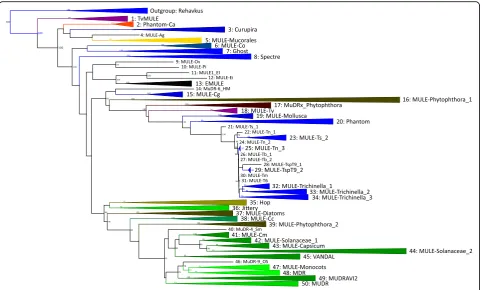
cartoo-nised depiction of MULE phylogeny (Fig. 2), highlights
host groups across phylogeny, with the exception of more derived clades, which as mentioned above, contain elements almost exclusively originating from plant host genomes.
We find limited evidence for the existence of MULEs in chordates, with the exception of one sequence from
the Pacific transparent sea squirt (Ciona savigny). The
presence of MULES in the genomes of the Florida
lance-let Branchiostoma floridae and horse Equus caballus
were previously reported [24], yet while an amino acid
alignment was provided for a FLYWCH zinc finger, none were provided for the transposases of these elements, and we were unable to detect evidence of MULE trans-posases in the nucleic acid sequences provided for these taxa, or during independent database searches. In
Repbase, 9 reports of MuDR elements exist from
verte-brate host genomes, 6 of which originate from the
gen-ome of the zebrafish Danio rerio and 3 from the
genomes of placental mammals. However, of these 9 re-ports, only 3 are listed as autonomous elements
(MuDR-1_DR, MuDR-2_DR, MuDR-3_DR) [37], their
ORFs are extremely fragmented, and we were not able to detect a match between these sequences and MULE transposases. Moreover, we were not able to align the above mentioned protein sequences to our mutator
alignment (Additional file 3), strongly suggesting that
these supposedly vertebrate MULE sequences are in fact mis-identified. Consequently, the identity of the 4750
MuDR elements listed from the zebrafish and those
from Eutherian genomes [38–41] require re-evaluation.
A striking observation from our analyses is that, with the exception of plant MULEs (which are mainly found in crops and other cultivated species), many of the ge-nomes that contain MULE elements belong to parasitic/ pathogenic species that either attack plants (e.g. insects,
fungi and the Oomycete Phytophthora) or animals (e.g.
diverse eukaryote groups including:Schistosoma,
Tricho-monas, Nasonia, Lepeophtheirus, Trichinella, Candida).
A potential explanation for this pattern is a bias in se-quencing effort directed towards parasitic species, due to their important impacts on health or agriculture. However, several alternative hypotheses may explain the potential increased load or activity of MULEs in parasite
genomes [42–44]. For example, the genomes of parasitic
Phytophthora and fungal pathogens are often
consider-ably larger than those of non-parasitic stramenopiles and fungi, and their genome expansions are typically a
consequence of increases in TE copy number [45].
Add-itionally, the hypothesis of “two-speed genomes” in
fila-mentous plant pathogens suggests that repeat-rich regions of the genome evolve quickly, facilitating new regulatory functions and rearrangements that can
enhance parasite adaptation to host defences, whereas
gene-rich regions evolve more slowly [43]. Under this
hypothesis, the success of MULEs in Phytophthora
spe-cies (especiallyP. infestans), and the fungi Puccinia
gra-minis andFusarium oxysporumcould be facilitated by a
decreased stringency towards suppressing TE mobility. Similar processes may be applicable to parasitic insects, such as the peach potato aphid and Colorado potato
beetle, which are globally important pests of crops [46,
47]. Selection for novel resistance mutations has been
intense in many insect species over recent decades, fol-lowing the extremely high exposures to insecticides
ex-perienced by many insect populations globally.
Indeed, the role of successive TE insertions in pro-moting increased host insecticide resistance via the evolution of genomic novelty has been documented in Drosophila [48].
An interesting and diagnostic feature of MULEs is
their unusually long TIRs [2]. As mentioned above, TIRs
in MULEs vary greatly in length, and elements included in our analysis possess TIRs between 14 and 500 bp. Fur-thermore, this variation appears to be independent of
phylogeny (Table 1, Additional file1). It is not currently
clear why such great variation exists in TIR length within and between MULE groups over phylogeny. TIRs contain promoters that trigger transcription of the
trans-posase [49], and so are important for basic transposon
functioning. However, it has been suggested that TIRs may be used by host genomes to distinguish between host genes and those of genomic parasites (given read-through transcription of TEs resulting in fold-back at TIRs to form hairpin double stranded RNA structures)
[50]. Indeed, long MULE TIRs are known to be
associ-ated with small interfering RNAs (siRNAs) and TIR loss is suggested to present a potential mechanism for escape
from siRNA-based silencing [51]. Consequently, differing
intensities of host-transposon co-evolutionary dynamics may provide a potential explanation for widespread vari-ation observed in MULE TIR length, if this offers an al-ternative and less dramatic means of temporarily evading host detection than total loss of TIRs.
MULE taxonomy
Progress in genome sequencing and the resultant emer-gence of new elements has outpaced evolutionary ana-lyses of MULEs over recent years, resulting in several inconsistencies in MULE taxonomy. With reference to our phylogenetic analysis, which partition MULE diver-sity into a series of highly supported major MULE clades
(Additional file 1), below we provide suggestions aimed
at improving the clarity of MULE taxonomy.
Phantom is a structurally variable MULE family
de-scribed from a diverse set of eukaryotic host taxa [24].
We included 13 canonical Phantom sequences [24] in
our analysis. Our results strongly suggest that a sup-posed element from the genome of the pathogenic yeast
Candida albicans(Additional file1, group 2),should be
excluded from the Phantom family. The C. albicans
element is the sister taxa to elements from the
Platyhel-minth Schistozomas and is separated from all other
Phantom elements by several clades containing
se-quences from diverse host species. Remaining Phantom
elements occur in 3 highly supported clades, broadly
de-fined by host species, as follows: group 17, 23
Phy-tophthoraelements; group 18, 32Trichomonas vaginalis
elements; group 20, 10 elements from various inverte-brate hosts; and group 21, an isolated sequence from
Trichinella spiralis (MULE-Ts_1). MULEs in group 17
from Phytophthora occur alongside many MuDRx
ele-ments from P. infestans. The original MuDRx element
was detailed in a RepBase report in 2009 [52], ahead of
the description ofPhantomelements [24], so we suggest
that it is preferable to maintain the name MuDRx for
the family of elements represented by group 17.
Ele-ments in group 18 exist only from T. vaginalis, and
since Phantom was described as a group of MULEs
widely distributed in animals, it seems more appropriate to reserve the name for group 20 and reassign group 18 an alternative name, and so we refer to it here as
MULE-Tv. Phantom elements in group 20 occur
along-side“Muta”elements described from the tiger mosquito
Aedes aegypti [21]. Muta elements were described
re-cently [21], and so Phantom has priority as a name for
this family of elements, and we suggest maintaining the
status of group 20 as the Phantom family. Given that
group 21 represents a single MULE sequence from T.
spiraliswe name it MULE-Ts_1.
Issues relating to the nomenclature of several plant MULE clades are apparent. Jittery, described in maize,
occurs together with a MUJITOS2 element from rice
(Oryza sativa), a MUMET1 element from barrelclover
(Medicago truncatula), a MUTRIM1 element from
ein-korn wheat (Triticum monococcum) and multipleMuDR
elements from both monocotyledonous and
dicotyledon-ous host plant genomes (group 36, Additional file 1).
With reference to MULE phylogeny (Additional file 1),
it is apparent that these lineages occur as part of a larger, highly-supported clade of plant MULEs (group 36)
in-cluding Jittery, which has the unusual transposition
be-haviour of apparent excision without reinsertion [53].
MUDRAVI elements constitute a polyphyletic group
represented by clades including the elements
MUDRAVI1andMUDRAVI2(groups 49 and 50
respect-ively, Additional file 1). The MUDRAVI2 group (group
49) contains elements extracted from the grape vine
(Vitis vinifera) genome, and many sequences from
di-cotyledonous plant genomes, whereas the MUDRgroup
Table 1 A summary of the major characteristics of each MULE group identified in the phylogenetic analysis performed in this study (shadings as illustrated in Additional file 1 )
(Continued) Group No.
Table
1
A
summary
of
the
major
characteristics
of
each
MULE
group
identified
in
the
phylogenetic
analysis
performed
in
this
study
(shadings
as
illustrated
in
Additional
file
1
)
(Continued) Group No.
Grou
p
Name
H
ost
phyla
TSD
lengt
h
TIR
length
O
RF
numbe
r
Zn
finge
r
type
O
ther
motifs/O
RFs
49
MUDR
A
V
I2
Mag
noliop
hyta
Not
indicated/9
bp
80
–
290
bp
and
amin
o
acid
sequenc
es
1
or
2
SWIM
or
CCHC
PM
D
in
mos
t,
oft
en
an
tisense
50
MUDR
Mag
noliop
hyta
Not
indicated/9
–
10
bp
30
–
320
bp
and
amin
o
acid
seq
1
o
r
2
SWIM
(CCHC
for
MuDR-13B_
Atr
and
MuDRB_PT)
PM
D
in
antise
nse
for
mos
t
of
them
50
sub-group
Phytoph
thor
a
O
omyc
ota
Not
indicated
in
RepB
ase
40
–
55
bp
1
SWIM
(C3
HC
4
ring
finge
r
for
37_Pi)
FAR1
in
MUL
E-1_
Pi
and
Mu
DR-2_
Pso
50
sub-group
MUDRA
VI
Mag
noliop
hyta
Not
indicated/9
bp
63
–
447
bp
and
amin
o
acid
sequenc
es
1
SWIM
and
C2H2
for
two
memb
ers
range of different host plant species, including
MUDRAVI1 from grapevine, tobacco (Nicotiana
sylves-tris), soybean (Glycine max), a diploid cotton (
Gossy-pium raimondii), one sequence from white jute
(Chorcorus capsularis), ATMU from Arabidopsis,
SHA-MUDRA from the barrelclover, and several sequences
from cereals, among them OSMU and RMU1A23 from
rice. We named this clade MUDR (from maize) as it is
the oldest element with a specific name in this group. We find support for the existence of a clade
contain-ing multiple VANDAL elements (group 45, Additional
file1).VANDALelements are notable TEs since they are
apparently autonomous but appear to either totally lack or have short degenerate terminal inverted repeats (TIRs), and were the first non-TIR autonomous DNA
TEs described in eukaryotes [51]. A transposition
mech-anism that does not require TIRs may provide an effi-cient means to avoid host genomic defences against TE
mobility [10]. The anti-silencing protein VANC may be
involved in such a mechanism, as it induces hypomethy-lation of these elements, facilitating their transcription
[54]. The originalVANDALelement was described from
Arabidopsis [51], but it occurs together with elements
from other Brassicaceae plant genomes (group 45,
Add-itional file 1 and Table 1), some of which do contain
TIRs, suggesting a potential later evolutionary switch to a non-TIR based mechanism of transposition.
Origin of MULES and relationship to Rehavkus elements If the MULE superfamily is considered to exclude
Rehavkus elements, the host of the earliest branching
MULE clade is the parabasalid excavate Trichomonas
vaginalis, while the next earliest branching clade
in-cludes elements from the platyhelminthSchmidtea
med-iterranea and the oomycote stramenopile Phytophthora
infestans. However, if Rehavkus is considered to be a
MULE family, a metazoan origin for the entire group is
more plausible, given that Rehavkus is restricted to
in-sect and annelid worm hosts (Additional file1, Table1).
To date, very few Rehavkus elements have been
identi-fied and known elements are described in Repbase only
[55]. The structure of Rehavkus elements is similar to
that of MULEs, except for the presence of a
mini-satellite sequence prior to the 3′TIR and the
pos-session of a PHD finger in the transposase domain
(Add-itional file 4: Table S1). In a broad-scale phylogenetic
analysis examining the phylogenetic relationships of the catalytic domain of all eukaryotic cut-and-paste transposase superfamilies, Rehavkus elements were lumped together with MULEs, on the basis of several conserved residues in the DDE domain, similar length TIRs, and especially their shared long TIRs which are
a particular feature of some MULEs [26].
Conclusions
MULEs are important TEs due to their high activity rates, bias toward inserting close to genes, and applications in
genetic research [2, 7, 56]. MULEs are also notable for
their structural variability, including their frequent take up of foreign DNA and highly variable TIRs, and because of the unusual transposition behaviour displayed by
mem-bers including VANDAL [2, 53, 57]. Recent years have
seen a great increase in the diversity of MULE elements and their known hosts, particularly outside of plants, and evidence now exists that is suggestive of a history of
fre-quent host switching across phylogeny [21, 22].
Conse-quently, MULEs offer considerable promise as a model DNA TE system for varied research questions in host-transposon co-evolutionary interactions.
Our phylogenetic analyses divide MULE diversity into a number of major families, and we identify several new MULE clades, greatly expanding knowledge of elements from arthropod hosts in particular. Our results suggest that MULEs are more prevalent outside of plant hosts, which are traditionally considered as their focal host group. Due to the lack of recent evolutionary analyses, our findings significantly increase understanding of MULE diversity and evolution. Given our findings, it is likely that many more MULE elements await discovery, both in plants and in their other hosts. Hence, to facili-tate future research on MULEs, we propose an updated taxonomic context for partitioning MULE diversity.
Methods
Retrieval of MULE elements
We discovered an unknown TE sequence in the genome
of the green peach aphidMyzus persicaewhich we name
Spectre. Spectre shared features in common with
Muta-tor-like elements (MULEs), with 8 bp TSDs and 74 bp
TIRs, and it clustered firmly in the middle of known
MULE phylogeny. Consequently, Spectre was used to
search genomes present in the online aphid genome database AphidBase, using BLASTn and BLASTx to identify related sequences. The following aphid genome releases were searched (representing the most recent
re-leases in each case at the time of searching):
Acyrtosi-phon pisum, genome v2, Aphis glycines genome,
Diuraphis noxiagenome 1.0,Myzus cerasigenome v1.1,
Myzus persicae Clone G006 assembly v2 and
Ropalosi-phum padi genome v1.0. These searches revealed that
additional elements closely related to Spectre were
present in the M. persicae genome, the Acyrtosiphon
pisum genome, and in the M. cerasi genome. After
searching available aphid databases, we performed an
ex-tensive search for elements similar to Spectre using
BLASTn and BLASTx queries on NCBI GenBank,
retaining all hits with ≥50% identity that were≥50% of
the length of the query sequence.
To collect known MULEs for a comprehensive
bioinfor-matic review of the Mutator superfamily, we performed
text searches of NCBI GenBank using common abbrevia-tions for MULEs (e.g. MuDR, Mutator, Mule, Mu), retain-ing any elements containretain-ing complete or near complete transposase domains. Additionally, we downloaded amino acid sequences for all autonomous eukaryote MULEs
available in Repbase [58]. We also downloaded sequences
for MULE transposons described in the supplementary in-formation of relevant publications and elements
corre-sponding to these articles from Genbank [9, 18, 21, 22,
24]. Lastly, elements were included from another article
on request [26]. After assembling a wide range of MULE
sequences, we performed a phylogenetic analysis and identified a large number of highly supported monophy-letic MULE clades. Using one sequence per clade as a query in turn, we then performed successive BLASTn, BLASTx, tBLASTn, and PSI-BLAST searches on NCBI GenBank to identify further MULE sequences, as well as BLASTx and tBLASTx searches on two other databases:
Ensembl Genomes [59] and FlyBase [60].
In this study we focus analyses on MULE elements from eukaryote genomes. Insertion sequence elements (IS elements) in prokaryotic genomes with similarity to MULE transposases are known (i.e. the IS256 group), however, these are considered distantly related to eukaryotic MULEs, which form a well-supported mono-phyletic group to the exclusion of MULE-like insertion
sequences in phylogenetic analyses [18,22].
Annotation of retrieved elements
Retrieved elements were annotated with Artemis
soft-ware [61], using the ORFfinder and BLASTx tools on
NCBI for conserved domains, and the Palindrome
ana-lyser tool of DNA Anaana-lyser to find TIRs [62]. Motifs
such as zinc finger domains were identified using
MOTIF (https://www.genome.jp/tools/motif/) or the
BLASTp option of ORFfinder.
Phylogenetic analyses
In total, amino acid sequences for 1631 MULEs were
collected (for details see Table 1 and Additional file 4:
Table S1). For phylogenetic analyses we focussed on the transposase domain, since this is the only highly con-served region of DNA TEs. Transposase domains were
aligned using Muscle [63], using the profile alignment
option and the DDE domain alignment of Yuan &
Wess-ler 2011 [26], as a basis for alignment. The alignment
was manually curated using MEGA v7 [64] and
Gen-eious v11.1.4 [65]. We used members of the Rehavkus
TE group as an outgroup to root our phylogeny, since
these are closely related to canonical MULEs [26]. Some
MULE elements from Repbase did not align to other se-quences, and were consequently not considered as MULE elements and were not included in phylogenetic
analyses (see Additional file3).
To infer the evolutionary history of MULEs, we used
PartitionFinder2 [66] to identify the best fitting amino acid
evolution model for our alignment, followed by a maximum-likelihood phylogenetic analysis with IQ-tree
[67]. The selected model of amino acid evolution was VT
+ G and we performed 1000 bootstrap repetitions [68].
Following phylogenetic analysis, ClusterPicker [29]
was used to infer phylogenetic clusters based on boot-strap support values and genetic distance. Both the ini-tial and main bootstrap support thresholds were specified as 80%. We examined a range of genetic dis-tance thresholds from 1.5 to 4.5% (covering the range of
suggested settings in ClusterPicker [29]), at an interval
of 0.1%. Following this, a graph of the relationship be-tween the number of clusters inferred and the applied
genetic distance threshold was examined (Additional file5).
With reference to group delineation, there is a first major decrease in the number of identified clades when applying a 3.6% sequence distance threshold. There is a subsequent major decrease at a threshold of 3.8%, and a final major decrease at a threshold of 4.2%, before the pattern plateaus out at 10 very large inferred groups. We chose to adopt the 3.6% threshold since this delineates clades at a rela-tively inclusive level (avoiding excessive splitting), and is most consistent with previously identified clades and pat-terns in TE host range. However, we include trees for each threshold at 0.1% increments between 2.6–4.2% for
MULE taxa in Additional file 1 were colour labelled according to host taxonomy (at the level of phyla or
similar) in FigTree v1.4 (tree.bio.ed.ac.uk
/software/fig-tree/). Clade names correspond to the host taxonomic group that they belong to, or to the first described MULE in the literature for taxa including more than one
element (e.g.Jittery, group 36).
Sequences of the newly identified elements in the
Ghost and Spectre clades have been deposited in
Gen-Bank, with the following accession numbers: Ghost:
MH937730 and Spectre: MH937731. Records for these
elements will also be deposited into the online repeat database RepBase.
Additional files
Additional file 1:Phylogenetic tree of the amino-acid DDE transposase domain of 1631 autonomousMutator-like elements. The tree results from a phylogenetic analysis using maximum likelihood inference, with 1000 bootstrap repetitions. Clade support values above 0.75 are indicated adjacent to each clade. Clades are divided into groups, as indicated by alternate shading, with a corresponding clade name and number to the right. For each clade (except eight groups for which we only recovered the amino acid transposase domain), a schematic summarising the structure of the TEs contained within each group is illustrated, with structural features represented by different coloured rectangles (please see the accompanying key). Elements are named according to their Repbase or Genbank ID, or according to the name provided in the article describing them. The host genome for each element is indicated to the right hand side of its ID, and labels are coloured broadly according to the taxonomic kingdom that the species belongs to: blue for Metazoa, purple for Excavates (Parabasalids), taupe for Oomycetes and Diatoms
(Stramenopiles), black for Amoebozoa, orange/yellow for Fungi, and green for Plantae. Family-level groupings for MULE clades consisting of
≥2 elements are indicated with right curly braces. When more than one schematics represent the structure of the elements within a clade, dotted lines indicate which elements the schematic depicts. The alignment used for this phylogenetic analysis is provided in Additional
file7. (SVG 6820 kb)
Additional file 2:Table S2.Genomic features and characteristics of eachGhost,Spectreand new aphidPhantomelements identified from the aphid genomes analysed. (XLSX 13 kb)
Additional file 3:An amino acid alignment of elements that were removed from the phylogenetic analysis as a consequence of their lack of alignment with other MULE DDE domains. (FASTA 94 kb)
Additional file 4:Table S1.Information on the different clusters indicated in Additional file1. (XLSX 41 kb)
Additional file 5:A graph of the number of assigned clusters according to the thresholds applied in each ClusterPicker analysis. (JPG 122 kb)
Additional file 6:Output trees from ClusterPicker with each inferred cluster coloured alternately, at the genetic distance thresholds of: 2.6, 3.6, and 4.2%. (ZIP 170 kb)
Additional file 7:The amino acid alignment used to perform our phylogenetic analysis. (FASTA 6699 kb)
Abbreviations
MULEs:Mutator-like elements; ORF: Open reading frame; siRNAs: Small
interfering RNAs; TEs: Transposable elements; TIRs: Terminal inverted repeats; TSD: Target site duplication
Acknowledgements
Myzus cerasiDNA sequencing data were downloaded from AphidBase. Funding for the sequencing was provided by ERC Starting Grant
APHIDHOST-310190 awarded to Jorunn Bos at the James Hutton Institute, United Kingdom.
Myzus persicaeDNA sequencing data were also downloaded from AphidBase. Funding forMyzus persicaeclone G006 genomic sequencing was provided by USDA-NIFA award 2010-65105-20558. Funding forMyzus persicaeclone O genomic sequencing was provided by The Genome Analyses Centre (TGAC) Capacity and Capability Challenge program project CCC-15 and BB/J004553/1 from the Biotechnology and Biological Sciences Research Council (BBSRC) and the John Innes Foundation. We are grateful to Kun Liu and Susan R. Wessler for providing an alignment ofAedes aegyptiMULE sequences.
Funding
This work was supported by a Biotechnology and Biological Sciences Research Council (BBSRC) David Phillips Fellowship to AH (grant number: BB/ N020146/1). CB received funding from the European Research Council (ERC) under the European Union’s Horizon 2020 research and innovation programme (grant agreement n°646625).
Availability of data and materials
The data used in this study are available in Supplementary material.
Authors’contribution
MD performed analyses, and drafted figures and the manuscript. KS and CB performed bioinformatic analyses on theM. persicaegenome, and provided theM. persicae Spectretransposable element sequence. AH designed the study, and contributed to the drafting of the manuscript and figures. All authors read and approved the final manuscript.
Competing interest
The authors declare that they have no competing interest.
Ethics approval and consent to participate
Not applicable.
Consent for publication
Not applicable.
Publisher’s Note
Springer Nature remains neutral with regard to jurisdictional claims in published maps and institutional affiliations.
Received: 1 October 2018 Accepted: 1 March 2019
References
1. Cresse AD, Hulbert SH, Brown E, Lucas JR, Bennetzen JL.Mu1-related transposable elements of maize preferentially insert into low copy number DNA. Genetics. 1995;140:315–24.
2. Lisch D. Mutator and MULE Transposons. Microbiol Spectr. 2015;3:MDNA3– 0032.
3. Robertson DS. Characterization of a mutator system in maize. Mutat Res. 1978;51:21–8.
4. Walbot V. The Mutator transposable element family of maize. Genet Eng (N Y). 1991;13:1-37. PMID: 1369337.
5. Le QH, Wright S, Yu Z, Bureau T. Transposon diversity in Arabidopsis thaliana. Proc Natl Acad Sci U S A. 2000;97:7376–81.
6. Feschotte C, Pritham EJ. DNA transposons and the evolution of eukaryotic genomes. Annu Rev Genet. 2007;41:331–68.
7. Lisch D. Mutator transposons. Trends Plant Sci. 2002;7:498–504. 8. Rudenko GN, Walbot V. Expression and post-transcriptional regulation of
maize transposable element MuDR and its derivatives. Plant Cell. 2001;13: 553–70 Available from:https://www.plantcell.org/content/plantcell/13/3/ 553.full.pdf.
9. Neuvéglise C, Chalvet F, Wincker P, Gaillardin C, Casaregola S. Mutator-like element in the yeast Yarrowia lipolytica displays multiple alternative splicings. Eukaryot Cell. 2005;4:615–24.
10. Fu Y, Kawabe A, Etcheverry M, Ito T, Toyoda A, Fujiyama A, et al. Mobilization of a plant transposon by expression of the transposon-encoded anti-silencing factor. EMBO J. 2013;32:2407–17.
12. Jiang N, Bao Z, Zhang X, Eddy SR, Wessler SR. Pack-MULE transposable elements mediate gene evolution in plants. Nature. 2004;431:569–73. 13. Hudson ME, Lisch DR, Quail PH. The FHY3 and FAR1 genes encode
transposase-related proteins involved in regulation of gene expression by the phytochrome A-signaling pathway. Plant J. 2003;34:453–71.
14. Rongcheng L, Lei D, Casola C, Ripoll DR, Feschotte C, Wang H. Transposase-Derived transcription factors regulate light signaling inArabidopsis. Science (80- ). 2007;318:1302–5.
15. Joly-Lopez Z, Forczek E, Hoen DR, Juretic N, Bureau TE. A gene family derived from transposable elements during early angiosperm evolution has reproductive fitness benefits in Arabidopsis thaliana. PLoS Genet. 2012;8:e1002931. 16. Chalvet F, Grimaldi C, Kaper F, Langin T, Daboussi MJ. Hop, an active
Mutator-like element in the genome of the fungus Fusarium oxysporum. Mol Biol Evol. 2003;20:1362–75.
17. Haas BJ, Kamoun S, Zody MC, Jiang RHY, Handsaker RE, Cano LM, et al. Genome sequence and analysis of the Irish potato famine pathogen Phytophthora infestans. Nature. 2009;461:393–8.
18. Pritham EJ, Feschotte C, Wessler SR. Unexpected diversity and differential success of DNA transposons in four species of Etamoeba protozoans. Mol Biol Evol. 2005;22:1751–63.
19. Lopes FR, Silva JC, Benchimol M, Costa GGL, Pereira GAG, Carareto CMA. The protist trichomonas vaginalis harbors multiple lineages of
transcriptionally active Mutator-like elements. BMC Genomics. 2009;10:1–16. 20. Bowler C, Allen AE, Badger JH, Grimwood J, Jabbari K, Kuo A, et al. The
Phaeodactylum genome reveals the evolutionary history of diatom genomes. Nature. 2008;456:239–44.
21. Liu K, Wessler SR. Functional characterization of the active Mutator-like transposable element, Muta1 from the mosquito Aedes aegypti. Mob DNA [internet]. Mob DNA; 2017;8:1–12. Available from:https://doi.org/10.1186/ s13100-016-0084-6
22. Jacinto DS, Muniz HDS, Venancio TM, Wilson RA, Verjovski-Almeida S, Demarco R. Curupira-1 and Curupira-2, two novel Mutator-like DNA transposons from the genomes of human parasites Schistosoma mansoni and Schistosoma japonicum. Parasitology. 2011;138:1124–33.
23. Kapitonov V V., Jurka J. DNA transposon from theNematostella vectensis
genome. 2007.
24. Marquez CP, Pritham EJ. Phantom, a new subclass of Mutator DNA transposons found in insect viruses and widely distributed in animals. Genetics. 2010;185:1507–17.
25. Hua-Van A, Capy P. Analysis of the DDE motif in the mutator superfamily. J Mol Evol. 2008;67:670–81.
26. Yuan Y-W, Wessler SR. The catalytic domain of all eukaryotic cut-and-paste transposase superfamilies. Proc Natl Acad Sci [Internet] 2011;108: 7884–7889. Available from:http://www.pnas.org/cgi/doi/10.1073/pnas. 1104208108
27. Liu K, Wessler SR. Transposition of Mutator-like transposable elements (MULEs) resembles hAT and Transib elements and V(D) J recombination. Nucleic Acids Res. 2017;45:6644–55.
28. Ragonnet-Cronin M, Hodcroft E, Hué S, Fearnhill E, Delpech V, Brown AJL, et al. Automated analysis of phylogenetic clusters. BMC Bioinformatics. 2013; 14:317. Published online 2013 Nov 6. https://doi.org/10.1186/1471-2105-14-317.
29. Rota-Stabelli O, Daley AC, Pisani D. Molecular timetrees reveal a cambrian colonization of land and a new scenario for ecdysozoan evolution. Curr biol [internet]. Elsevier Ltd. 2013;23:392–8. Available from:.https://doi.org/10. 1016/j.cub.2013.01.026.
30. Hadley NF, Williams SC. Surface activities of some north American scorpions in relation to feeding. Ecology. 1968;49:726–34.
31. Uma DB, Weiss MR. Flee or fight: ontogenetic changes in the behavior of cobweb spiders in encounters with spider-hunting wasps. Environ Entomol. 2012;41:1474–80 Available from: https://academic.oup.com/ee/article-lookup/doi/10.1603/EN12126.
32. Schwager EE, Sharma PP, Clarke T, Leite DJ, Wierschin T, Pechmann M, et al. The house spider genome reveals an ancient whole-genome duplication during arachnid evolution. BMC Biol BMC Biology. 2017;15:1–27. 33. Schaack S, Gilbert C, Feschotte C. Promiscuous DNA: horizontal transfer of
transposable elements and why it matters for eukaryotic evolution. Trends Ecol Evol. 2010;25:537–46.
34. Kroon LPNM, Brouwer H, de Cock Awam, Govers F. The genusPhytophthora
anno 2012. Phytopathology. 2012;102:348–64 Available from:https:// apsjournals.apsnet.org/doi/10.1094/PHYTO-01-11-0025.
35. Wang XW, Lombard L, Groenewald JZ, Li J, Videira SIR, Samson RA, et al. Phylogenetic reassessment of theChaetomium globosumspecies complex. Persoonia. 2016;36:83–133.
36. Diao X, Freeling M, Lisch D. Horizontal transfer of a plant transposon. PLoS Biol. 2006;4:e5 cited 2013 Jan 28] Available from:http://www.
pubmedcentral.nih.gov/articlerender.fcgi?artid=1310652&tool= pmcentrez&rendertype=abstract.
37. Kojima KK, Jurka J. MuDR-1_DR. Repbase Reports. 2014;14:1469. 38. Howe K, Clark M, Torroja C, Torrance J, Berthelot C, Muffato M, et al. The
zebrafish reference genome sequence and its relationship to the human genome. Nature. 2013;496:498–503 Available from:http://www.nature.com/ nature/journal/vaop/ncurrent/full/nature12111.html?utm_source=feedly. 39. Kapitonov VV, Jurka J. RICKSHA. Repbase Reports; 1998. p. 1–2. 40. Kapitonov VV, Jurka J. RICKSHA_0. Repbase Reports; 1999. p. 0–1. 41. Kapitonov V V., Jurka J, Smith AF. RICKSHA. 2005.
42. Stapley J, Santure AW, Dennis SR. Transposable elements as agents of rapid adaptation may explain the genetic paradox of invasive species. Mol Ecol. 2015;24:2241–52.
43. Dong S, Raffaele S, Kamoun S. The two-speed genomes of filamentous pathogens: waltz with plants. Curr Opin Genet Dev. 2015;35:57–65. Available from:https://doi.org/10.1016/j.gde.2015.09.001
44. Rey O, Danchin E, Mirouze M, Loot C, Blanchet S. Adaptation to global change: a transposable element-epigenetics perspective. Trends Ecol Evol; 2016;31:514–526. Available from:https://doi.org/10.1016/j.tree.2016.03.013 45. Raffaele S, Kamoun S. Genome evolution in filamentous plant pathogens: why bigger can be better. Nat Rev Microbiol ; 2012;10:417–430. Available from:https://doi.org/10.1038/nrmicro2790
46. Bass C, Puinean AM, Zimmer CT, Denholm I, Field LM, Foster SP, et al. The evolution of insecticide resistance in the peach potato aphid, Myzus persicae. Insect Biochem Mol Biol; 2014;51:41–51. Available from:https://doi. org/10.1016/j.ibmb.2014.05.003
47. Schoville SD, Chen YH, Andersson MN, Benoit JB, Bhandari A, Bowsher JH, et al. A model species for agricultural pest genomics: the genome of the Colorado potato beetle, <i>Leptinotarsa decemlineata<\i> (Coleoptera: Chrysomelidae). Sci Rep. 2018;8:1–18.
48. Schmidt JM, Good RT, Appleton B, Sherrard J, Raymant GC, Bogwitz MR, et al. Copy number variation and transposable elements feature in recent, ongoing adaptation at the Cyp6g1 locus. PLoS Genet. 2010;6:1–11. 49. Rudenko GN, Ono A, Walbot V. Initiation of silencing of maize MuDR/mu
transposable elements. Plant J. 2003;33:1013–25.
50. Slotkin RK, Martienssen R. Transposable elements and the epigenetic regulation of the genome. Nat Rev Genet. 2007;8:272–85.
51. Kapitonov VV, Jurka J. Molecular paleontology of transposable elements from Arabidopsis thaliana. Genetica. 1999;107:27–37.
52. Jurka J. MuDR3x_SM, MuDR4x_SM, MuDR5x_SM, MuDR4_SM. Repbase Rep. 2009;9:1901–4.
53. Xu Z, Yan X, Maurais S, Fu H, O’Brien DG, Mottinger J, et al. Jittery, a Mutator distant relative with a paradoxical mobile behavior: excision without reinsertion. Plant Cell. 2004;16:1105–14 Available from:http://www. pubmedcentral.nih.gov/articlerender.fcgi?artid=423203&tool= pmcentrez&rendertype=abstract.
54. Hosaka A, Saito R, Takashima K, Sasaki T, Fu Y, Kawabe A, et al. Evolution of sequence-specific anti-silencing systems in Arabidopsis. Nat Commun. 2017;8:1–10. 55. Kapitonov VV, Jurka J. Rehavkus-1_HR. Repbase Reports. 2008;8:375. 56. Bennetzen JL. Transposable element Mu1 is found in multiple copies only
in Robertson’s Mutator maize lines. J Mol Appl Genet. 1984;2:519–24. 57. Yu Z, Wright SI, Bureau TE. Mutator-like elements in Arabidopsis thaliana:
structure, diversity and evolution. Genetics. 2000;156:2019–31. 58. Bao W, Kojima KK, Kohany O. Repbase update, a database of repetitive
elements in eukaryotic genomes. Mob DNA [internet]. Mob DNA. 2015;6:1– 6. Available from:.https://doi.org/10.1186/s13100-015-0041-9.
59. Kersey PJ, Allen JE, Allot A, Barba M, Boddu S, Bolt BJ, et al. Ensembl genomes 2018: an integrated omics infrastructure for non-vertebrate species. Nucleic Acids Res. 2018;46:D802–8.
60. Thurmond J, Goodman JL, Strelets VB, Attrill H, Gramates LS, Marygold SJ, et al. FlyBase 2.0: the next generation. Nucleic Acids Res. 2018;47:D759–65 Available from:https://academic.oup.com/nar/advance-article/doi/10.1093/ nar/gky1003/5144957.
62. Brázda V, Kolomazník J, Lýsek J, Hároníková L, Coufal J,Št’astný J. Palindrome analyser–a new web-based server for predicting and evaluating inverted repeats in nucleotide sequences. Biochem Biophys Res Commun. 2016;478:1739–45.
63. Edgar RC. MUSCLE: multiple sequence alignment with high accuracy and high throughput. Nucleic Acids Res. 2004 ;32:1792–1797. Available from: [cited 2014 Jul 11]http://www.pubmedcentral.nih.gov/articlerender. fcgi?artid=390337&tool=pmcentrez&rendertype=abstract
64. Kumar S, Stecher G, Tamura K. MEGA7: molecular evolutionary genetics analysis version 7.0 for bigger datasets. Mol Biol Evol. 2016;33:1870–4. 65. Kearse M, Moir R, Wilson A, Stones-Havas S, Cheung M, Sturrock S, et al.
Geneious basic: an integrated and extendable desktop software platform for the organization and analysis of sequence data. Bioinformatics. 2012;28: 1647–9.
66. Lanfear R, Calcott B, Kainer D, Mayer C, Stamatakis A. Selecting optimal partitioning schemes for phylogenomic datasets. BMC Evol Biol. 2014;14:1–14. 67. Nguyen LT, Schmidt HA, Von Haeseler A, Minh BQ. IQ-TREE: a fast and
effective stochastic algorithm for estimating maximum-likelihood phylogenies. Mol Biol Evol. 2015;32:268–74.