Volume 6 Issue 2 Article 5
November 2019
Conditional Strong Matching Preclusion of the Alternating Group
Conditional Strong Matching Preclusion of the Alternating Group
Graph
Graph
Mohamad Abdallah
American University of Kuwait, [email protected]
Eddie Cheng
Oakland University, [email protected]
Follow this and additional works at: https://digitalcommons.georgiasouthern.edu/tag
Recommended Citation Recommended Citation
Abdallah, Mohamad and Cheng, Eddie (2019) "Conditional Strong Matching Preclusion of the Alternating Group Graph," Theory and Applications of Graphs: Vol. 6 : Iss. 2 , Article 5.
DOI: 10.20429/tag.2019.060205
Available at: https://digitalcommons.georgiasouthern.edu/tag/vol6/iss2/5
We would like to thank the anonymous referees for a number of helpful comments and suggestions.
Abstract
The strong matching preclusion number of a graph is the minimum number of ver-tices and edges whose deletion results in a graph that has neither perfect matchings nor almost-perfect matchings. Park and Ihm introduced the problem of strong match-ing preclusion under the condition that no isolated vertex is created as a result of faults. In this paper, we find the conditional strong matching preclusion number for
then-dimensional alternating group graphAGn.
1
Introduction
Given a graph G = (V, E), a set M of pairwise nonadjacent edges is called matching. A
perfect matching M in G is a matching such that every vertex in G is incident to exactly one edge in M. Analmost-perfect matching inG is a set of edges such that every vertex in
G, except one, is incident with exactly one edge inM, and the exceptional vertex is incident to none. If G has a perfect matching, then G has an even number of vertices; if G has an almost-perfect matching, then G has an odd number of vertices. We say that the graph G
is matchable if it has either a perfect matching or an almost-perfect matching. Otherwise, it is called unmatchable.
A matching preclusion set ofGis a set of edges whose deletion results in an unmatchable graph [3]. The matching preclusion number ofG, denoted bymp(G), is the minimum size of all possible matching preclusion sets ofG. Any such optimal set is called anoptimal matching preclusion set. If G is unmatchable, then mp(G) = 0. Brigham et al. [3] introduced the concept of matching preclusion as a measure of robustness in the event of edge failure in interconnection networks, as well as a theoretical connection to conditional connectivity.
A trivial case of matching preclusion occurs when all edges in G incident to a single vertex are deleted when G has even number of vertices, or when all edges in G incident to two particular vertices are deleted when Ghas an odd number of vertices. This case models a situation where link failures are concentrated at only a very few nodes of a communication network. When such case is unlikely to happen, Cheng et al. [10] introduced a useful notion called conditional matching preclusion which removes from consideration the case when the matching preclusion set produces a graph with an isolated vertex after the edge deletion. The conditional matching preclusion number, denoted mp1(G), is the minimum size of all
conditional matching preclusion sets of G.
Park and Ihm [7] introduced the concept of strong matching preclusion where the match-ing preclusion set can contain vertices in additional to edges. This concept corresponds to the type of failure in a communication network which occurs through nodes and commu-nication lines. The strong matching preclusion set of G is a set of vertices and/or edges whose deletion leads to an unmatchable graph. The strong matching preclusion number is the minimum size of strong matching preclusion sets inG. For the same reason Cheng et al. introduced the conditional matching preclusion, Park and Ihm [8] introduced the concept of conditional strong matching preclusion and discussed its fundamental properties for some classes of graphs and interconnection networks.
group graph AGn, which is the minimum size of all conditional strong matching preclusion
sets of AGn.
2
Preliminaries
A trivial case of matching preclusion occurs when all edges in G incident to a single vertex are deleted when G has an even number of vertices, or when all edges in G incident to two particular vertices are deleted when G has an odd number of vertices. In this paper, our graphs will always have an even number of vertices. We call an optimal solution of the trivial case of matching preclusion a trivial optimal matching preclusion set. Let F be an optimal strong matching preclusion set of a graph G = (V, E), and let F = FV ∪FE where FV
consists of vertices in F and FE consists of edges in F. We may assume that no element in FE is incident to an element of FV since F is optimal. In fact, if f ∈ FE is incident to u∈FV, thenG−F =G−(F − {f}). If F is an optimal strong matching preclusion set of G and G−F has an isolated vertex, then F is a basic optimal strong matching preclusion set. Based on this definition, it is possible to have a basic optimal matching preclusion setF
withG−F odd and without almost-perfect matchings. We can further restrict this class by requiring that, in addition, G−F must be even. Then F is calledoptimal strong matching preclusion set.
The following proposition considers the relationship between basic strong matching preclu-sion sets and trivial strong matching preclupreclu-sion sets.
Proposition 2.1. [4] LetGbe ar-regular even graph withr≥2. Suppose thatsmp(G) =r.
Then every basic optimal strong matching preclusion set is trivial.
Let F ⊆ V(G)∪E(G), F is a conditional strong matching preclusion set of G if G−F
has neither a perfect matching nor an almost-perfect matching and no isolated vertices. The minimum cardinality of all such sets is denoted bysmp1(G), and called theconditional strong matching preclusion number of G. In this paper, we assumeG has no isolated vertices. IfG
is unmatchable, then smp1(G) = 0. The following propositions follow directly from the fact
that a matching preclusion set is a special case of a strong matching preclusion set consisting of edges only.
Proposition 2.2. [4] Let G be a graph with an even number of vertices. Then smp(G) ≤
mp(G)≤δ(G), where δ(G) is the minimum degree of G.
Proposition 2.3. [8] For every graph G for which all the four numbers, mp(G), mp1(G),
smp(G), and smp1(G) are well defined, smp(G) ≤ smp1(G) ≤ mp1(G) and smp(G) ≤
mp(G)≤mp1(G).
Under the condition of no isolated vertices allowed after the deletion of edges and/or vertices, an easy way to build a conditional strong matching preclusion set in G is to try a fault set F that leaves after deletion a path (u, z, v) made of the three vertices u, z and
v, where degG−F(u) = degG−F(v) = 1. If G−F is even, then the resulting graph becomes
unmatchable. Therefore we can build a candidate conditional strong matching preclusion set as follows. Let NG(·) represents the set of neighboring vertices in G. Given a path (u, z, v)
1. Fuzv contains every vertex w∈(NG(u)∩NG(v))− {z},
2. Fuzv contains the edge uv if uv ∈E(G),
3. for every vertex w∈NG(u)−NG(v), Fuzv contains exactly one of wand uw,
4. for every vertex w∈NG(v)−NG(u), Fuzv contains exactly one of wand vw.
The next fundamental proposition provides sufficient conditions to make Fuzv a
condi-tional strong matching preclusion set.
Proposition 2.4. [8] For an arbitrary path (u, z, v) in a graph G, Fuzv is a conditional
strong matching preclusion set of G if
1. there is no isolated vertex in G−Fuzv, and
2. G−Fuzv has an even number of vertices.
The conditional strong matching preclusion set described in Proposition 2.4 is called
trivial as it is one of the simplest ways of building a conditional strong matching preclusion set. The following proposition provides an upper bound for smp1(G).
Proposition 2.5. [8] If there exists a trivial conditional strong matching preclusion set Fuzv
for some path (u, z, v) in a graphG, thensmp1(G)≤degG(u) +degG(v)−2−gG(u, v), where gG(u, v) is |N(u)∩N(v)| if (u, v)∈E(G) or |N(u)∩N(v)| −1 otherwise.
The alternating group graph was introduced by Jwo et al. [5] as an interconnection network topology for computing systems. Let An be the alternating group, that is, An is
the set of even permutations of the set {1,2, . . . , n}. By [1], the size of An is n2! and the set
Ω = {(1 2 i) |3 ≤ i ≤ n} ∪ {(1 i 2) |3 ≤ i ≤ n} is a generator set for An. Define the
alternating group graph AGn = (Vn, En) of dimension n as follows: Vn =An, the set of all
even permutations, and En = {(p, q) |p, q ∈ An, q = p·h, for h ∈ Ω}, where “·” is the
usual binary associative operator defined by u·v(x) = u(v(x)). AGn is a Cayley graph of
the alternating group [6].
AGn can be recursively built by using n copies of AGn−1. Let Hi denote the induced
subgraph of AGn corresponding to the permutations p∈ An such that the last symbol of p
is i. Note that instead of last position, we can considerHi according to the jth position for
any 3 ≤ j ≤ n. We refer to this as a decomposition along the jth position. The following proposition is an easy and known result of the recursive structure of AGn:
Proposition 2.6. Let AGn be the alternating group graph of dimension n ≥4.
(I) |Vn|= n2! and |En|=
(n−2)n! 2 .
(II) AGn is(2n−4)-regular.
(III) AGnconsists ofnvertex-disjoint subgraphs,H1, H2, . . . , Hn, each isomorphic toAGn−1.
(V) There are exactly(n−2)! independent edges between Hi and Hj for all i6=j. An edge between different Hi’s will be called a cross edge.
(VI) Each vertex in Hi has exactly two neighbors outside Hi (which are called its outside
neighbors); these two outside neighbors are in different Hk’s, and there is an edge between them. Thus every vertex forms a triangle with its two outside neighbors.
(VII) For every different i, j, and k, there are exactly (n−3)! vertices in Hi that have an outside neighbor in Hj and an outside neighbor in Hk.
Proposition 2.7. [12] Let u, v ∈Vn. Then |N(u)∩N(v)| ≤2.
Using the results from Proposition 2.5 and Proposition 2.7, we can establish an upper bound for the size of the conditional strong matching preclusion set of AGn.
Proposition 2.8. For n≥4, smp1(AGn)≤4n−11.
Lemma 2.1. Suppose that a graph G has an almost-perfect matching that misses a vertex
v that is not isolated, then there exists another almost-perfect matching in G that misses a vertex other than v.
Proof. LetM be an almost-perfect matching in Gthat misses the vertex v ∈V(G). Since v
is not isolated, then v is adjacent to some vertex u ∈V(G). The matching M saturates u, so let the edge wu ∈M. Let M0 = (M − {wu})∪ {uv}, M0 is an almost-perfect matching inG that misses the vertex w.
Lemma 2.2. Let F ⊆ Vn for n ≥ 5, such that |F| = 4n−12. If F ⊆ V(Hi) for some
i∈ {1, . . . , n}, then we can choose the decomposition via a different position so that at most
4n−15 of the vertices in F belong to Hj for some j ∈ {1, . . . , n}.
Proof. Without loss of generality we can assume that F ⊆ V(Hn), then all the 4n −12
vertices end with n. We can look at these vertices as a (4n−12) ×n array, where each row represents the corresponding permutation of each vertex. The nth column contains the number n only. If the (n −1)st column contains at most (4n −15) numbers of the same numberifor somei∈ {1, . . . , n−1}, then we can decompose along this position. Otherwise, this column contains at least 4n −14 i’s for some i ∈ {1,2, . . . , n−1}. For notational convenience, we can assume that i=n−1, so the entries of the (n−1)st column must be the number (n−1) except for at most 2 rows. Repeating the same process, and assuming that we do not find the desired position to decompose along, then when we reach the 3rd column we will have at most 2(n−3) rows different from
3 4 5 . . . (n−1)n
so we get at least (4n−12)−2(n−3) = 2n−6 rows of the form 3 4 5 . . . (n−1)n
more than 4n−15 numbers of the same numberi, and therefore decomposing along the ith position guarantees that at most 4n−15 vertices are in the new Hi.
Lemma 2.3. LetF ⊆Vn∪En forn≥5, such that|F|= 4n−12. If F ⊆V(Hi)∪E(Hi)for somei∈ {1, . . . , n}, then we can choose the decomposition via a different position so that at most 4n−15 of the elements in F belong to Hj for somej ∈ {1, . . . , n}.
Proof. Let F = FV ∪ FE be a subset of H
i for some i ∈ {1,2, . . . , n}, where FV is
the set of vertices in F and FE is the set of edges in F. Let FV = {u
1, u2, . . . , up}
and FE = {x1y1, x2y2, . . . , xqyq}. We have p + q = 4n − 12. Consider the set L =
{u1, u2, . . . , up, x1, x2, . . . , xq}inV(H1). By Proposition 2.2, We can decompose via a
differ-ent position so that at most 4n−15 elements of L belong to Hj for some j ∈ {1, . . . , n}.
Note that if some xi ∈ L is outside Hj and if yi ∈ V(Hj) then the faulty edge xiyi will be
a cross edge and it is not a fault in Hj. Therefore we can conclude that at most 4n−15 of
the elements in F belong to Hj.
Theorem 2.4. [4] Let n ≥ 4. Then smp(AGn) = 2n−4. Moreover every optimal strong
matching preclusion set of AGn is trivial.
3
The Main Result
Theorem 3.1. Let n≥4. Then smp1(AGn) = 4n−11.
Proof. Let F ⊆ Vn ∪En be a set of faults in AGn such that AGn −F has no isolated
vertices. F = FV ∪FE, where FV = Vn∩F and FE = En∩F. We want to show that if
|F| ≤4n−12, then AGn−F has a perfect or an almost-perfect matching. Suppose n = 4.
If |F| ≤ 4 then, by Theorem 2.4, AG4 −F has a perfect matching or an almost-perfect
matching and every matching preclusion set of size 4 is the set of vertices and/or edges that isolates a vertex. Note that when n = 4, 2n −4 = 4n −12 = 4, so if we delete 4 faults without leaving an isolated vertex in AGn−F, the graph AGn−F must contain a perfect
or an almost-perfect matching. Then smp1(AG4)≥5. By Proposition 2.8, smp1(AG4)≤5,
then we have smp1(AG4) = 5. Hence, the claim is true forn = 4.
We proceed by induction on n. Suppose that smp1(AGn−1) = 4(n−1)−11 = 4n−15,
we want to show that smp1(AGn) = 4n−11. Let Fi = FiV ∪FiE be the set of faults inHi
for i= 1, . . . , n. We consider several cases depending on the faults’ distribution in the Hi’s.
Case 1. |Fi| ≤ 2n−7 for all i ∈ {1, . . . , n}. For i, j ∈ {1, . . . , n} such that i 6= j, there are
(n−2)!−(4n−12) possible cross edges between Hi−Fi andHj−Fj. So when n≥6,
there are at least 12 possible cross edges. SinceHi is (2n−6)-regular and|Fi| ≤2n−7,
then Hi−Fi contains no isolated vertices, then by Theorem 2.4 (or by the induction
hypothesis) there exists a perfect matching or an almost-perfect matching in every
Hi − Fi for i = 1, . . . , n. For notational convenience, assume that |F1V|, . . . ,|FkV|
are odd for some k ∈ {1, . . . , n}, and |FV
k+1|, . . . ,|FnV| are even. By the induction
perfect matchings Mj in Hj −Fj for j =k+ 1, . . . , n. As mentioned above, there are
at least 12 cross edges between anyHi−Fi and Hj−Fj for i6=j. We want to choose
a cross edge e =uv in AGn−F between Hi−Fi and Hj−Fj where u ∈V(Hi −Fi)
and v ∈ V(Hj −Fj) so that Hi −(Fi ∪ {u}) and Hj −(Fj ∪ {v}) have no isolated
vertices. In every Hi −Fi, there could be at most one such vertex u whose deletion
produces an isolated vertex in Hi−(Fi∪ {u}), then there could be at most two cross
edges that cannot be chosen. As a result, we can always find a cross edge e = xixj
betweenHi−Fi andHj−Fj such that Hi−(Fi∪ {xi}) andHj−(Fj∪ {xj}) have no
isolated vertices. We consider two possibilities depending on the parity of k.
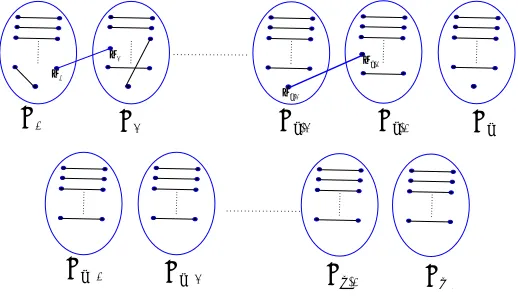
k is even. For i= 1, . . . , k−1, pick cross edgesx1x2, x3x4, . . . , xk−1xk∈E(AGn−F)
as described above, where xi ∈ V(Hi −Fi). Thus Hi −(Fi ∪ {xi}) contains an even
number of vertices and has no isolated vertices. Since |Fi ∪ {xi}| ≤ 2n−6, then by
Theorem 2.4 there exist perfect matchings Mi0 in Hi −(Fi ∪ {xi}) for i = 1, . . . , k.
Therefore Sk i=1M
0
i ∪ {x1x2, x3x4, . . . , xk−1xk} ∪
Sn
j=k+1Mj is a perfect matching in
AGn−F.
k is odd. We use the same argument and notation as above. The set Sk−1
i=1 M
0
i ∪
{x1x2, x3x4, . . . , xk−2xk−1} ∪
Sn
j=kMj is an almost-perfect matching in AGn−F. See
Figure 1.
H1 H
2 Hk-2 Hk-1 Hk
Hk+1 H
k+2 Hn-1 Hn
x1
x2
xk-2
xk-1
Figure 1: Case 1: |Fi| ≤2n−7 fori∈ {1, . . . , n}
Suppose n = 5. If there is an edge between every pair of Hi −Fi and Hj −Fj in AGn −F, then we are done. But such a violation can only occur for one pair say H1 −F1 and H2 −F2. Thus the graph induced by V(H1)∪V(H2) has at least six
faults. So there are only two faults not yet discovered. Now, the above construction works unless k = 2. (If k ≥ 3, we can avoid pairing H1 −F1 and H2 −F2). Since
there are only two faults not yet discovered and n= 5. We may assume that |F3|= 0
and none of the cross edges betweenH1−F1 and H3−F3, and between H2−F2 and
H3−F3 are faulty edges. Now choosex1x3 andx2x03 appropriately. NowH3− {x3, x03}
has a perfect matching, and we can continue with the usual construction. Case 2. |F1|= 2n−6 and |Fi| ≤2n−7 for all i6= 1.
Case 2.1. H1−F1 has no isolated vertices. By the induction hypothesis, there exists a perfect
Hi−Fi contains a perfect or an almost-perfect matching Mi for i6= 1. Then this
case is similar to Case 1.
Case 2.2. H1−F1 has an isolated vertex u∈V(H1−F1).
Case 2.2.1. F1 is not a matching preclusion set in H1. By Proposition 2.1, |F1V| is odd.
ThenH1−F1 has an almost-perfect matchingM1 missing the vertex u. Since
AGn−F has no isolated vertices, then the vertexumust be adjacent to some
outside neighbor u0 in AGn −F. Without loss of generality, assume that u0 ∈ V(H2 −F2). Let F20 = F2 ∪ {u0}, we consider two cases depending on
whether the resulting subgraph induced by H2−F20 has an isolated vertex or
not.
Case 2.2.1.1. H2−F20 has no isolated vertices. Since|F20| ≤2n−6, then by the induction
hypothesis,H2−F20 has a perfect or an almost-perfect matchingM2. We
consider two cases depending on whether M2 is a perfect or an
almost-perfect matching.
M2 is a perfect matching. By the induction hypothesis, we can find perfect
or almost-perfect matchingsMiinHi−Fifori≥3. Since|Fi| ≤2n−7 for i≥3, then we can proceed as in Case 1 and combine those matchings to get a perfect or an almost-perfect matching M0 in the subgraph induced by (AGn−F)−(V(H1)∪V(H2)). ThenM0∪M1∪M2∪ {uu0}is a perfect
or an almost-perfect matching in AGn−F.
M2 is an almost-perfect matching. If |F20| ≤2n−7, then we can proceed
as in Case 1 to find a perfect or an almost-perfect matching M0 in the subgraph induced by (AGn −F)− (V(H1) ∪ {u0}), and the set M0 ∪
M1 ∪ {uu0} is a perfect or an almost-perfect matching in AGn −F. If
|F20|= 2n−6, then letx∈V(H2−F20) be the unsaturated vertex byM2.
Under this assumption, there is only one fault left outside the subgraph induced by V(H1)∪V(H2). Since x is not isolated in H2 −F20, then by
Proposition 2.1 there exists another almost-perfect matching in H2−F20
missing a vertex different from x. So without loss of generality we can assume that xhas two outside neighbors in AGn−F or else we consider
the other almost-perfect matching. Let x0 be the outside neighbor of
x, such that x0 ∈ V(Hj − F) for some j 6= 1,2. Let Fj0 = Fj ∪ {x0},
then by the induction hypothesis there exists a perfect or an almost-perfect matching Mj in Hj −Fj0, and Mi in Hi −Fi for all i 6= 1,2, j.
Since |Fj0| and |Fi| are less than or equal to 2n−7, then we can use the
construction of Case 1 to find a perfect or an almost-perfect matching
M0 in the subgraph induced by (AGn−F)−(V(H1)∪V(H2)∪ {u0, x0}).
Then the set M0∪M1∪M2∪ {uu0, xx0} is a perfect or an almost-perfect
matching in AGn−F.
Case 2.2.1.2. H2−F20 has an isolated vertex. Then we can choose the second outside
neighbor of u, u00, which belongs to V(Hk) for some k 6= 1,2. If u00 ∈ V(Hk−Fk) anduu00 ∈E(AGn−F), thenHk−(Fk∪ {u0}) has no isolated
have |F20| = 2n−6 and u0 is adjacent to a vertex z ∈ V(H2 −F2) and
all faults in H2 are adjacent and/or incident to z as well. The vertex z
has two outside neighbors inAGn−F, letz0 ∈V(Hk−Fk) be an outside
neighbor of z for some k 6= 1,2. We consider the parity of |FV
2 |.
|FV
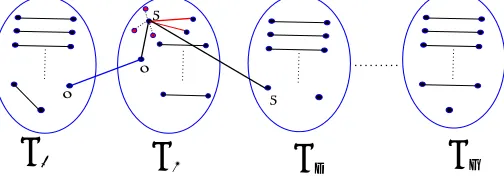
2 | is even. Then there exists a perfect matching M2 in H2−F2, and
in this case the edge u0z must belong to M2. As in Case 1, we can find
a perfect or an almost-perfect matching M0 in the subgraph induced by (AGn−F)−(V(H1)∪V(H2)∪{z0}). ThenM1∪(M2−{u0z})∪{uu0, zz0}∪
M0 is a perfect or an almost-perfect matching inAGn−F. See Figure 2.
H
1H
2
H
nu
u' z
H
kz'
Figure 2: Case 2.2.1: |F2V| is even
|FV
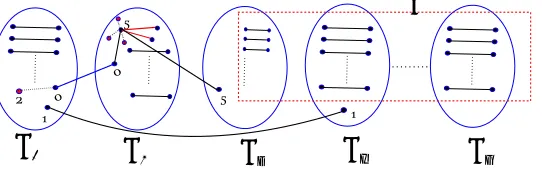
2 | is odd. Then choose an appropriate vertex x ∈ V(H2 −F2) such
that x has an outside neighbor x0 ∈ V(Hp −Fp) for some p 6= 1,2 with xx0 ∈ E(AGn− F) and H2 −(F ∪ {x}) has no isolated vertices. Let
F200 = F2 ∪ {x}, then |F200V| is even of size 2n− 6 and has no isolated
vertices, then by Theorem 2.4H2−F200has a perfect matchingM
0
2. By the
induction hypothesis, there exists a perfect or an almost-perfect matching
Mi in Hi −(Fi ∪ {x0, z0}) for i ≥ 3. Since all the faults except one are
in the subgraph induced by V(H1)∪V(H2), then|Fi∪ {x0, z0}| ≤2n−7
for i ≥ 3, then we can use the construction of Case 1 to combine the
Mi’s and get a perfect or an almost-perfect matchingM00 in the subgraph
induced by (AGn−F)−(V(H1)∪V(H2)∪{x0, z0}). ThereforeM1∪(M20−
{u0z})∪ {uu0, zz0, xx0} ∪M00is a perfect or an almost-perfect matching in
AGn−F. See Figure 3.
H
1H
2
H
pu
u' z
H
k z' xH
n x'Figure 3: Case 2.2.1: |F2V| is odd
Case 2.2.2. F1 is a matching preclusion set in H1. Then F1 is a basic strong matching
preclusion set. Since smp(H1) = 2n−6, andH1 is even and regular, then by
Case 2.2.2.1. Assume that FV
1 6= ∅. It is easy to find a vertex w in F1 such that
H1−(F1− {w}) has no isolated vertices. The vertex wmust be adjacent
tou inH1−(F1− {w}). Since uis isolated in H1 and because AGn−F
contains no isolated vertices, then u must have an outside neighboru0 in
AGn−F. Without loss of generality, assume thatu0 ∈ V(H2−F2). Let
v ∈ V(H1 −F1) such that H1 −(F1 ∪ {v}) has no isolated vertices and
v has an outside neighbor v0 ∈V(Hp−Fp), with vv0 ∈E(AGn−F), for
somep6= 1,2. LetF10 = (F1− {w})∪ {v}, then|F10|= 2n−6 and contains
an even number of vertices. Moreover, H1−F10 has no isolated vertices,
then by Theorem 2.4 we can find a perfect matchingM1 inH1−F10. This
matching must contain the edge uw.
Assume that H2 − (F2 ∪ {u0}) has no isolated vertices. Then by the
induction hypothesis there exists a perfect or an almost-perfect matching
Mi in Hi − (Fi ∪ {u0, v0}) for i ≥ 2. As in Case 1, we can combine
those matchings to get a perfect or an almost-perfect matching M0 in the subgraph induced by (AGn−F)−(V(H1)∪ {u0, v0}). Then the set
(M1− {uw})∪ {uu0, vv0} ∪M0 is a perfect or an almost-perfect matching
in AGn−F.
Assume that H2−(F2∪ {u0}) has an isolated vertexz. Under this case we
can choose the other outside neighbor ofu,u00 ∈V(Hk), for somek 6= 1,2.
Ifu00 is a faulty vertex oruu00is a faulty edge, then we can guarantee that the vertex z has two outside neighbors inAGn−F. Let z0 be an outside
neighbor ofz such thatz0 ∈V(Hk−Fk) withzz0 ∈E(AGn−F) for some k 6= 1,2.
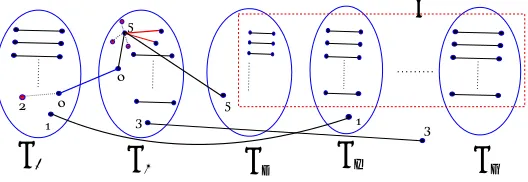
– If|FV
2 |is even, then there exists a perfect matchingM2 inH2−F2, and
in this case the edge u0z belongs to M2. As in Case 1, we can find a
perfect or an almost-perfect matching M0 in the subgraph induced by (AGn−F)−(V(H1)∪V(H2)∪ {z0, v0}). Then M1 ∪(M2− {u0z})∪
{uu0, zz0, vv0} ∪M0 is a perfect or an almost-perfect matching in AGn− F. See Figure 4.
H1 H
2 Hp
u u'
z
Hk
z'
Hn
v' w
v
M'
Figure 4: Case 2.2.2.1: |FV
2 | is even
– If|FV
2 | is odd, then choose a vertexx∈V(H2−F2) such that xhas an
outside neighborx0 ∈V(Hq−Fq) for someq6= 1,2 and H2−(F2∪ {x})
has no isolated vertices. LetF200 =F2∪ {x}, then |F200V| is even and of
size 2n−6 and has no isolated vertices, then by Theorem 2.4H2−F200has
almost-perfect matchingM00in the subgraph induced by (AGn−F)−(V(H1)∪
V(H2)∪ {x0, z0, v0}) . ThenM1∪(M20− {u
0z})∪ {uu0, vv0, zz0, xx0} ∪M00 is a perfect or an almost-perfect matching in AGn−F. See Figure 5.
H
1H
2
H
pu u'
z
H
kz'
H
nv' w
v
M''
x
x'
Figure 5: Case 2.2.2.1: |F2V| is odd
Case 2.2.2.2. Assume that FV
1 =∅. Then all the faults inside H1 are edges. Then the
vertex u is incident to (2n−6) faulty edges in H1. Deleting the vertex
u from H1 includes the deletion of all those (2n −6) edges. Choose a
vertexv ∈V(H1− {u}) such thatH1− {u, v}has no isolated vertices and
v has two outside neighbors in AGn−F. By Theorem 2.4, there exists
a perfect matching M1 in H1 − {u, v}. Then M1 is a perfect matching
in H1−(F1∪ {u, v}). The construction of the perfect or almost-perfect
matching in AGn−F follows the same way as in Case 2.2.2.1.
Case 3. |F1|= 2n−6 and |F2|= 2n−6. Note that all the faults are in the subgraph induced
byV(H1)∪V(H2).
Case 3.1. Assume that H1 −F1 and H2 −F2 have no isolated vertices. By the induction
hypothesis, there exist perfect or almost-perfect matchingsM1 andM2 inH1−F1
and H2 −F2 respectively. If M1 and/or M2 are almost-perfect matchings, then
at most two vertices will be missed by M1 ∪M2. Let x ∈ V(H1 − F1) and
y∈V(H2−F2) be these vertices and let x0 ∈ V(Hp−Fp) and y0 ∈V(Hq−Fq),
where p, q 6= 1,2, be their corresponding outside neighbors. Since |Fi| = 0 for i≥3, then|Fi∪ {x0, y0}| ≤2 fori≥3, then we can use the construction of Case 1
to find a perfect or an almost-perfect matching M0 in the subgraph induced by (AGn−F)−(V(H1)∪V(H2)∪ {x0, y0}). Therefore M1∪M2∪M0∪ {xx0, yy0}is
a perfect or an almost-perfect matching in AGn−F.
Case 3.2. Assume thatH1−F1 has an isolated vertexu, andH2−F2 has no isolated vertices.
The vertexumust be adjacent to a vertexu0 ∈V(Hk−Fk) for somek 6= 1,2 such
thatuu0 ∈E(AGn−F). Since |F1|= 2n−6 andH1−F1 has an isolated vertex,
then we will consider two cases depending on whether F1 is a strong matching
preclusion set inH1 or not.
Case 3.2.1. Assume that F1 is not a matching preclusion set. By Proposition 2.1, |F1V|is
odd. Then H1 −F1 has an almost-perfect matching M1 missing the vertex
u. By the induction hypothesis, H2 −F2 has a perfect or an almost-perfect
Mi for i ≥ 3. Using the same idea of Case 1, we can find a perfect or
an almost-perfect matching M0 in the subgraph induced by (AGn −F)−
(V(H1)∪V(H2)∪ {u0}).
If M2 is a perfect matching, then M1∪M2 ∪M0 ∪ {uu0} is a perfect or an
almost-perfect matching in AGn−F.
IfM2 is an almost-perfect matching, thenM2 misses a vertexx∈V(H2−F)
which has an outside neighbor x0 in the subgraph induced by (AGn−F)−
(V(H1)∪V(H2)∪ {u0}). Note that we are assuming thatx0 6=u0, since ifx0 =
u0, then by Proposition 2.1 we can find another almost-perfect matching in
H2−F which misses a vertex other thanxand this vertex can not be adjacent
to u0. By the induction hypothesis, Hi −(Fi∪ {u0, x0}) has a perfect or an
almost-perfect matching Mi0 for i≥3. Using the same idea of Case 1, we can find a perfect or an almost-perfect matching M00 in the subgraph induced by (AGn−F)−(V(H1)∪V(H2)∪{u0, x0}). Thus the setM1∪M2∪{uu0, xx0}∪M00
is a perfect or an almost-perfect matching in AGn−F.
Case 3.2.2. Assume that F1 is a matching preclusion set. Then by Proposition 2.1,|F1V|
is even.
Case 3.2.2.1. AssumeFV
1 6=∅. Letwbe a faulty vertex inH1and chosex∈V(H1−F1)
such that H1−(F1 ∪ {x}) has no isolated vertices. Since all the faults
are in the subgraph induced byV(H1)∪V(H2), then the vertex xhas at
least one outside neighbor x0 ∈ V(Hk−Fk) with xx0 ∈E(AGn−F) for
some k 6= 1,2. Let F10 = (F1 ∪ {x})− {w}, the subgraph H1−F10 has no
isolated vertices and|F10|= 2n−6 and|F10V|is even, then by Theorem 2.4 there exists a perfect matchingM1 inH1−F10. This matchingM1includes
the edge uw. By the induction hypothesis, H2 −F has a perfect or an
almost-perfect matching M2.
Assume that M2 is a perfect matching in H2 −F2. By the induction
hypothesis,Hi−(Fi∪{u0, x0}) has a perfect or an almost-perfect matching Mi for i ≥ 3, and since |Fi ∪ {u0, x0}| ≤ 2n −7, then we proceed as in
Case 1 to find a perfect or an almost-perfect matchingM0 in the subgraph induced by (AGn−F)−(V(H1)∪V(H2)∪ {u0, x0}). Thus the set (M1−
{wv}) ∪ {uu0, xx0} ∪ M0 is a perfect or an almost-perfect matching in
AGn−F.
Assume that M2 is an almost-perfect matching, thenM2 misses a vertex
y∈V(H2−F2) which has an outside neighbory0 in the subgraph induced
by (AGn−F)−(V(H1)∪V(H2)∪ {u0, x0}). Again, we are assuming that
y0 6= u0, since if y0 = u0, then by Proposition 2.1 we can find another almost-perfect matching in H2−F2 which will miss a vertex other than y
and this vertex can not be adjacent to u0. In addition, the choice of x is not unique inH1−F1. By the induction hypothesis, Hi−(Fi∪ {u0, x0, y0})
has a perfect or an almost-perfect matchingMi0 fori≥3. Using the same idea of Case 1, we can find a perfect or an almost-perfect matchingM00in the subgraph induced by (AGn−F)−(V(H1)∪V(H2)∪{u0, x0, y0}). Thus
matching in AGn−F.
Case 3.2.2.2. Assume F1V = ∅. Then u is incident to (2n−6) faulty edges. Let e be a faulty edge in H1 and u, w ∈V(H1−F1) be its endpoints. The vertex
w must have an outside neighbor w0 ∈ V(Hp −Fp) for some p 6= 1,2.
Note that it is possible to have p = k. By the induction hypothesis,
Hi−(Fi ∪ {u0, w0}) has a perfect or an almost-perfect matching Mi for i ≥3 and H2−F2 has a perfect or an almost-perfect matching M2. We
can now proceed as in the case above to find a perfect or an almost-perfect matching in AGn−F.
Case 3.3. Assume thatH1−F1 has an isolated vertex u, and H2−F2 has an isolated vertex
v. Then u must be incident to a cross edge that has its other endpoint in some
Hk − Fk where k 6= 1,2, and v is incident to a cross edge that has its other
endpoint in some Hj −Fj where j 6= 1,2. Let uu0 and vv0 be those edges, so u0 ∈V(Hk−Fk) and v0 ∈V(Hj−Fj). It is possible to have k=j and u0 =v0. If u0 =v0, then by Proposition 2.6,uv ∈E(AGn−F), and we can include this edge
in the matching to saturate u and v.
Case 3.3.1. IfF1 andF2 are not matching preclusion sets inH1 andH2 respectively. Then
this case is similar to Case 3.2.1.
Case 3.3.2. If F1 is a matching preclusion set in H1 but F2 is not a matching preclusion set in H2. Then this case is similar to Case 3.2.2.
Case 3.3.3. If F1 andF2 are matching preclusion sets inH1 andH2 respectively. ThenF1
and F2 are basic strong matching preclusion sets in H1 and H2 respectively.
By Proposition 2.1, F1 and F2 are trivial, so |F1V| and |F2V| are even. As in
Case 3.2.2, we can always find a matchingM1 inH1−F1 missing the vertices
u, x ∈ V(H1 − F1), and a matching M2 in H2 − F2 missing the vertices
v, y ∈V(H2−F2). Since the choice of the vertices x and y is not unique, we
can choose those vertices so that their outside neighbors do not lie in the same
Hi. Letu0, x0, v0, y0be the outside neighbors ofu, x, v, y respectively, such that x0 and y0 are in different Hi’s. By the induction hypothesis, there exists a
perfect or an almost-perfect matchingMi in everyHi−(Fi∪{u0, x0, v0, y0}) for i≥3, and since|Fi∪ {u0, x0, v0, y0}| ≤2n−7 fori≥3, then we can proceed as
in Case 1 and combine those matchings to get a perfect or an almost-perfect matching M0 in the subgraph induced by (AGn−F)−(V(H1)∪V(H2)∪
{u0, x0, v0, y0}). Therefore, M1∪M2 ∪M0 ∪ {uu0, xx0, vv0, yy0} is a perfect or
an almost-perfect matching in AGn−F.
Case 4. 2n−5 ≤ |F1| ≤ 4n −16 for n ≥ 6. When n = 5, the compound inequality is not
valid. So we must consider the cases when n = 5 and |F1| = 5 or |F1| = 6. The case
when n = 5 and |F1| = 5 will be covered in Case 5. If n = 5 and |F1| = 6 then,
by Lemma 2.3, we can choose another decomposition via a different position so that |F1| ≤5.
Case 4.1. H1−F1 has no isolated vertices. By the induction hypothesis, H1−F1 contains
a perfect or an almost-perfect matchingM1. We consider two cases depending on
M1 is a perfect matching. Since every Hi−Fi contains no isolated vertices, then
we can proceed as in Case 1 to find a perfect or an almost-perfect matchingM0 in the subgraph induced by (AGn−F)−V(H1). Then the set M1∪M0 is a perfect
or an almost-perfect matching in AGn−F.
M1 is an almost-perfect matching. Letu∈V(H1−F1) be the unsaturated vertex
byM1. If u has an outside neighbor u0 in some Hk−Fk where Hk−(Fk∪ {u0})
contains no isolated vertices, then we can also proceed as in Case 1 by finding a perfect or an almost-perfect matching M0 in the subgraph induced by (AGn− F)−(V(H1)∪ {u0}), soM1∪M0∪ {uu0}is a perfect or an almost-perfect matching
inAGn−F. Assume thatu has no such outside neighbor. Since H1−F1 has no
isolated vertices, thenuis adjacent to some vertexv inH1−F1 andv is saturated
by M1. Let vw ∈ M1. The vertices u and w can have at most two common
neighbors, so there are at least 4n−14− |F1| vertices in H1 −F1 adjacent to
either u or w. Let F1 = F −F1; we know that |F1|+|F1| = 4n−12, so there
are at least 4n−14−(4n−12− |F1|) =|F1|+ 2 vertices in H1−F1 adjacent to
eitheruorw. Then we can guarantee thatuorw are adjacent to at least|F1|+2
2
vertices xk incident to edges ek = xkyk ∈ M1 for k = 1, . . . ,
|F1|+2
2
. We want to choose a vertexyk such that yk is not adjacent/incident to a fault outsideH1.
Since each yk has two outside neighbors, then we have at least |F1|+ 1 choices
for yk; at most |F1| can be at fault and no two outside neighbors can be in the
sameHi. So we can find yk0 ∈Hk−F, where ykyk0 ∈E(AGn−F), and satisfying
the propertyHk−(F ∪ {y0k}) has no isolated vertices. Thus we can use a similar
construction to Case 1 to find a perfect or an almost-perfect matchingM0 in the subgraph induced by (AGn−F)−(V(H1)∪V(H2)∪ {y0k}). If wxk∈E(H1−F1),
thenM10 =M1∪ {wxk, uv} − {vw, xkyk}is an almost-perfect matching inH1−F1
missingyk, then the setM10∪M0∪{yky0k}is a perfect or an almost-perfect matching
inAGn−F. If uxk ∈E(H1−F), thenM10 =M1∪ {uxk} − {xkyk} is an
almost-perfect matching in H1−F missing yk. Therefore, the setM10 ∪M
0∪ {y
kyk0} is a
perfect or an almost-perfect matching inAGn−F.
Case 4.2. H1−F1 has an isolated vertexu∈V(H1−F1). LetNH1(u) be the set of neighbors
of uin H1.
Case 4.2.1. NH1(u)∩F V
1 6=∅. Let w∈NH1(u)∩F V
1 . We consider the parity of |F1V|. Assume |FV
1 | is odd. Let F
0
1 =F1 − {w}, so |F10| ≤4n−17 and H1 −F10 has no
isolated vertices, then by the induction hypothesis there exists a perfect matching
M1 in H1 −F10. M1 contains the edge uw. The vertex u must have an outside
neighbor u0 in AGn−F, or else u becomes an isolated vertex in AGn −F. By
the induction hypothesis, there exists a perfect or an almost-perfect matching
Mi in Hi − (Fi ∪ {u0}) for i ≥ 2. Using the same idea as in Case 1, we can
find a perfect or an almost-perfect matching M0 in the subgraph induced by (AGn−F)−(V(H1)∪ {u0}), then the set (M1− {uw})∪ {uu0} ∪M0 is a perfect
or an almost-perfect matching in AGn−F. Assume |FV
1 | is even. Let F10 = F1 − {w}, so |F10| ≤ 4n−17 and H1−F10 has
outside neighbor x0 ∈ V(Hk−Fk) with xx0 ∈ E(AGn−F) for some k 6= 1 and H1−(F10∪ {x}) has no isolated vertices. By the induction hypothesis, there exists
a perfect matchingM1 in H1 −(F10 ∪ {x}) that contains the edge uw, and there
exists a perfect or an almost-perfect matchingMi inHi−(Fi∪ {u0, x0}) fori≥2.
Using the same idea as in Case 1, we can find a perfect or an almost-perfect matching M0 in the subgraph induced by (AGn−F)−(V(H1)∪ {u0, x0}), then
the set (M1− {uw})∪ {uu0, xx0} ∪M0 is a perfect or an almost-perfect matching
inAGn−F.
Case 4.2.2. NH1(u)∩F V
1 = ∅. Then u is incident to (2n−6) faulty edges in H1. Let f be
one of those edges. We consider the parity of|F1V|.
Assume |FV
1 | is odd. Let F
0
1 =F1−f, wheref has endpoints uand v inH1−F1.
Consider the set F100 = F10 ∪ {u}. F100 has an even number of vertices, of size less than or equal to 4n −16 and H1 −F100 has no isolated vertices. Then by the
induction hypothesis, there exists a perfect matchingM1 in H1−F100. The vertex
u must have an outside neighbor u0 ∈ V(Hk − Fk) for some k 6= 1 such that uu0 ∈ E(AGn −F). By the induction hypothesis, there exists a perfect or an
almost-perfect matching Mi in Hi −(Fi ∪ {u0}) for i ≥ 2. We can assume that
|Fk∪ {u0}| ≤ 2n−7, since if not then |Fk|= 2n−7 and all the faults will be in
the subgraph induced byV(H1)∪V(Hk), soucan have another outside neighbor
in Hl−Fl for some l 6= 1, k. Then |Fi ∪ {u0}| ≤ 2n−7 for i ≥ 2 and hence we
can apply the same idea as in Case 1 to construct a perfect or an almost-perfect matchingM0 in the subgraph induced by (AGn−F)−(V(H1)∪ {u0}). Then the
setM1∪ {uu0} ∪M0 is a perfect or an almost-perfect matching in AGn−F. Assume|FV
1 |is even. LetF
0
1 =F1−f. We can choose the edgef =uwsuch that
whas an outside neighborw0 ∈V(Hj−Fj) for somej 6= 1 withww0 ∈E(AGn−F).
The vertex u must have an outside neighbor u0 ∈ V(Hk−Fk) for some k 6= 1
such thatuu0 ∈E(AGn−F). Note that there are (2n−6) possible choices forf
and there are at most (2n−7) faults outside H1 −F1, so we can always choose
wsuch that w has two outside neighbors inAGn−F. Then we can assume that u0 and w0 are in different Hi, so we can claim that |Fi ∪ {w0, u0}| ≤ 2n−7. By
the induction hypothesis, there exists a perfect or an almost-perfect matching
Mi in Hi − (Fi ∪ {w0, u0}) for i ≥ 2. Using the same idea as in Case 1, we
can find a perfect or an almost-perfect matching M0 in the subgraph induced by (AGn−F)−(V(H1)∪ {u0, w0}). Therefore, the set (M1−uw)∪ {uu0, ww0} ∪M0
is a perfect or an almost-perfect matching inAGn−F.
Case 5. |F1| = 4n −15. Note that H1 −F1 can have at most one isolated vertex. We will
assume that H1 −F1 has an isolated vertex u∈V(H1−F1). The case when H1 −F1
has no isolated vertices will be treated the same. Under this condition, there are three faults left outside H1. Since AGn−F has no isolated vertices then there exists an
outside neighbor u0 ∈V(Hp−Fp) for somep6= 1 with uu0 ∈E(AGn−F).
Case 5.1. NH1(u)∩F V
1 =∅. Then u is incident to (2n−6) edges. Let f =uv be a faulty
edge inH1 such thatvhas two outside neighbors inAGn−F. Letv0 ∈V(Hk−F),
H1 −(F1 −f) has no isolated vertices, then by the induction hypothesis there
exists a perfect or an almost-perfect matching M1 inH1−(F1−f).
Assume that f /∈ M1. Then M1 is a perfect or an almost-perfect matching in
H1−F1. By the induction hypothesis, there exists a perfect or an almost-perfect
matchingMi in Hi−Fi. We can combine these matchings to get a perfect or an
almost-perfect matchingM in (AGn−F).
Assume that f ∈ M1. There are three faults outside H1, we can claim that
|Fi∪ {u0}| ≤3 for everyi≥2, because if not thenu0 is in the sameHi along with
the other faults and this guarantees the existence of another outside neighbor of u in AGn − F. Moreover, v has two outside neighbors in AGn −F so we
can claim that |Fi ∪ {u0, v0}| ≤ 2n −7 for i ≥ 2. Now as in Case 1 we can
find a perfect or an almost-perfect matching M0 in the subgraph induced by (AGn−F)−(V(H1)∪ {u0, v0}). Therefore M1∪M0∪ {uu0, vv0}is a perfect or an
almost-perfect matching in AGn−F.
Case 5.2. NH1(u)∩F V
1 6=∅. Letw∈NH1(u)∩F V
1 . By the induction hypothesis, there exists
a perfect or an almost-perfect matchingM1 inH1−(F1− {w}). We consider the
parity of|FV
1 |.
|FV
1 | is odd. Then M1 is a perfect matching containing the edge uw. As in
the previous case, we can claim that |Fi ∪ {u0}| ≤ 3 for every i ≥ 2, so by the
induction hypothesis there exists a perfect or an almost-perfect matching Mi in Hi−(Fi∪ {u0}) for i≥2. We combine all theMi’s to get a perfect or an
almost-perfect matching M0 in the subgraph induced by (AGn−F)−(V(H1)∪ {u0}).
Therefore (M1 − {uw})∪M0 ∪ {uu0} is a perfect or an almost-perfect matching
inAGn−F.
|FV
1 | is even. Then M1 is an almost-perfect matching in H1−(F1 − {w}). Let
M10 = M ∩E(H1 −F). M10 is a matching in H1 −F that misses two vertices,
one of them is u and some other vertex x. Note that M10 is an almost-perfect matching in the subgraph induced by H1 −(F1∪ {u}), so we claim that x has
outside neighbor(s) inAGn−F, because if not then by Proposition 2.1 we can find
another almost-perfect matching in H1 −(F1∪ {u}) missing a vertex other than
x. Letx0 be the outside neighbor ofxinAGn−F. As in the previous case we can
claim that |Fi ∪ {x0, u0}| ≤ 2n−7 for i ≥ 2. By the induction hypothesis there
exists a perfect or an almost-perfect matchingMi inHi−(Fi∪ {x0, u0}) fori≥2.
We combine all theMi’s to get a perfect or an almost-perfect matchingM0 in the
subgraph induced by (AGn−F)−(V(H1)∪{x0, u0}). ThereforeM10∪M0∪{uu0, xx0}
is a perfect or an almost-perfect matching inAGn−F.
4
Conclusion
is 4n −11. Classifying all types of optimal conditional strong matching preclusion sets of
AGn is left as a future research.
References
[1] R. Ledermann. Introduction to the Theory of Finite Groups. Olivier and Boyd, London, 1949.
[2] V. Kumar, A. Grama, A. Gupta, and G. Karypis. Introduction to Parallel Computing: Design and Analysis of Algorithms. Benjamin/Cummings, 1994.
[3] R. C. Brigham, F. Harary, E.E. Violin, and J. Yellen. Perfect matching preclusion,
Congressus Numerantium, 174: 185–192, 2005.
[4] P. Bonneville, E. Cheng, and J. Renzi. Strong matching preclusion for the alternating group graphs and split-stars. Journal of Interconnection Networks, 12(4): 277–298, 2011.
[5] J.S. Jwo, S. Lakshmivarahan, and S.K. Dhall. A new class of interconnection networks based on the alternating group. Networks, 23: 315–326, 1993.
[6] N. Biggs. Algebraic Graph Theory. Cambridge University Press, 1979.
[7] J.-H. Park and I. Ihm. Strong matching preclusion. Theoretical Computer Science, 412: 6409–6419, 2011.
[8] J.-H. Park and I. Ihm. Strong matching preclusion under the conditional fault model.
Discrete Applied Mathematics, 161: 1093–1105, 2013.
[9] E. Cheng, M.J. Lipman, and H.A. Park. Super connectivity of star graphs, alternating group graphs and split-stars. Ars Combinatoria, 59: 107–116, 2001.
[10] E. Cheng, L. Lesniak, M.J. Lipman, and L. Lipt´ak. Conditional matching preclusion sets. Information Sciences, 179(8): 1092–1101, 2009.
[11] D.B. West. Introduction to Graph Theory. Prentice Hall, 1996.