Int. J. Curr. Res. Biosci. Plant Biol. 2014, 1(4): 67-73
Original Research Article
Diversity of Climber and Creeper Medicinal and Aromatic Plants with Special
Reference to Their Regeneration in Herbal Garden for Ex-situ Conservation
D. K. Patel*
Department of Rural Technology, Guru Ghasidas Vishwavidyalaya (A Central University), Bilaspur, 495 009, Chhattisgarh, India
*Corresponding author.
A b s t r a c t K e y w o r d s
Plants are remarkable source of valuable substances for human beings. These are showing variation in their habitat as well as their habit. As per climatic conditions, the plants are showing their presence in different sites. Some plant species which are climbing and creeping in their tendency are referred as climbers and creepers. A climber plant includes tendrils and creepers having adventitious roots on nodular part of the stem helpful for their climbing and creeping on any substratum. In present study 37 species of climber and creeper plants having medicinal and aromatic properties were selected, and were collected from various parts of Chhattisgarh State, India. These were regenerated in Herbal Garden (in poly bags and prepared beds) for increase their population further and for ex-situ conservation.
Climber
Creeper
Medicinal and aromatic plants (MAPs)
Ex-situ conservation
Herbal garden
Introduction
Climbers are weak stemmed plants (Dutta, 1689) showing variations from trees and shrubs which are self supported plants. These are different in their mechanical characters (Isnard et al., 2009), well adopted to climb on any support like large trees. Suitable modifications for mechanical support viz., hooks, tendrils and roots in modified forms are found in these kinds of plants.
India is a rich center of biodiversity with important hot spots, Western Ghat and Eastern Himalaya.
Climbers and creepers are important components of plant diversity and are also valuable for their medicinal uses, nutrient recycling, etc. (Schnitzer and Bongers, 2002). The climbers are rooted in soil but need for a support to their weak stem (Richards, 1952). Ex-situ conservation of climbing plants are very much needed with reference to their roles that they play. Recent study conducted at University of Agricultural Sciences, Bangalore, Karnataka is an example of ex-situ conservation of climbing plants (Rajkumar and Rajanna, 2011).
International Journal of Current Research in
Biosciences and Plant Biology
ISSN: 2349-8080 Volume 1 Number 4 (November-2014) pp. 67-73
Int. J. Curr. Res. Biosci. Plant Biol. 2014, 1(4): 67-73 The climbing plants in tropical forests of southern
Eastern Ghats, Tamil Nadu (Muthumperumal and Parthasarathy, 2009), useful climbers of Fatehpur, Uttar Pradesh (Agarwal, 2013) and diversity and distribution of climbers in semi-deciduous rain forest (Ghollasimood et al., 2012) provides the knowledge on climbing plants. Patel et al. (2013) focused on climbers in urban set up-Ahmedabad and Gandhinagar.
Many climbers and creeper plants are found to be useful for treatment of various disorders. Curative climbers of Maruthamalai hills in the southern Western Ghats of Tamil Nadu, India have been reported by Sarvalingam et al. (2011). Suthari et al. (2014) reported the climbing plants of northern Telangana in India and their ethno-medicinal and economic uses. Diversity and status of ethno-medicinal plants of Almoda district in Uttrakhand, India was assessed by Kumari et al. (2011). Indigenous uses of medicinal plants in North Garo Hills, Meghalaya, NE India was noticed recently by Sharma et al. (2014).
Some important studies on diversity of climbers in different parts of India by Gentry (1991), Ghosh and Mukherjee (2006), Bandopadhya and Mukherjee (2010) and, Jangid and Sharma (2011) suggest that the climbers are forming main components of ecosystem. The conservation of important and endangered medicinal plants, their conservation and the ethnomedicinal uses, including climbers is very essential to establish their appropriate utilization (Mahajan, 2006; Ajaib et al., 2012; Singh et al., 2013). The present study is aimed to investigate the climber and creeper plants having medicinal and aromatic properties from various parts of Chhattisgarh State, India and to propagate them in herbal garden as a mean of ex-situ conservation.
Materials and methods
Plants or useful parts of Medicinal and Aromatic Plants (MAPs) of the category climbers and creepers were collected from different parts of the Chhattisgarh State, India and were identified with the help of local floras. Climbing and creeping MAPs showing variation in their habit like herbaceous and shrub/climber/creeper were considered for the present study. The collected plants were subjected to propagation in Herbal Garden in the campus of Guru Ghasidas
Vishwavidyalaya, Bilaspur for ex-situ conservation.
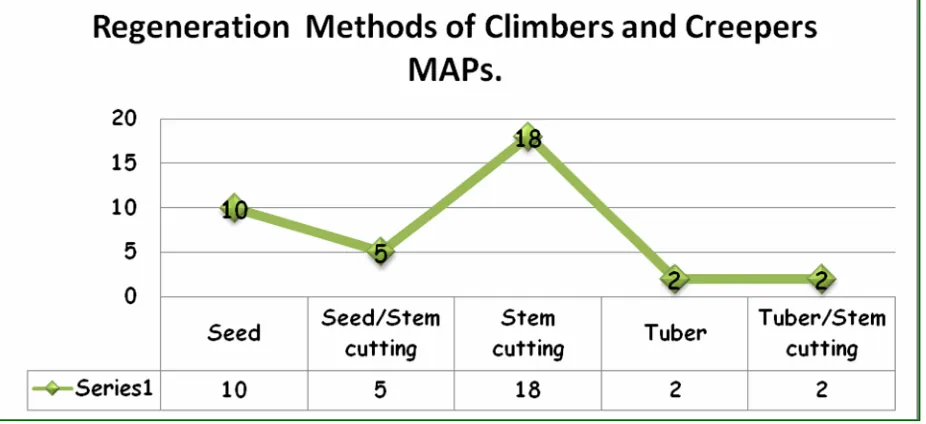
According to the propagative nature of the climber and creeper MAPs, they were subjected to propagation by seeds, stem cuttings, tuber or seed/stem cutting modes. The mature disease free seeds and other parts useful for their propagation were collected for further multiplication purpose. New individuals were developed using seeds or by vegetative modes and some of the plant species were up-rooted and directly introduced in to the Herbal Garden.
Plant propagation was done in poly bags as well as in the prepared beds. The plant parts used for further propagation in poly bags were transferred after their maturation, in selected beds following fulfillment of water and other requirements. The climbers/creepers developed in poly bags were transferred in to the field by providing facilities to the newly developing MAP individuals.
Results
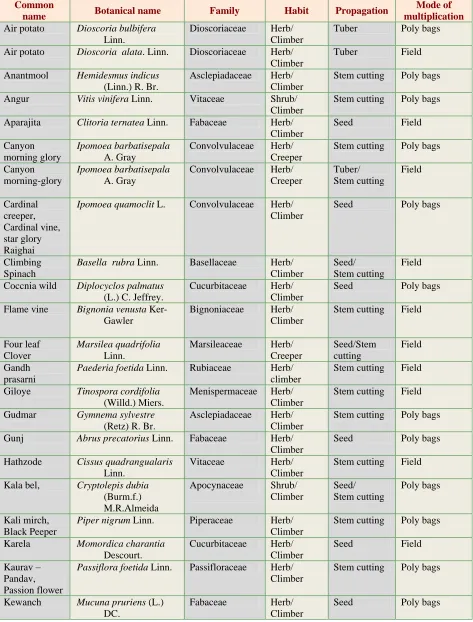
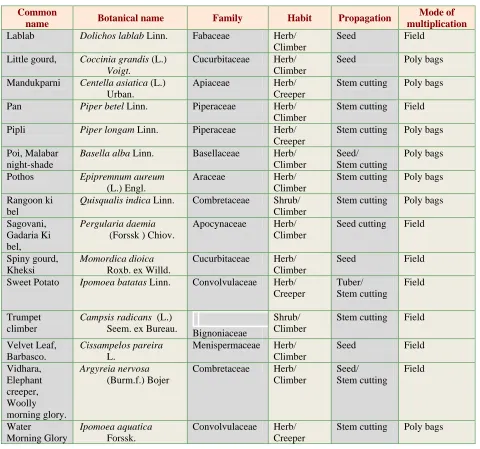
There were 37 species of climbers/creepers of the MAPs were collected and introduced in the Herbal Garden for propagation and for ex-situ conservation and are listed in Table 1 with the details on their common name, botanical name, family, habit and the propagation mode of each plant.
Family-wise distribution of climber/creeper MAPs followed by their habits is given in Table 2. A maximum of five plant species of family Convolvulaceae were introduced in to the Herbal Garden, followed by four species of the family Cucurbitaceae and three species of family Piperaceae. Rest of the plant species belonging to 17 different families were intermediately regenerated and conserved in the Herbal Garden.
Int. J. Curr. Res. Biosci. Plant Biol. 2014, 1(4): 67-73
Table 1. Climber and creeper Medicinal and Aromatic Plants (MAPs) and their regeneration in Herbal Garden.
Common
name Botanical name Family Habit Propagation
Mode of multiplication
Air potato Dioscoria bulbifera
Linn.
Dioscoriaceae Herb/ Climber
Tuber Poly bags Air potato Dioscoria alata. Linn. Dioscoriaceae Herb/
Climber
Tuber Field Anantmool Hemidesmus indicus
(Linn.) R. Br.
Asclepiadaceae Herb/ Climber
Stem cutting Poly bags Angur Vitis vinifera Linn. Vitaceae Shrub/
Climber
Stem cutting Poly bags Aparajita Clitoria ternatea Linn. Fabaceae Herb/
Climber
Seed Field Canyon
morning glory
Ipomoea barbatisepala
A. Gray
Convolvulaceae Herb/ Creeper
Stem cutting Poly bags Canyon
morning-glory
Ipomoea barbatisepala
A. Gray
Convolvulaceae Herb/ Creeper Tuber/ Stem cutting Field Cardinal creeper, Cardinal vine, star glory Raighai
Ipomoea quamoclit L. Convolvulaceae Herb/ Climber
Seed Poly bags Climbing
Spinach
Basella rubra Linn. Basellaceae Herb/ Climber
Seed/ Stem cutting
Field Coccnia wild Diplocyclos palmatus
(L.) C. Jeffrey.
Cucurbitaceae Herb/ Climber
Seed Poly bags Flame vine Bignonia venusta
Ker-Gawler
Bignoniaceae Herb/ Climber
Stem cutting Field Four leaf
Clover
Marsilea quadrifolia
Linn.
Marsileaceae Herb/ Creeper Seed/Stem cutting Field Gandh prasarni
Paederia foetida Linn. Rubiaceae Herb/ climber
Stem cutting Field Giloye Tinospora cordifolia
(Willd.) Miers.
Menispermaceae Herb/ Climber
Stem cutting Field Gudmar Gymnema sylvestre
(Retz) R. Br.
Asclepiadaceae Herb/ Climber
Stem cutting Poly bags Gunj Abrus precatorius Linn. Fabaceae Herb/
Climber
Seed Poly bags Hathzode Cissus quadrangualaris
Linn.
Vitaceae Herb/ Climber
Stem cutting Field Kala bel, Cryptolepis dubia
(Burm.f.) M.R.Almeida
Apocynaceae Shrub/ Climber Seed/ Stem cutting Poly bags Kali mirch, Black Peeper
Piper nigrum Linn.
Piperaceae Herb/ Climber
Stem cutting Poly bags Karela Momordica charantia
Descourt.
Cucurbitaceae Herb/ Climber
Seed Field Kaurav
Pandav, Passion flower
Passiflora foetida Linn. Passifloraceae Herb/ Climber
Stem cutting Poly bags Kewanch Mucuna pruriens (L.)
DC.
Fabaceae Herb/ Climber
Int. J. Curr. Res. Biosci. Plant Biol. 2014, 1(4): 67-73
Table 1. Cntd.
Common
name Botanical name Family Habit Propagation
Mode of multiplication
Lablab Dolichos lablab Linn. Fabaceae Herb/ Climber
Seed Field Little gourd, Coccinia grandis (L.)
Voigt.
Cucurbitaceae Herb/ Climber
Seed Poly bags Mandukparni Centella asiatica (L.)
Urban.
Apiaceae Herb/ Creeper
Stem cutting Poly bags Pan Piper betel Linn. Piperaceae Herb/
Climber
Stem cutting Field Pipli Piper longam Linn. Piperaceae Herb/
Creeper
Stem cutting Poly bags Poi, Malabar
night-shade
Basella alba Linn. Basellaceae Herb/ Climber
Seed/ Stem cutting
Poly bags Pothos Epipremnum aureum
(L.) Engl.
Araceae Herb/ Climber
Stem cutting Poly bags Rangoon ki
bel
Quisqualis indica Linn. Combretaceae Shrub/ Climber
Stem cutting Poly bags Sagovani,
Gadaria Ki bel,
Pergularia daemia
(Forssk ) Chiov.
Apocynaceae Herb/ Climber
Seed cutting Field Spiny gourd,
Kheksi
Momordica dioica
Roxb. ex Willd.
Cucurbitaceae Herb/ Climber
Seed Field Sweet Potato Ipomoea batatas Linn. Convolvulaceae Herb/
Creeper Tuber/ Stem cutting Field Trumpet climber
Campsis radicans (L.)
Seem. ex Bureau.
Bignoniaceae
Shrub/ Climber
Stem cutting Field Velvet Leaf,
Barbasco.
Cissampelos pareira
L.
Menispermaceae Herb/ Climber
Seed Field Vidhara, Elephant creeper, Woolly morning glory. Argyreia nervosa (Burm.f.) Bojer
Combretaceae Herb/ Climber Seed/ Stem cutting Field Water Morning Glory Ipomoea aquatica Forssk.
Convolvulaceae Herb/ Creeper
Stem cutting Poly bags
Table 3 and Fig. 2 show the habit diversity of the climber/creeper MAPs. A maximum of 26 herbs were introduced which were climbing/creeping in nature, whereas 6 herb/climbers, 4 shrub/climbers and a shrub/creeper were collected and conserved in the Herbal Garden during the period of the study. Previous studies on diversity of climbers in different parts of India suggest that the climbers are the main components of ecosystem, and their conservation is important to establish their appropriate utilization (Mahajan, 2006; Ajaib et al., 2012; Singh et al., 2013). The present study results also show that the conservation of important MAPs of climber/creeper category in the study area is possible ex-situ. Further
investigation on long term conservation and propagation modes is in progress.
Acknowledgements
Int. J. Curr. Res. Biosci. Plant Biol. 2014, 1(4): 67-73
Table 2. Family wise distribution of climber and creeper Medicinal and Aromatic Plants (MAPs).
Family Herb/ Climber
Herb/ Creeper
Shrub/
Climber Total Apiaceae - 1 - 1 Apocynaceae 2 - - 2 Araceae 1 - - 1 Asclepiadaceae 2 - - 2 Basellaceae 2 - - 2 Bignoniaceae 1 - 1 2 Combretaceae - - 2 2 Convolvulaceae 1 4 - 5 Cucurbitaceae 4 - - 4 Dioscoriaceae 2 - - 2 Fabaceae 4 - - 4 Marsileaceae - 1 - 1 Menispermaceae 2 - - 2 Passifloraceae 1 - - 1 Piperaceae 2 1 - 3 Rubiaceae 1 - - 1 Vitaceae 1 - 1 2
TOTAL 37
Fig. 1: Regeneration methods of climber and creeper Medicinal and Aromatic Plants (MAPs).
Table 3. Diversity in habit of the climber and creeper Medicinal and Aromatic Plants (MAPs).
Habit Type Number of the Aromatic Plants Herb/Climber 26
Herb/Creeper 06 Shrub/Climber 04 Shrub/Creeper 01
Int. J. Curr. Res. Biosci. Plant Biol. 2014, 1(4): 67-73
Fig. 2: Percentage (%) diversity in habit of the climber and creeper Medicinal and Aromatic Plants (MAPs).
References
Agarwal, P., 2013. A study of useful climbers of fatehpur, U.P., India. Int. J. Pharm. Life Sci. 4(9), 2957 2962.
Ajaib, M., Khan, Z. D., Siddiqui, M. F., 2012. Ethnobotanical study of useful climbers/twiners of District Kotli, Azad Jammu & Kashmir. Int. J. Biol. Biotech. 9(4), 421-427.
Bandopadhya, S., Mukherjee, S. K., 2010. Diversity of climbing plants in Koch Bihar District of West Bengal, India. Pleione. 4(1), 82-89.
Dutta, A. C., 1689. A Class Book of Botany. Oxford University Press, Calcutta.
Gentry, A.H., 1991. The distribution and evolution of climbing plants. In: The Biology of Vines. Eds.: Putz, F.E., Mooney, H.A. Cambridge University Press, Cambridge. pp.3-51.
Ghollasimood, S., Hanam, F., Zajre, M., Kanziah, A. K., 2012. Abundance and distribution of climbers in coastal hill forest in Perk, Malasiya. J. Agricult. Sci. 4(5), 245 254.
Ghosh, A., Mukherjee, P. K., 2006. Diversity of climbers and lianas of North Andaman. Nat. Conf. Forest Biodiv. Res.: Exploration, Coservation and Management. Madurai Kamaraj University, Madurai.
Isnard , S., Rowe, N. P., Speck, T., 2009. Moving with climbing plants from Charles Darwins time in to 21st century, Darwin Bicentrial Special Invited Paper, University of California. American J. Bot. 96, 1205 1221.
Jangid, M. S., Sharma, S. S., 2011. Climbers of Taluka Modasa, District Sabarkatha (Gujarat) India. Life Sci. Leaflet. 14, 466-471.
Kumari , P., Joshi, G. C., Tewari, L. M., 2011. Diversity and status of ethnomedicinal plants of Almoda District in Uttrakhand, India. Int. J. Biodiv. Conserv. 3(7), 298 326.
Mahajan, S. K., 2006. An Ethnobotanical Survey of Climbers Reported From Nimar Region of Madhya Pradesh. Nat. Conf. Forest Biodiv. Res.: Exploration, Coservation and Management. Madurai Kamaraj University, Madurai.
Muthumperumal, C., Parthasarathy, N., 2009.Angiosperms, climbing plants in tropical forests of southern Eastern Ghats Tamil Nadu, India. Check List 5(1), 92 111.
Patel, R. G., Patel, Y. B., Makand, A., Jasrai, Y. T., 2013. Climbers in urban set up Ahmedabad and Gandhinagar. Life Sci. Leaflet. 2, 1 8. Rajkumar, M. H., Rajanna, M. D., 2011. Ex-situ
Int. J. Curr. Res. Biosci. Plant Biol. 2014, 1(4): 67-73 Richards, P., 1952. The Tropical Rain Forest.
Cambridge University Press, Cambridge. Sarvalingam, A., Rajendran, A., Arvindhan, V.,
2011. Curative climbers of Maruthamalai hills in the southern Western Ghats of Tamil Nadu, India. Int. J. Med. Arom. Plant. 1(3), 326 332. Schnitzer, S. A., Bongers, F., 2002. The ecology of
lianas and their role in forests. Trend. Ecol. Evol. 17, 223 230.
Sharma, M., Sharma, C. L., Marak, P. N., 2014. Indigenous uses of medicinal plants in North
Garo Hills, Meghalaya, NE India. Res. J. Recent Sci. 3, 137 146.
Singh, D., Mishra, M., Yadav, A. S., 2013. Gloriosa superba Linn: An important endangered medicinal plant and their conservation strategies. Int. J. Bot. Res. 3(1), 19-26.