The TALP-UPC phrase-based translation system for EACL-WMT 2009
José A.R. Fonollosa and Maxim Khalilov and Marta R. Costa-jussà and José B. Mariño and Carlos A. Henríquez Q. and Adolfo Hernández H. and
Rafael E. Banchs TALP Research Center
Universitat Politècnica de Catalunya, Barcelona 08034
{adrian,khalilov,mruiz,canton,carloshq,adolfohh,rbanchs}@talp.upc.edu
Abstract
This study presents the TALP-UPC sub-mission to the EACL Fourth Worskhop on Statistical Machine Translation 2009 evaluation campaign. It outlines the ar-chitecture and configuration of the 2009 phrase-based statistical machine transla-tion (SMT) system, putting emphasis on the major novelty of this year: combina-tion of SMT systems implementing differ-ent word reordering algorithms.
Traditionally, we have concentrated on the Spanish-to-English and English-to-Spanish News Commentary translation tasks.
1 Introduction
TALP-UPC (Center of Speech and Language Applications and Technology at the Universitat Politècnica de Catalunya) is a permanent par-ticipant of the ACL WMT shared translations tasks, traditionally concentrating on the Spanish-to-English and vice versa language pairs. In this paper, we describe the 2009 system’s architecture and design describing individual components and distinguishing features of our model.
This year’s system stands aside from the previous years’ configurations which were per-formed following anN-gram-based (tuple-based) approach to SMT. By contrast to them, this year we investigate the translation models (TMs) interpolation for a state-of-the-art phrase-based translation system. Inspired by the work pre-sented in (Schwenk and Estève, 2008), we attack this challenge using the coefficients obtained for the corresponding monolingual language models (LMs) for TMs interpolation.
On the second step, we have performed additional word reordering experiments, com-paring the results obtained with a
statisti-cal method (R. Costa-jussà and R. Fonollosa, 2009) and syntax-based algorithm (Khalilov and R. Fonollosa, 2008). Further the outputs of the systems were combined selecting the trans-lation with the Minimum Bayes Risk (MBR) al-gorithm (Kumar, 2004) that allowed significantly outperforming the baseline configuration.
The remainder of this paper is organized as follows: Section 2 presents the TALP-UPC’09 phrase-based system, along with the translation models interpolation procedure and other minor novelties of this year. Section 3 reports on the ex-perimental setups and outlines the results of the participation in the EACL WMT 2009 evaluation campaign. Section 4 concludes the paper with dis-cussions.
2 TALP-UPC phrase-based SMT
The system developed for this year’s shared task is based on a state-of-the-art SMT sys-tem implemented within the open-source MOSES toolkit (Koehn et al., 2007). A phrase-based trans-lation is considered as a three step algorithm: (1) the source sequence of words is segmented in phrases, (2) each phrase is translated into tar-get language using translation table, (3) the tartar-get phrases are reordered to be inherent in the target language.
Classically, a phrase-based translation system implements a log-linear model in which a foreign language sentence f1J = f1, f2, ..., fJ is
trans-lated into another languageeI
1 = e1, e2, ..., eI by
searching for the translation hypothesis eˆI
1 maxi-mizing a log-linear combination of several feature models (Brown et al., 1990):
ˆ
eI1= arg max
eI 1
( M
X
m=1
λmhm(eI1, f1J)
)
where the feature functionshmrefer to the system
models and the set ofλmrefers to the weights cor-responding to these models.
2.1 Translation models interpolation
We implemented a TM interpolation strategy fol-lowing the ideas proposed in (Schwenk and Es-tève, 2008), where the authors present a promis-ing technique of target LMs linear interpolation; in (Koehn and Schroeder, 2007) where a log-linear combination of TMs is performed; and specifi-cally in (Foster and Kuhn, 2007) where the authors present various ways of TM combination and ana-lyze in detail the TM domain adaptation.
In the framework of the evaluation campaign, there were two Spanish-to-English parallel train-ing corpora available: Europarl v.4corpus (about 50M tokens) andNews Commentary(NC) corpus (about 2M tokens). The test dataset provided by the organizers this year was from the news do-main, so we considered the Europarl training cor-pus as "out-of-domain" data and the News Com-mentary as "in-domain" training material. Unfor-tunately, the in-domain corpus is much smaller in size, however the Europarl corpus can be also used to increase the final translation and reordering ta-bles in spite of its different nature.
A straightforward approach to the TM interpo-lation would be an iterative TM reconstruction ad-justing scale coefficients on each step of the loop with use of the highest BLEU score as a maxi-mization criterion.
However, we did not expect a significant gain from this time-consumption strategy and we de-cided to follow a simpler approach. In the pre-sented results, we obtained the best interpola-tion weight following the standard entropy-based optimization of the target-side LM. We adjust the weight coefficient λEuroparl (λN C = 1 −
λEuroparl) of the linear interpolation of the target-side LMs:
P(w) =λEuroparl·PEuroparlw +λN C·PN Cw (1)
where Pw
Europarl and PN Cw are probabilities
as-signed to the word sequence w by the LM esti-mated on Europarl and NC data, respectively.
The scale factor values are automatically opti-mized to obtain the lowest perplexityppl(w) pro-duced by the interpolated LMP(w). We used the standard script compute−best−mix from the SRI LM package (Stolcke, 2002) for optimization. On the next step, the optimized coefficients λEuroparlandλN Care generalized on the
interpo-lated translation and reordering models. In other words, reordering and translation models are in-terpolated using the same weights which yield the lowest perplexity for LM interpolation.
The word-to-word alignment was obtained from the joint (merged) database (Europarl + NC). Then, we separately computed the translation and reordering tables corresponding to the in- and out-of-domain parts of the joint alignment. The final tables, as well as the final target LM were obtained using linear interpolation. The weights were se-lected using a minimum perplexity criterion esti-mated on the corresponding interpolated combina-tion of the target-side LMs.
The optimized coefficient values are: for Span-ish: NC weight = 0.526, Europarl weight = 0.474; for English: NC weight = 0.503, Europarl weight = 0.497. The perplexity results obtained using monolingual LMs and the 2009 development set (English and Spanish references) can be found in Table 1, while the corresponding improvement in BLEU score is presented in Section 3.3 and sum-mary of the obtained results (Table 4).
Europarl NC Interpolated English 463.439 489.915 353.305 Spanish 308.802 347.092 246.573
Table 1: Perplexity results obtained on the Dev 2009 corpus and the monolingual LMs.
Note that the corresponding reordering models are interpolated with the same weights.
2.2 Statistical Machine Reordering
the source language (S) into a reordered source language (S’), which more closely matches the order of the target language. To infer more re-orderings, it makes use of word classes. To cor-rectly integrate the SMT and SMR systems, both are concatenated by using a word graph which of-fers weighted reordering hypotheses to the SMT system. The details are described in (?).
2.3 Syntax-based Reordering
Syntax-based Reordering (SBR) approach deals with the word reordering problem and is based on non-isomorphic parse subtree transfer as described in details in (Khalilov and R. Fonollosa, 2008).
Local and long-range word reorderings are driven by automatically extracted permutation pat-terns operating with source language constituents. Once the reordering patterns are extracted, they are further applied to monotonize the bilingual corpus in the same way as shown in the previ-ous subsection. The target-side parse tree is con-sidered as a filter constraining reordering rules to the set of patterns covered both by the source- and target-side subtrees.
2.4 System Combination
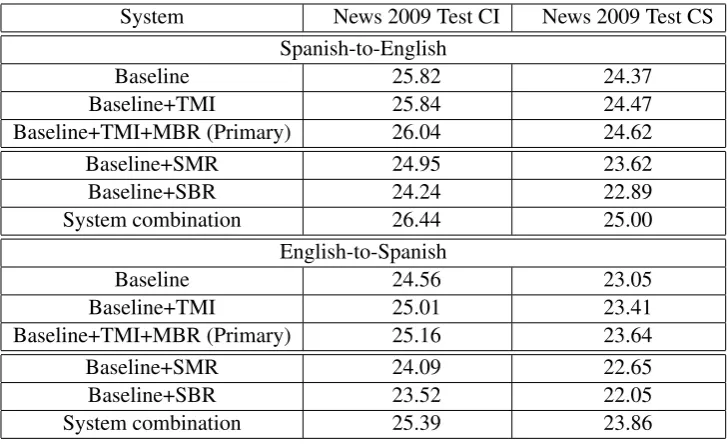
Over the past few years the MBR algorithm uti-lization to find the best consensus outputs of dif-ferent translation systems has proved to improve the translation accuracy (Kumar, 2004). The sys-tem combination is performed on the 200-best lists which are generated by the three systems: (1) MOSES-based system without pre-translation monotonization (baseline), (2) MOSES-based SMT enhanced with SMR monotonization and (3) MOSES-based SMT augmented with SBR mono-tonization. The results presented in Table 4 show that the combined output significantly outperforms the baseline system configuration.
3 Experiments and results
We followed the evaluation baseline instructions1
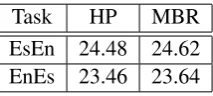
to train the MOSES-based translation system. In some experiments we used MBR decod-ing (Kumar and Byrne, 2004) with the smoothed BLEU score as a similarity criteria, that al-lowed gaining 0.2 BLEU points comparing to the standard procedure of outputting the translation with the highest probability (HP). We applied the Moses implementation of this algorithm to the list
1http://www.statmt.org/wmt09/baseline.html
of 200 best translations generated by the TALP-UPC system. The results obtained over the official 2009 Test dataset can be found in Table 2.
Task HP MBR
[image:3.595.364.471.111.159.2]EsEn 24.48 24.62 EnEs 23.46 23.64
Table 2:MBR versus MERT decoding.
The "recase" script provided within the base-line was supplemented with and additional mod-ule, which restore the original case for unknown words (many of them are proper names and loos-ing of case information leads to a significant per-formance degradation).
3.1 Language models
The target-side language models were estimated using the SRILM toolkit (Stolcke, 2002). We tried to use all the available in-domain training mate-rial: apart from the corresponding portions of the bilingual NC corpora we involved the following monolingual corpora:
• News monolingual corpus (49M tokens for English and 49M for Spanish)
• Europarl monolingual corpus (about 504M tokens for English and 463M for Spanish)
• A collection of News development and test sets from previous evaluations (151K tokens for English and 175K for Spanish)
• A collection of Europarl development and test sets from previous evaluations (295K to-kens for English and 311K for Spanish)
Five LMs per language were estimated on the corresponding datasets and interpolated follow-ing the maximum perplexity criteria. Hence, the larger LMs incorporating in- and out-of-domain data were used in decoding.
3.2 Spanish enclitics separation
For the Spanish portion of the corpus we imple-mented an enclitics separation procedure on the preprocessing step, i.e. the pronouns attached to the verb were separated and contractions as del
post-processing, the segmentation was recovered in the English-to-Spanish direction using target-side Part-of-Speech tags (de Gispert, 2006).
3.3 Results
The automatic scores provided by the WMT’09 organizers for TALP-UPC submissions calculated over the News 2009 dataset can be found in Ta-ble 3. BLEU and NIST case-insensitive (CI) and case-sensitive (CS) metrics are considered.
Task Bleu CI Bleu CS NIST CI NIST CS EsEn 25.93 24.54 7.275 7.017 EnEs 24.85 23.37 6.963 6.689
Table 3: BLEU and NIST scores for preliminary official test dataset 2009 (primary submission) with 500 sentences excluded.
The TALP-UPC primary submission was ranked the 3rd among 28 presented translations for the Spanish-to-English task and the 4th for the English-to-Spanish task among 9 systems.
The following system configurations and the in-ternal results obtained are reported:
• Baseline: Moses-based SMT, as proposed on the web-page of the evaluation campaign with Spanish enclitics separation and modi-fied version of “recase“ tool,
• Baseline+TMI:Baseline enhanced with TM interpolation as described in subsection 2.1,
• Baseline+TMI+MBR: the same as the latter but with MBR decoding,
• Baseline+TMI+SMR: the same as Base-line+TMIbut with SMR technique applied to monotonize the source portion of the corpus, as described in subsection 2.2,
• Baseline+SBR: the same asBaselinebut with SBR algorithm applied to monotonize the source portion of the corpus, as described in subsection 2.3,
• System Combination: a combined output of the 3 previous systems done with the MBR algorithm, as described in subsection 2.4.
Impact of TM interpolation and MBR decod-ing is more significant for the English-to-Spanish translation task, for which the target-side mono-lingual corpus is smaller than for the Spanish-to-English translation.
We did not have time to meet the evalua-tion deadline for providing the system combi-nation output. Nevertheless, during the post-evaluation period we performed the experiments reported in the last three lines of Table 4 ( Base-line+TMI+SMR,Baseline+SBRandSystem com-bination).
Note that the results presented in Table 4 differ from the ones which can be found the Table 3 due to selective conditions of preliminary evaluation done by the Shared Task organizers.
System News 2009 Test CI News 2009 Test CS Spanish-to-English
Baseline 25.82 24.37
Baseline+TMI 25.84 24.47
Baseline+TMI+MBR (Primary) 26.04 24.62
Baseline+SMR 24.95 23.62
Baseline+SBR 24.24 22.89
System combination 26.44 25.00
English-to-Spanish
Baseline 24.56 23.05
Baseline+TMI 25.01 23.41
Baseline+TMI+MBR (Primary) 25.16 23.64
Baseline+SMR 24.09 22.65
Baseline+SBR 23.52 22.05
[image:4.595.117.481.523.745.2]System combination 25.39 23.86
4 Conclusions
In this paper, we present the TALP-UPC phrase-based translation system developed for the EACL-WMT 2009 evaluation campaign. The major nov-elties of this year are translation models interpola-tion done in linear way and combinainterpola-tion of SMT systems implementing different word reordering algorithms. The system was ranked pretty well for both translation tasks in which our institution has participated.
Unfortunately, the promising reordering tech-niques and the combination of their outputs were not applied within the evaluation deadline, how-ever we report the obtained results in the paper.
5 Acknowledgments
This work has been funded by the Spanish Gov-ernment under grant TEC2006-13964-C03 (AVI-VAVOZ project).
References
P. Brown, J. Cocke, S. Della Pietra, V. Della Pietra, F. Jelinek, J.D. Lafferty, R. Mercer, and P.S. Roossin. 1990. A statistical approach to machine
translation. Computational Linguistics, 16(2):79–
85.
A. de Gispert. 2006. Introducing linguistic knowledge into Statistical Machine Translation. Ph.D. thesis, Universitat Politècnica de Catalunya, December.
G. Foster and R. Kuhn. 2007. Mixture-model
adap-tation for SMT. InIn Annual Meeting of the
Asso-ciation for Computational Linguistics: Proc. of the Second Workshop on Statistical Machine Transla-tion (WMT), pages 128–135, Prague, Czech Repub-lic, June.
M. Khalilov and J. R. Fonollosa. 2008. A new subtree-transfer approach to syntax-based reordering for sta-tistical machine translation. Technical report, Uni-versitat Politècnica de Catalunya.
Ph. Koehn and J. Schroeder. 2007. Experiments in do-main adaptation for statistical machine translation. InIn Annual Meeting of the Association for Compu-tational Linguistics: Proc. of the Second Workshop on Statistical Machine Translation (WMT), pages 224–227, Prague, Czech Republic, June.
Ph. Koehn, H. Hoang, A. Birch, C. Callison-Burch, M. Federico, N. Bertoldi, B. Cowan, W. Shen, C. Moran, R. Zens, C. Dyer, O. Bojar, A. Con-stantin, and E. Herbst. 2007. Moses: open-source toolkit for statistical machine translation. In Pro-ceedings of the Association for Computational Lin-guistics (ACL) 2007, pages 177–180.
Sh. Kumar and W. Byrne. 2004. Minimum bayes-risk decoding for statistical machine translation. In In HLTNAACL’04, pages 169–176.
Sh. Kumar. 2004. Minimum Bayes-Risk Techniques in
Automatic Speech Recognition and Statistical Ma-chine Translation. Ph.D. thesis, Johns Hopkins Uni-versity.
F. Och and H. Ney. 2004. The alignment template approach to statistical machine translation. Compu-tational Linguistics, 3(4):417–449, December.
M. R. Costa-jussà and J. R. Fonollosa. 2009. An
Ngram reordering model. Computer Speech and
Language. ISSN 0885-2308, accepted for publica-tion.
H. Schwenk and Y. Estève. 2008. Data selection and smoothing in an open-source system for the 2008 nist machine translation evaluation. InProceedings of the Interspeech’08, pages 2727–2730, Brisbane, Australia, September.
A. Stolcke. 2002. SRILM: an extensible language
modeling toolkit. InProceedings of the Int. Conf.