Impact Factor: 5.515
A Dynamic EE and SE Estimation for
the Load Matrix Method
Abstract— This letter investigates the tradeoff between energy efficiency (EE) and spectral efficiency (SE) in downlink multiuser OFDM using load matrix concept. Given the SE requirement and maximum power limit, a constrained optimization problem is formulated to maximize EE. Because of the multi-dimensional and non-convex nature of the problem, we first transform the multicriteria optimization problem with high complexity into a simpler single objective optimization problem. Then a novel power allocation algorithm is proposed to achieve maximum EE. Simulation results demonstrate the effectiveness of the proposed scheme as well as illustrate the fundamental tradeoff between energy efficient and spectral efficient transmission in downlink multiuser OFDM.
Index Terms—Energy efficiency, orthogonal frequency division multiplexing, power allocation
I. INTRODUCTION
Information and communication technology (ICT) is playing an increasingly important role in global greenhouse gas emissions since the amount of energy consumption for ICT increases dramatically with the exponential growth of service requirement. Therefore, pursuing high energy efficiency (EE) is becoming the mainstream for future wireless communications design. Various EE methods have been proposed for different layers of wireless communication networks. For network planning it has been shown that reducing cell size can increase EE For physical layer, different transmission techniques such as orthogonal frequency division multiple access (OFDMA), multiple input multiple output (MIMO) techniques, and relay transmission have been reconsidered from the EE point of view instead of traditional spectral efficiency (SE). Energy efficient OFDM systems have been first addressed with consideration of circuit consumption in [3]. It has been demonstrated that there is at least a 20% reduction in energy consumption with performing EE optimization. In [4], cross-layer design for energy efficient wireless communications has been discussed detailed. It has been shown that using both power and modulation order adaptation, the EE-oriented design always consumes less energy than the traditional fixed power schemes. In [5], it is shown that, by adapting modulation order to balance
K.Venkata Ramana Assoc.prof., Dept.of ECE
Sree Chaitanya Institute of Technological Sciences, KNR
[email protected], 9491699941
Narmala Raju Assoc.prof., ECE Dept.
Jyothishmathi Institute of Technology and Science, KNR
Impact Factor: 5.515 output (SISO) systems. Adaptive switching between MIMO with two transmit antennas and single-input multiple-output (SIMO) is addressed to save energy at mobile terminals. In this letter, the tradeoff between EE and SE in downlink multiuser OFDM is addressed. We account for both circuit and transmit power when designing optimal EE systems. The optimization objective is to maximize EE while satisfying SE requirements and power limits. Compared with throughput maximization under power limits [11] or the power minimization with respect to target data rate constraints [12], this objective function, which measures as the transmitted bits per unit energy consumption, is particularly suitable for designing green communication systems. The multi-dimensional and non-convex nature of the optimization problem in multiuser systems makes it more challenging than the throughput maximization or power minimization problems. Hence, we first transform the multicriteria optimization problem with high complexity into a simpler single objective optimization problem. Then we propose a novel power allocation algorithm to achieve maximum EE. The comparison among the energy efficient power allocation scheme, rate adaptive power allocation scheme and margin adaptive power allocation scheme is carried out to demonstrate the advantage of the proposed scheme. The rest of this letter is organized as follows. The system model is presented in the second section. Section III introduces a novel power allocation algorithm for achieving maximum energy efficiency in downlink multiuser OFDM.
II. OFDM DEFINATION
Orthogonal frequency-division multiplexing (OFDM) is a method of encoding digital data on multiple carrier frequencies. OFDM has developed into a popular scheme for wideband digital communication, whether wireless or over copper wires, used in applications such as digital television and audio broadcasting, DSL Internet access, wireless networks, powerline networks, and4G mobile communications.
OFDM is a frequency-division multiplexing (FDM) scheme used as a digital multi-carrier modulation method. A large number of closely spaced orthogonal sub-multi-carrier signals are
used to carry data[1] on several parallel data streams or channels. Each sub-carrier is modulated
with a conventional modulation scheme (such as quadrature amplitude modulation or phase-shift
keying) at a low symbol rate, maintaining total data rates similar to conventional
single-carrier modulation schemes in the same bandwidth.
Impact Factor: 5.515 simultaneously at the same frequency, as the signals from multiple distant transmitters may be combined constructively, rather than interfering as would typically occur in a traditional single-carrier system.
III. SYSTEM MODEL
This letter considers the downlink of multiuser OFDM in a single cell with M mobile station
(MS) and N Remote Access Unit (RAUs), as shown in Fig. 1. The radius of the circular cell is R.
The BS can be regarded as a special RAU and is denoted by RAU 1. The RAUs connected with the center BS/RAU 1 through optical fibers. We assume that channel state information (CSI) is available at the transmitter and receiver. When the maximum ratio combining (MRC) is utilized at the receiver, the signal to noise ratio (SNR) of MS is given by
Energy Efficient Optimization Model for OFDM The objective of rate adaptive (RA) optimization is formulated as
Impact Factor: 5.515
-8 -6 -4 -2 0 2 4 6 8
10 20 30 40 50 60 70 80
Transmit Eb/No in dB
ca
pa
ci
ty
(b
ps
/H
z)
capacity vs Eb/N0 for varying nr in rician channel with one dominant path
nr=3,nt=2 nr=4,nt=2 nr=5,nt=2
IV. OPTIMAL POWER ALLOCATION ALGORITHM
To obtain the optimal power allocation algorithm for achieving maximum EE in the downlink
OFDM as follows:
Step 1: calculate optimal power in transmitters and receivers
Step 2: calculate upper bound and lower bound values
Step 3: calculate optimal power at transmitters and receivers
Step 4: allocate the antennas for trans mission and reception
Impact Factor: 5.515
-8 -6 -4 -2 0 2 4 6 8
10 20 30 40 50 60 70 80
Transmit Eb/No in dB
ca
pa
ci
ty
(b
ps
/H
z)
capacity vs Eb/N0 for varying nr in rician channel with two dominant paths
nr=3,nt=2 nr=4,nt=2 nr=5,nt=2
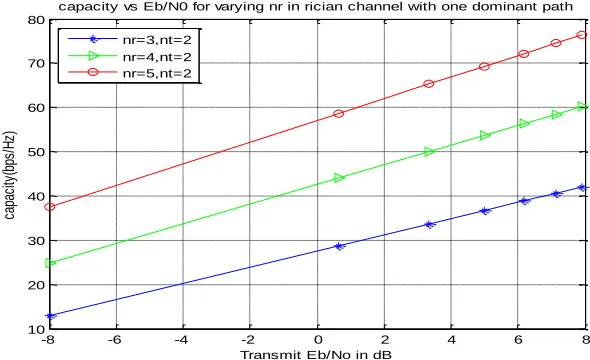
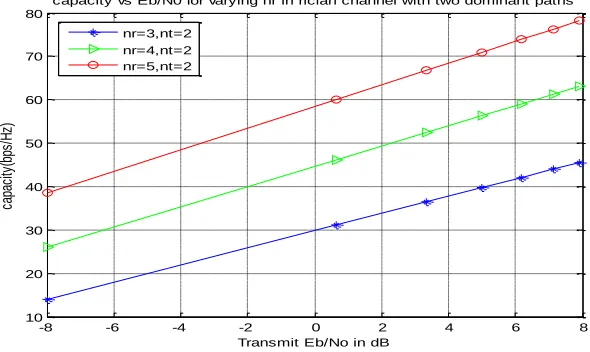
figure 6.1(b) SNR capacity is plotted for 2 transmitters and different receivers with k=1. It is observed that the capacity is increased as the no. of receivers increased. Assuming that the dominant paths are two and interference to noise ratio is 0dB
VI. CONCLUSION
In this letter, we have investigated the EE-SE relation in downlink DAS. A novel power allocation algorithm is proposed to achieve maximum EE. Simulation results show that there is a tradeoff between EE and SE, which is very important for designing green communication systems. For future research, EE-SE tradeoff model and power allocation scheme when OFDM techniques are utilized and/or multiple cells are deployed need to be addressed.
REFERENCES
[1] G. P. Fettweis and E. Zimmermann, “ICT energy consumption-trends and challenges,” in
Proc. 2008 International Symposium Wireless PersonalMultimedia Communication, pp. 1-4.
[2] B. Badic, T. O’Farrrell, P. Loskot, and J. He, “Energy efficient radio access architectures for
green radio: large versus small cell size deployment,” in Proc. 2009 IEEE VTC, pp. 1-5.
[3] G. Miao, N. Himayat, Y. Li, and D. Bormann, “Energy efficien design in wireless OFDMA,”