1 | http://mojes.um.edu.my/ EISSN: 2289-3024
MALAYSIAN ONLINE JOURNAL OF EDUCATIONAL SCIENCES JANUARY 2019, 7 (1)
INTRODUCTION
One of the important goals that students are expected to learn in mathematics is determining how to tell the time, which is seen as the first step in child development (Safran & Şimşek, 2009). Since any work in the day is made within a certain plan and program, it is important to learn to tell the time in order to express the timing of any event (Williams, 2004). Time telling is a practical task that is accomplished by children in school and out of school, and little is known about it (Siegler & McGilly, 1989). Students are expected to learn to tell the time, because it is a common cognitive activity that is frequently used in everyday life (Williams, 2012). Unfortunately, not all individuals find it easy to read the time (Catterall, 2008) since time is abstract (Williams, 2004) and it is a complex and unseen phenomenon (Andersson, 2008). Most students at primary school seem to have problems on telling the time (McGuire, 2007; Harris, 2008) because of its cognitive complexity (Williams, 2012). In telling the time, the child's first experience with recorded time is the 12-hour time system. Origo Education (2007) defined this system as 12 hours division of day. Time activities presented at primary school include telling the time using this system. Telling the time also has a prominent role in the early childhood, but the students face with it in more detail during primary school (Wien & Kirby-Smith, 1998; Rose & Whitty, 2010). Reading the clock starts at the first grade of primary school and continues with reading half and quarter hours at the second grade. At the third grade, students are expected to be able to read the time as minutes and hours (Ministry of National Education, 2017).
HOW DO THIRD GRADE STUDENTS READ THE CLOCK?
*Nejla Gürefe
Department of Mathematics Education, Usak University, Turkey
Şeyma Özdil
Department of Classroom Teaching, Usak University, Turkey
ABSTRACT
Students require knowledge of fraction, arithmetic and integer to tell the time. The purpose of the current study is to discover the conceptual knowledge related
to hours, how the students read the clock and use half and quarter concepts to read the time in Turkey. A qualitative research method with a case study approach was used for this research. The participants of the study consisted of 12 students studying at the third grade of a public school located in the west of Turkey. The data of the study were collected through semi-structured interviews. A form consisted nine questions was used in the interviews. The data were then analysed using content analysis. As the result of analysis, it was determined that the students used fraction knowledge, number of minute and absolute time while telling the time, but mostly for fraction knowledge and some students could not associate the knowledge in the subject of the fractions with the reading the clock.
2 | http://mojes.um.edu.my/ EISSN: 2289-3024
MALAYSIAN ONLINE JOURNAL OF EDUCATIONAL SCIENCES JANUARY 2019, 7 (1)
Different cultures have developed various ways to organize, communicate and record the time. Analog and digital clocks are the most frequently used clock displays for time alignment (Bock, Irwin, Davidson, & Levelt, 2003). It is expected that children learn to interact with analogue and digital time vehicle, encode symbolic, pictorial and time displays associated with these events, adhere to daily timelines, and develop essential strategies, procedure and knowledge to tell the time (Burny, Valcke, & Desoete, 2009). Reading the time on an analogue clock involves mathematical thinking about fractions and using time-reading knowledge (Clauscen, 2016). The Australian Curriculum and Assessment Reporting Authority (ACARA) (2014) expected children to associate half information in fractions with half past hour on an analogue clock. In addition, students are asked to be able to use fraction knowledge to read and explain time such as half past hour, a quarter past, and a quarter to (Burny et al., 2009). In order to apply fraction knowledge in telling the time, students need teaching and learning experiences that can identify the link between telling the time and fraction knowledge (Williams, 2012). Several studies in the literature argued that primary school students have a relationship between reading the clock and fraction information, but no empirical evidence has been obtained (Clauscen, 2016). Since there have been no past research conducted on this issue in Turkey, this work proved to be needed and all the more important in order to investigate students’ time telling using fraction knowledge in our country.
When the literature is investigated, it was seen that there have been various researches done so far regarding this issue. Some of the studies determine the smallest angular separation between hours and minutes in given two hours (Paivio, 1978), differences in their ability which show using analogue and digital clock images depending on children’s age (Friedman & Laycock, 1989), how the students read the time on an analogue clock (Kuchinsky, Bock, & Irwin, 2011) and fraction knowledge in telling the time, verbal discourse and procedural knowledge, cognitive competence and in particular accuracy (Clauscen, 2016). There are more about how the students with mental disabilities developed reading clock ability (Dağseven, 2001; Karabulut & Yıkmış, 2010), the difficulties children encountered in learning time (McGuire, 2007; Harris, 2008), the students’ drawing-telling process (Smith & MacDonald, 2009), the stages of the development of students to understand the clock (Aldridge & White, 2002; Pengelly, 1985), the conceptualization of various time systems such as speed, distance and time relation and day, month and year (Friedman, 1986; Levin, Wilkening, & Dembo, 1984) and also how 7-10 year old children identify and produce various types of time on an analogue clock (Vakali, 1991). All of these studies revolved around the ideas of time and students understanding time. The study by Bock, Irwin, Davidson and Levelt (2003) has proved that there is a major cultural difference in telling the time. However, in our country, there are no studies regarding how students decide what time it was; therefore, it is not possible for us to have specific knowledge on this subject. Daily observations have shown that children learning to tell the time use many strategies (Siegler & Mcgilly, 1989). In addition, Williams (2004) stated that reading time occurred with the production of components such as hours and minutes, so that different types of time reading (e.g. reading quarter to six as five fourty-five etc.) contained different matching sets from different conceptual outcomes. There are two different displays in reading the clock, relative and absolute (Bock, Irwin, Davidson, & Levelt, 2003; Williams, 2004). This present study aimed to determine how third grade students read the half and quarter hours alongside their understanding of some concepts related to the time and the utilization of fraction information in telling the time.
METHODOLOGY
Research Design
3 | http://mojes.um.edu.my/ EISSN: 2289-3024
MALAYSIAN ONLINE JOURNAL OF EDUCATIONAL SCIENCES JANUARY 2019, 7 (1)
Participants
The participants of the study consisted of 12 students studying at the third grade of a public school located in the West of Turkey. The participants selected for the sampling method were asked if they have knowledge about telling the time. In the selection of participants, the students’ math performance and mathematical score were also taken as reference and the students were selected among the successful, moderate and low students according to the principle of maximum diversity. The students’ names were coded as S1, S2, …, S12 in the study. Out of the 12 students, five students (S2, S3, S8, S10, S11) were female, seven students (S1, S4, S5, S6, S7, S9, S12) were male.
Data Collection Tools and Process
Semi-structured interviews were conducted with the students and the interviews lasted around 10-15 minutes. In the interviews, a form consisting of nine open ended questions was used. Questions about half and quarter hours were included in the form. The questions were listed as: determining time on an analogue clock, showing as an analogue clock time given on digital clock, and conceptual understanding of clock concepts such as half (semi), half* (half) and quarter. The researcher consulted the opinions of the participants’ teacher and a faculty member to determine whether the questions were deemed suitable for the students’ level. Taking the experts’ opinions into consideration, the questions in the form were then finalized and used with the additional questions during the interviews. The interview sessions was recorded by a voice-recorder. In addition, students were given paper and pencil and were told to use them when needed, and the explanations and drawings written by the students on the given paper were also evaluated as data.
Data Analysis
This study sought to determine how the students read and drew the clock and used fraction knowledge. Content analysis was carried out to analyse the data. Codes were generated from given answers for each question, and then these codes were combined under certain categories. Data were analysed according to relative expression reference to fraction, relative expression reference to number of minutes and absolute time suggested by Clauscen (2016). Absolute time shows a sign in the time as the number of hours followed by the number of minutes, relative hours a quarter times or minutes (Williams, 2004). Taking the descriptions into account, if the students read the clock using the “half and quarter” concepts, it could be said that they used fraction knowledge. However, if they read the clock emphasising the number of minutes, (e.g. 30 minutes past nine, 15 minutes past twelve etc.) they are then using the number of minutes as the strategies and if they read the clock as given numbers (e.g. reading eighteen thirty for 18:30 clock, etc.), it could be said that they used absolute times. Both researchers have analysed the data at a separate time to ensure the reliability of coding analysis in the study. The formula suggested by Miles and Huberman (1994) was used to determine the consistency between coding schemes. The coding consistency was found to be 85%. On the non-conforming codes, two researchers reached consensus after making the necessary debate.
FINDINGS
The students were asked questions to determine reading situations of analogue and digital clocks and their conceptual understanding related to the concept of half an hour and quarter times. The findings were handled as half and half* concepts and the reading clock were set according to their answers.
Half and Half* Concepts
4 | http://mojes.um.edu.my/ EISSN: 2289-3024
MALAYSIAN ONLINE JOURNAL OF EDUCATIONAL SCIENCES JANUARY 2019, 7 (1)
"... it may be the same. Because half is divided two parts from the middle, and number six divides the clock into two parts, because six is half of twelve. (S1)","Half* is half of an hour. The half* is 30 minutes…(S2)”, “Half is a little small, half* is different because it was showed on the clock. Because, I can say that the hour is half past two, but I can not say that the hour is two halves. If 1 say half, I can not know that it is on eight or nine. …(S3)”, “Half and half* can have the same meaning. For example, we understand that the hour is half when the clock is at half past six…(S4)”, “it means half…(S6)”, “…because half past is the hour, but half is concept… we can do half apple, but we can not do half*. (S5)”,” Because, half* can be said to show the all of the hour. (S12)”, “It's like a half. Half* is used for hour, but it looks like half. It is to pass thirty minutes on the hour ... In fact, half* is the same with half. Because when it is half* past an hour the hour (hour hand) is in the middle. If the time is half past two, the hour hand is between two and three, it shows half of an hour. We accept the same because we divide into half from its middle. (S10)”, “For example, this (shows interval of the hour) is half*… (S7)”, “Half. (S8)”, “It looks like half, it is half of the sixty. Twenty is half of the sixty. (S9)”.
It has been determined from the student’ descriptions that six referred to half of twelve on the clock, 30 minutes as half of an hour, 30 minutes which is half of the sixty and the situation which the hour hand is located between two numbers could be half*.
Reading Clock
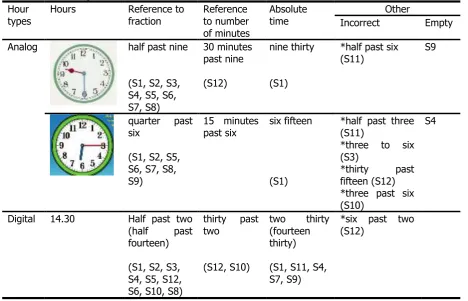
Students who wanted to read analogue and digital clocks used fraction information, number of minutes and absolute time. In addition, there were also some students who could not read the clock at all and read the time incorrectly, as shown in Table 1.
Table 1
The students’ reading clock
Hour
types Hours Reference to fraction Reference to number of minutes
Absolute
time Incorrect Other Empty
Analog half past nine
(S1, S2, S3, S4, S5, S6, S7, S8) 30 minutes past nine (S12) nine thirty (S1)
*half past six
(S11) S9
quarter past six
(S1, S2, S5, S6, S7, S8, S9)
15 minutes
past six six fifteen
(S1)
*half past three (S11)
*three to six (S3)
*thirty past fifteen (S12) *three past six (S10)
S4
Digital 14.30 Half past two (half past fourteen)
(S1, S2, S3, S4, S5, S12, S6, S10, S8)
thirty past two
(S12, S10)
two thirty (fourteen thirty)
(S1, S11, S4, S7, S9)
5 | http://mojes.um.edu.my/ EISSN: 2289-3024
MALAYSIAN ONLINE JOURNAL OF EDUCATIONAL SCIENCES JANUARY 2019, 7 (1)
Hour models
12.15 quarter past
twelve
(S1, S4, S6, S7, S8, S9)
15 minutes past twelve
(S8)
twelve fifteen
(S12, S7)
*three to twelve (S11)
*fifteen to twelve (S3)
*twelve past five (S5)
S2, S10
6 | http://mojes.um.edu.my/ EISSN: 2289-3024
MALAYSIAN ONLINE JOURNAL OF EDUCATIONAL SCIENCES JANUARY 2019, 7 (1)
examined, it was determined that some of the students explained clocks correctly, but their drawings were shown to be incorrect. Some students drew their numbers from 1 to 12 in the circle, while others only draw 3, 6, 9 and 12 numbers in the clock. Some of them could not establish the space of the numbers equally as well, so the places where the numbers were supposed to be located at were deemed incorrect.
Although the clock showed “quarter past six”, some students read the clock as half past three (S11), three to six (S3), thirty past fifteen (S12), three past six (S10). The students also misread “quarter past twelve” and instead read it as three to twelve (S11), fifteen to twelve (S3) and twelve past five (S5). When examining Table 1, it was determined that students generally read quarter times incorrectly. This could happen because the students did not fully understand the concept of the quarter. The following conversations took place between the researcher (R) and S3 who read both quarter times incorrectly.
R: Do you read at 12:15 time? May you show it on the hour? Why do you draw?
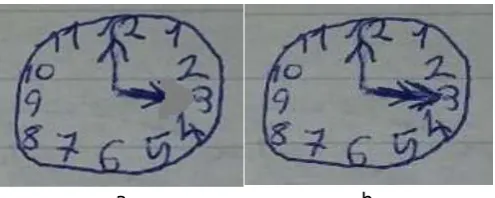
S3: (drawing Figure 1, the hour hand points number three, the minute hand points number twelve) Fifteen to twelve.
R: …What was the quarter?
S3: A thing which shows half.
R: Is 12:15 clock a quarter?
S3: No...
R: Why?
S3:Iıı. Yes. Because there is a difference between them (the hour and minute hands). R: How is it?
S3: It is a little small. e.g. it comes here (the minute hand comes to number six). I know that it is half.
R: Ok, if it was so (if the hand which shows number twelve demonstrates number six and the other hand shows number three), would it be quarter?
S3: It could be half. (S3 said that it was quarter when the minute hand was carried to the other numbers)
R: …Are four pieces necessary to obtain the quarter?
S3: No.
R: How the parts must be?
S3: …three parts must be equal.
a b
Figure 1. a. Model drawn by S3 for 12:15 b. Shape drawn with the help of the researcher
7 | http://mojes.um.edu.my/ EISSN: 2289-3024
MALAYSIAN ONLINE JOURNAL OF EDUCATIONAL SCIENCES JANUARY 2019, 7 (1)
quarter concept. Later on, the student said that the minute hand must point number six to be half an hour. Thus, it could be said that the student knew half concept on the clock. Afterwards, the student explained quarter concept as the difference between the hour and minute hands, and then stated three equal parts in the quarter. She also read the clock as three to six which was actually quarter past six. Quarter concept was asked to her in order to investigate whether she knew how to use quarter while reading the clock. She defined it as a small part of the shape. These situations showed that she was not absolutely aware of the quarter concept in telling the time and did not have the correct knowledge about the quarter concept. If she had understood what the quarter concept was, she would have read the clock using the fraction knowledge.
S2 was asked to read clock which showed quarter past six on the analogue clock given and the student could read it correctly. The following dialogue took place between S2 and the researcher.
R: Can you read the clock below? (The time that shows 06:15 is being asked)
S2: Quarter past six.
R: Can you explain why you read it in this way?
S2: Because there are three ... It shows three, quarter past.
R: Why do you say quarter when the minute hand points number three? S2: Because the minute hand is pointing three. ...
R: ... I mean, all ...
S2: When all of it is divided into four, it comes here (shows number three) thus we say quarter time.
S2 told the time using conceptional understanding related to quarter in the fraction subject in the interviews. The student said that the time was quarter past because the minute hand pointed number three. Later she divided analogue hour into four parts which had circle shape and one part of it was signified the section where number three was located. However, the student did not specify number nine as the quarter. She only labelled number three as "quarter”. This situation showed that she did not use fraction knowledge in reading the clock completely.
S8 was asked to read the clock which was quarter past twelve on the analogue clock given and was able to read the clock using fraction knowledge and the number of the minute. S8 then explained quarter concept utilizing angles. The following dialogue took place between S8 and the researcher.
R: Would you show 12.15 clock with a model?
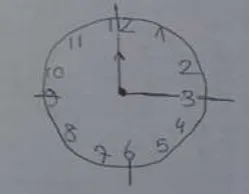
S8: (Drawing the clock in Figure 2)
R: Which one is the hour and the minute hand?
S8: The long hand is the hour hand, the other is the minute hand.
R: What time does it show?
S8: Fifteen past twelve, quarter past twelve.
R: Why do you say quarter?
S8: Because this is a quarter (it shows figure) ...
R: How do you know it is a quarter?
S8: Perpendicular angle indicates ninety. Quarter looks alike perpendicular angle. This is 30
8 | http://mojes.um.edu.my/ EISSN: 2289-3024
MALAYSIAN ONLINE JOURNAL OF EDUCATIONAL SCIENCES JANUARY 2019, 7 (1)
Figure 2. Shape drawn by S8 for 12:15
In the interview with S8, the student could read and model the clock given as 12:15 correctly using the fraction knowledge and number of minutes. However, even if the student expressed the roles of the long and short hands correctly, she read the clock incorrectly. She read the clock as quarter past twelve. When asked why, she stated that one quarter of the circle was a perpendicular angle which was 90 degrees. She said that the point showed number three and this was quarter because quarter resembled perpendicular angle. She could not think nor model the time as an analogue clock, she only thought as circle model. She divided the circle which has 360-degree angle into twelve to indicate that each angle between consecutive numbers is 30 degrees and the angle between the numbers 12 and 3 is 90 degrees, and she stated that those with 90 degrees were quarters. It was seen that the quarter was determined by taking one quarter of 360 degrees. Thus, every 90 degrees showed quarter. At 15:30, measurement of the angle between the hour and minute hands is 90 degrees. Taking the student’s comment into account, it should have been a quarter time. Whereas one of the four parts on the circle model specifies the quarter, but this is not the case on the clock. Quarter is only in this case which the minute hand points the numbers "3" and "9". She had a sufficient understanding on quarter concept in the fractions, but she had a limitation related to that the quarter concept should only be shown on the circle model. This situation can be thought of as a reflection that student could not fully conceptualize the quarter concept in fractions.
In the interviews, questions like "When does the clock show quarter time? Why?” were asked to the students to determine whether they were aware of the quarter times in the hours. Dialogues in the interviews related to the questions were given below.
R: When does the clock show quarter time?
S1: Three ...
R: Which one does show three?
S1: The Minute hand.
R: Ok, What will the other one show?
S1: Six or twelve ...
R: Ok, can we call it a quarter when the hour hand points nine?
S1: No, then it will not be a quarter, the hour splits into two halves, it's like half.
9 | http://mojes.um.edu.my/ EISSN: 2289-3024
MALAYSIAN ONLINE JOURNAL OF EDUCATIONAL SCIENCES JANUARY 2019, 7 (1)
Students who were asked to read half past times on the clocks read them as half*. For example, taking the twelve numbers into account on the hour, S1 stated that the twelve were exactly one hour and number six which was half of it was read as half*. S2 stated that the whole hour was 60 minutes and 30 minutes which was half of it was read as half*. The following interview depicted the situation with the students.
R: Do you read the 14:30 by showing it on a watch model?
S1: Before or after lunch?
R: After lunch.
S1: Fourteen thirty, no, half past fourteen.
R: How else can we read it?
S1: Fourteen thirty, two thirty ...
R: Can we say that it is half* past two?
S1: Yes.
R: Why do you use half*? What does it mean?
S1: Can it be half? It can be said that it is half* because twelve is whole and six is half of twelve.
A: If there was not a half word, could we say another word instead of half*? S1: Half. Because the clock is full, twelve is an exact hours, six is half of twelve.
S1 who used fraction knowledge and absolute time reading argued that half* was one hour considering the clock as a whole. He used absolute time reading clock as fourteen thirty and fraction knowledge as half past fourteen. It was determined that he took the numbers into account on the hour and stated that number six was half or half* because number six was half of number twelve when 12 was exact one hour. The usage of half in a whole concept for the half-or-half* concepts showed that he used fraction knowledge. Likewise, S2 said that one hour was 60 minutes and 30 minutes was half of it.
R: Do you read the 14:30 clock by showing it on a watch model?
S2:(Can not draw). Half* past two.
R: What does half* mean?
S2: Because half the clock ...
R: What does one hour?
S2: 60 minutes.
R: How much does half represent?
S2: 30 minutes ...
The researcher asked the student to tell the whole hour, and it was seen that the student expressed the whole by taking the minute at one hour into account. At that time, she used fraction knowledge, because she read the hour as half past two wherefore minute hand showed a point which represented 30 minutes and 30 minutes were half of 60 minutes. She used half* concept, not half concept, and she explained it as half of an object. S4 interpreted half-concept similar to S2 and the following dialogue was actualized between the R and S4.
R: Do you read the clock? Why do you read it in this way?
S4: Half past nine.
R: Why did you say half*?
S4: Because ... (thinking ...)
R: You just told me that half* was half of an object. Why did you say half*in here?
S4: Let's just say; one hour is sixty minutes, 5, 10, 15, 20, 25, 30 (counting to the thirtieth minute). Thirty minutes passed number nine a little, because if it were nine, it (the hour hand)
would have come on nine. It's half past an hour because thirty minutes have passed.
R: Where is the place which points 60 minutes?
10 | http://mojes.um.edu.my/ EISSN: 2289-3024
MALAYSIAN ONLINE JOURNAL OF EDUCATIONAL SCIENCES JANUARY 2019, 7 (1)
S4 stated that half of an hour was 30 minutes because an hour was 60 minutes. Unlike S2, however, this student said that the hour which was half past nine on the analogue clock was half past nine, because the hour hand was not exactly on number nine, that it has passed nine, and the minute hand was on the thirtieth minute. He used also fraction knowledge to read the clock while showing understanding of half of an hour as 30 minutes.
DISCUSSION
In this study, it was detected that all the models used were found to be circular. Clauscen (2016) stated that the circular region model may be the only model used to teach time reading on an analogue clock. This may be due to the circle of the analogue clock model used by the teachers in the class or because it is the most commonly and frequent type of analogue clock model seen and known by the students in their daily lives. In addition, some students used number of minutes and absolute time strategies as well as fraction information.
11 | http://mojes.um.edu.my/ EISSN: 2289-3024
MALAYSIAN ONLINE JOURNAL OF EDUCATIONAL SCIENCES JANUARY 2019, 7 (1)
According to the findings, it has been determined that some students read the clocks incorrectly. One of the mistakes in reading the clock was that the roles of the hour hand and minute hand were mixed. For example, "quarter past six" time was read as “half past three” and “thirty past fifteen” by some of the students. In this situation, students were often confused between whether the hands of the clock indicate the hour or minute. A student may confuse the reading of the clock of 30 minutes as 6 o’clock when they see the long hand of the clock pointing at it. This was a problem for most of the students, they were confused with the meaning of the clock hands. Smith and MacDonald (2009) argued that the hands, which represent the hour and minute hand, should be taught using the terms “hour” and “minute” hands instead of “big” and “little” or “long” and “short” hands in order for their roles and movements and what they measure to be understood by the students conceptually. Therefore, the usage of the hour and minute hands concepts should be recommended in the process of teaching of the hands by teachers. Another mistake determined in the current study is that the time shown by the minute hand is considered to be the direct number itself, not the minute. In other words, the numbers indicating minutes and the number which was pointed by the minute hand were mixed up by the students. For example, some students read quarter past as “three to six” and “three past six” on the analogue clock and 12:15 as “three to twelve” on the analogue clock. These students considered three as the numerical value, not minute value. The students did not realize that the number value represented by the minute hand would actually be counted as 5 minutes from number 12. On the contrary, Vakali (1991) determined that the third and fourth grade students read the time correctly, without intermixing number of minutes with numbers pointed by the minute hand. However, in the present study, one student read 14:30 on the digital clock as “six past two”. Here, the student could not think that six which was pointed by the minute hand showed the number of minutes. That is, the student did not say that six represented thirty minutes. Some students also read the number "three" as “quarter to”. For example, students misread 12:15 on the digital clock and said that it was "three to twelve” and “fifteen to twelve”. They have misread place where number three pointed by the minute hand existed as “to”.
As a result, we can say that the clock system is very important and indispensable for our life. For this reason, it is suggested that teachers should be very particular in the classroom while teaching their students on how to tell the time. They also need to organize their teaching in a way that students could understand during the development and acquisition of the time concept.
CONCLUSION
In the study, it was determined what 3rd grade students at primary school know some concepts like half, half*, and quarter on the hour based from how they read analogue and digital clocks and utilized fraction information in this process. It has been determined that the digital clocks were modelled by the students, but the models made were sometimes incorrect and sometimes correct. All of the models used by the students were also found to be circular. However, some students used number of minutes and absolute time strategies as well as fraction information. From the concepts, students seemed to understand and used the half/half* concepts as having same meaning. As a result of the findings obtained in the study, it was seen that the students utilized fraction knowledge, number of minute and absolute time strategies and read the clock correctly, but some students read the time either incorrectly or could not read at all. However, the students mostly used fraction knowledge in this study.
12 | http://mojes.um.edu.my/ EISSN: 2289-3024
MALAYSIAN ONLINE JOURNAL OF EDUCATIONAL SCIENCES JANUARY 2019, 7 (1)
ACKNOWLEDGEMENT
This study was presented as an oral presentation at International Congress on Science and Education (ICSE-2018), Turkey.
REFERENCES
Aldridge, S. & White, A. (2002). What’s the time, Ms White? Australian Primary Mathematics Classroom,
7(2), 7–12.
Andersson, U. (2008). Mathematical competencies in children with different types of learning difficulties.
Journal of Educational Psychology, 100, 48–66. doi:10.1037/0022-0663.100.1.48
Australian Curriculum and Assessment Reporting Authority. (2014). F-10 curriculum: Year one mathematics, number: one half, work sample portfolio summary, satisfactory. Retrieved from http://www.acara.edu.au/curriculum/worksamples/Year_1_Mathematics_Portfolio_Satisfactory .pdf
Bock, K., Irwin, E. I., Davidson, D. J., & Levelt, W. J. M. (2003). Minding the clock. Journal of Memory and Language,48, 653-685.
Burny, E., Valcke, M., & Desoete, A. (2009). Towards an agenda for studying learning and instruction focusing on time-related competences in children. Educational Studies, 35, 481-492.
Catterall, R. (2008). Doing time. Mathematics Teaching,209, 37-39.
Clauscen, H. M. (2016). Exploring fraction knowledge with telling time: a case study of students who have learning difficulties (Master’s dissertation). Retrieved from QUT ePrints. (102439)
Dağseven, D. (2001). Zihinsel engelli öğrencilere temel toplama ve saat okuma becerilerinin kazandırılması, sürekliliği ve genellenebilirliğinde, doğrudan öğretime göre hazırlanmış öğretim materyali ve basamaklandırılmış öğretime göre hazırlanmış öğretim materyalinin farklılaşan etkiliği [The effectiveness of instructional materials that were designed according to direct instruction and interactive unit in acquisition, maintenance and generalization of addition and telling time skills in students with mental retardation] (Master’s dissertation).Retrieved from https://tez.yok.gov.tr/UlusalTezMerkezi/tezSorguSonucYeni.jsp. Accession No:108833.
Friedman, W. J. (1986). The development of children's knowledge of temporal structure. Child Development, 57, 1386-1400.
Friedman, W. J. & Laycock, F. (1989). Children's analog and digital clock knowledge. Child Development,
60, 357-371.
Harris, S. (2008). It’s about time: Difficulties in developing time concepts. Australian Primary Mathematics Classroom,13(1), 28–31.
Karabulut, A. & Yıkmış, A. (2010). The effectiveness of simultaneous prompting on teaching the skill of telling the time to individuals with mental retardation. Abant Izzet Baysal University Journal of Faculty of Education, 10(2), 103-113.
Kuchinsky, S. E., Bock, K., & Irwin, D. E. (2011). Reversing the hands of time: Changing the mapping from seeing to saying. Journal of Experimental Psychology: Learning, Memory, and Cognition, 37(3), 748-756. doi:10.1037/a0022637.
Levin, I., Wilkening, F., & Dembo, Y. (1984). Development of time quantification: integration and nonintegration of beginnings and endings in comparing durations. Child Development, 55, 2160-2172.
McGuire, L. (2007). Time after time. Australian Primary Mathematics Classroom, 12(2), 30–32.
Ministry of National Education. (2017). Mathematics course curriculum for primary education 1, 2, 3 and 4 classes. Ankara: State Books Directorate Publishing
Miles, M. B. & Huberman, A. M. (1994). Qualitative data analysis: An expanded sourcebook. (2nd ed.). Calif: SAGE Publications.
Origo Education. (2007). The Origo handbook. Queensland: Origo Education.
Paivio, A. (1978). Comparisons of mental clocks. Journal of Experimental Psychology: Human Perception and Performance,4(1), 61-71.
13 | http://mojes.um.edu.my/ EISSN: 2289-3024
MALAYSIAN ONLINE JOURNAL OF EDUCATIONAL SCIENCES JANUARY 2019, 7 (1)
Rose, S. & Whitty, P. (2010) ‘Where do we find the time to do this?’ Struggling against the tyranny of time. Alberta Journal of Educational Research, 56(3), 257-273.
Safran, M. & Şimşek, A. (2009). Development of time perception in children. The Journal of International Social Research, 2(6), 542-548.
Siegler, R. S. & McGilly, K. (1989). Strategy choices in children’s time-telling. In I. Levin & D. Zakay (Eds.), Time and human cognition: A life-span perspective (pp. 185–218), Oxford, England: North-Holland.
Smith, T. & MacDonald, A. (2009). Time for talk: The drawing-telling process. Australian Primary Mathematics Classroom, 14(3), 21-26.
Vakali, M. (1991). Clock Time in seven to ten year-old children. European Journal of Psychology of Education, 6, 325–336. doi: 10.1007/BF03173154.
Wien, C. A. & Kirby-Smith, S. (1998). Untiming the curriculum: A case study of removing clocks from the program. Young Children,53, 8-13.
Williams, R. F. (2004). Making meaning from a clock: Material artifacts and conceptual blending in time-telling instruction (Unpublished doctoral dissertation). University of California, San Diego,
CA.
Williams, R. F. (2012). Image schemas in clock-reading: Latent errors and emerging expertise. The Journal of the Learning Sciences, 21, 216-246. doi:10.1080/10508406.2011.553259