Research Journal
Volume 12, No. 2, June 2018, pages 29–34
DOI: 10.12913/22998624/87041 Research Article
IMAGE CLASSIFICATION FOR JPEG COMPRESSION
Jevgenij Tichonov1, Olga Kurasova1, Ernestas Filatovas2
1 Vilnius University, Institute of Mathematics and Informatics, Akademijos str. 4, LT-08663, Vilnius, e-mail: [email protected], [email protected]
2 Vilnius Gediminas Technical University, Sauletekio av. 11, LT-10223, Vilnius, e-mail: [email protected]
ABSTRACT
We analyse storage problems of digital images in accordance with image quality and
image compression efficiency. Storage problems are relevant for Cloud storage and file hosting services, online file storage providers, social networks, etc. In this paper,
an approach is proposed to process a group of images with a JPEG algorithm that all the processed images satisfy the minimum threshold of quality with the automatic
se-lection of the quality factor (QF). The experimental investigation reveals advantages of the compression efficiency of the proposed approach over the traditional JPEG algorithm. The proposed approach enables saving storage spaces while maintaining the desirable image quality.
Keywords: Image quality, image classification, JPEG algorithm, storage of images, quality prediction, SSIM, PSNR.
INTRODUCTION
Nowadays, problems of digital data storage, processing, and information presentation are es
-pecially relevant. Image storage techniques ana
-lysed in the paper can be used for different host and Cloud services, online file storage providers, social networks, etc. In this paper, we investigate various digital images captured by digital cam
-eras and an efficient storage of these images. We aim to design a more efficient (than the existing) approach to store images in JPEG format. For this purpose, we use the image classification consid -ering to image properties in order to maintain the
set quality of the images.
JPEG image compression standard and its basic principles were proposed many years ago [16], however, currently, the standard is widely
used and remains the most popular algorithm for
image compression. A quality factor (QF) is the main parameter influencing the image quality after JPEG compression, which determines the compression ratio. This parameter is an integer
number between 0 and 100, used to parameterize a quantization matrix. The greater this number is, the less information is lost. The problem is that the QF value can influence the each image quality differently when the quality is assessed by Full-Reference measures [2, 8]. The paper [15] shows
that when compressing different images by JPEG algorithm with the same compression factor, a different compression efficiency is obtained. In
the paper [13] it was showed that the image qual-ity after processing by JPEG algorithm depends
on the image content. The image quality was as
-sessed by the following measures: Compression Ratio (CR), Signal to Noise Ratio (SNR), Peak Signal to Noise Ratio (PSNR) and Mean Square Error (MSE) [11] and the Structural similarity (SSIM) index method [17].
One of the most popular approaches of image
storage is based on the repetitive quality assess
-ment of each compressed image and/or repetitive transcoding operations. Here, compression algo
-rithm is applied several times for each image, the
quality of the compressed images are assessed
each time by the quality assessment measures, and
the settings of compression are selected according to the obtained results [3]. The papers [1, 9, 10]
described optimal and near-optimal quality trans-coding systems using predictive quality factor and
scaling parameters where you need to compute measurements and/or transcoding operations
re-petitively. In such a way, storage space could be saved while maintaining high quality of images. However, these approaches are time-consuming.
We suggest to employ computational
intel-ligence techniques with a view to predicting the
image quality before usage of a compression
al-gorithm. The classification-based approach for the
image storage method was analysed in the paper [14]. Here, the influence of the JPEG algorithm on
the image quality was predicted using Linear
Dis-criminant Analysis (LDA) [5] when classifying
images into two classes. The first classes consist of images whose quality does not change significant
-ly after compression (high-quality). The quality of the second class images changes significantly after compression (low-quality). When comparing to a conventional JPEG, such classification-based ap
-proach allows saving 15% of storage space, while maintaining the user predefined quality. However, classification into only two classes is not sufficient from the user’s point of view. Moreover, the prob
-lem of image feature selection should be solved to improve classification quality. This paper presents
an approach for image storage when the images
are classified into three classes.
The remainder of this paper is organized as follows. The proposed classification-based image compression approach is described in Section 2. The results of the experimental investigation are presented in Section 3. Finally, conclusions are drawn in Section 4.
PROPOSED CLASSIFICATION-BASED
COMPRESSION APPROACH
The paper proposes an approach to process a
group of images by the JPEG algorithm so that all the processed images would satisfy the
mini-mal quality threshold defined by a user, and the QF value would be selected automatically. The
proposed approach allows predicting how the
JPEG algorithm will affect the image quality. In the process of the proposed approach, a classifica
-tion problem is solved in order to group images into three classes, depending on how strongly the JPEG algorithm will affect their quality. The pro
-cess of the proposed JPEG image compression
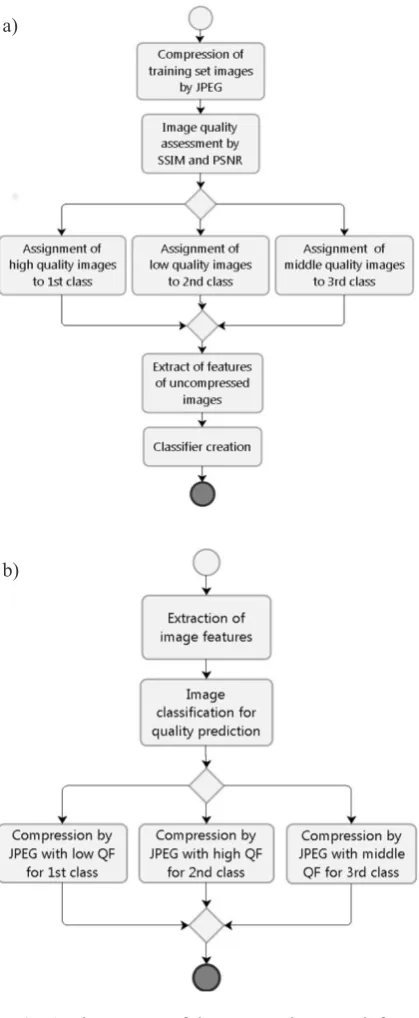
approach is illustrated in Figure 1. It should be noted that the training process is performed once, and the compression – on demand.
The quality threshold is calculated by using the quality assessment measures. For objectivity,
we select two least correlated [3] quality measures:
PSNR which analyses the difference between pix
-els and the SSIM index which estimates the total image changes. Quality thresholds are set at the intersection of these two measures (Figure 2).
To set classes for classifier training, we com -ply with the following rules:
• the images, whose the quality after the JPEG algorithm has changed the least, are assigned to the first class (SSIM > qs1 and PSNR > qp1);
• the images, whose quality has changed the most, are assigned to the second class (SSIM < qs2 and PSNR < qp2);
• the image whose quality has changed in
average, are assigned to the third class
(qs2 < SSIM < qs1 and qp2 < PSNR < qp1). It should be noted that not all the images fall into one of these classes (for example, SSIM < qs2 and PSNR > qp1). However, such three sets are
selected in order to get a more accurate training
of classifiers.
EXPERIMENTAL INVESTIGATION
The digital image database SUN2012 [18], which consists of 16 873 different images, is used. For the experimental investigation, the images with dimensions not smaller than 1024 × 768 pixels are selected (the total number of such images is 2 963).
Classifier creation
For an initial assignment of the images to
classes, the images are processed by the JPEG algorithm. The measures of image quality are computed: the SSIM values range from 0.802 to 0.999, the PSNR values – from 25.7 to 57.3.
450 images (150 images of each class) are selected to train a classifier. LDA is applied to image classification. The classification accuracy is evaluated using a 10 fold cross-validation. The numerical values of the quality thresholds qs1, qs2,
qp1, qp2 for training sets are determined experi
-mentally in such a way that the classification ac
-curacy would be obtained as high as possible. The options of the classifier are presented in Table 1.
images. Thus, the problem of image feature se
-lection for a higher classification accuracy must be solved. In order to set numerical values of im
-age features, various geometric transformations, region and image properties, texture analysis are
commonly applied [4, 6, 7, 12].
In this experimental investigation, the fol
-lowing 55 different image features are used: the means and standard deviations of pixel values, entropy, histograms (in RGB, HSV and YCbCr), the amount of bits per pixel, and the number of different regions of similar colour areas in the images, processed by global image thresholding (see Figure 3).
The correlation coefficients of 55 features are calculated, and 16 least correlated features are used for image classification, where the cor
-relation coefficients is less than 0.7. After 10 fold cross-validation, the classification accuracy 0.76 is obtained, when the images are classified into three classes. The confusion matrix shows (Fig
-ure 4) that the first and second classes are not overlapped. It means that the classifier does not
Fig. 1. The process of the proposed approach for storage of image groups: a) the training process, b)
the compression
Fig. 2. Selection the quality thresholds
a)
b)
Table 1. Options of the classifier
1st class (High quality after JPEG)
2nd class (Low quality after JPEG)
3rd class (Middle quality after JPEG)
Classification method LDA (Linear Discriminant Analysis)
Evaluation of accuracy 10 Fold Cross-Validation
Class assignment rules SSIM > qs1
and PSNR > qp1
SSIM < qs2
and PSNR < qp2
qs2 < SSIM < qs1 and qp2 < PSNR < qp1
Quality thresholds qs1 = 0.94, qp1 = 37, qs2 = 0.92, qp2 = 32
confuse high-quality with low-quality images
af-ter compression. It is obvious that an image can fall into high-quality or middle-quality class, as
well as the same situation can occur with
middle-quality and low-middle-quality classes. It happens when the quality of the misclassified images is near thresholds. However, such class overlapping does not influence classification accuracy significantly.
Comparison of the proposed approach and conventional JPEG algorithm
The proposed approach is compared with the conventional JPEG algorithm in order to estimate the storage space of the compressed images.
Fig. 3. Regions of similar colours Fig. 4. Confusion matrix
Table 2. The quality requirements and the QF values
1st case 2nd case
Conventional
JPEG Proposed approach Conventional JPEG Proposed approach
Desired quality High-quality image Middle-quality image
Quality requirements SSIM > 0.94and PSNR > 37 SSIM > 0.92 and PSNR > 32
JPEG quality factor QF = 95
QF = 50 (1st class)
QF = 95 (2nd class)
QF = 85 (3rd class)
QF = 85
QF = 40 (1st class)
QF = 85 (2nd class)
QF = 65 (3rd class)
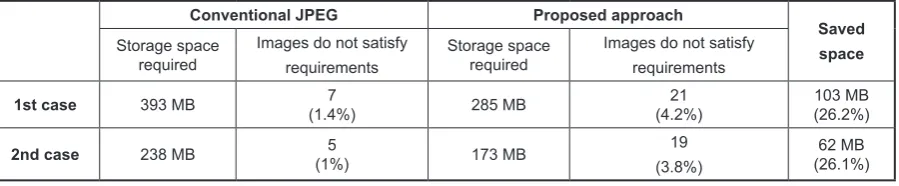
Table 3. Comparison of the proposed approach and conventional JPEG algorithm (the average amount of 10 experiments)
Conventional JPEG Proposed approach
Saved space
Storage space
required Images do not satisfyrequirements Storage space required Images do not satisfyrequirements
1st case 393 MB (1.4%)7 285 MB (4.2%)21 103 MB (26.2%)
2nd case 238 MB (1%)5 173 MB 19
(3.8%)
62 MB (26.1%) Two cases are investigated:
In the first case, it is desired to obtain high-quality images after compression. For this pur
-pose, we use the obtained quality thresholds (see Table 1) and the following quality requirements: SSIM > 0.94 and PSNR > 37.
In the second case, it is desired to obtain mid
-dle-quality images after compression. The fol
-lowing quality requirements are used: SSIM > 0.92 and PSNR > 32.
It is identified experimentally that in order to achieve the predefined quality threshold by using the conventional JPEG algorithm, it is necessary to apply QF = 95 in the first case, and QF = 85 in the second case. To achieve the predefined thresh
of QF are defined depending on the image class. In the first case, QF = 50 for the first class im
-ages, QF = 95 for the second class im-ages, and QF = 85 for the third class images. In the second case, QF = 40 for the first class images, QF = 85 for the second class images, and QF = 65 for the third class images (see Table 2).
The experiment is repeated 10 times for each case when using different sets of images. Each
time the set contains 500 randomly selected im-ages that are used for class prediction and storage
space evaluation. The average amount of image storage space after the compression and the aver -age number of im-ages which do not satisfy the
predefined quality requirements are presented in Table 3. Here, the average amount of saved space by the proposed approach is also given. The results show that, when applying the qual
-ity requirements and the QF values, presented in Table 2, about 26% of the storage space is saved
by the proposed approach compared with the
con-ventional JPEG algorithm. Moreover, only about 4% of images do not meet the predefined quality. It should be noted that the quality of these im
-ages is very close to the quality thresholds, how
-ever, the quality of these images does not differ from the desirable level significantly. The other values of the desired quality factors can be used (different from Table 2). Then the increase of the QF values for different classes will lead to the de
-crease of misclassification. However, in this case, the saving of the storage space will decrease com
-pared with the conventional JPEG algorithm.
CONCLUSIONS
In this paper, the computational
intelligence-based approach for storage of the compressed
im-ages has been proposed and investigated. Here, an image classification problem of the three class
-es has been solved to predict the JPEG effect on image quality.
The approach allows processing large im -age groups by the JPEG algorithm so that the QF
value is selected for each image automatically, satisfying the desired image quality. For this pur
-pose, classification by image features is applied, where the images are classified into three classes, taking into account objective quality of the im
-ages. The suitable features describing the images have been selected. The resulting classification accuracy is obtained equal to 0.76. Such accu
-racy is high enough for the case of three classes.
Moreover, the confusion matrix has shown that the images of the first (high-quality images) and
second (low-quality images) classes do not
con-fuse with each other.
In order to highlight a superiority of the pro
-posed approach, the comparative experimental investigations have been carried out. The experi
-ments have shown that the proposed approach en
-ables to save about 26% of digital image storage space, while maintaining the desired image qual
-ity, compared with the conventional JPEG algo
-rithm. The image quality is assessed by full-ref
-erence measures – PSNR and SSIM index. When using the proposed approach, the desired quality is maintained for about 96% of the images.
The proposed approach is designed to store various digital images, captured by digital cam
-eras, and can be applied to Cloud storage and file hosting services, online file storage providers, so
-cial networks, etc.
In further investigations, it is purposeful to develop a wide-purpose method for image stor
-age using computational intelligence techniques, which could be used for images of specific content and formats, e.g. medical images, GIS images, etc.
REFERENCES
1. Coulombe, S. and Pigeon, S., Low-Complexity Transcoding of JPEG Images With Near-Optimal Quality Using a Predictive Quality Factor and Scaling Parameters. IEEE Transactions on Image Processing, vol. 19, no. 3, 2010, 712-721.
2. Eskicioglu, A. M., Quality measurement for mo
-nochrome compressed images in the past 25 years. Proceedings of IEEE International Conference on Acoustics, Speech, and Signal Processing, vol. 4, 2000, 1907-1910.
3. Forczmanski, P. and Mantiuk, R., Adaptive and Quality-Aware Storage of JPEG Files in the Web Environment. International Conference, ICCVG, Warsaw, 2014.
4. Gonzalez, R., Woods, R. and Eddins, S., Digital Image Processing Using MATLAB, New Jersey: Prentice Hall, 2003.
5. Guo, Y., Hastie, T. and Tibshirani, R., Regularized Discriminant Analysis and Its Application in Mi
-croarrays. vol. 8, no. 1, 2007, 86-100.
6. Haralick, R. and Shapiro, L., Computer and Robot Vision: Vol. 1, Addison-Wesley, 1992.
8. Moorthy, A. K. and Bovik, A., Blind Image Qua
-lity Assessment: From Natural Scene Statistics to Perceptual Quality. IEEE Transactions on Image Processing, vol. 20, no. 12, 2011, 3350-3364. 9. Pigeon, S. and Coulombe, S., K-Means Based
Prediction of Transcoded JPEG File Size and Structural Similarity. International Journal of Mul
-timedia Data Engineering and Management, vol. 3, no. 2, 2012, 41-57.
10. Pigeon, S. and Coulombe, S., Computationally efficient algorithms for predicting the file size of JPEG images subject to changes of quality factor and scaling. Proc. 24th Queen’s Biennial Symp. Kingston, Canada, Jun., 2008, 378–382.
11. Salomon, D., A guide to data compression met
-hods. Springer Science & Business Media, 2013. 12. Solomon, A. and Breckon, T., Fundamentals of Di
-gital Image Processing: A Practical Approach with Examples in Matlab. John Wiley & Sons, Inc., 2011. 13. Tichonov, J. and Kurasova, O., Classification of Large Images Before Applying Compression Algorithms. Journal of Young Scientists, vol. 1, no. 43, 2015.
14. Tichonov, J., Kurasova, O. and Filatovas, E., Qual
-ity Prediction of Compressed Images via Classi
-fication. Image Processing and Communications Challenges 8, Bydgoszcz, 2017.
15. Viraktamath, S. V. and Attimarad, G. V., Perfor
-mance Analysis of JPEG Algorithm. International Conference on Signal Processing, Communica
-tion, Computing and Networking Technologies (ICSCCN 2011), 2011, 629-633.
16. Wallace, G. K., The JPEG still picture compression standart. IEEE Transactions on Consumer Electro
-nics, vol. 38, no. 1, 1992, 18-34.
17. Wang, Z., Bovik, A. C., Sheikh, H. R. and Si
-moncelli, E. P., Image quality assessment: From error visibility to structural similarity. IEEE Tran
-sactions on Image Processing, vol. 13, no. 4, 2004, 600-612.
18. Xiao, J., Hays, J., Ehinger, K., Oliva A. and To
-rralba, A., SUN Database: Large-scale Scene Recognition from Abbey to Zoo. IEEE Confe
-rence on Computer Vision and Pattern Recogni