Journal of Pharmaceutical Technology, Research and Management Vol. 2, No. 1, May 2014 pp. 13–28
©2014 by Chitkara University. All Rights Reserved.
DOI: 10.15415/jptrm.2014.21002
Sustained Release Solid Dispersions of
Pentoxyfylline: Formulation and Optimization
SanDeeP KumaR1, manju nagPal1*, KalPana nagPal2 anD gitiKa aRORa DhingRa3
1Chitkara College of Pharmacy, Chitkara University, Rajpura-140401, Patiala, Punjab, India.
2School of Pharmacy, Lovely Faculty of Applied Medical Sciences, Lovely Professional University, Jalandhar-Delhi G.T. Road, Phagwara-144411, Punjab, India.
3NCRD’s Sterling Institute of Pharmacy, Nerul, Navi Mumbai-400706, India. *email: [email protected]
abstract
Objective: The purpose of the study is to formulate and optimize sustained release solid dispersions of pentoxyfylline using a combination of eudragit polymers and ethyl cellulose.
methods: Solid dispersions were formulated by solvent evaporation method. Preliminary batches were formulated using various drug to polymer ratio; with eudragit S100 and L100 (1:1 to 1:5 ratio), and with ethyl cellulose (1:1 to 1:3 ratio) and evaluated for solubility analysis. Based on results of preliminary batches, Box Behnken design was further applied and three factors (X1- concentration of Eudragit S100, X2- concentration of Eudragit L100, X3- concentration of Ethyl Cellulose) were selected with three levels (+1, 0, -1). Multiple linear regression was applied to generate polynomial equations and statistical evaluation. Prepared solid dispersions were investigated for sustained release properties via in vitro dissolution studies. Fourier transform infrared spectroscopic analysis (FTIR), X-ray diffraction analysis (X-RD), Differential scanning calorimetry (DSC) studies were carried out to evaluate drug polymer interactions. Scanning Electron Microscopy (SEM) analysis of optimized solid dispersion was carried out to evaluate surface morphology of the particles.
Kumar, S. Nagpal, M. Nagpal, K. Dhingra, G.A.
Conclusion: Release retarding effect was found to be dependent on polymer concentration. Therefore, an optimized combination may lead to better sustaining effect.
Keywords: solid dispersion, eudragits, solubility studies, dissolution, scanning electron microscopy.
1. intRODuCtiOn
E
xtended release (ER) drug delivery systems are developed to moderate the drug release characteristics to achieve specific goals that cannot be accomplished with conventional drug delivery systems. Potential therapeutic benefits of an appropriately designed ER dosage form include improved efficacy, reduced adverse effects, low cost, flexible release characteristics, increased convenience and patient compliance (Qui et al.2000; Colombo et al. 2003). The solid dispersion approach is commonly used to improve the dissolution properties of poorly water-soluble drugs using hydrophilic polymeric carriers as dispersing agents. Several studies have been reported on solid dispersions using water-insoluble carriers to produce sustained release dosage forms of highly water soluble drugs (Zijlstra
et al. 2007; Droogge et al. 2004; Nagarsenker et al. 2000). Solid dispersion technique is widely used in the preparation of matrices with insoluble polymers for the production of sustained-release dosage forms (Katikaneni et al. 1995). Among the existing matrix forming polymers, methacrylic resins (Eudragit®) appear predominantly attractive due to their chemical stability, compactibility and variability in physicochemical parameters(Rodriguez et al.1993). The
most interesting among acrylic polymers are Eudragit RL (highly permeable) and Eudragit RS (less permeable). Both are neutral copolymers of poly ethylacrylate (methyl methacrylate and trimethyl aminoethyl methacrylate chloride). These are insoluble in water and digestive juices, though both swell and are permeable (Tiwari et al. 2009). The release retarding characteristics of methacrylic acid copolymers (Eudragit® L and S) and amino methacrylate (Eudragit® RL and RS) in solid dosage forms has been revealed through various experimental evidences(Kidokoro et al. 2001; Zhuet al. 2000; Palmieri et al. 2000; Bruce et al. 2000). The sustained release solid dispersion presents
various possible advantages for poorly bioavailable drug candidates and can be delivered proficiently there by enhancing their bioavailability. The decreased dissolution rate of drug in insoluble carrier matrices helps in prolonging the duration of time during which the drug is released. Therefore, these systems are appropriate for designing sustained release dosage forms (Gurnasinghani
Sustained Release Solid Dispersions of Pentoxyfylline: Formulation and Optimization Box–Behnken design is an experimental design used for response surface
methodology and was introduced by George Box and Donald Behnken in 1960. This is an autonomous quadratic design and does not contain an embedded factorial or fractional factorial design. In this design, the treatment combinations are at the middle points of edges of the process space and at the centre and it require 3 levels (-1, 0, +1) of each factor. Pentoxyfylline (PX) is a derivative of tri-substituted xanthine. Chemically it is 1-(5oxohexyl)-3, 7-dimethylxanthine, and is a hemorrheologic agent (an agent that affects blood viscosity). Pentoxyfylline is having solubility in water and ethanol. PX is a xanthine derivative used in the treatment of peripheral vascular disease (Thube
et al. 2010). It has very short half-life of 0.4 to 0.8 h due to which the frequency of administration is very much high (Moffat et al. 2011). Thus the present drug may serve as an ideal candidate for sustained release action. In the present investigation, attempts would be made to sustain the release of highly water soluble drug Pentoxyfylline using solid dispersion technique employing release retardants like Eudragit L100, Eudragit S100 and Ethyl cellulose (EC).
2. mateRialS & methODS 2.1 materials
Pentoxyfylline was obtained as a gift sample from Bakul Pharma Pvt. Ltd., Mumbai (India). Eudragit L100 and Eudragit S100 were procured from Evonik Rohm Pharma Polymers. Mumbai (India) as gift samples. Ethyl Cellulose was purchased from LOBA Chemie Laboratory reagents Pvt.Ltd., Mumbai (India). All other reagents were of suitable analytical grades and were used as received.
2.2 methods
2.2.1 Preparation of solid dispersions (preliminary batches)
Kumar, S. Nagpal, M. Nagpal, K. Dhingra, G.A.
Various drug to polymer ratios were used (1:1 to 1:5 for Eudragit S100 and L100); (1:1 to 1:3 for ethyl cellulose).
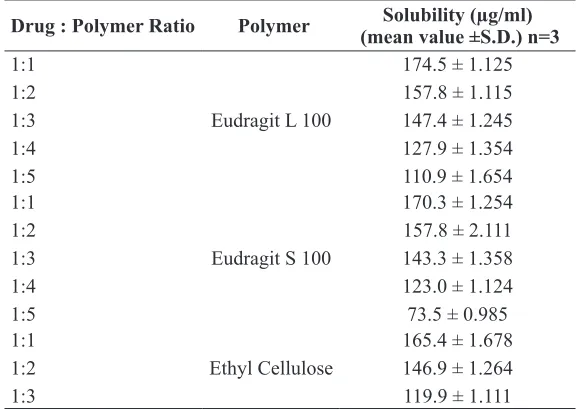
Equilibrium solubility studies were performed with all the batches to find out the maximum and minimum levels of polymers which can be further utilized for optimization. The composition of various preliminary batches with their solubility data is given in Table 1.
table 1: Composition of preliminary batches of solid dispersions and solubility data
Drug : Polymer Ratio Polymer (mean value ±S.D.) n=3Solubility (µg/ml)
1:1 1:2 1:3 1:4 1:5
Eudragit L 100
174.5 ± 1.125 157.8 ± 1.115 147.4 ± 1.245 127.9 ± 1.354 110.9 ± 1.654 1:1
1:2 1:3 1:4 1:5
Eudragit S 100
170.3 ± 1.254 157.8 ± 2.111 143.3 ± 1.358 123.0 ± 1.124 73.5 ± 0.985 1:1
1:2 1:3
Ethyl Cellulose
165.4 ± 1.678 146.9 ± 1.264 119.9 ± 1.111
2.2.2 Statistical design for optimization
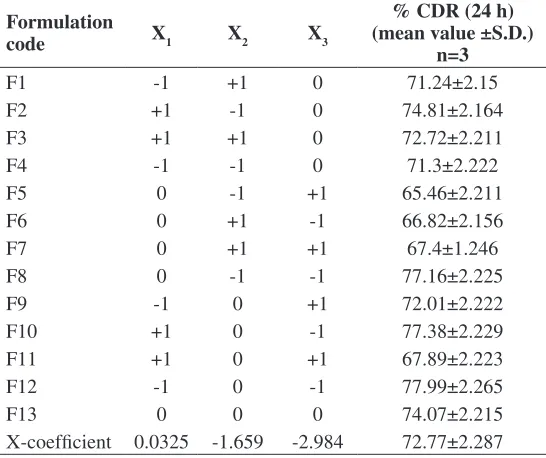
Box Behnken design was constructed to determine the effect of concentration of polymers on cumulative drug release. Based upon this three factors were selected with three levels (-1, 0, +1). These are X1- Eudragit S100, X2- Eudragit L100 and X3- Ethyl cellulose. 13 formulation batches (F1-F13) were prepared accordingly. The composition and percent cumulative drug release (%CDR) data of all solid dispersion batches is shown in Table 2.
Coded level -1 0 +1
Sustained Release Solid Dispersions of Pentoxyfylline: Formulation and Optimization
2.2.3 Characterization and evaluation of Solid Dispersions
Differential Scanning Calorimetry (DSC)
Thermal properties of pure pentoxifylline, polymeric carriers and solid dispersion batches (F1-F13) were analyzed by differential scanning calorimetry (Mettler Toledo, DSC 821e). Samples were sealed in aluminium pans and scanned from
50 to 300oC at a heating rate of 10oC/min in nitrogen atmosphere.
Fourier transform infrared (FtiR) Spectroscopy: Infrared absorption spectra of pure drug pentoxyfylline, polymeric carriers and solid dispersion batches were obtained using potassium bromide disks, under static air using FTIR spectrophotometer (Perkin Elmer Spectrum 400).
Content uniformity: Precisely weighed amount of solid dispersion batches (F1-F13) (equivalent to 5 mg) were dissolved in 10 ml of ethanol taken in volumetric flask (100 ml) and the volume was made upto mark with phosphate buffer (pH 7.4). The solution was filtered and content uniformity was analyzed at 273 nm by UV spectrophotometer (Systronics, AU-2701).
table 2: Composition of design batches and cumulative drug release data
Formulation
code X1 X2 X3
% CDR (24 h) (mean value ±S.D.)
n=3
F1 -1 +1 0 71.24±2.15
F2 +1 -1 0 74.81±2.164
F3 +1 +1 0 72.72±2.211
F4 -1 -1 0 71.3±2.222
F5 0 -1 +1 65.46±2.211
F6 0 +1 -1 66.82±2.156
F7 0 +1 +1 67.4±1.246
F8 0 -1 -1 77.16±2.225
F9 -1 0 +1 72.01±2.222
F10 +1 0 -1 77.38±2.229
F11 +1 0 +1 67.89±2.223
F12 -1 0 -1 77.99±2.265
F13 0 0 0 74.07±2.215
Kumar, S. Nagpal, M. Nagpal, K. Dhingra, G.A.
In vitro Dissolution Studies: The dissolution studies of pure drug pentoxyfylline and solid dispersion batches(F1-F13) (equivalent to 100 mg of drug) were carried out using USP dissolution apparatus type II in 900 ml phosphate buffer (pH 7.4) at 37 ± 0.5oC at a speed of 100 rpm. Aliquots were withdrawn at
regular intervals for 24 h. The withdrawn samples volumes were replenished with equal volumes of phosphate buffer. The samples were analyzed for drug concentration at 273 nm UV spectrophotometer.
X-Ray Diffraction: Powder X-Ray diffraction patterns were traced employing X-ray Diffractometer (XPERT-PRO,PW3050/60 Goniometer) for the samples, using Ni filtered Cu radiation at a voltage of 45 Kv, using a current of 40 mA. The sample analysis was done over 2θ range of 0-50o with scan step size of
0.017o and scan step time 25 sec.
Scanning electron microscopy: The samples of drug and the solid dispersions batches (F5, F6) were mounted onto the stubs using double sided adhesive tape and coated with gold palladium alloy using fine coat ion sputter (JEOL, JFC-1100). The samples were then analyzed under the scanning electron microscope (JSM-6100 SEM) for external morphology.
3. ReSultS anD DiSCuSSiOn
3.1 Differential Scanning Calorimetry (DSC)
The results of DSC studies are shown in Figure 1(a) to 1(f). The DSC thermogram of Pentoxyfylline (Figure 1a) showed an endothermic peak at 105.2oC with an enthalpy of 7.977 J/g corresponding to its melting point, which
indicates its crystalline nature. DSC thermogram of Eudragit L 100 exhibited an endothermic peak at 70oC with an enthalpy of 27.85J/g (Figure 1b). DSC
thermogram of Eudragit S 100 exhibited an endothermic peak at 76oC with
an enthalpy of 29.85J/g (Figure 1c). No sharp peaks in DSC thermogram of ethyl cellulose suggested amorphous nature of the polymer (Figure 1d).DSC thermograms of optimized solid dispersion batches F5-F6(Figure 1e - Figure 1f) showed minor changes in characteristic peak of drug such as slight shift or peak of reduced intensity. This suggests minor changes in crystalline habit of the drug during mixing with polymeric carriers. Additional peaks due to polymers were also observed in solid dispersions.
3.2 Fourier transform infrared (FtiR) Spectroscopy
The FTIR of the pure drug pentoxyfylline exhibited peaks at 1696.72 cm-1,
Sustained Release Solid Dispersions of Pentoxyfylline: Formulation and Optimization
Figure 1(b): DSC thermogram of Eudragit L100 Figure 1(a): DSC thermogram of pure drug Pentoxyfylline
Kumar, S. Nagpal, M. Nagpal, K. Dhingra, G.A.
Figure 1 (d): DSC thermogram of Ethyl Cellulose
Figure 1 (e): DSC thermogram of batch F5
Sustained Release Solid Dispersions of Pentoxyfylline: Formulation and Optimization spectrum of the drug. The FTIR spectrum of Eudragit L100 showed peak at
1155.94 cm-1due to ester vibrations and at 2950.67 cm-1 for O-H stretching and
at 1255 cm-1 due to C-O stretch and Eudragit S100 exhibited peaks at 1153.15
cm-1 and 1248.73 cm-1 due to ester vibrations and C-O stretch and at 2951.21 cm-1
due to O-H stretch. FTIR spectrum of ethyl cellulose showed –C-O-C- stretch at 1051.32 cm-1and C-H stretch at 1395.56 cm-1. FTIR spectrum of optimized
solid dispersion batches F5-F6exhibited peaks as the additive effect of the drug and the polymers. The characteristic peaks of drug appeared in FTIR of solid dispersions which indicated that there is no any interaction between drug and the polymers. FTIR spectra of pure drug, polymeric carriers and optimized solid dispersion batches (F5-F6) is shown in Figure 2 (a) to 2 (f).
Figure 2 (a): FTIR of pure drug Pentoxifylline
Kumar, S. Nagpal, M. Nagpal, K. Dhingra, G.A.
Figure 2(c): FTIR spectrum of Eudragit S100
Figure 2 (d): FTIR spectrum of ethyl cellulose
Sustained Release Solid Dispersions of Pentoxyfylline: Formulation and Optimization
table 3: Content uniformity of solid dispersion batches (F1-F13)
Formulation
Batches % Content uniformity(mean ± SD), n=3
F1 96.8 ± 0.005
F2 99.6 ± 0.011
F3 100.2 ± 0.007
F4 98.4 ± 0.014
F5 100.4 ± 0.009
F6 100.2 ± 0.021
F7 97.8 ± 0.003
F8 94.6 ± 0.007
F9 100.7 ± 0.013
F10 101.2 ± 0.004
F11 100.6 ± 0.012
F12 99.5 ± 0.022
F13 97.4 ± 0.008
3.3 Content uniformity
The content uniformity of various solid dispersion batches(F1-F13) was found with in USP limit (85-115%). The content uniformity results are depicted in Table 3.
3.4 In vitro dissolution studies:
In vitro dissolution of solid dispersion batches (F1-F13) and pure drug is shown in Figure 3. Pure drug pentoxyfylline exhibited almost 100% release in
Kumar, S. Nagpal, M. Nagpal, K. Dhingra, G.A.
3h. Sustained drug release was observed in all solid dispersion batches (65% -77% in 24 h). Batch F5 showed maximum sustained release effect as observed from release data (65.46% in 24 h).A combination of polymers (Eudragit S100, L100 and ethyl cellulose) may lead to better release retarding characteristics as compared to when used alone. Maximum drug release was obtained in F8 and F10 batches which may be attributed to lower concentrations of ethyl cellulose and eudragit L100. Eudragit S100 when present in higher concentrations with other polymers led to higher drug release which is contrary with solubility data of preliminary batches where Eudragit S100 led to more decrease in solubility as compared to Eudragit L100 (Table 1). Therefore, release retarding characteristics depend on synergistic effect of various polymers not the single polymer alone.
3.5 X-Ray Diffraction:
Overlay diagram of X-RD diffraction pattern of pentoxyfylline and best solid dispersion batches (batch F5 and F6) is shown in Figure 4. The presence or absence of crystallanity was determined by comparing some representative peaks in the diffraction of the solid dispersions with that of pure drug(pentoxifylline).X-RD of Pentoxyfylline showed sharp peaks at diffraction angle of 4.50, 13.21, 15.12 with peak intensities of 48.12, 100.00, 26.54 and area 252.46, 385.60, 175.64 respectively. X-ray diffraction patterns of solid dispersion batches F5 and F6 showed presence of characteristic peaks
Sustained Release Solid Dispersions of Pentoxyfylline: Formulation and Optimization
Figure 4: Overlay diagram of X-RD of the pure drug Pentoxyfylline; batch F5 and batch F6
Figure 5: SEM micrographs of (a) Pentoxyfylline at 500X, (b) batch F5 at 65X and (c) batch F6 at 65X.
(slight shift) of drug with reduced diffraction intensity, which indicated minor changes in crystallinity.
3.6 Scanning electron microscopy
The SEM micrographs of pure drug (Pentoxifylline) (Figure 5a) shows rod shaped crystalline structure. On the other hand, the photomicrograph of solid dispersion batch F5 and F6 (Figure 5b and 5c) showed smooth surfaced rectangular crystalline structure. This suggests change in drug crystalline habit to a new phase in solid dispersion batches.
3.7 Data analysis
Kumar, S. Nagpal, M. Nagpal, K. Dhingra, G.A.
worksheet was used for the execution of multiple linear regression. The real values of the factors were transformed to ease the calculations and to facilitate orthogonality of results. The model developed to estimate cumulative drug release (Y) can be represented mathematically as:
Y= 72.77 + 0.0325 X1 – 1.659 X2 -2.984 X3
Where, Y= % Cumulative drug release, X1= Amount of Eudragit S100, X2= Amount of Eudragit L100 and X3= Amount of Ethyl cellulose
To study the fitting and significance of mathematical model, analysis of variance was applied and % cumulative drug release was estimated (Table 4). The obtained F value 2.34 indicates regression to be significant. The estimated model can be used as a response surface for percent cumulative drug release.
table 4: Analysis of Variance
Df SS mS F Significance F
Regression 3 93.24217 31.08073 2.338336 0.141748
Residual 9 119.6263 13.29181
Total 12 212.8685
Figure 6: Effect plot of coefficient on % CDR
Sustained Release Solid Dispersions of Pentoxyfylline: Formulation and Optimization 4. COnCluSiOn
A systematically designed study including the preparation and characterization of sustained release solid dispersions of pentoxyfylline was carried out using release retarding polymers (polymethylmethacrylates and ethyl cellulose). Release retardant properties of polymers are found to be concentration dependent in all solid dispersions. An optimized combination of Eudragits (S100 and L100) and ethyl cellulose [i.e. eudragit S 100 at middle level (0), eudragit L100 at low level (-1) and ethyl cellulose at high level (+1)] in (batch F5) leads to maximum release retardant effect. The polynomial equation generated by multiple linear regression also supports the drug release behavior. In retrospect, this model can be successfully used for design of sustained release solid dispersions.
aCKnOWleDgementS
The authors are indebted to Dr. Madhu Chitkara, Vice Chancellor, Chitkara University, Punjab, India; Dr. Ashok Chitkara, Chancellor, Chitkara University, Punjab, India; Dr. Sandeep Arora, Director, Chitkara College of Pharmacy, Chitkara University, Punjab, India; for technical support and laboratory facilities.
ReFeRenCeS
Aceves, J.M., Cruz, R., Hernandez, E. (2000). Preparation and characterization of furosemide-Eudragit controlled release systems. Int J Pharm, 195, 45-53.
DOI: http://dx.doi.org/10.1016/S0378-5173(99) 00303-8
Bruce, L.D., Shah, N.H., Malick, A.W., Infeld, M.H., McGinity, J.W.(2000). Properties of hot-melt extruded tablet formulations for the colonic delivery of 5-aminosalicylic acid. Eur J Pharm Biopharm. 59, 85– 97. DOI: http://dx.doi.org/10.1016/j.ejpb.2004.06.007
Colombo, P., Bettini, R., Santi, P. and Peppas, N.A. (2003). Swellable matrices for controlled drug delivery: gel-layer behavior, mechanisms and optimal performance. Pharm Sci Technol Today, 3,198–204. DOI: http://dx.doi.org/10.1016/S1461-5347(00)00269-8
Drooge, D.J., Hinrichs, W.L.J. and Wegman, K.A.M. (2004). Solid dispersions based on inulin for the stabilisation and formulation of Δ9-tetrahydrocannabinol. Eur. J. Pharm. Sci., 21, 511-523.
DOI: http://dx.doi.org/10.1016/j.ejps.2003.11.014
Goracinova, K., Klisarova, L.J., Simov, A. (1995). Physical characterization and dissolution properties of verapamil HCl coprecipitates. Drug Dev Ind Pharm., 21, 383-391. DOI: 10.3109/03639049509048119 Gurnasinghani, M.L., Bhatt, H.R., Lalla, J.K. (1989). Indomethacin delivery from matrix controlled release
indomethacin tablets. J Control Rel., 8, 211-222. DOI: http://dx.doi.org/10.1016/0168-3659(89) 90043-6
Katikaneni, P.R., Upadrashta, S.M., Neau, S.H. and Mitra, A.K. (1995). Ethylcellulose matrix controlled release tablets of a water soluble drug. Int J Pharm.,123, 119–125.
DOI: http://dx.doi.org/10.1016/0378-5173(95)00060-V
Kumar, S. Nagpal, M. Nagpal, K. Dhingra, G.A.
Moffat, A.C., Osselton, M.D., Widdop, B. (2011). Clarke’s analysis of drugs & poisons. 4th ed., UK, Pharmaceutical Press.
Nagarsenker, M.S., Meshram, R.N. and Ramprakash, G. (2000). Solid dispersion of hydroxypropyl b-Cyclodextrin and ketorolac: enhancement of in-vitro dissolution rates, improvement in anti-inflammatory activity and reduction in ulcerogenicity in rats. J Pharm Pharmacol, 52, 949- 960. DOI: http://dx.doi.org/10.1211/0022357001774831
Palmieri, G.E., Michelini, S., Martino, P.D., Martelli, S. (2000). Polymers with pH-dependent solubility: possibility of use in the formulation of gastroresistant and controlled-release matrix tablet. Drug Dev Ind Pharm., 26, 837–845. DOI: 10.1081/DDC-100101307
Pignatello, R., Ferro, M., De Guidi, G., Salemi, G., Vandelli, M.A., Guccione, S., Geppi, M., Forte, C., Puglisi, G. (2001). Preparation, Characterisation and photosensitivity studies of solid dispersions of diflunisal and Eudragit RS100 and RL100. Int J Pharm., 218, 27-42.
DOI: http://dx.doi.org/10.1016/S0378-5173(01)00597-X
Qui, Y., Zhang, D. (2000). Research and Development Aspects of Oral Controlled Release Systems, In: Wise, D.L.(eds). Handbook of Pharmaceutical Controlled Release Technology, New York, Marcel Dekker Inc., pp 465–503.
Rodriguez, L., Caputo, O., Cini, M., Cavallar, C. and Grecchi, R. (1993). In vitro release of theophylline from directly-compressed matrices containing methacrylic acid copolymers and/or dicalcium phosphate dehydrate. Farmaco, 48, 1597–1604.
Thube, M.W., Shahi, S.R. (2010). Formulation Development and Evaluation of extended release tablets of Pentoxifylline. Int J Pharm Res Dev, 2,1-11.
Tiwari, R., Srivastava, B., Tiwari, G., Rai, A. (2009). Extended release promethazine HCl using acrylic polymers by freeze-drying and spray-drying techniques: formulation considerations. Brazilian J Pharm Sci., 45(4), 829-840. DOI: http://dx.doi.org/10.1590/S1984-82502009000400029. Zhu, Y., Shah, N.H., Malick, A.W., Infeld, M.H., McGinity, J.W. (2000). Influence of thermal processing
on the properties of chlorpheniramine maleate tablets containing an acrylic polymer. Pharm Dev Technol., 7, 481–489. DOI: 10.1208/s12249-010-9378-z