http://dx.doi.org/10.9717/JMIS.2017.4.1.19
19
I. INTRODUCTION
The storage or transmission of digital video content for DTV, including ultra-high definition (UHD) video, as represented in a data file or bitstream, is processed according to a video compression format. The standard format for DTV video coding is MPEG-2/4/H [1-3]. Based on this standard for Full HD and UHD broadcasting, an additional 8, 16, or 32 vertical lines must be added to every video frame, which comprises the DTV essential hidden area (DEHA) and is essential for the effective functioning of the MPEG-2/4/H encoder, stream, and decoder.
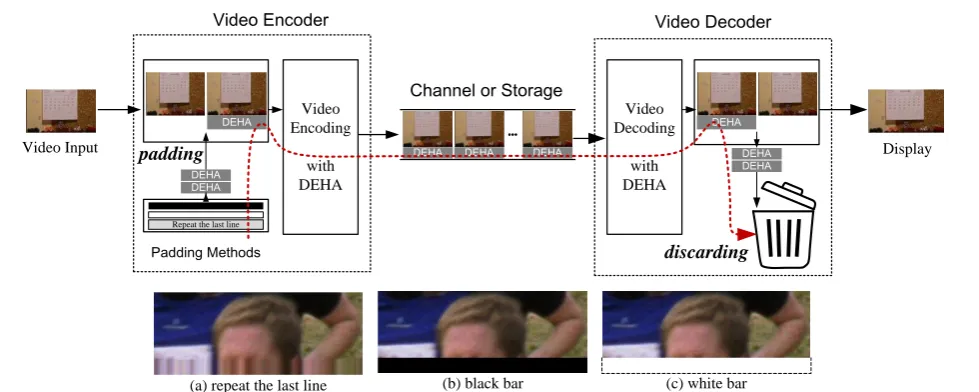
The DEHA is formed by padding the last line signal of input video at the bottom of the active video in an MPEG-2/4/H reference encoder. Once the DEHA is padded in the video encoder, it is then compressed with the active video, transferred to the decoder as part of the video stream, and then decoded in the video decoder. After decoding, the DEHA is discarded by the video decoder. However, while the DEHA is essential in the video encoding/decoding process, the DEHA is redundant in the channel utilization or storage efficiency. Hence, a purpose of this paper is to propose a method it effectively utilize the DEHA as a means of improving the video quality of digital
broadcasting, which has not been researched to date. This paper proposes a block mode DEHA method to more effectively utilize the DEHA as compared to conventional DEHA utilization. The block mode DEHA method is based on reducing the amount of DEHA data in the compressed video stream, which can improve the quality of the active video, by partitioning the DEHA as macroblocks. In theory, the proposed block mode DEHA method eliminates all DEHA data in the video stream, which suggests a significant improvement in both channel utilization and storage efficiency, and an overall improvement in video quality. Moreover, the proposed method can be easily implemented with existing video encoders, requiring only marginal and simple changes, which adds to the method’s attractiveness.
II. CONVENTIONAL DEHA
In DTV broadcasting systems, the vertical size of a picture in video stream specifies the height of each encoded picture, which is the height of the displayable part of the luminance component of the frame lines. In order to avoid start code emulation, the vertical size value should not be equal to 0 and should be an integer multiple of a basic encoding element such as a macroblock or
Video Quality for DTV Essential Hidden Area Utilization
Chan-Ho Han
1.*Abstract
The compression of video for both full HD and UHD requires the inclusion of extra vertical lines to every video frame, named as the DTV essential hidden area (DEHA), for the effective functioning of the MPEG-2/4/H encoder, stream, and decoder. However, while the encoding/decoding process is dependent on the DEHA, the DEHA is conventionally viewed as a redundancy in terms of channel utilization or storage efficiency. This paper proposes a block mode DEHA method to more effectively utilize the DEHA. Partitioning video block images and then evenly filling the representative DEHA macroblocks with the average DC coefficient of the active video macroblock can minimize the amount of DEHA data entering the compressed video stream. Theoretically, this process results in smaller DEHA data entering the video stream. Experimental testing of the proposed block mode DEHA method revealed a slight improvement in the quality of the active video. Outside of this technological improvement to video quality, the attractiveness of the proposed DEHA method is also heightened by the ease that it can be implemented with existing video encoders.
Key Words: digital broadcasting, DTV essential and hidden area, block mode DEHA, video compression, video quality.
Manuscript received March 30, 2017; Revised April 05, 2017; Accepted April 10, 2017. (ID No. JMIS-2017-0003) Corresponding Author (*): Chan-Ho Han, 1Department of Broadcasting Media Engineering, Kangwon National University, Samcheok, Republic of Korea, +82-33-540-3443, [email protected].
1Department of Broadcasting Media Engineering, Kangwon National University, Samcheok, Korea, E-mail:
20
coding tree unit of MPEG-2/4/H (i.e., 16, 32 or 64 lines). The standardization of DTV during the past several years has proven to be a challenging process, resulting in a multitude of standards and resolutions such as 1920×1080, 3840×2160, and 7680×4320. Indeed, video encoders add an extra 16 vertical lines to the 3840×2160 resolution, which results in a frame size of 3840×2176. As shown in Table 1 and Figure 1, the extra 8, 16, or 32 lines comprise the DEHA, which is essential to the effectiveness of the encoder, stream, and decoder, and is created by padding the bottom of the active video source.
Table 1. DTV Essential Hidden Area (DEHA)
Location
Pixel Size (H×V)
Full HD 4K UHD 8K UHD
Active video
input/output 1920×1080 3840×2160 7680×4320
DEHA 1920× 8 3840× 16 7680× 32
CODEC
and stream 1920×1088 3840×2176 7680×4352
As depicted in Figure 1(a), the current and conventional use of DEHA pads the last line signal of the input video at the bottom of the active video in MPEG-2/4/H reference encoders, helped by improved IC data processing speeds. This compares to early real-time H/W encoders that padded the DEHA with white, gray, or black bars, as shown in Figure 1(b-c). While the choice of DEHA mode has revealed minute differences in video quality, the differences are considered negligible and can be ignored. MPEG-2/4/H reference software suggests the use of the last line signal of the input video for reference mode DEHA.
The DEHA is essential for the video encoding and decoding process to function effectively: a process that commences with the DEHA padded in the video encoder, which is then compressed with the active video, transferred to the decoder as part of the video stream, and decoded in the video decoder. Once decoded, the DEHA is discarded. However, despite its essential function, the DEHA is currently viewed as being redundant in terms of channel utilization and storage efficiency. Hence, a core purpose of this research is to examine and propose methodology to more effectively utilize the DEHA, which has not been researched to date. Notably, this paper proposes a block mode DEHA method to replace the conventional use of DEHA, an improved method that reduces the amount of DEHA data in the compressed video stream, and consequently, improves the quality of the active video.
III. BLOCK MODE DEHA
Real-time H/W encoders have conventionally padded the DEHA with the last line signal of the input data or with black bars. The underlying unit to utilize the DEHA is a combination of representative block images. For example, in the case of video in DTV broadcasting, the DEHA is comprised of 240 block images. While the data comprising the DEHA serves no essential purpose, the quality of the active video can be compromised in the compression process as the quantity of the DEHA data increases; hence, the amount of compressed data in the DEHA should be minimized to preserve the quality of the active video.
Video Input padding
Video Encoding
with DEHA
DEHA
Video Decoding
with DEHA
DEHA DEHA
DEHA
Repeat the last line
Padding Methods discarding
DEHA
Video Encoder Video Decoder
Channel or Storage
DEHA DEHA DEHA
DEHA
Display
(a) repeat the last line (b) black bar (c) white bar
http://dx.doi.org/10.9717/JMIS.2017.4.1.19
21
Figure 2 depicts the encoding process of the 2nd macro-block within the DEHA. Notably, the numbers in the subscript of each image represent the location of the coefficient. For example, n0 represents the DC coefficient of the n-th block average while nx and ny represents the horizontal and vertical coefficient of the block image in the transformed domain. Moreover, the 1st and 2nd blocks in each image represent macroblocks in the active video region while the 3rd and 4th blocks represent macroblocks in the DEHA. Finally, the text description underneath each image represents the DEHA data that must be compressed for each example.
E20 E2x F20 F2x
E2y F2y V2 D1x
D10 C20 C2x D20 D2x
B20
A20
Y22
Y23 Y24 Y21
Y14
U2
E2xy F2xy
(A20-D10)
Y23: (C20-B20), (run, C2x)
Y24: (D20-C20), (run, D2x)
Y21: (A20-D10)
E20 E2x F20 F2x E2y F2y
V2
0 0 0
B20 A20
Y22
Y23 Y24
Y21
Y14
U2
E2xy F2xy
(A20)
Y23: (-B20)
Y24: (0)
Y21: (A20)
(a) (b)
E00 E2x F20 F2x
E2y F2y
V2 D10 B20 B20
B20
A20
Y22
Y23 Y24 Y21
Y14
U2
E2xy
D
E
H
A
A
ct
iv
e
Code Different : 1. 1st block DC
Y21: (A20-D10)
2. 3rd block DC Y23: (C20-B20) = 0
3. 4th block DC Y23: (D20-C20) = 0
E2xy
(c)
Fig. 2. The 2nd macroblock coding sequence of the last slice with DEHA: (a) reference, (b) black, and (c) proposed mode.
As shown in Figure 2(a), the reference mode DEHA method of compression generates significant DEHA data through repeating the last line signal of the input video. In contrast and at first glance, the black mode DEHA method appears to generate little or no data. However, the black mode DEHA method actually generates 120 pieces of DC data in each video frame in the 3rd block. Additionally, the first coded data of the 1st block in each macroblock have larger values than
that of the reference mode. For example, A20 in Figure
2(b) is greater than (A20-D10) in Figure 2(a). In
summary, both conventional methods result in additional DEHA data that must be compressed and
potentially compromise the quality of the active video stream.
To minimize the size of DEHA data in the compressed video stream, this paper proposes the use of block mode DEHA. This is accomplished by evenly filling the values of the 3rd and 4th DEHA blocks with the DC coefficient of the 2nd block for every macroblock as shown in Figure 3. The use of block images is advantageous, given that only the DC value remains after transforming the DCT or wavelet; hence, the compression efficiency increases.
0
Transform
n n n n n n n n n n n n n n n n n n n n n n n n n n n n n n n n n n n n n n n n n n n n n n n n n n n n n n n n n n n n n n n n
n n n n n n n n n
n n n n n n n n n n n n n n n n n n n n n n n n n n n n n n n n n n n n n n n n n n n n n n n n n n n n n n n n
0 n
Fig. 3. The transform of macroblock mode DEHA.
As shown in Figure 2(c), the block mode DEHA method suggests that the 3rd and 4th blocks contain no data for encoding, given that the DC values in the 3rd and 4th blocks are the same as the DC value transformed from the 2nd block. Hence, in theory, the proposed block mode DEHA method eliminates all DEHA data in the video stream, which suggests a significant improvement in both channel utilization and storage efficiency, and an overall improvement in video quality.
IV. EXPERIMENTAL RESULTS
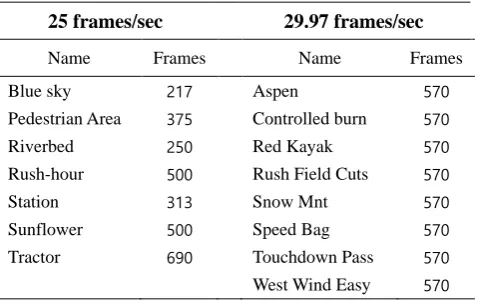
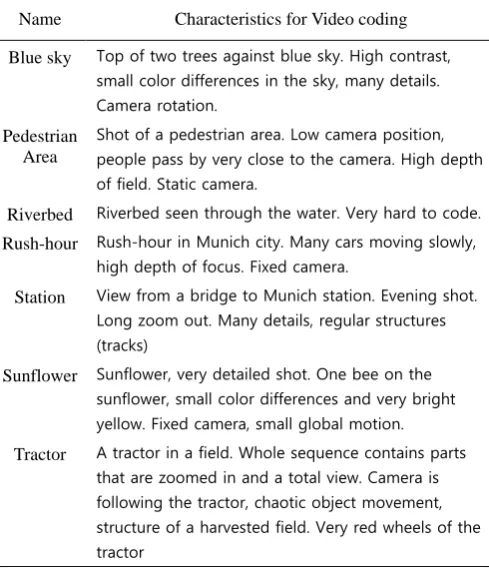
Seven test sequences based on the Taurus Media Technik and eight real sequences based on the NTIA/ITS for video quality research were used to evaluate the proposed method [4-5]. The resolution of each sequence was progressive at a resolution of 1920×1080 and frame rates of 25frames/sec and 29.97frames/sec, respectively. Tables 2 and 3 summarize the characteristics of each sequence for video coding.
Table 2. DTV Test Sequences.
25 frames/sec 29.97 frames/sec
Name Frames Name Frames
Blue sky 217 Aspen 570
Pedestrian Area 375 Controlled burn 570
Riverbed 250 Red Kayak 570
Rush-hour 500 Rush Field Cuts 570
Station 313 Snow Mnt 570
Sunflower 500 Speed Bag 570
Tractor 690 Touchdown Pass 570
22
Test sequences were all compressed with constant bit rate (CBR) coding using MPEG reference software of MPEG software simulation group.
Table 3. Sequences Characteristics.
Name Characteristics for Video coding
Blue sky Top of two trees against blue sky. High contrast,
small color differences in the sky, many details. Camera rotation.
Pedestrian Area
Shot of a pedestrian area. Low camera position, people pass by very close to the camera. High depth of field. Static camera.
Riverbed Riverbed seen through the water. Very hard to code.
Rush-hour Rush-hour in Munich city. Many cars moving slowly,
high depth of focus. Fixed camera.
Station View from a bridge to Munich station. Evening shot.
Long zoom out. Many details, regular structures (tracks)
Sunflower Sunflower, very detailed shot. One bee on the
sunflower, small color differences and very bright yellow. Fixed camera, small global motion.
Tractor A tractor in a field. Whole sequence contains parts
that are zoomed in and a total view. Camera is following the tractor, chaotic object movement, structure of a harvested field. Very red wheels of the tractor
The bitrates for MPEG CBR were set at 13Mbps and 17.5Mbps, based on the lower and upper bounds of TTA for HDTV broadcasting in Korea [5]. To analyze the DEHA, the GOP structure was fixed and set to closed-GOP for random access. As shown in Figure 4, the block mode DEHA padded at the bottom of the image was then compressed.
DTV essential hidden area (DEHA)
Fig. 4. An example proposed frame of block mode DEHA.
To analyze the effects of the proposed DEHA method based on block mode DEHA, an experiment was
conducted using MPEG CBR compression to compare the generated bits per frame from the proposed method against the conventional, reference method. The test results confirmed that the effects of the block mode DEHA method on the rate control were minimal as compared to the reference method, as shown in Table 4 and Fig 5.
Table 4. The average bit results of macroblock with DEHA [bits]
bitrate 13.0Mbps 17.5Mbps
DEHA
Seq. name Black Reference
Propos
ed Black Reference Proposed
Blue sky 39.78 40.57 42.97 52.98 53.83 56.35
Pedestrian
Area 11.02 15.61 12.14 15.32 22.46 16.74
Riverbed 9.83 13.75 13.05 14.20 19.38 17.66
Rush-hour 20.14 26.99 21.79 28.12 36.11 28.53
Station 33.76 47.21 36.33 44.27 59.16 45.59
Sunflower 31.71 34.07 40.98 41.41 46.47 52.68
Tractor 33.63 33.73 31.13 44.85 45.84 41.64
Average (difference)
25.70
(-4.58) 30.28 (-1.93) 28.34 (-6.01) 34.45 40.46 (-3.44) 37.03
Aspen 18.99 25.08 19.25 25.50 33.79 25.63
Controlled
Burn 20.04 28.45 19.67 27.94 39.63 27.62
Red Kayak 10.16 12.51 11.11 14.58 17.27 14.64
Rush Field
Cuts 9.41 12.41 11.27 13.41 17.45 15.06
Snow Mnt 13.82 22.13 15.12 19.16 30.87 21.12
Speed Bag 14.36 15.95 13.09 20.47 22.44 17.61
Touchdown
Pass 20.35 24.33 19.40 28.17 32.92 25.52
West Wind
Easy 21.00 27.12 22.64 29.72 37.30 30.91
Average (difference)
16.02
(-4.98) 21.00 (-4.55) 16.44 (-6.59) 22.37 28.96 (-6.70) 22.26
http://dx.doi.org/10.9717/JMIS.2017.4.1.19
23
Burn, Speed Bag, and Touchdown Pass. In general, the black mode generated the smallest amount of bits per sequence while the proposed method generating bit results more closely aligned with the black mode than the reference mode. 60 30 40 50 10 20 [bit] A v er ag e g en er at ed b it s/ m ac ro b lo ck -4.58 -6.01 -3.44 -1.93 -6.70 -6.59 -4.98 -4.55 Black mode Proposed mode Reference mode 17.5Mbps 17.5Mbps 17.5Mbps 13.0Mbps 13.0Mbps 13.0Mbps Asp en Con trolle
d B urn
Red Kay
ak
Rus h Fi
eld Cut s Snow Mnt Spee d B
ag
Touc hdow
n Pa ss Wes t W ind Easy Blu
e sk y
Pede stria
n A rea Riv erbe d Rus h-ho ur Stat ion Sunf low er Trac tor Avera ge
25 fra me/se c Avera ge 29.97 frame /sec w it h D E H A
Fig. 5. The average generated bit results of macroblock with DEHA.
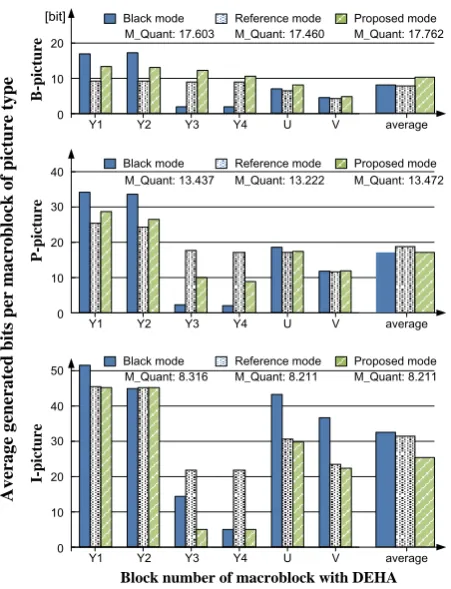
Contrary to theoretical expectations, the proposed method generated bit results greater than conventional methods in two sequences, Blue Sky and Sunflower. To examine these results more closely, a detailed analysis of the average generated bits of the Blue Sky sequence at 13.0Mbps in picture type is shown in Fig 6.
0 10 20 30 40
Y1 Y2 Y3 Y4 U V average
P -p ic tu re M_Quant: 13.222
M_Quant: 13.437 M_Quant: 13.472 Reference mode
Black mode Proposed mode
M_Quant: 8.211
M_Quant: 8.316 M_Quant: 8.211 0
10 20
Y1 Y2 Y3 Y4 U V average
B -p ic tu re 0 10 20 30 40 50
Y1 Y2 Y3 Y4 U V average
Block number of macroblock with DEHA
I-p ic tu re Reference mode
Black mode Proposed mode M_Quant: 17.460
M_Quant: 17.603 M_Quant: 17.762 Reference mode
Black mode Proposed mode
A v er a g e g en er a te d b it s p er m a cr o b lo ck o f p ic tu re t y p e [bit]
Fig. 6. The average generated bit results of macroblock with DEHA at 13.0Mbps Blue Sky sequence.
In support of the theoretical expectations of the proposed method, the I-picture at the bottom of Figure 6 shows the average generated bits precisely, which show the proposed method generated the smallest bit values. As described in Figure 2(b), the generated bits of the 1st and 3rd blocks of the black mode increased, while the generated bits of 3rd and 4th blocks are smaller values than that of the reference mode, as depicted in the P-picture. However, as shown in the B-picture, the values of all blocks of the proposed method are greater than that of the reference mode, due to horizontal motion in the video sequence as referenced by the horizontal coefficients Cnx and Dnx.
In summary, the experimental results validated the effectiveness of the proposed block mode DEHA in reducing the bitrate of DEHA in compressed video streams. As shown in the I-picture, the proposed method generates the smallest bits as compared to conventional methods. Moreover, due to the effects of motion estimation and compensation, the proposed method generates bits quite smaller than the reference mode and slightly larger than the black mode for B- and P-pictures, respectively. Experimental testing of the proposed block mode DEHA method revealed that the method reduced the number of bits by an average of -3.44 bits per macroblock for diverse test sequences (25frames/sec) and by -6.70bits per macroblock for real sequences (29.97frames/sec), as compared to the conventional reference DEHA method.
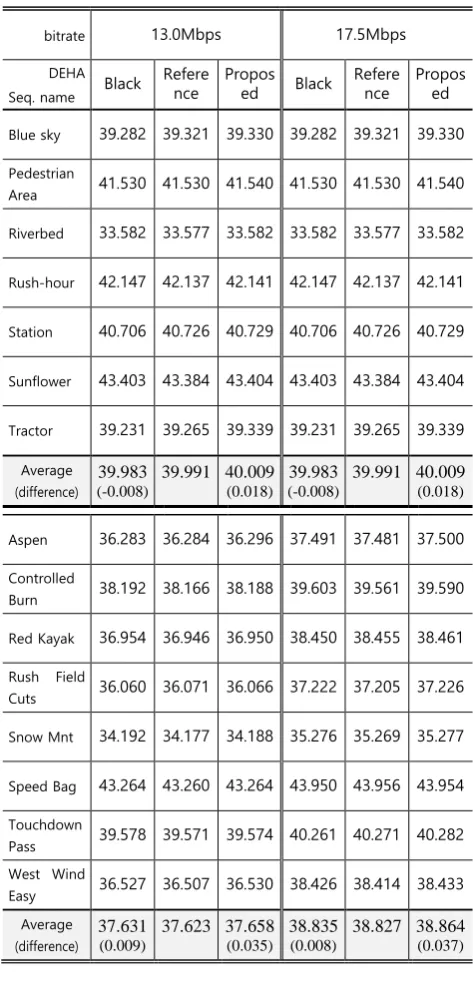
A second experiment was conducted to analyze the quality of the active region and DEHA upon reconstruction of the compressed video stream that included block mode DEHA. Results revealed an overall quality improvement of the active region, as shown in Table 5, Figure 7, and Figure 8.
As shown in Table 5, test sequences were compressed at a quality level ranging between 33dB and 44dB based on the proposed block mode DEHA at a frame rate of 25frames/sec. Compression qualities of almost sequences improved on average by 0.025dB. Moreover, the compression quality of all sequences was above 35dB, evidence of good quality, while the average compression quality of all sequences at a frame rate of 29.97frames/sec improved by 0.037dB at 17.5Mbps.
24
example, consider the current dilemma facing developers to secure computing power as a means of improving video
quality by 0.037dB. In contrast, such quality
improvements can be easily secured through minor changes to a conventional video encoder utilizing the proposed block mode DEHA method. And such improvements can raise the quality by at least 0.010dB.
Table 5. Video quality results of MPEG CBR encoding [dB]
bitrate 13.0Mbps 17.5Mbps
DEHA
Seq. name Black Reference
Propos
ed Black Reference Proposed
Blue sky 39.282 39.321 39.330 39.282 39.321 39.330
Pedestrian
Area 41.530 41.530 41.540 41.530 41.530 41.540
Riverbed 33.582 33.577 33.582 33.582 33.577 33.582
Rush-hour 42.147 42.137 42.141 42.147 42.137 42.141
Station 40.706 40.726 40.729 40.706 40.726 40.729
Sunflower 43.403 43.384 43.404 43.403 43.384 43.404
Tractor 39.231 39.265 39.339 39.231 39.265 39.339
Average
(difference) (-0.008) 39.983
39.991 40.009
(0.018)
39.983
(-0.008)
39.991 40.009
(0.018)
Aspen 36.283 36.284 36.296 37.491 37.481 37.500
Controlled
Burn 38.192 38.166 38.188 39.603 39.561 39.590
Red Kayak 36.954 36.946 36.950 38.450 38.455 38.461
Rush Field
Cuts 36.060 36.071 36.066 37.222 37.205 37.226
Snow Mnt 34.192 34.177 34.188 35.276 35.269 35.277
Speed Bag 43.264 43.260 43.264 43.950 43.956 43.954
Touchdown
Pass 39.578 39.571 39.574 40.261 40.271 40.282 West Wind
Easy 36.527 36.507 36.530 38.426 38.414 38.433 Average
(difference)
37.631
(0.009)
37.623 37.658
(0.035)
38.835
(0.008)
38.827 38.864
(0.037)
III. CONCLUSION
The compression of video in both Full HD and UHD broadcast systems requires the inclusion of DEHA for the
effective functioning of encoder, stream, and decoder. The DEHA is formed by padding extra vertical lines at the bottom of the active video, which is then compressed with active video, transferred to the decoder as part of the video stream, and then decoded in the video decoder. After decoding, the DEHA is discarded by the video decoder.
-20 -15 -10 -5 0
-0.02
-0.04 0.04
0.02
5 10 0.08
0.06
Black mode (17.5Mbps) Proposed (17.5Mbps)
Black mode (13.0Mbps) Proposed (13.0Mbps)
V
id
eo
q
u
al
it
y
i
m
p
ro
v
em
en
t
v
s.
re
fe
re
n
ce
m
o
d
e
D
E
H
A
Generated bits difference/macroblock vs. reference mode DEHA
0.22
0.20 [dB]
[bit]
Fig. 7.Video quality results of MPEG CBR encoding.
However, while the encoding/decoding process is dependent on the DEHA, the DEHA is conventionally viewed as a redundancy in terms of channel utilization and
storage efficiency. However, as shown through
experiments in this paper, the DEHA can be utilized as an essential feature in the encoding/decoding process of active video that can improve the quality of video broadcasting, which has not been researched or utilized to date.
This paper has proposed a block mode DEHA method to more effectively utilize the DEHA, based on the underlying assumption that the quality of active video can be improved by reducing the amount of DEHA data in the compressed video stream through improved channel utilization and storage efficiency. The proposed block mode DEHA achieves this assumption by partitioning video block images, including the DEHA, into macroblocks, of which the representative DEHA macroblocks are then evenly filled with the average DC coefficient of the active video macroblock. Theoretically, this process results in no DEHA data entering the video stream.
http://dx.doi.org/10.9717/JMIS.2017.4.1.19
25
compared to the conventional reference DEHA method. Moreover, experimental testing also found that the proposed block mode DEHA method improved the video quality on average by 0.018dB in test sequences (25 frames/sec) and by 0.037dB in real sequences (29.97 frames/sec).
The proposed block mode DEHA method provides evidence of not only improving video quality through more effective channel utilization and storage efficiency, but the method is also extremely easy to implement into conventional video encoders through minor and simple changes as compared to the time, resources, and effort required developing new video encoding or algorithms.
Acknowledgement
This work was supported by 2016 Research Grant from Kangwon National University (No. 620160119)
REFERENCES
[1] Information technologyGeneric coding of moving pictures and associated audio information, ITU Rec. H. 262 | ISO/IEC 13818-2, 1995.
[2] Advanced video coding for generic audiovisual servicesCoding of moving video, ITU Rec. H. 264 | ISO/IEC 14496-10, 2003.
[3] High Efficiency Video Coding, ITU Rec. H. 265 | ISO/IEC 23008-2 MPEG-H, 2013.
[4] H. Lars, "The SVT high definition multi format test set," Swedish Television Stockholm, Feb. 2006,
https://media.xiph.org/video/derf
[5] Test materials to be used in assessment of picture quality assessment, ITU-R Rec. BT.1210, 2004. [6] C. Lee, and S. Park. "Comparison of Multi-channel
Terrestrial Broadcasting Service Method Focused on MMS and KoreaView," The Journal of the Korea Contents Association, Vol. 12, No. 6, pp78-91, 2012.
Authors