251
*Corresponding author: Rainak Ghaderi, Razi Vaccineand Serum Research Institute, Hesarak, karaj, Iran. Tel: +98 26 34502892
Fax: +98 26 34552194
E-mail: [email protected]
Iranian clonal population of
Salmonella enterica
serovar Enteritidis,
char-acterized by multi-locus sequence typing (MLST) method
Rainak Ghaderi
*, Keyvan Tadayon, Pejvak Khaki, Nader Mosavari
Razi Vaccine and Serum Research Institute, Hesarak, Karaj, Iran.
Received: July 2015, Accepted: September 2015
ABSTRACT
Background and Objectives: Some 2 million tons of chicken meat is produced by Iran per annum, positioning Iran among the top producers in the region. This study aimed to evaluate the molecular epidemiology and genetic characteristics of Sal-monella enterica Enteritidis in Iran.
Materials and Methods: A representative selection of isolates (n=76), initially genotyped by a 7-locus MLVA typing sys-tem, was examined by the standard MLST genotyping.
Results and Conclusion: All the MLVA typed isolates, classified into six types, were gathered under a single ST11 MLST
type. This is an intriguing observation as much more genome heterogeneity was expected considering the extent of diversity in the host and geography origin of the examined isolates. ST11, on the other hand is not exclusively found in Iran as it is reported also from Brazil, Denmark, Japan and the United States. In explanation of these observations, ST11 might stand for a single probably ancestral clone of Salmonella enterica Enteritidis successfully scattered in all these geographically diverse countries. Further global investigation covering more isolates and methods like whole genome sequencing would be advisable.
Keywords:Salmonella enterica Enteritidis, MLST, MLVA, Genetic diversity
more than 1500 serovars (3), is the main cause of
zoonotic food-borne diseases throughout the world
(4). Among which,
Salmonella enterica
serovar
Enteritidis is one of the most frequently reported
reasons of human salmonellosis in developed
coun-tries. For nearly 2 decades, from 1970s through the
mid 1990s this serotype experienced a significant
increase, due to shelled eggs as its main
transmis-sion's vehicle (5). In the first decade of 21
st. century
Salmonella
Enteritidis along with
Salmonella
Ty-phimuium as the main etiological agents for
gastro-enteritis and diarrhea in Europe, affected over 75%
of human cases of salmonellosis (4).
While typhoidal
Salmonella
serovars are host
restricted (6), non-typhoidal
Salmonella
(NTS) are
zoonotic agents, that are found in a wide range of
ani-mal reservoirs such as poultry, pigs, and cattle. These
are considered as the common vehicle of human
sal-ORIGINAL
AR
TICLE
INTRODUCTION
Salmonella
is considered a major public health
problem on a global scale. It is estimated that 93.8
million cases of gastroenteritis due to
Salmonel-la
species with 155,000 deaths occur each year (1).
Salmonella enterica
including six subgroups (Ι, ΙΙ,
ΙΙΙa, ΙΙΙb, ΙV, and VΙ) together with
Salmonella
bon-gori compose the
Salmonella
genus which accounts
for more than 2600 serovars (2). Subgroup I defined
monellosis (7).
Salmonella enterica
Enteritidis as the
leading NTS serotype is capable of persisting in the
caecum or ovaries of chicken without presenting any
clinical sign. In young chicken next to the probable
condition of high mortality due to severe diarrhoea
and dehydration, there is a greater risk of
transform-ing to a carrier state in clinically recovered animals
(8). Determining contamination routes,
differenti-ating strains isolated in an outbreak from those of
obtained in sporadic cases and collecting data about
global distribution of a pathogen in a population has
raised the importance of epidemiological studies to
great extent (9). To conduct a precise
epidemiolog-ical surveillance and outbreak studies, subtyping
the microbial pathogens is critical to let closely
re-lated isolates be discriminated with an acceptable
resolution. Differentiation investigations among
Sal-monella
Enteritidis isolates is a challenging task, as
this pathogen stands atop in list of genetically
ho-mogenous serotypes (10).
Regardless of Kaufmann-White scheme based on
immunological classifications which can't go beyond
the serotyping level (11) other phenotypic
approach-es, like phage typing, biotyping and antibiotic
susceptibility testing have a series of drawbacks.
Phage typing demands specific typing phages, which
makes its reproducibility a great concern. To be more
specific, all these techniques lack the discriminatory
power which is essential for epidemiological related
Salmonella
isolates (12). DNA-based techniques,
in-cluding arbitrary primed PCR(13), pulsed-field gel
electrophoresis (PFGE) and ribotyping (14) have
resolved some of the problems, but still have
short-comings in their reproducibility and discriminatory
abilities (15).
In recent years, multiple-locus variable-number of
tandem repeat (MLVA) analysis (16) and
multiple-lo-cus sequence typing (MLST) (17) have been globally
recognized as highly discriminative standard
strate-gies in modern epidemiological studies of
salmonel-losis. MLVA genotyping has been successfully
em-ployed an effective tool for investigating strains that
are epidemiologically related or unrelated in specific
outbreaks (18). This method enhanced the
charac-terization of subspecies amid of a complex
epidem-ics risen by a single serovar with identical phages
happening simultaneously in different geographical
regions (19).
Multi locus sequence typing (MLST) was
intro-duced to molecular technology for the first time in
1998 as an optimal approach to represent accurate,
reproducible data as a solution to epidemiological
survey of bacterial pathogen in one hand and
evo-lutionary and population biology on the other (20).
This technique is based on assigning the nucleotide
sequences of a series of specific housekeeping, ri
-bosomal, virulence-related genes. Data produced
by MLST is very similar to those provided by multi
locus enzyme electrophoresis MLEE but with
great-er precision, since it has the capability to detect
in-dividual nucleotide alterations rather than
pheno-typical screening the expression of electrophoretic
mobilities (EM) of multiple core metabolic enzymes.
Although, there is not abundant information about
molecular epidemiology of
Salmonella
but in recent
years it seems a new wave of progressive tendency
spreading among the Iranian researchers (21-23) .
The objective of current study is MLST analysis of
population structure of
Salmonella
Enteritidis for the
first time in Iran to provide new insights into a global
scale lineage evaluation.
MATERIALS AND METHODS
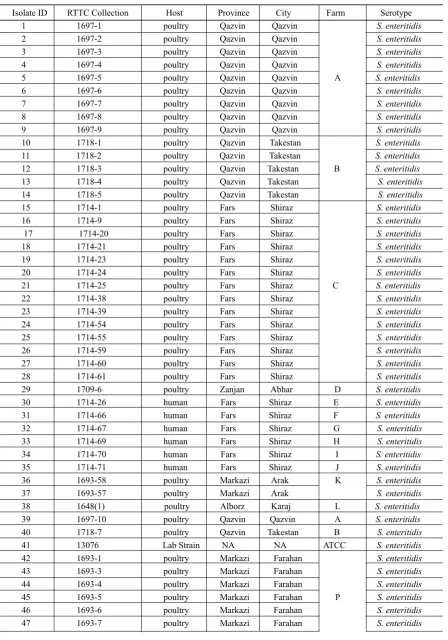
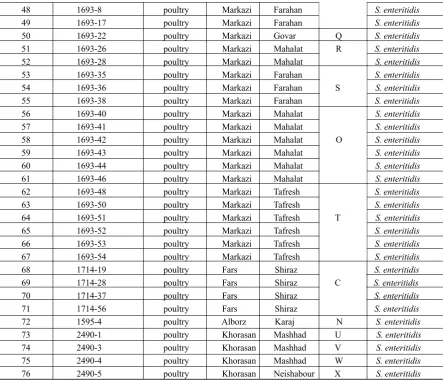
Selection of bacterial isolates. A total of
sev-enty-five
Salmonella
Enteritidis isolates
incorpo-rated in the study. Sixty-five chicken isolates were
obtained from cloaca of slaughtered bird carcasses.
The remaining chicken isolates were obtained from
autopsied birds from Khorasan Razavi province.
The human isolates were provided by fecal samples
of sporadic clinical cases which were archived in
Microbiology Department collection of Razi Vaccine
and Serum Research Institute. To make a
compar-ison analysis of the results, one
S.
Enteritidis type
strain (ATCC13076) was included (Table 1).
Serotyping. All strains were serotyped at Razi
Vaccine and Serum Research Institute,
Microbiolo-gy Department according to Kauffmann-White-Le
Minor scheme (3) by agglutination with "O" and "H"
antigen specific sera (Mast, Bootle, England).
DNA extraction. To perform MLVA and MLST
analysis bacterial DNA was extracted by simple
boiling method as described previously (24) with
little modification. Briefly a loopful of overnight
http://ijm.tums.ac.ir IRAN. J. MICROBIOL. Volume 7 Number 5 (Octobr 2015) 251-259
253
http://ijm.tums.ac.irTable 1. Bacterial isolates, animal and human source and locations
Isolate ID RTTC Collection Host Province City Farm Serotype 1 1697-1 poultry Qazvin Qazvin S. enteritidis
2 1697-2 poultry Qazvin Qazvin S. enteritidis
3 1697-3 poultry Qazvin Qazvin S. enteritidis
4 1697-4 poultry Qazvin Qazvin S. enteritidis
5 1697-5 poultry Qazvin Qazvin A S. enteritidis
6 1697-6 poultry Qazvin Qazvin S. enteritidis
7 1697-7 poultry Qazvin Qazvin S. enteritidis
8 1697-8 poultry Qazvin Qazvin S. enteritidis
9 1697-9 poultry Qazvin Qazvin S. enteritidis
10 1718-1 poultry Qazvin Takestan S. enteritidis
11 1718-2 poultry Qazvin Takestan S. enteritidis
12 1718-3 poultry Qazvin Takestan B S. enteritidis
13 1718-4 poultry Qazvin Takestan S. enteritidis
14 1718-5 poultry Qazvin Takestan S. enteritidis
15 1714-1 poultry Fars Shiraz S. enteritidis
16 1714-9 poultry Fars Shiraz S. enteritidis
17 1714-20 poultry Fars Shiraz S. enteritidis
18 1714-21 poultry Fars Shiraz S. enteritidis
19 1714-23 poultry Fars Shiraz S. enteritidis
20 1714-24 poultry Fars Shiraz S. enteritidis
21 1714-25 poultry Fars Shiraz C S. enteritidis
22 1714-38 poultry Fars Shiraz S. enteritidis
23 1714-39 poultry Fars Shiraz S. enteritidis
24 1714-54 poultry Fars Shiraz S. enteritidis
25 1714-55 poultry Fars Shiraz S. enteritidis
26 1714-59 poultry Fars Shiraz S. enteritidis
27 1714-60 poultry Fars Shiraz S. enteritidis
28 1714-61 poultry Fars Shiraz S. enteritidis
29 1709-6 poultry Zanjan Abhar D S. enteritidis
30 1714-26 human Fars Shiraz E S. enteritidis
31 1714-66 human Fars Shiraz F S. enteritidis
32 1714-67 human Fars Shiraz G S. enteritidis
33 1714-69 human Fars Shiraz H S. enteritidis
34 1714-70 human Fars Shiraz I S. enteritidis
35 1714-71 human Fars Shiraz J S. enteritidis
36 1693-58 poultry Markazi Arak K S. enteritidis
37 1693-57 poultry Markazi Arak S. enteritidis
38 1648(1) poultry Alborz Karaj L S. enteritidis
39 1697-10 poultry Qazvin Qazvin A S. enteritidis
40 1718-7 poultry Qazvin Takestan B S. enteritidis
41 13076 Lab Strain NA NA ATCC S. enteritidis
42 1693-1 poultry Markazi Farahan S. enteritidis
43 1693-3 poultry Markazi Farahan S. enteritidis
44 1693-4 poultry Markazi Farahan S. enteritidis
45 1693-5 poultry Markazi Farahan P S. enteritidis
46 1693-6 poultry Markazi Farahan S. enteritidis
the MLVA types represented in dendrogram using
categorical coefficient.
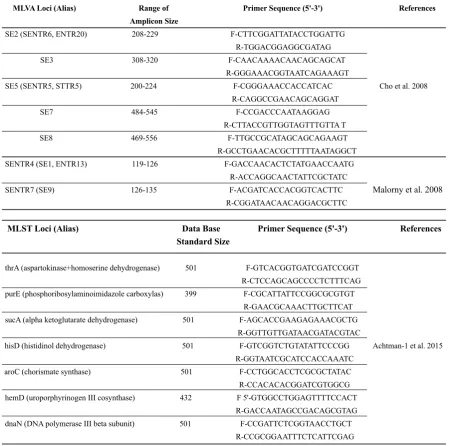
MLST. To Characterize
Salmonella
Eteritidis
iso-lates based on MLST scheme, internal fragments of
seven housekeeping genes were utilized as follows:
thr
A (aspartokinase+homoserine dehydrogenase),
pur
E (phosphoribosylaminoimidazole carboxylas),
suc
A (alpha ketoglutarate dehydrogenase),
his
D
(his-tidinol dehydrogenase),
aro
C (chorismate synthase),
hem
D (uroporphyrinogen III cosynthase),
dna
N
(DNA polymerase III beta subunit)
Amplification protocols proposed by the Warwick
University MLST database (27) were used in this
study, including primers which have been selected
from the set of primers presented under the titles of
amplifications & sequences. All the primers were
and suspended in 0.5 ml of TE buffer and vortexed.
Cell suspension was boiled at 98 °C for 10 min and
immediately cooled on ice for 5 min. The suspension
was centrifuged at 12,000 g for 5 min. Small
por-tion (1/64 v/v) of a 10-mg/ml Proteinase K solupor-tion
(Roche, Germany) was added to the supernatant and
this mixture was directly used for PCRs.
VNTR. Seven MLVA loci including SE2, SE3,
SE5, SE7, SE8, SENTR4, and SENTR7 were
select-ed (Table 2). Amplification details were describselect-ed
previously (25). To compare the diversity between
MLVA loci, Nei’s diversity index was calculated as
1−Σ (Allele)2. Simpson’s diversity index of the sev
-en-loci MLVA system was measured according to
Hunter and Gaston (26). The BioNumerics software
v4.61 (Applied Maths, Belgium) was used to cluster
48 1693-8 poultry Markazi Farahan S. enteritidis
49 1693-17 poultry Markazi Farahan S. enteritidis
50 1693-22 poultry Markazi Govar Q S. enteritidis
51 1693-26 poultry Markazi Mahalat R S. enteritidis
52 1693-28 poultry Markazi Mahalat S. enteritidis
53 1693-35 poultry Markazi Farahan S. enteritidis
54 1693-36 poultry Markazi Farahan S S. enteritidis
55 1693-38 poultry Markazi Farahan S. enteritidis
56 1693-40 poultry Markazi Mahalat S. enteritidis
57 1693-41 poultry Markazi Mahalat S. enteritidis
58 1693-42 poultry Markazi Mahalat O S. enteritidis
59 1693-43 poultry Markazi Mahalat S. enteritidis
60 1693-44 poultry Markazi Mahalat S. enteritidis
61 1693-46 poultry Markazi Mahalat S. enteritidis
62 1693-48 poultry Markazi Tafresh S. enteritidis
63 1693-50 poultry Markazi Tafresh S. enteritidis
64 1693-51 poultry Markazi Tafresh T S. enteritidis
65 1693-52 poultry Markazi Tafresh S. enteritidis
66 1693-53 poultry Markazi Tafresh S. enteritidis
67 1693-54 poultry Markazi Tafresh S. enteritidis
68 1714-19 poultry Fars Shiraz S. enteritidis
69 1714-28 poultry Fars Shiraz C S. enteritidis
70 1714-37 poultry Fars Shiraz S. enteritidis
71 1714-56 poultry Fars Shiraz S. enteritidis
72 1595-4 poultry Alborz Karaj N S. enteritidis
73 2490-1 poultry Khorasan Mashhad U S. enteritidis
74 2490-3 poultry Khorasan Mashhad V S. enteritidis
75 2490-4 poultry Khorasan Mashhad W S. enteritidis
http://ijm.tums.ac.ir
provided and went under optimization tests to find
the best match for pair primers in final test. Next to
this experimental evaluation the annealing
tempera-tures was modified to 62.9°C for
hem
D and 58°C
for the 6 remaining of genes. Amplifications for the
hem
D gene were carried out with approximately 12
µl reactions containing 6 µl PCR master mix
(Am-pliqon, Denmark), 1.5 µl of working solution (5 pM/
µl) from each flanking primer and 1.5 µl of DNA
template plus 1.5 µl of molecular-grade PCR water.
In the second protocol used for
thr
A,
pur
E,
suc
A,
his
D,
aro
C,
dna
N , reaction mixtures contained 6
µl PCR master mix (Ampliquor, Denmark), 0.3 µl of
each flanking primer (5 pM/µl) and 1.5 µl of DNA
template and 4 µl molecular-grade PCR water to a
volume of 12 µl. PCR reactions were run on an
Ep-pendorf PCR system (EpEp-pendorf, Germany) were
an initial 1 min denaturation at 95ºC followed by 35
cycles of denaturation (94ºC for 40 sec), annealing
(62.5ºC for 20 sec) and extension (72ºC for 30 sec)
with a final elongation step of 72ºC for 5 min was
used for the first protorol reactions. For the second
group this was the same except the annealing
tem-perature which was lowered to 58ºC (Table 3).
IRAN. J. MICROBIOL. Volume 7 Number 5 (Octobr 2015) 251-259
255
http://ijm.tums.ac.irTable 2. MLVA & MLST Primers and their references
MLVA Loci (Alias) Range of Primer Sequence (5'-3') References Amplicon Size
SE2 (SENTR6, ENTR20) 208-229 F-CTTCGGATTATACCTGGATTG R-TGGACGGAGGCGATAG SE3 308-320 F-CAACAAAACAACAGCAGCAT R-GGGAAACGGTAATCAGAAAGT
SE5 (SENTR5, STTR5) 200-224 F-CGGGAAACCACCATCAC Cho et al. 2008 R-CAGGCCGAACAGCAGGAT SE7 484-545 F-CCGACCCAATAAGGAG
R-CTTACCGTTGGTAGTTTGTTA T SE8 469-556 F-TTGCCGCATAGCAGCAGAAGT R-GCCTGAACACGCTTTTTAATAGGCT SENTR4 (SE1, ENTR13) 119-126 F-GACCAACACTCTATGAACCAATG R-ACCAGGCAACTATTCGCTATC
Malorny et al. 2008 SENTR7 (SE9) 126-135 F-ACGATCACCACGGTCACTTC
R-CGGATAACAACAGGACGCTTC
MLST Loci (Alias) Data Base Primer Sequence (5'-3') References Standard Size
thrA (aspartokinase+homoserine dehydrogenase) 501 F-GTCACGGTGATCGATCCGGT R-CTCCAGCAGCCCCTCTTTCAG purE (phosphoribosylaminoimidazole carboxylas) 399 F-CGCATTATTCCGGCGCGTGT R-GAACGCAAACTTGCTTCAT
sucA (alpha ketoglutarate dehydrogenase) 501 F-AGCACCGAAGAGAAACGCTG R-GGTTGTTGATAACGATACGTAC hisD (histidinol dehydrogenase) 501 F-GTCGGTCTGTATATTCCCGG Achtman-1 et al. 2015 R-GGTAATCGCATCCACCAAATC
Sequence typing data analysis. PCR products
in-cluding DNA amplicons (40pg/µl of concentration)
along with primers (10ng/µl of concentration) were
sent to Macrogen® (South Korea – Seoul)
compa-ny to be sequenced by Sanger method. The results
were received in chromatogram format, that needed
to be analyzed by related bioinformatics softwares,
like Chromas Lite Ver. 2.01(28) to evaluate the
se-quence results, Clustal X Ver.2.0.11(29) to align the
segments and compare their nucleotides, and
Arte-mis (30) as a DNA sequence viewer and annotation
tool that allows visualization of sequence features
and the results of analyses within the context of the
sequence.
RESULTS
VNTR.
Successful amplification of all isolates re
-corded four alleles for SE5 and two alleles for SE7
and no allelic formation in all other five loci with
monomorphic state. To validate these findings se
-lected isolates were gone under sequencing
proce-dures with 175 PCR products. Considering 11 various
VNTR scores previously observed from gel
electro-phoresis (25), Nie's diversity index was calculated,
ranging from 0 (SE2, SE3, SE7, SE8, and SENTR4)
up to 0.15 (SENTR7) and 0.58 (SE5). Altogether six
"MLVA-type" as allele combination with
Single-lo-cus variant (SLV) was identified, in which three ML
-VA-type were common between human and chicken
isolates.
MLST. MLST analysis did not represent any
nucle-otide differences among Seventy-five
S. Enteritidis
isolates collected from various Iranian cities and also
standard strain (ATCC13076). The only allelic profile
which was obtained from Warwick University MLST
data base (27) according to the panel of mentioned
seven housekeeping genes were respectively (2,3,5,
6,7,11) which was categorized as the Sequence Type
(ST)11 in MLST data base. Considering 6 out of 7
loci identical, ST814, ST745, ST640, ST616, ST470,
ST460 were regarded as the closest sequence type
registered on MLST data base (Fig. 1).
DISCUSSION
As the first report of Multi locus sequence typing
of
Salmonella
Enteritidis population in Iran our study
characterized all isolates as a unique ST (ST 11) which
was in notable contrast with diversity observed by
Multi locus VNTR analysis in the same collection.
Similar report has been presented in Japan (31) that
among 30
S.
Enteritidis isolates collected between
1980 and 1990, all were categorized in the same
se-quence type 11. Referring to MLST data base,
Den-mark was among the countries with the most frequent
report of this sequence type such as No.9968721-11
registered in 2003, along with a broad range of records
from US and Europe (32). Another recent report from
Brazil (33) covering a period of more than two
de-cades showed 44 out of 46 isolates
Salmonella
Enter-itidis have been typed as belonging to ST 11.
ST11
http://ijm.tums.ac.ir IRAN. J. MICROBIOL. Volume 7 Number 5 (Octobr 2015) 251-259
257
http://ijm.tums.ac.irGenerally, molecular typing methods are intended
to tackle two different levels of epidemiological
prob-lems, which reflect different insights toward solving a
local or global epidemiology in different timeframes.
In one hand localized outbreak of disease in a short
period of time should be assessed and on the other,
relation between strains causing a disease in one
geo-graphic area with those observed around the world
during a longer period would be investigated. These
two different conceptual views demand different
ap-propriate scheme of molecular typing. However, they
should have one capability in common, which is their
inevitable discriminatory power (20), So that isolates
recorded in same molecular type are likely to be
de-scended from a younger ancestor and those belonging
to more distant ancestors are expected to differ in type
unless a relative higher clonal population would be
under study.
Two pivotal phenomena have been revealed based
on our VNTR scheme study. Firstly, fragment length
polymorphism was detected in just two out of seven
loci with rather slight 0.15 up to 0.58 Nie's diversity
index for SENTR7 and SE5 respectively. This means
other five loci which have been recorded in literature
as the most commonly used markers with the highest
reported levels of diversity has failed to provide any
heterogeneity. Secondly, all six allele combinations
presented in this study has been in Single locus
Varia-tion state. These two key factors have shown that our
Iranian Enteritidis population has a low level of
diver-sity within its entity, which accommodate with what
has been detected by MLST methodology.
Seven house keeping genes represent only a fraction
of the bacteria whole genome in MLST scheme which
hardly exceed 0.2% of it, but have proved a
stagger-ing level of diversity for numerous bacteria (34), to let
it claim among the highest discriminatory techniques
of population structure analysis (35). Considering this
privilege attributed to MLST scheme, observation
of the homogeneity between our population and one
standard (ATCC 13076) strain, seems something of
a paradox in our fundamental principles. Detecting
this odd similarity, a verification trial test consists of
3 different serotypes including
S.
Infantis,
S.
Typh-imurium and
S.
Enteritidis were arranged with an all
in one PCR operation. This experimental trial repeated
for 3 times to evaluate 3 out of seven housekeeping
genes namely
his
D,
thr
A,
suc
A. Comparing amplified
segments with those acquired in our previous studies
next to similar fragments in standard genome, were in
accordance to what was expected to see. Three
sim-ilar serotypes integrated to different clusters, based
on SNP differences between them, which was also in
agreement with what has been reported previously by
Achtman and colleagues (2). Also
S.
Enteritidis
stan-dard strain (ATCC 13076) though verified to be iden
-tical with
S.
Enteritidis isolates were in quite contrast
with other remaining two serotypes.
Back to identical entity of standard strain in
com-pare to our population, it might be due to the fact that
they all belonged to the same lineage with persistent
consensus genotype. Based on data released on MLST
data base, there are few records of
Salmonella
Enter-itidis strains belonging to Sequence type 11, regarding
the homogenus character of this serotype one cautious
explanation would be presumably that they have a
common historical origin.
Regarding the specific clonal character of
Salmonel-la
Enteritidis ST11 population two hypotheses have
been presented by Noda and colleagues (31): first ex
-istence of a niche in chicken reproductive tissues and
second, higher clonal population in those geographical
regions in which this sequence type is in circulation.
While it's been proved housekeeping genes might
pos-sess less effective role in chicken oviduct colonization
than genes related to factors like fimbriae or flagellae
or stress tolerance, the second hypothesis would more
probably interpret our conserved population. Under
the light of food-borne character of
Salmonella
Enter-itidis and existence of human cases representing the
similar sequence type 11, its higher clonal population
can be attributed to the potential transmission of this
pathogen between human beings and chickens
with-out substantial genetic changes like mutation. More
over having three of the six MLVA types found in this
study shared by chickens and human enteritis cases
suggests a strong association between the two.
In conclusion, notwithstanding high discriminatory
power, nucleotide changes accumulate in
housekeep-ing genes in long period of time. That is why the
allel-ic profile of isolates persists unchanged over a longer
timeframe, which make MLST a desirable tool for
global epidemiology. If it hadn't been for
unambigu-ous and portable character of this scheme there would
have been no chance of finding closely related isolates
Enteritidis with those in other countries and continents
in terms of evolutionary, fundamental relatedness and
population structural studies. Further global
investiga-tions covering more isolates and methods like whole
genome sequencing would be advisable.
AKNOWLEDGEMENTS
This work was fully financed with the state funds
from Razi Vaccine and Serum Research Institute,
un-der grant no. 2-18-18-90036.
REFERENCES
1. Majowicz SE, Musto J, Scallan E, Angulo FJ, Kirk M, O'Brien SJ, et al. The global burden of nontyphoidal
Salmonella gastroenteritis. Clin Infect Dis 2010; 50: 882-889.
2. Achtman M, Wain J, Weill FX, Nair S, Zhou Z, Sangal V, et al. Multilocus sequence typing as a replacement for serotyping in Salmonella enterica. PLoS Pathog
2012; 8: 1-15.
3. Grimont PA, Weill FX (2007). Antignenic formulas of the Salmonella serovars 9th. ed. WHO Collaboration Center for Resistance and Research on Salmonella, In-stitute Pasteur. Paris.
4. Litrup E, Torpdahl M, Malorny B, Huehn S, Chris-tensen H, Nielsen EM. Association between phylog-eny, virulence potential and serovars of Salmonella enterica. Infect Genet Evol 2010; 10: 1132-1139. 5. Hendriksen RS, Vieira AR, Karlsmose S, Lo Fo Wong
DM, Jensen AB, Wegener HC, et al. Global monitor-ing of Salmonella serovar distribution from the World Health Organization Global Foodborne Infections Network Country Data Bank: results of quality as-sured laboratories from 2001 to 2007. Foodborne Pat-hog Dis 2011; 8: 887-900.
6. Hald T, Lo Fo Wong DM, Aarestrup FM. The attribu-tion of human infecattribu-tions with antimicrobial resistant
Salmonella bacteria in Denmark to sources of animal origin. Foodborne Pathog Dis 2007; 4: 313-326. 7. Braden CR. Salmonella enterica serotype Enteritidis
and eggs: a national epidemic in the United States.
Clin Infect Dis 2006; 43: 512-517.
8. Sadeyen JR, Trotereau J, Velge P, Marly J, Beaumont C, Barrow PA, et al. Salmonella carrier state in chick-en: comparison of expression of immune response
genes between susceptible and resistant animals. Mi-crobes Infect 2004; 6: 1278-1286.
9. Olive DM, Bean P. Principles and applications of methods for DNA-based typing of microbial organ-isms. Journal of clinical microbiology 1999; 37: 1661-1669.
10. Olson AB, Andrysiak AK, Tracz DM, Guard-Bouldin J, Demczuk W, Ng LK, et al. Limited genetic diversity in Salmonella enterica serovar Enteritidis PT13. BMC Microbiol 2007; 7: 87.
11. Popoff MY, Bockemuhl J, Gheesling LL. Supplement 2001 (no. 45) to the Kauffmann–White scheme. Res Microbiol 2003; 154: 173-174.
12. Threlfall EJ, Frost JA. The identification, typing and fingerprinting of Salmonella: laboratory aspects and epidemiological applications. J Appl Bacteriol 1990; 68: 5-16.
13. Fadl AA, Khan MI. Genotypic evaluation of Salmo-nella enteritidis isolates of known phage types by ar-bitrarily primed polymerase chain reaction. Avian Dis
1997; 41: 732-737.
14. Thong KL, Ngeow YF, Altwegg M, Navaratnam P, Pang T. Molecular analysis of Salmonella enteritidis
by pulsed-field gel electrophoresis and ribotyping. J Clin Microbiol 1995; 33: 1070-1074.
15. Zheng J, Keys CE, Zhao S, Meng J, Brown EW. En-hanced subtyping scheme for Salmonella enteritidis. Emerg Infect Dis 2007; 13: 1932-1935.
16. Kruy SL, Van Cuyck H, Koeck JL. Multilocus variable number tandem repeat analysis for Salmonella enter-ica subspecies. Eur J Clin Microbiol Infect Dis 2011; 30: 465-473.
17. Jolley KA, Maiden MC. Using MLST to study bac-terial variation: prospects in the genomic era. Future Microbiol 2014; 9: 623-630.
18. Malorny B, Junker E, Helmuth R. Multi-locus vari-able-number tandem repeat analysis for outbreak stud-ies of Salmonella enterica serotype Enteritidis. BMC Microbiol 2008; 8: 1-8.
19. Hopkins K, Peters T, de Pinna E, Wain J. Standard-isation of multilocus variable-number tandem-repeat analysis (MLVA) for subtyping of Salmonella enterica serovar Enteritidis. Euro Surveill 2011; 16: 1-29. 20. Maiden MC, Bygraves JA, Feil E, Morelli G, Russell
JE, Urwin R, et al. Multilocus sequence typing: a
por-table approach to the identification of clones within
populations of pathogenic microorganisms. Proc Natl Acad Sci U S A 1998; 95: 3140-3145.
21. Golab N, Khaki P, Noorbakhsh F. Molecular Typing of Salmonella Isolates in Poultry by Pulsed-Field Gel Electrophoresis in Iran. Int J Enteric Pathog 2014; 2: 1-5.
en-http://ijm.tums.ac.ir terica subsp. enterica serovar Entritidis, isolated from
poultry, cattle and human in Iran by ERIC-PCR. Inter-national Journal of Biosciences (IJB) 2014; 5: 147-153. 23. Peighambari SM, Akbarian R, Morshed R, Yazdani A.
Characterization of Salmonella isolates from poultry sources in Iran. Iranian Journal of Veterinary Medi-cine 2013; 7: 35-41.
24. Karimnasab N, Tadayon K, Khaki P, Moradi Bidhendi S, Ghaderi R, Sekhavati M, et al. An optimized afford-able DNA-extraction method from Salmonella enteri-ca Enteritidis for PCR experiments. Archives of Razi
2013; 68: 105-109.
25. Ghaderi R, Tadayon K, Avagyan S, Khaki P, MoradiBidhendi S, Forbes KJ, et al. The population structure of Salmonella enterica Enteritidis in Iran analyzed by multiple-locus variable-number tandem repeat analysis. Trop Anim Health Prod 2012; 45: 1-6. 26. Hunter PR, Gaston MA. Numerical index of the
dis-criminatory ability of typing systems: an application of Simpson's index of diversity. J Clin Microbiol 1988; 26: 2465-2466.
27. Achtman-1 M. MLST Databases at UoW. 2015 [cit-ed 2015/05/29]; Available from: http://mlst.warwick. ac.uk/mlst/dbs/Senterica.
28. McCarthy C (1996). Chromas: version 1.3. Griffith
University. Brisbane, Australia.
29. Larkin MA, Blackshields G, Brown NP, Chenna R, McGettigan PA, McWilliam H, et al. Clustal W and Clustal X version 2.0. Bioinformatics 2007; 23: 2947-8.
30. Anonymous. Artemis: Genome Browser and Annota-tion Tool. [cited 2012/12/20]; Available from: http:// www.sanger.ac.uk/resources/software/artemis/. 31. Noda T, Murakami K, Asai T, Etoh Y, Ishihara T,
Kuroki T, et al. Multi-locus sequence typing of Sal-monella enterica subsp. enterica serovar Enteritidis strains in Japan between 1973 and 2004. Acta Vet Scand 2011; 53: 1-6.
32. Achtman-2 M. MLST Databasesat UoW. 2015 [cit-ed 2015/05/29]; Available from: http://mlst.warwick. ac.uk/mlst/dbs/Senterica/handlers/getFileData/home/
cbailster/mlst/zope/Extensions/gadfly/Senterica/DB/
PublicStrains.txt.
33. Campioni F, Pitondo-Silva A, Bergamini AM, Falcão JP. Comparison of four molecular methods to type Sal-monella Enteritidis strains. Apmis 2015; 123: 422-426. 34. Anon. Comprehensive list of all MLST databases.
2015 [cited 2005/05/30]; Available from: http://pubm-lst.org/databases.
35. Maiden MCJ. Multilocus sequence typing of bacteria.
Annu Rev Microbiol 2006; 60: 561-588.