*Corresponding author:Shiddharthy R ISSN: 0976-3031
Research Article
A NOVEL CLUSTER BASED EFFICIENT BROADCASTING PROTOCOL IN VANETs
Shiddharthy R* and Gunavathi R
Department of Computer Applications, Sree Saraswathi Thyagaraja College, Pollachi, India
DOI: http://dx.doi.org/10.24327/ijrsr.2018.0902.1554
ARTICLE INFO ABSTRACT
The advancement in technology and networks has led to the introduction of safety systems with vehicles. Vehicular Ad Hoc Networks are one of the emerging areas for emergency situation warning since traffic safety is a concern for everyone. VANETs are Ad-Hoc vehicle networks between vehicles equipped with communication facilities. The application areas of VANETs, includes are autonomous vehicles, warning systems, collision avoidance/notification and traffic optimization. Broadcast storm arises due to frequent contention and collisions in transmission among neighboring vehicles. To limit the number of packet transmissions by Cluster Based Efficient- Broadcast (CBE-B) algorithm. The main aim is to broadcast a messages from farthest node and reduce collisions between the nodes. Due to distributed clustering this protocol can overcome challenges of data broadcast storm. Packets will be then forwarded only to selected vehicles, opportunistically elected as cluster-heads. CBE-B performances have been assessed in vehicular scenarios, mostly highway scenarios and performance are measured in terms of Packet Delivery Ratio and Throughput.
INTRODUCTION
Vehicular Ad Hoc Network (VANET) is a subset of Mobile Ad hoc Network (MANET). VANETs rely heavily on broadcast transmission. Vehicular Ad hoc Networks (VANETs) are accessed between the vehicles to communicate among themselves for safety measures. Most of recent research works have focused on analyzing VANETs as well-connected networks, providing high vehicular traffic density in low cost wireless communication. VANET consists of basic communication devices to develop peer to peer communication network. The vehicles are considered as source and destination node in VANET network. It works on developing base station to perform distribution of information over the nodes to avoid collision. The network router developed in VANET provides safety travelling in roads by broadcasting messages among the nodes. During the transmission the information of the nodes should receive at proper time without any delay.
The VANET can be used in both light and heavy weighted applications. There are some limitations using VANET mainly in high traffic collision. The broadcasting messages in traffic network causes failure of transmission which results in collision. It causes redundancy in network topologies results in collaboration of transmitting messages between the nodes of vehicle. If it cause failure, the vehicle will rebroadcast the
message again n again in affected network creates more redundant messages.
The research works have focused on analyzing VANETs as well-connected networks, providing high vehicular traffic density. When a vehicle rebroadcasts a message, it is fact that neighboring vehicles have already received it and results in a large number of redundant messages. They detect the dangerous situation, they will inevitably broadcast messages relating to the same event, leading to a dramatically excessive message redundancy arises a broadcast storm problem. The design of reliable and efficient routing protocols for supporting highly diverse, and mainly intermittently connected vehicular network topologies, is still a challenge. Hybrid solutions based on both V2V, and vehicle-to-infrastructure (V2I) communications, result as a viable alternative to routing protocols that exploit the V2V paradigm only [14].
In this paper, a design of cluster-based broadcast technique for safety applications in VANETs is implemented. The approach named as Cluster Based Effective- Broadcast (CBE-B), in order to reduce the broadcast storm effect using clustering of vehicles in road. This approach is very efficient because of using limited number of vehicles to forma Cluster Head (CH). As a result, CBE-B limits the number of transmissions, broadcasting a messages with high efficiency and propagation
International Journal of
Recent Scientific
Research
International Journal of Recent Scientific Research
Vol. 9, Issue, 2(B), pp. 23874-23878, February, 2018
Copyright © Shiddharthy R and Gunavathi R, 2018, this is an open-access article distributed under the terms of the Creative Commons Attribution License, which permits unrestricted use, distribution and reproduction in any medium, provided the original work is properly cited.
DOI: 10.24327/IJRSR CODEN: IJRSFP (USA)
Article History:
Received 06th November, 2017 Received in revised form 14th December, 2017
Accepted 23rd January, 2018 Published online 28th February, 2018
Key Words:
speed and preserves good network performance.
The rest of this paper is organized as follows. In Section 2 summarize a various protocols and some of the research efforts directed at their evaluation. Section 3 introduced an evaluation scenario of proposed protocol and description of the algorithms under investigation, followed by the explanation. Section 4 presents the performance criteria and comparison of algorithms. Finally, Section 5 summarizes conclusions.
Related Work
Fasolo et.al (2006) [3] focused on a Vehicular Ad Hoc Network (VANET) that makes use of IEEE 802.11 for Inter Vehicular Communication (IVC) on distributed position based broadcast protocol Smart Broadcast (SB). The SB protocol aims to minimizing the rebroadcast delay. When the coverage areas are divided among adjacent sectors in which each nodes have the capacity to estimate their position. Mainly SB is employed to minimize the time to perform a hop, since it does not spend more time to solve the collisions. It considers a contention resolution procedure to elect the relay nodes which permits fast and reliable message propagation in a VANET.
Broadcasting is mainly employed to resolve network issues. Due to host mobility the operations such as finding a route to a particular host, paging a particular host and sending an alarm signal are executed more frequently. Broadcast storm arises due to the overlap of radio signals by flooding results in redundancy, contention, and collision. To solve tis issues Tsang et.al [10] proposed a several schemes to reduce redundant rebroadcasts and differentiate timing of rebroadcasts by inhibiting some hosts from rebroadcasting. Several schemes namely distance-based, location-based, probabilistic, cluster-based schemes and counter-cluster-based have been proposed to solve this problem. The location-based scheme is the best method it can eliminate most redundant rebroadcasts under all kinds of host distributions without compromising reachability.
Vegni et.al [11] presented a hybrid communication for vehicular networking based on network infrastructure (e.g., wireless network access points) through a vehicle-to-infrastructure protocol and traditional vehicle-to-vehicle networking. vehicular communications in short range are supported by Vehicle-To-Vehicle (V2V) protocols, considering smart vehicles equipped by on-board computers with sensors (e.g., radar, ladar, etc.) and multiple network interface cards. The optimal path selection technique is adopted by V2X, allowing protocol switching to vehicles communicating via V2V or V2I. It represents a policy to decide for the optimal vehicular communication protocol (i.e., V2V or V2I) between two end nodes to improve the network performance.
The design of a cross layered MAC and clustering solution for supporting the fast propagation of broadcast messages in a Vehicular Ad Hoc Network (VANET) is proposed by Luciano and Marco (2015) [14]. Ghodrati and Mohammadkhanli [15] (2013) proposed a dynamic virtual backbone in the vehicular network by distributed dynamic clustering algorithm. It is responsible for implementing an efficient messages propagation and forwarding broadcast messages by balancing the backbone connections as well as the cost or efficiency trade-off and the hops-reduction.
To enhance collision-free and delay-bounded transmissions for safety applications under various traffic conditions Vidhya and Ramalingam [16] (2016) proposed a technique broadcasting mechanism based on MAC protocol. Tonguz et.al (2006) [17] focused on Dedicated Multi-channel MAC (DMMAC) adaptive broadcasting mechanism enables every vehicle in the network to have a chance to conduct collision-free and delay-bounded transmission for safety applications. In DMMAC, all vehicles are equipped with a single half-duplex radio transceiver and multiple radios implemented with current hardware may suffer from too much cross-channel interference.
Proposed Work
A Cluster Based Efficient Broadcast (CBE-B) Algorithm is expect to minimize the number of rebroadcast message by clustering the vehicles on road. This algorithm works in efficient way to elect cluster heads based on following criteria. Reliable protocols use three methods i.e.,(i) rebroadcasting, where the transmitter node retransmits the same message for many times (ii) selective ACK, where the transmitter requires ACK from a small set of the neighbors and (iii) changing parameters, where the transmitter changes transmission parameters according to the expected state of the network. The problem statement for reliable protocols is to design a protocol that can deliver a message from a single source to every node in the own transmission range with the highest possible reliability and minimum delay.
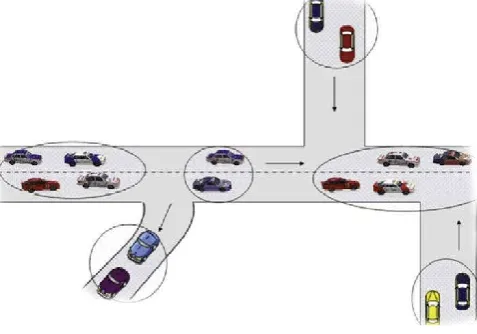
VANETs is that a vehicular network is partitioned into a number of clusters a vehicles within a partition can communicate either directly or through multiple hops among each other, but no direct connection exists between partitions, as well depicted in Fig. 1. Vehicles belonging to the same cluster can communicate each other, while due to the gaps among consecutive clusters, no inter-cluster communications are available. A particular class of routing protocols namely, the cluster-based approaches uses this assumption by exploiting clusters formation [9]. Based on geographical locations, directions of movement, speed and many other metrics, vehicles can group into different clusters.
Fig 1 Schematic Diagram of Vehicle Clusters.
Cluster-Based Efficient – Broadcast
messages in VANET. The broadcasting of messaging in VANET network is desirable by using the proposed work with less number of transmission nodes and delay. This can be done by using three main parameters such as rebroadcast possibility (Pij), Vehicle speed (V) and receiving order of messages by nodes (MSG_No). It detects the cluster of vehicles in a fast and efficient way and elect one as CH vehicle for each cluster detected. The new cluster head is responsible to rebroadcast the messages.
Fig 2 Message broadcast in the transmission range of crashed vehicle
Algorithm of Proposed CBE-B Protocol
Based on the above three parameters the proposed algorithm collects the information of vehicle position in GPS receiver. The bilateral roads are considered as unilateral by the algorithm to avoid collision. If the node of a vehicle is congested in collision it automatically gives message with vehicle id to the network. The figure 2 shows that message (Vehicle ID, Location).
The proposed algorithm is composed of two phases are Setup Phase and Steady-state phase as follows
Setup Phase
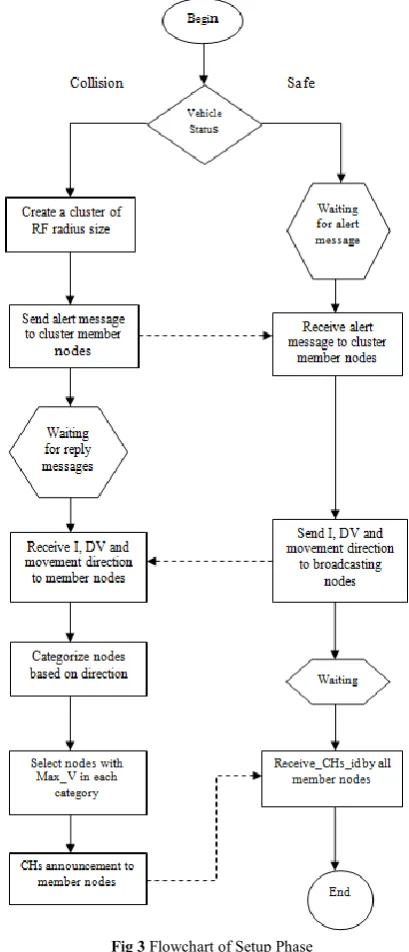
If the vehicle suffers due to collision acts as a base station and it automatically calculates the radius of radio range to form cluster. The broadcasting of acknowledgement message between the nodes inside the cluster is send to base station. The acknowledgement message contains nodes connecting speed, identifier and direction of moving vehicle. In which helps the direction of moving divides the vehicles into two categories whereas based on node speed the base station selects cluster header for each category the faster the vehicle is more preferred. Based on the following flowchart the working of the setup phase is given in fig 3.
Steady-State Phase
The rebroadcasting of warning messages is carried out by each cluster head and based on their vehicle speed new cluster head is determined to enhance the process quickly. There are several stages in steady state phase in each stage a new cluster head is selected. The messages are numbered in order as variables to rebroadcast and it kept fixed until next cluster is set. This phase follows some rules to select the cluster head as follows:
The cluster head is selected by high probability even if the node is father. It is calculated by using rebroadcast parameter of pi, j formulated as Pi, j = Di, j/ R.
The next parameter is speed of the moving node.
Also, if the node receives less warning messages with higher probability is selected as cluster head.
The algorithm of Steady State phase is given as
Step 1 - Initialization of Cluster_Head among the nodes.
Step 2 - Broadcasting of warning messages.
Step3 -To receive acknowledgement messages (ack_msg) from cluster
nodes.that contains node identifier (ID), node velocity (V), location of node (Loc), direction of movement in node (Dir_Veh).
Step 4 - Nodes those are moving in the direction of cluster head, puts into
Cluster_Mems group should satisfy the following condition
For (j=1, j<=Cluster_Size;j++)
If Dir_Vehi = Dir_Vehj
Cluster_Members ← Vehj;
Step 5 - Each member of the group should follow the criteria with three factors
distance, speed and warning message of each nodes.
For (j=1, j<= Size (Cluster_Mems); j++)
then calculate Pi, j = Di, j/ R
Resultj ← Pi, j * Vj * 1/ MSG_No;
Step 6 - Create Table_Vehi is formed by current cluster head from the obtained
information.
Step 7 - Selection of next Cluster Head (CH) can be obtained from the above
table between nodes in the Cluster_Mems
In our proposed method algorithm, when a vehicle received a warning message, responses to the sender with an ACK message. If its movement direction be the same with
broadcasting node, based on the next cluster head selection algorithm, it will participate in optimal cluster head selection algorithm to be the next cluster head.
EXPERIMENTAL
RESULTS
Network Configuration
The proposed CBE-B algorithm has been validated in highways to avoid number of vehicles in rural areas. The simulation environment used for the proposed work is given in the following Table I. It describes the various parameters used for the simulation.
Table I Simulation Parameters and Values
Parameters Value
Channel Wireless channel Antenna Omni/Directional Antenna MAC Protocol IEEE 802.11
Routing Protocol AODV No. of Nodes 100
Performance Parameters
The performance analysis of the VANET based on Cluster based Effective Broadcast algorithm is simulated on NS2. The performance of the proposed protocol is analyzed by parameters such as throughput and Packet Delivery Ratio and compared with the existing Cisco Discovery Protocol (CDP) Protocol.
Throughput - Throughput denotes that the correct cluster detection has occurred if the amount of packet exchange has increased significantly.
Packet Delivery Ratio - Packet Delivery Ratio is defined as the ratio of number of packets successfully received and number of packets transmitted. It increases due to successful transmission of packets by the intermediate nodes.
Table II Performance Parameters for CBE-B Algorithm
Protocols Throughput
(%)
Packet Delivery Ratio
CBE-B 85 95.8
CDP 72 81.2
Fig 4 Throughput for CBE-B
In Fig.4 shows throughput experienced by vehicles moving in highway scenario. Throughput for proposed CBEB protocol shows higher than existing method. Fig 5 Packet Delivery Ratio for CBE-B protocol. From the results it is evident that
proposed CBE-B protocol reduce the number of packet transmissions.
Fig 5 Packet Delivery Ratio for CBE-B
CONCLUSION
The broadcast storm is a common problem in network. To alleviate this issue a protocol is designed by selectively broadcast the message within their own transmission range that will reduce the network overload and limit the message retransmission. The cluster based routing protocols is implemented in Vehicular Ad-Hoc Network to reduce the number of packet transmissions and to align the vehicular positions by Cluster Based Effective Broadcast algorithm. In order to detect traffic congestions in a fast way and with low overhead. Only a limited number of vehicles are elected as cluster-heads to forward messages. The simulation results shows that it works efficiently by means of a faster detection of congested area.
References
1. Bur K, Kihl M. Evaluation of selective broadcast algorithms for safety applications in vehicular ad hoc networks. Int J Veh Technol 2011:13 (2011).
2. Chen W, Guha RK, Kwon TJ, Lee J, Hsu IY. A survey and challenges in routing and data dissemination in vehicular ad-hoc networks. In: Proceedings on IEEE international conference on vehicular electronics and safety, Columbus, OH, USA; 2008. p. 328–333.
3. Fasolo E, Zanella A, Zorzi M. An effective broadcast scheme for alert message propagation in vehicular ad hoc networks. In: Proceedings on IEEE interna-tional conference on communications (ICC), vol. 9; 2006. p. 3960-3965.
4. Gunter Y, Wiegel B, Grossmann H. Cluster-based medium access scheme for VANETs. In: Proceedings on intelligent transportation systems conference; 2007. 5. Hartenstein H, Laberteaux K. VANET: vehicular
applications and internetworking technologies. Wiley & sons, Ltd.; 2010.
6. Hafeez KA, Zhao L, Liao Z, Ma BN-W. A Fuzzy-logic-based cluster head selection algorithm in VANETs. In: Proceedings on IEEE international conference on communications (ICC); 2012. p. 203–207.
7. Kakarla J, Sathya S, Laxmiand GB, Babu RB. A survey on routing protocols and its issues in VANET. Int J Comput Appl 2011;28(4):38-44.
0 10 20 30 40 50 60 70 80 90 100
CBEB CDP
Thro
ughpu
t
(%
)
Protocols
70 75 80 85 90 95 100
CBEB CDP
Pa
ck
et
Deli
v
er
y
Ratio
8. Koyamparambil Mammu AS, Hernandez-Jayo U, Sainz N. Cluster-based MAC in VANETs for safety applications. In: Proceedings on international conference on advances in computing, communications and informatics (ICACCI); 2013. p. 1424-1429.
9. Luo Y, Zhang W, Hu Y. A new cluster based routing protocol for VANET. In: Proceedings on second international conference on networks security wireless communications and trusted computing (NSWCTC), vol. 1; 2010. p. 176-180.
10. Ni S, Tseng Y, Chen Y, Sheu J. The broadcast storm problem in a mobile ad hoc network. In: Proceedings on the fifth annual ACM/IEEE international confer-ence on mobile computing and networking (MobiCom); 1999. p. 151-162.
11. Vegni AM, Little TDC. Hybrid vehicular communications based on V2V–V2I protocol switching. Int J Veh Inf Commun Syst (IJVICS) 2011;2(3/4):213–31.
12. Ramakrishnan, B., Rajesh, R.S. and Shaji, R.S., 2011. CBVANET: A cluster based vehicular adhoc network model for simple highway communication. International Journal of Advanced Networking and Applications, 2(4), pp.755-761.
13. Wisitpongphan N, Tonguz O, Parikh J, Mudalige P, Bai F, Sadekar V. Broadcast storm mitigation techniques in vehicular ad hoc networks. IEEE Wirel Commun 2007;14(6):84-94.
14. Bononi, L. and Di Felice, M., 2007, October. A cross layered mac and clustering scheme for efficient broadcast in vanets. In Mobile Adhoc and Sensor Systems, 2007. MASS 2007. IEEE International Conference on (pp. 1-8). IEEE.
15. Ghodrati, A.D. and Mohammadkhanli, L., 2013. A New Cluster-Based Efficient Broadcast Algorithm for Alert Message Dissemination in VANETs. International Research Journal of Applied and Basic Sciences, 4, pp.1235-1244.
16. Vidhya, B. and Ramalingam, M., 2016. Opportunistic Cluster Based Broadcasting Using Selective Reliable Broadcast in VANET. Wireless Communication, 8(1), pp.35-40.
17. Tonguz, O.K., Wisitpongphan, N., Parikh, J.S., Bai, F., Mudalige, P. and Sadekar, V.K., 2006, October. On the broadcast storm problem in ad hoc wireless networks. In Broadband Communications, Networks and Systems, 2006. BROADNETS 2006. 3rd International Conference on (pp. 1-11). IEEE.
*******
How to cite this article: