Please cite this article as: K. Priya Jhanji, R. Amit Kumar, PVN Likhith, Influence of Circular and Square Cut-outs on Fiber Glass/Epoxy Composite Laminate under Tensile Loading, International Journal of Engineering (IJE), IJE TRANSACTIONS A: Basics Vol. 31, No. 1, (January 2018) 104-109
International Journal of Engineering
J o u r n a l H o m e p a g e : w w w . i j e . i rInfluence of Circular and Square Cut-outs on Fiber Glass/Epoxy Composite Laminate
under Tensile Loading
K. Priya Jhanji*, R. Amit Kumar, PVN Likhith
School of Aeronautical Sciences, Hindustan Institute of Technology and Science, Chennai, India
P A P E R I N F O
Paper history:
Received 30 May 2017
Received in revised form 26 November 2017 Accepted 30 November 2017
Keywords: Composites Cut-outs
Stress Concentration Mechanical Properties Tensile Strength
A B S T R A C T
Use of composites for a range of structural application in aircrafts, space-crafts, automobiles, etc., has widely spread in the last few years. Other than weight reduction, cut-outs provide pathways to link different aircraft parts. In this paper, an experimental investigation was conducted to study the effect of a cut-out on the tensile strength of the fiber glass/ epoxy composite plate. Geometry of the cut-out is one of the important factors which can critically alter the mechanical properties. So, cut-outs with various geometrical shapes such as square and circle were introduced in the fiber glass/ epoxy composite plate and tensile tests were performed under ambient conditions. It was determined from the tests that specimens with circular cut-out have higher tensile strength as compared to specimens with square cut-out.
doi: 10.5829/ije.2018.31.01a.15
1. INTRODUCTION1
Composite materials have huge demand in the aircraft industry due to their various positive contributions towards mechanical properties like high specific density and high specific strength, low sensitivity to fatigue loads and low weight, etc. Thin and hollow structures provide further reduction in weight of the structure by removal of excess materials. This weight reduction in aerospace industry and automotive industry is achieved by means of providing cut-outs in the structures through which various parts are connected either by wires or other means. Cut-outs are also needed for various other purposes like pathway for mechanical fasteners, repairs and to access damaged areas in the structure. According to the requirements, different types of cut-outs such as square, rectangular and circular are used in various aircraft and automotive components. Cut-outs are also the cause of failure in many components as the stress concentration increases near the cut-out region and cracking occurs.
*Corresponding Author’s Email:[email protected] (Kanu Priya Jhanji)
coupled strength and energy criterion were used to analyze the effect of various hole-diameters for both isotropic and orthotropic plates. The strength of all plates decreased with increase in diameter of the hole [4]. A three dimensional finite element method revealed that the stress and strain are not always maximum at the mid plane of the plate and vary with the thickness of the plate [5]. The influence of cut-out on the ultimate failure load of Kenaf 29 fiber/epoxy laminate having different fiber orientation using both experimental and analytical methods were used to understand the criticality of the failure in the nearby region of the cut-out. The fiber orientation affected the ultimate tensile and compressive strength of the laminate [6]. An experimental investigation on the glass/epoxy laminate containing circular cut-out located at the center, and effect of the variations in the size of the cut-out and fiber- angle orientations on the ultimate compressive load was studied as well. It was found that laminate containing small sized cut-out has more load carrying capacity and this capacity decreases as the size of the cut-out increased. The cross-ply laminate can carry more loads under compression as compared to other configurations [7]. The influence of static loading on composite laminate having cut-outs were studied by varying factors like different number of layers, lamination angle and types of composite materials. Both experimental and numerical analysis technique was used to determine the changes in stress-strain under tensile loading. Composite laminate with circular cut-out has least strain and stress [8]. A parametric study on the metal plate containing cut-outs with different geometries such as cut-out orientation from the base line and bluntness ratio were studied and it has been revealed that as the angle of orientation increase from the baseline the stress concentration factor increase along with it and sharp edges provide more stress concentration as compared to blunt edges [9]. Analysis on the thin Fiber Reinforced Polymer laminates under tensile and various other types of loading showed that the failure of all the specimens under tensile load originate from the weakest region. Any kind of defects or flaws can act as the cause of failure of the material/ component. The location of failure relies upon the location of the defect [10]. Various parameters such as abrasive materials, hydraulic pressure, cutting orientation, traverse rate and standoff distance effects the cutting process of glass/epoxy laminate through abrasive water jet cutting operation [11].
The goal of this study is to perform experiments on the woven fiberglass/epoxy laminates with and without cut-outs and observe the variations in the mechanical properties when tensile load is applied under ambient conditions. E-glass cross ply laminates with circle and square cut-outs at the center were used in this study. The circular cut-out has uniform area whereas square
cut-out perpendicular to the axial length is studied because stress concentration is more at the corners of the square cut-out taken along the axial length, so the latter position of square cut-out is not expedient. The area of all the cut-outs is constant.
In previous research, the focus was on response of composites with notches under compression loads. This research work is focused on the response of woven glass/epoxy laminates under uniaxial tension. Also, the effect of various types of cut- outs on the load bearing capacity has been discussed.
2. EXPERIMENTAL INVESTIGATION
2. 1. Composite Laminate Fabrication and
Preparation of Test Specimens In this research, E
glass fibers were selected to form a bidirectional fabric which has thickness of 0.285mm.The epoxy resin along with hardener in the ratio 10:1 was used to provide a perfect bond between the matrix and reinforcement phase of the fiberglass/epoxy laminate. The thickness of the composite laminate was obtained by stacking the seven alternate layers of E-glass fabric and epoxy resin manually. Curing was performed at room temperature for 24 hours and at 100⁰C for two hours by using vacuum bag technique. The properties of E- glass fiber and epoxy resin are shown in Tables 1 and 2.
TABLE 1. E-glass fiber properties
S.No. Mechanical Properties Values
1. Density (kg/m3) 2.6 *10-12
2. Modulus of Elasticity (MPa) 8.1 *104
3. Poisson’s Ratio 0.23 4. Bulk Modulus (MPa) 5 *104 5. Shear Modulus (MPa) 3.3 *104
6. Tensile Strength (MPa) 2050 7. Compressive Strength (MPa) 5000
TABLE 2. Properties of Epoxy Resin (Hardener HY951and
Resin LY556)
S.No. Mechanical Properties Values
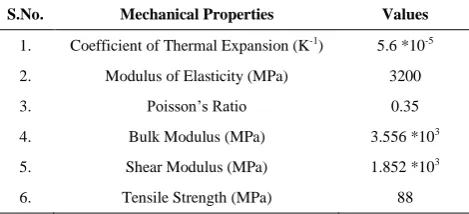
1. Coefficient of Thermal Expansion (K-1) 5.6 *10-5
2. Modulus of Elasticity (MPa) 3200 3. Poisson’s Ratio 0.35 4. Bulk Modulus (MPa) 3.556 *103 5. Shear Modulus (MPa) 1.852 *103
Different cutting techniques like laser cutting, plain water jet cutting and abrasive water jet cutting can be used on the graphite epoxy laminates. Due to heat dissipation laser cutting was not preferred as it causes delamination and various other damages to the material. Plain water jet cutting also results in delamination of the materials but it only occurs at very high speeds. In comparison to laser cutting and plain water jet cutting technique, abrasive water jet cutting is favorable because it provides good surface finish and prevents the occurrence of micro-damages. In this work, abrasive water jet cutting technique was implemented to cut all the specimens into the required dimensions. To eject an extremely high velocity jet through a nozzle orifice, highly pressurized water stream was passed through it at the speed of 900m/s. Natural garnet sand particles were mixed in this thin coherent water stream and projected on the surface of the laminate to perform the cutting operation. All the specimens are of thickness 2 mm, their length is 250 mm and width is 25mm. Aluminum tabs are glued at edges of all the specimens to provide proper grip between specimen and the machine jaws. Geometry of the specimens along with aluminum tabs is shown in Figure 1. The same testing procedure is followed through the test as mentioned in the ASTM D3039.
As geometry of the cut-out has great influence on the maximum load bearing capacity of a material or structure, the two most commonly used shapes i.e. square and circle were inscribed in the composite specimens and tests were performed. The failure location changes with variation in the type and size of cut-outs. The ratio of diameter of the hole to the width of the specimen plays important role towards strength variation. The area of both the cut-outs was kept as 8 mm2.
The specimen property variation is determined by applying tensile load to three categories of specimens i.e. Category 1: Virgin Specimens; Category 2: Centered circular cut-out specimens; Category 3: Centered square cut-out specimens. Each category has 3 specimens and all tests were performed at room temperature. All the specimens are shown in Figures 2-4.
2. 2. Test Procedure and Equipment Used The
test was conducted under quasi-static tensile load for all the specimens.
Figure 1. Geometry of the specimen
Figure2. Category 1 Specimens
Figure 3. Category 2 Specimens
Figure4. Category 3 Specimens
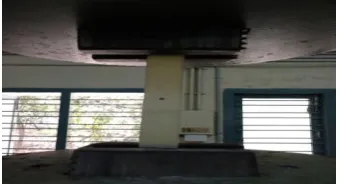
A specimen was placed between the upper and lower jaws of the hydraulic machine and clamped manually to avoid any slippage during the test. The machine and the specimen setup are shown in Figure 5.
The gauge length was maintained at 150 mm and the load was applied to pull the specimen in y- direction. The load was varied in steps from zero to the point of fracture of the specimen and the corresponding stress-strain curve was obtained from the computer connected with the hydraulic machine. The same procedure was followed to test specimens of all the categories.
3. RESULTS AND DISCUSSIONS
This section presents the results obtained from the experimental investigation of both intact and notched fiber glass/epoxy laminates under tensile load.
A total number of nine specimens was tested, which includes three specimens from each category. i.e. 3 virgin specimens, 3 specimens with circular cut-out and 3 specimens with square cut-out.
The results are presentd in Figures 6-8. Figure 6 shows the stress vs. strain curve for Category 1 specimens (C11, C12, and C13). Figures 7 and 8 signify the variation in stress and strain of fiber/glass epoxy laminates in the presence of cut-outs. These figures show stress-strain curve for Category 2 specimens (C21, C22, and C23) and Category 3 specimens (C31, C32, and C33).
For all specimens, stress-strain curves show nonlinearity in the beginning due to fluctuations of loads, and as the machine gets stable, a linear phase is observed until the damage has initiated which is followed by rapid growth and fracture. The properties of all specimens are presented in Table 3.
From the plots and the table it is evident that the Category 1 specimens have the highest strength in comparison with the Category 2 and 3 specimens. So, any kind of cut-out results in the reduction of the strength. Introduction of circular out and square cut-out resulted in approximately 20-25% and 30-35% strength reduction, respectively. Strength is more in specimens having circular cut-outs as compared to specimens with square cut-outs. Strain is greatest in Category 1 specimens followed by category 2 and 3 specimens.
Figure 6. Stress-Strain curve for Category 1 Specimens
Figure 7. Stress-Strain curve for Category 2 specimens
Figure 8. Stress-Strain curve for Category 3 specimens
TABLE 3. Properties of all the Specimens
S
p
ec
ime
n
D
ime
n
si
o
n
(l
en
g
th
*
w
id
t
h
)
(mm
2)
U
lt
im
a
te
S
tr
en
g
th
(k
N
/mm
2)
S
tr
a
in
%
A
v
er
a
g
e
U
lt
im
a
te
S
tr
en
g
th
(k
N
/mm
2)
A
v
er
a
g
e
S
tr
a
in
%
C11 250.15*25 0.395 8.4
0.394 8.5 C12 250*25.1 0.407 7.9
C13 250.1*249 0.380 9.2 C21 249.8*252 0.310 7.2
0.303 7.9 C22 250.3*249 0.300 7.8
C23 250.16*25 0.300 8.8 C31 250.2*248 0.285 5.7
0.281 5.9 C32 250*25.2 0.281 6.1
C33 249.9*251 0.277 6
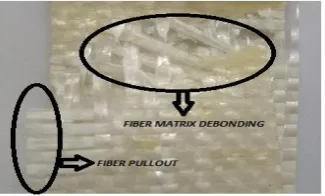
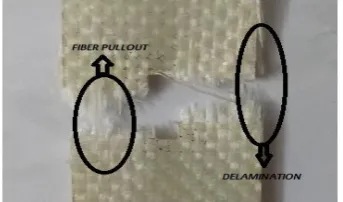
Failure modes of all configurations are shown in Figures 9-11.
The virgin specimens failed in the region towards the top edge (edge near to application of load) due to greater stress at that particular region. The specimens failed in brittle fashion with fiber pullout and fiber-matrix de-bonding along the fibers.
All notched specimens showed multiple failures at various locations. The entire set of notched specimens showed de-lamination and fiber pullout. In case of circular specimen, the failure occurred in a direction normal to the direction of load.
Figure 9. Virgin specimen after failure
0 0.1 0.2 0.3 0.4 0.5
0 2 4 6 8 10
C11 C12 C13
Str
e
ss(
kN
/mm
2
)
Strain(%)
0 0.1 0.2 0.3 0.4
0 2 4 6 8 10
C21 C22 C23
Str
e
ss(
kN
/mm
2)
Strain (%)
0 0.1 0.2 0.3
0 2 4 6 8
C31 C32 C33
Str
e
ss(
kN
/mm
2
Figure 10. Specimen with circular notch after failure
Figure11. Specimen with square notch after failure
In specimens having square notch, the failure started near top right corner and propagated towards the center.
4. CONCLUSIONS
This work provided the essential information to design any component with and without cut-out. It is evident from this paper that the presence of cut-out results in the reduction of resistance to the applied tensile load. Both strength and strain decreases in the order: Category 1, Category 2 and Category 3. Square cut-outs results in greater reduction of the load bearing capacity of fiber glass/epoxy laminates as compared to circular cut-outs, so circular cut-outs are more preferred where usage of cut-out in the structure is inevitable.
5. REFERENCES
1. Watsar, S.D. and Bharule, A., "Stress analysis of finite plate with special shaped cutout", International Journal of Scientific
Engineering and Research, Vol. 3, No. 4, (2015), 145-150.
2. Woo, J.-H. and Na, W.-B., "Effect of cutout orientation on stress concentration of perforated plates with various cutouts and bluntness", International Journal of Ocean System
Engineering, Vol. 1, No. 2, (2011), 95-101.
3. Rezaeepazhand, J. and Jafari, M., "Stress analysis of perforated composite plates", Composite Structures, Vol. 71, No. 3, (2005), 463-468.
4. Martin, E., Leguillon, D. and Carrère, N., "A coupled strength and toughness criterion for the prediction of the open hole tensile strength of a composite plate", International journal of
Solids and Structures, Vol. 49, No. 26, (2012), 3915-3922.
5. Yang, Z., Kim, C.-B., Cho, C. and Beom, H.G., "The concentration of stress and strain in finite thickness elastic plate containing a circular hole", International journal of Solids and
Structures, Vol. 45, No. 3, (2008), 713-731.
6. Talib, A.A., Ramadhan, A., Rafie, A.M. and Zahari, R., "Influence of cut-out hole on multi-layer kevlar-29/epoxy composite laminated plates", Materials & Design, Vol. 43, (2013), 89-98.
7. Aljibori, H.S.S., Chong, W., Mahlia, T., Chong, W., Edi, P., Al-Qrimli, H., Anjum, I. and Zahari, R., "Load–displacement behavior of glass fiber/epoxy composite plates with circular cut-outs subjected to compressive load", Materials & Design, Vol. 31, No. 1, (2010), 466-474.
8. Riyah, N. and Ahmed, N., "Stress analysis of composite plates with different types of cutouts", Anbar Journal of Engineering
Sciences, Vol. 2, No. 1, (2009), 11-29.
9. Mohan, K.M., Rajesh, S., Yogesh, H. and Yeshaswini, B., "Study on the effect of stress concentration on cutout orientation of plates with various cutouts and bluntness", International
Journal of Modern Engineering Research, Vol. 3, No. 3,
(2013), 1295-1303.
10. Kuraishi, A., Tsai, S.W. and Wang, J., "Material characterization of glass, carbon, and hybrid-fiber scrimp panels", Report
SAND2002-3538, Stanford University, Department of
Aeronautics and Astronautics, (2002), 28-35.
11. Azmir, M. and Ahsan, A., "Investigation on glass/epoxy composite surfaces machined by abrasive water jet machining",
Journal of Materials Processing Technology, Vol. 198, No. 1,
Influence of Circular and Square Cut-outs on Fiber Glass/Epoxy Composite Laminate
under Tensile Loading
K. Priya Jhanji, R. Amit Kumar, PVN Likhith
School of Aeronautical Sciences, Hindustan Institute of Technology and Science, Chennai, India
P A P E R I N F O
Paper history:
Received 30 May 2017
Received in revised form 26 November 2017 Accepted 30 November 2017
Keywords: Composites Cut-outs Stress Concentration Mechanical Properties Tensile Strength ديكچ ه هدافتسا زا زوپماک ی ت اه ارب ی ط ی ف سو ی ع ی زا اهدربراک ی هزاس ا ی رد پاوه ی ،ام فس ی هن اه ی اضف یی ، وردوخ و غ ی هر رد دنچ لاس خا ی ر هب روط هدرتسگ ا ی شرتسگ ی هتفا تسا . هب غ ی ر زا شهاک ،نزو تاعطق رب ی هد هدش شور اه یی ار ارب ی لاصتا تاعطق فلتخم پاوه ی ام مهارف م ی دننک . رد ا ی ن ،هلاقم ی ک هعلاطم ی برجت ی ارب ی سررب ی ثأت ی ر لکش شرب رب ور ی تمواقم ششک ی قرو زوپماک ی ت ش ی هش لا ی فا / سکوپا ی ماجنا هدش تسا . هسدنه ی شرب زا لماوع مهم ی تسا هک م ی دناوت صاوخ ناکم ی ک ی ار هب روط مشچ گ ی ر ی غت یی ر دهد . اربانب ی ،ن تاعطق رب ی هد هدش زا هحفص ی زوپماک یت ی ف ی رب ش ی هش / سکوپا ی اب لاکشا سدنه ی فلتخم دننام عبرم و اد ی هر باختنا و امزآ ی ش اه ی ششک ی تحت ارش ی ط حم ی ط ی ماجنا تفرگ . زا ا ی ن نومزآ اه صخشم دش هک هنومزآ اه ی اب شرب اد ی هر ا ی اراد ی ماکحتسا ششک ی رتلااب تبسن هب هنومن اه یی اب شرب عبرم دنتسه .