*Corresponding author:Adarsh Kumar ISSN: 0976-3031
Research Article
POWER QUALITY IMPROVEMENT IN PV GRID CONNECTED SYSTEM BY USING
ACTIVE FILTER AND ANFIS BASED MPPT
Adarsh Kumar
1and Qureshi M.F
21
Department of Electrical Engg., Scholar, Dr. C.V. Raman University, Bilaspur, India
2Department of Electrical Engg., Additional Director, DTE Raipur, India
DOI: http://dx.doi.org/10.24327/ijrsr.2018.0910.2788
ARTICLE INFO ABSTRACT
The power quality problems like voltage fluctuation, voltage distortion, and harmonics at the L.T. line are generated by source and load, In this paper present review of Power quality problems and mitigation technique by using active filters. Firstly the design of a shunt Active Power Filter (SAPF) for grid-connected photovoltaic systems is presented.
The main purpose of this paper to design high efficient PV integrated with grid. Efficiency of PV is improved by using MPPT technique. ANFIS based MPPT is the proposed method of this paper. The ANFIS based MPPT scheme works fast and gives improved results under change of solar irradiation. The simulation study is done using MATLAB/SIMULINK software.
The proposed system injects PV power into the grid, by feeding the SAPF; to eliminate harmonics currents and compensate reactive power produced by nonlinear loads. To inject the photovoltaic power to the grid we use a boost converter controlled by a Fuzzy logic (FLC) algorithm for maximum power point tracking (MPPT). The overall system is designed and developed using MATLAB/Simulink software. Simulation results confirm the performance of the grid-connected photovoltaic system based on SAPF. For the MPPT controller, the results show that the proposed FLC algorithm is fast in finding the MPPT than conventional techniques used for MPPT like perturbed and observed. The simulated compensation system shows its effectiveness such as the sinusoidal form of the currents and the reactive power compensation. This technique is compared with the proposed ANFIS based MPPT scheme which is based on fast changing radiation.
The ANFIS is trained to generate maximum power corresponding to the given solar irradiance level and temperature. The response of the ANFIS-based control system is highly precise and offers an extremely fast response. The main objective for a grid-connected Photovoltaic (PV) inverter is to feed the harvested energy from PV panels to the grid with high efficiency and power quality. The simulation results show that the proposed ANFIS MPPT controller is very efficient, very simple and low cost.
INTRODUCTION
It is anticipated that Photovoltaic system will be major source of energy fulfilling global energy needs. The application of PV systems in power systems can be divided into two main fields: off-grid or stand-alone applications and on-grid or grid-connected applications. Stand-alone PV systems can be used to provide power for remote loads that do not have any access to power grids while grid-connected applications are used to provide energy for local loads and for the exchange power with utility grids. Photovoltaic system has been increasingly used in medium sized grid with domestic utilities. PV panels are connected in series and parallel to generate usable amount of voltage and current. By series connection voltage level can be
built up and by parallel connection current density can be increased. In addition to that Converter configuration should be efficient and cost effective. PV systems can enhance the operation of power systems by improving the voltage profile and by reducing the energy losses of distribution feeders, the maintenance costs, and the loading of transformer tap changers during peak hours.
In comparison with other renewable technologies, PV systems still face major difficulties and may pose some adverse effects to the system, such as overloading of the feeders, harmonic pollution, high investment cost, low efficiency, and low reliability, which hinder their widespread use. Moreover, variations in solar irradiation can cause power fluctuation and
International Journal of
Recent Scientific
Research
International Journal of Recent Scientific Research
Vol. 9, Issue, 10(B), pp. 29074-29081, October, 2018
Copyright © Adarsh Kumar and Qureshi M.F, 2018, this is an open-access article distributed under the terms of the Creative Commons Attribution License, which permits unrestricted use, distribution and reproduction in any medium, provided the original work is properly cited.
DOI: 10.24327/IJRSR
CODEN: IJRSFP (USA)
Article History:
Received 12th July, 2018
Received in revised form 23rd
August, 2018
Accepted 7th September, 2018
Published online 28th October, 2018
Key Words:
Photovoltaic, MPPT, ANFIS,
Adarsh Kumar and Qureshi M.F., Power Quality Improvement In Pv Grid
voltage flicker, resulting in undesirable effec
penetrated PV systems in the power system. Some control methods, such as Maximum Power Point Tracking (MPPT) can be used to improve efficiency of PV systems. In such controllers, both the produced voltage and the current of the PV array should be controlled. This may complicate the PV system structure with increased possibility of failure while tracking maximum power in unexpected weather conditions. The PV system-based distributed generations (DGs) may energize the local loads after the system has been disconnected from the utility grid during faulty conditions. In these situations, any unintentional
The nonlinear loads appear to be prime sources of harmonic distortion in a power distribution system. Harmonic currents produced by nonlinear loads are injected back into power distribution systems through the point of common coupling (PCC).These perturbations (harmonics) are the origin of many problems and affect electrical equipment connected to the power supply.
In order to enhance the power quality by considering current distortion limits for non linear loads, many systems have been proposed. This paper presents an analysis and simulation of PV systems, connected in SAPF, for harmonics elimination and reactive power compensation. The SAPF injects
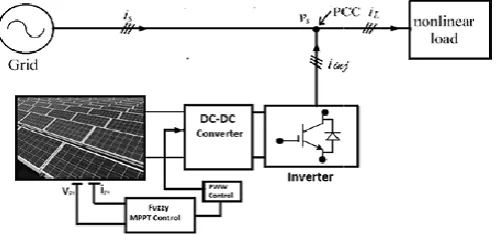
the same amplitude and reverse phase of the load current to compensate for the source current. Figure 1 shows the proposed system; the three phase SAPF system is based on a three inverter. The shunt APF is designed to be connected in with the nonlinear load. It is connected to the distribution network in the PCC. For the Shunt Active Filter reference current computation, we used the P-Q Theory. Also, a DC/DC converter can be used to adjust the value of the output voltage of PV systems. Fuzzy Logic Control (FLC) is used as a robust controller for MPPT.
Fig 1 block diagram of SAPF fed by PV systems
The major challenge lies in using the PV power generation systems is to tackle the non-linear characteristics of PV array. The PV characteristics depend on the level of irradiance and temperature. PV array experiences different irradiance levels due to passing clouds, neighbor buildings or trees. The output Power-Voltage (P-V) and current-voltage (I
of a photovoltaic system is affected by environmental factors such as solar irradiance and temperature levels. Finding the maximum extractable power at the nonlinear output characteristic of the PV system is one of the influential factors affecting the efficiency and overall cost of the control unit in a photovoltaic system. Fuzzy logic based MPPT which does not require the knowledge of the PV panel but yields good results in fast change in radiation. ANN method and Artificial Neuro
Power Quality Improvement In Pv Grid Connected System By Using Active Filter And Anfis Based MPPT
voltage flicker, resulting in undesirable effects on high penetrated PV systems in the power system. Some control methods, such as Maximum Power Point Tracking (MPPT) can be used to improve efficiency of PV systems. In such controllers, both the produced voltage and the current of the PV e controlled. This may complicate the PV system structure with increased possibility of failure while tracking maximum power in unexpected weather conditions. The PV based distributed generations (DGs) may energize the as been disconnected from the utility grid during faulty conditions. In these situations, any
The nonlinear loads appear to be prime sources of harmonic distortion in a power distribution system. Harmonic currents are injected back into power distribution systems through the point of common coupling (PCC).These perturbations (harmonics) are the origin of many problems and affect electrical equipment connected to the
ity by considering current distortion limits for non linear loads, many systems have been proposed. This paper presents an analysis and simulation of PV systems, connected in SAPF, for harmonics elimination and reactive power compensation. The SAPF injects the current in the same amplitude and reverse phase of the load current to compensate for the source current. Figure 1 shows the proposed system; the three phase SAPF system is based on a three-phase inverter. The shunt APF is designed to be connected in parallel with the nonlinear load. It is connected to the distribution network in the PCC. For the Shunt Active Filter reference Q Theory. Also, a DC/DC converter can be used to adjust the value of the output voltage systems. Fuzzy Logic Control (FLC) is used as a robust
block diagram of SAPF fed by PV systems
The major challenge lies in using the PV power generation linear characteristics of PV array. The PV characteristics depend on the level of irradiance and temperature. PV array experiences different irradiance levels sing clouds, neighbor buildings or trees. The output voltage (I-V) characteristic of a photovoltaic system is affected by environmental factors such as solar irradiance and temperature levels. Finding the power at the nonlinear output characteristic of the PV system is one of the influential factors affecting the efficiency and overall cost of the control unit in a photovoltaic system. Fuzzy logic based MPPT which does not panel but yields good results in fast change in radiation. ANN method and Artificial Neuro
Fuzzy interference system (ANFIS) method are suitable for fast changing irradiation and partial shading but can be implement with those system that can get sufficien
paper proposes the ANFIS based MPPT to compute the optimal duty cycle of DC-DC boost converter and compare with IC based techniques.
It is well known that the output power of photovoltaic (PV) panels holds highly non-linear characteristic. For a certain temperature and irradiation, there will be a specific maximum power at certain voltage so
(MPP). The voltage of MPP changes with the irradiation and especially the temperature varying. Thus, the system needs to operate at the MPP of PV array by controlling the inverter, no matter how much irradiation, what temperature or other conditions. Moreover, the generated
system, which is mostly provided to the utility grid, not only should be of sinusoidal current, but also must satisfy the requirements of the power grids, such as no DC component of the inverter output current, minimization of the harmo
result of no harmonic pollutions on the power grids, and so on. These requirements impose the inverter with a high control. The challenge is how to meet the above requirements with minimum cost, which has to be faced for the majority of designers.
To obtain maximum power from photovoltaic array, photovoltaic power system usually requires maximum power point tracking controller (MPPT).The perturb and observe (P&O) method needs to calculate dP/dV to determine the maximum power point (MPP).
implement, it cannot track the MPP when the irradiance changes rapidly and it oscillates around the MPP instead of tracking it. The incremental conductance method can track MPP rapidly but increases the complexity of the a
which employs the calculation of dI/dV. The constant voltage method which uses 76% open circuit voltage as the MPP voltage and the short-circuit current method are simple, but they do not always accurately track MPPs. AI based methods are most suitable for improving the dynamic performance of maximum power point tracking. Considering the non characteristics of solar PV module, the AI methods provide a fast, flexible and computationally demanding solution for the MPPT problem. Fuzzy logic c
networks are two main AI methods used for MPPT. In this paper, designing and implementation of ANFIS based MPPT scheme is presented. ANFIS combines the advantages of neural networks and fuzzy logic and hence deals efficient with non linear behavior of solar PV modules. This paper thus uses ANFIS techniques to determine the maximum power of a PV module for variable solar irradiance and temperature conditions.
Proposed Scheme
Irradiance level and operating temperature a
input for the ANFIS reference model. The ANFIS reference model gives out the crisp value of maximum available power from the PV module at a specific temperature and irradiance level. The actual output power from the PV module, at same temperature and irradiance level, is calculated by using multiplication algorithm on sensed operating voltage and currents. Two powers are compared and the error is given to a
Connected System By Using Active Filter And Anfis Based MPPT
Fuzzy interference system (ANFIS) method are suitable for fast changing irradiation and partial shading but can be implement with those system that can get sufficient training data. This paper proposes the ANFIS based MPPT to compute the optimal DC boost converter and compare with IC
It is well known that the output power of photovoltaic (PV) linear characteristic. For a certain temperature and irradiation, there will be a specific maximum power at certain voltage so-called maximum power point of MPP changes with the irradiation and especially the temperature varying. Thus, the system needs to operate at the MPP of PV array by controlling the inverter, no matter how much irradiation, what temperature or other conditions. Moreover, the generated energy from the PV system, which is mostly provided to the utility grid, not only should be of sinusoidal current, but also must satisfy the requirements of the power grids, such as no DC component of the inverter output current, minimization of the harmonics, as a result of no harmonic pollutions on the power grids, and so on. These requirements impose the inverter with a high-grade control. The challenge is how to meet the above requirements with minimum cost, which has to be faced for the majority of
To obtain maximum power from photovoltaic array, photovoltaic power system usually requires maximum power point tracking controller (MPPT).The perturb and observe (P&O) method needs to calculate dP/dV to determine the maximum power point (MPP). Though it is relatively simple to implement, it cannot track the MPP when the irradiance changes rapidly and it oscillates around the MPP instead of tracking it. The incremental conductance method can track MPP rapidly but increases the complexity of the algorithm, which employs the calculation of dI/dV. The constant voltage method which uses 76% open circuit voltage as the MPP circuit current method are simple, but they do not always accurately track MPPs. AI based methods uitable for improving the dynamic performance of maximum power point tracking. Considering the non-linear characteristics of solar PV module, the AI methods provide a fast, flexible and computationally demanding solution for the MPPT problem. Fuzzy logic controller and artificial neural networks are two main AI methods used for MPPT. In this paper, designing and implementation of ANFIS based MPPT scheme is presented. ANFIS combines the advantages of neural networks and fuzzy logic and hence deals efficiently with non linear behavior of solar PV modules. This paper thus uses ANFIS techniques to determine the maximum power of a PV module for variable solar irradiance and temperature
proportional integral (PI) controller, to generate control signals. The control signal generated by the PI controller is given the pulse to the IGBT for triggering purpose. The generated signals control the duty cycle of quasi-z-source inverter in order to adjust the operating point of the PV module. The objectives to be achieved by the proposed control system are
1. Maximum power point tracking.
2. Desired stable output power to the Grid. The output power of the inverter should be controllable and adjustable on the basis of users’ demand in case of the Grid.
Fig 2 Simulation model of the proposed system
Fig 3 PV array model
The output voltage, magnitude and frequency constant regardless of the change in the input conditions. Solar irradiance and the temperature and other weather data are collected using weather transmitters arrangements. The outputs of the solar irradiance and temperature transducers are current/ voltage signals which are logged in real time using standard data loggers. These data are then being transferred to the PC for further processing or implementation of real
system using the ANFIS controller. Model of a PV array
The nonlinear equations depend on the incident solar irradiation, the cell temperature, and on the reference values. These reference values are generally provided by manufacturers of PV modules for specified operating conditions such as STC for which the irradiance is 1000W/m2 and the cell temperature is 25 ºC. Real operating conditions are always different from the standard and mismatch effects can also affect the real values of these meat parameters.
ANFIS for MPPT tracking
This is training data set for ANFIS reference model. ANFIS is capable of developing the input-output mapping of training proportional integral (PI) controller, to generate control signals. al generated by the PI controller is given the pulse to the IGBT for triggering purpose. The generated signals source inverter in order to adjust the operating point of the PV module. The objectives to
roposed control system are
Desired stable output power to the Grid. The output power of the inverter should be controllable and adjustable on the basis of users’ demand in case of the
proposed system
The output voltage, magnitude and frequency constant regardless of the change in the input conditions. Solar irradiance and the temperature and other weather data are arrangements. The outputs of the solar irradiance and temperature transducers are current/ voltage signals which are logged in real time using standard data loggers. These data are then being transferred to the PC for f real-time control
The nonlinear equations depend on the incident solar irradiation, the cell temperature, and on the reference values. These reference values are generally provided by of PV modules for specified operating conditions such as STC for which the irradiance is 1000W/m2 and the cell temperature is 25 ºC. Real operating conditions are always different from the standard and mismatch effects can
hese meat parameters.
This is training data set for ANFIS reference model. ANFIS is output mapping of training
data sets when it is trained with sufficient number of epochs. By adjusting the values of membership functions ANFIS generates the set of fuzzy rules in order to produce appropriate output for different values of inputs. Parameters of membership functions are adjusted or changed till the error is reduced to minimum value. Matlab/Simulink model of PV module is used to generate the training data set for ANFIS by varying the operating temperature in steps of 5°C from 10°C to 70°C and the solar the solar irradiance varies from 50 to 1000 W/m in a step of 50 W/m.
Fig 4 Control circuit of ANFIS
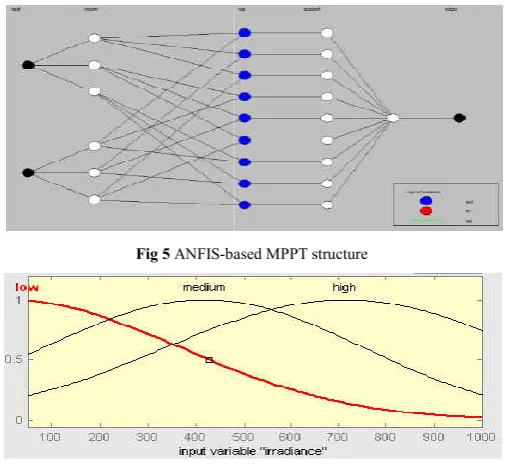
The neuro-fuzzy structure shown in Fig.5 is a five network. The structures shows two inputs of the solar irradiance and the cell temperature, which is translat appropriate membership functions, three functions for the solar irradiance in Fig.6 and three functions for temperature in Fig.7. These membership functions are generated by the ANFIS controller based on the prior knowledge obtained from the training data set. The membership function’s shape varies during the training stage and the final shape obtained after the completion of the training is shown in Figs. 5and 6. They are termed as “low,” “medium,” and high.”
Fig 5 ANFIS-based MPPT structure
Fig 6 Membership function of solar irradiance
data sets when it is trained with sufficient number of epochs. By adjusting the values of membership functions ANFIS generates the set of fuzzy rules in order to produce appropriate output for different values of inputs. Parameters of membership are adjusted or changed till the error is reduced to minimum value. Matlab/Simulink model of PV module is used to generate the training data set for ANFIS by varying the operating temperature in steps of 5°C from 10°C to 70°C and ance varies from 50 to 1000 W/m in a
Control circuit of ANFIS
fuzzy structure shown in Fig.5 is a five-layer network. The structures shows two inputs of the solar irradiance and the cell temperature, which is translated into appropriate membership functions, three functions for the solar irradiance in Fig.6 and three functions for temperature in Fig.7. These membership functions are generated by the ANFIS controller based on the prior knowledge obtained from the ng data set. The membership function’s shape varies during the training stage and the final shape obtained after the completion of the training is shown in Figs. 5and 6. They are termed as “low,” “medium,” and high.”
based MPPT structure
Adarsh Kumar and Qureshi M.F., Power Quality Improvement In Pv Grid
Fig 7 Membership function of PV cell temperature
There are nine rules that can follow in the ANFIS rule editor, shown in Fig.8.
Fig 8 Membership functions created by ANFIS
The rulers shown the temperature and irradiance can be moved to check the rules for other operating conditions.
The functions of the power converter of a PV system consists of Maximum Power Point Tracking (MPPT), DC/AC power converter, grid synchronization, power quality, act
reactive power control – and anti-islanding detection power converter interface of grid-connected PV system. The system has a PV generation set-up, which can be a single module, a string of series connected modules, or an array of parallel connected strings. PV inverters nowadays have high demand, which are manufactured
Fig 9 Three phase grid connected 100KW PV with DC_DC Boost and Inverter
PV Array
Power Quality Improvement In Pv Grid Connected System By Using Active Filter And Anfis Based MPPT
Membership function of PV cell temperature
There are nine rules that can follow in the ANFIS rule editor,
Membership functions created by ANFIS
temperature and irradiance can be moved to check the rules for other operating conditions.
The functions of the power converter of a PV system consists of Maximum Power Point Tracking (MPPT), DC/AC power converter, grid synchronization, power quality, active and islanding detection power connected PV system. The system up, which can be a single module, a string of series connected modules, or an array of parallel d strings. PV inverters nowadays have high demand,
Three phase grid connected 100KW PV with DC_DC Boost and Inverter
Fig 10 General circuit diagram of Photovoltaic cell. Fig.11 V
curve of PV
The PV system in this study is modeled on the basis of a single-diode model. Solar cells have nonlinear voltage
(V-I) characteristics due to the p
shows a typical voltage current characteristic of solar pa Since current of solar panel is approximately constant on the left side of maximum power point (MPP), this region can be defined as current source region. On the other hand, voltage range of solar panel is rather a limited on the right side of MPP and this side can be named as constant voltage source.
SIMULATION AND RESULTS
The MATLAB /SIMULINK model of the MPPT system consists of the 100 KW PV module, IC and ANFIS based MPPT controller, three phase inverter and 25KV grid. PV module is polycrystalline silicon type that produces 305.2 W at 1000 W/ m2 and its parameters are given below. By using this PV module, simulation works were carried out under steady state and dynamic conditions with proposed
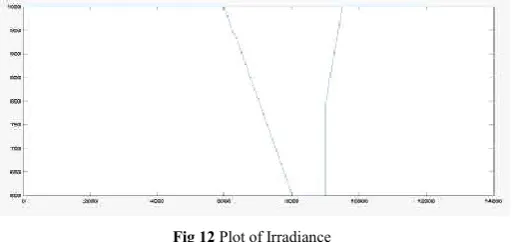
Fig 12 Plot of Irradiance
ANFIS technique and with conventional IC algorithms, respectively, for evaluation and comparison analysis. The input of dc– dc converter was around 271V, the output was 500 V and the duty cycle of PWM was about 50%. The main importance factors used to analyze pe
algorithm are time response, oscillation, overshoot and stability. Fig.12 show a irradiation plot which is constant at 1000w/m2 and changing 1000w/m2 to 600w/m2 at fast rate to show partial shading effect of PV.
Connected System By Using Active Filter And Anfis Based MPPT
General circuit diagram of Photovoltaic cell. Fig.11 V-I characteristics curve of PV
The PV system in this study is modeled on the basis of a diode model. Solar cells have nonlinear voltage-current I) characteristics due to the p-n junction of diode. Fig. 10 shows a typical voltage current characteristic of solar panel. Since current of solar panel is approximately constant on the left side of maximum power point (MPP), this region can be defined as current source region. On the other hand, voltage range of solar panel is rather a limited on the right side of MPP
this side can be named as constant voltage source.
SIMULATION AND RESULTS
The MATLAB /SIMULINK model of the MPPT system consists of the 100 KW PV module, IC and ANFIS based MPPT controller, three phase inverter and 25KV grid. PV polycrystalline silicon type that produces 305.2 W at 1000 W/ m2 and its parameters are given below. By using this PV module, simulation works were carried out under steady state and dynamic conditions with proposed
Plot of Irradiance
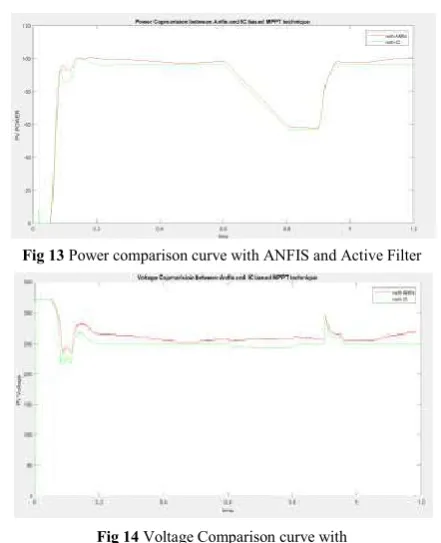
Fig 13 Power comparison curve with ANFIS and Active Filter
Fig 14 Voltage Comparison curve with
ANFIS and IC Steady-state test was done for fast change in irradiances. Fig.13 shows effect of each MPPT algorithm towards the MPP of Power, followed by detailed analysis results as described in Table 1. Fig.14 shows effect of each algorithm towards the voltage, followed by detailed analysis results as described in Table 2. The time response of IC based MPPT algorithm is 0.0. All algorithms could extract MPP of the PV module. The critical situation was when the irradiation was about 250–1000 W/m2. In specific situation, the conventional IC did not work well with low irradiation and caused power losses. From Table 1, it also contributes to the slowest time response, high oscillation and not that stable. By comparing it with ANFIS as shown in Fig. 13 & 14 and listed in Compare Table below, the ANFIS shows that it is much better as compared with IC. The ANFIS also shows a good time response, good efficiency, low oscillation and stable. The efficiency is high, time response is fast, really low oscillation exists and operation is more stable. Despite effect towards MPP, the algorithms should also affect the boost dc–dc converter. The ANFIS performs much better with low overshoot and oscillation. For IC, the time response is about 0.06s before reaching to stable state, overshoot is about 71 V and high oscillation exists. For ANFIS algorithm, the time response is about 0.04 before reaching stable state, overshoot is about 50V and low oscillation is observed. Therefore, from the simulation results, performance of ANFIS algorithm is much better as compared to both conventional MPPT algorithms in terms of time response, overshoot maximum power ratio, oscillation and stability.
System Development
For the synchronization of utility grid and grid connected PV system, some condition has to satisfy like voltage level, frequency and phase sequence matching. This synchronization is done by PV inverter which having advance power electronics technology. The power-voltage relationship or current-voltage relationship of the cell can generally be representing the Electrical characteristics of a PV unit. The changes of solar
irradiance on the cell and the cell temperature are directly varies these characteristics. A proper simulation model is needed to convert the changes of temperature and radiation on generated voltage and current of the PV arrays. So that at the different weather conditions, the dynamic performance of PV system can be analyze.
Fig 15 Grid connected PV system
Fig 16 Equivalent circuit Diagram of PV cell
Solar cell is basically a photovoltaic cell form of p-n junction. It when exposed to sunlight absorbs some energy greater than band-gap. This creates some hole-electron pairs proportional to incident radiations. These carriers are affected by internal electric fields of p-n junction and forms photo current proportional to solar insulation. PV cells have nonlinear characteristics which vary with radiation intensity and temperature. PV cells produces less than 3W at 0.5 to 0.6 Volts, so cells are connected in series to produce enough power. The terminal equation for the current and voltage of the array of PV panels are given as under (fig 16):
IPh= Light Generated Current
V= Terminal Voltage Of The Cell, Id = Diode Current, Io = Saturation Current, IP = Shunt Current, q = Electron Charge, k = Boltzmann Constant, T =Temperature, RD = Series Resistance RP = Shunt Resistance
Adarsh Kumar and Qureshi M.F., Power Quality Improvement In Pv Grid Connected System By Using Active Filter And Anfis Based MPPT
theory with phase. Output of the Inverter is near to Sinusoidal. 6 switches are used and its switching is controlled by discrete PWM signals. Electrical diagram for inverter is shown in Fig.17.
Fig 17 PWM 3 phase inverter with passive filter
Fig 18 Solar cell circuit model (Single-diode).
RESULTS AND DISCUSSION
As shown in Figure 19, for this test, we have varied by steps, both the irradiation S and temperature T at very short times.
Fig 19 Responses of the two MPPT controllers (fuzzy and P&O), irradiation G
and temperature T are variables.
The main aspects referred of the P&O algorithm are, oscillations around the mpp in steady state; low tracking speed; Simulation results confirm that the fuzzy controller operates much better than the P&O controller. Fig.20 shows the source current waveform deformed before filtering. The shunt APF supplied by PV array is injected current (iInj) as shown in Fig.21. The active filter has imposed a sinusoidal source current waveform instantaneously as illustrated in Fig.22. The obtained current and voltage waveforms are in phase as illustrated in Fig.22 (b). Fig.23 shows the spectrum analysis of the source current with/without a PV-SAPF. The current THD (total harmonic distortion) is reduced from 31.34% to 3.27% on the grid network, which confirms the good quality of filtering after using the PV-SAPF, the simulation results show a good filtering of harmonic currents and a perfect compensation of reactive power.
Fig 20 Supply current of phase-a before the insertion of SAPF PV system
Fig 21 Reference current Iref1 of phase-a
Fig.22 Harmonic current of phase-a generated by the SAPF PV system
Fig 23 Supply current of phase-a after the insertion of SAPF PV system.
Fig.24 Power factor of phase-a before the insertion of SAPF PV system.
Fig.25 Power factor of phase-a after the insertion of SAPF PV system
Fig 26 Harmonic spectrum of supply current (a) before, (b) after the insertion
of SAPF PV system.
Active Filters
AF's are also used to improve voltage balance, regulate terminal voltage, eliminate voltage harmonics and suppress voltage flicker in three-phase systems. These issues are achieved by combination or individually. Large numbers of publications are presents work regarding the power quality survey, measurements, analysis, cause, and effects of harmonics and reactive power in the electric networks.
Fig 27 Current-fed-type Active Filter
or VSI bridge structure. The topologies are shunt, series, or a combination of both. Fig. 27 shows the current-fed (PWM) inverter structure. It behaves as a non-sinusoidal current source to meet the harmonic current requirement of the nonlinear load. Fig.28 shows an shunt active filter, it eliminates current harmonics, reactive power compensation and balancing balanced current. For stabilizing and improving the voltage profile, it can be used as a static var generator in the power system network. Fig.29 shows a stand-alone active series filter. It is connected before the load in series with the mains, using a matching transformer. It can reduces negative-sequence voltage and regulate the voltage on three-phase systems, it can eliminate voltage harmonics, and to balance and regulate the terminal voltage of the load or line.
Fig 28 Voltage-fed-type Active Filter.
Fig 29 Series-type Active Filter.
CONCLUSIONS
The paper proposes ANFIS-based PV power generation system operating in Grid integration mode. The interface stage between the generation source and the Grid is accomplished by a active filter. The shoot through duty ratio is controlled using ANFIS to harness the maximum available power from the PV system. The Grid side voltage and frequency is regulated by controlling the modulation index of the interface of the filter. Thus simultaneous control of shoot through duty ratio and the modulation index ensure the control objectives achieved. Simulation and experimental results are provided to verify the proposed control approach. The hybrid system of wind and solar using ANFIS-MPPT operation for the proposed scheme will be reported in the future. Wide range of irradiation level, constant, fast changing has been discussed. The performance analysis of maximum power tracking (MPPT) algorithms on the basis of time taken to track maximum power point (MPP) and various important factors such as efficiency, stability, settling time, overshoot in power and voltages before reaching MPP are done so that accurate results are obtained.
The present article presents an analysis and simulation of a three-phase active filter fed by PV systems. An MPPT fuzzy
logic controller is employed to feed the grid by the maximum allowable PV power. This system is used to eliminate harmonics and to compensate reactive power generated by nonlinear loads. Performances of the active filters are related to the current references quality. This method is very important because it allows harmonic currents and reactive power compensation simultaneously. Simulation results show that the current obtained after filtering and the voltage waveforms are in phase.
These analysis show that the response of the system when we use ANFIS is better than FLC as it is fast and precise in tracking MPP but with more overshooting in voltage and duty cycle during changing irradiation level. Efficiency of ANFIS controller is 100% and while FLC has efficiency of 93%. Also, the current total harmonic distortion (THD) is reduced from 32.14% to 2.54% which confirms the good filtering quality of harmonic currents and the perfect compensation of reactive power which improve the power quality.
References
1. Masoud Farhoodnea, Azah Mohamed, Hussain Shareef, Hadi Zayandehroodi,” power Quality Analysis of Grid-Connected Photovoltaic Systems in Distribution Networks ,” ISSN 0033-2097, R. 89 NR 2A/2013 2. Omran, W.A., M. Kazerani, and M.M.A. Salama.,” A
study of the impacts of power fluctuations generated from large PV systems ,” in IEEE, PES/IAS Conference on Sustainable Alternative Energy (SAE), 1-6, 2009. 3. Seok-Ju, L., P. Hae-Yong, K. Gyeong-Hun, S.
Hyo-Ryong, M.H. Ali, P. Minwon, and Y. In-keun ,” The experimental analysis of the grid-connected PV system applied by POS MPPT ,” In International Conference on Electrical Machines and Systems , 1786-1791,2007. 4. Bin, W., H. Tianxiao, J. Bo, D. Xinzhou, and B.
Zhiqian” Dynamic modeling and transient fault analysis of feeder in distribution system with MW PV substation” in 45th International Universities Power Engineering Conference (UPEC), 2010. 1-5
5. Maximum power point tracking scheme for PV systems operating under partially shaded conditions. Patel, H., V.Agarwal, IEEE Trans. Ind. Electron. 2008, 55, 1689– 1698.
6. M. farhat, L.Sbita, Advanced ANFIS-MPPT Control Algorithm for Sunshine Photovoltaic pumping Systems, The First International Conference on Renewable Energies and VEhicular Technology, Hammamet, pp. 167
7. Maximum Power Point Tracking (MPPT) Scheme for Solar Photovoltaic System, Ahteshamul Haque (2014) Maximum Power Point Tracking (MPPT) Scheme for Solar Photovoltaic System, Energy Technology & Policy, 1:1, 115-122, DOI: 10.1080/23317000. 2014.979379
Adarsh Kumar and Qureshi M.F., Power Quality Improvement In Pv Grid Connected System By Using Active Filter And Anfis Based MPPT
9. R. Belaidi, A. Haddouche, and H. Guendouz, "Fuzzy logic controller based three-phase shunt active power filter for compensating harmonics and reactive power under unbalanced mains voltages," Energy Procedia, vol. 18, pp. 560-570, 2012.
10. K. Srikanth, T. K. Mohan, and P. Vishnuvardhan, "Improvement of power quality for microgrid using fuzzy based UPQC controller," in Electrical, Electronics, Signals, Communication and Optimization (EESCO), 2015 International Conference on, 2015, pp. 1-6.
11. B. Bendib, H. Belmili, and F. Krim, "A survey of the most used MPPT methods: Conventional and advanced algorithms applied for photovoltaic systems," Renewable and Sustainable Energy Reviews, vol. 45, pp. 637-648, 2015.
12. Y. Bouzelata, E. Kurt, N. Altın, and R. Chenni, "Design and simulation of a solar supplied multifunctional active power filter and a comparative study on the current-detection algorithms," Renewable and Sustainable Energy Reviews, vol. 43, pp. 1114-1126, 2015
13. K.H. Chao and C.-J. Li, "An intelligent maximum power point tracking method based on extension theory for PV systems," Expert Systems with Applications, vol. 37, pp. 1050-1055, 2010.
14. B. Subudhi and R. Pradhan, "A comparative study on maximum power point tracking techniques for photovoltaic power systems," Sustainable Energy, IEEE transactions on, vol. 4, pp. 89-98, 2013.
15. M. S. Hamad, A. Fahmy, and M. Abdel-Geliel, "Power quality improvement of a single-phase grid-connected PV system with fuzzy MPPT controller," in Industrial Electronics Society, IECON 2013-39th Annual Conference of the IEEE, 2013, pp. 1839-1844.
How to cite this article:
Adarsh Kumar and Qureshi M.F., 2018, Power Quality Improvement In Pv Grid Connected System By Using Active Filter And Anfis Based MPPT. Int J Recent Sci Res. 9(10), pp.29074-29081. DOI: http://dx.doi.org/10.24327/ijrsr.2018.0910.2788