R E S E A R C H
Open Access
Effects of hysterectomy with simultaneous
bilateral salpingectomy on the subsequent
pelvic mass
Xiaopei Chao
1†, Xiaoxia Wang
2†, Yu Xiao
3, Mingliang Ji
1, Shu Wang
1*, Honghui Shi
1*, Qingbo Fan
1, Lan Zhu
1*,
Jinhua Leng
1, Dawei Sun
1and Jinghe Lang
1Abstract
Objectives:To analyze the clinicopathological characteristics of subsequent pelvic masses after hysterectomy for benign diseases, and to compare the masses following hysterectomy with or without simultaneous bilateral salpingectomy.
Methods: This study retrospectively analyzed patients undergone reoperation for pelvic mass subsequently to previous hysterectomy for benign disease from January 2012 to December 2016 in Peking Union Medical College Hospital.
Results: A total of 247 patients were enrolled in this study, of which 80.16% (n= 198) received simple
hysterectomy, and 5.67% (n= 14) underwent hysterectomy with bilateral salpingectomy. The clinicopathological data of patients undergone simple hysterectomy or simultaneous bilateral salpingectomy was compared. In the former group, we found that 68.18% (n= 135) of the pelvic massed were benign, and the remaining 31.82% (n= 63) were malignant. In latter group, 57.10% (n= 8) were benign (8%) and 42.90% (n= 6) were malignant. Univariate analysis showed that the age of surgery for pelvic masses in patients undergoing hysterectomy with simultaneous bilateral salpingectomy was significantly younger than that in patients without salpingectomy (median, 44.5 vs 50 years,P< 0. 0001), and the time interval between hysterectomy and onset of pelvic masses was also significantly shorter (median, 2 vs 5 years, P< 0.0001). And the probability of pelvic encapsulated effusion was significantly higher for the salpingectomy group. Multivariate analysis showed that there was no significant difference of the age of resection of pelvic mass, the time interval hysterectomy and pelvic mass onset, and the probability of pelvic encapsulated effusion between the two groups.
Conclusions:The results showed that the incidence of secondary benign pelvic masses may be reduced when hysterectomy was performed with simultaneous bilateral salpingectomy. However, there was no statistical difference in the clinical characteristics and pathological types of pelvic masses between patients received hysterectomy with or without salpingectomy.
Keywords:Hysterectomy, Salpingectomy, Pelvic mass, Diagnosis
© The Author(s). 2019Open AccessThis article is distributed under the terms of the Creative Commons Attribution 4.0 International License (http://creativecommons.org/licenses/by/4.0/), which permits unrestricted use, distribution, and reproduction in any medium, provided you give appropriate credit to the original author(s) and the source, provide a link to the Creative Commons license, and indicate if changes were made. The Creative Commons Public Domain Dedication waiver (http://creativecommons.org/publicdomain/zero/1.0/) applies to the data made available in this article, unless otherwise stated.
* Correspondence:[email protected];[email protected]; [email protected]
†Xiaopei Chao and Xiaoxia Wang contributed equally to this work. 1Department of Obstetrics and Gynecology, Peking Union Medical College
Introduction
Hysterectomy is the most common gynecological oper-ation and is widely accepted as the final treatment of many common gynecological diseases. However, the risk of reoperation increased due to complications of hysterec-tomy, such as pelvic adhesion. The recurrence of pelvic mass after hysterectomy is the common reason for reoper-ation [1–3]. It had been reported that simultaneous bilat-eral salpingectomy during hysterectomy may reduce the incidence of ovarian serous carcinoma and some benign pelvic diseases, thus reducing the risk of reoperation after hysterectomy [4–6]. Simultaneous bilateral salpingectomy has been routinely carried out in many medical institu-tions at present. However, few studies have explained whether salpingectomy affects the time of pelvic mass on-set, clinical characteristics and pathological types of pelvic masses after hysterectomy in patients who have been treated again for various pelvic masses.
This study reviewed the medical records of patients re-ceived reoperation for pelvic masses following hysterectomy due to benign diseases, compared the clinical and patho-logical features in patients who underwent hysterectomy with or without bilateral salpingectomy, and analyzed the possible influence of simultaneous salpingectomy on the re-currence of pelvic masses.
Methods and materials
Ethics
This study was approved by the Ethics Committee of Pe-king Union Medical College Hospital (No. S-K331).
Patients
Identify patients who underwent surgery in Peking Union Medical College Hospital for pelvic mass after hysterectomy due to benign disease from January 2012 to December 2016 using ICD-9 disease code.
Inclusion criteria
A history of hysterectomy due to gynecological benign disease was clearly identified, and patients who under-went reoperation for pelvic mass during the required time period were included.
Exclusion criteria
Patients who underwent surgery for pelvic mass but had no history of hysterectomy, had a uterine pathology of malig-nant tumors, or whose surgery of pelvic mass was not per-formed in the specified period were excluded from the study. Medical staff collected the medical records of enrolled patients in detail, including age of hysterectomy and the indications, age of the pelvic mass onset, time interval from the hysterectomy to the onset of pelvic mass, ovi-duct or ovary being resected or remained in previous surgery, main manifestations and imaging features at the
time of pelvic mass onset, and pathological type of the pelvic mass. Patients were divided into two groups ac-cording to hysterectomy with or without bilateral salpin-gectomy, and the clinicopathological characteristics of two groups were compared and analyzed.
Statistics
The statistical analysis was performed using SPSS 23.0 (SPSS Inc., Chicago, IL, USA) in reference to whether the fallopian tubes were resected or not. Receiver Operating Characteristic (ROC) curve was constructed to define the optimal cutoff value for age of hysterectomy (< 45 years vs
≥45 years), age of the operation for pelvic mass (< 52 years vs≥52 years), and time interval from the hysterectomy to the onset of pelvic mass (< 5 years vs ≥5 years) (Table 1, Fig. 1). Continuous variables were summarized with me-dians and interquartile ranges. Two groups were analyzed by independent t test, and multiple groups were analyzed by one-way ANOVA. The categorical variables were sum-marized with rates using Chi-square test or Fisher’s exact test to analyze. Variables withP< 0.05 by univariate ana-lysis were included in multivariate anaana-lysis, and logistic re-gression model was used for fitting with P< 0.05 considered statistical significance. All analysis was two-sided and significance level was set atP< 0.05.
Results
Demographics data of study population
12.5%; in malignant group, ovarian origin 83.3%, and pelvic exogenous derived 16.7%.
Clinical characteristics between two groups
Univariate analysis showed that the age of surgery for pelvic mass in patients undergoing hysterectomy with simultaneous salpingectomy was significantly younger than those without salpingectomy [median(IQR), 44.5 (41.0, 49.0) years vs 50.0 (47.0, 56.0), P< 0.0001]. Grouped by ROC curve, more patients below 52 years old with pelvic mass were found in salpingectomy group (100% vs 57.58%,P= 0.001). The time interval from hys-terectomy to the pelvic mass onset was significantly shorter (median, 2 vs 5 years, P< 0.0001) and more pa-tients had the time interval less than 5 years in salpin-gectomy group. Further statistics were performed separately referring to the time interval from hysterectomy to the onset of benign and malignant pelvic masses. Re-sults revealed that the time interval between benign pelvic masses and hysterectomy was shorter in salpin-gectomy group [median(IQR), 1.5 (0.7,3.0) vs 4.0 (2, 9.25), P< 0.0001]. On the contrary, there was no dif-ference between the two groups in the time interval between hysterectomy and malignant pelvic masses
Table 1Univariate analysis of clinical characteristics of pelvic masses following hysterectomy with or without simultaneous bilateral salpingectomy
Hys N(%) Hys + BS N(%) Pvalue
Total number of cases 198 14
Age at hysterectomy (median[IQR], years)
43 [40,47] 42 [36,44] 0.143
Group of age at hysterectomy
< 45 116 (58.6) 11 (78.6) 0.168
≥45 82 (41.4) 3 (21.4)
Etiology of hysterectomy
Endometriosis/adenomyosis
No 150 (75.8) 4 (28.6) < 0.0001
Yes 48 (24.2) 10 (71.4)
Uterine leiomyoma
No 64 (32.3) 9 (64.3) 0.020
Yes 134 (67.7) 5 (35.7)
Postpartum massive hemorrhage
No 195 (98.5) 14 (100) 1.0
Yes 3 (1.5) 0 (0)
Cervical intraepithelial neoplasia
No 186 (93.9) 14 (100) 1.0
Yes 12 (6.1) 0 (0)
Endometrial intraepithelial neoplasia
No 194 (98.0) 14 (100) 1.0
Yes 4 (2.0) 0 (0)
Manifestation for medical consultation
Physical examination findings
No 96 (48.5) 8 (57.1) 0.531
Yes 102 (51.5) 6 (42.9)
Abdominal distension and anorexia
No 163 (82.3) 13 (92.9) 0.473
Yes 35 (17.7) 1 (7.1)
Abnormal defecation
No 190 (96.0) 13 (92.9) 0.466
Yes 8 (4.0) 1 (7.1)
Abdominal pain
No 151 (76.3) 9 (64.3) 0.339
Yes 47 (23.7) 5 (35.7)
Micturition
No 187 (94.4) 14 (100) 1.0
Yes 11 (5.6) 0 (0)
Lower limb pain
No 196 (99.0) 14 (100) 1.0
Yes 2 (1.0) 0 (0)
Vaginal flow or bleeding
No 194 (98.0) 14 (100) 1.0
Table 1Univariate analysis of clinical characteristics of pelvic masses following hysterectomy with or without simultaneous bilateral salpingectomy(Continued)
Hys N(%) Hys + BS N(%) Pvalue
Yes 4 (2.0) 0 (0)
Total/Subtotal hysterectomy
Total 166 (83.8) 14 (100) 0.135
Subtotal 32 (16.2) 0 (0)
Age of surgery for pelvic mass (median[IQR])
50 [47,56] 44.5[41, 49] < 0.0001
Age group
< 52 114 (57.58) 14 (100) 0.001
≥52 84 (42.42) 0 (0)
The time interval from hysterectomy to the pelvic mass onset (median[IQR])
5 [2,10] 2 [1,4] < 0.0001
Time group
< 5 89 (44.95) 11 (78.6) 0.024
≥5 109 (55.05) 3 (21.4)
The time interval from hysterectomy to the pelvic benign mass onset (median[IQR])
4.0[2, 9.25] (n= 134)
1.5[0.7,3.0] (n = 8)
< 0.0001
The time interval from hysterectomy to the pelvic malignant mass onset (median[IQR])
7 [3,10.75] (n= 64)
4.5 [0.93, 8.25] (n= 6)
0.223
onset. In addition, the cause of hysterectomy being endo-metriosis or adenomyosis was significantly more common in the salpingectomy group (71.4% vs 24.2%, P< 0.0001), while hysterectomy due to leiomyoma was less common (35.7% vs 67.7%,P= 0.020). There were no significant dif-ferences in age of hysterectomy and the main complaints of pelvic mass (Table 1). Multivariate analysis showed that there was no significant difference in the time interval from pelvic mass onset to the hysterectomy between two groups. Thus, in the salpingectomy group, the etiology for hysterec-tomy being endometriosis or adenomyosis may be related to the earlier onset of pelvic masses (Table2).
Pathology characteristics between two groups
The pathology characteristics were compared in patients undergone hysterectomy with and without bilateral
Fig. 1aROC curve of the age of hysterectomy;bROC curve of the age of pelvic masses resected;cROC curve of the time interval from hysterectomy to the pelvic mass onset
Table 2Multivariate analysis of clinical characteristics of pelvic mass after hysterectomy with or without bilateral salpingectomy
Parameter β S.E. Pvalue OR(95%CI)
Intercept −2.404 0.644 <.0001
Endometriosis/ adenomyosis
1.511 0.640 0.018 4.532 (1.293–15.880)
Leiomyoma −0.777 0.651 0.206 0.460 (0.138–1.535)
Age of resection
of pelvic mass −
1.523 0.832 0.067 0.218 (0.043–1.114)
Time interval between hysterectomy and pelvic mass onset
−0.237 0.741 0.750 0.789 (0.185–3.373)
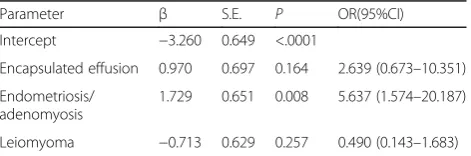
salpingectomy. Univariate analysis showed that the inci-dence of pelvic encapsulated effusion was higher in the salpingectomy group (28.6% vs 7.1%, P= 0.021), while there was no significant difference between the two groups referring to other pathological types (Table 3). However, when the main indications of hysterectomy (endometriosis/adenomyosis and leio-myoma) were included in analysis, multivariate ana-lysis showed that there was no significant difference of the incidence of pelvic encapsulated effusion be-tween the two groups (Table 4). This may be ex-plained by the previous history of endometriosis or adenomyosis in the salpingectomy group.
Discussion
Hysterectomy is one of the most commonly used surgi-cal methods for gynecologisurgi-cal benign diseases. Patients always hope that they will not receive reoperation for gynecological diseases when hysterectomy was per-formed, which is not the case. The occurrence of pelvic masses after hysterectomy is one of the most common causes for reoperation. 39% of women who underwent hysterectomy for benign gynecologic indications re-ceived elective bilateral salpingo-oophorectomy to pre-vent ovarian cancer [7]. Recent studies shown that prophylactic bilateral salpingectomy is helpful not only in preventing high-grade serous type ovarian cancer, but also in decreasing adnexal pathologies [8]. Question was raised subsequently on whether or not the fallopian tubes are resected during hysterectomy relate to the na-ture and origin of the subsequent pelvic masses. How-ever, there is no consensus on whether bilateral fallopian tubes should be resected with hysterectomy for benign diseases in premenopausal women.
Total of 247 patients were enrolled in this study. In simple hysterectomy group, the most common chief complaints for the onset of pelvic mass were found by physical examination, abdominal distension and an-orexia. Most common chief complaints in hysterectomy with salpingectomy group were found by physical exam-ination and abdominal pain. 20.20% benign masses were derived from oviduct, and no malignant masses were de-rived from oviduct for the former group. Neither benign nor malignant masses were derived from oviduct in the latter group.
It has been thought that the fallopian tube has little physiological function after completing fertility, and may have potential of inducing cancer. More and more evi-dences show that ovarian cancer, especially high-grade serous carcinoma, originates from the fallopian tube. Malignant transformation of the fallopian tube can lead not only to fallopian tubal carcinoma, but also lead to the occurrence of ovarian and peritoneal carcinoma [2,
3]. Bilateral salpingectomy can reduce the risk of ovarian
carcinoma for women with BRCA1/2 gene mutations or general population [9–12].
In addition, the retained fallopian tubes have the risk of secondary benign lesions, such as hydrosal-pinx, fallopian tube ovarian abscess, fallopian tube prolapse, mesenchymal cyst of oviduct, etc. [13]. It has been reported that the risk of reoperation due to tubal diseases after hysterectomy without bilateral pingectomy is twice as high as that with bilateral sal-pingectomy. Morse, et al. reported that women who underwent hysterectomy had 8% lifetime risk of reop-eration for hydrosalpinx [14]. Another retrospective study reported that patients without preventive salpin-gectomy had a higher incidence of adnexal benign tu-mors (26.9% vs 13.9%, P= 0.02) [15]. The percentage of simple hysterectomy and hysterectomy with bilat-eral salpingectomy in our study is similar to those of Shiber Linda Dalal, et al. (80.16, and 5.67% respect-ively in the former one; 76, and 4% respectrespect-ively in the latter one,) [16]. Shiber, et al. revealed that 82% of pelvic masses following hysterectomy are benign, and 18% were malignant. 12.4% were derived from fallopian tubes, accounting for 6.7% of benign masses and 12.9% of malignant masses. Therefore, the au-thors suggest that simultaneous salpingectomy with hysterectomy may reduce the incidence of benign tu-mors derived from the fallopian tubes. In this study, 68.2% of the pelvic masses in the simple hysterectomy group were benign and 31.8% were malignant. Tubu-lar masses accounted for 16.2% of the total pelvic masses and 21.5% of the benign masses, and there were no malignant tumors. In the simultaneous salpin-gectomy group, 57.1% of the pelvic masses were benign and 42.9% were malignant with none of the masses de-rived from fallopian tube. Therefore, the results of this study are in accordance to the results of Shiber that hys-terectomy combined with simultaneous bilateral salpin-gectomy may reduce the incidence of fallopian tubes derived pelvic masses, which accounted for 12.4–16.2% of total pelvic masses and 6.7–21.5% of total benign pelvic masses.
Table 3Univariate analysis of pathological characteristics of pelvic mass after hysterectomy with or without simultaneous bilateral salpingectomy
Hys N(%) Hys + BS N(%) Pvalue
Total number of cases 198 14
Malignant
No 135 (68.2) 8 (57.1) 0.391
Yes 63 (31.8) 6 (42.9)
Ovarian serous carcinoma
0 175 (88.4) 11 (78.57) 0.388
1 23 (11.6) 3 (21.43)
Ovarian mucous carcinoma
0 190 (96.0) 14 (100) 1.0
1 8 (4.0) 0 (0)
Ovarian endometrioid carcinoma
0 194 (98.0) 14 (100) 1.0
1 4 (2.0) 0 (0)
Ovarian clear cell carcinoma
0 195 (98.5) 13 (92.9) 0.241
1 3 (1.5) 1 (7.1)
Ovarian sarcoma
0 196 (99.0) 13 (92.9) 0.186
1 2 (1.0) 1 (7.1)
Ovarian undifferentiated carcinoma
0 196 (99.0) 14 (100) 1.0
1 2 (1.0) 0 (0)
Ovarian primary PNET
0 198 (100) 14 (100) 1.0
1 0 (0) 0 (0)
Other uncertain types of ovarian carcinoma
0 192 (96.97) 14 (100) 1.0
1 6 (3.0) 0 (0)
Pelvic extraovarian carcinoma
0 190 (96) 13 (92.9) 0.466
1 8 (4) 1 (7.1)
Peritoneal derived carcinoma
0 195 (98.5) 14 (100) 1.0
1 3 (1.5) 0 (0)
Vaginal stump carcinoma
0 197 (99.5) 14 (100) 1.0
1 1 (0.5) 0 (0)
Carcinoma in other sites
0 195 (98.5) 14 (100) 1.0
1 3 (1.5) 0 (0)
Benign
No 63 (31.8) 6 (42.9) 0.391
Table 3Univariate analysis of pathological characteristics of pelvic mass after hysterectomy with or without simultaneous bilateral salpingectomy(Continued)
Hys N(%) Hys + BS N(%) Pvalue
Yes 135 (68.2) 8 (57.1)
Cervical leiomyoma
0 194 (98.0) 14 (100) 1.0
1 4 (2.0) 0 (0)
Cervical intraepithelial neoplasia
0 197 (99.5) 14 (100) 1.0
1 1 (0.5) 0 (0)
Hydrosalpinx
0 178 (89.9) 14 (100) 0.371
1 20 (10.0) 0 (0)
Mesenchymal cyst of oviduct
0 191 (93.9) 14 (100) 1.0
1 7 (6.1) 0 (0)
Ovarian oviduct abscess
0 196 (99.0) 14 (100) 1.0
1 2 (1.0) 0 (0)
Ovarian endometriosis
0 168 (84.8) 12 (85.7) 1.0
1 30 (15.2) 2 (14.3)
Ovarian physiological cysts
0 178 (89.9) 14 (100) 1.0
1 20 (10.1) 0 (0)
Ovarian serous cystadenoma
0 184 (92.9) 13 (92.8) 1.0
1 14 (7.1) 1 (7.2)
Ovarian mucinous cystadenoma
0 178 (89.9) 14 (100) 0.370
1 20 (10.1) 0 (0)
Ovarian fibroma
0 194 (98.0) 14 (100) 1.0
1 4 (2.0) 0 (0)
Ovarian teratoma
0 195 (98.5) 14 (100) 1.0
1 3 (1.5) 0 (0)
Ovarian epidermoid cyst
0 196 (99.0) 14 (100) 1.0
1 2 (1.0) 0 (0)
Encapsulated effusion
0 184 (92.9) 10 (71.4) 0.021
1 14 (7.1) 4 (28.6)
Intravascular leiomyomatosis
hand, there were fewer cases with salpingectomy in this study, which may affect the statistical results. On the other hand, the objects of this study were the pa-tients who underwent reoperation due to pelvic mass after simple hysterectomy with and without simultan-eous bilateral salpingectomy, and we did not enrolled all patients underwent hysterectomy. Therefore, result of this study cannot concluded that simultaneous sal-pingectomy cannot reduce the incidence of benign and malignant masses, and cannot make difference on the nature of the pelvic masses. The prospective study we are currently conducting may help explaining this issue.
Conclusion
In conclusion, the results of this study showed that 14.65% of the pelvic masses in the hysterectomy group originated from fallopian tubes, accounting for 21.48% of the benign masses, while the pelvic masses in the sal-pingectomy group had no tumors originating from fallo-pian tubes. Therefore, hysterectomy with simultaneous bilateral salpingectomy may reduce the recurrence of pelvic masses, especially benign pelvic masses. However, there were no significant differences in clinical features and pathological types between the two groups.
Abbreviations
IQR:Interquartile range; ROC: Receiver operating characteristic curve
Acknowledgements
We appreciate the gynecologists at Peking Union Medical College Hospital for their diligent clinical work and precise data recording about the cases we reported in this article.
Funding
This study was funded by CAMS Youth Talent Award Project (No. 2018RC320006), CAMS Innovation Fund for Medical Sciences (CIFMS) (No. 2016-I2M-1-002), and Chinese Academy of Medical Sciences Initiative for In-novative Medicine (CAMS-2017-I2M-1-002).
Availability of data and materials
The dataset supporting the conclusions of this article is included within the article and its Additional files.
Authors’contributions
HS, SW, and LZ developed the idea for the project. The study was designed by SW. XC, XW, and MJ executed the study and performed the data analysis and takes full responsibility for the integrity of the data. XC and XW drafted the manuscript with inputs and critical discussion from QF, JL, DS and JL. YX had reviewed the pathological slides. The final version has been approved by all authors.
Ethics approval and consent to participate
This study was approved by the Ethics Committee of Peking Union Medical College Hospital on Aug. 2017 (No. S-K331).
Consent for publication
Not applicable.
Competing interests
The authors declare that they have no competing interests.
Publisher’s Note
Springer Nature remains neutral with regard to jurisdictional claims in published maps and institutional affiliations.
Author details
1Department of Obstetrics and Gynecology, Peking Union Medical College
Hospital, Peking Union Medical College & Chinese Academy of Medical Science, Shuaifuyuan No. 1, Dongcheng District, Beijing 100730, China.
2
Department of Gynecology, Gansu Provincial Maternity and Child-care Hospital, Lanzhou City, Gansu Province, People’s Republic of China.
3Department of Pathology, Peking Union Medical College Hospital, Peking
Union Medical College & Chinese Academy of Medical Science, Beijing 100730, China.
Received: 18 January 2019 Accepted: 19 March 2019
References
1. Brill AI, Nezhat F, Nezhat CH, et al. The incidence of adhesions after prior laparotomy: a laparoscopic appraisal. Obstet Gynecol. 1995;85:269–72. 2. Davey AK, Maher PJ. Surgical adhesions: a timely update, a great challenge
for the future. J Minim Invasive Gynecol. 2007;14:15–22.
3. Diamond MP, Wexner SD, diZereg GS, et al. Adhesion prevention and reduction: current status and future recommendations of a multinational interdisciplinary consensus conference. Surg Innov. 2010;12(3):183–8. 4. Committee on Gynecologic Practice. Committee opinion no. 620:
salpingectomy for ovarian cancer prevention. Obstet Gynecol. 2015; 125(1):279–81.
5. Berlit S, Tuschy B, Kehl S, et al. Laparoscopic supracervical hysterectomy with concomitant bilateral salpingectomy- why not? Anticancer Res. 2013; 33(6):2771–4.
6. Dietl J, Wischhusen J, Hausler SF. The post-reproductive fallopian tube: better removed? Hum Reprod. 2011;26(11):2918–24.
7. Asante A, Whiteman MA, Cox S, et al. Elective oophorectomy in the United States: trends and in-hospital complications, 1998-2006. Obstet Gynecol. 2010;116(5):1088–95.
Table 3Univariate analysis of pathological characteristics of pelvic mass after hysterectomy with or without simultaneous bilateral salpingectomy(Continued)
Hys N(%) Hys + BS N(%) Pvalue
1 2 (1.0) 1 (7.1)
Pelvic leiomyoma
0 196 (99.0) 14 (100) 1.0
1 2 (1.0) 0 (0)
Others benign masses arising from extraovarian sites
0 192 (97.0) 14 (100) 1.0
1 6 (3.0) 0 (0)
Abbreviations:BSbilateral salpingectomy,HysHysterectomy,IQRinterquartile range,PNETprimitive neuroectodermal tumor
Table 4Multivariate analysis of pathological characteristics of pelvic mass after hysterectomy with or without bilateral salpingectomy
Parameter β S.E. P OR(95%CI)
Intercept −3.260 0.649 <.0001
Encapsulated effusion 0.970 0.697 0.164 2.639 (0.673–10.351)
Endometriosis/ adenomyosis
1.729 0.651 0.008 5.637 (1.574–20.187)
Leiomyoma −0.713 0.629 0.257 0.490 (0.143–1.683)
8. Dhakal S, Zheng YX, Yi XF. Current Updates on Salpingectomy for the Prevention of Ovarian Cancer and Its Practice Patterns Worldwide[J]. Chin Med Sci J. 2017;32(3):185–192.
9. Falconer H, Yin L, Gronberg H, et al. Ovarian cancer risk after salpingectomy: a nationwide population-based study[J]. J Natl Cancer Inst. 2015;107(2). 10. Madsen C, Baandrup L, Dehlendorff C, et al. Tubal ligation and salpingectomy
and the risk of epithelial ovarian cancer and borderline ovarian tumors: a nationwide case-control study. Obstet Gynecol Scand. 2015;94(1):86–94. 11. Erickson BK, Conner MG, Landen CN Jr. The role of the fallopian tube in the
origin of ovarian cancer. Am J Obstet Gynecol. 2013;209:409–14. 12. Kindelberger DW, Lee Y, Miron A, et al. Intraepithelial carcinoma of the
fimbria and pelvic serous carcinoma: evidence for a causal relationship. Am J Surg Pathol. 2007;31(2):161–9.
13. Ghezzi F, Cromi A, Siesto G, et al. Infectious morbidity after total laparoscopic hysterectomy: does concomitant salpingectomy make a difference? BJOG Int J Obstet Gynaecol. 2009;116(4):589–93.
14. Morse AN, Schroeder CB, Magrina JF, et al. The risk of hydrosalpinx formation and adnexectomy following tubal ligation and subsequent hysterectomy: a historical cohort study. Am J Obstet Gynecol. 2006;194:1273–6.
15. Vorwergk J, Radosa MP, Nicolaus K, et al. Prophylactic bilateral
salpingectomy (PBS) to reduce ovarian cancer risk incorporated in standard premenopausal hysterectomy: complications and re-operation rate. J Cancer Res Clin Oncol. 2014;140(5):855–65.