Open Access
Correspondence
Country development and manuscript selection bias: a review of
published studies
Reza Yousefi-Nooraie*
1,2, Behnam Shakiba
2and Soroush Mortaz-Hejri
1Address: 1Center of Evidence Based Medicine, Tehran University of Medical Sciences, Shariati hospital, Kargar shomali Ave, Tehran, Iran and 2Students' Scientific Research Center, Third floor, Faculty of medicine, Tehran University of Medical Sciences, Tehran, Iran
Email: Reza Yousefi-Nooraie* - [email protected]; Behnam Shakiba - [email protected]; Soroush Mortaz-Hejri - [email protected]
* Corresponding author
Abstract
Background: Manuscript selection bias is the selective publication of manuscripts based on study characteristics other than quality indicators. One reason may be a perceived editorial bias against the researches from less-developed world. We aimed to compare the methodological quality and statistical appeal of trials from countries with different development status and to determine their association with the journal impact factors and language of publication.
Methods: Selection criteria: Based on the World Bank income criteria countries were divided into four groups. All records of clinical trials conducted in each income group during 1993 and 2003 were included if they contained abstract and study sample size. Data sources: Cochrane Controlled Trials Register was searched and 50 articles selected from each income group using a systematic random sampling method in years 1993 and 2003 separately. Data extraction: Data were extracted by two reviewers on the language of publication, use of randomization, blinding, intention to treat analysis, study sample size and statistical significance. Disagreement was dealt with by consensus. Journal impact factors were obtained from the institute for scientific information.
Results: Four hundred records were explored. Country income had an inverse linear association with the presence of randomization (chi2 for trend = 5.6, p = 0.02) and a direct association with the use of blinding (chi2 for trend = 6.9, p = 0.008); although in low income countries the probability of blinding was increased from 36% in 1993 to 46% in 2003. In 1993 the results of 68% of high income trials and 64.7% of other groups were statistically significant; but in 2003 they were 66% and 82% respectively. Study sample size and income were the only significant predictors of journal impact factor.
Conclusion: The impact of country development on manuscript selection bias is considerable and may be increasing over time. It seems that one reason may be more stringent implementation of the guidelines for improving the reporting quality of trials on developing world researchers. Another reason may be the presumptions of the researchers from developing world about the editorial bias against their nationality.
Published: 01 August 2006
BMC Medical Research Methodology 2006, 6:37 doi:10.1186/1471-2288-6-37
Received: 24 February 2006 Accepted: 01 August 2006
This article is available from: http://www.biomedcentral.com/1471-2288/6/37
© 2006 Yousefi-Nooraie et al; licensee BioMed Central Ltd.
Background
Publication bias is defined as "the tendency to publish research results based on the strength and direction of findings"[1]. It is well documented that studies with non-significant or negative results are substantially less likely to be submitted for publication[2,3]. In addition, the pro-portion of published articles from low income countries is lower than more developed nations in many research fields, including psychiatry[4], cardiovascular disease[5] and epidemiology[6]. A recent survey concluded that researchers from less-developed countries believe that one likely reason is a substantial editorial bias against their work[7]. The tendency of editors to publish research results based on study characteristics other than quality indicators is called generally manuscript selection bias in the current study, which is broader than the publication bias definition. The purpose of present study was to com-pare the methodological quality and statistical appeal of published trials from countries with different develop-mental status and to determine their association with the journal impact factor and language of publication.
Methods
Selection criteria
Based on the World Bank income criteria countries were divided into low, lower-middle, upper-middle and high income groups[8]. All records of clinical trials conducted in each income group during 1993 and 2003 were included if they contained abstract and the number of study participants (study sample size) could be calculated from the abstract content.
Search strategy
Cochrane Central Register of Controlled Trials (2005, issue1) was searched for all trials including the names of countries in each income group in the Institution field of the records. Fifty articles in each income group were selected using a systematic random sampling method in years 1993 and 2003 separately, which comprised of the total of 400 citations. All the citations identified by the above searches were screened and animal studies, non interventional studies or conference abstracts were excluded by consensus; then the sampling was performed once more to replace the excluded citations.
Data extraction
Data were extracted by two reviewers on the language of publication, use of randomization, blinding (masking, placebo or sham), intent(ion) to treat analysis, study sam-ple size and statistical significance. An article was classi-fied as non-English if it was described in the bibliographic details. Quality assessment was restricted to the statement of randomization, blinding and intention to treat analy-sis. The results of a trial was called significant when there was at least a p < 0.05, the 95% confidence interval
excluded no effect, or the statistical significance was stated qualitatively in the results section for any finding of the study. Disagreement was dealt with by discussion. Infor-mation on journal impact factor was obtained from the 1994 and 2003 editions of the Science Citation Index Journal Citation Reports.
Statistical analysis
The Chi square for trend test was applied to the cross-tab of randomization (or blinding, significance) and country income to assess the differences between levels of country income.
Forward stepwise linear regression was performed to model the relation of country income to journal impact factor. We included the following potential confounders as covariates: language of publication, study sample size, randomization, blinding, statistical significance and pub-lication year.
As the journal impact factor was not normally distributed, we performed logarithmic transformation. We dichot-omized the country income (High income = 1, others = 0), publication year (2003 = 1, 1993 = 0), language of publication (English = 1, others = 0), use of randomiza-tion, use of blinding and statistical significance. All analy-ses were undertaken in SPSS version 11.5 (SPSS, Inc., Chicago, IL). A p value of less than 0.01 was considered statistically significant.
Results
Four hundred records were explored. There were 377(94.3%) English language articles. According to the title, abstract or keywords the number of Controlled clin-ical trials which refer to the studies that compare one or more intervention groups to one or more comparison (control) groups was 384(96%). The number of rand-omized controlled trials was 298(74.5%), before and after studies was 14(3.5%) and the frequency of crossed-over studies was 39(9.7%). Double-blind and single-blind methods were mentioned in 141(35.3%) and 39(9.8%) of records respectively. The loss to follow-up percent was stated in 29 abstracts and 5 studies reported an intention-to-treat analysis.
Country income
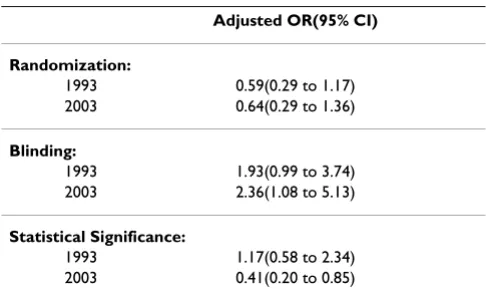
association with the use of blinding (Chi square for trend = 6.9, p = 0.008). As shown in table 2 in 1993 the articles from high income countries had an odds ratio of 1.17 for having statistically significant results compared with the other countries, after adjustment for the language of pub-lication. The odds ratio decreased to 0.41 in the year 2003. There were 2 studies in high-middle income group and 3 in low-middle income group reported an intention to treat analysis.
Journal impact factor
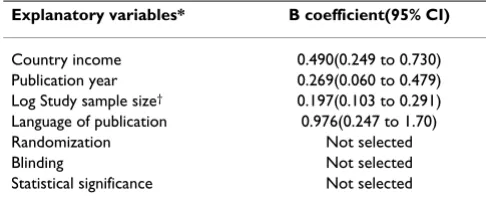
In forward stepwise linear regression model, fitted on the log impact factor the country income, the language of publication, study sample size and the publication year were independent predictors of journal impact factor which remained in the model (table 3). The final model accounted for 14.7% of the variance in journal impact fac-tor and was statistically significant (F = 12.2, p < .0001).
Discussion and conclusion
The frequencies of blinding and statistical appealing indi-cators in the published articles from low income nations have increased more than developed countries during the past ten years and the presence of randomization had a negative association with country development in both occasions. On the one hand, this finding may be due to an enhancement of exclusive and biased use of critical appraisal checklists by the editors of western medical jour-nals. On the other hand, it may refer to the developing world authors, who might be more keen to selectively report the studies that are larger, have less serious limita-tions, and containing positive and significant findings in international english language journals, because of the presumption that editors and reviewers are biased against their nationality[9,10].
The poorer countries are underrepresented both on the editorial boards and in the pages of medical journals, which stated as a systematic bias against the diseases of poverty [11].
Some aspects of this bias is demonstrated in the studies, that the majority of the editorial board members of inter-national medical journals come from nations with a high human development index [12,13] and the studies enroll-ing some participants from the United States are more likely to be published[14]. In our study the effect of coun-try development on the odds of the statistical significance of published studies was considerable after adjustment for the language.
We didn't find a significant relationship between method-ological quality indicators of the research and the impact factor of the medical journal that cited it. Conversely, study sample size and country income were more impor-Table 1: The frequency of randomized studies, use of blinding and statistical significance among different income groups in the years1993 and 2003 (numbers in the parentheses represent the 95% CIs of the absolute change)
Low Lower-middle Upper-middle High
Randomized studies:
1993 38/50(76%) 36/50(72%) 34/50(68%) 31/50(62%)
2003 44/50(88%) 38/50(76%) 39/50(78%) 37/50(74%)
Absolute change (%) 12 (-2 to 27) 4(-13 to 21) 10(-7 to 27) 12(-6 to 30)
Blinded studies:
1993 18/50(36%) 23/50(46%) 25/50(50%) 30/50(60%)
2003 23/50(46%) 16/50(32%) 22/50(44%) 23/50(46%)
Absolute change (%) 10(-9 to 29) -14(-32 to 5) -6(-25 to 14) -14(-33 to 5)
Significant results:
1993 29/50(58%) 30/50(60%) 38/50(76%) 34/50(68%)
2003 40/50(80%) 41/50(82%) 42/50(84%) 33/50(66%)
Absolute change (%) 22(4 to 39) 22(5 to 39) 8(-7 to 24) -2(-20 to 16)
Table 2: The odds ratios of the presence of randomization, blinding and reporting significant results in the articles from high income countries to the reports from the other nations adjusted for the language of publication
Adjusted OR(95% CI)
Randomization:
1993 0.59(0.29 to 1.17)
2003 0.64(0.29 to 1.36)
Blinding:
1993 1.93(0.99 to 3.74)
2003 2.36(1.08 to 5.13)
Statistical Significance:
1993 1.17(0.58 to 2.34)
tant predictors of journal impact factor, despite the gener-ally accepted belief that the journal impact factor could be used as a measure of journal quality[15,16].
Consequently we can interpret the result as an alarm sign that the impact of country development on the manu-script selection bias is increasing by time. Publication bias is a preventable problem[17] and we suggest that "Devel-oping country bias" should be intentionally stated as an independent factor which can contribute to biased inclu-sion of research manuscripts for publication; Publication bias awareness raising programs should be planned for developing world researchers; In addition, current stand-ards for reporting trials should be enforced more equally on the articles from different nations [18].
We used The Cochrane Central Register of Controlled Tri-als (CENTRAL) as the source of studies which serves as the most comprehensive source of records related to control-led trials. As of January 2003, CENTRAL contained just over 350,000 citations to reports of trials and other stud-ies potentially relevant to Cochrane Reviews. CENTRAL includes citations to reports of controlled trials that might not indexed in MEDLINE, EMBASE or other bibliographic databases; citations published in many languages; and other sources that are difficult to access[19].
Present study has several limitations. First, the main prob-lem with our study is the lack of a denominator i.e. the study presents no data on the total number of papers sub-mitted only on those papers published. If only very small numbers of papers are published then this introduces a bias so that it is not possible to make assumptions about the quality of papers as a whole. Second, all assessments are done based on the data provided in title, abstract and keywords and obviously several useful information might be omitted. Abstracts from higher impact journals might contain more information and therefore yield higher quality scores than those from other types of journal. If so, the real differences between low and high income coun-tries may be more than what is reported in our study. Poor
(or even fraudulent) documentation and adoption of CONSORT statement from journals may affect the results. Another important constraint of relying on the abstract is that the failure to report a feature, e.g. blinding in the abstract does not necessarily equate with failure to carry it out. Third, we limit our investigation to clinical trials and may underestimate the real heterogeneity among different income groups. Fourth, data extractors were not blinded to country and journal. We reduced its effects by consider-ing the most objective characteristics of the studies that could be extracted by the abstracts. Fifth, the country income has been presumed as a surrogate for develop-mental status. Finally, all studies included in the present study were cited in Cochrane Central Register of Control-led Trials which serves as the most comprehensive source of records related to controlled trials, but mainly consists of the articles indexed in MEDLINE and EMBASE. There is a proven language bias in these databases[20] and may limit the external validity of our results.
Because of the above mentioned drawbacks we suggest to interpret the results of the present study with more cau-tion.
Competing interests
The author(s) declare that they have no competing inter-ests.
Authors' contributions
Study concept and design: Yousefi-Nooraie. Acquisition of data: Yousefi-Nooraie, Mortaz-Hejri. Analysis and interpre-tation of data: Yousefi Nooraie, Shakiba, Mortaz-Hejri.
Drafting of the manuscript: Shakiba, Yousefi-Nooraie. Criti-cal revision of the manuscript for important intellectual con-tent: Yousefi-Nooraie, Shakiba.
Acknowledgements
We gratefully acknowledge Akbar Soltani, MD, for his valuable comments on the manuscript. There was no external funding for this study. Supports were available from the Students' Scientific Research Center, Tehran Uni-versity of Medical Sciences, Iran.
References
1. Dickersin K, Olson CM, Rennie D, Cook D, Flanagin A, Zhu Q, Reiling J, Pace B: Association between time interval to publication and statistical significance. JAMA 2002, 287:2829-2831. 2. Dickersin K, Chan S, Chalmers TC, Sacks HS, Smith HJ: Publication
bias and clinical trials. Control Clin Trials 1987, 8:343-353. 3. Easterbrook PJ, Berlin JA, Gopalan R, Matthews DR: Publication
bias in clinical research. Lancet 1991, 337:867-872.
4. Patel V, Sumathipala A: International representation in psychi-atric literature: survey of six leading journals. Br J Psychiatry
2001, 178:409.
5. Mendis S, Yach D, Bengoa R, Narvaez D, Zhang X: Research gap in cardiovascular disease in developing countries. Lancet 2003,
361:2246-2247.
6. Yach D, Kenya P: Assessment of epidemiological and HIV/ AIDS publications in Africa. Int J Epidemiol 1992, 21:557-60. 7. Horton R: North and South: bridging the information gap.
Lancet 2000, 355:2231-2236.
Table 3: Linear regression model fitted on log impact factor
Explanatory variables* B coefficient(95% CI)
Country income 0.490(0.249 to 0.730)
Publication year 0.269(0.060 to 0.479)
Log Study sample size† 0.197(0.103 to 0.291)
Language of publication 0.976(0.247 to 1.70)
Randomization Not selected
Blinding Not selected
Statistical significance Not selected
*The randomization, use of blinding and statistical significance were not selected in the final forward stepwise regression model.
Publish with BioMed Central and every scientist can read your work free of charge "BioMed Central will be the most significant development for disseminating the results of biomedical researc h in our lifetime."
Sir Paul Nurse, Cancer Research UK
Your research papers will be:
available free of charge to the entire biomedical community
peer reviewed and published immediately upon acceptance
cited in PubMed and archived on PubMed Central
yours — you keep the copyright
Submit your manuscript here:
http://www.biomedcentral.com/info/publishing_adv.asp
BioMedcentral
8. World Bank Group: Data and Statistics. 2005 [http://www.world bank.org/data/countryclass/classgroups.htm].
9. Egger M, Smith GD: Bias in location and selection of studies.
BMJ 1998, 316:61-66.
10. Thornton A, Lee P: Publication bias in meta-analysis: its causes and consequences. Journal of Clinical Epidemiology 2000,
53:207-216.
11. Horton R: Medical journals: evidence of bias against the dis-eases of poverty. Lancet 2003, 361:713-713.
12. Keiser J, Utzinger J, Tanner M, Singer BH: Representation of authors and editors from countries with different human development indexes in the leading literature on tropical
medicine: survey of current evidence. BMJ 2004,
328:1229-1232.
13. Tutarel O: Composition of the editorial boards of leading medical education journals. BMC Med Res Methodol 2004, 4:3. 14. Olson CM, Rennie D, Cook D, Dickersin K, Flanagin A, Hogan JW,
Zhu Q, Reiling J, Pace B: Publication bias in editorial decision making. JAMA 2002, 287:2825-2828.
15. Garfield E: Journal impact factor: a brief review. CMAJ 1999,
161:979-980.
16. Lee KP, Schotland M, Bacchetti P, Bero LA: Association of journal quality indicators with methodological quality of clinical research articles. JAMA 2002, 287:2805-2808.
17. Shields PG: Publication bias is a scientific problem with adverse ethical outcomes: the case for a section for null results. Cancer Epidemiol Biomarkers Prev 2000, 9:771-772. 18. Mills E, Wu P, Gagnier J, Heels-Ansdell D, Montori VM: An analysis
of general medical and specialist journals that endorse CON-SORT found that reporting was not enforced consistently. j clin epidemiol 2005, 58:662-667.
19. Dickersin K, Manheimer E, Wieland S, Robinson KA, Lefebvre C, McDonald S, the CENTRAL Development Group: Development of the Cochrane Collaboration's CENTRAL Register of Con-trolled Clinical Trials. Evaluation and the Health Professions 2002,
25:38-64.
20. Nieminen P, Isohanni M: Bias against European journals in med-ical publication Databases. Lancet 1999, 353:1592.
Pre-publication history
The pre-publication history for this paper can be accessed here: