Address for correspondence
Review Article
A REVIEW ON ANALYTICAL METHOD FOR DETERMINATION OF
CHANNEL BLOCKER
INTRODUCTION[1]:
Calcium channel blockers (CCBs) are another class of first line antihypertensive in. All 3 subgroups of CCBs dihydropyridine (Ni
phenylak=lkylamine and benzothiazepine equally efficacious antihypertensive. They lower BP by decresing peripheral resistance without compromising c.o. despite vasodilatation, fluid retention is insignificant. The onset of antihypertensive action is quick.
availability of long acting preparations, most agents can be administered once a day. Mono therapy with CCBs is effective in~50% hypertensive, their action is independent of patient’s rennin status, and they may improve arterial compliance. Other advantages of CCBs are:
Zeel T. Doshi,
Jignesh S. Shah
*,
Dilip G. Maheshwari
Department of Quality
Assurance and Pharm
Regulatory Affairs,
L. J Institute of Pharmacy,
Ahmedabad,
Gujarat, 382210, India
Journal of Global Trends in Pharmaceutical Sciences
Calcium channel blockers (CCBs) or Calcium antagonists are among the most widely used drugs in cardiovascular medicine with roles not only in hypertension but also in angina. CCBs promote vasodilator activity by reducing calcium influx into vascular smooth
operated calcium channels in the cell membrane. Interference with intracellular calcium influx is also important in cardiac muscle, cardiac conduction tissue and gastrointestinal smooth muscle. It includes drugs li
Diltiazem, Felodipine, Isradipine, Lacidipine, Lercanidipine, Nicardipine, Nifedipine, Nisoldipine and Verapamil. . This Review
developed for determination of Calcium channel blocker like U.V. Spectrophotometric, HP
Key Words:
Jignesh S. Shah *
Department of Quality Assurance and
Pharm Regulatory Affairs,
L. J Institute of Pharmacy,
Ahmedabad, Gujarat, 382210, India
E-mail: [email protected]
Address for correspondence
A REVIEW ON ANALYTICAL METHOD FOR DETERMINATION OF
CHANNEL BLOCKER IN DIFFERENT DOSAGE FORMS
Calcium channel blockers (CCBs) are another class of first line antihypertensive in. All 3 subgroups of CCBs dihydropyridine (Nifedipine), and benzothiazepine are . They lower BP by decresing peripheral resistance without compromising c.o. despite vasodilatation, fluid The onset of antihypertensive action is quick. With the availability of long acting preparations, most agents can be administered once a day. Mono
with CCBs is effective in~50% hypertensive, their action is independent of tus, and they may improve arterial compliance. Other advantages of CCBs
1. Do not compromise haemodynamic: No impairment of physical work capacity.
2. No sedation or other CNS effect; cerebral perfusion is maintained: compatible with intense mental activity.
3. No contraindicated in asthma, angina (specially variant) and PVD patients: may benefit these conditions.
impair renal perfusion.
4. Do not affect male sexual function. deleterious effect on plasma lipid profile, uric acid level and electrolyte balance.
5. Shown to have no\minimal effect on quality of life. No adverse foetal effects noted: Can be used during pregnancy can weaken uterine contractions during labour).
CCBs promote vasodilator activity by reducing calcium influx into vascular smooth muscle cells by interfering with voltage operated calcium channels in the cell
Journal of Global Trends in Pharmaceutical Sciences
Journal home page: www.jgtps.com
Calcium channel blockers (CCBs) or Calcium antagonists are among the most widely used drugs in cardiovascular medicine with roles not only in hypertension but also in angina. CCBs promote vasodilator activity by reducing calcium influx into vascular smooth muscle cells by interfering with voltage operated calcium channels in the cell membrane. Interference with intracellular calcium influx is also important in cardiac muscle, cardiac conduction tissue and gastrointestinal smooth muscle. It includes drugs li
Diltiazem, Felodipine, Isradipine, Lacidipine, Lercanidipine, Nicardipine, Nifedipine, Nisoldipine and Verapamil. . This Review e
developed for determination of Calcium channel blocker like U.V. Spectrophotometric, HPLC, RP-HPLC, LC-MS/MS.
Key Words: Calcium channel blocker, Hypertension, Spectrophotometric
Department of Quality Assurance and
Pharm Regulatory Affairs,
L. J Institute of Pharmacy,
Ahmedabad, Gujarat, 382210, India
[email protected]
ABSTRACT
- 2230-7346
A REVIEW ON ANALYTICAL METHOD FOR DETERMINATION OF CALCIUM
E FORMS
Do not compromise haemodynamic: No impairment of physical work capacity.
No sedation or other CNS effect; cerebral perfusion is maintained: compatible with
No contraindicated in asthma, angina (specially variant) and PVD patients: these conditions. Do not
Do not affect male sexual function. No deleterious effect on plasma lipid profile,
lyte balance.
minimal effect on No adverse foetal effects noted: Can be used during pregnancy (but can weaken uterine contractions during
CCBs promote vasodilator activity by reducing calcium influx into vascular smooth muscle cells by interfering with voltage-operated calcium channels in the cell
Journal of Global Trends in Pharmaceutical Sciences
Calcium channel blockers (CCBs) or Calcium antagonists are among the most widely used drugs in cardiovascular medicine with roles not only in hypertension but also in angina. CCBs promote vasodilator activity by reducing muscle cells by interfering with voltage-operated calcium channels in the cell membrane. Interference with intracellular calcium influx is also important in cardiac muscle, cardiac conduction tissue and gastrointestinal smooth muscle. It includes drugs like Amlodipine Diltiazem, Felodipine, Isradipine, Lacidipine, Lercanidipine, Nicardipine, enlists different method developed for determination of Calcium channel blocker like U.V.
membrane. Interference with intracellular calcium influx is also important in cardiac muscle, cardiac conduction tissue and gastrointestinal smooth muscle. In cardiac tissues, CCBs have potential for negative inotropic, chronotropic and dromotropic activity while the gastrointestinal effects predispose to constipation. These effects vary with different agents according to ability to penetrate cardiac and other tissues, relative affinity for calcium channels in different tissues and the influence of reflux cardiac stimulation secondary to peripheral vasodilation. There are 3 types of calcium channels.
(a) Voltage sensitive channel: Activated when membrane potential drop to around -40 mV or lower.
(b) Receptor operated channel: Activated by Adr and other agonists-independent of membrane depolarization.
(c) Leak channel: small amounts of Ca2+ leak into the resting cell and are pumped out by Ca2+ ATP ase.
Reported methods are categorized depending on the following considerations:
1. Single component Calcium channel blocker analyzed by UV-Spectroscopy methods and Chromatographic method.
2. Analysis of Calcium channel blocker with combination with other class drugs by UV-Spectroscopy methods and Chromatographic method
Table 1: Analysis of single component of Calcium channel blocker by UV-Spectroscopy methods
Sr. no. Drug Method Description Ref
1 Estimation of Amlodipine besylate in tablets
UV spectroscopic Method Detection wavelength: 366 nm Linearity range:5-25 μg/ml. Co-relation co-efficient: 0.999. LOD: 0.136
LOQ:0.400
2
2 Validation of Cilnidipine UV spectroscopic Method Detection wavelength: 240 nm Linearity range:3-18μg/ml Co-relation co-efficient: 0.9994 % Recovery range:98.0%-102.0%
3
3 Isradipine Loaded into Solid Lipid Nanoparticles
UV Spectroscopic Method Detection wavelength: 327 nm Linearity range:5-30μg/ml Co-relation co-efficient: 0.999 % Recovery range:100.08% LOD:0.1115 μg/ml
LOQ:0.3378 μg/ml
4
4 Nicardipine hydrochloride in bulk and formulation
UV Spectroscopic Method Detection wavelength: 235 nm Linearity range:5-25μg/ml Co-relation co-efficient: 0.999 % Recovery range:98.8-101.5% LOD:0.1032 μg/ml
LOQ: 0.3130 μg/ml
5
5 Nimodipine in Bulk and Tablet Formulation
UV Spectroscopic Method Detection wavelength: 238.5 nm Linearity range:5-30μg/ml Co-relation co-efficient: 0.9981 % Recovery range:100.001% LOD:0.7469 μg/ml
LOQ: 2.26 μg/ml
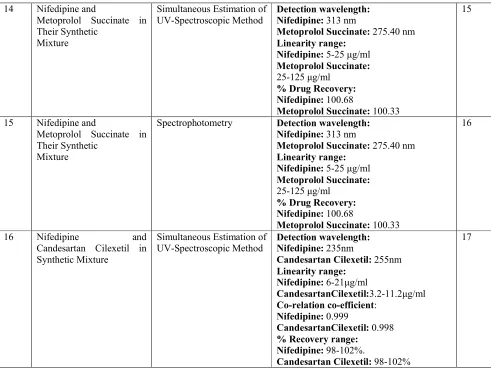
Table 2: Analysis of Calcium channel blocker with combination with other drugs by UV spectroscopy
Sr.no Drug Method Description Ref.
6. Amlodipine and Losartan in bulk drug and tablet dosage formulation
Simultaneous Estimation of UV-Spectroscopic Method
Detection wavelength: Amlodipine besylate: 237 nm Losartan potassium: 202 nm Linearity range:
Amlodipine besylate:1.257.5μg/ml Losartan potassium:12.5-75μg/ml Co-relation co-efficient:
Amlodipine besylate: 0.998 Losartan potassium: 0.999 % Recovery range:97.3-102.3% LOD:
Amlodipine besylate: 0.02μg/ml Losartan potassium: 0.03μg/ml LOQ:
Amlodipine besylate: 0.03μg/ml Losartan potassium: 0.05μg/ml
7
7. Amlodipine Besylate and Bisoprolol Fumarate in Pharmaceutical
Preparations
UV Spectrophotometric Method
Detection wavelength:
Amlodipine besylate: 222 nm Bisoprolol fumarate: 365 nm Linearity range:
Amlodipine besylate:5-100 μg/ml Bisoprolol fumarate: 5-100 μg/ml Co-relation co-efficient: 0.999 % Recovery range:
Amlodipine besylate: 99.33-99.61% Bisoprolol fumarate: 100.28-100.80% LOD:
Amlodipine besylate: 4.31 μg/ml Bisoprolol Fumarate: 13.07 μg/ml LOQ:
Amlodipine besylate: 1.45μg/ml Bisoprolol Fumarate: 4.42μg/ml
8
8 Cilnidipine and
Telmisartan in tablet dosage form
UV Spectrophotometric Method for the Simultaneous Estimation and Absorbance Ratio Method
Simultaneous Equation Method Detection wavelength:
Cilnidipine: 240 nm Telmisartan:297nm Linearity range: Cilnidipine: 4-10μg/ml Telmisartan:6-18μg/ml Co-relation co-efficient: Cilnidipine: 0.9998 Telmisartan:0.9992
Q-Absorbance Ratio Method Detection wavelength: 270 nm Linearity range:
Cilnidipine: 4-10μg/ml Telmisartan:6-18μg/ml Co-relation co-efficient: Cilnidipine: 0.9998 Telmisartan:0.9990
9
9 Estimation of Nebivolol and Cilnidipine in Pharmaceutical
Formulation
First Order Derivative UV Spectrophotometric Method
Detection wavelength: Nebivolol: 221.6 nm Cilnidipine: 249 nm Linearity range:
Nebivolol: 4-20 Cilnidipine: 5-25 Co-relation co-efficient: Nebivolol: 0.999 Cilnidipine: 0.998 10 Atorvastatin Calcium and
Felodipine from Tablet Dosage Form
Dual Wavelength Spectrophotometric Method for Simultaneous Estimation
Detection wavelength: Atorvastatin Calcium: 245 nm Felodipine: 268 nm
Mobile Phase: Acetonitrile: Double Distilled Water (70:30)
Linearity range:
Atorvastatin Calcium: 20-100 μg/ml Felodipine: 2-12 μg/ml
11
11. Metoprolol and Amlodipine in bulk and Their formulation
UV-spectrophotometric method for simultaneous Estimation
Detection wavelength: Metformin: 223 nm Amlodipine: 240 nm Linearity range: Metformin: 10-90 μg/ml Amlodipine: 1-60 μg/ml Co-relation co-efficient: 0.999 % Recovery range:
Metformin: 99.78% Amlodipine: 99.82%
12
12 Atenolol and Lercanidipine
Hydrochloride in combined dosage form
Ratio
Derivative and Dual Wavelength Method
Ratio Derivative (Method A) Detection wavelength: Atenolol: 266.98 nm
Lercanidipine Hydrochloride: 386.97 nm Linearity range:
Atenolol: 25-125 μg/ml
Lercanidipine Hydrochloride: 5-25 μg/ml Co-relation co-efficient:
Atenolol: 0.99985
Lercanidipine Hydrochloride: 0.99971 Dual Wavelength (Method B)
Detection wavelength: Atenolol: 234.01 nm and238.66nm
Lercanidipine Hydrochloride: 253.33 nm and286.07nm
Linearity range: Atenolol: 50-90μg/ml
Lercanidipine Hydrochloride: 10-18 μg/ml
Co-relation co-efficient: Atenolol: 0.99983
Lercanidipine Hydrochloride: 0.99979 13
13 Nifedipine and Atenolol in Combine Dosage Forms
Simultaneous Estimation of
UV-Spectroscopic Method Detection wavelength: Nifedipine: 341.2 nm Atenolol: 273.8 nm Linearity range: Nifedipine: 2-10μg/ml Atenolol: 5-25 μg/ml LOD:
Nifedipine: 0.273 μg/ml Atenolol: 0.159 μg/ml LOQ:
14 Nifedipine and
Metoprolol Succinate in Their Synthetic
Mixture
Simultaneous Estimation of
UV-Spectroscopic Method Detection wavelength: Nifedipine: 313 nm
Metoprolol Succinate: 275.40 nm Linearity range:
Nifedipine: 5-25 μg/ml Metoprolol Succinate: 25-125 μg/ml
% Drug Recovery: Nifedipine: 100.68
Metoprolol Succinate: 100.33
15
15 Nifedipine and
Metoprolol Succinate in Their Synthetic
Mixture
Spectrophotometry Detection wavelength: Nifedipine: 313 nm
Metoprolol Succinate: 275.40 nm Linearity range:
Nifedipine: 5-25 μg/ml Metoprolol Succinate: 25-125 μg/ml
% Drug Recovery: Nifedipine: 100.68
Metoprolol Succinate: 100.33
16
16 Nifedipine and
Candesartan Cilexetil in Synthetic Mixture
Simultaneous Estimation of
UV-Spectroscopic Method Detection wavelength: Nifedipine:235nm Candesartan Cilexetil: 255nm Linearity range:
Nifedipine: 6-21μg/ml
CandesartanCilexetil:3.2-11.2μg/ml Co-relation co-efficient:
Nifedipine: 0.999
CandesartanCilexetil:0.998 % Recovery range:
Nifedipine: 98-102%.
Candesartan Cilexetil: 98-102%
17
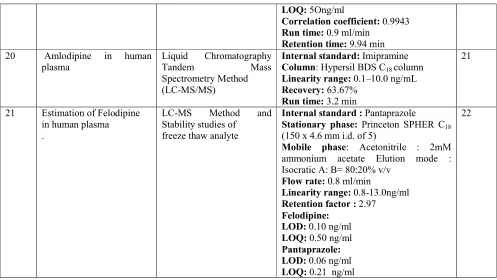
Table 3: Analysis of single component Calcium channel blocker by chromatographic method
Sr.no. Drug Method Description Ref
17 Cilnidipine, a new calcium antagonist, in human plasma
high performance liquid chromatography with tandem mass spectrometric detection
Internal standard:Nimodipine Column: C18 column
Mobile phase: CH3OH : NH4Ac (96:4
v/v).
Linearity range: 0.1–10 ng mL−1 Co-relation co-efficient:0.9994 Run time:3 min
18
18 Felodipine in bulk and pharmaceutical dosage form
RP-HPLC Method Detection wavelength: 238 nm
Stationary phase:C18(150 x 4.6 mm i.d.
of 5) coupled with guard column
Mobile phase: Acetonitrile: Water 70:30 Run time: 10 min
Retention time: 8.29 min % RSD:<2%
19
19 Felodipine In Rat Plasma RP-HPLC Method Detection wavelength: 260 nm
Stationary phase: Spherisorb ODS column(250mm x 4.6mm, 5 μm)
Mobile phase:
Methanol:Water 80:20 %v/v Linearity: 50 ng - 150 ng/ml LOD: 25 ng/ml
LOQ: 5Ong/ml
Correlation coefficient:0.9943 Run time: 0.9 ml/min
Retention time: 9.94 min 20 Amlodipine in human
plasma
Liquid Chromatography
Tandem Mass
Spectrometry Method (LC-MS/MS)
Internal standard:Imipramine Column: Hypersil BDS C18 column
Linearity range: 0.1–10.0 ng/mL Recovery:63.67%
Run time:3.2 min
21
21 Estimation of Felodipine in human plasma .
LC-MS Method and Stability studies of
freeze thaw analyte
Internal standard :Pantaprazole
Stationary phase: Princeton SPHER C18
(150 x 4.6 mm i.d. of 5)
Mobile phase: Acetonitrile : 2mM ammonium acetate Elution mode : Isocratic A: B= 80:20% v/v
Flow rate:0.8 ml/min
Linearity range:0.8-13.0ng/ml Retention factor : 2.97
Felodipine: LOD:0.10 ng/ml LOQ:0.50 ng/ml Pantaprazole: LOD:0.06 ng/ml LOQ:0.21 ng/ml
22
Table 4: Analysis of Calcium channel blocker with combination with other drugs by Chromatographic methods
Sr.no
. Drug Method Description Ref
22 Amlodipine besylate and Olmesartan medoxomil from tablet
RP-HPLC Method Detection Wavelength: 248 nm Mobile phase:
Acetonitrile: water 60:40 Flow rate:
1.0 ml/min Retention time:
3.69 & 4.90 min for Metformin Hydrochloride and Sitagliptin Phosphate respectively.
Linearity range: 5‐35 μg ml‐1 Mean percent recovery:
Olmesartan medoxomil: 99.75 % to 100.62 %
Amlodipine besylate:98.91 % to 102.05 %
23
23 Valsartan and Amlodipine in Capsule Formulation.
Stability Indicating RP-HPLC Method
Detection wavelength: 234 nm
Stationary phase: RP C18 Column
(Kromasil, 250 x 4.6 mm) Mobile phase:Acetonitrile:
Phosphate buffer (0.02M, pH 3.0), (56:44 v/v)
Flow rate: 1.0 ml/min Retention time: Amlodipine:3.07 min Valsartan:6.20 min
24
24 Amlodipine and
Benazepril hydrochloride from
Stability indicating RP-HPLC Method
Detection wavelength: 240 nm
Stationary phase:Zorbax SB C18, 5 μm,
250 mm × 4.6 mm
their combination drug product
Mobile phase: Phosphate buffer: Acetonitrile 65:35 (v/v)
Linearity:
Amlodipine: 6–14 μg/ml
Benazepril hydrochloride: 12–28 μg/ml Mean percent recovery:
Amlodipine: 99.91
Benazepril hydrochloride: 100.53% 25 Chlorthalidone and
Cilnidipine in bulk and combined tablet dosage form
RP-HPLC Method Detection wavelength: 240 nm
Stationary phase: Inertsil ODS 3V (250 × 4.6 mm, i.d., 5 μm)
Mobile Phase: 0.025 M Potassium dihydrogen orthophosphate buffer whose pH was adjusted to 2.5 using dilute orthophosphoric acid (solvent A) and Acetonitrile (solvent B)
Linearity range:
Chlorthalidone:200-600 μg/ml Cilnidipine:160-480 μg/ml Regression coefficient(r2): 0.999
LOD:
Chlorthalidone:0.50 μg/ml Cilnidipine: 0.40 μg/ml LOQ:
Chlorthalidone:1.50μg/ml Cilnidipine: 1.20 μg/ml
Retention time:
Chlorthalidone:3.872 minutes Cilnidipine:7.668 minutes Flow rate:1 ml/min
26
26 Cilnidipine and Olmesartan medoxomil in their combined tablet dosage form
RP-HPLC METHOD Detection wave;ength: 265 nm
Stationary phase: C18 (250 x 4.6mm,5 μm in particle size)
Mobile Phase: Acetonitrile:Buffer (75:25 %v/v) pH 6.5 adjusted by 1 % Triethylamine
Linearity range:
Cilnidipine: 10-90 μg/ml Olmesartan medoxomil: 20-180 μg/ml for
LOD:
Cilnidipine: 0.130
Olmesartan medoxomil: 0.790 LOQ:
Cilnidipine: 0.395
Olmesartan medoxomil: 2.397 Correlation coefficient: Cilnidipine: 0.9982
Olmesartan medoxomil: 0.9951 Retention time:
Cilnidipine: 2.655 min
Olmesartan medoxomil: 4.720 min Flow rate:1 ml/min
27
27 Cilnidipine and Telmisartan in
combined tablet dosage form
RP-HPLC Method Detection wavelength: 245 nm
Stationary phase: HiQ sil C18 HS column (250 × 4.6 mm i.d.)
Potassium dihydrogen ortho phosphate buffer (pH 3) (90:10, v/v))
Linearity range:
Cilnidipine: 1-10 μg mL-1 Telmisartan: 5-30 μg mL-1 LOD:
Cilnidipine: 0.60 μg mL-1 Telmisartan: 0.28 μg mL-1
LOQ:
Cilnidipine: 1.81 μg mL-1 Telmisartan: 0.86 μg mL-1 Correlation coefficient: Cilnidipine: 0.996
Telmisartan: 0.999 % Recovery:
Cilnidipine: 99.60-99.83 Telmisartan: 99.40-100.39 28 Atenolol and Nitrendipine
in Tablet Dosage Form
RP-HPLC Method Detection wavelength: 235 nm
Stationary phase: Phenomenox C-18 column having dimensions of 4.6×250 mm and particle size of 5 μm.
Mobile Phase:
Methanol: Acetonitrile: Water (40:40:20 v/v)
Linearity range: Atenolol: 30-70μg/ml
Nitrendipine: 6-14 μg/ml LOD:
Atenolol: 1.96 μg/ml Nitrendipine:0.34 μg/ml LOQ:
Atenolol: 5.95 μg/ml Nitrendipine: 1.03 μg/ml Retention time:
Atenolol: 2.61 min Nitrendipine: 6.11 min % Recovery:
Atenolol: 99.05-100.51% Nitrendipine: 99.14-101.60% Flow rate: 1.5 ml/min
29
29 Atenolol and
Nifedipine in pharmaceutical dosage forms
RP-HPLC Method Detection wavelength: 235nm Mobile Phase:
Methanol: Acetonitrile: Water (60:20:20)
Stationary Phase: ODS C18 column
Linearity:
Nifedipine : 2-10μg/ml Atenolol:5-25 μg/ml Flow rate: 1.0ml/min
30
30
Nifedipine and dehydro-nifedipine in human plasma
Liquid chromatography tandem mass spectrometry
Mobile Phase:
Methanol : 50 mM ammonium acetate solution (50:50, v/v).
Stationary Phase:RP-18 (4 μm) Linearity range:0.5–100 ng/ml
31 Nifedipine and Atenolol in capsule formulation
RP-HPLC Method Detection wavelength:237 nm
Mobile Phase: 0.01M phosphate buffer solution: Methanol (50:50 v/v, pH 4.0) Stationary Phase: ODS metaphase C18
-250×4.6 mm Retention time: Atenolol : 1.8 min Nifedipine : 7.7 min
37
CONCLUSION:
This Review represents the Reported Spectrophotometric and Chromatographic Methods Developed and Validated for determination of Calcium channel blocker in different Dosage Forms. Here Calcium channel blocker shows the simple, accurate, precise method development of the different drug formulations. The blocker, HPLC, RP-HPLC, and LC-MS/MS.
ACKNOWLEDGEMENT:
The Authors are thankful to Dr. K. Pundarikakshudu, Director of L. J. Institute of Pharmacy, Ahmedabad, India for providing all the facilities and encouragement to carry out the work.
REFERENCES:
1. KD Tripathi., Essential of Medical Pharmacology. 6th Edition., Jaypee Brother Medical Publisher (P) Ltd., 543-544.
2. BH. Rajesh Varma1, Praveen Kumar Jampana, G. Raveendra Babu, P. Sri Lakshmi Surekha, T. Kala Praveen and P. Sambhasiva Rao, “UV Spectroscopic Method for Estimation of Amlodipine Besylate in Tablets” International Journal of Pharmaceutical, Chemical and Biological Sciences. 2014, 4(1), 69-73. 3. Pankaj P. Chaudhari and A. V. Bhalerao,
“Method Validation for Spectrophotometric Estimation of Cilnidipine” International Journal of Pharmacy and Pharmaceutical Sciences. 2012, 4(5), 96-98.
4. Hitesh Katariya and Jagruti Prajapati, “Development and Validation of UV Spectrophotometric Method for Determination of Isradipine Loaded into Solid Lipid Nanoparticles” International Journal of Pharmaceutical Sciences Review and Research. 2013, 20(2), 162-166.
5. Amala Mateti, Kiran Aarelly, Manish Kumar Thimmaraju and N. Raghunandan, “Method Development and Validation of Nicardipine Hydrochloride in bulk and formulation
using UV Spectrophotometric Method” Journal of Chemical and Pharmaceutical Research. 2012, 4(7), 3688-3694.
6. Sandeep Lahot and Sanjay Toshniwal, “Development and Validation of UV Spectrophotometric Method of Nimodipine in Bulk and Tablet Formulation” Asian Journal o f Bio medical and Pharmaceutical Sciences. 2012, 2(7).
7. Ramya Gavini, S. B. Puranik, G. V. S. Kumar*, K. A. Sridhar1 and Ramya Gavini, “Simultaneous estimation of amlodipine and losartan by UV-method in bulk drug and tablet dosage formulation” Scholars Research Library. 2012, 4(5), 2206-2212.
8. RB Kakde, VH Kotak, AG Barsagade, NK Chaudhary and DL Kale, “Spectrophotometric Method for Simultaneous Estimation of Amlodipine Besylate and Bisoprolol Fumarate in Pharmaceutical Preparations” Research J. Pharm. and Tech. 2008, 1(4), 513-515. 9. M.Haripriya, Neethu Antony and P.
Jayasekhar , “Development and Validation of UV Spectrophotometric Method for the Simultaneous Estimation of Cilnidipine and Telmisartan in Tablet Dosage form utilising Simultaneous Equation and Absorbance Ratio Method” International Journal of Pharmacy and Biological Sciences. 2013, 3(1), 343-348. 10. Ms. Krupa Chaitanya Thula,
“Development and Validation of First Order Derivative UV Spectrophotometric Method For Simultaneous Estimation of Nebivolol and Cilnidipine in Pharmaceutical Formulation” International Journal of Pharmaceutical Sciences Review and Research. 2015, 31(1), 243-247.
12. Satyanarayana Rath, Susanta Kumar Panda, Rashmi Ranjan Sarangi, Arun Kumar dash, Sangram Kumar Rath and Srikant Nayak, “UV-Spectrophotometric Method for Simultaneous Estimation of Metoprolol and Amlodipine in Bulk and their Formulation” International Journal of Biological & Pharmaceutical Research. 2011, 2(2), 50-54.
13. Vishnu P. Choudhari, Vishnu M. Suryawanshi, Rashmi H. Mahabal, Sayali G. Deshchougule, Kishor P. Bhalerao and Bhanudas S. Kuchekar, “Simultaneous Spectrophotometric Estimation of Atenolol and Lercanidipine Hydrochloride in Combined Dosage form by Ratio Derivative and Dual Wavelength Method” International Journal of Pharmaceutical Sciences Review and Research. 2010, 3(1), 73-76. 14. Shelke O. S., Sable K. “Development and
Validationof a UV Specrophotometric Method for the Simultaneous Determinaton of Nifedipine and Atenolol in Combine Dosage Form” International Research Journal of Pharmacy. 2012, 3(4), 360-364.
15. Sojitra Rajanit1, “Absorbance Correction Method for Simultaneous Estimation of Nifedipine and Metoprolol Succinate in Their Synthetic Mixture Using From Spectrophotometry” International Journal of Pharma Sciences and Research. 2015, 6(3), 552-557.
16. Pinakin K Patel and Dipti B Patel, “Simultaneous Estimation of Nifedipine and Lidocaine in Cream by First Order Derivative Spectrophotometric Method” Inventi Rapid: Pharm Analysis & Quality Assurance. 2013, 2013(3), 1-5.
17. Priyanka A. Dhobi. and Jignasa Modi, “Development and Validation of UV-Spectrophotometric Method for Simultaneous Estimation of Nifedipine and Candesartan Cilexetil in Synthetic Mixture” Journal of Pharma Research. 2015, 4(3), 112-115.
18. Xianhua Zhanga, Suodi Zhaia, Rongsheng Zhaoa, Jin Ouyangb and Xiaoguang Lia, “Determination of cilnidipine, a new calcium antagonist, in human plasma using high performance liquid chromatography with tandem mass spectrometric detection” Analytica Chimica Acta. 2007,600 (1-2), 142-146. 19. Dhale Chaitali, Joshi Suhas, Shete
Shubhangi, “Development and validation
for the estimation RP-HPLC Method For Analysis Of Felodipine in Bulk And Pharmaceutical dosage form.” Int.Res.J.Pharm. 2014, 5(10), 772-774. 20. Minal Raghunath Narkhede, Bhanudas
Shankar Kuchekar, and Jitendra Yadav Nehete, “Development And Validation Of RP-HPLC Method For Estimation Of Felodipine In Rat Plasma.” Analytical Chemistry : An Indian Journal.8(4), 506-510
21. Jignesh Bhatt, Sadhana Singh, Gunta Subbaiah, Bhavin Shah, Sandeep Kambli and Suresh Ameta, “A rapid and sensitive liquid chromatography–tandem mass spectrometry (LC-MS/MS) method for the estimation of amlodipine in human
plasma” Biomedical
chromatography.2007, 21(2), 169-175. 22. V.Sreedevi, Putta Rajesh Kumar and
Rajesh Thatavarti, “LC-MS Method Development and validation for the estimation of Felodipine in human plasma and Stability studies of freeze thaw analyte.” IJPSR. 2011, 2(2), 65-73 23. Pournima s. patil, “RP-HPLC Method for
Simultaneous Estimation of Amlodipine Besylate and Olmesartan Medoxomil from Tablet” International Journal of Pharmacy and Pharmaceutical Sciences. 2012, 3(3), 146-149.
24. Chitlange SS, Bagri Kiran and Sakarkar DM, “Stability Indicating RP- HPLC Method for Simultaneous Estimation of Valsartan and Amlodipine in Capsule Formulation” Asian Journal of Research in Chemistry. 2008, 1(1), 15-18.
25. K. Raghu Naidu, Udhav N. Kale and Murlidhar S. Shingare, “Stability indicating RP-HPLC Method for Simultaneous Determination of Amlodipine and Benazepril Hydrochloride from their Combination Drug Product” Journal of Pharmaceutical and Biomedical Analysis. 2005, 39(1-2), 147-155.
26. Neelima Kudumula and Y. Rajendra Prasad, “ Development and validation of RP-HPLC Method for the Simultaneous Estimation of Chlorthalidone and Cilnidipine in Bulk and Combined tablet dosage form” Pharmacophore. 2014, 5(4), 442-450.
and Olmesartan Medoxomil in their Combined Tablet Dosage Form” International Journal of Pharmacy and Biological Sciences. 2014, 4(1), 157-160. 28. Prajakta Pawar and Santosh V. Gandhi,
Padmanabh B. Deshpande, Suvarna Vanjari and Swapnil U. Shelar, “Simultaneous RP-HPLC Estimation of Cilnidipine and Telmisartan in Combined Tablet Dosage Form” Der Chemica Sinica. 2013, 4(2), 6-10.
29. M. V. Kumudhavalli, K. Anand Babu and B. Jayakar, “Development and validation of a RP-HPLC Method for Simultaneous Estimation of Atenolol and Nitrendipine in Tablet Dosage Form” Der Pharma Chemica. 2011, 3 (4), 63-68.
30. Vidyadhara, R.L.C.Sasidhar, B. Praveen Kumar, N.T. Ramarao and N. Sriharita, “Method Development and Validation for
Simultaneous Estimation of Atenolol and Nifedipine in Pharmaceutical Dosage Forms by RP-HPLC” Oriental Journal of Chemistry. 2012, 28(4), 1691-1696.
31. B Streela, C Zimmera, R Sibenalera and A Ceccatob, “Simultaneous Determination of Nifedipine and Dehydronifedipine in Human Plasma by Liquid Chromatography–Tandem Mass Spectrometry” Journal of Chromatography B: Biomedical Sciences and Applications. 1998, 720(1–2), 119– 128.
32. Streel B, Zimmer C, Sibenaler R and Ceccato A, “Simultaneous Determination of Nifedipine and DehydroNifedipine in Human Plasma by Liquid Chromatography-Tandem Mass Spectrometry.”J. Chrom. B: BioMed. Sci. App. 1998, 19, 119-128.
All © 2010 are reserved by Journal of Global Trends in Pharmaceutical Sciences.