ISSN: 1942-9703 / © 2017 IIJ Abstract—Primary health care is globally admitted as a
proper approach to improve health for everyone, but primary health care in Indonesia is currently curatively oriented and it costs too much money for medication. Primary health care in Indonesia is also suboptimal because there is a lack of organization model with specific management characteristics such as integrative, strategic, effective, efficient, distributive and affordable in number of regions. Primary Health Care in Indonesia involves primary health care for personal (UKP), primary health care for community (UKM), and primary health care for worker (K3) but the integrated health care that covers up UKP, UKM and K3, do not yet exist. Business architecture modeling for primary health care to support the integration of primary health care with disease prevention orientation, therefore, is needed. However, business architecture modeling for primary health care in Indonesia is very difficult. Business processes of primary health care in Indonesia are very complex and less integrative. Therefore, new methodology is needed to facilitate business architecture modeling. The proposed business architecture modeling methodology was validated by applying it to modeling business architecture of Primary Health Care in Indonesia. Result from this implementation shows that the proposed methodology can clearly guide modeling business architecture of Primary Health Care in Indonesia and the business architecture model of primary health care in Indonesia can be used and developed on the demand of Indonesian people.
Index Terms — Enterprise Architecture, Business Architecture, Primary Health Care, Indonesia.
I. INTRODUCTION
ational Health System is a method of health care delivered by central government, local government, private and Indonesian people to improve health development and health rate. National Health System has been arranged over the frame of innovation, reference
Manuscript received October17, 2016. This work was supported in part by the Faculty of Computer Science, Brawijaya University.
Nugraha, Dwi Cahya A., was with Faculty of Computer Science, Brawijaya University, Indonesia. (E-mail: [email protected]).
Aknuranda, Ismiarta, was with Faculty of Computer Science, Brawijaya University, Indonesia. (E-mail: [email protected]).
Andarini, Sri, was with Faculty of Medicine, Brawijaya University, Indonesia. (E-mail: [email protected]).
Roebijoso, Jack was with Faculty of Medicine, Brawijaya University, Indonesia. (E-mail: [email protected]).
system, and revitalization of primary health care. Primary health care is where individual or community has their first contact with health care [1], [2]. Primary health care underlines medication and recovery but without disregarding prevention measures, such as fitness care and healthy lifestyle [1]. In the concept of primary health care, community health is an effective medium to achieve socio-economic development [2].
Primary health care is globally admitted as a proper approach to produce health for everyone [1]. However, primary health care in Indonesia remains suboptimal. Health cost increases every year. National expense at health sector in 2005 is 0.81% of Gross Domestic Product (GDP), and it increases in 2007 to 1.09% of GDP. In 2004, health budget is 5.54 trillion IDR, and this number ascends to 18.75 trillion IDR in 2006. Indonesian Government’s expense at health sector has increased continuously but the contribution of government to health finance is very small, for around 38% of health finance total. The proportion of health finance derived from government does not count health prevention and health promotion [1].
National Social and Healthcare Security (Badan Penyelenggara Jaminan Sosial) abbreviated as BPJS has a report that shows claim for BPJS-Health remains high which counts for 42.6 trillion IDR while the total premium charge is 41.06 trillion IDR in 2014-2015 [3]. Primary health care in Indonesia is currently curatively oriented, and it costs too much money for medication. It also represents how suboptimal is primary health care in Indonesia, because there is a lack of organization model with specific management characteristics such as integrative, strategic, effective, efficient, distributive and affordable in number of regions. Primary Health Care in Indonesia involves primary health care for personal (UKP), primary health care for community (UKM), and primary health care for worker (K3) but the integrated health care that covers up UKP, UKM and K3, do not yet exist. Business architecture modeling for primary health care to support the integration of primary health care with disease prevention orientation, therefore, is needed. This model provides the detailed business architecture and facilitates the revolution and application of centralized technology system which may be useful to apply for reducing medication cost. Based on effective and efficient service performance, a good public management sector is required by good governance [21]. However, business architecture modeling for primary health
A Business Architecture Modeling Methodology
to Support the Integration of Primary Health
Care: Implementation of Primary Health Care in
Indonesia
Dwi Cahya Astriya Nugraha, Ismiarta Aknuranda, Sri Andarini, and Jack Roebijoso
care in Indonesia is very difficult. Business processes of primary health care in Indonesia are very complex and less integrative. Therefore, new methodology is needed to facilitate business architecture modeling.
Business Architecture is made of business strategy, performance matrix, business process and their relation [4]. Business architecture is only a part of enterprise architecture. Enterprise architecture is a group of models used to provide clear description understandable by the enterprise. Model defines different viewpoint of different enterprise, and it focuses on some aspects to reduce complexity. Enterprise model may contain activities, processes, organizations, information and behavior diagrams [5]. Enterprise architecture is also a structure that produces a coherent and consistent business system where various strategic elements of business process are connected properly, where business’ mission and goal are compatible to IT’s mission and goal, and where decision on important topic can be wisely made, especially on the topics about the integration with internal and external information systems and the optimization of business process [6]-[9]. Detailed and accurate information will influence decision-makers in making decisions [22]. Institution will be stronger and are able to build network among them if they have their own ability to manage information [23]. To develop enterprise architecture, specific mindset is needed, and it is called as architecture (EA) framework. Indeed, EA framework is a tool to develop extensive coverage of different architectures [10]. There are several kinds of EA frameworks or methods that can be used to engineer enterprise architecture, such as Zachman Framework [11], Federal Enterprise Architecture Framework (FEAF) [12], DoD Architecture Framework (DoDAF) [13], Treasury Enterprise Architecture Framework (TEAF) [14], and The Open Group Architectural Framework (TOGAF) [15]. The purpose of each framework is to obtain good enterprise architecture that matches with the organization’s demand and thus that can be used by the organization to achieve strategic goal. Result of each EA framework is a model/blueprint that provides integrated information system to fulfill organization demand [10].
TOGAF is a standard framework that has been developed since 1990s. It covers various aspects of enterprise architecture, including Architecture Development Method (ADM) for manual, reference model, and meta-model [9]. TOGAF is used in various fields such as bank, manufacture industry and education. Concerning with the development of enterprise architecture, TOGAF provides methods and tools that may be more detailed at certain higher degree than other EA frameworks. The advantage of TOGAF also includes flexibility and open source [16]. To develop enterprise architecture model, it needs a modeling language. ArchiMate is a modeling standard language for enterprise architecture and it is distinguished for it openness and independency. The specification of Archimate helps many enterprise architects to explain, to analyze and to visualize the relation across business domains in less ambiguous ways [17]. ArchiMate comprises of specific language for enterprise architecture modeling, manual for modeling, visualization, and architecture analysis [7]. Important benefit is that ArchiMate can model general enterprise architecture in all architecture domains. If there is no
language for general enterprise architecture, then an enterprise architect must rely on the existing method and technique from different domain. For instance, BPMN Notation [18] is used for business process domain, and UML Notation [19] is used for information system domain [7]. ArchiMate as a modeling language for enterprise architecture is an important element of EA framework, and has been accepted as the standard by The Open Group [20].
In this research, the author attempts to develop a new methodology that refers to TOGAF ADM in TOGAF 9.1, and also to apply a modeling standard language for enterprise architecture, ArchiMate 3.0, to develop a business architecture model. The author also managed to apply this methodology to the construction of business architecture modeling to describe primary health care in Indonesia. It is expected that the methodology of business architecture modeling can be made compatible with every enterprise in each sector and business architecture model of primary health care in this research can be useful in the context of Indonesia to help optimize the primary health care in order to reduce the health cost.
II. RESEARCH METHODOLOGY
A. Review Stage
For identifying the problem, it is important to model the business architecture of primary health care in Indonesia. The trigger of research is how the business architecture of primary health care can be modeled to support the integrated primary health care. Answering this question, a review against previous studies is conducted to obtain the methodology of business architecture modeling at health sector. Result of this review indicates that there is no specific methodology in making business architecture. Previous studies only focus on the construction of enterprise architecture where inside enterprise architecture, there is business architecture. Based on this idea, some phases are proposed to exist in constructing enterprise architecture and these phases become the part of methodology in making business architecture. The methodology of business architecture modeling is referred to TOGAF ADM in TOGAF 9.1 and the modeling language in Archimate 3.0. TOGAF ADM is selected because the method is detailed and flexible, and it can be adjusted with the change and demand of engineering. Archimate is used because it can define general language in describing the development and operation of business process, organization structure, and information path.
ISSN: 1942-9703 / © 2017 IIJ expectation, the author took action and interacted with the
operation. Therefore, the author performs Action Research (AR) as the approach to the research by applying and evaluation the proposed methodology.
Fig.1. Business Architecture Modeling Methodology
III. THE APPLICATION OF BUSINESS ARCHITECTURE
MODELING METHODOLOGY TO PRIMARY HEALTH CARE IN
INDONESIA
A. Stage 1: Data Collection
Data collection is carried on through field observation at one Community Health Center in Indonesia, also by interviewing relevant stakeholders and compiling supplementary documents.
B. Stage 2: Preliminary
Preliminary stage is a preparation or planning stage for the expected enterprise architecture to keep the process of architecture modeling on the expected direction. In this stage, framework is constructed to illustrate the vision of architecture. This stage also establishes the scope of enterprise architecture and secures the commitment of relevant stakeholders in enterprise architecture. Architectural principles also need to be documented as shown in Figure 2. Having clear architecture principles can help ensure that decisions are taken in accordance with the desired result.
The resultant model is the business architecture modeling of Primary Health Care Integration in Indonesia that involves primary health care for personal (UKP), primary health care for community (UKM), and primary health care for worker (K3). TOGAF is the selected framework because it has TOGAF ADM with several phases that facilitate the construction of enterprise architecture. Because the focus of this paper is given on the construction of business
architecture, then only three phases and one supporting activity in TOGAF ADM are used, respectively Preliminary, Phase A: Architecture Vision and Phase B: Business Architecture, and Requirement Management.
The commitment of stakeholders is relevant with the policies of organizing primary health care oriented toward disease prevention and integrated care. As shown by the result of field observation, interview and supplementary document, there are policies or arrangements for delivering primary health care oriented toward disease prevention. However, the implementation is still suboptimal, and besides, the integrated health care that covers up UKP, UKM and K3, do not yet exist.
Fig.2. Goal and Principle View
C. Stage 3: Architecture Vision
Architecture vision is about defining scope, business goal, business target, organization profile, organization structure, and organization’s vision and mission; identifying stakeholder, boundaries and expectations of architecture; determining vision of architecture; and validating business context in preparing statement of architecture work. In this stage, questions are asked to understand ideal architecture.
The goal that wants to achieve from the business architecture modeling of primary health care in Indonesia is a detailed description about the business architecture modeling of primary health care with orientation toward disease prevention, and it is made by integrating primary health care for personal (UKP), primary health care for community (UKM), and primary health care for worker (K3), and thus, the model shall be understandable, usable and applicable to Indonesian people for improving community health and reducing medication cost. Figure 3 illustrates current state stakeholder view, and Figure 4 illustrates proposed state stakeholder view.
Fig.4. Proposed State of Driver and Stakeholder View
D. Requirements Management
Requirements Management may be helpful in processing the demand for architecture throughout phases. Some elements such as organization core business, organizational issue, business solution concept, and information system solution concept are identified.
The core operation of primary health care is to provide curative care and recovery without disregarding improvement and prevention efforts, such as fitness service and healthy lifestyle. After discerning over the result of field observation, interview and supplementary document, it is found the description of problem, and this problem is that the managerial model for primary health care that is integrative, effective, efficient, distributive and affordable does not yet exist. It increases total health cost because curative care is emphasized more. As a consequence, the imported health material increases. The capacity of advance health facility is not evenly distributed or possibly not feasible enough. Health care efforts in Indonesia are quite contradictive with the higher health cost, the increasing health problem, the low absorption of workers with poor care quality, the suboptimal income of health team, and the less measurable health status of the participant. The integration of efforts in primary health care for personal (UKP), primary health care for community (UKM) and primary health care for worker (K3) is hampered by the distinctive system and practice of the local health, especially in the age of National Health Security. Primary health care is still suboptimal. Pain risk is also great. Health reference to the advance health service and also health cost are also greater. Thus, health cost mismatch may become unfavorable consequence.
Business solution to the problem is that business architecture modeling of primary health care with orientation toward disease prevention by integrating primary health care for personal (UKP), primary health care for community (UKM) and primary health care for worker (K3). The detail business architecture is the product of this integration, and it facilitates the revolution and application of centralized technology system that may be reducing medication cost and improving the health of Indonesian people.
E. Stage 4: Business Architecture
Business Architecture involves some activities such as: identifying baseline architecture (as is), mainly about how is
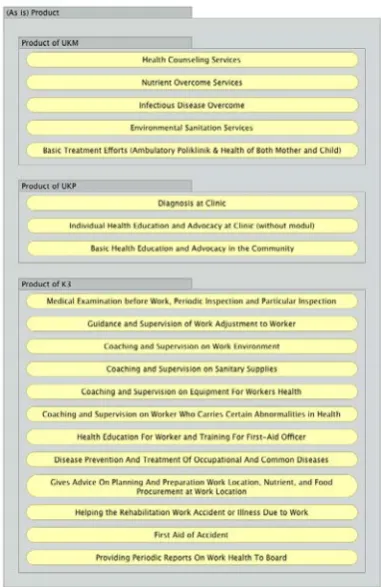
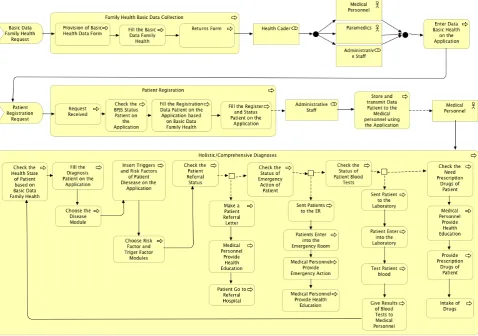
business architecture of the organization recently; determining architecture target (to be), or the expected business architecture; and conducting gap analysis between baseline and target. In this stage, organization structure, product, function and process of the business are identified to plan the target of business architecture. The analysis against the gap between actual business architecture and targeted business architecture is elaborated in Table 1. Organization structure view is shown in Figure 5, some actors are involved in primary health care, such as Government, CHC/Clinic Employee, Medical Personnel, Paramedic, and Community. Each actor can play one role or few roles. Figure 6 illustrates current state of business product view, and Figure 7 illustrates proposed state of business product view. The functions of business in primary health care current state are shown in Figure 8 and the functions of business in primary health care proposed state are shown in Figure 9. The main business functions are basic health data collection, patient registration and diagnosis as shown at Figure 10 as current state and Figure 11 as proposed state.
TABLEI
GAP ANALYSIS BETWEEN ACTUAL BUSINESS ARCHITECTURE AND
TARGETED BUSINESS ARCHITECTURE
Actual Business Architecture (as is) Analysis Targeted Business Architecture (to be) 1 The recording of
Patients’ data during registration excludes complete data of Patients’ family and Patients’
genosociogram.
Inputting the complete data about Patients’ family and Patients’
genosociogram.
The recording of Patients’ data during registration must include complete data of Patients’ family and Patients’ genosociogram. 2 In diagnosing Patients,
Medical Personnel is not analyzing factors triggering Patients’ disease.
• Analyzing the factors triggering Patients’ disease. • Training for
Medical Personnel to analyze the factors triggering Patients’ disease. In diagnosing Patients, Medical Personnel must analyze factors triggering Patients’ disease.
3 In diagnosing Patients, Medical Personnel does not analyze the risk factors of Patients’ disease.
• Analyzing the risk factors of Patients’ disease.
• Training for Medical Personnel to analyze the risk factors of Patients’ disease.
In diagnosing Patients, Medical Personnel must analyze the risk factors of Patients’ disease.
4 Medical Personnel does not optimally give counseling to Patients, Patients’ Family, and Patient’s work environment.
Optimizing the counseling to Patients, Patients’ Family, and Patient’s work environment.
Medical Personnel shall optimally give counseling to Patients, Patients’ Family, and Patient’s work environment. 5 UKP, UKM, and K3
are not yet integrated.
Integrating UKP, UKM, and K3.
UKP, UKM, and K3 shall be integrated.
ISSN: 1942-9703 / © 2017 IIJ Fig. 5. Organization Structure View
Fig. 6. Current State of Business Product View
Fig. 7. Proposed State of Business Product View
Fig. 9. Proposed State of Business Function View
Fig. 10. Current State of Process Business View: Registration and Diagnosis Patient
ISSN: 1942-9703 / © 2017 IIJ IV. CONCLUSION
Although business architecture modeling was an important issue for enterprise, specific methodology for business architecture modeling was still understated. Through a review of literature in this paper, a methodology was then developed and proposed for business architecture modeling. This methodology of business architecture modeling was tested and validated through practical application. The application was conducted by modeling the business architecture of primary health care in Indonesia. Although it still needs further validation, the application showed that methodology clearly guide business architecture modeling to support the integrated primary health care.
This research employed TOGAF 9.1 because it provides relatively detailed guidance for the construction of business architecture. This methodology involves TOGAF ADM and the standard language for enterprise architecture modeling, ArchiMate 3.0. Graphic visualization using the standard language for enterprise architecture modeling, ArchiMate 3.0, has showed business architecture model at high-level visualization. When all selected processes had been modeled, it was seen that the model was definitely able to manage the processes and also the proposed improvement of the process. The resultant model was easily understandable and can also be modified. The understandable model may facilitate the evaluation model utilization.
The result of modeling was the current and proposed model of primary health care in Indonesia that can be used and developed on the demand of Indonesian people. The main implication of this research is that the methodology of business architecture modeling could be adjusted on demand of each enterprise to any sector, and this facilitated the conduct of business architecture modeling.
ACKNOWLEDGMENT
The authors wish to thank the members of the Information System Research Group, Master students of Computer Science, and Faculty of Medicine at Brawijaya University, Indonesia, for supporting this study.
REFERENCES
[1] Department of Health of Indonesia Republic, National Health System
[online]. Department of Health of Indonesia Republic, 2009 [cited 6
April 2016]. Available:
http://pppl.depkes.go.id/_asset/_regulasi/KEPMENKES_374-2009_TTG_SKN-2009.pdf
[2] N. Bondale, S. Kimbahune, A. Pande, “mHEALTH-PHC: An ICT Tool for Primary Healthcare in India,” IEEE Technology And Society Magazine, pp. 31-38, 2013.
[3] M. Sukiwan, The claim is greater than premiums, Health BPJS overdrawn [online], Kontan.co.id, 2016 [cited 6 April 2016]. Available:
http://translate.google.com/translate?hl=en&sl=id&tl=en&u=http%3A %2F%2Fkeuangan.kontan.co.id%2Fnews%2Fklaim-lebih-besar-dari-premi-bpjs-kesehatan-tekor
[4] D. Kang, J. Lee, K. Kim, “Alignment of Business Enterprise Architectures using fact-based ontologies,” Expert Systems with Applications, vol. 37, no. 4, pp. 3274-3283, 2010.
[5] A. Vasconcelos, P. Sousa, J. Tribolet, “Information System Architectures: Representation, Planning and Evaluation,” Systemics, Cybernetics And Informatics. 2003;1(6):78-84.
[6] G. Doucet, J. Gøtze, P. Saha, S. Bernard, “Coherency Management: Architecting the Enterprise for Alignment, Agility and Assurance,”
International Enterprise Architecture Institute. 2009.
[7] M. Lankhorst, “Enterprise Architecture at Work: Modelling Communication and Analysis,” 2nd ed. Berlin: Springer, 2009. [8] J. Ross, P. Weill, D. Robertson, “Enterprise architecture as strategy,”
Boston, Mass: Harvard Business School Press, 2006.
[9] The Open Group, “TOGAF Version 9,” Zaltbommel [Netherlands]: Van Haren Pub., 2009.
[10] A Practical Guide to Federal Enterprise Architecture Version 1.0 [online]. 1st ed. Chief Information Officer Council; 2001 [cited 22 April 2016]. Available: http://www.gao.gov/special.pubs/eaguide.pdf [11] Zachman International - Enterprise Architecture [online].
Zachman.com. 2016 [cited 9 April 2016]. Available: http://www.zachman.com
[12] CIO Council, “Federal Enterprise Architecture Framework, Version 1.1,” The Chief Information Officers Council; 1999.
[13] Chief Information Officer U.S., “The DoDAF Architecture Framework Version 2.02” [online]. Department of Defense. 2010 [cited 19 August 2016]. Available: http://dodcio.defense.gov/Portals/0/Documents/DODAF/DoDAF_v2-02_web.pdf
[14] Department of the Treasury Chief Information Officer Council, “Treasury Enterprise Architecture Framework,” Department of the Treasury, 2000.
[15] The Open Group, Leading the development of open, vendor-neutral IT standards and certifications | The Open Group [online]. Opengroup.org, 2016 [cited 11 August 2016]. Available: http://www.opengroup.org
[16] The Open Group, “TOGAF® Version 9.1,” [online]. Opengroup.org, 2011 [cited 16 April 2016]. Available: http://www.opengroup.org/architecture/togaf91/downloads.htm
[17] The Open Group, “The ArchiMate® Enterprise Architecture Modeling Language,” The Open Group [online]. Opengroup.org, 2016 [cited 22 August 2016]. Available:
http://www.opengroup.org/subjectareas/enterprise/archimate-overview
[18] OMG, “BPMN v2.0 Beta 1” [online]. Omg.org, 2016 [cited 12 August 2016]. Available: http://www.omg.org/cgi-bin/doc?dtc/09-08-14
[19] M. Staron, L. Kuzniarz, C. Wohlin, “Empirical assessment of using stereotypes to improve comprehension of UML models: a set of experiments,” Journal of Systems and Software, vol. 79, no. 5, pp. 727–742, 2006.
[20] Van Haren Publishing. “Archimate 3.0 specification,” Van Haren Pub, 2016.
[21] A.S. Dewi, “The Role of Local e-Government in Bureaucratic Reform in Terong, Bantul District, Yogyakarta Province, Indonesia,”
Internetworking Indonesia Journal, vol. 3, no.2, pp. 49-56, 2011. [22] M. Alnoukari, “Using Business Intelligence Solutions for Achieving
Organization’s Strategy: Arab International University Case Study,”
Internetworking Indonesia Journal, vol.1, no.2, pp. 11-15, 2009. [23] Y. Widodo, “The Experience of NGOs in Indonesia to Develop
Participatory Democracy by the Use of the Internet,” Internetworking Indonesia Journal, vol. 3, no. 2, pp. 35-48, 2011.
Dwi Cahya Astriya Nugraha is a master student in Faculty of Computer
Science at Brawijaya University. She received a scholarship from Research Intensification for Sustainable Education and Training (RISET) Brawijaya University. She works in Information Systems Research Group Faculty of Computer Science Brawijaya University as research assistant under supervision of Ismiarta Aknuranda, Ph.D. She also works as Lecturer at private university. Dwi interested in Software Engineering, Information Systems (Business Informatics), and Human-Computer Interaction research.
Ismiarta Aknuranda, Ph.D is a Lecturer at Department of Computer
Science, University of Brawijaya, Indonesia. He works in the Information Systems Research Group Faculty of Computer Science Brawijaya University. He obtained his Ph.D. at University of Manchester.
Dr. dr. Sri Andarini, M.Kes is also a medical personnel and experts with
the national health system. She is also Dean of the Faculty of Medicine Faculty at Brawijaya University.
Dr. dr. Jack Roebijoso, MSc(OM), PKK is medical personnel who