Available Online at www.ijpret.com 1842
INTERNATIONAL JOURNAL OF PURE AND
APPLIED RESEARCH IN ENGINEERING AND
TECHNOLOGY
A PATH FOR HORIZING YOUR INNOVATIVE WORKA NOVEL ENCRYPTION AND HIDING ALGORITHM FOR DATA SECURITY
MISS. PRUTHVIKA S. KADU1, DR. H. R. DESHMUKH2
1.Master of Engineering Scholar, Computer science and Engineering Department, IBSS College of Engineering, Amravati, India. 2.Guide, Amravati, India.
Accepted Date: 05/03/2015; Published Date: 01/05/2015
Abstract: To maintaining the secrecy and confidentiality of images is a vibrant area of research, with two different approaches being followed, the first being encrypting the images through encryption algorithms using keys, the other approach involves hiding the data using data hiding algorithm to maintain the images secrecy. A content owner encrypts the original image using an encryption key, and a data-hider can embed additional data into the encrypted image using a data-hiding key though he does not know the original content. With an encrypted image containing additional data, a receiver may first decrypt it according to the encryption key, and then extract the embedded data and recover the original image according to the data-hiding key.
Keywords: Cover image, data hiding, data extraction, Image encryption, Image decryption and Data recovery.
Corresponding Author: MISS. PRUTHVIKA S. KADU
Access Online On:
www.ijpret.com
How to Cite This Article:
Available Online at www.ijpret.com 1843 INTRODUCTION
Today everyone use computer networks to share resource and to exchange information. This computer network can be classified into many types based on the properties like protocol, topology and architecture. The nodes in a peer-to-peer network will communicate with one another. The information exchanged by these nodes can be easily hacked by using any one or more of the hacking tools such as IP Sniffer (Build around packet sniffer), Nagios (The Open Source Network Monitoring Software), MRTG (The Open Source Traffic Monitoring Software), REMSTATS (Network monitoring software), Sysmon (Network monitoring software), Cricket (Router monitoring), MRTG (Traffic monitoring), Ntop (Traffic monitoring) and Kismet (Wireless scanning) which is available in the market. These tools generally used to monitor the network status but the hackers can use to hack the data. The information like bank account details, use name, password, personal details and more will be hacked by the hackers and they can misuse the same. This problem can be solved normally by using encryption and decryption algorithms (Cryptography).
The process of hiding information inside another media is called steganography. The media with secret information is called stego media and without hidden information is called cover media[1]. Steganography has a long history of been used as a way to protect security and privacy of valuable information. While cryptography focuses on protecting the secret message by jumbling its content, steganography concerns on protecting the secret message by concealing its mere existence.. Using different techniques, we can send secret data in the form of an image, a music file or even a video file by embedding it into the carrier, forming a stego signal. At the receiver’s end, the secret data can be recovered from the stego signal using different algorithms[2].
Available Online at www.ijpret.com 1844 applications, especially in today’s modern, high-tech world. Privacy and secrecy is a concern for most people on the internet. Hidden image allows for two parties to communicate secretly and covertly.
The strength of data hiding gets amplified if it combines with cryptography. The terminologies used in data hiding are cover-image, hidden image, secret message, secret key and embedding algorithm. image is the carrier of the message such as image, video or audio file. Cover-image carrying the embedded secret data is the hidden Cover-image. Secret message is the information that is to be hidden in a cover image. The secret key is used to embed the message depending on the hiding algorithm [4]. The embedding algorithm is the way, which is used to embed the secret information in the cover image.
The security of the transformation of hidden data can be obtained by two ways: encryption and data hiding. A combination of the two techniques can be used to increase the data security. In encryption, the message is changed in such a way so that no data can be disclosed if it is received by an attacker. Whereas in Data hiding, the secret message is embedded into an image often called cover image, and then sent to the receiver who extracts the secret message from the cover message. When the secret message is embedded into cover image then it is called a hidden image. The visibility of this image should not be distinguishable from the cover image, so that it almost becomes impossible for the attacker to discover any embedded message.
I. Literature Survey
Fridrich et al. (2001) [5], proposed the reversible data embedding method for the authentication purpose so the embedding capacity of this method is low. To separate the data extraction from image decryption, Zhang emptied out space for data embedding in the idea of compressing encrypted images [6], [7].
Available Online at www.ijpret.com 1845 W. Liu, W. Zeng proposed, when the secret data to be transmitted are encrypted, a channel provider without any knowledge of the cryptographic key may tend to compress the encrypted data due to the limited channel resource, a lossless compression method for encrypted gray image using progressive decompose and rate compatible turbo codes is developed in [7].
The method in [8] compressed the encrypted LSBs to vacate room for additional data by finding syndromes of a parity-check matrix, and the side information used at the receiver side is the spatial correlation of decrypted images.
A novel method for RDH in encrypted images, for which we do not “vacate room after encryption” as done in [9], but “reserve room before encryption”. In that, we first empty out room by embedding LSBs of some pixels into other pixels with a traditional RDH method and then encrypt the image, so the positions of these LSBs in the encrypted image can be used to embed data. In methods of [8]–[9], the encrypted 8-bit gray-scale images are generated by encrypting every bit-planes with a stream cipher.
II. Proposed Methodology
Data hiding provides easy way of implementing the methods. The idea behind this design is to provide a good, efficient method for hiding the data from hackers and sent to the destination securely. This system would be mainly concerned with the algorithm ensuring the secure data transfer between the source and destination. For that we first used data hiding and then encryption and vice-versa. In data hiding we will use cover image for security purpose. The medium in which information is to be hidden, is called as cover image.
The secret key use for encrypting the image and data hiding is same. To resolve that problem we will use one secret key for encrypting the image and another secret key for data hiding. A content owner encrypts the original image using an encryption key, and a data-hider can embed additional data into the encrypted image using a data-hiding key. With an encrypted image containing additional data, a receiver may first decrypt it according to the encryption key, and then extract the embedded data and recover the original image according to the data-hiding key. Thus, if the both keys are different then there are lot of security in data transmission.
Available Online at www.ijpret.com 1846 called as secret sharing. This is one of the secure process in secure data transmission. This improves the overall quality of an image.
Proposed system has four main phases:
Data Hiding
Image Encryption
Image Decryption
Data extraction and image recovery
The overall flow of implementation is given as follows
(Sender Side)
1. Select input image
2. Apply data hiding scheme
3. Then apply image cryptography by selecting random encryption key
4. Display output image
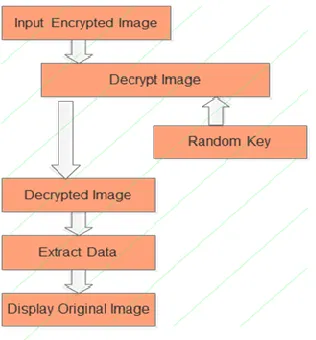
Available Online at www.ijpret.com 1847 (Receiver side)
1. Select encrypted image
2. Decrypt image using the same key which has been used while encryption
3. Display decrypted image
4. Extract data
5. Generate Original Image.
6. Display Result
Figure 1. 2 Data Flow Diagram for Receiver Side
3.1Data Hiding Algorithm:
Step1:Select an Image
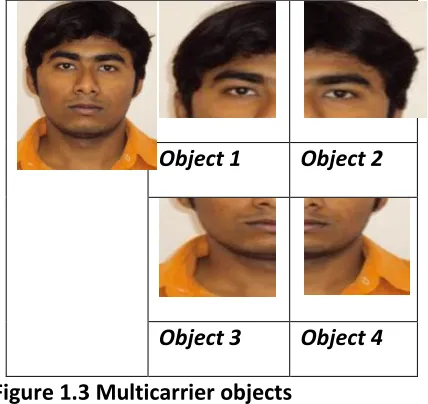
Step2: Split an Image into multi –carrier objects.
Step3:Select Secrete data for hiding.
Step4: Use Shifting method to hide data.
Step5:Select Guard Pixels from an multi-objects images.
Available Online at www.ijpret.com 1848 Step7:Repeat Step from 2 to step 6 until all encrypted data not hidden into multi carrier images
Step8:Join multi carrier objects to create a single image.
Step9:Stop
3.1.1 Splitting Carrier Image into Multi Carrier objects
In a Proposed Method , We split an carrier image as shown below
Object 1 Object 2
Object 3 Object 4
Figure 1.3 Multicarrier objects
Carrier object can be represented with
𝐼𝑚 = 𝑂1 + 𝑂2 ) || (𝑂3 + 𝑂4)12 34 eq…….3.1.1
Where,
O1,O2,O3,O4 =Image Objects
|| =Vertical Join
+=Horizontal Join
3.1.2 Selection of Guard Pixels Region
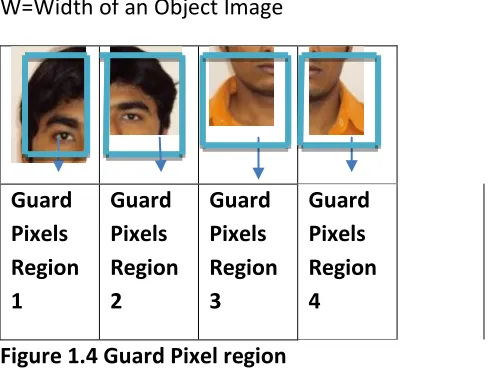
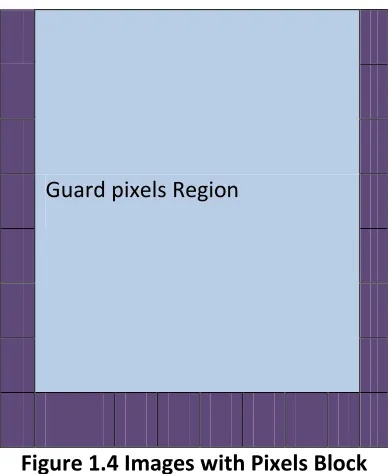
Available Online at www.ijpret.com 1849 We avoid mutual collision between two objects at their boundary lines. Thus guard pixels region of an individual object can be represented with
𝐺𝑝𝑥 = 𝐻 − 4 𝑋 𝑊 − 4 eq……3.1.2
Where,
H=Height of an Object Image
W=Width of an Object Image
Guard Pixels Region 1
Guard Pixels Region 2
Guard Pixels Region 3
Guard Pixels Region 4
Figure 1.4 Guard Pixel region
Over all guard pixels region can be represented with an equation
Initially Gp=0
𝐺𝑝 = 𝐺𝑝 + 4𝑖=1𝐺𝑝𝑖eq---3.1.3
Where
Gp=Over all guard pixels count.
Gpi=Individual guard pixels count
3.1.3 Higher LSB Method for Data Embedding
Available Online at www.ijpret.com 1850 Guard pixels Region
Figure 1.4 Images with Pixels Block
An individual pixel is represented with 24 Bits in RGB format as shown
Figure 1.5 A pixel representation
In the above shown diagram, each color component is represented with 8 bits pixels as
MS B
LS B
MS B
Available Online at www.ijpret.com 1851 MS
B
LS B
Figure 1.6 Pixels color region
In proposed methodology, we replace 5 bits from LSB side with data bits as shown
MS B
Replace with Data Bits
MS B
Replace with Data Bits
MS B
Replace with Data Bits
Figure 1.7 Replacing LSB side data bits
Thus total data hiding capacity in terms of bits is represented with
𝐻𝑐 = 𝐺𝑝 𝑥 15eq……….3.1.3
Where
Hc=Data Hiding Capacity
Through proposed method quantization error of 32occors which may affect image intensity but preserves its quality.
3.1.3.1 Higher LSB Algorithm
Step1: Select Pixels.
Step 2: Select R,G,B components.
Step 3: if ((R + 32)>255) ||(R-32)<0), ((G + 32)>255) ||(G-32)<0), ((B + 32)>255) ||(B-32)<0), then discard pixel components else replace it’s 5 LSB side bits with data bits.
Available Online at www.ijpret.com 1852 Step 5: Stop
3.2 Image Encryption
Proposed Image Encryption algorithm
Step1: Select an image
Step2: Split image pixel components
Step3: XOR higher(Red, Green, Blue) pixels components with lower components
Step4: Set (XOR result+ Lower LSB) to encrypted pixel
Step4: Repeat step2 to 4 until all pixels are XORedStep5: Stop
In a proposed methodology, an RGB Image encryption scheme work as follows
An image with RGB format can be represented as
Figure 1.8 RGB formatted pixel
Each component of image pixel is of 8 bits represented with
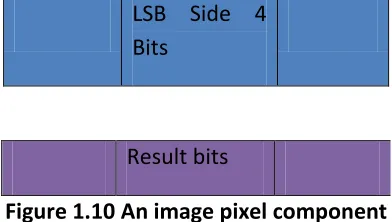
Figure 1.9 An image pixel component
An image encryption is a process where image is converted into unreadable format(
Applicable for each component)
MSB Side 4 Bits
Available Online at www.ijpret.com 1853 LSB Side 4
Bits
Result bits
Figure 1.10 An image pixel component
Set result bits with an each component of pixel so an encrypted pixel becomes
MS B
LSB
MS B
LSB
MS B
LSB
Figure 1.11 Encrypted Image Pixel Representation
Lets Consider an Example, a Pixels represented with 24 bits value as
111010100110111011000110. It’s RGB Components become
1 1 1 0 1 0 1 0
0 1 1 0 1 1 1 0
1 1 0 0 0 1 1 0
Figure 1.12 RGB Component Representation
XOR for Red Component
1 1 1 0
XOR
1 0 1 0
Available Online at www.ijpret.com 1854
0 1 0 0
So resultant red pixel component is
0 1 0 0 1 0 1 0
Same for all Green and Blue Pixels components
3.3 Data Extraction Algorithm:
Step1: Select a Stego image
Step2: Split stego image
Step3: Select guard region
Step4: Select length key
Step5: Extract data bits from 1 to 5 color bits
Step6: Generate Data
Step7: Decrypt Data
Step8: Stop
III. Experimental results
Table 1: Features Comparison
Sr. No. Content New System Old System
1. Security Two Level Security Single level Security
2. Key Used Two One
3. Text, Doc, Pdf files are
allowed
Yes Only text
4. Partitioning of Data Yes No
Capacity Comparison
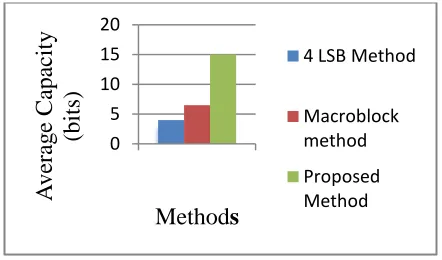
Available Online at www.ijpret.com 1855 In a proposed system we can hide 15 bits of data into an image so providing more security than the previous two methods.
Figure 1.13 Capacity Comparison
IV. CONCLUSION
The main objective of the proposed scheme is to improve security, reliability and efficiency of secret message. In this scheme, we divide the input image into four carrier images, hides segmented data in each part of an image and then performing encryption. Here we hide data into image. The image can be of any format i.e. bmp, jpeg. As we are using the cover medium through which data is to be sent so there is no possibility that the data is to be revealed.
In future work, we can split the image into more than four carrier objects. We can even increase the hiding capacity of our application. We can use Asymmetric cryptographic techniques as well as symmetric and asymmetric techniques simultaneously.
Different encryption algorithms to provide more security. A comprehensive combination of image encryption and data hiding compatible with lossycompression.The video based data hiding has been achieved and to provide high security separate key should be used for encryption and decryption.
V. REFERENCES
1. V. Saravanan and A. Neeraja, “Security Issues in Computer Network and Steganaography”,2013 IEEE :978-1-4673-4603-0/12
2. Birgit P tzmann, Information hiding terminology-results of an informal plenary meeting and additional proposals, Proc. of the First International Workshop on Information Hiding, vol. 1174, pp. 347-350. Springer, 1996.
0 5 10 15 20 A ve ra g e C apa cit y (bits) Methods
4 LSB Method
Macroblock method
Available Online at www.ijpret.com 1856 3. Cachin, C.: An information-theoretic model for steganography. In: Aucsmith, D. (ed.) IH 1998. LNCS, vol. 1525, pp. 306-318. Springer, Heidelberg, 1998.
4. Lini Abraham, NeenuDaniel ,” Secure Image Encryption Algorithms: A Review”, International Journal of Scientific & Technology Research volume 2, issue 4, April 2013, PP-186-189.
5. MohanrajArumugam and Rabindra Kumar Singh, “Data Hiding and Extraction Using a Novel Reversible Method for Encrypted Image” IJREAT International Journal of Research in Engineering & Advanced Technology, Volume 1, Issue 1, March, 2013, PP-1-5.
6. Kim, H.J., Sachnev, V., Shi, Y.Q., Nam, J., Choo, H.G., 2008. A novel difference expansion transform for reversible data embedding. IEEE Transaction Information Forensics and Security 3(3), 456–465.
7. M. Johnson, P. Ishwar, V. M. Prabhakaran, D. Schonberg, and K. Ramchandran, “On compressing encrypted data,” IEEE Trans. Signal Process., vol. 52, no. 10, pp. 2992–3006, Oct. 2004.
8. W. Liu, W. Zeng, L. Dong, and Q. Yao, “Efficient compression of encrypted grayscale images,” IEEE Trans. Image Process., vol. 19, no. 4, pp. 1097–1102, Apr. 2010.
9. X. Zhang, “Lossy compression and iterative reconstruction for encrypted image,” IEEE Trans. Inform. Forensics Security, vol. 6, no. 1,pp. 53–58, Feb. 2011.
10. X. Zhang, “Reversible data hiding in encrypted images,” IEEE Signal Process. Lett., vol.
18, no. 4, pp. 255–258, Apr. 2011.
11. X. Zhang, “Separable reversible data hiding in encrypted image,” IEEE Trans. Inf.
Forensics Security, vol. 7, no. 2, pp. 826–832, Apr. 2012.
12. P. Tuyls, H. D. L. Hollmann, J. H. Van Lint, and L. Tolhuizen, “XOR based visual